




Abstract
This study investigates the effect of multi-walled carbon nanotubes (MWCNT) on the high strain rate properties of carbon fiber reinforced polymer (CFRP) fabric impregnated with shear thickening fluids (STF). Three GFRP-STF and twelve GFRP-MWCNT/STF composite specimens were conducted using a split Hopkinson pressure bar (SHPB). Spherical silica nanoparticles (20.0 wt%) and polyethylene glycol were used to prepare silicon-based-STF (SiO2/STF). On this basis, MWCNT with 0.4, 0.8, and 1.2 wt% were further used to synthesize the MWCNT/STF, respectively. The SHPB test showed that MWCNT/STF has a more significant strain rate effect, with stress increases of 71.1%, 57.5%, and 26.0% under 3800 s−1, 5100 s−1, and 6100 s−1, respectively. The results also showed that MWCNT significantly improved the yield stress and strain energy absorption of SiO2/STF under a high strain rate. The maximum yield stress increase was 71.1%, and the maximum increase in strain energy absorption was 229.1%. The results of CFRP-MWCNT/STF revealed that MWCNT/STF treatment enhanced the high strain rate impact properties of CFRP-SiO2/STF. The improved effect is up to 27.9%, 133.6%, and 165.7% in yield stress, impact toughness, and energy absorption efficiency, respectively. The mass fraction of MWCNT significantly affects the impact properties of CFRP-MWCNT/STF under high strain rate loading, but this effect decreases with the increase of strain rate. Thus, CFRP-MWCNT/STF is more suitable for application in a high strain rate impact environment than CFRP-SiO2/STF.
Introduction
Carbon fiber reinforced polymer (CFRP) has high specific modulus, high specific strength, fatigue resistance, exceptional vibration damping characteristics, low thermal expansion coefficient, and excellent thermal stability, and is widely used in aviation, aerospace, automotive industry, civil engineering, and other fields.1,2 However, the fiber layout is concentrated in all laminate directions since CFRP is made of unidirectional carbon fibers or plain-woven fabrics by laminating and hot pressing. The strength in the normal direction mainly depends on the strength of the resin matrix. Thus, CFRP is prone to damage or failure when subjected to out-of-plane impact loads.3,4 To improve CFRP's impact resistance mechanical properties, scholars proposed CFRP impregnated with shear thickening fluids (CFRP-STF) composites and studied their mechanical properties under low-velocity impact.5–8 However, under the high strain rate impact caused by an explosion, bullet impact, and vehicle collision, the ultimate failure strength and energy absorption capacity of CFRP-STF may change significantly due to the strain rate effect. Therefore, it is necessary to improve the mechanical properties of CFRP-STF composites under high strain rate impact.
Carbon nanotube (CNT) is a quantum material with an axial micrometer and radial nanometer sizes.9,10 It has exceptionally high strength and excellent toughness,11–13 as well as the electrical and thermal conductivity of metal materials,14–16 the heat and corrosion resistance of ceramic materials,17,18 the braid ability of textile fibers,19,20 and the lightweight and accessible processing properties of polymer materials.21,22 Therefore, as a composite reinforcement, carbon nanotubes can make their composites show good strength, elasticity, fatigue resistance, and isotropy.
In the field of reinforcing fiber, Sarath Kumar et al. 23 investigate the effect of multi-walled carbon nanotubes (MWCNT) in epoxy on the performance of epoxy-carbon fabric (CF) composites. The results report that the tensile strength, fracture elongation, and storage modulus of the epoxy-MWCNT-CF multi-scale composites improved by 18%, 8%, and 14% with 1 wt% MWCNT in epoxy compared to the epoxy-CF composite, respectively. The results of Zeng et al. 24 also showed that the tensile and flexural properties of MWCNT–glass fiber fabric (MGFf) multi-scale composites were significantly enhanced, and observed that MWCNTs in MGFf multi-scale composites behaved as hooked fibers to improve the interlaminar adhesion. Soliman et al. 25 conducted an analytical study investigating the low-velocity impact response of a thin CFRP fabric reinforced with functionalized MWCNTs. Regarding the influence of MWCNTs on the impact and post-impact behavior of CFRP laminates, Kostopoulos et al. 26 showed that MWCNTs not only enhance the resistive mechanical performance under higher energy levels but also improve the effective compression modulus and the compression strength after impact. To improve the residual strength of CFRP panels, Ismail et al. 27 also investigated the post-impact behavior of MWCNTs as nanofiller, which enhanced the flax/CFRP panel. For the glass FRP (GFRP), Zhang et al. 28 and Wang et al. 29 demonstrated that MWCNTs are effective in improving the impact resistance of GFRP fabrics under low impact energies in terms of a reduced damage factor and enhanced perforation threshold compared with neat GFRP fabrics.
From the above literature, MWCNT significantly enhances fiber mechanics. However, research on the impact mechanical properties of MWCNT in CFRP-STF composite materials has yet to be reported, especially under high strain rate impact. Therefore, this work first investigated the stress response and energy absorption of MWCNT/STF and silica-based STF (SiO2/STF) using the split Hopkinson pressure bar (SHPB) test and discusses the improvement effect of MWCNT. Based on this result, the development of MWCNT on the high strain rate impact properties of CFRP-MWCNT/STF composites is evaluated through its stress response and energy absorption. The effect of the mass fraction of MWCNT on CFRP-MWCNT/STF is also investigated.
Experimental methods
Raw materials and MWCNT/STF preparation
MWCNT/STF is prepared by mechanical stirring, and its dispersed phase is SiO2 with particle size 12 nm, (AEROSIL200, purchased from the Evonik Degussa) and MWCNT nanoparticles with inner diameter 3–5 nm, outer diameter 8–15 nm, and length 3–12 μm (purchased from the Suzhou Hengqiu Graphene Company Limited). The dispersion medium is polyethylene glycol (PEG200) with hydroxyl value 510-623mgKOH/g, purchased from the Tianjin Guangfu Fine Chemical Research Institute, China.
First, SiO2 and MWCNT nanoparticles were dried for 12 h in a vacuum drying oven at 55°C to remove water; Then, gradually weigh a certain amount of SiO2 and MWCNT nanoparticles into a beaker containing PEG200, and continue to stir until the particles are uniformly dispersed in PEG200; Repeat the above process until the mass fraction of SiO2 and MWCNT meets the test requirements; Finally, place MWCNT/STF in a vacuum drying oven at 80°C for 24 h to remove bubbles. The prepared MWCNT/STF is carbon black and has good fluidity, as shown in Figure 1(a) and (b). Physical photo of MWCNT/STF and CFRP materials.
CFRP impregnation and microscopy characteristics
As shown in Figure 1(c), woven plain-weave unidirectional CFRP fabrics were used in all the impact tests, and the diameter was 40 mm. The aerial density, monolayer thickness, elastic modulus, and failure elongation were 300g/m2, 0.17 mm, 210 GPa, and 1.5%, respectively. The preparation process of CFRP-MWCNT/STF is as follows: First, cut the CFRP cloth into a shape with a diameter of 40 mm, and place it in an 80°C vacuum drying oven for 12 h to remove water. Then, MWCNT/STF and anhydrous ethanol were mixed at a mass fraction of 1:1 to obtain a diluted shear-thickening solution. After that, soak the cut CFRP fabric in MWCNT/STF diluted with absolute ethanol for 5–10 min, place it in a dryer for drying, and weigh the mass every 2 hours until the mass does not change; Finally, CFRP-MWCNT/STF is pasted along its periphery with thermoplastic urethane adhesive respectively, and compacted with a flat vulcanizer.
SEM images of neat CFRP, CFRP-SiO2/STF, and CFRP-MWCNT/STF specimens are shown in Figure 2. Figure 2(a) reveals that the filaments of CFRP are smooth, and some gaps exist in them.
8
In contrast, the filaments of CFRP-SiO2/STF were covered with some nanoparticles, and the surface became rough, as depicted in Figure 2(b).
8
Moreover, Figure 2(c) shows that the surface of CFRP-MWCNT/STF becomes more irregular, and the gaps between fibers become denser due to the filling of MWCNT nanoparticles. SEM of neat CFRP, CFRP-20%SiO2/STF, and CFRP-1.2%MWCNT/STF composites. (a) Neat CFRP (b) CFRP-20%SiO2/STF (c) CFRP-1.2%MWCNT/STF.
MWCNT/STF test and rheological characteristic
The steady rheological properties of MWCNT/STF with different mass mix proportions were tested with an AR2000 rheometer. The diameter of the flat rotor was 25 mm, the space between the flat plates was 0.25 mm, and the environment temperature was 25°C. From Figure 3, the MWCNT/STF of each mass fraction ratio has significant shear thinning and shear thickening effects. Compared with 20%SiO2-STF, 0.8%MWCNT-STF and 1.2%MWCNT-STF have better shear thickening properties except 0.4%MWCNT-STF. For example, the peak viscosity increases by 55.5% and 124.0%, respectively, and the critical shear rate decreases by 80.0%. The above phenomena indicate that adding MWCNT can significantly enhance the steady-state rheological properties of SiO2/STF. The reason may be that SiO2 particles adsorb on MWCNT and form larger, fuller, and closer particle clusters, which makes STF challenging to flow. At the same time, reducing the average spacing between particle clusters makes it easier to form “particle clusters,” so the peak viscosity of the system is significantly improved, and the critical shear rate is significantly advanced. Steady-state rheological response of MWCNT/SiO2-STF.
SHPB impact testing
The SHPB apparatus used in this test is shown in Figure 4. The whole test system consists of a loading device, a pressure bar device, and a data acquisition system. The pressure bar device comprises an incident bar, a transmission bar, an absorption bar, and an end-damping device. In the test, all rods are aluminum with a diameter of 40mm, an elastic modulus of 70 GPa, a density of 2.71g/cm3, and a wave velocity of 5218 m/s. The length of the incident rod and transmission shaft is 1800mm. In addition, considering using a shaper to control the loading wave, the size of the impact rod is 300 mm. Considering the continuity and systematicity of research work, the CFRP-MWCNT/STF, and CFRP-STF tested in this work are all three layers and laid at 90° between layers.
8
The loading device uses high-pressure pure nitrogen as the power source, and the data acquisition system calculates the strain rates corresponding to the air pressure as 3800 s−1, 4100 s−1, 5100 s−1, and 6100 s−1, respectively.
30
SHPB impact test set up.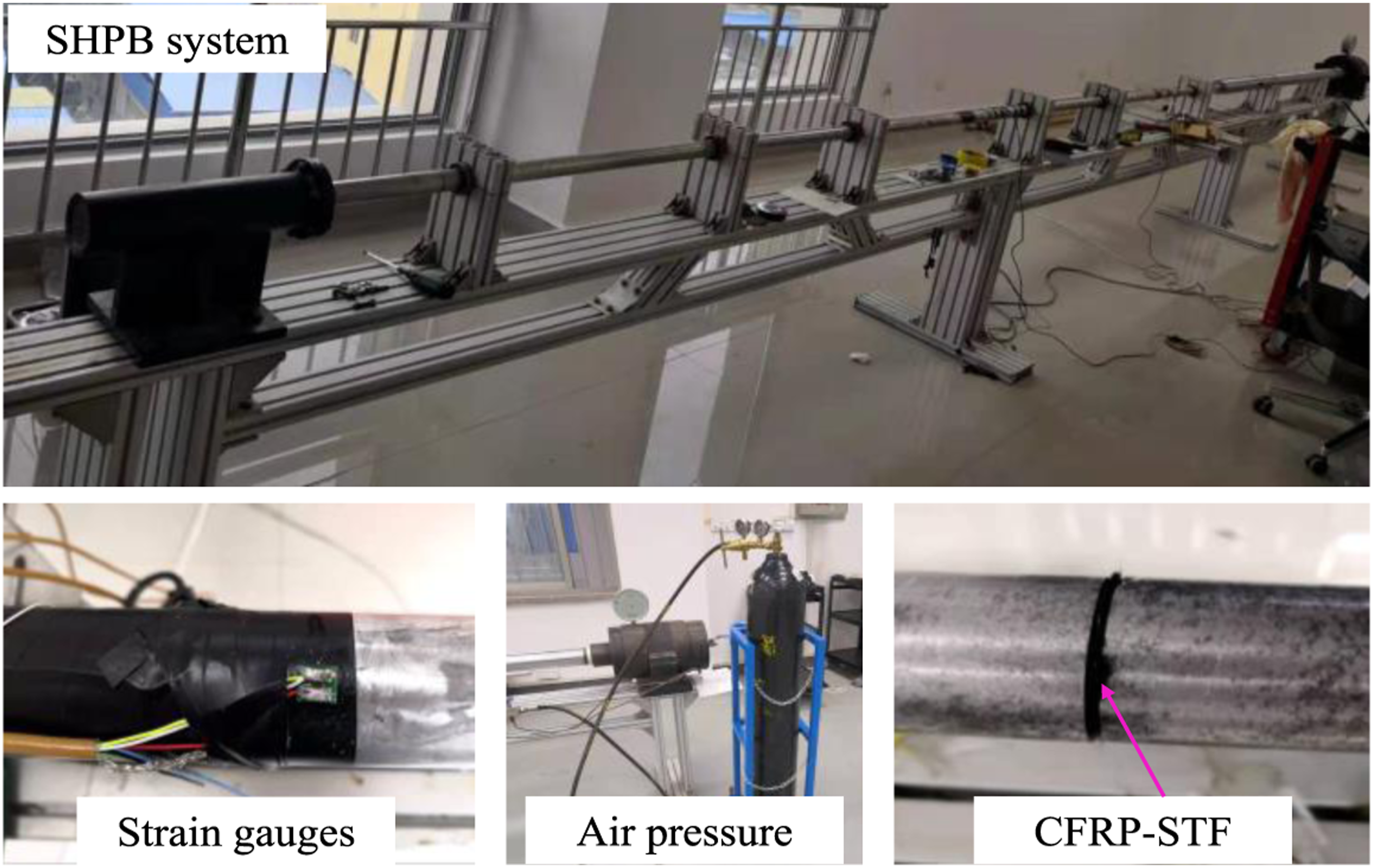
Results and discussion
Impact response of MWCNT/STF under high strain rate
Figure 5 shows the impact response characteristics of 1.2%MWCNT/STF and 20%SiO2/STF at three high strain rates. Figure 5(a) shows that the stress-strain curves show an “uplift” phenomenon with the increase of strain rate, indicating that both have significant strain rate effects. However, under the same strain rate loading, 1.2%MWCNT/STF has a considerable advantage in the peak stress. The three strain rates increase by 71.1%, 57.5%, and 26.0%, respectively, which indicates that 1.2%MWCNT/STF can withstand higher and faster impact loads than 20%SiO2/STF. Stress response of 1.2%MWCNT/STF under different strain rates. (a) Stress versus strain (b) Local magnification of Figure 5(a).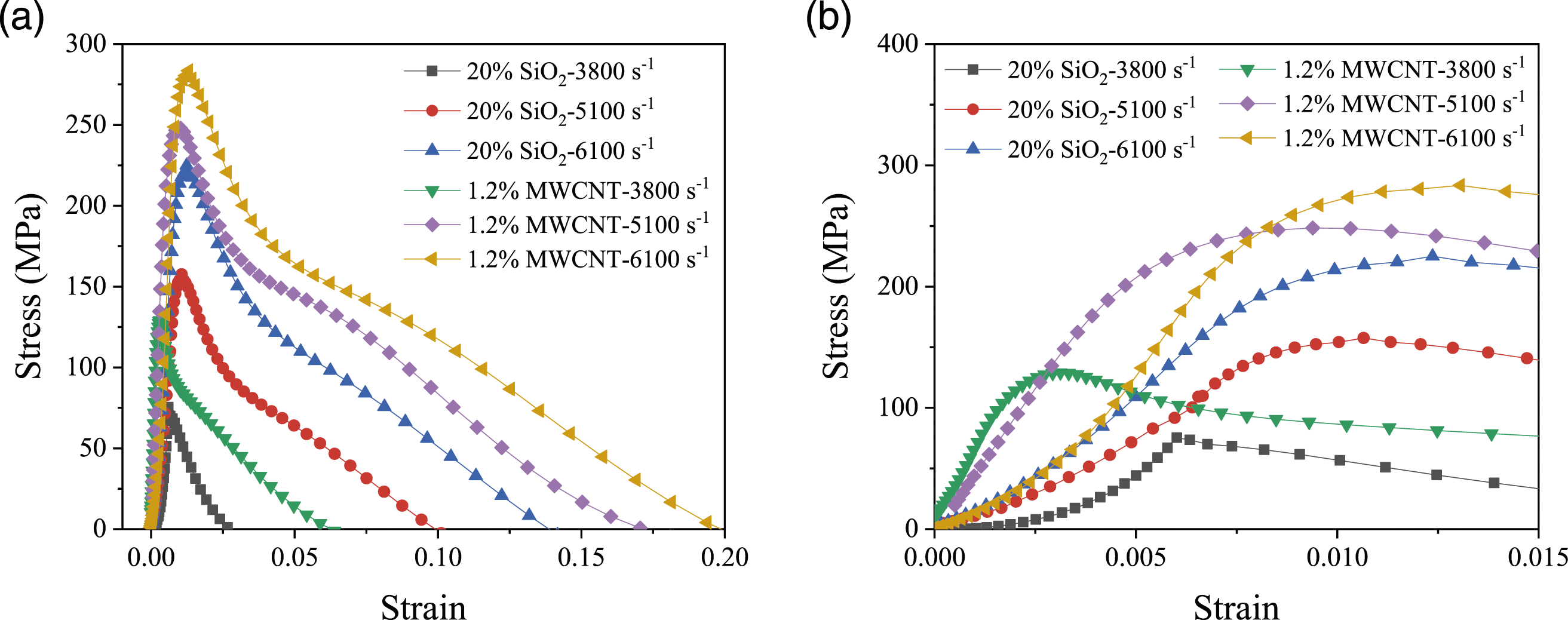
Figure 5(b) is a locally enlarged view of Figure 5(a) in the strain range of 0.00–0.015. It can be seen that the elastic modulus (defined as the slope of the elastic stage of the stress-strain curve) of 20%SiO2/STF and 1.2%MWCNT/STF at the elastic stage show a significant strain rate effect with different high strain rates. It should be noted that the stress-strain curve of 20%SiO2/STF shows a “lifting” behavior to the upper left with the increase of strain rate, indicating that its elastic modulus increases with the increase of strain rate. However, 1.2%MWCNT/STF shows the opposite behavior, showing the behavior of “turning” to the right and down with the increase of strain rate, indicating that its elastic modulus decreases with the increase of strain rate. Importantly, the elastic modulus of 1.2%MWCNT/STF at three high strain rates is greater than that of 20%SiO2/STF at their corresponding strain rates, indicating that 1.2%MWCNT/STF has a faster response. The reason may be that MWCNT, due to its multi-wall shape and strong adsorption, makes more SiO2 nanoparticles gather around it and form larger particle clusters so that the compression ratio caused by its stress wave will be smaller than formed by a single SiO2 particle cluster. Therefore, the elastic modulus of 1.2%MWCNT/STF is greater than 20%SiO2/STF.
The strain energy absorption of 1.2%MWCNT/STF and 20%SiO2/STF at three high strain rates is shown in Figure 6(a) and (b). From Figure 6(a), adding MWCNT has significantly improved the energy absorption capacity of 20%SiO2/STF, and the higher the loaded strain rate, the better the improvement effect. As shown in Figure 6(b), when the strain rate is 5100 s−1, adding 1.2%MWCNT can increase the energy absorption peak of 20%SiO2/STF by 229.1%, 7.6 times that of 3800 s−1, and 2.7 times that of 6100 s−1. This phenomenon is mainly caused by the new particle clusters formed by MWCNT adsorbing SiO2 nanoparticles and the change in the volume fraction of the suspension. When the strain rate is 3800 s−1, the compression of the suspension volume is not obvious, and the new particle clusters mainly bear the stress wave transmission. Therefore, improving energy absorption capacity is insignificant at this time. When the strain rate is high, the volume of 1.2%MWCNT/STF and 20%SiO2/STF is compressed to the static plugging density of particles. The stress wave transmission is mainly borne by the force-chain network structure formed by new particle and SiO2 nanoparticle clusters. The physical properties of new particle clusters are superior to SiO2 nanoparticle clusters. Therefore, the improvement of energy absorption capacity of 1.2%MWCNT/STF is significantly increased. Absorbed energy of 1.2%MWCNT/STF under different strain rates. (a) Absorb energy versus time (b) Maximum absorb energy.
Impact response of CFRP-MWCNT/STF under high strain rate
Figure 7 shows the stress responses of CFRP-1.2%MWCNT/STF and CFRP-20%SiO2/STF at 3800 s−1, 5100 s−1 and 6100 s−1. From Figure 7(a), the stress response curves of the two have similar shapes and are divided into elastic stages (the peak stress in this stage is yield stress), plastic stage, densification lifting stage, and failure stage. However, from Figure 7(b), adding MWCNT can improve the yield stress of CFRP-STF, especially when the high strain rate is low, such as 3800 s−1, the yield stress of CFRP-1.2%MWCNT/STF increases by 27.9%. In addition, as seen in Figure 7(a), the fracture strain of CFRP-1.2%MWCNT/STF and CFRP-20%SiO2/STF has no obvious change under three high strain rates. However, adding MWCNT can significantly increase CFRP's secondary stress increase ability, which increases 16.8 MPa, 34.9 MPa, and 22.8 MPa, respectively. This shows that CFRP-1.2%MWCNT/STF has a higher strain energy absorption capacity than CFRP-20%SiO2/STF. Stress response of CFRP-1.2%MWCNT/STF at different high strain rates. (a) Stress versus strain (b) Yield stress.
Figure 8 shows the strain energy absorption performance of CFRP-1.2%MWCNT/STF and CFRP-20%SiO2/STF at high strain rates. From Figure 8(a), although the energy absorption time-history curves of the two are similar, they both show the characteristics of approximate linear increase. However, Figure 8(b) reveals that the impact toughness of CFRP-1.2%MWCNT/STF has increased by 133.6%, 33.6%, and 6.8% at three high strain rates, respectively, compared with the enhancement effect of 20%SiO2/STF. It shows that the existence of MWCNT significantly improves the energy absorption capacity of CFRP-STF, and CFRP-MWCNT/STF is more suitable for engineering applications than CFRP-SiO2/STF. Effect of high strain rate on CFRP-1.2%MWCNT/STF energy absorption. (a) Energy absorption versus time (b) Impact toughness.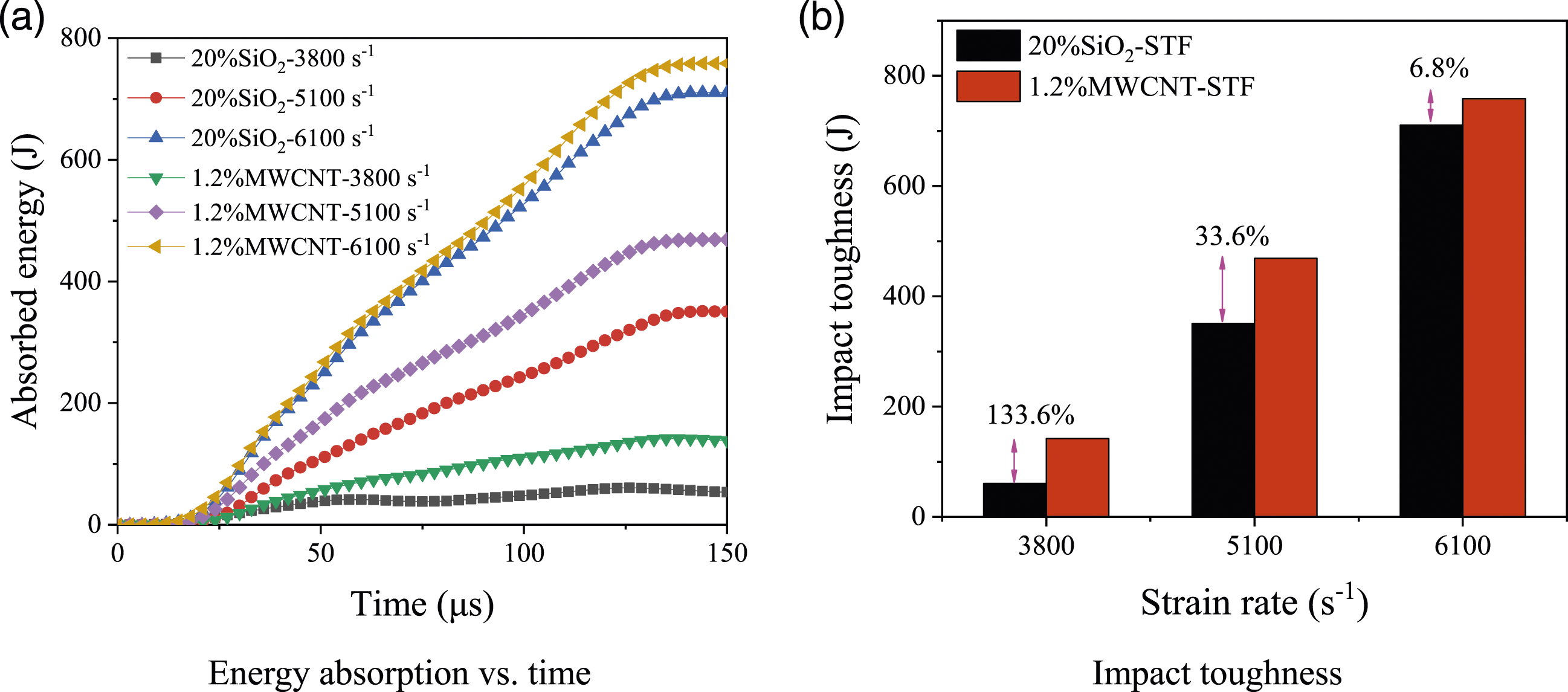
The energy absorption efficiency of CFRP-1.2%MWCNT/STF and CFRP-20%SiO2/STF at high strain rate are shown in Figure 9. The energy absorption efficiency is the stress normalized energy absorption capacity that can be calculated from the following equation. Energy absorption efficiency of CFRP-1.2%MWCNT/STF at different high strain rates. (a) Energy absorption efficiency (b) Maximum efficiency.

From Figure 9(a), the energy absorption efficiency of CFRP-1.2%MWCNT/STF and CFRP-20%SiO2/STF has a similar shape, and both show a linear increase with the same slope between strain 0-0.01, indicating that CFRP absorbs energy by itself in this stage. After that, the energy absorption efficiency curve enters the stage of the interaction of CFRP and STF. With the increase of strain rate, the energy absorption efficiency of all specimens increases nearly linearly until the fracture strain. In this process, the curve of CFRP-1.2%MWCNT/STF is always above the CFRP-20%SiO2/STF, indicating that the existence of MWCNT significantly enhances the energy absorption efficiency of CFRP-STF. As shown in Figure 8(b), the maximum energy absorption efficiency increases by 165.7%, 11.7%, and 8.7%, respectively, under the three strain rates.
Figure 10 shows the effect of MWCNT mass fraction on the mechanical properties of CFRP-MWCNT under high strain rate impact. From the figure, the yield stress, impact toughness, and maximum energy absorption efficiency of CFRP-MWCNT increase with the increase of MWCNT mass fraction. However, the increase is related to the rheological properties of MWCNT/STF and the strain rate under loading. As shown in Figure 10(a), when the strain rate is 3800 s−1, the yield stress of CFRP-MWCNT increases by 26.7% and 14.7%, respectively, with the increase of MWCNT mass fraction, but when the strain rate increases to 6100 s−1, the increase is 12.5% and 3.0% respectively. Further from Figure 10(b) and (c), the MWCNT mass fraction has a significant impact on the impact toughness and maximum energy absorption of CFRP-MWCNT/STF, especially when the strain rate is high, such as at a strain rate of 6100 s−1, the MWCNT mass fraction increases from 0.4% to 0.8%, and the impact toughness and maximum energy absorption increase by 51.8% and 1.29 times, respectively. However, when the MWCNT mass fraction further increases to 1.2%, the effect of this improvement is only slightly increased, indicating that when the MWCNT mass fraction is 1.2%, the mechanical properties of CFRP-MWCNT/STF for high strain rate impact resistance are optimal. Effect of MWCNT mass fraction on impact properties of CFRP-MWCNT/STF under high strain rate. (a) Yield stress (b) Impact toughness (c) Energy absorption efficiency.
The reasons for the above phenomena are complex. There are two main mechanisms for the mechanical properties of STF-reinforced fibers. One is the friction of nanoparticles between fibers;31–35 The other is the formation of “particle clusters” of nanoparticles between fibers.36,37 When CFRP-MWCNT/STF is impacted at a low strain rate, since MWCNT/STF does not enter the shear thickening stage, the yield stress of the specimen at this time is mainly due to the increased resistance caused by friction between MWCNT and SiO2 nanoparticles due to fiber deformation. The smaller particles, the greater the friction force.38,39 Therefore, the smaller the mass fraction of MWCNT, the better the yield stress of CFRP. The increase of CFRP-MWCNT/STF yield stress at 6100 s−1 is speculated to be related to the strain rate effect of MWCNT/STF. At this time, the higher the mass fraction of MWCNT, the higher the yield stress of MWCNT/STF, but the corresponding strain is reduced. That is, the deformation of MWCNT/STF is small.
Conclusions
This work investigated the impact performance of CFRP-MWCNT/STF fabric and compared it with CFRP-SiO2/STF fabric under different high strain rates using the SHPB test. Results show that the strength and energy absorption increase with strain rate for MWCNT/STF and SiO2/STF. Although MWCNT/STF and SiO2/STF offer similar trends in stress response and energy absorption at different high strain rates, due to the strong adsorption and multi-wall shape of MWCNT, MWCNT/STF can absorb much more impact energy than the SiO2/STF, and have higher yield stress. The CFRP-1.2%MWCNT/STF composite exhibited higher values of specimen yield stress, impact toughness, and energy absorption efficiency compared to CFRP-20%SiO2/STF under high strain rates. Moreover, the increasing effect is most significant, especially when the high strain rate is lower. In addition, the yield stress, impact toughness, and maximum energy absorption efficiency of CFRP-MWCNT/STF increase with the increase of MWCNT mass fraction, which is related to the rheological properties of MWCNT/STF and the loading strain rate. Thus, treatment with MWCNT/STF tends to improve the impact resistance ability of CFRP under high strain rate conditions. This work also demonstrates that MWCNT/STF is more suitable for higher and faster impact load environments, for example, vehicle collision and military protection.
Footnotes
Acknowledgments
The authors acknowledge financial support from the Hunan Provincial Department of Education Project [grant number 18C0562] and supported by Natural Science Foundation of Zhejiang Province [grant number LY23E080011].
Declaration of conflicting interests
The author(s) declared the following potential conflicts of interest with respect to the research, authorship, and/or publication of this article: The authors declare that they have no known competing financial interests or personal relationships that could have appeared to influence the work reported in this paper.
Funding
The author(s) disclosed receipt of the following financial support for the research, authorship, and/or publication of this article: This work was supported by the Hunan Provincial Department of Education Project (18C0562). Natural Science Foundation of Zhejiang Province (LY23E080011).
Ethical approval
The authors declare that the submitted manuscript does not involve human or animal research.
