




Abstract
People increasingly need air filters with ultra-high efficiency due to air pollution. In this work, BNNSs (boron nitride nanosheets) were prepared by chemical method using potassium permanganate and sulphuric acid. This functionalization induced the exfoliation of the layered structure of h-BN into monolayer or few-layer sheets. Infrared spectrum analysis shows that the oxidation functional group was introduced into hexagonal boron nitride. Further investigation of the crystallization property was accomplished by XRD analysis in conclusion that the crystal structure was not changed for the introduction of oxidation functional group. The polyacrylonitrile (PAN) and BNNSs/PAN nanofiber films were constructed by electrospinning. It is found that the electrospun nanofiber films had good filtration effect and could capture the most particles in the air because of electrostatic adsorption. The removal rate of particle by the filters reached 99.8% for BNNSs/PAN nanofiber films. Addition of BNNSs increaed the mechanical property of the nanofiber films.
Keywords
Introduction
In recent years, air pollution poses a serious risk to human health in Asia.1-2 Particle matter (PM) is very dangerous to human health, climate and ecosystems. Particularly, PM2.5 (particles with diameters less than 2.5 μm) 3 has been classified as a first-level carcinogen by the World Health Organization (WHO) for it carry numerous bacterial or virus and then become an aerosol in the air which is very harmful to human lungs.4-6 It results in serious respiratory, cardiovascular diseases, cancers.7-9 Therefore, particle pollution control is widely concerned by the public and government. 10
Electrets filter is an important part of fabric filters used in particle control. 11 Electrostatic electrets are dielectric materials that store space and dipole charges for a long time. At present, most electret materials are electrostatic electrets after fiber forming, but this method has the disadvantages of low charge and unstable charge. The surface charge of the electrets is space charge, such as surface charge or volume charge, or polarized charge arranged by dipole.12–14 At present, polypropylene (PP), nylon-11 (PA11), FEP and other materials are commonly used as electrets. These materials are good piezoelectric electrets (also known as ferroelectric electrets). 12 If the space layer is too thin, the top and bottom electrets may contact each other under a small mechanical deformation, some researchers have made materials into fluffy or foam structures to achieve better electrostatic adsorption effect.
Electrospinning is an advanced technique to fabricate nanofibers and an effective way in-situ charge injection.13–16 The ability of charge retention depends on the dielectric properties and electric field strength of the polymer, especially the position where the charge is trapped in the material. 14
Gao and coworkers 6 confirmed the volume charges trapped in deep energy levels and dipole charges formation during electrospinning. Compared with corona discharge filtration material, electrospun membrane has longer charge holding time and stronger filtration stability. The electrospun membrane composed of dielectric polymer showed enhanced charge stability and excellent filtration performance. 17 It is a good material for disposable respirator and indoor air purifier. He and coworkers used polytetrafluoroethylene needle felt to prepare filter materials by corona discharge method. 18 It was found that the filtration efficiency of filter materials after corona charging was significantly higher than that of uncharged filter materials, and the surface potential decreased with the deposition of particles on the filter membrane, resulting in the reduction of filtration efficiency of filter materials.11,19,20
Nowadays, a variety of polymers are used to prepare nanofiber air filtration membrane by electrospinning technology, for example, polyacrylonitrile (PAN), polyamine ester (PU), polylactic acid (PA), polyvinyl alcohol (PVA), polyvinylidene fluoride (PVDF), etc.21–22 PAN is an amorphous vinyl-type polymer that contains a cyano group in each repeat unit. It has smaller dielectric loss and higher thermal stability that allow it to be widely used as carbon fiber precursors.13,15 Boron nitride nanosheets (BNNSs) are 2D materials which can be exfoliated from hexagonal boron nitride (h-BN).23–24 The functional nanosheets could increase the storage modulus of the composites which improved the mechanical performance. 25 The pristine PAN exhibits good flexibility but poor strength. The BNNSs/PAN nanofibrous membranes exhibit an excellent tensile strength. As the BNNSs loading increased, the tensile strength and Young's modulus of BNNSs/PAN improved.26–27
Herein, in this paper, BNNSs was exfoliated off by strong oxidant potassium permanganate and concentrated sulfuric acid. Nanofibrous membranes were prepared by adding BNNSs into a solution containing PAN. The as-prepared nanofibrous membranes were light in weight and possessed good mechanical and filtration performance. The addition of BNNSs enhanced the mechanical performance of PAN nanofiber film. The filtration efficiency performance of BNNSs/PAN nanofiber film remains an outstanding removal efficiency of 99.8%.
Experiment
Materials
Polyacrylonitrile (PAN) powder (Mw∼150000) was purchased from sigma. N,N-Dimethylformamide (DMF) was purchased from Tian jin Fuyu Fine Chemical Co., Ltd Boron nitride power was purchased from macklin.
Exfoliated of boron nitride
To preparation mono or few-layer h-BN,1g of h-BN powder was mixed in 20 ml of concentrated sulfuric acid in a glass beaker stirring with magnetic stirrer at room temperature and cooling the beaker with running water. The potassium permanganate was slowly added to the beaker (1 g potassium permanganate added in 2 h). After the reaction was completed, the hydrazine hydrate was slowly added to neutralize the unreacted oxidant until the mixed solution turned white. BNNSs was obtained cleaned with water and dried in oven after centrifugation.
Preparation of electrospinning membrane PAN/BN composite
The prepared boron nitride nanosheets was put into a breaker with of 0.02g, 0.2g and 0.2g, the 18g DMF was added into the breaker, the mixed solution was heated to 60°C in a water bath for 30min. And then 2g of polyacrylonitrile fiber was added into the mixed solutionuntil the fibers were completely dissolved. In the same way, polyacrylonitrile fiber (2g) was dissolved in 18g DMF solution. The electrospinning voltage is 20 kV, solution feed rate in the electrospinning process is 1 mL/h, the distance between the needle and the receiving plate is 15 cm and the humidity is 40%.
Material characterization
The morphology and microstructure of the samples were examined using a FEI Quanta 450 scanning electron microscope with the electron energy of 20 kV and EDS for element analysis. The molecular structure of samples was tested by Fouriertransform infrared spectroscopy (FT-IR) in the wave number range from 4000 cm−1 to 650 cm−1(PerkinElmer Spotlight 400). The strength was tested by single fiber strength tester. The filtration performance of the sample was tested by promo2000 with differential pressure 5 bar and the test time 300s. This test simulates the use of the masks to remove the particles in the air.
Results and discussion
Figure 1 is a schematic diagram of stripping of BN and electrospinning of BNNSs/PAN. After oxidation of boron nitride by strong oxidant, oxygen-containing functional groups were grafted, and the layers of boron nitride were separated from each other. This method is simple, low-cost, and the obtained few layers of boron nitride can exist stably. Figures 1(d) and (e) is the suspension of BNNSs/PAN spinning solutionjust finished and 1 day later. The suspension of BNNSs/PAN spinning solution is stable after 1 day later because of hydroxyl (OH) groups of polyacrylonitrile interacts with BNNSs. (a) Schematic diagram of boron nitride stripping, (b)Diagram of polyacrylonitrile and boron nitride nanosheets, (c) Diagram of electrospinning,(d) Schematic of BNNSs/PAN nanofiber film, (e)SEM of BNNSs/PAN nanofiber film.
Exfoliated and characterization of boron nitride
The exfoliation process resulted in a uniform distribution of mono-layer or few-layer h-BN throughout the suspension, and the initial h-BN powder (before exfoliation) showed a large number of clusters with uneven thickness. After exfoliated, the boron nitride was peeled into a single layer or few layers which was observed under SEM.
28
Compared with h-BN, the regular morphology of h-BN almost disappeared (Figure 2(a)), and the irregular shape of BNNSs after peeling was replaced. Figures 2(c) and (d) is the EDS analysis of BNNSs, The atomic percentage of elements B and N is about 1:1. SEM of (a) BNNSs (b) h-BN, (c, d) EDS of BNNSs.
The crystallization behavior of stripped h-BN was studied by X-ray diffraction (Figure 3(a)). The X-ray diffraction data clearly show that most of the crystals are oriented in the (002) direction and the characteristic peaks are observed at 25.9°. The h-BN had characteristic hexagonal diffraction peaks at 25.9°, 40.9°, 43.1°, 49.5°, and 54.2°. These peaks are indexed to the (002), (100), (101), (102), and (004) planes, respectively, with the lattice constants of a = 0.2504 nm and c = 0.6661 nm. It can be seen from the figure that the crystal form of boron nitride has not changed before and after stripping, which indicates that the exfoliation process of BNNSs without destroying its crystal structure. (a) XRD patterns of BNNSs and raw h-BN powers, (b) FT-IR spectra of BNNSs and raw h-BN powers.
The FT-IR spectra (Figure 3(b)) of the raw h-BN show that B-N stretching: in-plane ring vibration around 1343 cm−1 and the B-N bending: out of plane vibration around 762 cm−1. In addition, the BNNSs have an additional peak at 1015 cm−1 different from the raw BN powder, which is the B-O deformation caused by the hydroxylation of the BNNSs. 21
Structure and mechanical properties of the BNNSs/PAN nanofiber film
The surface morphologies of the electrospun nanofiber with various BNNSs concentrations (0 wt.%, 1 wt.%, 5 wt.%, 10 wt.%) are shown in Figure 4 as well as the diameter distribution. It can be seen that the pristine PAN nanofibers have a smooth surface and an average diameter of 381 nm. The average diameter increased to 398 nm and 390 nm respectively when the addition of 1 wt.% and 5 wt.% BNNSs. When the concentration of BNNSs is 10wt.%, the composite BNNSs/PAN nanofiber can obtain a smaller diameter. The addition of BNNSs particle increased viscosity of spinning solution caused the nanofiber diameter increased. However, when a lot of BNNSs nanoparticle addition, the higher viscosity of electrospun precursor solutions provided electrospinning solution higher tensile force when exposed to an applied voltage. As shown in EDS mapping, BNNSs were uniformly distributed in PAN nanofibers. SEM of (a) PAN (b) BNNSs/PAN (1 wt.%) (c) BNNSs/PAN (5 wt.%) (d) BNNSs/PAN (10 wt.%), (e) SEM image of BNNSs/PAN corresponding EDS elemental maps of (f) C, (g) N, (f) B.
Mechanical properties are the main indexes of nanofibrous membranes, which are usually studied by measuring their tensile strengths. Figure 5 shows the stress-strain curve of the PAN and different dosage of BNNSs/PAN nanofiber films. The BNNSs additive shows improved mechanical performance owing to interfacial interaction between the BNNSs particles and PAN. As shown in Figure 5, the strength of the nanofiber film is significantly increased with the addition of BNNSs. When the content of BNNSs increased to 5 wt.%, the tensile of the nanofiber film reached to maximum. And then the tensile strength decreased when the content of BNNSs increased to 10 wt.% owning to the aggregation of BNNSs caused the uneven nanofiber. And an obvious decrease in elongation at break is observed indicating the nanofiber film becomes more brittle. The results indicate that the pristine PAN exhibits good flexibility but poor strength. Clearly, the BNNSs/PAN nanofiber films exhibit an excellent tensile strength as expected. Strain-stress curves of PAN and BNNSs/PAN nanofiber films.
Filtration performance of BNNSs/PAN nanofiber film
The filtration performance of electrospun membrane is tested by light-scattering spectrometer. The whole test process simulates the use of the mask. The electrospun membrane is used as the filter. The theory of the measurement is test the number of tiny particles passing through the filter material and calculate the concentration of particles in a specific time using the laser. During the test, the instrument generates negative pressure of five ba, resulting the aerosol in the air was inhaled into the instrument passed the filter.

Filtration performance of nanofiber films for PM1 and PM2.5.

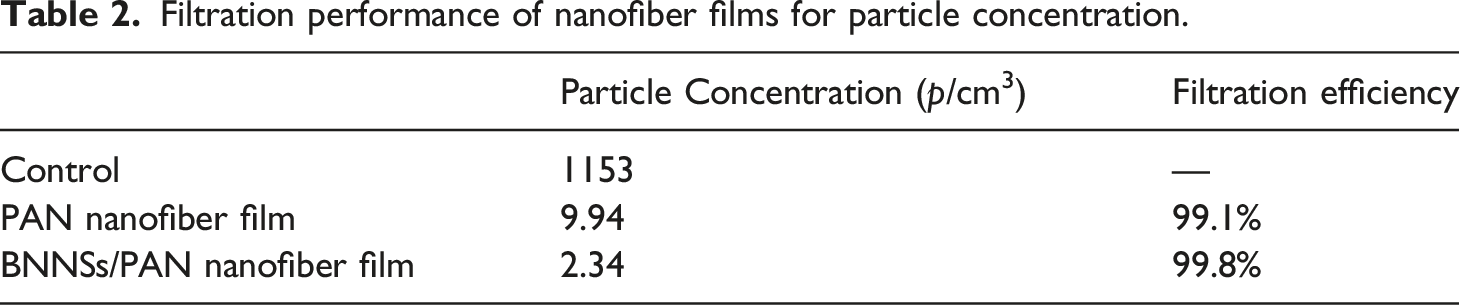
Filtration performance of nanofiber films for particle concentration.
Filtration performance compared to reported works.

As seen from Fig.6(a), it has a lot of small particles passed through Non-woven fabric filter materials, and these particles will have an impact on human health. However, electrospun membrane can remove most of the tiny particles by electrostatic adsorption. During the test period of 300s, there are 134069 particles in the air, only 251 particles passed through PAN nanofiber film and 65 particles passed through BNNSs/PAN nanofiber film. On the basis of the above analysis, it can be reasonably inferred that BNNSs/PAN nanofiber film has emerged as a good application prospect for the filtration of aerosols. The mechanism of the simultaneous effect of BNNSs/PAN nanofiber film on the aerosols filtration was shown in Fig.6(b). During the filtration process, aerosols were captured and tightly wrapped around the surface of nanofibers by electrostatic forces. The embedded BNNSs enhanced this filtration. (a) Particle number passed through the filter (b) Mechanism of the simultaneous effect of BNNSs/PAN nanofiber film on the aerosols filtration.
Conclusion
Boron nitride can be exfoliated by chemical method, which is simple, economical and efficient. Boron nitride nanosheets can be obtained when the ratio of boron nitride to potassium permanganate is 1:1 after 2 h reaction. Compared with the non-woven fabric, PAN nanofiber film, as well as BNNSs/PAN nanofiber film, the filtration performance of the electrospun membrane is significantly improved. Addition of BNNSs enhanced the filtration performance of the nanofiber film. The embeded BNNSs is one of the great important factors for enhancing mechanical property. For filtration performance, there are 134069 particles in the air, but only 65 particles passed through BNNSs/PAN nanofiber film indicating excellent filtration performance. The filtration efficiency of BNNSs/PAN nanofiber film could reach to 99.8% indicating that BNNSs/PAN nanofiber film had great potential as a cleaner use the treatment of smoke and dust pollutants.
Footnotes
Declaration of conflicting interests
The author(s) declared no potential conflicts of interest with respect to the research, authorship, and/or publication of this article.
Funding
The author(s) disclosed receipt of the following financial support for the research, authorship, and/or publication of this article: This work was supported by the Key Scientific Research Plan Projects of Shaanxi Education Department grant numbers 20JS049.
