




Abstract
Oil spill pollution is a constant threat to the environment nowadays. The treatment of an oil spill remains a challenge to environmental scientists. Among the various cleanup methods available, the use of sorbents for oil spill cleanups is a popular approach. In this work, an attempt has been made to produce cotton comber noil /recycled polyester needle punched nonwoven fabrics for the oil spill clean-up process. Box–Behnken experimental design is used to optimise the parameters such as cotton comber noil /recycled polyester blend proportion, needle punching density and areal density for maximum oil sorption capacity. At 70:30 cotton comber noil /recycled polyester blend proportion, 64.94 needle punching density and 100 GSM, maximum oil sorption was achieved. The maximum oil sorption achieved in the case of crude oil and vegetable oil is 45.90 g/g and 32.30 g/g respectively. The cotton comber noil/recycled polyester needle punched nonwoven fabric showed a stable water bead morphology with a static contact angle of 133.6. The present work indicates that the cotton comber noil/recycled polyester needle punched nonwoven fabric (70/30) is a potential sustainable product for oil spill removal applications.
Introduction
Over the years, the oil spill has created significant environmental and economic impacts on the global nations. Oil spillage can occur during the oil production, storage, mechanical failure of the equipment, tanker disasters, wars, and natural disasters.1–4 When oil gets spilled in water, it undergoes various physio-chemical changes such as evaporation, dissolution, oxidation, emulsification and microbial degradation. During the physio-chemical changes, a compound named Polycyclic Aromatic Hydrocarbon (PAH) is produced, having a large group of organic compounds with two or more fused aromatic rings. These compounds affect various biological processes and can be potent to cell mutagens.4–5 Even today, oil spills cleaning up from the sea is a difficult task.
Currently, various oil spill cleanup products namely skimmers, dispersants, in-situ burning and sorbents are employed for cleaning up oil spills. Among the various cleanup methods, the use of sorbents is a popular and economically efficient method for oil spill removal. 6 Sorbents remove the oil through the adsorption and absorption process and also a combination of both. The ideal sorbent products are expected to possess the characteristics such as high sorption capacity, hydrophobicity, high sorption rate, mechanical strength, retention over time, reusability, durability in aqueous media and biodegradability. 6 To date, there is no single sorbent which satisfies all the characteristics of ideal sorbent products. Currently, polymeric fibers namely polypropylene, polyester, polystyrene, polyacrylonitrile and polyurethane foams are the main sorbent materials generally used for oil spill cleanups.7–8 These products generally possess high oil sorption capacity, but disposal after use is a challenging task as they are not biodegradable. Therefore, complete or partial replacement of synthetic fibers with natural ones serves as a potential oil sorbent medium.
Several researchers investigated the oil sorption behaviour of natural fibers such as kapok,9–11 milkweed, 12 nettle13–15 and silk in loose fiber form and structured forms. 16 Also, there are few studies conducted with regard to the oil sorption behaviour of cotton fibers. Choi et al. 6 studied the oil sorption behaviour of cotton, kapok, milkweed, kenaf, wool and polypropylene fibers. It was reported that, except for kenaf fibers, the oil sorption capacity of all other natural fibers was higher than polypropylene fibers. Choi 17 reported that oil sorption of cotton fiber in loose fiber form was higher than loose and structured polypropylene.
Hussein et al. 1 investigated the oil sorption behaviour of low-grade cotton in loose fiber form and reported that the material had good sorption characteristics. Singh et al. 18 investigated the influence of cotton fiber parameters such as micronaire, fineness and maturity on oil absorbency. Singh et al. 19 in another study reported that the oil sorption capacity of immature and finer cotton was higher than mature and coarser cotton fibers. Oil sorption properties of needle punched nonwoven fabrics prepared from coarse cotton, fine cotton, jute, kapok and its blends were reported in a recent study. It is reported that an increase in the jute fiber content in the nonwoven fabrics increases the oil sorption capacity of the samples. 20
Most of the previous studies reported the oil sorption behaviour of cotton sorbents in loose fiber form. The structured fabrics namely needle-punched nonwovens possess small pores to aid the penetration of oil droplets into the sorbent and hold the oil particles subsequent to sorption. The structured nonwoven fabrics can be collected easily from the spilled area after sorption and in general, they possess superior oil retention performance and reusability than the loose fibrous assemblies. 12
Cotton is one of the most important commodity fibers and ring spinning technology is commercially used to produce fine quality yarns from cotton fibers. Cotton comber noil (CCN) is the main byproduct obtained from the production of fine quality combed cotton yarns and it is mainly used as a raw material for open-end spinning technology for the manufacture of coarser yarns. 21 Recently, recycled polyester fibers (rPET) have gained increased attention among researchers and it has been used to develop several technical textile products including acoustic insulation materials, filter fabrics, geotextiles, automotive carpets, oil spill clean-up pads, thermal jackets etc.21–23
From the extensive literature review, it can be concluded that a scanty studies undertaken with regard to the development of cotton comber noil /recycled polyester fabric for the oil spill cleanup process. Hence, in the present study, cotton comber noil and recycled polyester fibers have been used. By using Box–Behnken's experimental design, the parameters such as cotton comber noil /recycled polyester blend proportion, needle punching density and areal density have been optimized for maximum oil sorption. The aim of this study is to produce needle punched nonwoven fabrics from cotton comber noil and recycled polyester and use the Box–Behnken experimental design to model and predict the fabric oil absorbency. This study may open up a new avenue of cotton comber noil /recycled polyester nonwovens for the oil spill cleanup process.
Materials and methods
The cotton comber noil (Figure 1(a)) and recycled PET fiber (Figure 1(b)) are the main fibers used in this study. The physical characteristics of cotton comber noil and recycled polyester were determined as per the standard test procedure and listed in Table 1. Two different types of oil i.e. crude oil (light crude oil) and vegetable oil (peanut oil) were used in this study. The density values of the crude oil and the vegetable oil were 0.92 g/cm3 and 0.82 g/cm3, respectively. The surface tension values of the crude oil and the vegetable oil were 31 mN/m and 25 mN/m, respectively. The viscosity values of crude oil and vegetable oil at 20°C temperature were 0.351 Pa.s and 0.234 Pa.s, respectively. The density of the oil was measured using DCAT Tensiometer. The viscosity of the oil was measured using a Brookfield viscometer. Oil sorption tests were performed at 20°C temperature only. The strength and elongation of the fibers were measured in accordance with the ASTM D3822-07 standard by using Instron tensile tester. Fiber fineness was measured in accordance with the ASTM D1577-07 standard. As per ASTM D 6242–98 and ASTM D 5729–97 standards, the areal weight and thickness of the cotton/recycled polyester nonwoven fabrics were determined, respectively. High volume Instrument was used to determine the uniformity ratio and fiber span length. ASTM D4605-86 was used to determine the fiber properties. Nonwoven fabric porosity was determined as per the procedure reported elsewhere.
12
Samples of nonwoven fabric with known mass were immersed in n-decane until saturation. The volume of n-decane absorbed (V1) by the sample was calculated by measuring the mass of the saturated sample. The fabric porosity was calculated using the following relationship: Image of (a) cotton comber noil fiber (b) recycled polyester fiber. Physical characteristics of cotton comber noil and recycled polyester fiber.


Chemical composition analysis
Chemical composition of cotton comber noil.

A known weight of raw cotton fiber was soaked in diluted water that was prepared by using a blend of 1.72% of sodium hypochlorite and some drops of sulphuric acid. After 1 h, the residue is collected, dried at room temperature, and weighed.
24
The % of cellulose content in the cotton fiber is determined by using the below relationship
The insoluble lignin present in the cotton fiber was determined using APPITA P11s-78 method. The cotton fibers were hydrolyzed with 72% of sulphuric acid in an ultrasonic bath for 1 h at a controlled temperature of 30°C. Subsequently, methylene chloride is added to it and kept in an autoclave for 1 h at 125°C temperature. The % of lignin content available in the cotton fiber was determined using the below relationship
The wax content present in the cotton fiber was determined using the Soxhlet apparatus. A known weight of cotton fiber was placed in petroleum benzene liquid at 100°C temperature. The fiber was dried and weighted after 4 h. The weight difference provides the wax content in the fiber. The weight-loss method was used to determine the moisture content present in the fiber. The sample of known weight was kept in a hot air oven at a temperature of 105 ± 5°C for 4 h. Subsequently, the sample was taken out and weighted. The difference in weight gives moisture content present in the fiber. Subsequently, the percentage of moisture content present in the cotton fiber was determined by using the below relationship
Preparation of Comber noil/Polyester blended needle punched nonwoven fabrics
Coded levels and their actual values of cotton comber noil /polyester blended needle punched nonwovens.
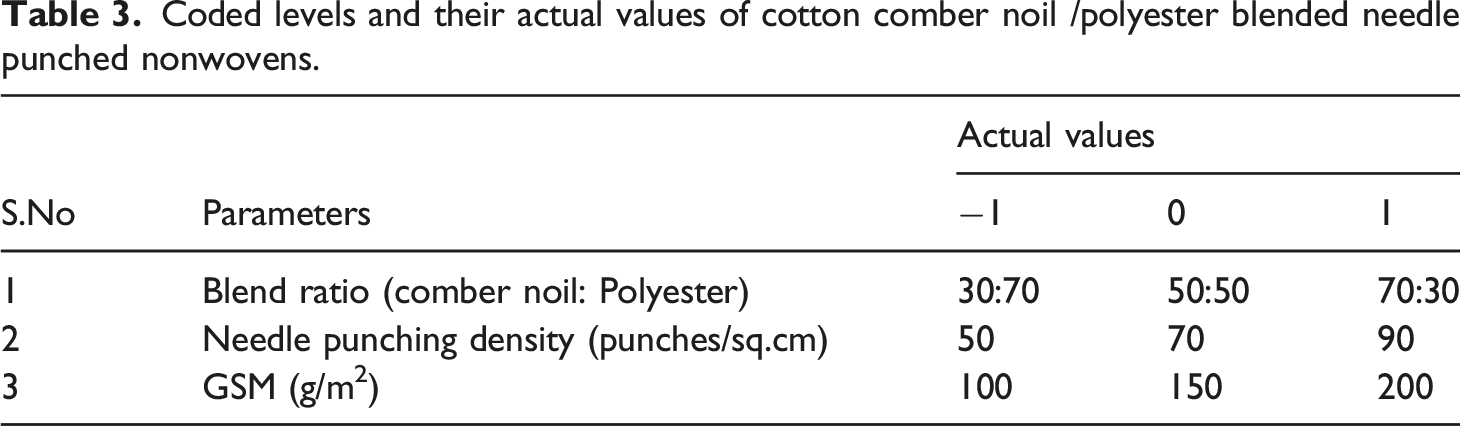

Method of preparation of needle punched nonwoven fabrics from CCN/rPET fibers and optimization.
Contact angle measurement
The contact angle between the liquid and sample was determined using Kruss Tensiometer K100 with Kruss lab desk software (Orbit Research Associates Private Limited, India).
Measurement of oil sorption capacity
The oil sorption capacity of the nonwoven was measured as per ASTM F 716-09 standard. A known mass of the sample (M
d
) was taken and the samples were dipped in oil for 15 min. Subsequently, the samples were taken and hung in free air for a minute duration to drain the excess oil absorbed by the sample. After draining, the excess oil present in the sample was weighed and the mass of the wet sample was noted as (M
w
). The oil sorption capacity of the nonwovens was calculated by the following relationship.
Measurement of oil retention
A known mass of the sample (M
d
) was taken and the samples were dipped in oil for 15 min. Subsequently, the samples were taken and hung in free air for 15 min duration to drain the excess oil absorbed by the sample. The oil retention capacity was calculated by dividing the difference in the mass of the oil absorbed by the sample (S) i.e. (M
w
-M
d
) and the mass of oil retained by the samples after 15 min drain (R). The retention capacity of the sample was calculated by the below equation
8
:
Results and discussion
Fiber characterization
The fibers used in the work were analyzed with respect to their surface morphology, physical properties and chemical composition. The morphology of the fibers was obtained from the scanning electron microscope. The longitudinal view of cotton comber noil and recycled polyester fibers is shown in Figures 3(a) and (b). It can be observed from Figure 3(a), that the surface of cotton comber noil is somewhat bumpy which may be due to the existence of materials such as wax, lignin etc. Figure 3(b) shows the smooth surface structure of the recycled polyester fiber. Figure 4(a) and (b) shows SEM images of the needle punched CCN/rPET blended nonwovens. The presence of cotton comber noil and recycled polyester fibers is marked in Figure 4. It can also be noted from Figure 4(b) that a large number of cotton fibers are trapped between a few recycled polyester fibers. Longitudinal view of (a) cotton comber noil (b) recycled polyester fiber. SEM images of the needle punched CCN/rPET blended nonwovens (a) X200 (b) X500.

Oil sorption behavior
Oil sorption characteristics of comber noil/polyester blended needle punched nonwovens fabrics.

The contour diagrams (Figures 5–7) were drawn to understand the individual and interaction effects of blend proportion, needling density and GSM on oil sorption behaviour using standard statistical software. Figure 5 shows the influence of blend ratio and needling density on oil sorption. It is observed from Figure 5 that, as the cotton comber noil % increases, the oil sorption capacity of nonwoven fabrics increases against both crude oil and vegetable oil. The oil-sorption capacity of cotton comber noil/recycled polyester needle punched nonwoven fabrics depends on two parameters namely fiber component and fabric structure. In this study, cotton comber noil and recycled polyester fibers are used to develop nonwoven fabrics. Therefore, the oil sorption of nonwoven depends on the combined sorption behaviour of cotton comber noil and recycled polyester fibers. Influence of blend ratio and needle punching density on (a) crude oil sorption and (b) vegetable oil sorption. Influence of needle punching density and GSM on (a) crude oil sorption and (b) vegetable oil sorption. Influence of blend ratio and GSM on (a) crude oil sorption and (b) vegetable oil sorption.


Sorption of oil by cotton fibers could be due to the adsorption by intermolecular interaction of C-H bonds between surface waxes and absorbed oils and adsorption through physical trapping on the fiber surface through its surface morphology. 18 Liquid oil can also be trapped into the porous interior structure of the fiber which enhances the diffusion of oil through the fiber and improves the sorption properties of the fiber. Also, the low micronaire value of cotton fiber (Table 1) creates increased fineness and provides higher surface area, which in turn provides more sites for surface adsorption and inter-fiber capillary sorption resulting in maximum oil sorption capacity. Therefore, the oil sorption by cotton fiber matrix involves mechanisms such as adsorption, absorption, and inter-fiber capillary uptake.18,19 The oil sorption of recycled polyester is mainly due to its functional group and oleophilic-hydrophobic characteristics. 8
The other factor which influences oil sorption capacity is the fabric’s structural characteristics. From Figure 5, it is noted that, with increasing needle punching density, the oil sorption capacity of the material decreases. When the punch density increases, the fabric structure becomes more compact due to the better entanglement of fibers in the region. 25 As a consequence, the porosity of the material decreases thereby reducing the oil sorption capacity.
Figure 6 shows the influence of needle punching density and GSM on the oil sorption behaviour of the material. With the increase in GSM and needling density, the oil sorption capacity of the material decreases. When the GSM of the material is increased while maintaining the needle punching density as constant, the number of fibers available for the needle barb for needling increases. 26 Therefore, with the increase in GSM, the fabric consolidation increases, which reduces the oil sorption capacity.
Figure 7 shows the influence of blend ratio and GSM on crude oil sorption and vegetable oil sorption. It is observed from Figure 7 that, as the cotton comber noil % increases, the oil sorption capacity of nonwoven fabrics increases. It is also noted that the oil sorption capacity of the material decreases with an increase in fabric GSM. The reason for the same has been explained earlier.
Optimizing key predictor variables for oil sorption
ANOVA Table for crude oil sorption.

ANOVA table for Vegetable oil sorption.

From Table 6 (Vegetable oil sorption) it has been seen that the Model has an F-value of 80.35 which implies that the model is significant. There is only a 0.01% chance that an F-value this large could occur due to noise. p-values less than 0.0500 indicate model terms are significant. In this case, A, B, C, AC, A2, B2, C2 are significant model terms. The Lack of Fit F-value of 0.70 implies the Lack of Fit is not significant relative to the pure error. There is a 63.33% chance that a Lack of Fit F-value this large could occur due to noise. Non-significant lack of fit is good.
Figure 8(a) and (b) show the perturbation plots for crude oil and vegetable oil sorption. From the graphs, it has been seen that variables A (blend ratio) and C (GSM) have a steep slope and the variable B (Needle punching density has a curvature, which denotes that the response (crude and vegetable oil sorption (g/g)) is sensitive to the factor and the changes in the factor. Thereby it can be proposed that the variable of the developed model has a significant influence on the oil sorption properties of the developed nonwoven material. Perturbation plots for (a) Crude oil sorption and (b) Vegetable oil sorption.
The developed model was optimised with respect to maximum oil sorption of cotton comber noil/recycled polyester blended needle punched nonwoven for both crude and vegetable oil. The maximum oil sorption was found to be 45.90 and 32.30 g/g respectively. The optimised parameters for maximum oil sorption are 70:30 CCN: rPET (Blend ratio), 64.94 (Needle punching density) and 100 (GSM). The developed model has achieved a higher desirability value as shown in Figure 9. The desirability for crude oil sorption and vegetable oil sorption are 1 and 0.986,008 respectively. The overall desirability of the developed model is 0.992,979. Desirability chart for the developed model for oil sorption of crude oil and vegetable oil.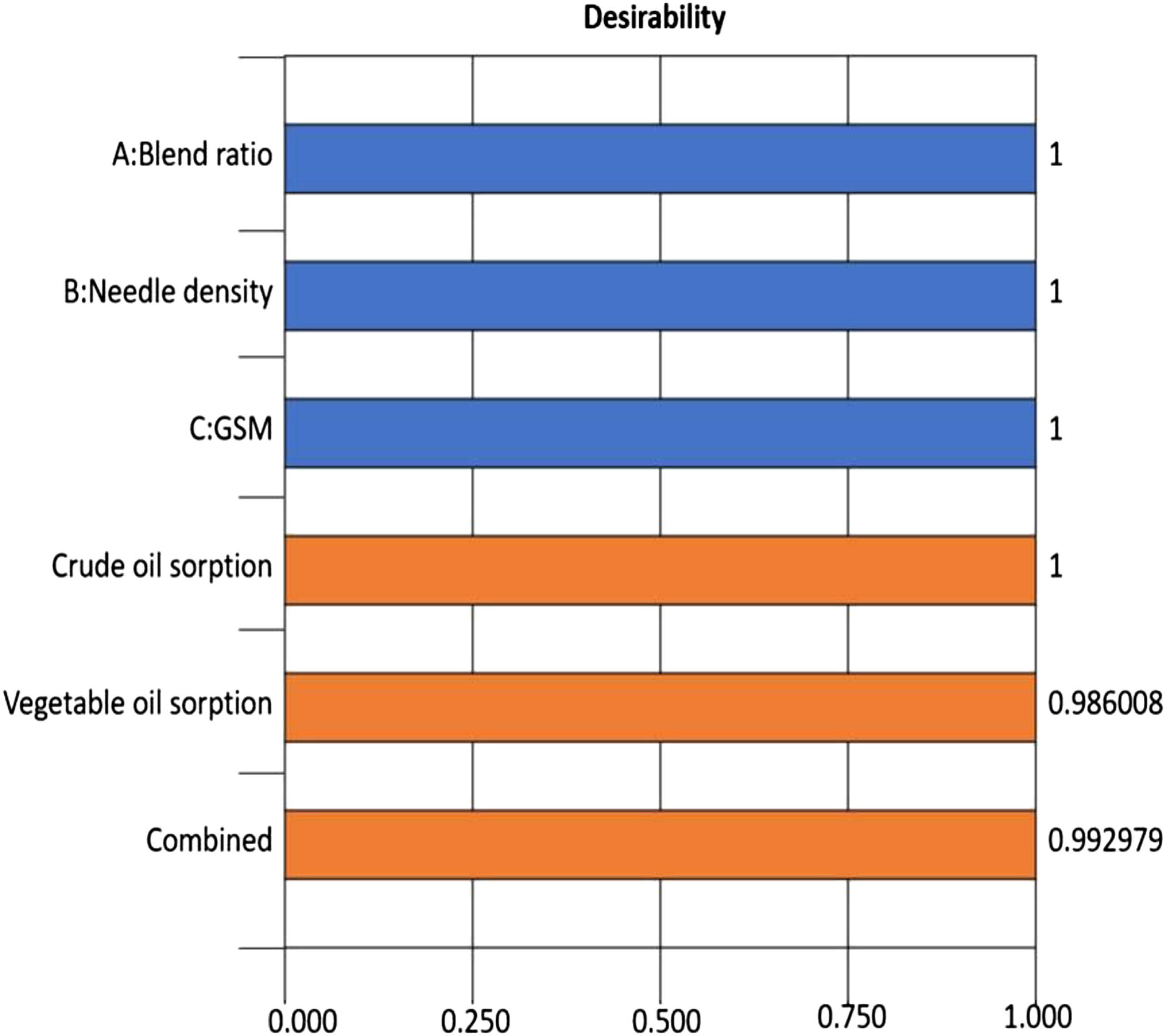
Influence of porosity on oil sorption behavior
The influence of porosity on the oil sorption behaviour of needle-punched nonwoven with respect to crude oil and vegetable oil is represented by a polynomial curve with a regression equation as shown in Figure 10. The R2 values for crude oil sorption and vegetable oil sorption with respect to porosity are 0.9364 and 0.9170, respectively. Samples with the highest porosity value indicate high oil sorption capacity and samples with the lowest porosity value indicate low oil sorption capacity. From Table 4 it is noted that the oil sorption capacity of the needle punched nonwovens is higher for crude oil than vegetable oil. It is believed that the adsorption ability of fibers towards high viscous oil is higher than low viscous oil.
27
Also, the capillary diffusion of oil into the small pores of the nonwoven fabric is affected by the high viscous oils, thus creating maximum adsorption. The oil density difference between crude and vegetable oil is another important factor influencing the oil sorption capacity.
28
Oil sorption capacity of cotton comber noil/recycled polyester needle punched nonwovens.
Wettability
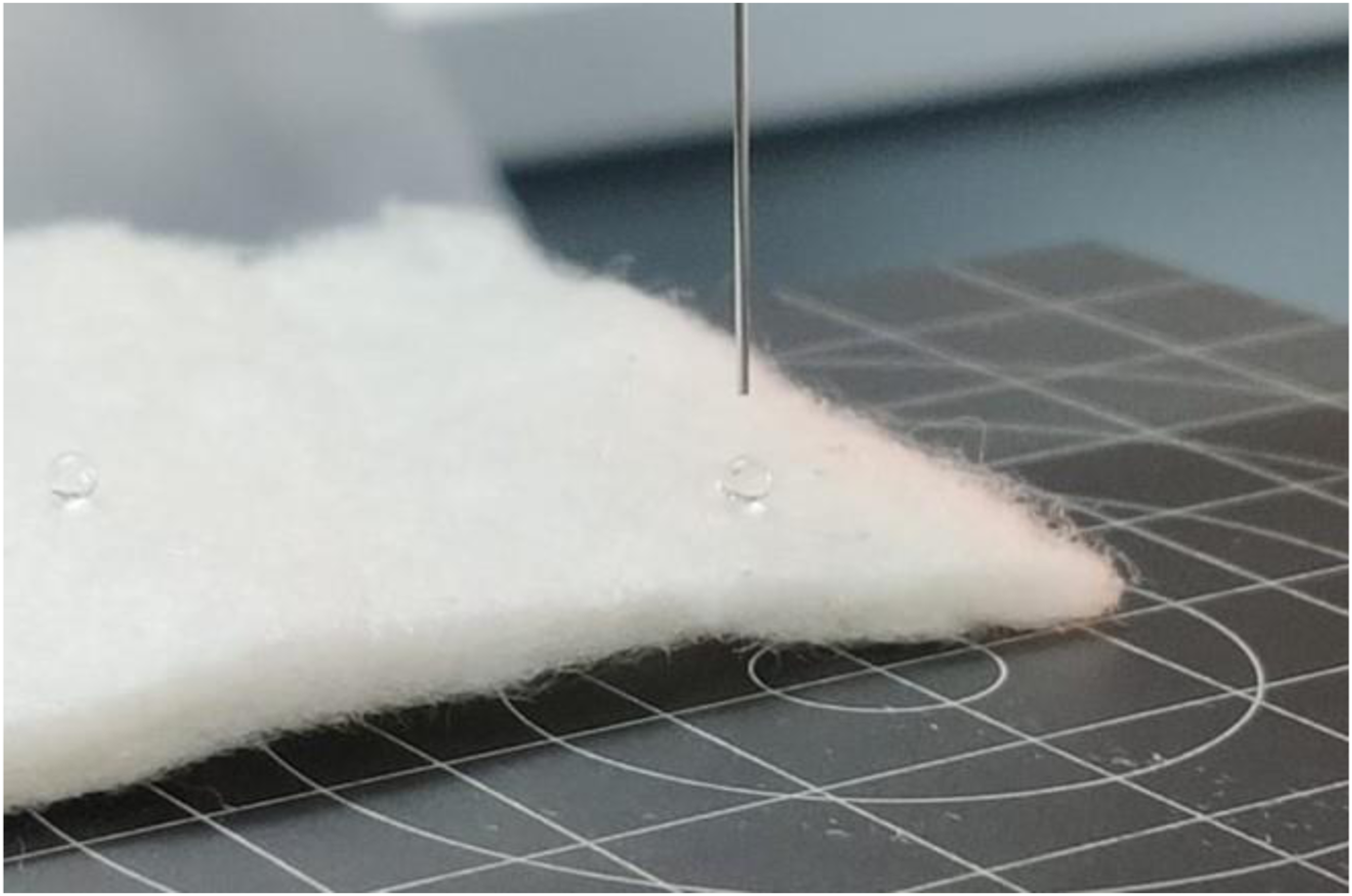
Wettability plays a major role in the oil sorption properties of nonwoven fabric substrates used in oil spill cleanup applications. The poor wettability of a nonwoven substrate reduces the effectiveness of the substrates to uptake oil in its structure. The wettability of substrates can be characterized by the contact angle. When water was dropped on the surface of cotton comber noil/recycled polyester needle punched nonwoven fabrics, a clear and stable water bead morphology was observed with a static contact angle of 133.6° (Figure 11). Morphology of liquid water droplets on the external surface of the cotton comber noil/recycled polyester needle punched nonwoven fabrics are also shown in Figure 12. The static contact angles of both crude and vegetable oil on the surface of the nonwoven fabrics were found to be zero. The wetting and the spreading of oils on the surface of the nonwovens took place in less than a sec, this signifies the hydrophobic-oleophilic nature of the comber noil/recycled polyester needle punched nonwoven fabrics. The oil droplet on single cotton comber noil fiber and recycled polyester fiber is shown in Figure 13(a) and (b) respectively suggesting the hydrophobic and oleophilic nature of the fibers. Water contact angle of CCN/rPET nonwoven fabric. Water droplet on CCN/rPET nonwoven fabric. Oil droplet on single fiber (a) cotton comber noil (b) recycled polyester.

Reusability
The number of cycles a needle punched nonwoven fabric can withstand before becoming unusable owing to issues like ripping, crushing, or other common deterioration is the major factor that may be used to forecast its reusability. Figure 14 shows the reusability performance of CCN/rPET needle punched nonwoven fabrics. From Figure 14, it is noted that the oil sorption capacity of nonwoven fabric diminishes with each cycle. The irreversible deformation of needle punched nonwoven textiles and the unrecoverable residual oil entrapped in the nonwoven fabrics could be the main factors causing the drop in oil sorption capacity of the nonwoven fabric.9,15 It is also noted from Figure 14 that after five cycles, the oil sorption capacity of CCN/rPET needle punched nonwoven fabrics against crude oil and vegetable oil are 18.3 g/g and 13.5 g/g, respectively. According to the findings, CCN/rPET needle punched nonwoven fabrics can be used several times owing to its reusability capability. Reusability performance of CCN/rPET needle punched nonwoven fabrics. Comparison of oil sorption capacity of sorbents.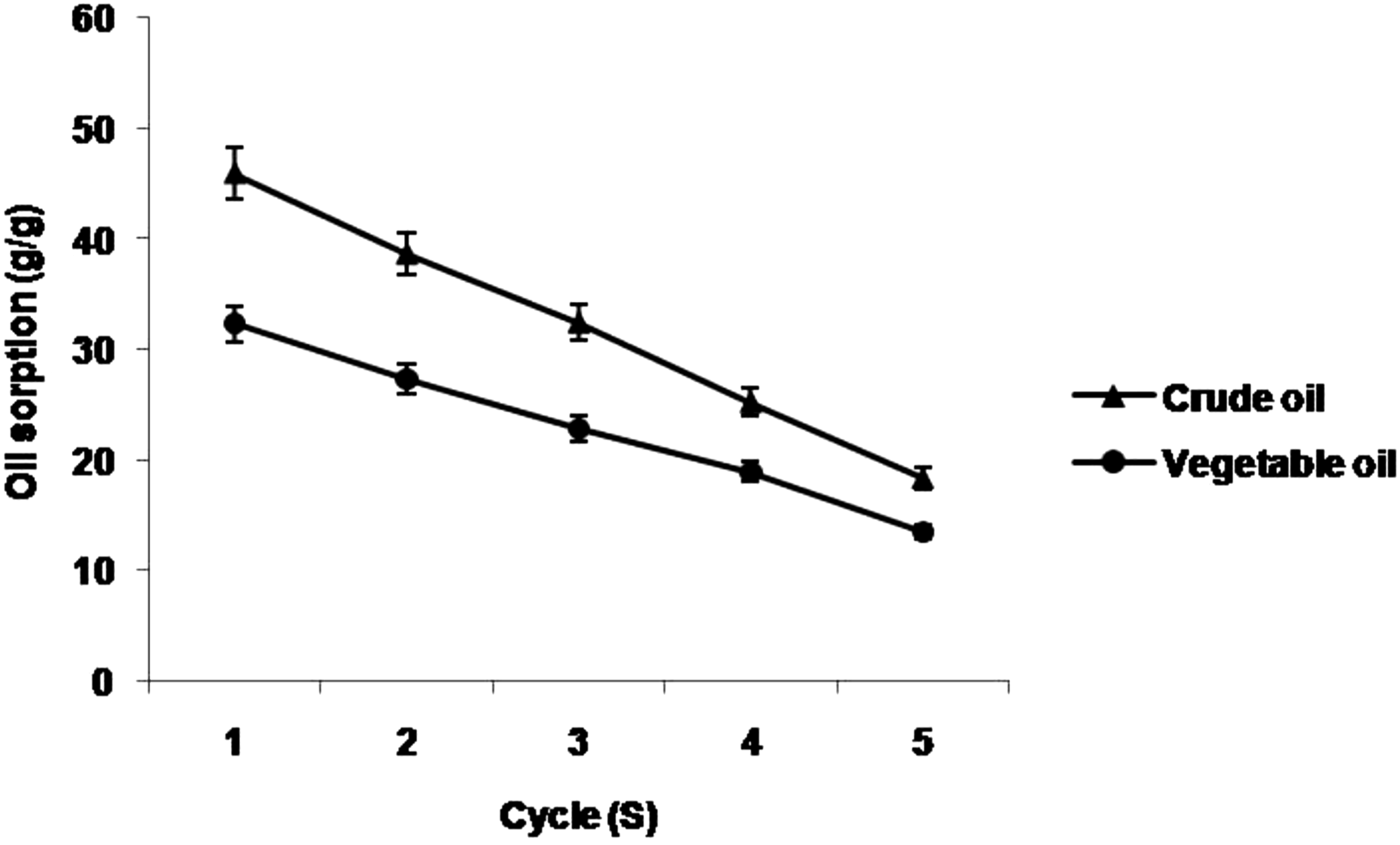
Comparison of oil sorption capacity of sorbents.

Conclusions
• Needle punched nonwoven fabrics from cotton comber noil /recycled polyester have been prepared and analyzed for oil sorption performance. • At 70:30 cotton comber noil /recycled polyester blend proportion, 64.94 needle punching density and 100 GSM, maximum oil sorption capacity of 45.90 g/g against crude oil and 32.30 g/g against vegetable oil were achieved. • Reusability test results showed that after five sorption/desorption cycles the oil sorption capacity of nonwoven was 18.3 g/g and 13.5 g/g against crude oil and vegetable oil respectively. • The oil sorption capacity of cotton comber noil /recycled polyester nonwoven fabrics was found to be higher than many synthetic sorbent materials. The use of cotton comber noil /recycled polyester as sorbent for oil spill removal is sustainable, has a low energy demand, low carbon footprint and is clean compared to 100% synthetic oil sorbents. • In conclusion, cotton comber noil /recycled polyester needle punched nonwoven fabrics 70/30 could be a potential sustainable material for oil spill treatment.
Footnotes
Declaration of conflicting interests
The author(s) declared no potential conflicts of interest with respect to the research, authorship, and/or publication of this article.
Funding
The author(s) received no financial support for the research, authorship, and/or publication of this article.
