




Abstract
This paper examined the heat release and wear comfort characteristics of clothing made of aluminium oxide (Al2O3)/graphite imbedded yarn fabrics for cold weather protective clothing. The wear comfort of the clothing was compared and discussed in terms of the moisture vapor resistance of the fabric, which was verified by far-infrared and light heat emission experiments. The maximum surface temperature of the Al2O3/graphite-imbedded sheath/core yarn fabric was 3.4°C higher than that of the regular one, which was attributed to heat release by the far-infrared radiation emitted from the Al2O3/graphite imbedded in the yarns. The moisture vapor resistance of the Al2O3/graphite-imbedded sheath/core yarn clothing, as measured by a sweating thermal manikin test, was 3.6% lower than that of the regular PET one. In addition, the clothing microclimate temperature of the Al2O3/graphite sheath/core yarn fabric measured by wearer trials was approximately 1°C higher than that of the regular PET fabric, which revealed the superior thermal insulation of the Al2O3/graphite sheath/core yarn clothing compared to the regular PET one. Finally, the superior breathability with thermal insulation of the Al2O3/graphite-imbedded sheath/core yarn fabric were revealed due to its good heat release and storage properties, which support the possible applications for cold weather protective clothing.
Keywords
Introduction
Attention has recently focused on the heat storage and release yarns using ceramic-imbedded spinning technology. In addition, interaction between the heat released from the ceramic particles and far-infrared (FIR) is of particular importance. Therefore, some studies1–5 related to their interactions have been carried out using ceramic particle-imbedded materials coated with different types of ceramic particles. Li et al. 1 examined the infrared radiation of woven fabric coated with Zn/ZnO nanoparticles. Anderson et al. 2 investigated the spectroscopic data for engineered polyester fabric imbedded by various amounts of TiO2 micro-particles. Hwang et al. 3 examined the far-infrared emissivity of a stainless steel/bamboo charcoal conductive fabric. Negishi and Kikuchi 4 reported that zirconium carbide (ZrC) in the yarn absorbs the heat emenated from the human body and reflects infrared radiation. Xu et al. 5 examined the infrared absorbing index and rates of temperature increase and decrease of various fabric types exposed to infrared radiation. The engineering of this type of yarn has long been explored and commercialized with success by many Japanese companies. Kuraray, 6 and Mitsubishi-rayon 7 in Japan developed the heat storage filaments using ZrC applicable to bedding textiles. Unitica 8 has commercialized Solar-α as a heat storage yarn imbedded with ZrC in the core of the nylon filament, and there are many types of heat storage fabrics with the brands of Megatron, Reothermo and Thermotron. The heat storage characteristics of the ZrC-imbedded yarns are achieved by transforming the thermal energy after absorbing near-infrared light from sunlight. Another function of this yarn is that ZrC in the yarn absorbs the heat emitted from the human body and/or reflects far-infrared radiation, which prevents the heat in the yarn and fabric from flowing out, resulting in the heat storage and release properties. 4 Differently from the ZrC-imbedded yarn and fabric commercialized in the market, many studies9–14 using different ceramic particles have been carried out. These research findings focused on the heat storage/release characteristics according to the ceramic types and contents imbedded in the yarns. Kuo et al. 9 reported that the emissivity of SiO2- and TiO2-imbedded polypropylene fibers was approximately 0.85 and the temperature rise was 8.6°C. Lin and Chang 10 examined the effect of carbonized powder of the charcoal fibers to obtain the far-infrared emission characteristics. Lin et al. 11 in another study reported the effect of ceramic powders such as Al2O3, TiO2 and SiO2 to obtain a far-infrared emissive polypropylene master batch. In addition, Lin et al. 12 examined the far-infrared emissivity characteristics of the PET filaments wrapped with bamboo charcoal nylon fibers according to the contents of the different ceramic powders. Pooley et al. 13 examined the engineered emissivity of textile fabrics by the inclusion of TiO2 ceramic particles. They measured emissivity of TiO2-imbedded yarns using TSS-5X measuring equipment (Japan Sensor Corporation, Japan). Lin et al. 11 also measured the emissivity of PP/Wood composites using TSS-5X measuring device. Another studies performed by Lin et al.12,14 have measured the emissivity of bamboo/charcoal imbedded yarns using TSS-5X and Amega 500 Infrared system, respectively. On the other hand, many studies on the heat storage and release properties of the ceramic-imbedded PET fabrics were carried out with relation to the wear comfort.15–20 Bahng and Lee 15 examined the heat-generating property of the ceramic-imbedded PET fabrics using Al2O3/SiO2-imbedded filaments. They also reported rapid sweat-absorbing and fast-drying properties of these ceramic-imbedded fabrics using the moisture management tester (MMT) and, moreover, revealed an excellent thermal insulation due to the heat generation and storage characteristics of the ceramic-imbedded fabrics. Furuta et al. 16 examined the moisture permeability and heat storage properties of the ZrC-imbedded fabrics. They reported the superior moisture permeability of the ZrC-imbedded PET fabrics compared to the regular PET fabric due to heat-storage property. In addition, Kim and Kim17,18 examined the wear comfort and heat storage properties of the ZrC-imbedded knitted fabrics. They reported higher heat retention rate and faster moisture drying properties of the ZrC-imbedded fabric than those of regular PET fabrics. However, the thermal wear comfort in previous studies was mostly assessed in the fabric state made of ZrC imbedded yarns, and did not determine the actual wearing performance of the clothing, which is very important for cold weather protective clothing. Concerning the studies related to the actual wearing performance of cold weather protective clothing in relation to the wear comfort using thermal manikin equipment. Yoo and Kim 21 examined water vapor transfer and condensation in cold weather clothing ensemble using human-clothing-environment simulator under the cold chamber condition, −15±0.5°C, 20±5% RH. McCullough 22 reported the thermal resistance of cold weather clothing using thermal manikin placed in a cool/cold environmental chamber. Mäkinen 23 reported European standards for cold protective clothing: cold environment is defined as a temperature < −5°C (EN 342 protective clothing (2005)). Investigating previous studies related to thermal manikin, thermal manikins can be divided into three categories. 24 The first thermal manikin is standing (not walkable) and non-perspiring ones. 25 The second category is moveable (walkable), but non-perspiring ones such as the copper manikin ‘Charlie’ in Germany. 26 The third generation manikin is movable and perspiring one, which are ‘Coppelius’ in Finland, ‘SAM’ in Switzerland, MTNW in USA, and ‘Walter’ in Hong Kong. 27 In this study, standing and non-perspiring thermal manikin (MTNW-Huey, Seattle, USA) with fifteen regulated segments was used and measures the heat losses due to condensation, convection and radiation losses over the whole surface of the manikin body and in all directions. By the way, few studies have examined the wear comfort using a sweating thermal manikin and the heat storage and release characteristics of the Al2O3-imbedded sheath/core yarn fabrics, despite the many commercialized heat storage textile goods in the market related to the fabrics imbedded with ceramic particles in the core of the yarns. Moreover, the previous findings did not provide objective experimental data such as the skin and microclimate temperature changes in the microclimate weather during the wearer trial by subject, or the moisture vapor resistance and the heat storage property of clothing worn by a sweating thermal manikin. Overall, there were few in-depth studies about the effects of heat release of the Al2O3 imbedded fabric to the moisture vapor resistance via sweating thermal manikin, which is very important to evaluate the comfortable feeling in cold weather protective clothing. Therefore, this study examined the wet thermal wear comfort of the Al2O3/graphite-imbedded fabric made of the sheath/core yarns via a quantitative evaluation by a sweating thermal manikin experiment. For this purpose, the Al2O3/graphite-imbedded sheath/core yarns were spun using a conjugated spinning machine, and two types of fabric specimen were prepared using sheath/core PET yarn and also regular PET yarn, as a control specimen. The surface temperature of Al2O3/graphite sheath/core and regular PET yarn fabrics was measured using a light heat emission apparatus. In addition, a sweating thermal manikin test was carried out to measure the moisture vapor resistance of the clothing, which was compared with that by a sweating guarded hot plate method and their results were discussed in terms of the far-infrared emissivity related to heat release property of the fabric specimens. Finally, these experimental results were compared and discussed with the skin and clothing microclimate temperatures measured by wearer test in a climate chamber.
Experimental
Preparation of Al2O3/graphite-imbedded sheath/core conjugated yarns
Mixing ratio of the sheath/core bicomponent PET filament.

Al2O3/graphite-imbedded PET sheath/core filament was spun with a mixing ratio of Al2O3 (0.7 wt. %) and graphite (0.1 wt. %) using these master-batch chips on a pilot conjugated spinning machine (TMT Co Ltd, Kyoto, Japan). Figure 1 shows a schematic diagram of the sheath/core bi-component spinning apparatus used in this study. As shown in Figure 1(a), a 24-hole spinneret was used with a capillary diameter of 0.2 mm and a length of 0.5 mm. Partially oriented yarn (POY) 120d/24f was spun with PET polymer (50 wt. %) in the sheath and Al2O3/graphite-imbedded PET polymer (50 wt. %) in the core shown in Figure 1(b). The PET polymer was characterized with intrinsic viscosity (0.665), glass transition temperature (Tg: 80.7°C), melting temperature (252°C), and TiO2 content (0.36 wt. %). The spinning temperature in the spintube shown in Figure 1(a) was 287°C. The heat temperatures in the extruder ranged from 310°C to 315°C in the sheath and 287°C–290°C in the core. The first godet roller speed and temperature were 3160 m/min and 80°C, respectively, and the second roller were 3100 m/min and 105°C, respectively (Figure 1(a)). The spinning speed on the take-up winder shown in Figure 1(a) was 3100 m/min. This POY was texturized into the draw textured yarn (DTY) 75d/24f with the following texturing conditions on a Murata 33H machine (Murata, Japan): draw ratio (1.60), heat temperature (140°C), velocity ratio (1.36) and feed speed (450 m/min). Yarn strength and elongation were measured using JIS L 1013 method. Schematic diagram of the bi-component spinning apparatus. (a) overview (b) sheath/core view
Preparation of the fabric specimens
Specification of fabric specimens.

PA: polyamide, PET: polyethylene terephthalate.
S/C: sheath/core, dtex/f: dtex/filament.
Elemental analysis and far-infrared emission characteristics
Elemental analysis of the Al2O3/graphite sheath/core and the regular PET yarn specimens was carried out using energy dispersive X-ray spectroscopy (EDS: Jeol LV 8500, Tokyo, Japan). The far-infrared emission characteristics of the Al2O3/graphite sheath/core and the regular PET yarn specimens were measured using a Fourier transform infrared (FT-IR) spectrometer (Midac M 2400-C, Irvine, USA). The emissivity and emissive power were assessed at 40°C, and wavelength range of 5–20 μm. Their mean and deviation for five readings of experimental data were calculated and the unit for emissive power was W/m2·μm. Cross-sections of yarns and fabrics were measured by SEM (S-4300, Hitachi Co, Japan) and high resolution SEM (S-4800, Hitachi Co, Japan), respectively.
Thermal radiation experiment
Thermal radiation by the light emission was measured using a light heat-emission apparatus (UL Chemical, Daegu, Korea). The lamp in this apparatus was a white tungsten lamp (Iwasaki, 3200 K, Tokyo, Japan). A specimen sized 10 × 10 cm was prepared at 20 ± 2°C and 64 ± 4% RH, and placed on a thermometer on the specimen die. The heat emission bulb placed 30 cm away from the specimen was switched on and the temperature change in the specimen was measured using a thermometer according to the measuring time.
Measurement of moisture vapor resistance of the fabric specimens
An understanding of how the moisture vapor resistance is influenced by the heat released from the Al2O3/graphite sheath/core fabric is important to examine the wear comfort of the heat storage and release fabrics for cold weather protective clothing. The moisture vapor resistance (Ret) of the fabric specimens was measured using a sweating guarded hot plate (Therm DAC, U.K.) according to the ISO 11,092 method. A fabric specimen, sized 30 cm x 30 cm, was prepared and conditioned in the standard atmosphere with a RH of 65% and a temperature of 20°C and the temperature of the guarded hot plate was kept at 35°C and with air flow speed of 1 m/s. The arithmetic mean of five readings from each fabric specimen was calculated. The moisture vapor resistance of the fabric specimen was calculated using equation (1).
Moisture vapor resistance of clothing via sweating thermal manikin measurement
An investigation of how the heat storage and release characteristics affect the moisture vapor resistance of the Al2O3/graphite sheath/core yarn clothing is needed to apply Al2O3/graphite-imbedded sheath/core yarn fabric to cold weather protective clothing and climbing sports-wear for winter. In addition, the previously measured Ret of the fabric could not provide objective data because the sweating guarded hot plate measuring method is not an actual wearing performance assessment, because it is measured using fabric, not clothing. Therefore, the moisture vapor resistance of the clothing was measured using a sweating thermal manikin. The experimental clothing was prepared using the two fabric specimens. Figure 2 shows the jacket and trousers size specifications, which were prepared as medium fit garment and did not consider air gap of clothing. Before measuring Ret , a sweating thermal manikin (Newton-20, NWTM, USA) was set to the no-sweating state. The skin temperature and total dry heat loss were measured according to parallel method of the ASTM F 1291, and the dry thermal resistance was first measured using equations (2) and (3). Prototype garment preparation (a) Jacket (b) Trouser. Positions of the attached sensors on the sweating thermal manikin. Sweating thermal manikins wearing the clothing in this experiment (a) Underwear clothing (b) Specimen 1 (c) Specimen 2.




Measurement of clothing microclimate and skin temperatures during wearer trials to verify that Al2O3/graphite-imbedded sheath/core yarn clothing can indeed offer suitable heat storage/release property for cold weather protective clothing, wearer trials by three healthy male human subjects were carried out. Sensors were attached to the chest area as shown in Figure 5(a). During the wearer trial test, the three test subjects wore each clothing made from the two woven fabric specimens. Every subject was then required to rest for 10 minutes sitting on a chair in a conditioned climate chamber with a temperature of 20°C and relative humidity of 65%. The subject was exposed to the light for 15 minutes and was then subjected to another 10 minutes of the stable stage without the light, as shown in Figure 5(b) and (c). Finally, the subject was allowed to sit and rest for 10 minutes. During the wearer trials, the microclimate and skin temperatures on the chest areas for each human subject were measured every minute, and the mean microclimate and skin temperatures for three subjects and their deviations were analyzed. Subject with sensors attached and subject wearing by the garment with and without light (a) Chest (b) Light-on (c) Light-off.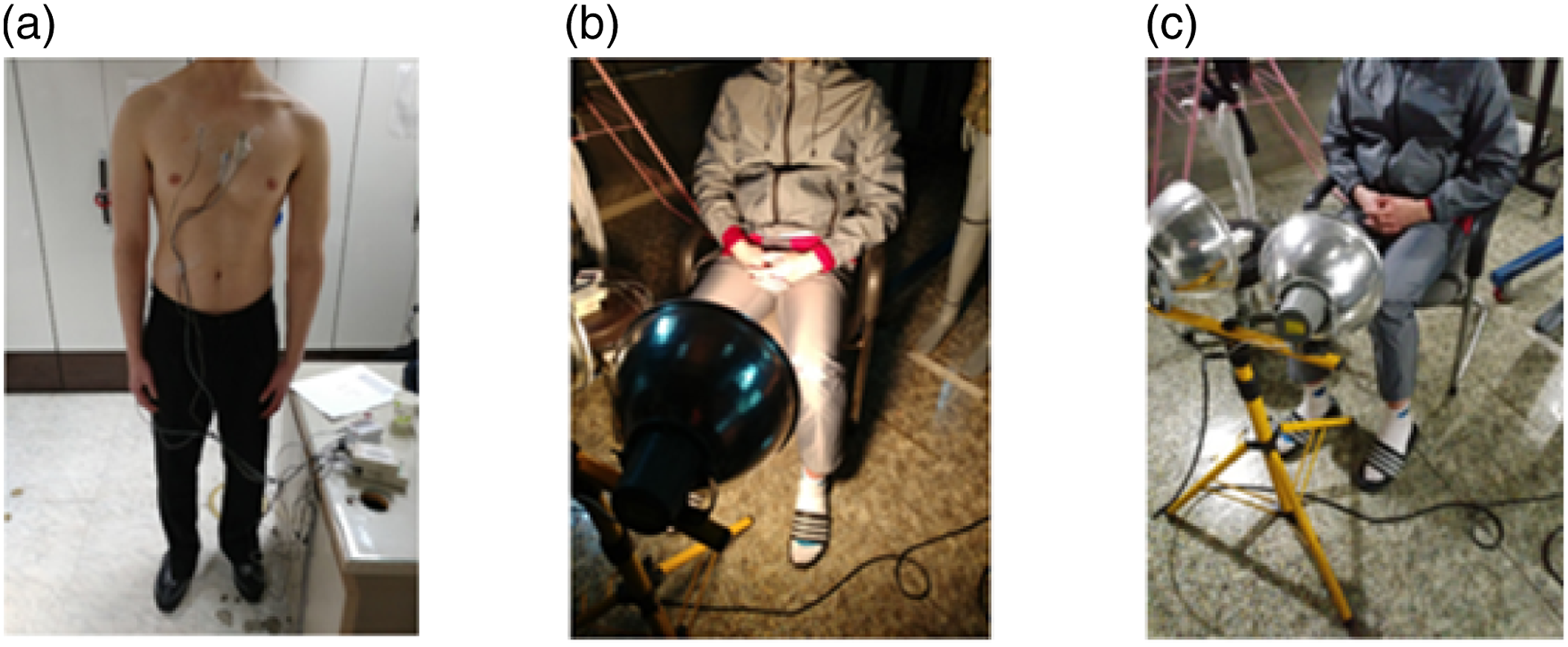
Results and Discussion
Elemental analysis of the Al2O3/graphite-imbedded sheath/core yarns
Elemental analysis of the Al2O3/graphite-imbedded sheath/core and regular PET yarn specimens was carried out by energy dispersive X-ray spectroscopy (EDS; Jeol LV 8500, Tokyo, Japan). Figure 6(a) and (b) present the results of the EDS of the two fabric specimens. As shown in Figure 6(a), Al is evident, and the C peak indicates the partial inclusion of graphite. Ti was also observed in the form of TiO2 (0.36 wt.%), which was used as a delustre agent and mixed in PET polymer. In Figure 6(b), C and Ti peaks were also observed, which were imbedded in the PET polymer. SEM and optical microscopy analyses for the ceramic particles imbedded in the yarns were carried out to verify the distribution and size of the particles in the yarns. Figure 7(a)–(d) show optical microscopy and SEM cross sectional images of the Al2O3/graphite-imbedded sheath/core and regular PET yarn specimens. Elemental analysis of the fabric specimens (a) Specimen 1 (b) Specimen 2. Images of ceramic-imbedded yarn cross-sections by optical microscopy and SEM (a) specimen 1 (x250) (b) specimen 2 (x250) (c) specimen 1 (x1500) (d) specimen 2 (x1500).

The black spots in Figure 7(a) and (b) are assumed to be Al2O3, graphite and TiO2 particles. In particular, the Al2O3 and graphite particles in Figure 7(a) are larger than the TiO2 particles in Figure 7(b), which is apparently verified in SEM images of these yarn cross-sections. Figure 7(c) and (d) show SEM images of the enlarged constituent filament cross-sections in the yarn specimens. As shown in Figure 7(c), the evident border between core and sheath could not found, but core seems to be more blackish than sheath, which is assumed to be border between core and sheath. The white spots in Figure 7(c) and (d) are assumed to be Al2O3, graphite and TiO2 particles. In addition, the size and distribution of the Al2O3 particles in the Al2O3/graphite-imbedded sheath/core yarns were also examined to locate the border of the sheath/core and Al2O3/graphite particles distribution in the core using high resolution SEM (Hitachi S 4800, Japan) prepared with the ion milling apparatus (Hitachi E−3500, Japan). Figure 8(a) presents the cross-section of one filament (x2500) in the Al2O3/graphite-imbedded sheath/core yarn specimen (POY 120d/24f) measured by high resolution SEM. Its diameter is 24.4 μm. The white spots in this filament are assumed to be Al2O3 particles and their size distribution is shown in Figure 8(b). Cross-section of one filament in POY by high resolution SEM (x2500) and particle size distribution of Al2O3 (a) Cross-section of one filament of POY (x2500) (b) Particle size distribution.
As shown in Figure 8(b), the particle size of the Al2O3 was distributed between 0.1 μm and 10 μm diameter, and the mean diameter was 896 nm. In particular, as shown in Figure 8(a), some white spots were shown at the sheath, despite the insertion of Al2O3/graphite particles in the core during the conjugated spinning. This was attributed to the spreading of these particles towards the sheath by swelling at the spinneret when the filament was spun and drawn at the drawing zone after coming down from the spinneret hole in the conjugated spinning machine. However, the border of the sheath/core is not clearly evident in Figure 8(a).
Far-infrared emission characteristics of the ceramic imbedded yarns
Emissivity and emissive power of the fabric specimens.

Note: dev. = max. - min.
ANOVA analysis of the emissive power and emissivity.

As shown in Table 3, the emissivity and emissive power of the Al2O3/graphite-imbedded sheath/core yarn were higher than those of the regular PET yarn. This indicates that Al2O3/graphite particles have higher efficiency for the far-infrared emission than TiO2 particles imbedded in PET regular yarn do. This result indicates that the heat released by the absorption or accumulation of the far-infrared emitted from Al2O3/graphite-imbedded sheath/core yarn is much more than that from the regular PET yarns, resulting in superior heat storage and release properties of the Al2O3/graphite sheath/core yarn.
Heat release of the Al2O3/graphite sheath/core yarn fabric
The surface temperature of the fabric specimens was measured by a light heat emission system. Figure 9 shows the surface temperature change of the fabric specimens according to the time lapsed (30 min) as the light emitted from 30 cm above the specimen. As shown in Figure 9, the surface temperature of the Al2O3/graphite-imbedded sheath/core yarn fabric (specimen 1) increased nonlinearly to 42.1°C during 10 min of light emission, and decreased rapidly to 23°C during 20 min since the light was turned off after 10 min, whereas the surface temperature of the regular PET fabric increased to 38.7°C and then decreased to 23°C. As shown in Figure 9, two fabrics exhibited the same level of the temperature decrease after 10 minute. These phenomena seem to be attributed to the greater heat decay from bulb due to the light-off than heat decrease emenated from TiO2 and Al2O3 ceramic particles imbedded in the yarn specimens 1 and 2 after light-off, resulting in same level of temperature decrease on the fabric surface. On the other hand, the maximum heat-release temperature after 10 min of the Al2O3/graphite-imbedded sheath/core yarn fabric was higher than that of the regular PET fabric, which was attributed to the heat released from the absorption or accumulation of the far-infrared radiation emitted from Al2O3 particles in the yarn, which was previously verified by the higher emissivity and emissive power of the Al2O3/graphite yarn than those of the regular PET one, as shown in Table 3. Surface temperature change of the fabric specimens.
Moisture vapor resistance of the fabric specimens by sweating guarded hot plate method
Understanding how the moisture vapor resistance is influenced by the heat storage and release characteristics due to the far-infrared radiation of the Al2O3/graphite-imbedded sheath/core yarn fabric is very important and this necessitates a comparison with Ret of clothing obtained from the sweating thermal manikin experiment. Figure 10 presents the moisture vapor resistance of the fabric specimens. Moisture vapor resistance of the fabric specimens.
As shown in Figure 10, the moisture vapor resistance (Ret) of the Al2O3/graphite-imbedded fabric (specimen 1) was lower than that of the regular PET fabric (specimen 2), i.e. it exhibited superior breathability. This was attributed to the more accelerated heat particles and perspiration vapors due to the higher fabric surface temperature of the Al2O3/graphite sheath/core fabric than that of the regular PET one (Table 3), which enabled the moisture vapor from the human body to escape easily and resulted in a lower moisture vapor resistance. Similar findings in previous studies were reported by Bahng and Lee 15 , Furuta et al. 16 and Shim et al. 28 , who all reported that the moisture vapor permeability increased with the imbedding of ceramic particles such as ZrC, Al2O3 and other ceramic powders.
Moisture vapor resistance of clothing by sweating thermal manikin test
Raw data related to the moisture vapor resistance of the clothing according to the sweating thermal manikin positions.

As shown in Table 5, the moisture vapor resistance (Ret) of the clothing (specimen 1) made of the Al2O3/graphite sheath/core yarn fabric was lower than that of the clothing (specimen 2) made of the regular PET fabric, which was attributed to greater heat (higher surface temperature in Figure 9 by the greater far-infrared (greater emissivity in Table 3) emitted from Al2O3/graphite in the sheath/core yarn than that from TiO2 in the regular PET yarn, which accelerates and easily expels the moisture vapor (perspiration) from the human body due to the higher temperature in the microclimate as previously mentioned. This result was in accordance with the Ret (Figure 10) of the fabric measured by the guarded hot plate method mentioned previously. The current findings measured by a sweating thermal manikin were in accordance with those of previous studies 28 using different measuring methods. Shim et al. 28 reported a similar finding in the evaporative resistance of the warm-up suit laminated with Al2O3- and ZrO2-incorporated membrane films using a sweating hot plate method and a sweating thermal manikin. They concluded that the warm-up suit laminated with Al2O3-incorporated membrane exhibited lower evaporative resistance with higher thermal insulation compared to the warm-up suit laminated with regular membrane.
Clothing microclimate and skin temperatures during wearer trials
Two different clothing prototypes were worn by the human subjects to measure the clothing microclimate and skin temperatures. Figure 11(a) and (b) present the clothing microclimate and skin temperatures with their deviations for the three subjects during the wearer trials, respectively. Clothing microclimate and skin temperature for subjects during wearer trials (a) microclimate temperature (b) skin temperature.
As shown in Figure 11(a), after commencing the light-on state (25 min), the clothing microclimate temperature of the Al2O3/graphite sheath/core yarn clothing was approximately 1°C higher than that of the regular PET yarn clothing. In addition, the microclimate temperature of the Al2O3/graphite sheath/core yarn clothing (specimen 1) increased with time (25 min) and decreased after 10 min of the light-off state (35 min), which was attributed to the heat by far-infrared emitted from Al2O3/graphite particles in the yarn. A similar change in the regular PET yarn clothing (specimen 2) was observed with time, which was attributed to the TiO2 in the yarn. As shown in Figure 11(a), during the last 10 min (after 35 min) of the rest time after terminating the light emission, the microclimate temperature of the Al2O3/graphite sheath/core yarn clothing appeared to be similar to that of the regular PET yarn clothing, possibly because the microclimate temperature of the Al2O3/graphite sheath/core yarn clothing decreased by depriving the heat in the microclimate due to the evaporation of perspiration from the human body, resulting in similar microclimate temperature to regular PET yarn clothing. The skin temperature, as shown in Figure 11(b), exhibited similar trend with time elapsed to that of the microclimate temperature, and the skin temperature of the Al2O3/graphite sheath/core clothing according to time elapsed ranged between 34.5°C and 35.3°C, which was slightly higher than the range of 33°C–34.8°C for the microclimate temperature. In particular, in Figure 11(b), the difference of the skin temperature between the Al2O3/graphite and regular PET yarn clothing appeared to be negligible, which can be explained by the temperature drop due to the evaporation of the perspiration from the human skin of subject wearing Al2O3/graphite yarn clothing, i.e. more evaporation of perspiration from the skin of human subjects occurs in the Al2O3/graphite yarn clothing than in the regular PET yarn clothing, which decreases the skin temperature and leads to a negligible difference of skin temperature between Al2O3/graphite and regular PET yarn clothing. However, the shape of the temperature change between light-on and -off (from 10 to 25 min) was similar to that of the light heat emission experiment, as shown in the previous findings (Figure 8).
Conclusion
The moisture vapor resistance measured using a sweating thermal manikin and the clothing microclimate and skin temperatures measured in a wearer trial with human subjects of the clothing made of Al2O3/graphite-imbedded sheath/core yarn fabric were examined in terms of the heat storage and release characteristics of this fabric, as verified by the far-infrared and the light heat emission experiments. The results were compared and discussed in terms of the moisture vapor resistance of the fabric measured by the sweating guarded hot plate method. The maximum surface temperature by the light heat emission experiment of the Al2O3/graphite-imbedded sheath/core yarn fabric was 3.4°C higher than that of the regular PET fabric. The moisture vapor resistance of the Al2O3/graphite sheath/core yarn fabric measured by the sweating guarded hot plate method was 8.9% lower than that of the regular PET fabric, i.e. it exhibited superior breathability. These results were caused by the higher heat storage and release characteristics of the Al2O3/graphite-imbedded sheath/core yarns, as verified by the higher emissivity and emissive power of the sheath/core yarn than those of the regular PET yarn. The moisture vapor resistance of the Al2O3/graphite-imbedded sheath/core clothing measured by a sweating thermal manikin test was 3.6% lower than that of the regular PET one, which was consistent with the result of the fabric by the sweating guarded hot plate method. In addition, the clothing microclimate temperature of the Al2O3/graphite sheath/core clothing during the wearer trial by human subjects was approximately 1°C higher than that of the regular PET fabric clothing, which revealed the superior thermal insulation of the Al2O3/graphite sheath/core clothing. Finally, the study revealed the superior breathability and thermal insulation of the Al2O3/graphite-imbedded sheath/core yarn fabric, which were caused by the higher heat storage and release properties of the Al2O3/graphite sheath/core yarn. These results support the possible applications for cold weather protective clothing.
Footnotes
Acknowledgements
Author thanks for support of yarn and fabric preparation to the processing laboratory in department of fiber system of Yeungnam University.
Declaration of conflicting interests
The author(s) declared no potential conflicts of interest with respect to the research, authorship, and/or publication of this article.
Funding
The author(s) received no financial support for the research, authorship, and/or publication of this article.
