




Abstract
As a non-invasive therapeutic modality, microwave hyperthermia has gained increasing prominence in recent breast cancer research. In microwave hyperthermia, the temperature of a cancerous lesion is raised to 39–45°C by microwave irradiation to shrink tumors. Currently available applicators in clinics are aperture antennas (or waveguides) that are bulky and stationary; as such, patients are required to stay in an uncomfortable position for an extended period of time. On this account, this paper introduces the design and characterization of a novel cotton fabric antenna for a truly wearable and patient-friendly breast hyperthermia therapy. The developed antenna, consisting of cotton and copper-plated polyester fabrics, offers flexibility, tenacity, moisture-absorbing properties and breathability desirable for potential integration into intimate apparel. On the other hand, the use of cotton fabric brings about a major concern: moisture is documented to alter the dielectric properties of cotton fabrics and hence could impact the antenna performance. Therefore, for the purpose of concept and design validation, this research investigated the impedance matching and heating performance at three levels (20%, 65% and 80%) of relative humidity (RH). From both simulations and measurements, the RH was found to shift the resonant frequency slightly, but did not critically affect the impedance matching and the heating performance – the measured temperature rises were 4.7–4.9°C and 2.3–2.5°C at the depths of 5 mm and 15 mm, respectively. These theoretical and experimental insights cast light on the feasibility and benefits of moisture-absorbing, cotton-based medical textiles for administration of highly patient-friendly breast hyperthermia.
Keywords
Introduction
Microwave hyperthermia is a class of non-invasive medical modality in which the temperature of cancerous lesions is raised to 39–45°C by microwave irradiation to induce cellular damage and death. 1 It has been evidenced by both cytological studies and clinical trials that cancerous tumors could shrink substantially within this temperature range while normal (healthy) tissues could withstand the heat, by their superior blood flow, which allows rapid thermal dissipation.1–3 In addition, it has been documented that mild heat could enhance the efficacy of conventional techniques such as chemotherapy and radiotherapy, and accordingly, microwave hyperthermia is often administered in combination.4–8
Waveguides (aperture antennas) are predominantly employed as non-invasive hyperthermia applicators in the current clinical environment.5,9 However, being bulky and stationary, these conventional apparatuses impose significant burdens on patients by restricting their body movements during treatment. 5 With an aim to alleviate this issue, several small-form factor and wearable designs have been proposed over the past few decades. Those include the printed circuit board (PCB) -based 10,11 and inkjet-printed 12,13 planar antennas that were designed for on-body microwave hyperthermia applications. Antennas with water-circulating systems were also proposed so as to reduce the applicator size and cool both antenna and skin surface.5,14
While these antennas were designed to be smaller in size, they seem to lack the fundamental requirements for comfort, such as breathability, lightweightness and flexibility to inherently conform to the body contour. From this point of view, textile-based antennas could be more advantageous. Being highly flexible, lightweight and breathable,15–18 antennas made of textile materials could be seamlessly integrated into clothing such as underwear.19,20 Moreover, having a relatively low dielectric permittivity owing to their highly porous nature, the use of textile materials has great potential in improving the gain, efficiency and bandwidth.21–23 In this context, a polyester-based fabric antenna was recently reported for wearable hyperthemia therapy. 24
This paper presents the design and characterization of a novel textile patch antenna made of cotton fabrics for hyperthermia therapy. Cotton fabrics have exceptional hygroscopic properties – up to 20% moisture content can be attained at 96 °F (35.6°C). 25 Due to these moisture-absorbing properties as well as their excellent tensile and tear strength, 26 sensorial comfort 27,28 and abrasion resistance, 29 cotton fabric could be a superior material over non-hygroscopic materials such as polyester. 24
Although the use of cotton fabric would be auspicious, there are latent concerns. The dielectric constants of cotton fabrics are reported to be highly susceptible to the relative humidity (RH) of the environment30,31; consequently, antennas made of cotton fabrics may experience a significant detuning or frequency shift under a wide range of RH conditions. 31 In addition, the dielectric loss of cotton fabrics could increase at an elevated RH, 30 leading to a potential deterioration in the heating performance of a cotton-based antenna. Therefore, this research examined the influence of the RH on the impedance matching and heating performance of a cotton fabric antenna. The prospect of administering hyperthermia therapy with the newly developed cotton-based hyperthemia applicator is discussed based on the results obtained from numerical and experimental investigations.
Methods
Breast model
For the purpose of concept and design validation, this work employed a homogeneous breast phantom in a hemispheric shape with a radius of 50 mm (Figure 1(a)). This phantom, fabricated following literature,
32
has been widely used in previous hyperthermia research,24,33,34 and its composition is given in Table 1. The complex relative permittivity of this phantom was 48.5 – 23.28j.
35
(a) Breast phantom (wrapped in plastic for preservation), (b) antenna sample (ground side) with a SubMiniature version A (SMA) connector, (c) antenna sample (patch side) placed in a measurement holder, (d) padding layer covering the patch, (e) temperature probes fixed with duct tape, and (f) antenna sample placed in the holder for measurements. Chemical composition (in grams) of the homogeneous breast phantom.
32


Antenna Design and fabrication
The designed cotton fabric antenna consists of a patch, a ground, a substrate and a padding layer, as well as an SMA connector for power feeding, as illustrated in Figure 2. The patch and ground were made of a commercially available, 0.08 mm-thick copper-plated polyester fabric (Cu fabric) with a fabric weight of 80 g/m2 (LessEMF Inc.). This fabric had an exceptionally dense, plain weave structure (360-by-280 threads-per-inch; Figure 3(a)) that contributed to a low sheet resistance (0.03 Ω/sq) and thus was favorable for developing a highly efficient antenna for hyperthermia therapy.
24
For the substrate and padding layers, a 1.4 mm-thick cotton fabric with a fabric weight of 230.9 g/m2 was adopted from a previous research.30,36 Woven with a 5-ply cotton yarn with a linear density of 4.6 Ne (equivalent to 0.128 g/m) in a relatively loose plain-weave construction (24-by-15 threads-per-inch; Figure 3(b)),
36
this cotton fabric had a high porosity (89%) and a small dielectric constant (Table 2),
30
desirable for developing an antenna with a wide bandwidth and a high gain.22,37 In addition, the small dielectric constant variation of this cotton fabric under the varying RH (Table 2)
30
was favorable to curtail the antenna detuning (shift in the resonant frequency) during operation, as will be discussed in Section 3. Designed cotton fabric antenna conforming to the hemispheric breast phantom, (a) YZ slice and (b) ZX slice (not to scale).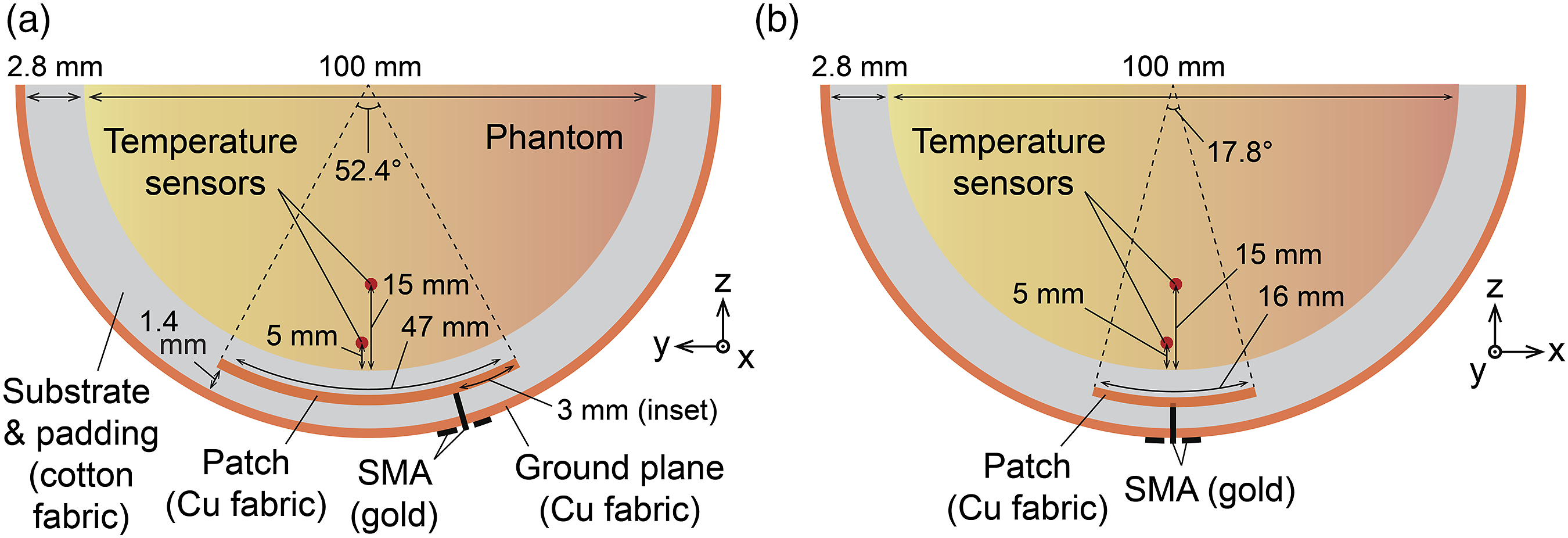


The dimensions of the antenna were optimized using a three dimensional (3D) full-wave electromagnetic (EM) simulator (ANSYS® HFSSTM). Based on the complex relative permittivity data under the standard atmospheric conditions (65% RH at 21°C) from literature30,36 (Table 2), the optimal patch size was determined to be 16 mm in width and 47 mm in length (Figure 2) for resonance at an industrial, scientific and medical (ISM) band (2.450 GHz), which is commonly investigated for hyperthermia applications. 8
In order to fabricate the fabric antenna in the designed geometry, the conventional flat-pattern method
38
was employed. By following the literature,
39
optimal patterns were generated for the patch, ground, substrate and padding layers (Figure 4(a)). The cotton and Cu fabrics were then cut with an electronic cutting machine (Provo Craft & Novelty, Inc.) into desired shapes and dimensions (Figure 4(b)). Next, the substrate, padding and ground plane pieces were respectively joined together by flatlock stitch to form the hemispheric geometry. The patch and ground were then securely mounted on the substrate layer with a heated polyamide fusible web (Bostik Inc.). A 50 Ω panel-mount SMA connector (Amphenol Corporation) was soldered to the patch and ground and then covered with a silver conductive epoxy adhesive (MG Chemicals Ltd.), which offered excellent electrical conductivity and adhesion performance to secure the connection. Because the Cu fabric had a low melting temperature, this additional process was necessary to reinforce the unavoidable cold solder joint. The finished antenna sample is shown in Figure 1(b)-(d). (a) Design patterns of the antenna components and (b) real fabric cuts.
Theoretical evaluation
Materials properties used in thermal simulation.

aThe densities of the cotton and Cu fabrics were calculated from the fabric weight and thickness.
Experimental evaluation
Prior to electrical and temperature measurements, the antenna sample was conditioned at 80%, 65% or 20% RHs (21°C) in the same manner reported previously. 36 The antenna sample was then laid on the breast phantom and fixed inside a 3D-printed polylactic acid (PLA) holder (Figure 1(f)) to ensure that the antenna remained in the intended hemispheric shape during the measurements (Figure 2).
The impedance matching was evaluated through monitoring of the reflection coefficient of the antenna sample in the frequency range of 1 to 4 GHz with a calibrated vector network analyzer (E5071C ENA Series Network Analyzer, Agilent Technologies Inc.). The thermal measurements were performed in the configuration described in a previous report
24
(Figure 5). In brief, a 20 dB amplifier (2.4 GHz 1 W High Gain Amplifier Module, Sireen Inc.) was connected to a computer-controlled 10 dBm-signal generator (SynthNV RF Signal Generator, Windfreak Technologies, LLC) to supply the antenna sample with 30 dBm (1 W) power at 2.450 GHz. The rises in temperature were measured by using contact probes of a thermometer (Fluke 52 II Dual Probe Digital Thermometer, Fluke Corporation) in two locations (5 mm and 15 mm deep tissues) of the breast phantom for 900 s, as depicted in Figure 2. Antenna powering setup for the measurement of heating performance, redrawn from.
24
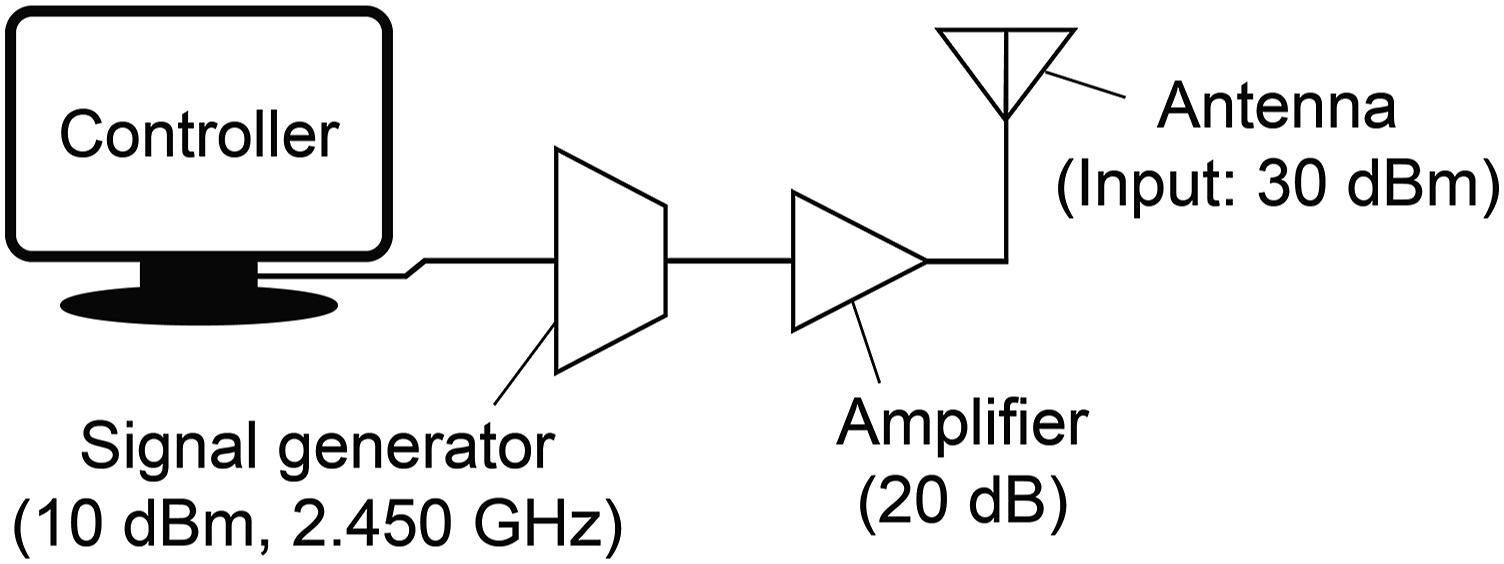
Results and Discussion
Reflection coefficient
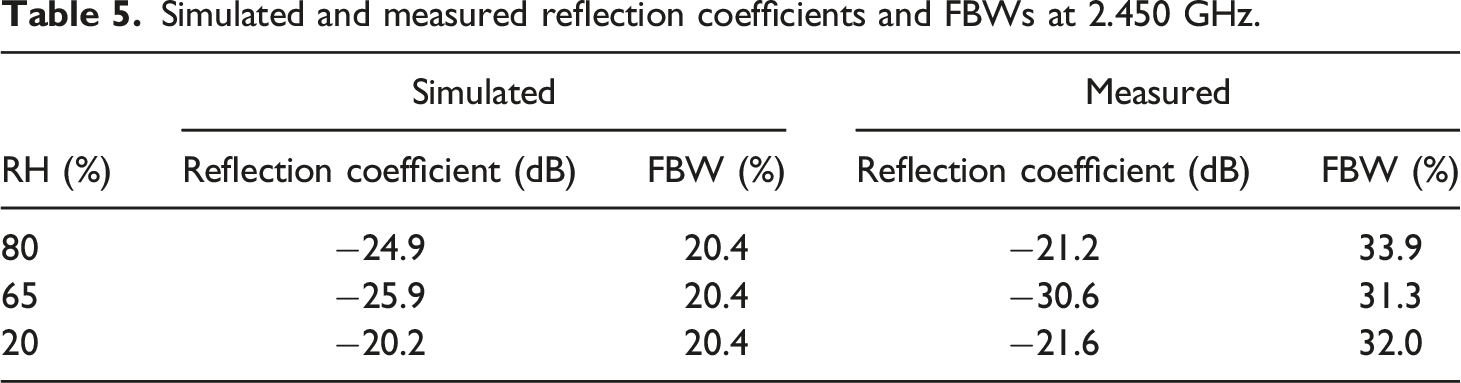
Figure 6, Table 4 and Table 5 show the simulated and measured reflection coefficients and resonant (operating) frequencies of the proposed antenna. Under the standard atmospheric conditions (65% RH), the impedance of the antenna sample was well matched to the source impedance (50 Ω) at 2.450 GHz (Table 4). The measured and simulated reflection coefficients were −30.6 dB and −25.9 dB at 65% RH, respectively (Table 5). The effect of RH on the reflection coefficient was found to be insignificant within the given RH range – both simulations and measurements showed that the reflection coefficients remained well below −10 dB at 2.450 GHz (Table 5). This satisfactory impedance matching confirms that the design of the cotton fabric patch antenna was valid in the broad range of RH levels (20%–80% RH), owing to the wide fractional bandwidth (FBW) of the cotton fabric antenna (Table 5). (a) Simulated and (b) measured reflection coefficients of the cotton fabric antenna under three RH conditions. Resonant frequencies of the simulated and measured and antenna applicator. Simulated and measured reflection coefficients and FBWs at 2.450 GHz.

Specific absorption rate
The SAR distribution in the breast phantom was computed for the standard atmospheric conditions (65% RH) and its cross-sectional slices are given in Figure 7(c)-(d). The major EM absorption (>100 W/kg) occurred near the center of the patch because of the substantial dielectric loss of the breast phantom. The SAR plotted as a function of the tissue depth is given in Figure 8. As shown, there was no major energy absorption in the regions deeper than ∼25 mm, indicating that the proposed system would be effective primarily for superficial tumors. (a) YZ and (b) ZX cuts of the simulated SAR distribution at 80% RH; (c) YZ and (d) ZX cuts of the simulated SAR distribution at 65% RH; and (e) YZ and (f) ZX cuts of the simulated SAR distribution at 20% RH. Simulated SARs plotted as a function of the tissue depth under different RH conditions.

Rates of energy deposition and heating efficiencies, computed by assuming an input power of 1 W.

aThe heating efficiency (%) was calculated by dividing the deposited power in the breast phantom by the input power, and then multiplied by 100.
Temperature rise
The simulated temperature elevation under microwave irradiation is given in Figure 9 for the standard atmospheric conditions. As expected, a significant thermal diffusion was observed in the breast tissue due to its high thermal conductivity (0.55 W·m−1·K−1). After 900 s of heating, the temperature was raised by more than 8.0°C near the center of the patch. Simulated temperature increment distributions at 65% RH (t = 0–900 s).
The temperature rises at 20% and 80% RH are given in Figure 10 and Figure 11, respectively. From these plots, it is seen that the high temperature (>8.0°C) region slightly expanded with decrease in the RH, in accordance with the higher SAR obtained for lower RH conditions (Figure 7). Simulated temperature increment distributions at 80% RH (t = 0–900 s). Simulated temperature increment distributions at 20% RH (t = 0–900 s).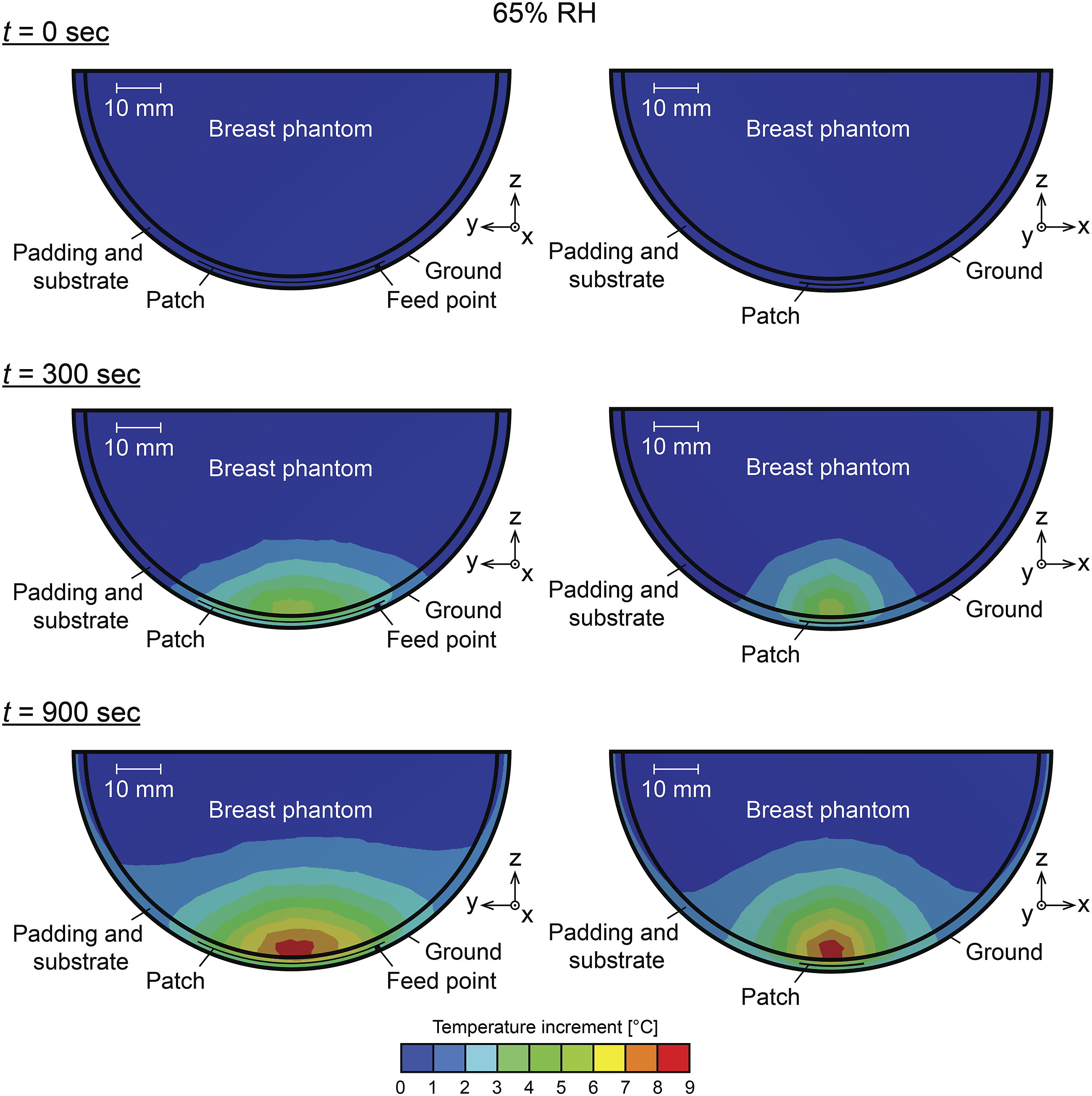

The temperature rises computed at the 5 mm- and 15 mm-deep tissues are plotted in Figure 12(a) as a function of the treatment time. It was found from these data that a higher RH tends to result in a slightly less temperature rise. However, regardless of RH levels, more than 8.1°C and 3.8°C temperature elevations were achieved at the depths of 5 mm and 15 mm, respectively, after 900 s of irradiation (Table 7). These substantial temperature rises suggest that the tissue temperature could be sufficiently raised with the proposed cotton fabric antenna in the broad RH range. Time series of the (a) simulated and (b) measured temperature rises at the 5 mm and 15 mm locations in the breast phantom. Calculated rates of energy deposition and heating efficiencies with an input power of 1 W.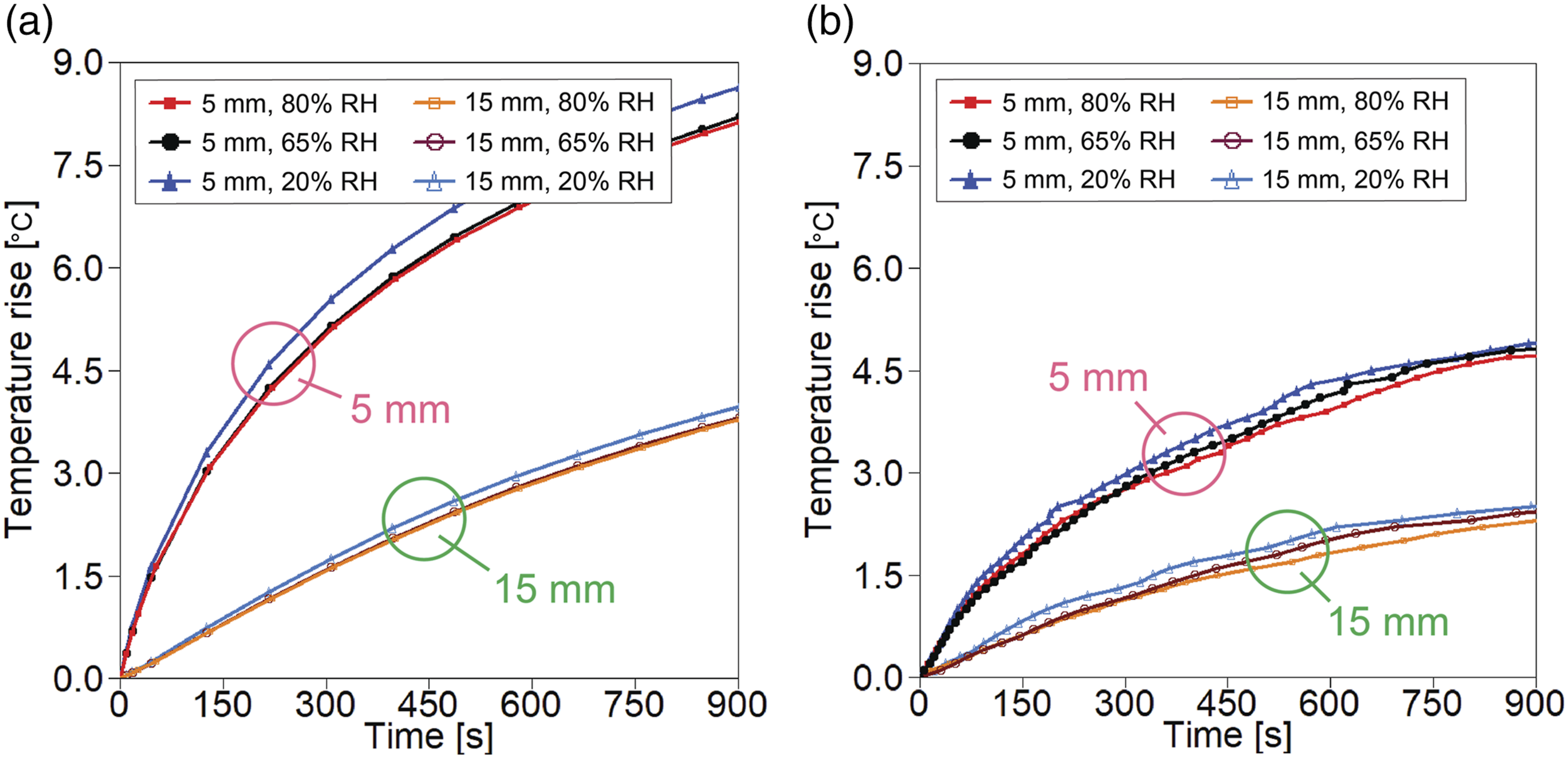

The measured temperature rises are given in Figure 12(b) and Table 7. After 900 s of heating at 65% RH, the tissue temperature was raised by 4.8°C and 2.4°C at the depths of 5 mm and 15 mm, respectively. By lowering the RH to 20%, minorly higher temperatures (4.9°C and 2.5°C at the depths of 5 mm and 15 mm, respectively) were achieved, while slightly lower temperatures (4.7°C and 2.3°C at the depths of 5 mm and 15 mm, respectively) were resulted at 80% RH. The marginally improved heating efficacy at a lower RH would be elucidated by a smaller dielectric loss of the cotton fabric in a drier condition. Overall, the experimental evidence casts light on the potential of administering hyperthermia therapy with the proposed cotton-based applicator.
Although the heating performance of the cotton-based antenna applicator was found to meet the typical requirements for the temperature rise,1,47–49 the measured rises were considerably less than those calculated by simulation (Figure 12(a)). The major contributor to this discrepancy could be the limited fabrication accuracy of the antenna sample. In the simulation model, the antenna was regarded to perfectly conform to the hemispheric contour of the breast phantom. In prototyping, however, the antenna was constructed from flat patterns, and as such the perfect hemispheric surface was not attained even with the help of the measurement holder. Because it is evident that the radiation performance of textile antennas is highly sensitive to flexing,21,50,51 the irregular surfaces of the antenna sample could have lowered the radiation efficiency.
Conclusions
This paper described the design and characterization of a cotton-based wearable antenna for breast hyperthermia therapy under diverse RH conditions. From both simulations and measurements, the dielectric constant variation was found to only minorly influence the antenna impedance matching, and this was primarily due to the wide impedance bandwidth of the cotton-based antenna. On the other hand, the SAR was reduced slightly at an elevated RH.
In the broad range of RHs (20%–80%), the measured temperature rises were over 4.7°C and 2.3°C at the depths of 5 mm and 15 mm, respectively. Also, a slightly better efficacy in heating was observed at a lower RH because of the lower dielectric constant of the cotton fabric. Although the calculated temperature rises were more than those measured, the experimental findings provide solid evidence that decent heating is feasible by using the cotton-based hyperthermia applicator in the wide range of RH.
In comparison to the previously reported non-hygroscopic textile antenna, 24 the cotton fabric antenna was found to be comparable in heating performance. Yet, since cotton fabrics offer excellent tensile and tear strength, 26 sensorial comfort 27,28 and abrasion resistance, 29 our newer approach would be more advantageous for intimate apparel integration.
Limitations and future directions
Based on theoretical and experimental investigations, this research accentuates the benefits of a cotton-based hygroscopic microwave applicator in hyperthermia treatment. There are, however, a couple of limitations to this study.
First of all, the cotton-based antenna prototyped in this research was produced from flat patterns, and as such the antenna was not able to intrinsically conform to the curved contour of the breast phantom. Consequently, the measured temperature rises were considerably lower than those obtained by simulation. In future work, the use of advanced fabrication techniques such as 3D printing 52,53 and 3D knitting 15,54–56 could be investigated to overcome the divergence from the simulated results. In addition, a study on cotton-based antennas in various fabric constructions would be pivotal for further optimization of antenna performance.
Secondly, the results obtained in this work may not immediately apply to the case of human tissues. The artificial breast model was homogeneous and did not fully represent the actual biophysical behaviors of human breasts. In real tissues, there are myriads of complex components such as skin, fats, both benign and malignant tumors, and blood vessels with various dielectric, electrical and thermal properties, all of which could critically affect the energy deposition and temperature elevation profiles in a more intricate way. Therefore, it is recommended to incorporate a more strictly represented phantom to further evaluate the performance and suitability of the cotton-based wearable microwave applicator.
Lastly, the power supply in this work was set constant at 1 W. In the actual treatment, however, a power adjustment must be implemented to best control the thermal effect for both safety and efficacy reasons. Therefore, power adjustment is another key research topic to be examined.
Footnotes
Acknowledgements
The authors are thankful to Prof. Janie F. Woodbridge for her assistance with weaving, Prof. Harvey A. West II for his assistance with fabric conditioning in the environmental chamber, and Prof. Jacob J. Adams and Mr. Bill Zhou for their assistance with antenna measurements.
Declaration of conflicting interests
The author(s) declared no potential conflicts of interest with respect to the research, authorship, and/or publication of this article.
Funding
The author(s) received no financial support for the research, authorship, and/or publication of this article.
