




Abstract
Different parts of the garment may be laminated with an interlining in order to obtain specific appearance and form. Mechanical properties of the laminated fabric is affected by the properties of interlining and differs from the face fabric. Moreover, the existence of seam for joining the laminated fabrics in various parts of the garment is another issue, which has to be considered during the evaluation of the mechanical behavior of garment. Garments’ time dependent mechanical behavior such as the tensile stress relaxation is of great importance while wearing them. In this study, the tensile properties and the stress relaxation of a group of woven fabric, which was laminated by a nylon interlining, were investigated at two strain levels, before and after stitching. In this regard, the effects of strain level, lamination process, seam type and the stitch length were evaluated. According to the results, it can be declared that increasing the strain level reduces the stress relaxation percentage. The laminated fabric presented higher values of tensile stress and strain, while lower stress relaxation was occurred in this structure compared to the un-laminated fabric. Analysis of results showed that higher stress relaxation was obtained for the “stitched laminated fabric” compared to the “laminated fabric without seam.” Overall, in the presence of seam, the stress relaxation is affected by the seam type and the stitch length. Finally, the best correlation between the experimental stress relaxation results and the viscoelastic models were obtained for the two-component Maxwell model. The result of this study should be considered in designing and manufacturing of protective textiles and clothing that include both lamination and stitching processes and during use may be encountered with constant strains for a period of time.
Introduction
While wearing garments and during the daily physical activities, various parts of the garment such as the fabric and seams are subjected to different levels of tensile strains. In some parts of the garments, interlinings are laminated to the fabric in order to improve the appearance and stability of the garment. Therefore, evaluation of the mechanical properties of the “laminated fabric” and the “stitched laminated fabric” is important. In some previous research works, the mechanical behavior of seams and also laminated fabrics have been investigated.
Shimazaki and Lloyd (1990) assessed the opening behavior of lockstitch seams subjected to the tensile cyclic loads and offered a predicting model for the explanation of the effects of sewing thread properties, the amount of applied load and the number of loading cycles. 1 Yildirim (2010) developed a mathematical model to calculate seam slippage in seat fabrics during constant loading and also seam fatigue test. They concluded that fabric density, yarn count of constituent yarns and stitch density are dominant reasons of seam slippage. 2 Sülar et al. (2015) investigated the influence of weave structure and density, linear density of warp and weft yarns, sewing thread type and count on the seam performance and appearance of cotton and polyester fabrics in terms of seam strength, seam efficiency, seam pucker and seam slippage. Obtained results revealed that the influence of sewing thread type on the seam efficiency of cotton fabric is not significant. In addition, polyester fabrics sewn with core-spun sewing thread presented worse seam puckering than mercerized cotton sewing thread. 3
Kim et al. (2011) examined the influence of fusing process and application of adhesive interlining on the flexural rigidity of the face fabric considering laminated theory. Their studies illustrated that considering mechanical characteristics of both fused face fabric and interlining is an effective way to predict bending behavior of laminated fabric with better accuracy. 4 Farzandi et al. (2013) analyzed the physical and mechanical properties of wind stoppers after fusing procedure. In this study, it was presented that the fusing process would improve the flexural rigidity, crease recovery, drape and rises air permeability and water vapor permeability of the fused wind stoppers. 5 Zhang and Kan (2018) reviewed the usage of fusible interlinings in clothing industry from various aspects of classification, manufacture, characteristic, function, fusing technology and application. 6 Sudhakar and Rengini (2020) in a review paper concentrated on the factors affecting the properties of fused fabric composites and provided a guidance for the choice of interlinings for a particular hand feel and performance. 7
When a garment is subjected to a definite extent of strain, as much as the strain remains constant, by the passage of time, the resultant stress considering the mentioned strain diminishes. This phenomenon is one of the important time-dependent mechanical property of the fabric, which is called the stress relaxation occurrence. Therefore, many previous research works have focused on the tensile and stress relaxation properties of fabrics as the constituent element of the garment.
Milasiene et al. (2003) evaluated the viscoelastic behavior of micro porous polyurethane film laminated leather and utilized the linear viscoelastic model such as generalized Maxwell model in order to predict their stress relaxation. Based on the results, it was declared that the viscoelastic nature of polyurethane film dominates on the long-term characteristics of the laminated leather layers. 8 Milašius et al. (2003) examined stress relaxation of breathable three-ply coated fabric in warp, weft and bias (45°) directions. Based on the outcomes, stress relaxation of coated samples in all studied directions is lower than the face layer. 9 In another research, Sajn et al. (2006) used various mechanical models such as the Maxwell’s model, Alfrey’s model and the three-component Maxwell’s model with nonlinear spring in order to predict the 1-h and the 24-h relaxation curves of fabrics with increased elasticity. The best explanation was achieved by means of models with higher components. 10 Urbelis et al. (2007) inspected stress relaxation behavior of woven and knitted fabrics that were joined to two warp knitted interlinings through fusing process under different strain levels. Their outcomes reveal that fusing procedure changed the fabric’s stress relaxation performance considerably. Stress relaxation trend of fused fabrics is similar to its constituent’s elements; however, its value depends on the physical and mechanical characteristics of fabric and interlining. 11 In a research by Urbelis and Petrauskas (2008) the stress relaxation of clothing fabrics subjected to the hygrothermal treatment and the fusing process was evaluated. In this work, it was declared that during the uniaxial extension, the stress values and the relaxation performance of fabrics and fused systems was influenced by the steaming cycle and the level of specimens’ deformability. 12 Gersak et al. (2011) investigated the stress relaxation performance of wound fabrics consisted of elastane yarns under constant strain, and they found that stress relaxation behavior of wound fabrics could be described considering Maxwell’s model and the modified standard linear solid model. 13 Hezavehi et al. (2013) examined the influence of extension rate on stress relaxation performance of cylindrical shell woven fabrics and studied the correlation of experimental outcomes with the viscoelastic models. The best agreement was obtained for the three-component Maxwell’s model. 14 Qureshi and Temesgen (2014) studied the stress relaxation phenomenon in nonwoven fabrics, they discovered that gsm of nonwoven structure, bonding method of fibers, and the constituent fibers have an influential effect on the stress relaxation performance. 15 Milašius and Laureckiene (2014) probed stress relaxation of woven fabrics consisted of multifilament polyester yarns during long time and they observed that rate of relaxation in terms of logarithm of time can be illustrated by two straight lines. 16 Hashemi et al. (2016) probed the stress relaxation behavior in two bar warp knitted fabrics considering strain value and fabric direction. Their outcomes reveal that not only fabric structure, but also strain level and fabric direction determine the stress relaxation performance of fabric. 17 Liu and Zhou (2019), focused on the inverse stress relaxation occurs during repeated wear in compression garments used in sportswear in order to offer a guidance for elevating the sportswear performance with regards to fabric engineering and stitch design. 18 Younesi and Ezazshahabi (2020) inspected tensile and stress relaxation of woven fabrics with various weave patterns in different directions. Their observations state that stress relaxation behavior of fabrics depends on the fabric direction, weave structure and also exerted strain level and its variation in terms of fabric direction follows a Gaussian function. 19 Mirjalili Bandari et al. (2020) assessed the impact of strain level on the tensile stress relaxation of rib weft knitted fabrics. In this research it was concluded that application of greater tensile strain would result in a growth in the stress relaxation of the fabrics. 20 Mirakhorli and Asayesh (2021) evaluated the tensile stress relaxation of rib weft-knitted fabrics consisting of different knitting patterns, in various directions. According to the results it was shown that the fabric structure considerably influenced the stress relaxation of them in both coarse and wale directions. 21 Asayesh and Yousefi (2020) investigated the tensile stress relaxation phenomenon in net warp knitted fabric with various structures. According to the outcomes of this study, pin hole-net and quasi-marqussite structures in comparison with tricot, sandfly and quasi-sand fly presented the highest and lowest stress relaxation, respectively. 22 Ruznan et al. (2020) assessed stress relaxation of two commercial bandage fabrics that were exposure to 20% extension during 24 h and over 5 days. Their results recommended that rewrapping the bandage after 12 h could be beneficial to keep the exerted pressure on the body in a reasonable range due to the stress relaxation of fabric. 23 Stolyarov and Mostovykh (2020) developed a viscoelastic model consist of elastic, viscous, friction element and also element with complex properties to estimate behavior of polyester woven fabric from various aspects. Their outcomes reveal that recommended model can predict time dependent performance of fabric with reasonable precise. 24
Reviewing former research works presented that although many researchers probed the stress relaxation of fabric with various structures, the influence of the application of interlining and lamination (that is applied to improve the fabric appearance and performance) were considered in very limited studies. In the previous studies, stress relaxation behaviour of textile materials with various forms including fibers, yarn and fabric with different structure such as knitted and woven have been considered. Since in the garments, protective textiles and clothing, and other industrial textiles, assemblies of these structures such as stitched fabric and laminated fabrics are utilized, and due to the constantly confronting of these assemblies with the various strain levels during application, detailed assessment of the stress relaxation of these assemblies is necessary. In addition, usually lamination of fabric in a garment is followed by stitching procedure that can affect the time dependent behavior of the laminated fabric, which was not considered in previous researches. In this regard, the aim of this study is to examine the tensile and stress relaxation of fabrics before and after lamination with an interlining. Then, the impact of stitching on the variation of stress relaxation of laminated fabric is considered. To this end, two common seam types that are utilized in joining fabrics including superimposed seam and lapped seam are considered for sample preparation. Since lockstitch is the most stitch type for assembling fabrics to each other in a garment, it is applied for stitching. Moreover, the effect of stitch length and seam type are examined on the stress relaxation of laminated fabric after stitching.
Experimental
Materials
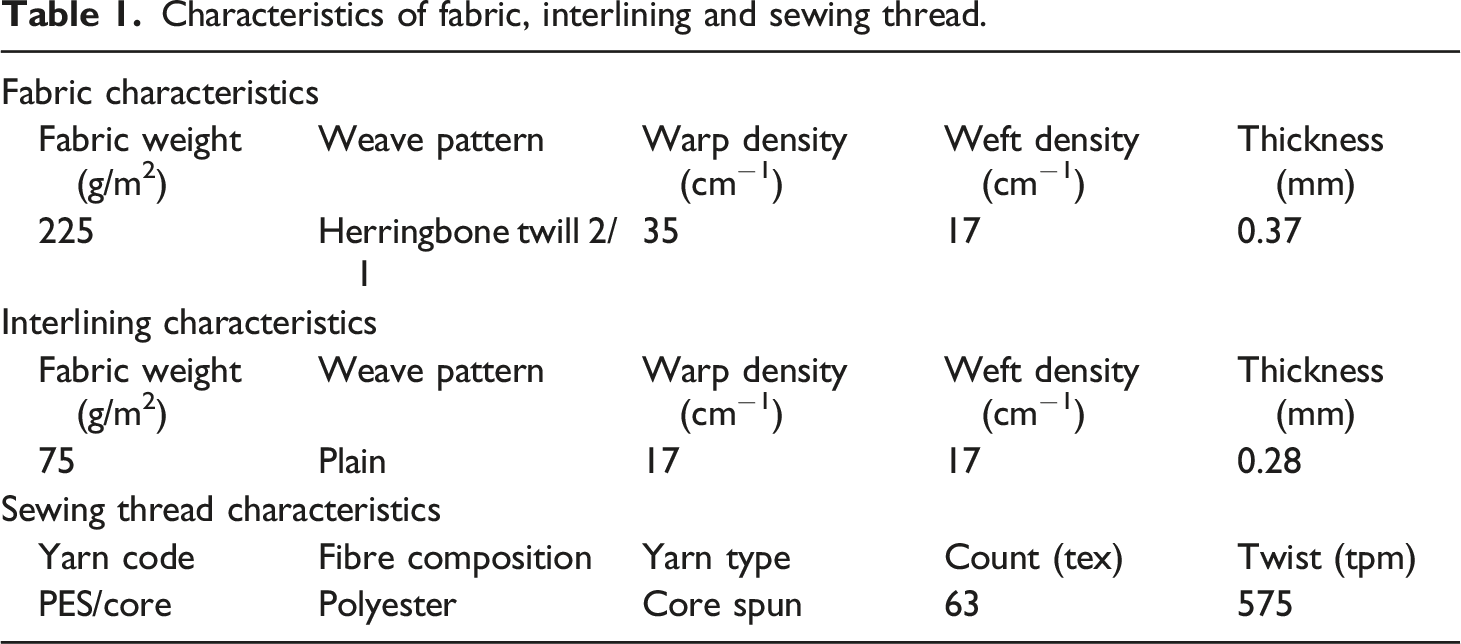
Characteristics of fabric, interlining and sewing thread.
Sample preparation
In order to probe the tensile and stress relaxation of laminated fabric, Gygli (PR8M) continuous fusing machine was utilized for joining the face fabric and interlining through fusing process. Both face fabric and interlining were cut in the warp direction with the dimension of
As sewing process, due to the lack of integration of fused fabric can change the tensile and stress relaxation behavior of laminated fabrics, it is necessary to investigate the tensile properties and stress relaxation of laminated fabrics both with seam and without seam.
To this end, two strips of laminated fabrics with the dimension of Configuration of the lapped and superimposed seam (a) superimposed seam; (b) lapped seam.
It should be noted that laminated fabric strips were sewn along the shorter edge (weft direction); consequently, the force is applied perpendicular to the seam line.
Testing procedure
Tensile characteristics
In order to examine the tensile behavior of the face fabric, interlining, and the laminated fabrics in both conditions of with seam and without seam, the BS EN ISO 13934-1:1999 standard test method was utilized and the tests were performed by the Instron 5566 tensile testing machine. According to the mentioned test method, the gauge length was set to 20 cm and test procedure was performed with the rate of 100 mm/min. Moreover, a pre-tension of 10 g was applied to all samples. For each specimen, five samples were tested and the tests were continued until complete failure of samples. The average values of various tensile parameters were reported.
Stress relaxation behavior
During the physical activities of the wearer and various body positioning, the entire garment including the fabric, laminated sections and the seam lines tolerate different levels of tensile loads for a period of time. Subsequently, besides the tensile performance of mentioned parts, their mechanical manner during the passage of time, such as stress relaxation should be considered. The stress relaxation behavior of the face fabric and the laminated components “while having seam” and “without seam,” were evaluated at two-strain levels (below the breaking strain) which were defined based on the results of their tensile behavior. The two mentioned strain levels were consisted of strain “before the yield point” and “between the yield and rupture point,” in order to investigate the stress relaxation performance of the mentioned components, in both linear and non-linear deformation zones, respectively. It should be considered that the stress relaxation tests for the laminated samples before and after stitching were carried out using Instron 5566 tensile testing machine.
The stress relaxation percentage of samples was calculated by equation (1):
For assessing the stress relaxation performance of the mentioned structures (fabric, interlining and laminated fabric in both conditions of with seam and without seam), five samples with the dimensions of 20 cm × 5 cm were tested. The stress relaxation tests were performed at two strain levels including the maximum elastic strain (before yield point) and 65% of the breaking strain. The initial length of the sample was 7.5 cm and the extension rate was 20 mm/min. The variation of the fabric’s stress was observed and analyzed for a period of 900 s. The setup of tensile testing machine for both stress relaxation and tensile strength of samples are presented in Figure 2. As it is mentioned in the Figure 2, the gauge length of stress relaxation and tensile behavior tests are different. Device setup for tensile behavior and stress relaxation tests.
Strain levels for stress relaxation experiment of all tested structures.

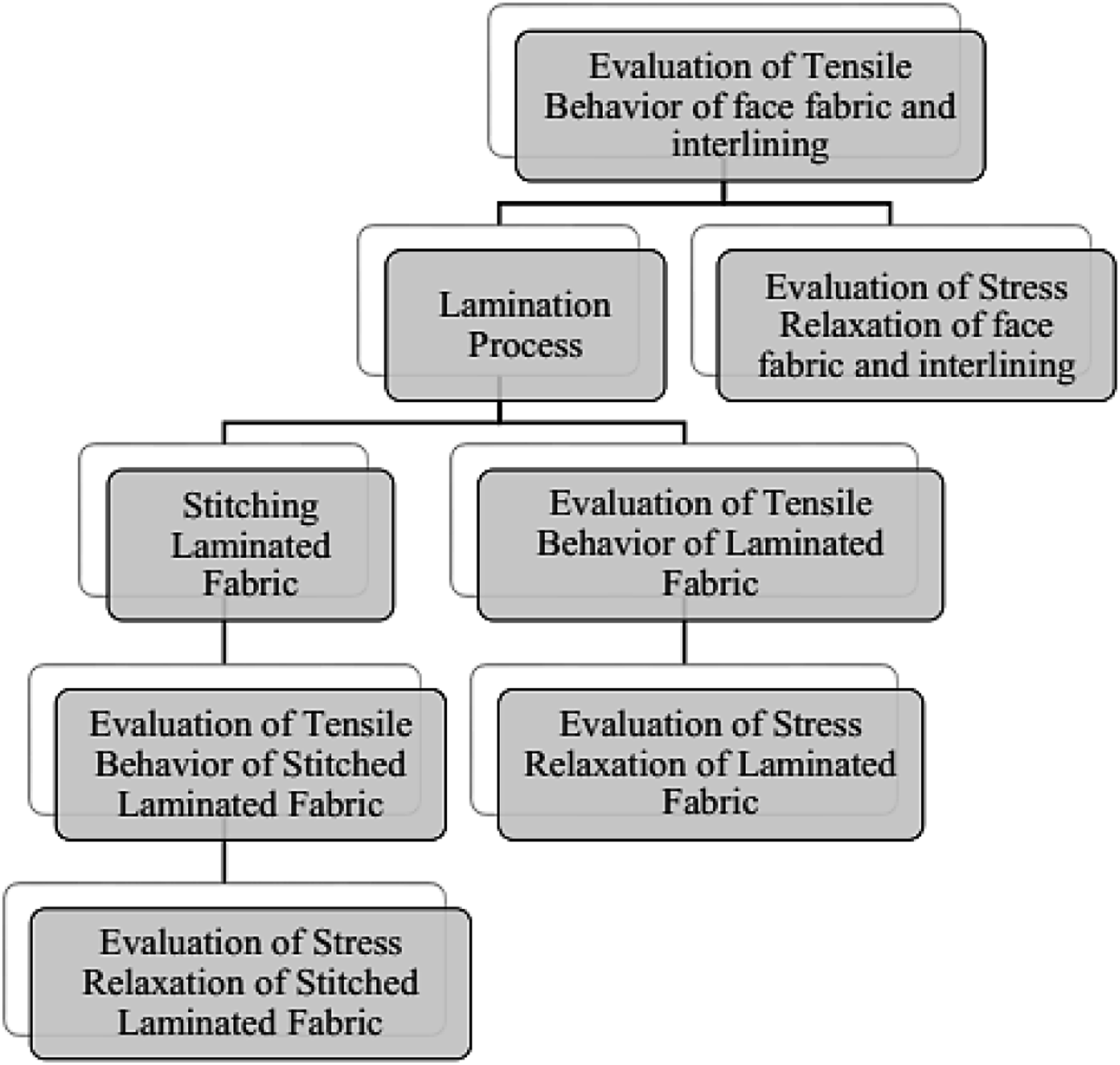
Testing process for various materials and assemblies.
Results and discussion
Tensile behavior
Prior to the evaluation of the tensile stress relaxation behavior of the stitched laminated fabric, it was necessary to investigate the tensile characteristics of the constituent elements of it including the face fabric and interlining, separately. Besides, the tensile performance of laminated fabric were measured before and after sewing. Basically, the mentioned experiments were carried out in order to define the strain levels in both elastic and non-linear deformation zones, which are required to be applied in the stress relaxation tests (Table 2).
Tensile properties of the face fabric, interlining and laminated fabric.

According to the results shown in Table 3, it was observed that the tensile breaking stress and the initial modulus of the face fabric was higher than the interlining, while the breaking strain of the interlining is much higher than the face fabric. The mentioned results can be interpreted based on the characteristics of them, which were reported in Table 1. The lower areal weight, warp and weft density and thickness of the interlining fabric is the reason for the obtained result. Moreover, the outcomes of the tensile tests showed that the strength and the initial modulus of the laminated fabric is slightly higher than the face fabric. The most considerable effect of lamination was on the breaking strain. The process of laminating a woven fabric with a layer of interlining would increase the firmness of the laminated structure, thus its resistance to deformation would rise and consequently higher value of modulus and lower amount of breaking strain were obtained.
Tensile properties of laminated seamed fabric.
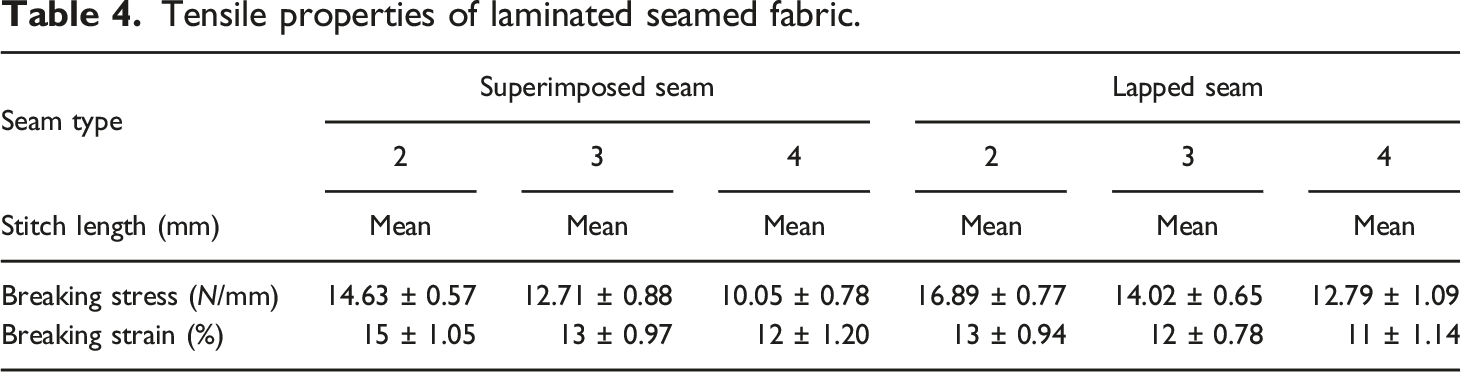
Considering the data gathered in Table 4, it can be declared that the breaking stress and breaking strain of the stitched laminated fabric were influenced by the seam type and also the stitch length. The breaking stress of the lapped seam was higher than the superimposed seam, since in lapped seam structure, both fabric’s edges are positioned in reverse directions. Therefore, the interlock points of the threads sewn with both fabric layers withstand the applied tensile force. In case of utilizing superimposed seam, fabrics edges are placed on the same directions, so during the extension of the superimposed seam, the exerted load is tolerated by the sewing thread in the seam line and fabric layers have no significant role in the confrontation against the tensile load, so the seam strength is reduced in this structure. Based on the mentioned elaboration on the effect of seam type on the tensile properties, it was also observed that the tensile breaking strain in the lapped seam structure is slightly lower than the superimposed seam, due to its higher resistance against deformation.
Moreover, the results gathered in Table 4, revealed that an increase in the stitch length, which in fact decreases the stitch density, would lead to a slight diminish in the value of tensile breaking stress and strain. The achieved outcome is related to the lower entanglement between the sewing thread and the laminated fabric.
Statistical analysis of results showed that the effect of seam type and the stitch length on the seam strength is significant at the confidence level of 95%.
Stress relaxation behavior
As it is known, stress relaxation can be defined as the reduction of induced stress in fabric or other textile structure, which is exposed to a specified level of strain, during the passage of time. As it was mentioned previously, in this study, stress relaxation behavior of face fabric, interlining, laminated fabric before and after sewing are investigated in both elastic and non-elastic deformation zones.
Face fabric and interlining
Stress relaxation of both face fabric and interlining were evaluated under two strain levels including before yield point and 65% of breaking strain during 900 s to examine stress relaxation of fabric and interlining in the elastic and non-elastic region. The variation of stress in terms of time for both face fabric and interlining are illustrated in Figure 4. According to this figure, a quick stress drop is clear at the first 30 s of the test. Then, stress reduction is followed with a low rate (nearly between the 30–250 s) and finally it leads to an approximately constant stress value. Stress relaxation behavior of face fabric and interlining at two strain levels (a) face fabric; (b) interlining.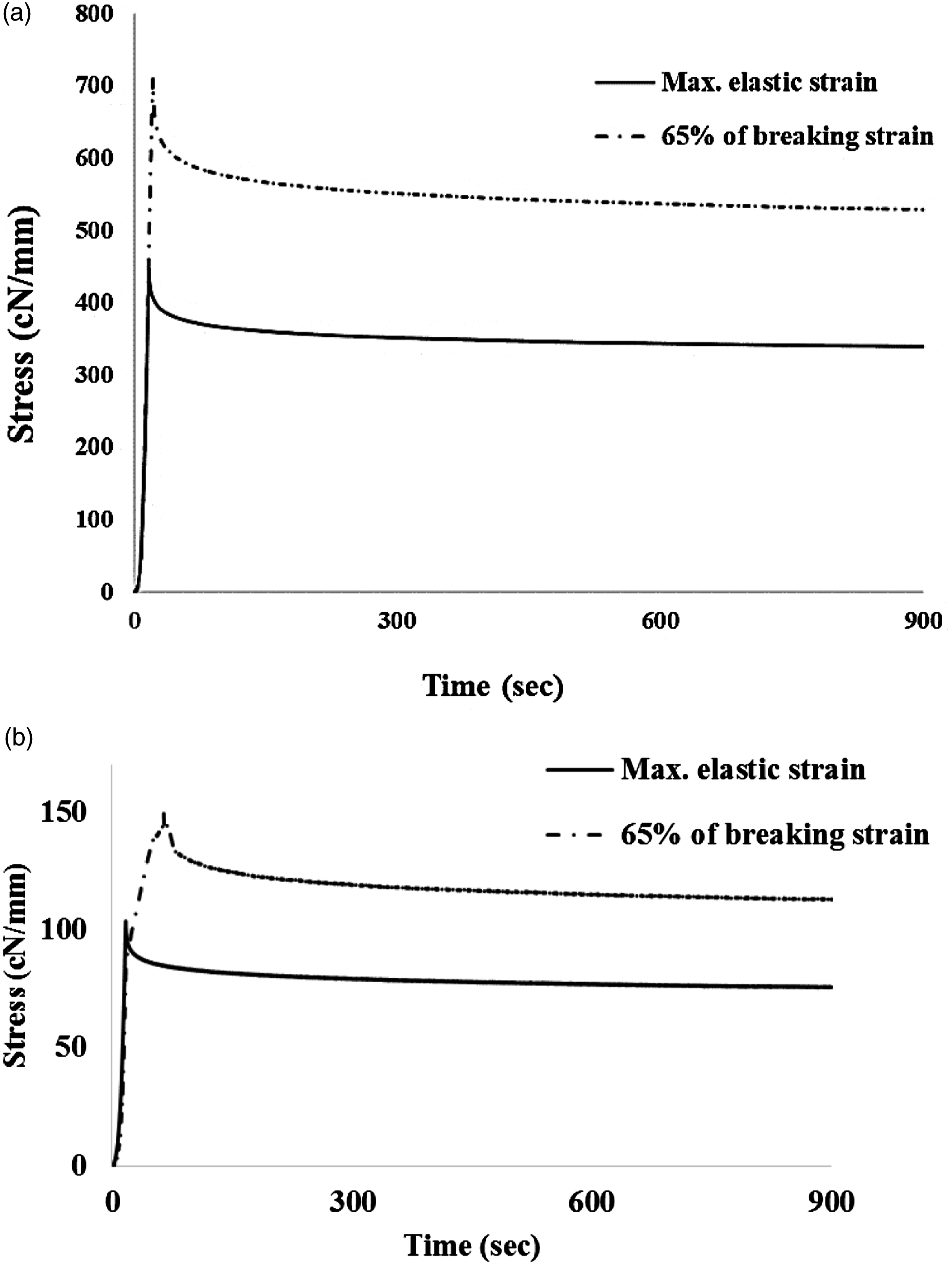
Based on Figure 4, it is observed that the rise of the strain level in both samples leads to the increase of stress value due to the higher strain and deformation made in the samples. The stress relaxation in face fabric and interlining in both strain levels were computed according to the equation (1). Obtained outcomes revealed that the stress relaxation of the face fabric and interlining at the maximum elastic strain were 24.7% and 26.4%, respectively. However, the value of stress relaxation of the former and the latter at 65% of breaking strain were correspondingly 25.46% and 26.54%. It seems that interlining has more tendency to get free of stress in comparison with the face fabric due to its lower warp density and higher extensibility. Therefore, the effect of strain level on the stress relaxation of interlining is not meaningful. On the other hand, increase of strain level results in more stress relaxation in the face fabric owing to the higher deformation developed in the fabric.
According to the statistical analysis of results, the difference of stress relaxation of face fabric and interlining at the confidence level of 95% is significant.
Laminated fabric
In order to investigate the impact of lamination on the stress relaxation of fabric, the face fabric was laminated by a woven interlining in fusing process. Stress relaxation behavior of laminated fabric was evaluated at two strain levels namely the maximum elastic strain and 65% of breaking strain. In Figure 5 the stress variation of laminated fabric at two strain levels are illustrated in terms of time. Stress relaxation behavior of laminated fabric at two strain levels.
According to the Figure 5, it can be noted that the same trend is achieved for the laminated fabric. In other words, the increasing of exerted strain on the specimen would lead to the higher stress in the sample. However, decrease of stress occurs during time with various rate, at first seconds it reduces rapidly and after that, it follows a moderate rate until remains almost constant.
Calculation of stress relaxation after lamination at two applied strains demonstrate that stress relaxation before and after yield point were 23.16% and 23.53%, respectively. It can be perceived that stress relaxation of face fabric and interlining decreases after lamination. However, the influence of strain level on the stress relaxation of laminated fabric is negligible. In fact, during fusing process that is utilized to join the interlining to the face fabric, due to the heating of the thermoplastic resin, the resin is converted to viscose material and performs as an adhesive. Because of application of pressure on the fabric and interlining during fusing process, the viscose resin penetrates into the fabric and in the ideal situation it is equally distributed between the fabric and interlining in the joining line. After the fusing procedure, the whole assembly cools down and thermoplastic resin again turns out to be rigid material. It should be considered that due to the penetration of resin into the fabric structure, the laminated fabric usually has more bending rigidity than face fabric. Consequently, the ability of laminated fabric to release the applied strain diminishes and it presents lower stress relaxation.
Stitched laminated fabric
On the aim of examination, the influence of sewing process and its related parameters such as stitch length and seam type on the stress relaxation of laminated fabric, stress relaxation of stitched laminated fabric after application of elastic strain was probed. In Figure 6 the stress variation of seamed samples during time is presented. Stress relaxation seamed laminated fabric at elastic strain (a) superimposed seam; (b) lapped seam.
Stress relaxation of laminated fabric after sewing.

In order to analyze the influence of stitch length and seam type on the stress relaxation, in Figure 7 stress relaxation of laminated fabric after sewing with various parameters are compared. The effect of stitch length and seam type on the stress relaxation.
As it is clear in Figure 7, the highest and lowest stress relaxation belong to the sample sewn with stitch length of 2 mm and 4 mm, respectively. As it was mentioned previously, in the samples prepared with stitch length of 2 mm, higher elastic stress is developed in the sample that results in an instability. Consequently, the sample has more tendency to recover to the free-state condition. Besides, sample with superimposed seam have more propensity to release the stress comparing with lapped seam. This result is due to difference of seam structure. In lapped seam, free edges of fabric layers are placed in opposite direction, however; in the superimposed seam free edges are located in the same direction. During stress relaxation test, when strain is exerted perpendicular to the seam line, in superimposed seam the stress is exerted on the sewing thread in the seam line. On the other hand, in the lapped seam the stress is applied on the seam line, which include two fabric layers jointed to each other by sewing thread. In fact, fabric layers interlocked by sewing thread tolerate the applied strain. Hence, in superimposed seam, the seam line has more movability to return to the free of stress condition.
Statistical analysis of results reveal that the influence of stitch length and seam type on the stress relaxation of laminated fabric is significant at the confidence level of 95%.
The effect of sewing and lamination on the stress relaxation
To explore the impact of various processes that are performed during clothing manufacturing on the stress relaxation of fabric, in Figure 8 stress relaxation of face fabric before and after lamination and sewing are compared. It can be observed that before fusing process, the stress relaxation of interlining is higher than face fabric. This result is related to the lower warp density and higher extensibility of the tested interlining. However, it should be considered that stress relaxation of various interlinings can be different and it depends on the structural characteristics of interlining. The influence of various process and the stress relaxation of fabric.
After the fusing process, stress relaxation of laminated fabric reduced considerably compared to the face fabric and interlining due to the penetration of heated viscose resin into the fabric under the pressure that lead to the joining face fabric and interlining. Then in the cooling stage, the resin again turns to the dry and rigid state that reduce flexibility and movability of yarn in the fabric, consequently; least stress relaxation is obtained in laminated fabric. However, assembling two strips of laminated fabrics by sewing enhances stress relaxation. In other words, when tensile strain is exerted on a seamed laminated fabric, developed tensile stress is applied on the weakest point of the assembly, which is the seam line due to the lack of integration. Hence, each interlocking point of fabric and sewing thread tolerate the stress and has higher movability to release the stress. As it was explained previously, by increasing the stitch length, because of the lower induced stress in the seam line results in less stress relaxation. In addition, superimposed seam type presents higher stress relaxation due to the placement of fabrics and sewing thread in the superimposed seam that increase ability of the sewing thread to move and recover to the free of stress state rather than lapped seam.
Stress relaxation correlation with viscoelastic models
Textile materials during deformation exhibit both viscous and elastic characteristics, therefore; they are named viscoelastic materials. In other words, their behavior during loading includes both immediate and time dependent responses as a result of elastic and viscous property. In order to investigate time-dependent behavior of viscoelastic materials, viscoelastic models that combined of spring and dashpot are used. Spring and dashpot are used to present elastic and viscous property of material. Various viscoelastic models with different combinations of spring and dashpot are developed to explain viscoelastic characteristics of material. “Maxwell’s model” is the simplest model; however, application of more elements leads to models that present better adaptation with experimental and real condition.
Sajn et al. (2006)
10
presented various mechanical models for the estimation of the viscoelastic performance of textile materials. In this study three-viscoelastic models including the “Maxwell’s model,” “two-component Maxwell’s model” and the “modified model of standard linear solid” was utilized in order to analyze the correlation between the experimental stress relaxation results obtained for the stitched laminated fabric and also the laminated fabric without seam. The mentioned models are observable in Figure 9. Viscoelastic models for analysis of stress relaxation (a) Maxwell’s model; (b) two-component Maxwell’s model; (c) modified model of standard linear solid.
The related equations to each of the models shown in Figure 9 are as below:


In the mentioned models (equation (2), (3) and (4)), μ is the coefficient of viscosity and E is the elastic modulus. The stress and time are noted as σ and t, respectively. In addition, τ is the relation between the coefficient of viscosity (μ) and the elastic modulus E, in the form of
The correction between the mentioned viscoelastic models and the stress relaxation behavior of the “face fabric,” “laminated fabric without seam” and the “stitched laminated fabric” is shown in Figure 10. Correlation between the experimental stress relaxation results and viscoelastic models (a) face fabric; (b) laminated fabric; (c) stitched laminated fabric.
As it is shown in Figure 10, by the comparison of the R-squared values obtained for the viscoelastic models which were analyzed in this study for the evaluation of the stress relaxation process of “face fabric,” “laminated fabric” and the “stitched laminated fabric,” it is clear that the best correlation was attained for the “two-component Maxwell’s model.” The values of the R-squared value for the “face fabric,” “laminated fabric,” and “stitched laminated fabric” were 0.9746, 0.9698 and 0.9689, respectively. Among the investigated models the “Maxwell’s model” showed the worst correlation because of its fewer elements and its simple structure, which reduced the model’s capability to correlate the experimental results.
In view of the previous works such as references 17 and19–21 it was observed that the two-component Maxwell model and the modified model of standard linear solid was used with an acceptable correlation for validation of the experimental results. In this research, it is more desired to utilize models with lower components but satisfactory compatibility. Therefore, the two-component Maxwell model was selected for the confirmation of the stress relaxation experimental results.
Conclusion
Since during body movement, various parts of the garment including fabric, laminated fabric and seamed fabrics are exposed to tensile strain, investigation of tensile behavior and stress relaxation of mentioned elements are necessary. In this regard, a worsted fabric and a woven interlining were utilized to make laminated samples. Furthermore, laminated strips were assembled by superimposed seam and lapped seam type and a commercial sewing thread with three different stitch lengths. Tensile strength and stress relaxation of various elements were measured. The obtained outcomes reveal that: • The breaking strain of laminated structure is lower than face fabric. • The seam type and stitch density affect the breaking stress of stitched laminated fabric. • The breaking stress of lapped seam is higher than superimposed seam. This result is related to the seam structure and the orientation of layers in the seam zone. • In both seam types, increase of stitch length leads to the lower breaking stress and strain due to the lower entanglement between the sewing thread and laminated fabric. • The interlining is more prone to release the induced stress due to its lower warp density and higher extensibility. • Stress relaxation of fabric and interlining decrease after lamination. • Samples stitched with smaller stitch length present higher stress relaxation. • In the similar condition, superimposed seam have higher stress relaxation than lapped seam. • The lamination process would decrease the stress relaxation of fabric. On the other hand, stitching of the laminated fabrics would lead to the increase of the stress relaxation percentage. • The experimental results of the stress relaxation behavior of the fabric, laminated fabric and the stitched laminated fabric with various stitch length were correlated by the two-component Maxwell’s model in an acceptable manner.
The result of this study should be considered in designing and manufacturing of protective textiles and clothing that include both lamination and stitching processes and during use may be encountered with constant strains for a period of time.
Footnotes
Declaration of conflicting interests
The author(s) declared no potential conflicts of interest with respect to the research, authorship, and/or publication of this article.
Funding
The author(s) received no financial support for the research, authorship, and/or publication of this article.
