




Abstract
The most common hernia treatment method is using a surgical mesh. The functional properties of surgical meshes, including structural and mechanical properties affect mesh performance. Anisotropy of the tensile behavior of the surgical mesh influences the hernia treatment process. In this research, a novel index named ‘isotropy index’ is introduced based on the analysis of the polar graph of the tensile properties of surgical meshes. The isotropy index, which is expressed in percent, was defined as the ratio of the polar diagram area of the tensile elastic modulus to the area of the circle surrounding the polar graph and calculated using the meshes' tensile elastic modulus in five directions(0°(course), 30°, 45°, 60°, and 90°(wale)) using the image processing method. For this purpose, common net warp-knitted fabrics in surgical mesh production were produced with five various knit patterns(quasi-Sandfly, Tricot, Pin-hole-net, Sandfly, and quasi-Marqussite) using polypropylene monofilament yarns, and their tensile properties were analyzed in various directions(0°(course), 30°, 45°, 60°, and 90°(wale)). Results revealed that the quasi-Sandfly mesh is the most isotropic(57.74%), and the quasi-Marqussite mesh is the most anisotropic(17.12%) among evaluated surgical meshes. Tricot mesh(54.98%), Sandfly mesh(49.17%), and Pin-hole-net mesh(46.41%) in terms of the tensile behavior isotropy are between quasi-Sandfly mesh and quasi-Marqussite mesh. The Sandfly mesh has the closest isotropy index to the abdominal wall tissue. Considering the importance of the lightness, adequate porosity, larger pore size, and closeness of the mesh’ isotropy index to abdominal wall tissue for enhancing mesh functional properties, the Sandfly mesh was selected as the best-knit pattern for surgical mesh.
Introduction
The most standard method of hernia healing is using a surgical mesh. A surgical mesh is a porous fabric mostly knitted from polymeric yarns using the warp-knitting method. 1 Several studies have revealed that hernia treatment with mesh leads to a lower recurrence rate. 2 The advantages and disadvantages of different mesh materials have been evaluated to create modern polymeric meshes in a historical duration. 3 As a perfect prosthesis, the mesh should have crucial functional properties: safety, sterilization ability, biocompatibility, enough strength, suitable pore size, adequate porosity, structural stability, and good formability. 4 As an ideal prosthesis, the mesh should have essential functional properties: safety, sterilization ability, biocompatibility, enough strength, suitable pore size, adequate porosity, structural stability, and adequate formability. 4 Among the surgical mesh’s structural properties, the type of surgical mesh, pore size, porosity, and weight are significant enough to affect mesh performance. 5 Implant biocompatibility has a substantial role in the repair process. The implant’s mechanical properties are a determining factor in the success of the treatment that can have a determining role in its biocompatibility. 6 Mechanical compatibility between mesh and body tissue is vital for creating an appropriate therapeutic response. 7 Mesh’s mechanical properties influence cellular functions like cell migration, growth, and differentiation, which have a significant role in mesh biocompatibility. Thus assessing meshes' mechanical properties is vital for achieving the best mesh function. 8 The surgical mesh’s fundamental mechanical properties are tensile strength, bursting strength, tearing resistance, and suture retention strength. 9 There must be mechanical compatibility between the mesh and the body tissue to overcome side effects and complications. 10 The mesh response to physiologic intra-abdominal forces is affected by mesh anisotropy. 11 A surgical mesh’s mechanical response has to define because an anisotropic mesh’s random orientation can lead to inconsistent surgical outcomes. 2
Saberski et al. investigated the anisotropy of synthetic surgical meshes. Results showed that most investigated meshes have anisotropic tensile behavior. Anisotropic mesh orientation may negatively affect hernia treatment, so manufacturers’ proper labeling of all implants should be mandatory. 11 Mirjavan et al. evaluated the isotropy index of the tensile behavior of five common porous fabrics used as surgical mesh and sheep fascia. Results demonstrated that evaluated porous fabrics have more isotropic tensile behavior than commercial meshes. Each evaluated fabric except Pin-hole-net is more isotropic than the abdominal wall fascia of sheep. 12 Deeken et al. studied tensile anisotropy of commercial meshes. Some of them have an isotropic tensile behavior. Others have an anisotropic tensile behavior in the longitudinal and transverse direction. 13
Research on the mechanical isotropy of surgical meshes is limited. Most of them have evaluated the isotropy of the meshes only by studying their behavior in longitudinal and transverse(wale and course) directions. While considering the mechanical properties of the meshes in various directions is essential in studying the isotropic behavior. Therefore, this research proposes a novel method for evaluating the tensile behavior isotropy of surgical meshes based on analyzing mesh tensile properties in five directions utilizing the image processing method.
Materials and methods
Mesh production and preparation
In this research, porous fabrics with five various common knit patterns were knitted on two guide bars Raschel warp-knitting machine(model: Karl Mayer, Id: 51547, Gauge(NPI) 12) using polypropylene monofilament that has fineness equal to 238.6 denier(Diameter: 0.194 mm). The half threading(one full, one empty) was used for knitting all fabrics. Evaluated fabrics include the quasi-Sandfly, Tricot, Pin-hole-net, Sandfly, and quasi-Marqussite. The guide bar lapping movements of produced meshes are presented in Figure 1. All the meshes were treated by heat set using hot air at 120°C for 1 minute by a laboratory stenter machine(Ernst Benz). Heat setting is an essential finishing process for dimensional stabilization and curling prevention of meshes. The guide bar lapping movements of produced meshes, (a) quasi-Sandfly, (b) Tricot, (c) Pin-hole-net, (d) Sandfly, and (e) quasi-Marqussite.
Physical properties measurement
Stitch density
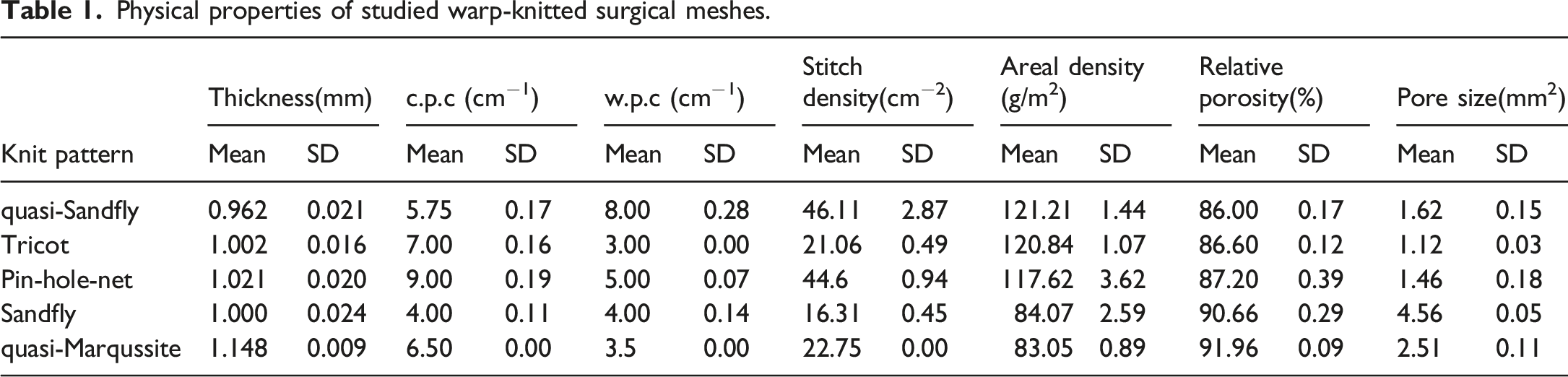
Physical properties of studied warp-knitted surgical meshes.
Areal density
The areal density of each mesh structure was measured by weighting five samples(12 × 12 cm2). The average results are presented in Table 1.
Thickness
For thickness measurement, the Shirley digital thickness tester was used. Each mesh’s thickness has been measured at 10 various random points under the pressure of 20 g/cm2. The average results are presented in Table 1.
Porosity and pore size measurement
Fabric porosity equals the total void space within the fabric’s volume. It operates as a valuable measurement of the potential of mesh for tissue ingrowth after transplantation. The fabric porosity is a criterion of porosity distribution all over fabric exhibited in percent. For 2D fabrics, porosity can be found by both the area method (image processing method) and weight (fabric density calculation method).1,14
The results of measuring angles of investigated mesh structural components.

Uniaxial tensile test
An Instron tensile tester(model 5666) with a load cell of 20 N was used to evaluate the uniaxial tensile properties of produced net warp-knitted meshes. To this end, from each mesh structure, five samples with the size 7 × 10 cm2 were prepared in various directions, including 0°(course), 30°, 45°, 60°, and 90°(wale). In other words, 25 tests were performed(5 samples * 5 directions) for each mesh structure. The grip displacement method was used in strain determination during tensile tests. The samples were tested using the effective length and width of 5 cm at a constant 20 mm/min speed. The length of the mesh sample, which is stretched between the tensile jaws, is 5 cm. This length was named effective length(Figure 2). Load and elongation values were recorded during the tensile test, and the stress-strain curves were plotted. Setting of the mesh sample in the Instron tensile tester.
Results
Results of tensile properties evaluation
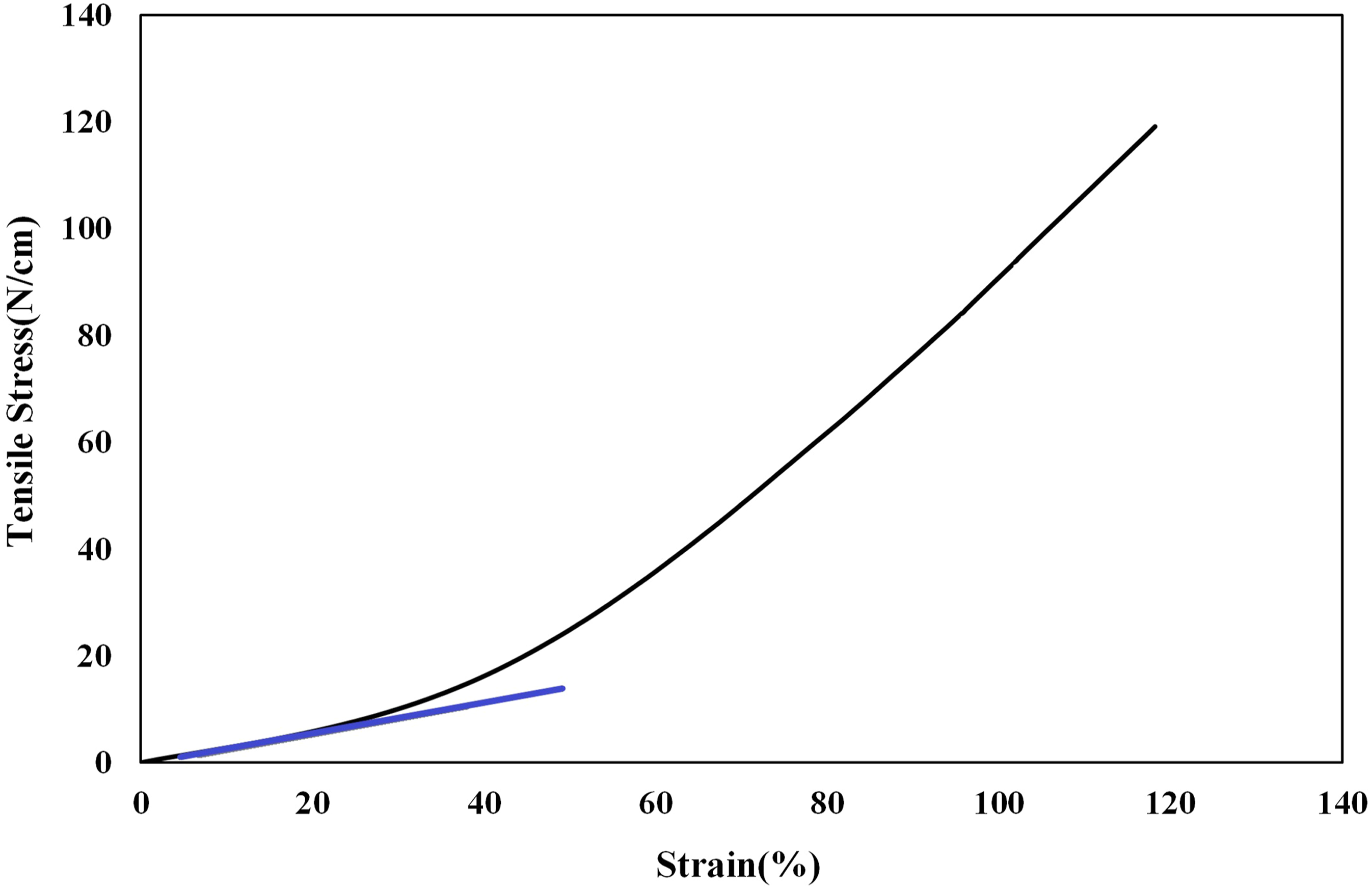
To characterize the tensile properties, the tensile elastic modulus of each mesh structure was obtained from the five tensile stress-strain curves of the mesh in each direction(0°, 30°, 45°, 60°, and 90°)(Figure 3). To obtain the elastic modulus of each mesh structure, the initial linear region of the stress-strain curve was identified, and a tangent line was drawn to this part of the curve (Figure 4). Then the slope of the tangent line, which represents the mesh’s elastic modulus, was calculated. It should be noted that tensile stress was calculated by dividing the tensile load by the fabric’s width
1
. After obtaining the mean tensile elastic modulus of the meshes in various directions, polar charts of the tensile elastic modulus of the meshes were plotted for each mesh structure. These polar charts are displayed in Figure 5. Based on the meshes' symmetrical structure, it is considered that the mesh in the corresponding directions in the ranges of 90°–180°, 180°–270°, and 270°–360° also behaves similarly in the range of 0°–90°. So instead of drawing polar diagrams in a quarter circle from 0 to 90, graphs are illustrated in 360°. The average tensile stress-strain curves of different mesh structures in various directions (a) quasi-Sandfly, (b) Tricot, (c) Pin-hole-net, (d) Sandfly, (e) quasi-Marqussite. Typical stress-strain curve of the quasi-Sandfly mesh structure. The Polar charts of the tensile elastic modulus of different mesh structures (a)quasi-Sandfly, (b)Tricot, (c)Pin-hole-net, (d)Sandfly, (e)quasi-Marqussite.

Results of the isotropy index of the produced meshes calculated by a novel method
In this research, a novel index named “Isotropy index” was defined and obtained from the polar graph of each mesh structure. This index was defined as the ratio of the area of the polar diagram of the tensile elastic modulus to the area of the circle surrounding the polar graph (equation (1)). As this ratio gets closer to 100, the mesh is more isotropic in tensile behavior. On the other hand, when the shape of the diagram is closer to the circle, it means that the fabric’s tensile behavior is more isotropic.
The Processed images of the polar graph and circle surrounding the polar graph of evaluated surgical meshes and abdominal wall tissue.


The Polar charts of the tensile elastic modulus of abdominal wall tissue.

The bar chart of the isotropy index of abdominal wall and studied mesh tensile elastic modulus.
Discussion
Analysis of the tensile behavior of produced meshes in various directions
Quasi-Sandfly mesh
The polar diagram of the quasi-Sandfly mesh’s elastic modulus has been shown in Figure 5. (a). This diagram was plotted by the tensile elastic modulus of quasi-Sandfly mesh in various directions, including 0°(course), 30°, 45°, 60°, and 90°(wale). The diagram was plotted in a complete circle, assuming that the tensile behavior is similar at complementary angles. Figure 5. (a) demonstrates that the quasi-Sandfly mesh has the highest and lowest mean tensile elastic modulus in 60° and 0° directions, respectively, and the tensile elastic modulus of this mesh in 45°, 30°, and 90° directions is between them respectively. Obviously, by increasing the proximity of the mesh’s structural elements such as stitches, underlaps, and in-lay yarns to the direction of the tensile test, the fabric’s resistance to tensile deformation increases. According to Figure 8 and Table 2, it is clear that the alignment of the stitches in this mesh structure(α) is much closer to 60° than other directions, so the tensile elastic modulus is the highest in 60° direction. On the other hand, the stitches' direction has the maximum difference with the 0° direction, which leads to the lowest tensile elastic modulus in 0° direction for this mesh structure. The tensile elastic modulus of quasi-Sandfly mesh in 45°, 30°, and 90° directions decreases by decreasing the proximity of the direction of the stitches to the direction of the tensile test. The image of the quasi-Sandfly mesh’s measured structural angle(α).
Tricot mesh
The polar diagram of the Tricot mesh’s tensile elastic modulus has been demonstrated in Figure 5(b). This diagram was plotted in the same way as described previously. Figure 5(b) indicate that the Tricot mesh has the highest and least tensile elastic modulus in 60° and 0° directions respectively, and its tensile elastic modulus in 90°, 30°, and 45° directions are between them respectively. Although it is expected that the Tricot mesh has the highest tensile elastic modulus in 90° direction due to the verticality of the stitches direction, it is evident that its modulus in 60° direction is larger than 90° direction. According to Figure 9 and Table 2, because the direction of the stitches legs(ω = 62.58°) is very close to 60° direction, it has the highest tensile elastic modulus in 60° direction among all directions. In this structure, underlaps are more involved in bearing tension in the 60° than 90°, because the angle of underlaps(β = 30.53°) is closer to 60° than 90° direction. Therefore, the Tricot mesh has a larger tensile elastic modulus in 60° than 90° directions. After 60° direction, the Tricot mesh has the highest tensile elastic modulus in 90° direction, which is expected due to stitches' verticality. The tensile elastic modulus of the Tricot mesh in 30°, 45°, and 0° directions decreased by reducing the underlaps’ proximity to the tensile test. The image of the measured structural angles(β&ω) of the Tricot mesh.
Pin-hole-net mesh
The polar diagram of the tensile elastic modulus of Pin-hole-net mesh has been shown in Figure 5(c). This diagram was plotted in the same way as described previously. The Pin-hole-net mesh has the highest and lowest tensile elastic modulus in 30° and 90° directions respectively, and its tensile elastic modulus in 45°, 0°, and 60° directions are between them respectively. According to Figure 10 and Table 2, it is clear that the alignment of the stitches in this mesh structure is much closer to 30° than other directions, so the tensile elastic modulus in the 30° direction is the highest. On the other hand, the stitches' direction has the maximum difference with the 90° direction, which leads to the lowest tensile elastic modulus in 90° direction for this mesh structure. Figure 10 demonstrates that the tensile elastic modulus of Pin-hole-net mesh in 45°, 0°, and 60° directions decrease by decreasing the proximity of the direction of the stitches to the direction of tension. The image of the measured structural angle(γ) of the Pin-hole-net mesh.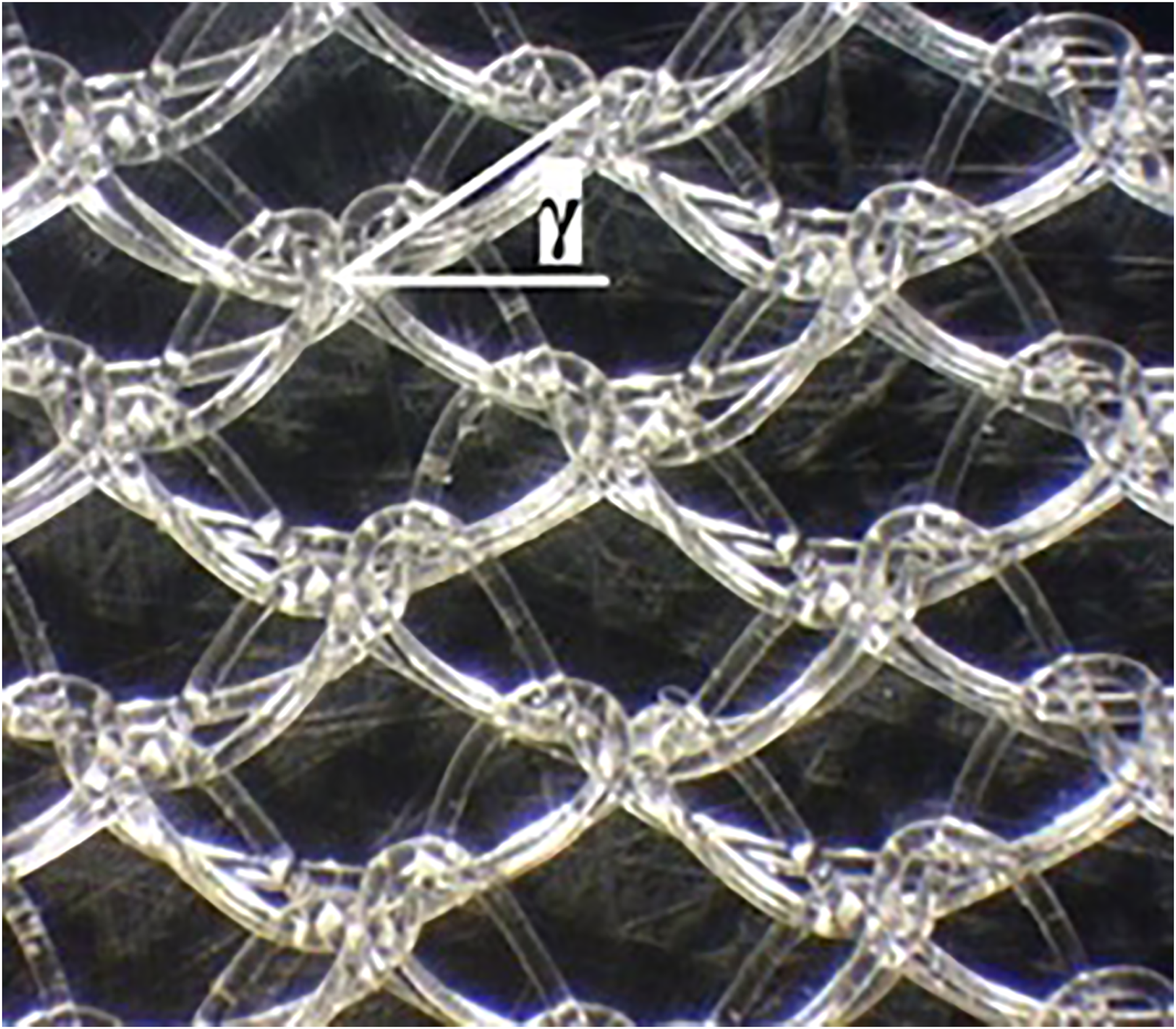
Sandfly mesh
The polar diagram of the Sandfly mesh’s tensile elastic modulus has been exhibited in Figure 5(d). This diagram was plotted in the same way as described previously. As can be seen, the Sandfly mesh has the highest and lowest tensile elastic modulus in 60° and 0° directions respectively, and its tensile elastic modulus in 45°, 30°, and 90° directions are between them respectively. According to Figure 11 and Table 2, it is evident that the alignment of stitches in this mesh structure(θ) is much closer to 60° direction than other directions; thus, the tensile elastic modulus in 60° direction is the highest. On the other hand, the stitches' direction has the maximum difference with the 0° direction, which leads to the lowest tensile elastic modulus in 0° direction for this mesh structure. The tensile elastic modulus of the Pin-hole-net mesh in 45°, 30°, and 90° directions decreases by reducing the proximity of the stitches’ direction to the direction of the tensile test. The image of the measured structural angle(θ) of the Sandfly mesh.
Quasi-Marqussite mesh
The polar diagram of the quas-Marqussite mesh’s tensile elastic modulus has been illustrated in Figure 5(e). This diagram was plotted in the same way as previously described. Figure 5(e). demonstrate that the quasi-Marqussite mesh has the highest and lowest tensile elastic modulus in 90° and 30° directions respectively, and its tensile elastic modulus in 60°, 45°, and 0° directions are between them respectively. According to Figure 12 and Table 2, it is obvious that the alignment of stitches in this mesh structure is much closer to 90° direction than other directions, so the tensile elastic modulus in 60° direction is the highest. Although it is expected that the quasi-Marqussite mesh has the lowest tensile elastic modulus in 0° direction due to the higher difference of this direction with the stitches' direction, it is observed that its tensile elastic modulus in 0° direction is larger than 30° direction. It can be attributed to the fact that the direction of the in-lay yarns is closer to 0° direction than the 30° direction; hence the in-lay yarns have more participation in tensile strength in the 0° direction than 30° direction, which leads to the higher elastic modulus of the mesh in the 0° direction than the 30° direction. The tensile elastic modulus of the quasi-Marqussite mesh in 60° and 45° directions decreases by reducing the proximity of the stitches' direction to the direction of the tensile test. The image of the measured structural angles(δ & φ) of the quasi-Marqussite.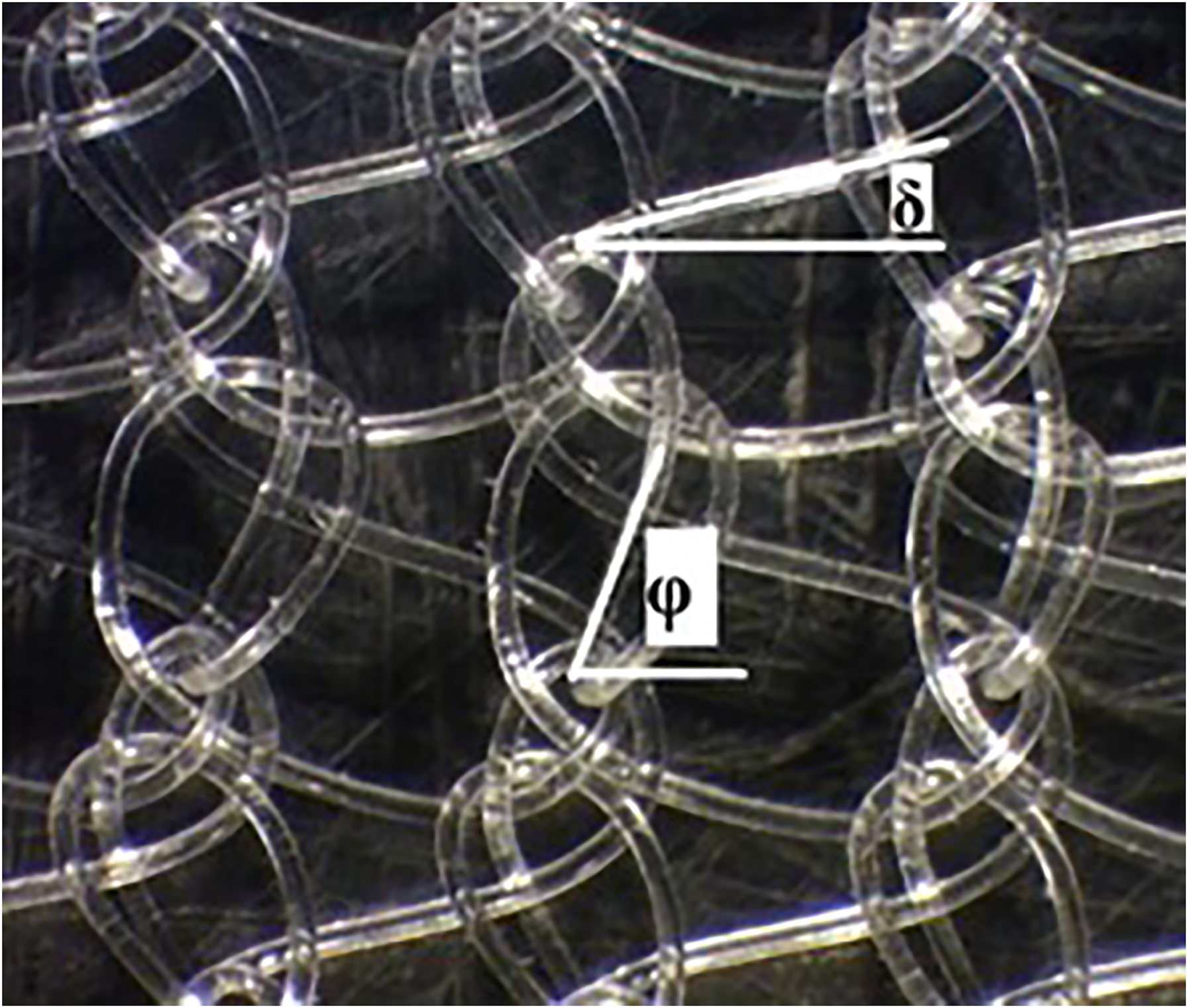
Analysis of the isotropy index of studied meshes
According to Figure 7 the quasi-Sandfly and quasi-Marqussite mesh have the highest and least isotropy index of tensile elastic modulus. The Tricot mesh, Sandfly mesh, and Pin-hole-net mesh are between them regarding the isotropy index of tensile elastic modulus. So the quasi-Sandfly mesh is the most isotropic, and the quasi-Marqussite mesh is the most anisotropic mesh among evaluated surgical meshes.
The results reveal that when the shape of the mesh’s polar diagram is similar to a circle, the mesh has a higher isotropy index. For example, because the quasi-Sandfly mesh is the most isotropic, the form of its polar graph most closely resembles a circle. Moreover, the quasi-Marqussite mesh is the most anisotropic since the shape of its polar graph is far from a circle.
It should be noted the results of the present paper confirm the previous researches in terms of meshes' mechanical and structural properties 1 . So in this paper, the quasi-Sandfly mesh is the strongest, and the quasi-Marqussite mesh is the weakest Structure in terms of tensile properties similar to previous studies on these structures.
The results of the calculation of the isotropy index of studied meshes are shown in Figure 6. According to Figure 6, the abdominal wall isotropy index value is 51.90%. The sandfly has the nearest, and the quasi-Marqussite has the farthest isotropy index than the abdominal wall tissue. The Tricot, Pin-hole-net, and quasi-Sandfly are between them based on nearness to the abdominal wall isotropy index. These results are analyzed using limited data on the tensile properties of the females' abdominal walls with meshes. Although this comparison is a profitable start to study in this field, it is essential to conduct more extensive studies for a more detailed analysis. Considering most meshes' structural and mechanical properties, including meshes’ weight, porosity, pore size, tensile properties, and nearest of mesh’ isotropy index to isotropy index of human abdominal wall tissue, the Sandfly mesh was selected as the best-knit pattern for surgical mesh production.
Conclusion
This research produced surgical meshes with different structures(quasi-Sandfly, Tricot, Pin-hole-net, Sandfly, and quasi-Marqussite) using the polypropylene monofilament. Then, the isotropy indexes of their tensile elastic modulus were calculated by analyzing their tensile properties in five directions(0°(course), 30°, 45°, 60°, and 90°(wale)) using the image processing method. According to the results, the quasi-Sandfly mesh is the most isotropic (57.74%), and the quasi-Marqussite mesh(17.12%) is the most anisotropic mesh among considered surgical meshes. Tricot mesh(54.98%), Sandfly mesh(49.17%), and Pin-hole-net mesh(46.41%) in terms of the tensile behavior isotropy are between quasi-Sandfly mesh and quasi-Marqussite mesh. As the shape of the mesh’s polar diagram becomes close to a circle, the mesh exhibits a better isotropy index. The Sandfly mesh was chosen as the best-knit pattern for surgical mesh based on the lightness, adequate porosity, larger pore size, and proximity of the mesh’s isotropy index to abdominal wall tissue for enhancing its functional properties.
This paper presents a new method that can be the foundation for developing studies on the isotropy of textiles with different structures. So the approach presented in this research can be used for development in future studies. One of the present study results is that the structure of meshes can be improved in terms of isotropy. As a result, the more isotropic the mesh structure, the more similar its tensile behavior is in different directions, so the surgeon will have more freedom of action when the mesh is transplanted into the body, and the surgery will be incredibly easier.
Footnotes
Declaration of conflicting interests
The author(s) declared no potential conflicts of interest with respect to the research, authorship, and/or publication of this article.
Funding
The author(s) disclosed receipt of the following financial support for the research, authorship, and/or publication of this article: This work was supported by the Amirkabir University of Technology (40/1119).
