



Abstract
Shear stiffening gel (SSG) with significant shear stiffening effect overcomes the problems of fluid volatilization and particle deposition, and exhibits a wide range of application prospects in intelligent protection. In this work, SSG with different rheological properties were manufactured by mechanical blending and crosslinking and coated on Kevlar fabric. The dynamic rheological properties of SSG and the low-velocity impact resistance of Kevlar/SSG composites were investigated, and the coupling mechanism between SSG and Kevlar fabric was analyzed. The results reveal that the storage modulus of SSG increases by 3–6 orders of magnitude when shear frequency ranges from 0.1 to 100 Hz, and the highest storage modulus reached 2.53 MPa. The impact deformation of the composite is reduced after SSG stiffening, and the infiltration of SSG inside the fabric also prevents fibers pull-out during the impact process. By synergizing the performance of SSG and Kevlar fabric, the optimal single-layer T280 composite can absorb up to 70.21% of the impact energy, reaching the energy absorption efficiency of 0.5 J/g. The process optimization and rheological design provide a theoretical foundation to further enhance the impact resistance performance.
Keywords
Introduction
For decades, flexible impact resistant materials have been widely applied in individual protection, transportation, aerospace, and military fields.1–7 Compared with rigid materials, flexible materials have the advantage of deforming with objects during movement.8–12 Among them, high-performance fabrics and their composites have been proved to be effective in fabricating flexible impact resistant materials. In terms of impact resistant fabric composites, researches have been conducted to investigate the effect of fabric structure on the impact behavior of composites, such as laminated fabric, 13 3D spacer fabric, and 14 knitted fabric. 15 However, restricted by the fiber property, further work is required to improve the impact resistance property.16,17 An effective approach is to apply functional material on fabric to produce synergetic effect when they are subjected to impact.
The shear stiffening effect, with modulus or viscosity abruptly increased by external stimulation, is a special phenomenon of polymers and fluid suspensions. 18 Materials that exhibit shear stiffening effects are considered as shear stiffening materials. 19 Currently, there are mainly two types of shear stiffening materials, one of which is shear thickening fluid (STF) and the other is shear stiffening gel (SSG). Differently, the STF is a suspension system while the SSG is the polymer blend. 20 Based on integrating fast response and strain rate sensitivity, shear stiffening materials exhibit great research value in the fields of impact resistance, damping and intelligent sensors. 21
SSG, also known as SP (silly putty) 22 or STG (shear-thickening gel), 23 is a type of boron-siloxane polymer silicone rubber with typical viscoelastic property. Compared with STF, SSG possesses a higher initial viscosity and more stable properties, making it easier to store. Meanwhile, the problems of particle sedimentation and fluid volatilization of STF were overcome. 24 As the external strain rate increases, SSG shifts from plastic to rubbery and then to glassy state. With the mutation of state, the mechanical properties of SSG, such as storage modulus and yield stress, are greatly enhanced and a large amount of mechanical energy was absorbed during the process of transition. 25 Considering the reversible state transform, SSG has been designed and manufactured for individual and industrial protection. 26 The SSG was introduced into polyurethane sponge-based polymer by approach of “dip and dry” and the impact load was weakened by two orders magnitude. 27 Zhao et al. developed a type of SSG/MVQ (polymethyl vinyl siloxane) composite that exhibits excellent self-healing and impact resistance performance by mixing SSG with MVQ using an expandable microsphere as a blowing agent. 28 Xu et al. designed a soft sandwich composite consisting of two layers of Kevlar sheets and an SSG core and the composite exhibits a 60% higher energy absorption than neat Kevlar under low-velocity impact. 29 In these researches, the introduction of SSG has greatly improved the performance of original materials, and the unique rheology of SSG plays an important role in it.
The rheology of SSG can be designed and controlled by raw materials and synthesis process. 30 By introducing different functional particles, SSG with different rheological properties can be prepared. Xu et al. studied the rheological properties of SSG with different concentrations of CaCO3 and the shear storage modulus of the SSG increased with doping. 29 Tian et al. prepared four different SSG with different mass ratios of silicone oil and revealed the peak shear stress improved with the increase of silicone oil concentration. 31 In these researches, SSG with different rheological performance was manufactured by different reaction temperatures and introducing functional particles.
In this work, the influence of different processes, including different reaction temperatures, nano-silica content, and boric acid content on the rheology of SSG were investigated. Simultaneously, the composites of Kevlar/SSG based on different SSG rheology were manufactured by coating process. Then, the low-velocity impact experiment was conducted on Kevlar/SSG composites to evaluate the coupling effect of fabric and different types of SSG. The proposed SSG-coated fabric greatly improves the impact resistance of single-layer fabric and is of potential in the field of design flexible impact-resistant materials.
Experimental
Materials
The hydroxyl silicone oil (PDMS, 1500 cp, colorless transparent viscous liquid) was purchased from Shoucheng Chemical Co Ltd, Zhejiang, China. boric acid and oleic acid were purchased from Sinopharm Chemical Reagent Co Ltd, Shanghai, China. The silica (SiO2) with an average particle size of 12 nm was purchased from Guangzhou GBS High-Tech and Industry Co, China. The Kevlar fabric with an area density of 200 g/m2 and a thickness of 0.26 mm was purchased from Beijing Junantai Protection Technology Co, China. The warp and weft yarns have the same density of 60 yarns/10 cm.
Preparation of shear stiffening gel and Kevlar/shear stiffening gel composites
The preparation process of SSG is shown in Figures 1(a)–(d), and the synthetic chemical reaction is displayed in Figure 2. First, the boric acid was heated to 180°C for 2 h to prepare pyroboric acid. Then, the pyroboric acid, silica, and hydroxyl silicone oil were mixed with different proportions and then reacted at different environment temperatures by oil bath for 3h. In order to ensure a homogeneous reaction, a 15 r/min of stir was applied by an agitator while heating. Finally, 1 mL of oleic acid was added as a plasticizer to the reacted mixture. In order to further investigate the shear stiffening characteristics of SSG, a set of samples with different nano silica content was fabricated. The specific parameters of preparing SSG are summarized in Table 1. The silicone oil content of all components is 100 g, and the samples are named according to the content of silica, pyroboric acid, and reaction temperature. For example, when the proportions of reactants are the same, the five samples are named T200–T280 according to the reaction temperature. B50S100 refers to 5 g of pyroboric acid and 10 g of silica in the reactant. Experimental procedure: (a)-(d) The synthesis steps of SSG, (e) Coating treatment of fabrics with SSG, (f) Low-velocity impact test. SSG: shear stiffening gel. Synthetic chemical reaction of shear stiffening gel polymer. The parameters of the different groups shear stiffening gel.

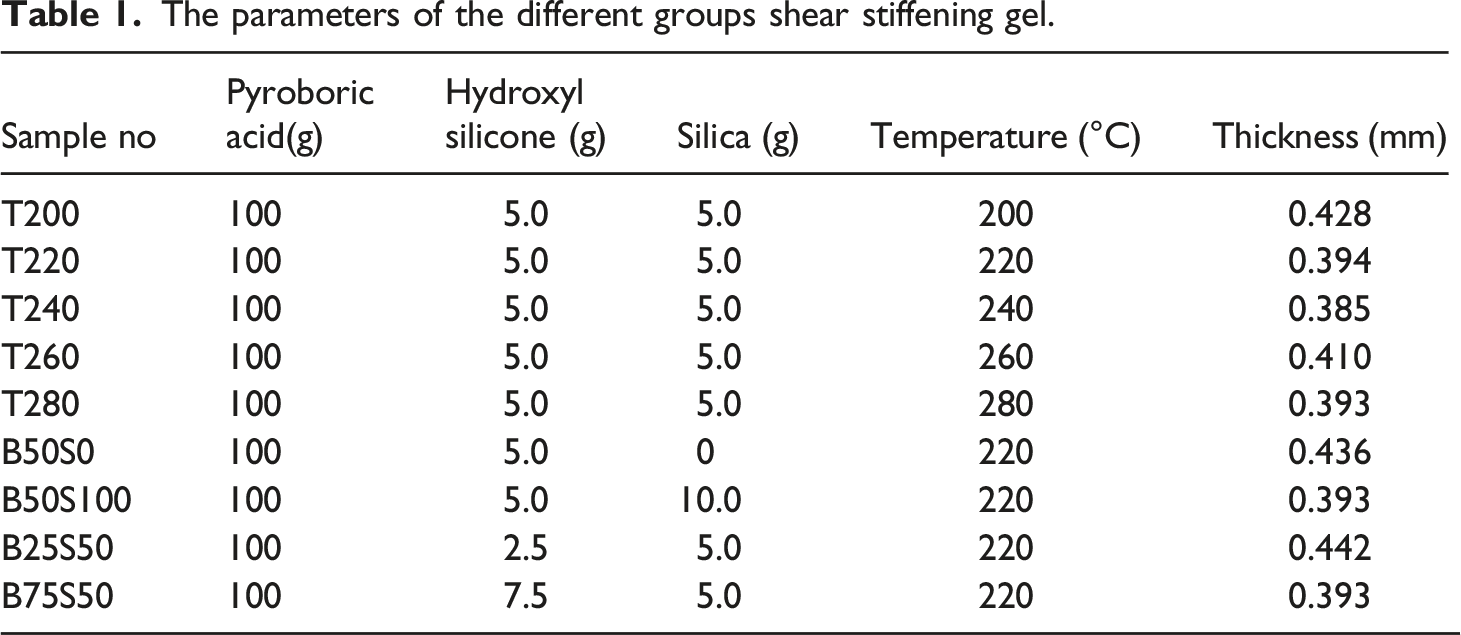
Figure 1(e) gives the schematic of Kevlar/SSG composite fabrication. The 12 cm×12 cm Kevlar fabric was coated by nine types of SSG with the same weight of 5 g. In addition, in the follow-up study of the impact of SSG coating weight on the impact behavior of composites, coating weight of 3 g and 7 g samples were also manufactured for comparison with the SSG of T220.
Characterization
Rheological property testing
The rheological property of SSG was conducted by a rotational rheometer (TA Instruments, US) at 25°C and 65% humidity. The diameter of the plate was 20 mm, and the gap between two plates was set to 1.9 mm. The shearing frequency was set between 0.1 and 100 Hz and at least three samples were tested and averaged for the mean value.
Low-velocity impact testing
The dynamic impact performance of Kevlar/SSG composites was tested by a falling weight impact machine (Instron 9250HV, US) as specified from ASTM D7136M-2012. A striker (4.83 kg) with a diameter of 12.7 mm was selected and released from three different heights of 120, 150, and 180 mm, corresponding to the impact energy of 5.70, 7.12, and 8.55 J and the size of the specifications are 12 cm×12 cm. The composite was held by pneumatic fixture with a 3.5 mm radius hole in its center. The instant-impact contact load is recorded by the upper sensor and at least three samples were tested and averaged for the mean value.
Fourier transform infrared spectroscopy testing
The FTIR spectroscopy (FTIR-1500, JOSVO, Tianjin, China) is used to analyze the functional groups of T220 sample synthesized through ATR mode from 4000-500 cm−1 in this work.
Surface topography observation
A stereo microscope (Nikon SMZ-10A, Japan) is used to observe the surface morphology of neat fabric and its composite.
Results and discussion
Characterization of shear stiffening gel
Figure 3 displays the morphology of nine SSG prepared by different ingredient ratios and reaction temperatures. It can be seen from Figures 3(a)–(e) that as the reaction temperature increases, the surface color of SSG gradually changes from light to dark. However, there is no significant difference in the surface color of SSG when the ingredient is changed and the reaction temperature is constant at 220°C as presented in Figures 3(f)–(i), indicating that the temperature has a significant influence on the reaction process of SSG synthesis. The higher reaction temperature facilitates the reaction and causes more cross-linking. Surface topography of different shear stiffening gel: (a) T200, (b) T220, (c) T240, (d) T260, (e) T280, (f) B50S0, (g) B50S100, (h) B25S50, (i) B75S50.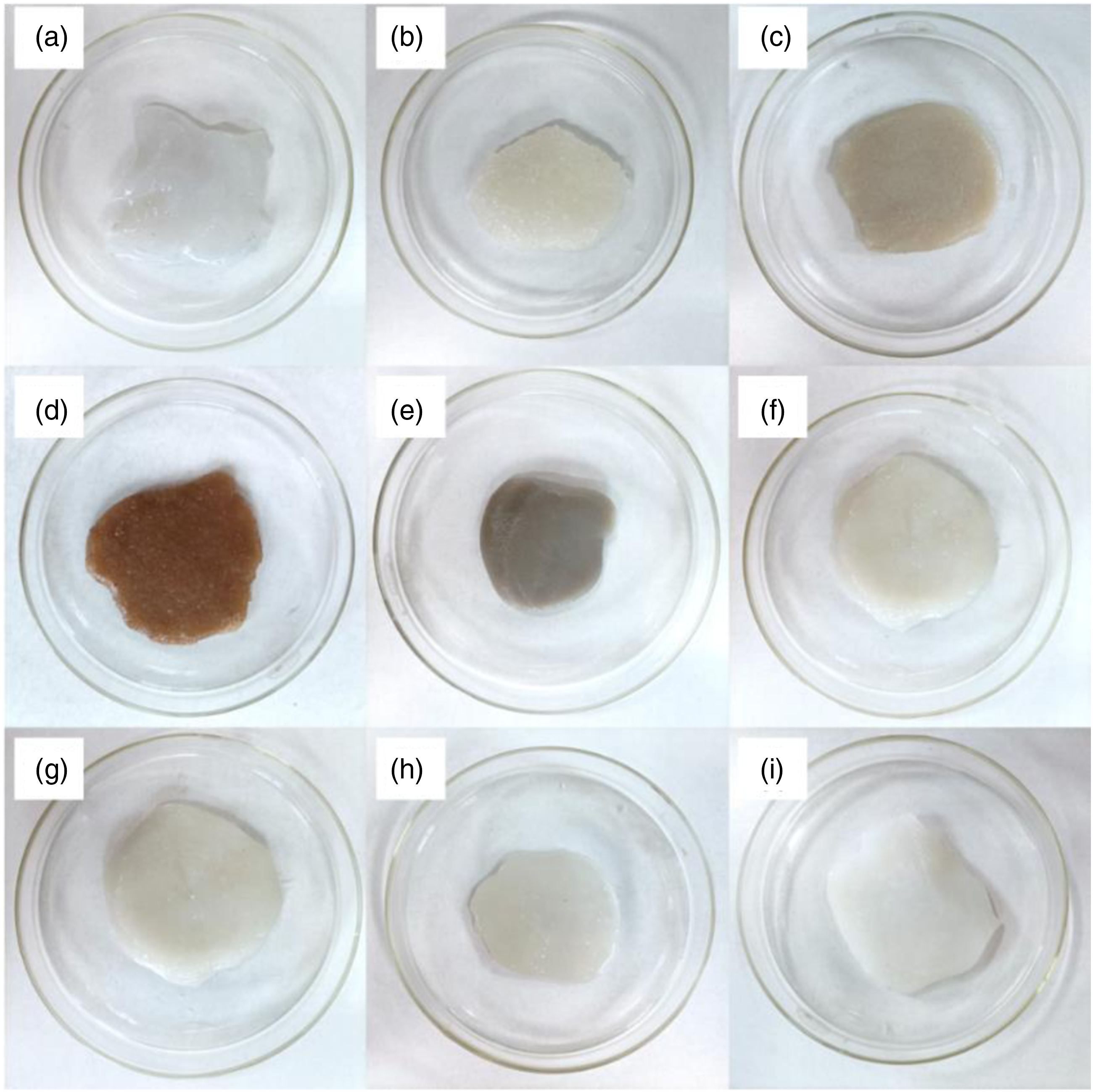
The infrared spectrum of T220 samples was shown in Figure 4. The IR spectra characteristic peak of T220 were obtained by the stretching vibrations of the Si-O-B (867 cm−1), Si-O (1020 cm−1), Si-CH3(1259 cm−1), B-O (1340 cm−1), and C-H (2960 cm−1). 867 cm−1 is the characteristic absorption peak of Si-O-B and is proved that B is introduced into the main chain structure of Si-O. It can be seen from the infrared spectrum that the SSG contains of Si-O-B, B-O, Si-CH3, Si-O groups, indicating that the crosslinking reaction between PDMS and boric acid occurs. Infrared spectrum of T220.
Figure 5 displays the rheological properties of SSG corresponded to Figure 3, and it can be seen that the storage modulus ( Rheological properties (storage modulus, loss modulus and loss factor) of different SSG samples: (a)-(c) Influence of reaction temperature on dynamic rheology; (b)-(f) Influence of boron content on dynamic rheology; (g)-(i) Influence of silica content on dynamic rheology.
As presented in Figure 5(a), the dynamic storage modulus of all samples is positively correlated with the reaction temperature. Among them, T200 exhibits the lowest overall storage modulus. When the shear rate is 0.237 Hz, the storage modulus is only 0.34517 Pa. However, when the shear frequency reaches 100 Hz, the storage modulus increases to 197370 Pa with six orders magnitude improvement, demonstrating an obvious shear stiffening effect. In contrast with T200, T280 shows the highest overall storage modulus, ranging from 5186.4 to 2535500 Pa increasing by three orders of magnitude. It can be concluded from T200–T280 that the higher the reaction temperature, the higher the overall storage modulus of the sample, namely a stronger elastic property. The elevating reaction temperature improves the reaction efficiency and increases the cross-linking between the active groups, leading to a higher dynamic storage modulus. The effect of pyroboric acid concentration on the dynamic rheology of SSG is presented in Figures 5(d)–(f). The B25S50 with the lowest boron content exhibits the highest initial storage modulus, while the B75S50 with the highest content shows the lowest initial storage modulus. In terms of peak storage modulus, the boron content has a positive relationship and the more pyroboric acid in the reactant, the higher the peak storage modulus of SSG. To be specific, the storage modulus of B25S50 ranges from 13506 to 219500 Pa while the B75S50 ranges from 841.95 to 1112900 Pa. When the shear frequency range is 0.1–100 Hz, the storage modulus of B25S50 is increased by one order of magnitude, while the storage modulus of B75S50 is increased by four orders of magnitude. This phenomenon is attributed to the increase in the boron content in the reactant, which leads to more “B-O cross bonds” in the polymer chain. Figures 5(g)–(i) reveals the effect of nano particles on the rheological properties of SSG. Silica has stable performance and cannot directly participate in the cross-linking reaction. Although from Figure 5(g), silica is found to significantly improve the SSG property. With the increase of silica content, the overall dynamic energy storage modulus of SSG increases. Specifically, when the shear frequency is 100 Hz, the storage modulus of B50S0 is 375270 Pa, and the storage modulus of B50S100 reaches 1019800 Pa.
Figure 5(b), (e), and (h) display the dynamic loss modulus (
To further investigate the properties of SSG, the loss factor is used to evaluate its state, which is obtained by the following formula
When Q > 1, the material is soft and can flow, showing a viscous state similar to liquid. When Q reaches around 1 means the material is in the state of the transition zone. When Q < 1, the material reaches a rubbery state and exhibits solid elastic characteristics. As presented in Figure 5(c), (f), and (i), the loss factor of all samples decreases with the shear frequency and all samples exhibit a similar phenomenon, and the loss factor ranges from magnitude 10−1 to 101. The magnitude of the loss factor demonstrates the transition of SSG from viscous to a rubbery state. When the shear frequency is close to 0.1 Hz, T200 exhibits the highest loss factor (50.4), corresponding to the strongest viscosity. When the shear frequency comes to 100 Hz, T260 exhibits the lowest loss factor (0.0684), corresponding to the strongest elasticity.
Dynamic impact performance of Kevlar/shear stiffening gel composites
Curve and failure mode analysis
The surface morphology of neat Kevlar fabric and its composite is presented in Figure 6. It can be seen that the SSG can be evenly coated on the fabric. As mentioned above, SSG has a certain of fluidity under static condition and is able to penetrate into the voids between fibers. The surface morphology of neat fabric and T220 composite.
Impact curve and failure mode analysis
Figure 7 shows the impact curve of the composite at an impact height of 150 mm, and the rheology of SSG has a significant influence on the impact performance of composite. Compared with neat fabric, all SSG samples present an enhancement effect. Among T200–T280 shown in Figure 7(a), the T280 exhibits a highest peak load and up to 318.2 N, which is 249.4% higher than neat fabric. On the contrary, T200 exhibits a relatively lower peak load (184.3 N) than other samples, which is consistent with the difference of storage modulus in Characterization of shear stiffening gel. The storage modulus of SSG is positively related to the reaction temperature. However, the T220 displays a higher peak load than T240. This is attributed to the wettability of SSG and fabric which is similar to the impregnation effect of shear thickening fluid.
32
The energy absorption (EA) of the composite can be obtained by the formula (a)-(c): Load-Impact time curve of different samples; (d)-(f) Energy-Displacement curve of different samples, (g) peak load, (h) energy absorption and (i) penetration depth of different samples.

Figure 8 shows the three typical damage morphology of fabric and its composites under impact. As presented in Figure 8(g), the damage morphology of the neat fabric is the pull-out of multiple perpendicular warp and weft yarns. The fiber is mainly subjected to the pulling force brought by the striker. During overcoming the friction, slip occurs. Therefore, the effective bearing area of the neat fabric is smaller (Figures 8(a) and (d)), and the tensile properties of fibers cannot be fully exploited. By introducing different SSG, the bearing disadvantage of fabric can be effectively improved. During the process, the striker must overcome both the frictional resistance between fibers and shear stiffening characteristic of SSG. As presented in Figure 8(h), SSG with low storage modulus has good wettability and better integrated with fabrics. When the striker penetrates, the instant pulling between fibers results in a sudden increase of internal friction coefficient. The samples coated with low storage modulus SSG can effectively improve the fiber extraction performance, and the failure mode of the composite is transformed into the impact burst. Different types of impact performance: (a)-(c) Top view, (d)-(f) Side view, (g)-(i) Impact morphology, (j)-(k) Microscopic molecular chain state.
On the other hand, the striker drives SSG to stiffen, which is conducive to the transverse diffusion of the impact load (Figure 8(e)), thus increasing the effective bearing area during impact (Figure 8(b)). When SSG with high storage modulus (marked with SSG#2) is introduced to the fabric, the composite failure model is transformed to instant brittle facture of SSG and disordered extraction of fiber shown in Figure 8(i). The friction effect of this type of SSG is not as strong as that of SSG with low storage modulus (marked with SSG#1). Therefore, the fabric produces a relatively large pull-out effect. However, the instant storage modulus of SSG#2 is higher, and its stiffening effect is more obvious, resulting in a larger bearing area (Figures 8(c) and (f)), thus further improving the impact resistance of composite.
From a micro perspective, the strengthening mechanism of the composite is attributed to the entanglement and reorganization of the SSG molecular chain shown in Figure 8(j). Under the stimulation of impact, a large amount of “B-O cross bond” do not have enough time to self-adjust (Figure 8(k)), resulting in extensive SSG stiffen in high strain rate area, thus improving the bearing area and internal friction performance.
Impact morphology analysis of Kevlar/shear stiffening gel composites
Figure 9 demonstrate the impact morphology of samples of T220, T260, and T280. Among them, the storage modulus of T220 is lower and thus it has the best wettability. The instant slip between the infiltrated fibers triggers the stiffening characteristic of SSG during impact, resulting in a sudden increase in internal friction. Therefore, the T220 shows the phenomenon of fabric bursting as presented in Figure 9(c). Compared with T220, T260 exhibits a higher storage modulus. As presented in Figure 9(f), the SSG in contact with striker shows an instant stiffening and brittle fracture. However, T260 exhibits poor wettability and its impact resistance is dominated by the stiffening characteristic of SSG when impacted. Thus, the composite displays a phenomenon of disorderly pull-out of the yarn. As for the T280 sample shown in Figure 9(i), SSG shows the highest peak storage modulus. The striker is completely blocked by the composite and a large amount of impact energy is dissipated through the stiffening and flow of SSG. Figure 9(a), (d), and (g) show the load bearing schematic of different compotes, the SSG with higher storage modulus dissipate the impact stress through stiffening, thus driving a large range of fabrics to carry out coordinated load-bearing. Effect of reaction temperature on impact performance: (a) (d) (g) Side view of different samples, (b) (e) (h) The change of molecular chain when different samples are impacted, (c) (f) (i) Impact morphology of different samples.
From a microscopic view, the different impact behaviors are attributed to the “B-O cross bond” in SSG. The increase of the reaction temperature contributes to a stronger reaction activity and promotes more dynamic B-O bonds. Compared with T220 (Figure 9(b)) and T260 (Figure 9(e)), more “B-O cross bond” in T280 lead to more difficult entanglement and recombination (Figure 9(h)), resulting in higher instant storage modulus and stronger anti-penetration effect.
The influence of boron on the impact behavior of composite is shown in Figure 10. As presented in Figure 10(c), B25S50 exhibits an impact burst phenomenon similar to T220. A good wettability enhances the friction effect between the fibers, and the fabric produces less pull-out. In contrast, B75S50 shows a brittle fracture phenomenon of SSG and produces a disordered pulling of yarn (Figure 10(f)) similar to T260. Compared with B25S50 (Figure 10(a)), a higher storage modulus of B75S50 further facilitates the transverse load-bearing of composite (Figure 10(d)). This proves that increasing the boron content in reactant can also contribute to more “B-O cross bond” as presented in Figure 10(e), thus improving the impact resistance of the composite. Effect of boron on impact performance: (a) (d) Side view of different samples, (b) (e) The change of molecular chain when different samples are impacted, (c) (f) Impact morphology of different samples.
Figure 11 reveals the influence of silica particle content on the impact behavior of the composite. B50S0 exhibits a similar burst morphology with T220 and B25S50 (Figure 11(c)). Analogously, B50S100 shows similar morphology to T260 and B75S50, and the brittle fracture of SSG is observed on the extracted fibers (Figure 11(f)). The impact failure mode of the composite is changed for different silica content. Unlike the effect of temperature and boric acid mass ratio, silica does not directly participate in the reaction. This proves that the impact resistance of the composite can be further enhanced by introducing nanoparticles. The introduction of nano silica contributes to the improvement of the instant strain rate around the particles during impact (Figure 11(e)), so that more “B-O cross bond” blocking and unable to self-adjustment, thus further improving the impact properties of the composite. Effect of silica on impact performance: (a) (d) Side view of different samples, (b) (e) The change of molecular chain when different samples are impacted, (c) (f) Impact morphology of different samples.
Influence of impact velocity on T220 composite
For the strain rate sensitivity of SSG, it is of significance to investigate the impact performance of composite at different impact velocities. Figure 12 reveals the impact curve of T220 with a coating weight of 5 g at different impact heights (0.12, 0.15, and 0.18 m), corresponding to impact velocities of 1.54, 1.72, and 1.88 m/s. As presented in Figure 12(a), the impact load increases simultaneously with the impact time and improves the energy absorption behavior. When the impact height is 0.12 m, the energy absorption of T220 is 2.64 J shown in Figure 12(d). When the impact height increases to 0.18 m, the energy absorption of T200 reaches 4.23 J. The energy absorption rate (EAR) of the composite can be obtained by the following formula (a) Load-Impact time curve, (b) energy-displacement curve at the impact height of 0.12 m, 0.15 m and 0.18 m, (c) Peak load and impact time histogram and (d) energy absorption (EA) and energy absorption ratio (EAR) histogram of T220 at the impact height of 0.12 m, 0.15 m and 0.18 m.
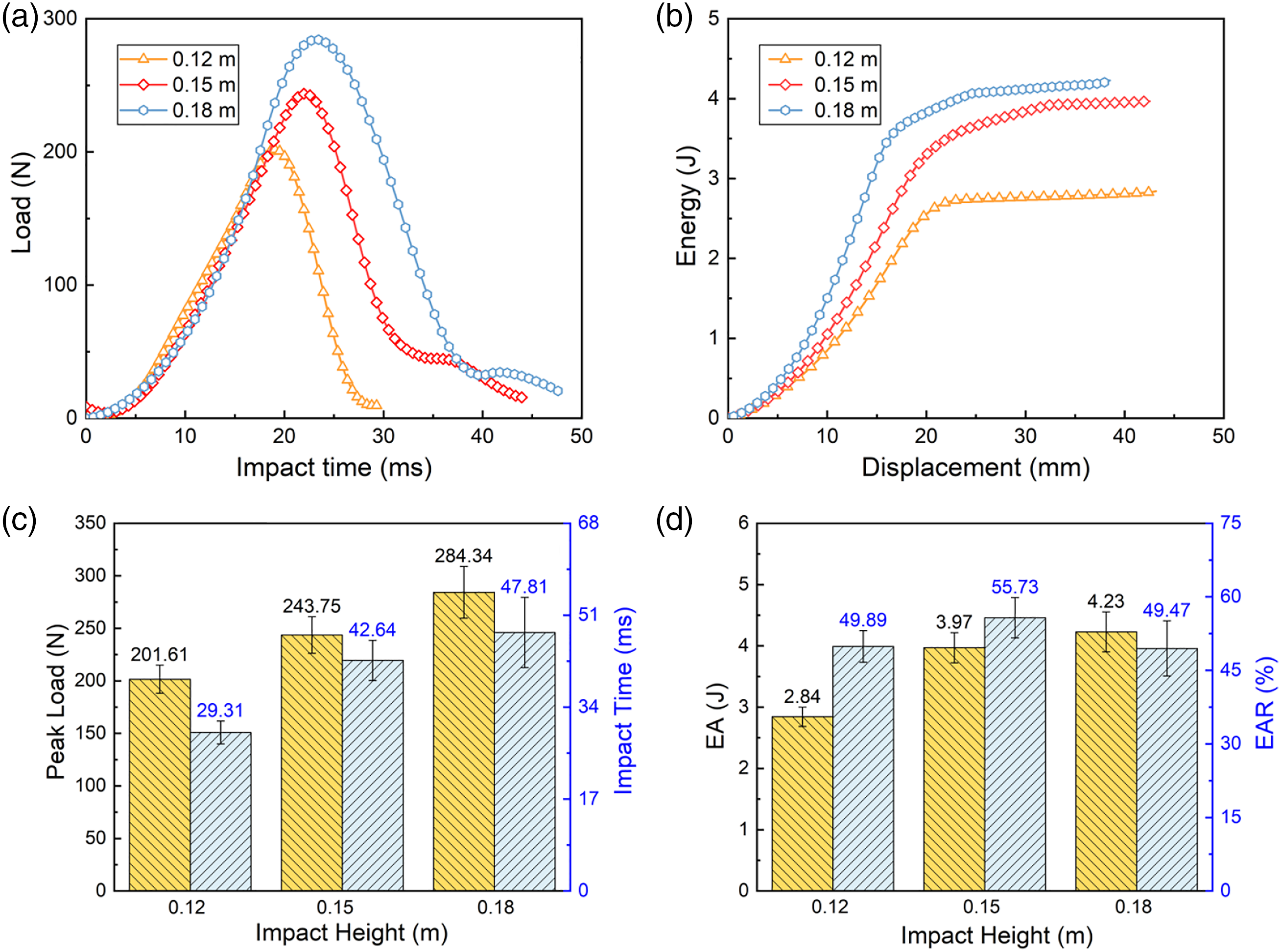
When the impact height of T220 is 0.12 m, the EAR of the composite is 46.34% as presented in Figure 12(d). Furthermore, when the impact height increases to 0.15 and 0.18 m, the EAR reached 55.74% and 49.50%, respectively. Through the low-velocity impact research at different velocities, the excellent dynamic impact resistance behavior of SSG-coated Kevlar fabric is demonstrated.
Influence of shear stiffening gel content on T220 composite
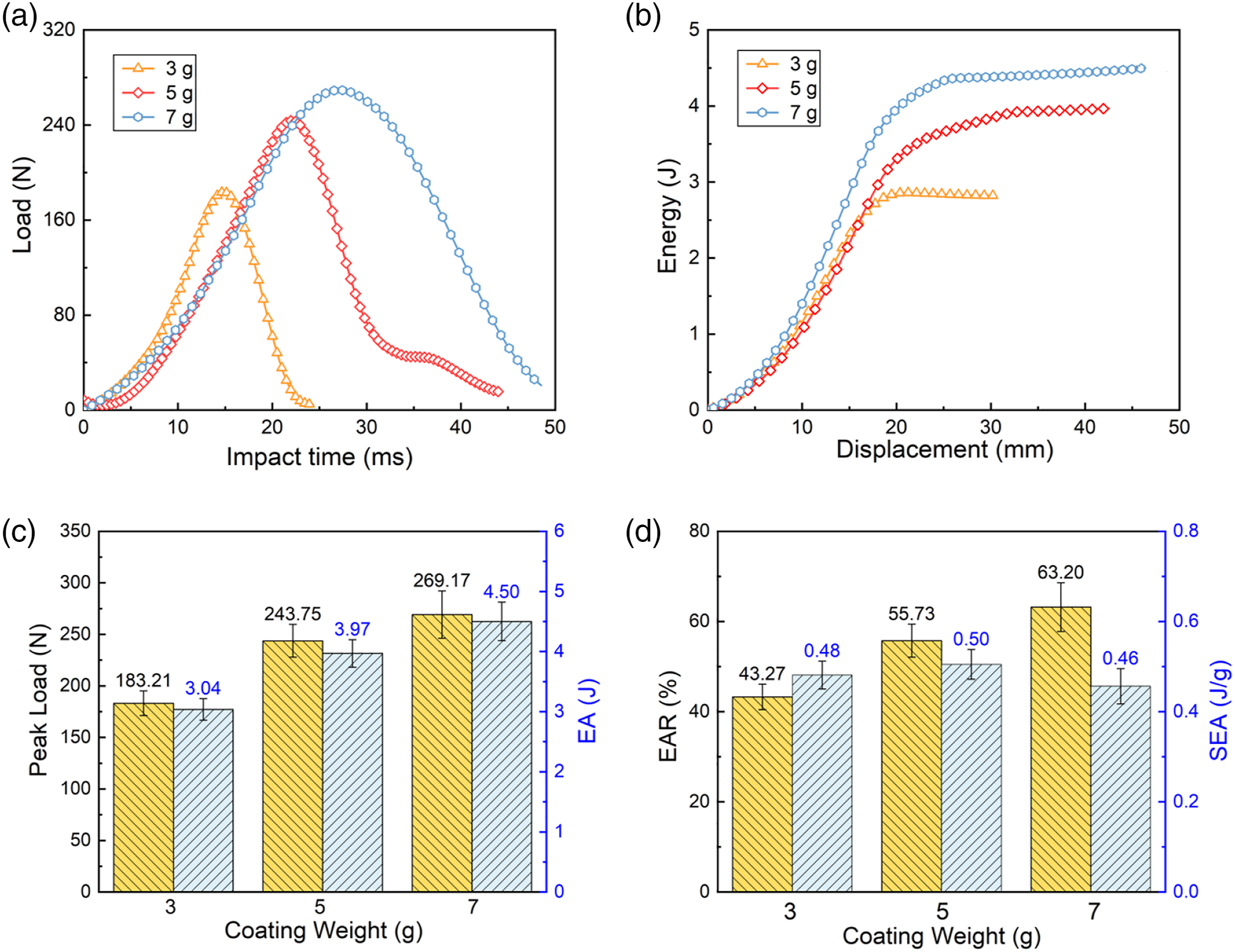
The weight per unit area of SSG coating affect the comprehensive impact performance of the composite. Figure 13 displays the dynamic impact performance of T220 when the coating weight is 3, 5, and 7 g, respectively. It can be seen from Figure 13(a) that the higher the coating weight, the greater the impact resistance is. The peak load of 7g sample is 269.17 N, 46.93% higher than that of 3 g sample. In terms of energy absorption (Figure 13(b)), the energy absorption of 7 g is 48.02% more than 3 g sample. However, when the coating weight is high to a certain degree, it will lead to material waste and the specific energy absorption (SEA) reduction. The SEA can be obtained by the following formula (a) Load-impact time curve and (b) energy-displacement curve with the coating weight of 3 g, 5 g and 7g. (c) Peak load and energy absorption (EA) histogram and (d) energy absorption ratio (EAR) and specific energy absorption (SEA) histogram of T220 with the coating weight of 3 g, 5 g and 7g.
Conclusions
The SSG with shear stiffening effect exhibits wide application in the field of impact resistance. The influence of process parameters on the dynamic rheological properties of SSG and impact performance of Kevlar/SSG composites were investigated in this work. Studies have shown that the overall storage modulus of SSG is positively correlated with reaction temperature, pyroboric acid content, and silica content. The dynamic loss factor of all SSG samples is in the range of 10−1–101. The storage modulus of T200 is increased by six orders of magnitude at the shear frequency of 0.1–100 Hz and the peak storage modulus of T280 reaches 2.53 MPa. The low-velocity impact was conducted on Kevlar fabrics coated with different SSG, and the relationship between storage modulus and impact resistance was investigated. It is shown that during the impact process, two effects play positive roles in impact performance. One is the instant stiffening of SSG, and the other is the wettability of SSG in fabric, which improves the friction between fibers and extraction resistance during impact. With the increase of impact velocity and coating weight, the peak load and energy absorption increase simultaneously. The EAR and SEA of the single-layer T280 composite reach the highest 70.21% and 0.50 J/g, respectively, showing an excellent impact resistance expected in the field of flexible impact resistance material.
Footnotes
Declaration of conflicting interests
The author(s) declared no potential conflicts of interest with respect to the research, authorship, and/or publication of this article.
Funding
The author(s) disclosed receipt of the following financial support for the research, authorship, and/or publication of this article: This work was supported by the Natural Science Foundation of Tianjin (Grant numbers 18JCQNJC72600), and the Program for Innovative Research Team at the University of Tianjin (TD13-5043).
