




Abstract
Due to the particular physiological conditions of the human body, activity in cold weather condition is of great importance and needs unique thermal clothing. In this research, three-layered heating fabrics were designed and woven to analyze their performance in cold climates. The samples consist of three types of heating elements (nickel-chrome, tungsten, and aluminum-chrome) and two different states for embedding the heating elements in the fabric structure. In order to investigate the effect of voltage on the heat flux and maximum temperature, all specimens were subjected to two voltage levels of 9 and 12 V for 10 min, the process of heat production, the influence of structural factors on the flux and temperature and also the thermal efficiency was analyzed. In addition, in order to select the optimum sample, the amount of required energy for maintaining body comfort was calculated based on the theoretical equations at the ambient temperatures of −5 and −10°C. The results showed that the woven sample using tungsten elements and the weft-to-element ratio of 12 had the desirable heating performance and could maintain the skin surface temperature around the thermal comfort zone.
Introduction
Performing physical activity in cold and severe weather conditions is always one of the challenges that human beings face. One of the solutions to tolerate the cold weather conditions without wearing heavy clothing is the use of multilayer heating fabrics. In these textiles, by using heating elements and temperature control equipment, heat generation and intelligent temperature control are performed in the textiles. The use of personal heating clothing in the form of electrically heated garments, PCM garments, chemical heating garments, and fluid/air flow heating garments is common in industries worldwide, especially in cold environments. 1 Development and application of heating fabrics and also the analysis and simulation of their heating performance were the subject of many previous research works.
Haisman (1988) evaluated the efficiency of the electrically heated garments through cold-chamber experiments. According to this research, the helpfulness of electrically heated garments in preserving hand temperatures was proved and it was declared that these garments would reduce the foot temperature loss, even in the exceedingly cold weather of −32°C. 2 In a research by Więźlak and Zieliński (1993), it was declared that the textile heating elements which are produced from non-woven fabrics are intended to be of slight usage by consideration of high electric resistance of the conductive non-woven fabrics. In this usage, the resistance of a heating element made of woven fabric is lower than that of a heating element of the same dimensions made of knitted fabric and are more recommended in practice. 3 Bhat et al. (2006) developed a conductive cotton fabric, in order to be used in heating devices and apparel. 4 Kayacan and Bulgan (2009) evaluated the heating behavior of metallic textiles fabrics, which were produced by single and multi-ply steel yarns. It is pointed that the heating pad dimensions, metallic yarn structure and the power supply conditions influence the heating level. 5 Kayacan et al. (2009) investigated the performance of the heating garment based on steel-based conductive yarns, with the aid of a thermal mannequin in cold weather environments. 6 In a study by Wang and Lee (2010), the heating efficiency and the total thermal insulation of an electrically heated vest and its association to the microclimate temperature distribution in a three-layer clothing ensemble were evaluated by both theoretical and thermal manikin analysis. 7 Couto et al. (2011) probed the heat transfer of an alpine-climbing mitt containing an electrical heating multilayer ensemble by using a numerical model and considering environmental conditions. 8 Hao et al. (2012) proposed an enhanced fabrication method of flexible heating fabrics by weaving alternatingly silver filaments or coated silver yarns (CSYs) into plain fabrics and by controlling the density of conductive filaments with regards to the heating requirements. 9 Yen et al. (2013) analyzed the heat transfer phenomena of anisotropic thermal conductivity fabrics containing electric conductive yarns. In this study, it was declared that utilizing non-electric conductive yarns in a direction perpendicular to electric conductive yarns increased the temperature regularity. 10 Hamdani et al. (2013) investigated the thermo-mechanical properties of knitted heating fabrics containing silver-coated polymeric yarns by considering the heating and cooling rates and heat distribution over the surface of knitted fabrics. 11 Wang et al. (2013) utilized an arc ion plating method for deposition at low temperature to produce carbon-based coatings on a glass fiber fabric in order to be used in a flexible heating fabric. 12 Neves et al. (2015) performed a numerical study to investigate the heat transport through a blanket with an embedded smart heating system with regards to the impacts of thickness and thermal conductivity of the blanket, the position of heating wires relative to the skin, the distance between heating wires, applied heating power, and temperature range for operation of the heating system. 13 Yen et al. (2015) studied the cold protective performance of electrically heated and chemically heated garments in cold environments using a Newton manikin operating in constant temperature mode. 14 Roh and Kim (2016) fabricated a temperature sensing and heating textile by using metal composite embroidery yarn for the consistent maintenance of a definite targeted temperature by considering the human optimum thermal comfort in daily wear irrespective of the inner microclimate and outer climate circumstances. 15 Akbar et al. (2016) produced weft-knitted heating pads using acrylic and polyester as the main yarns and three different Copernic, thermotech –N, thermaram as conductive yarns, in both “all-knit” and “in-lay” insertions and evaluated their heating properties. 16 Park et al. (2016) investigated the effect of the distance of the heating unit from the body on the effective thermal insulation and heating efficiency of a multi-layered winter clothing system. According to the results, it was concluded that the nearer the heating unit to the body, the higher the effective thermal insulation was in both ambient temperature conditions. 17 Thilgavathi et al. (2017) developed an electric heating fabric by sewing silver-coated nylon yarn over the polyester fabric and evaluated the heating fabric properties such as power supply and saturation time for a particular temperature. 18 Li et al. (2018) fabricated highly electrically conductive and healable superamphiphobic cotton fabrics with exceptional electromagnetic interference shielding and electro-thermal heating ability. 19 Pragya et al. (2020) utilized a braiding-cum-weaving system for the fabrication and analysis of the properties of electricity-induced heating fabrics and evaluated the heating response under various conditions such as time, voltage and input power. 20 Song et al. (2020) presented a novel partial-body heating system (NPHS), including three electrically heating pads in the feet, hips, and shoulder regions with controllable surface temperatures. In this study, it was demonstrated that partial-body heating could successfully preserve thermoregulation, improve thermal comfort, and offer a better sleep quality in a cold environment. 21
A review of the previous works showed that providing an accurate measure of the heating fabric performance that indicates its efficiency and effectiveness has been neglected by former researchers. Behavioral complexities, such as the dependence of the heating fabric performance on the heat transfer coefficient of its structural elements and the amount of the supplied electrical power, have led to severe challenges in providing an acceptable standard.
Criticism of various articles points out the extent to which the criteria used in these articles have fundamental weaknesses. For instance, in research by Kim and Lee (2019), a piece of heating fabric was supplied with various voltage levels and the dynamic variations of the fabric’s surface temperature were recorded. 22 It is evident that according to this method, an increase in the supplied voltage would result in the produced heating energy in a way that the slope of this relationship is related to the electrical circuit resistance. On the other hand, the increment of the surface temperature is associated with the fabric’s thermal capacity and conductivity, and also the ambient temperature. Indeed, in these complex circumstances, comparing the performance of the samples is not acceptable and cannot be generalized to the results of other researchers. Similar concerns can be applied to other works, such as the research proposed by Hamdani et al. (2013). 11
Due to the practical essence of heating fabrics, in the current investigation, it was tried to develop a specific criterion to evaluate their thermal performance and clearly express the efficiency of the heating fabric.
One of the most essential applications of heating fabrics is to preserve body temperature in cold environments. Therefore, as a measure of efficiency, it can be claimed that the amount of electrical energy consumption per unit area of fabric surface in certain environmental conditions, in a way that the skin surface temperature is maintained at the desired temperature of 33° C, is a good choice. The heating fabric with the lowest consumption of electrical energy per unit area can perform the assigned task with higher efficiency. It is clear that this criterion is affected by the thermal conductivity of the fabric and its heating power. In order to demonstrate the practical efficiency of this criterion, by the measurement of the fabric’s thermal properties and modeling of stable heat transfer under defined conditions, the standard power consumption of the samples was calculated and compared with experimental outcomes.
In this regard, a group of woven three-layer heating fabrics consisting of various heating element types and element presence ratios was produced and their heating performance, such as the maximum temperature and flux, subjected to different applied voltages, were analyzed. Besides, the thermal insulation properties of fabrics were evaluated as an important parameter in determining the efficiency of heating fabrics.
Experimental
Materials and fabrication of the three-layer heating fabric
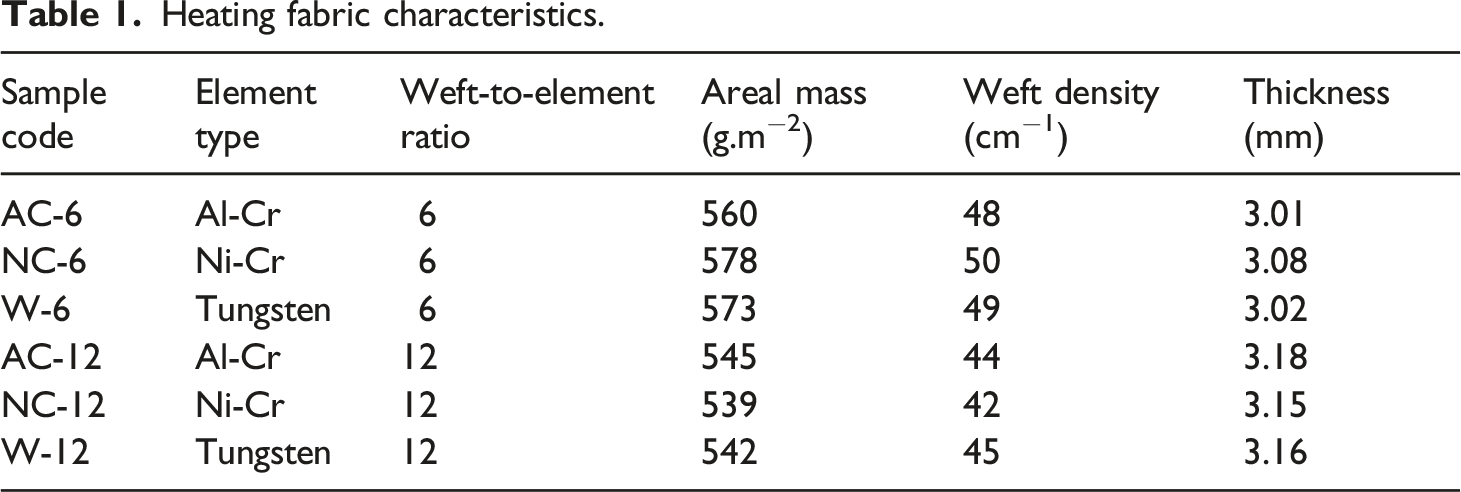
In this study, six types of three-layer warp stitched woven fabrics were designed and produced on a handloom mechanism with eight shafts in the way that the front layer and back layer fabrics had the Twill 2/2 weave pattern. Moreover, three kinds of heating elements consisting of Aluminum-Chrome (Al-Cr), Nickel-Chrome (Ni-Cr), and Tungsten (W) elements with a diameter of 0.1 mm were embedded in the middle layer as wadded weft. Furthermore, the existence of heating elements in the fabric structure had two settings of 6 and 12, which means that in a set of fabrics after 6 weft yarn insertions and in another set of fabrics after 12 weft yarn insertions, and one heating element was inserted in the fabric. It should be noted that both warp and weft yarns of surface layers were acrylic with the count of 24/2 (Nm). The weave structure and also the fabric’s front and back images are shown in Figure 1. In this Figure, the red and blue squares represent the front and back surface layer yarns, respectively. The green squares are the position of the warp stitches between the surface layers and the yellow squares point to the positioning of the wadded heating element. Weave structure and the images of three-layer heating fabric. (a) Weave structure-weft-to-element ratio 6, (b) Weave structure-weft-to-element ratio 12, (c) Fabric’s front surface, (d) Fabric’s back surface.
As it is apparent in the fabric images, in this structure, the heating elements are completely covered by the fabric’s front and back layers. Therefore, the elements are not in direct contact with the skin and this structure can solely be utilized on bare skin.
Heating fabric characteristics.
Thermal conductivity assessment
The thermal conductivity of a textile material is a prominent feature for the evaluation of the performance of the fabric, especially with regards to the comfort aspects, in different environmental conditions. Based on the existing standard testing methods for the estimation of the fabric’s thermal properties, first, the thermal insulation of the fabric should be measured. The thermal insulation or in other words the thermal resistance properties of the produced three-layer heating fabrics were evaluated based on the BS 4745 standard test method using the Tog-meter testing apparatus and by the utilization of the two-plate scheme, as shown in Figure 2. Two-plated Tog-meter instrument.
From this experiment, the value of thermal resistance (Rf) is calculated from equation (1).
Rair: The thermal resistance of the air; Rair is the thermal resistance caused by the presence of the air between the standard and top plate, so the test for evaluation of Rair was done without placing any fabric between the mentioned plates and was calculated from equation (2), where T′ are the temperatures in this situation. 
By defining the thermal resistance of each sample, the thermal conductivity (K) can be calculated from equation (3)
Heat flux and temperature measurement device and evaluation method
In order to evaluate the heating performance of three-layer heating fabrics such as the maximum heat flux and maximum temperature, the heating sensor (FHF02SC), which had the ability to measure both temperature and heat flux at the same time, was employed. The output value of the sensor is voltage and the maximum heat flux is calculated according to the following equation (4)
The measurement equipment for the mentioned test is shown in Figure 3. Heat flux and temperature measurement equipment. (a)voltmeter, (b) digital power supply, (c) Heat flux sensor, (d) Thermocouple type T.
In this experiment, the three-layer heating fabrics were subjected to electrical current for 10 min at two voltage levels of 9 and 12 (V), while the sensor was situated between the fabric and an insulated surface.
Based on the data obtained from each test, besides the heat flux of the produced fabrics, it was possible to estimate the electrical resistance (Ω) of the heating fabric from equation (5)
Moreover, the input power (W) is calculated from equation (6)
It should be noted that the output power in this case, is the measured heat flux (W/m2) multiplied by the sample surface area. Therefore, the thermal efficiency was calculated from equation (7)
Results and discussion
Thermal conductivity of the heating fabrics
The thermal conductivity of fabrics is related to the fabric’s structural parameters and more importantly, the thickness of each structure. In this study, the thermal resistance and the thermal conductivity of heating fabrics were measured to investigate the influence of the heating element’s type and presence on the thermal properties of fabrics. Besides, the values of thermal conductivity would be utilized in the assessment of the efficiency of heating fabrics by consideration of thermal comfort aspects in various environmental conditions, which will be analyzed in the following sections.
Thermal resistance and thermal conductivity of three-layer heating fabrics.
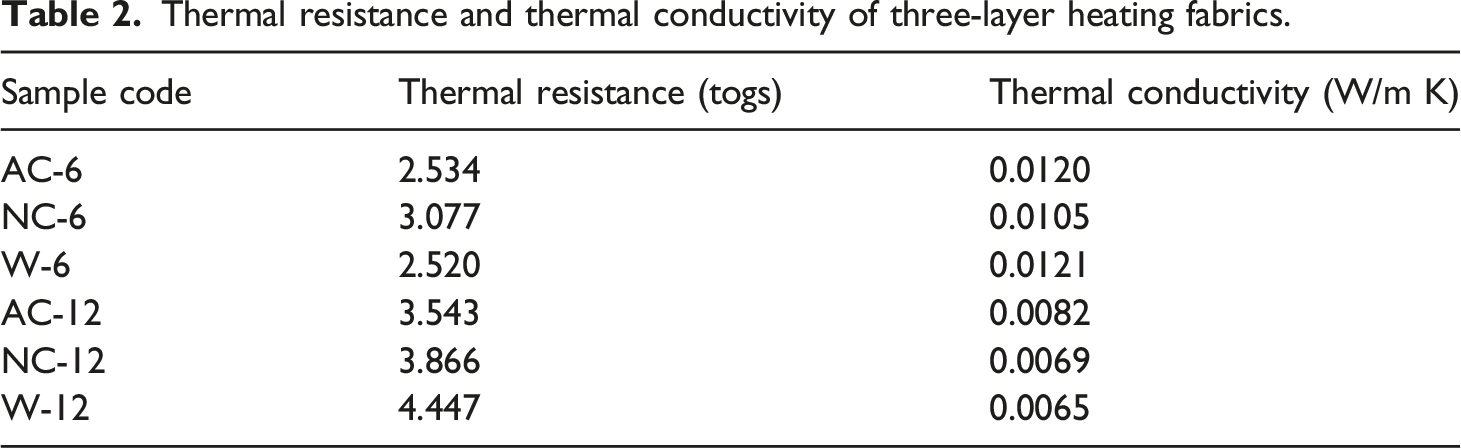
According to the results shown in Table 2, it seems that the element type and also the weft-to-element ratio did not affect the thermal resistance and the thermal conductivity of the studied fabrics. Therefore, statistical analysis of results using the ANOVA test was carried out at the confidence range of 95% and it was confirmed that the element type (p-value= 0.66) and weft-to-element ratio (p-value= 0.62) did not have a significant influence on the thermal properties of heating fabrics.
It has to be considered that the thermal conductivity of fabric is mainly affected by the fabric thickness, bulkiness, and also the ability of the fabric to entrap air inside the structure. By considering the values of different fabric’s thicknesses, it is obvious that the type of element the presence ratio of elements did not affect the fabric thickness and thus the thermal properties of fabrics. Besides, all the elements was of similar fineness and very fine compared to the acrylic yarns, so it can be declared that the thermal insulation characteristic of fabrics were remained approximately identical, which is necessary for the sole evaluation of their heating ability in various environmental conditions.
Heat production procedure in three-layer heating fabrics
The heat production procedure of the studied three-layer heating fabrics is of great importance during the analysis of their heating performance. Therefore, in this part, the heating trend of fabrics that were subjected to different amounts of voltages was probed and the effects of element type and weft-to-element ratio on the heating process were evaluated.
In Figure 4, the heating trend of various fabrics can be observed through the temperature–time diagrams of two different voltages. It should be noted that all tests were carried out for 10 min. Heating process of different fabrics at various voltages.
According to Figure 4, it is clear that the highest recorded temperature belongs to the Tungsten (W) element, followed by the aluminum-chrome (AC) and the nickel-chrome (NC) elements. Moreover, it can be declared that the heating trend during the passage of time is different while different element types were incorporated in the fabric. In case of utilizing the tungsten element, at about the first 150 s of the experiment, the temperature rises with an approximately sharp slope and after that, there is a gradual increase until reaching a constant value. While for the nickel-chrome element, the temperature increment has a slight trend and at the last 150 s of the test, it remained almost constant. However, the diagrams obtained for the aluminum-chrome element point to nearly steady variations of temperature during the testing process. As an example, for the element-to-weft ratio of 12 and a constant voltage of 12 (V), the rate of temperature increment for the tungsten element was 2.34 (°c/min), which was higher compared to nickel-chrome and aluminum-chrome elements with the rates of 0.76 (°c/min) and 0.42 (°c/min), respectively.
In addition, from Figure 4, it can be observed that when the applied voltage to the fabric increases from 9 to 12 (V), the maximum recorded temperature for each heating fabric becomes more. The mentioned increasing trend is more evident for the tungsten element compared to the two other elements.
Evaluation of heating temperature, flux, and efficiency
Maximum produced temperature and heat flux at two voltage levels.
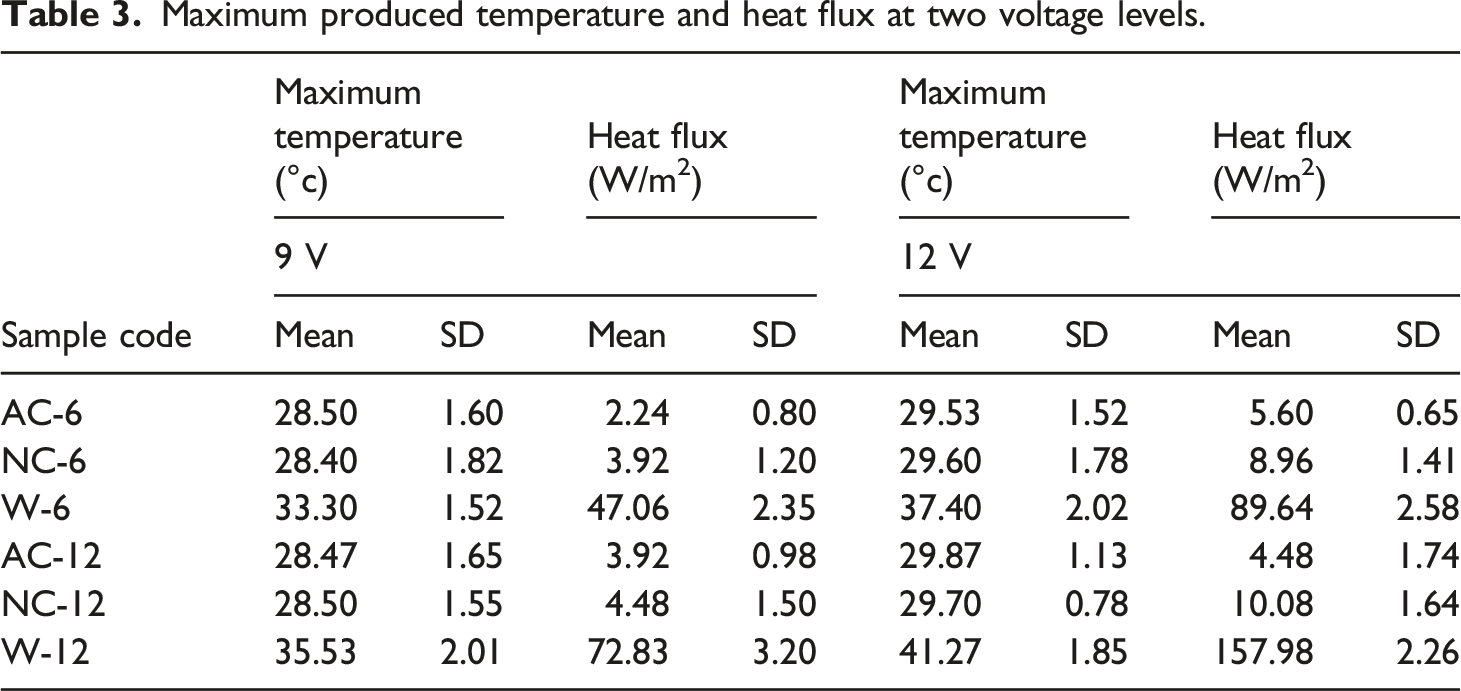
The obtained maximum temperature can considerably affect the application of the produced heating fabric. In this regard, in the current section, the maximum generated temperature by each of the produced fabrics with different structural parameters were analyzed and compared (Figure 5). Maximum temperature recorded for various fabrics at two different voltages.
As it is clear in Figure 5, in comparison of the effect of element type on the maximum generated heat, the highest value was obtained for the Tungsten element. It should be noted that the maximum recorded temperature for Ni-Cr and Al-Cr elements were almost similar.
Besides, the charts shown in Figure 5 points to the fact that for each element type, the heating fabrics with the weft-to-element ratio of 12 exhibited higher temperature values compared to weft-to-element ratio of 6. This increase is related to the lower length of elements for fabrics with a weft-to-element ratio of 12. Based on equation (5), decreasing of the element length would result in an increase in the electrical current and therefore, the temperature value rises. Moreover, it is evident that by increasing the amount of applied voltage from 9 to 12 (V), the maximum temperature showed a rising trend. The growth of the maximum temperature regarding the voltage was more considerable in the heating fabrics consisting of Tungsten elements.
Statistical analysis of results using the ANOVA test, evaluating the effect of the produced heating fabrics’ structural parameters on the maximum temperature, at the confidence range of 95%, reveals that the mentioned temperature is significantly influenced by the mentioned structural parameters. Based on the results of post-ANOVA test (Duncan), it was confirmed that the Al-Cr and Ni-Cr elements did not have a significant difference in generating the maximum temperature.
The heat flux of the heating fabrics is another prominent feature that determines their efficiency when used in different end-uses and conditions. The comparison of the obtained heat flux of the produced three-layer fabrics is exhibited in Figure 6. Heat flux of various fabrics at two different voltages.
According to Figure 6, it can be declared that the heat flux of the fabrics consisting of tungsten elements is not comparable with the two other elements and it is much higher. Among the fabrics containing the Ni-Cr and Al-Cr elements, the values of the heat flux for the Ni-Cr element is more than the Al-Cr, but the difference between the heat fluxes of these two elements is slight. Therefore, it can be declared that the tungsten heating fabrics have the best heating performance compared to other fabrics.
In consideration of the influence of the weft-to-element ratio on the measured heat flux, it is observed that for all element types and at both voltage levels, when the weft-to-element ratio is lower, the value of heat flux diminishes. The mentioned declining trend is due to the increase of the heating element length in a unit area of the heating fabric. When a specified voltage is applied to the fabric with a higher length of the element, the electrical current (A) decreases; thus, the heat flux of the fabric reduces.
In addition, an increment of the applied voltage from 9 to 12 (V) would result in a rise in the amount of generated heat flux. In the case of Ni-Cr and Al-Cr element, the variation of the heat flux due to the alteration of voltage and the weft-to-element ratio is slight, while for the fabrics containing tungsten element a considerable change in the value of heat flux is apparent.
ANOVA results for the influence of different parameters on the heat flux.

Evaluation of the heating efficiency and the electrical resistance of the fabrics
As it was mentioned earlier in the text, the heating efficiency of the three-layer heating fabrics is the rate of the output power from the fabric to the input power to the system. The heating efficiency is a measure of the effective performance of the system. In this regard, in order to be aware of the efficiency of the heating system, it was necessary to calculate and analyze the heating efficiency in the produced fabrics from equation (7).
Maximum temperature, electrical resistance and heating efficiency of fabrics subjected to constant input flux of 100 (w/m2).

According to the results shown in Table 5, it can be observed that among the tested fabrics during the application constant input flux, the fabrics consisting of tungsten element had the lowest electrical resistance followed by Ni-Cr and Al-Cr elements. Moreover, increasing of the weft-to-element ratio would lead to a reduction of the electrical resistance of the fabrics. Therefore, it can be declared that the W-12 had the best heating performance compared to other fabrics. Since the input flux for all fabrics were similar, it is possible to state that the W-12 fabric produced higher amount of temperature and heat flux by consuming lower extent of voltage due to its slight electrical resistance. Thus, the optimum heating fabric structure belongs to the W-12 sample.
Simulation of the heating performance of fabrics in different ambient temperatures
The designed heating fabrics are considered to be used in cold weather environments. In this regard in this study, it was intended to evaluate the heating performance of these fabrics when used in the skin in cold weather condition, and by consideration of the thermal comfort of the fabric’s consumer.
The schematic of the heat transfer phenomenon of the produced heating fabric when used on the skin in cold weather conditions is shown in Figure 7. Heat transfer schematic of the heating fabric.
Tskin is the skin’s surface temperature, Tsur is the heating fabric’s surface temperature, and Tamb is the ambient temperature. 
Therefore, it is desired to calculate the heat transfer rate from fabric to the atmosphere by equation (9).
Since it is important to consider the area of fabric from which the heat transfer occurred, the heat flux (Fambient) from the fabric to the atmosphere was estimated from equation (10).
As it was stated in previous researches, 23 the body heat transfer flux (Fmetabolism) to the environment due to the metabolism activities in case of resting and very light physical activities was considered around 80 W/m2. Besides, during the sensation of thermal comfort, the human skin’s surface temperature is approximately 34 °C.
From equations (8) and (10), the fabric’s heat flux in which the human thermal comfort is preserved can be calculated from equation (11).
The calculation was performed for two levels of ambient temperature, including −5 and −10 °C.
In order to calculate Fambient according to equations (9) and (10), first, it is necessary to calculate the fabric’s surface temperature (Tsur), which can be obtained from equation (12), in case of the desired value of Fmetabolism (in our case 80 W/m2).
Surface temperature and calculated ambient and fabric heat flux (w/m2).

Based on the obtained results (Table 6), the minimum required heat flux of each of the produced fabrics to preserve the human thermal comfort is observable. By comparing these results with the measured heat flux of fabrics at different voltage levels that are shown in Figure 6, it can be concluded that only the heating fabrics consisting of tungsten elements have the ability to meet the heat flux requirements for the maintenance of the consumers’ thermal comfort. The best voltage level for the desirable thermal comfort is 12 (V) that can provide the required fabric heat flux at both temperatures of −5 and −10 °C.
On the whole, the most preferred heating fabric is the one which can supply the necessary heat flux for maintenance of the body thermal comfort, with a lower level of fabric’s heat flux and surface temperature. The lower the value of heat flux, the lower the energy consumption of the system. Therefore, it can be concluded that the optimum heating fabric among the designed and produced fabrics is the W-12 sample.
Conclusion
Application of heating fabrics in order to protect human body against heat loss in extremely cold weather conditions has to be considered instead of using heavy and thick clothing. In this study, six types of three-layer warp stitched woven fabrics, in which the heating elements were completely embedded in the middle layer was designed and produced and their heating performance with regards to the human body thermal comfort was analyzed. In the designed fabrics, three types of heating elements, including the nickel-chrome, aluminum-chrome, and tungsten, were embedded with two weft-to-element ratios of 6 and 12. The analysis was carried out while the fabrics were subjected to two voltage levels of 9 and 12 (V).
In order to assess the heat production performance of the fabrics, according to the obtained results, it was concluded that by increasing the voltage level from 9 to 12 (V), the values of heat flux and the maximum temperatures were incremented for all fabric structures. The mentioned growing trend was more evident for the fabrics containing Tungsten compared to the other elements. Moreover, it was observed that the fabrics with the weft-to-element ratio of 12 had higher temperature and flux. Statistical analysis of results also revealed that the parameters such as element type and presence ratio have a significant influence on the heating performance of the fabrics (significance level α = 0.05).
In addition, the heating efficiency of fabrics was evaluated when subjected to equal input power and it was noticed that the fabrics which produced higher levels of temperature and heat flux had better heating efficiency, as well.
Finally, by consideration of the thermal comfort condition of the human body, the heating performance of fabrics was simulated at two ambient temperatures of −5 and −10 °C. Based on the achieved results, it was concluded that the optimum heating fabric is the fabric that can maintain the body thermal comfort while having the lowest heat flux. Therefore, the W-12 sample was determined as the optimum heat-generating fabric.
Footnotes
Declaration of conflicting interests
The author(s) declared no potential conflicts of interest with respect to the research, authorship, and/or publication of this article.
Funding
The author(s) received no financial support for the research, authorship, and/or publication of this article.
