




Abstract
In this study, the primary goal is to utilize the biological waste of water hyacinth (Eihhornia crassipes) plant fiber–reinforced polymer composite materials for commercial applications, especially for lightweight materials aspects. In this work, the physical, mechanical (tensile, flexural, and impact), thermal, and morphological properties of water hyacinth natural fiber composite samples are investigated. We strongly believe that only a minimum amount of work has to be done to this water hyacinth fiber composite oriented. Especially all the previous literature reported the hyacinth fibers are extracted from the retting process and manual method. But, in this work, hyacinth fibers are extracted from the new novel mechanical way of the extraction process. From the results of chemical analysis, water hyacinth fiber contains a very high 62.15% cellulose content and a minimum amount (14.82%) of hemicellulose content. The crystallinity index of water hyacinth fiber composite is 54.82%. The surface of the hyacinth composite is examined with the help of a scanning electron microscope. The thermal degradation of hyacinth fiber composite is measured with the help of the thermogravimetric analysis method. Based on the final experimental results, the water hyacinth natural fiber composite is the better alternative for other traditional fiber composites and it is strongly recommended for lightweight material applications.
Keywords
Introduction
Decreasing the negative impact of environmental conditions now researchers focus on natural fibers as a reinforcement material compared to synthetic fibers. 1 Natural fibers are lavish and copious. Particularly it is extracted from aquatic plants so it is easily growing up. One of the fastest-growing characteristic aquatic plants is water hyacinth (Eichhornia crassipes), which belongs to the pontederiaace family. This plant easily covered up the entire water surface within some days. It is the very worst behavior of hyacinth plants to create an unnecessary condition for water bodies and local peoples. Hyacinth plants mainly originated in the Amazon basins, Brazil. 2 A huge amount of high-growth natural fibers are not yet used in commercial products because of rapid growing characteristics and thick mats. Normally, water hyacinth produces thick dense mats to the water surfaces. It contains the bulbous stem. The bulbous is the main reason the plant floats on the upper surface of the water bodies. 3 Water hyacinth presents in the water it creates a nuisance problem for the local body peoples and aquatic animals. Because the plant fully occupied the water surfaces, even the sun rays will not penetrate and go to the below the level of water. So, automatically the other aquatic animals die due to lack of sun rays. It blocks the water to canals, ponds. Mainly water departments, fishing, irrigation, tourism departments are severely affected by these water hyacinth plants. 4 From the presence of water, the hyacinth parent plant stem contains more masses and it gains more amount of cellulose contents. But, after the cultivation process, it loses its own masses. With the presence of water, hyacinth produces daughter plants and seeds. This seed withstands nearly 20 years. From the consideration of outside of the native range, it is very highly problematic. Conventionally this plant rises above the water at 1m height. It reproduces the daughter plants by the way of runners or stolons. Hyacinth plant reproduces sexually or clonally. These flowers are classified as long, medium, and short concerning the stems. The medium size of hyacinth morph occurred frequently and the long type morph occurred in some periodicals only and the short type morph rarely occurred.
The effect of temperature also plays a very important role in the water hyacinth plant growth range. 5 If the temperature range is 12°C it is the minimum growth temperature of the water hyacinth plant. This minimum temperature maximum is used in home gardens. Rezania et al. 6 and Cifuentes et al. 7 noted the optimum growth temperature is 25–30°C. Most of the tropical and subtropical region waterbodies maintain at this level temperature than the hyacinth plant-covered effetely all over the water surfaces. The maximum growth temperature of the water hyacinth is 33–35°C. At this temperature hyacinth leaves and stems lose the water molecules due to evaporation and high sunlight. Automatically the plant growth is stopped by sun rays. In most of the dessert places, this situation occurs. 8
Water hyacinth plant petioles have nitrogen-fixing bacteria. But they do not fix nitrogen until it is facing the deficiency of nitrogen. If the salinity percentage was greater than 15% the hyacinth plant is not withstood to live on the water bodies. But, if the plant is present in water it heavily reduces the salinity, dissolved oxygen, total dissolved solids values. Compared to the standard water hyacinth present water samples are heavily affected by this plant. 9 Conventionally hyacinth dried plant fibers are used as a braiding material. And it is used for the production of decorative materials, bags, and footwear. Plant dried stem particles are used for the production of furniture and it is a better alternative to plywood and medium density fiberboards. From the higher amount of nitrogen content, this hyacinth plant is used for substrate of biogas production and from foreign countries, this plant is used as animal feed. 10 If the hyacinth plant is not controlled then the entire lake, ponds are affected by this plant to block the sun rays and water. It depletes the dissolved oxygen level and rottenly killed fish. Water hyacinth plant rottenly creates mosquitoes production nearby water bodies, snail fever, and new diseases. 11 It creates a physical imbalance and changes the entire mechanical, physical properties of man-made reservoirs.
As a result of their toughness and durability, water hyacinth fiber products can last up to three to 5 years. Market trends can be adapted to any form according to market trends. A variety of products are made from water hyacinth fiber, including baskets, furniture, and women’s purses. The stems of the water hyacinth, one of the main raw materials used to produce water hyacinth fiber, are known to be tough and flexible at the same time. The properties of water hyacinth fibers allow them to be woven into any form that can be envisioned. Natural water hyacinth fiber has a golden brown color, but various natural and chemical dyes can be added to make the artwork even more vibrant. Decorative products can be constructed solely out of the fibers of water hyacinth.
This study focuses on the characterization and utilization of water hyacinth plants to make lightweight material products using aquatic wastewater hyacinth plants (Eichhornia crassipes). In this work, the hyacinth fibers are extracted from a novel extraction method. This study investigates the mechanical properties, single fiber tensile strength, X-ray diffraction, Fourier transform infrared imaging, surface morphology and elemental analysis of the water hyacinth plant reinforced composite samples. Based on this study findings, the hyacinth fiber composites are strongly recommended to use for commercial and house holding applications.
Materials and methods
Materials
The hyacinth plants are collected from the local water bodies nearby Trichy district lakes, Tamil Nadu, India. Once the plants are collected then it is separated by its parts. The secondary materials epoxy and hardener is purchased at Covai Seenu & Company, Tamil Nadu, India. The epoxy matrix material and hardener, when analyzed at 25°C at 10.000 mPa, 10 mPa and 0.97 g/cm3, have viscosities of 1.15 g/cm3 and 0.97 g/cm3. (Figure 1) Water hyacinth fiber composite methodology.
Methods
Water hyacinth fiber extraction process
Water hyacinth (Eichhornia crassipes) plant is initially identified in southern zones of Tamil Nadu, India. Especially from the Tiruchirappalli district, the hyacinth plant is covered by most of the ponds, lakes, and water bodies. From the beginning stage, the hyacinth plant is collected from the water bodies. After that, the plant is separated by its parts like hyacinth stem, leaf, petioles, and roots. By utilizing the plant stem water hyacinth fiber is extracted. Normally this hyacinth plant stem is 2–3 m long with a spongy leaf and purple flowers.12,13
Hyacinth fiber is extracted from the parent plant stem in this study using a novel mechanical extraction method. This method uses 0.5HP electric motors (bare motors), monoblock bearings, two alternative shafts, one permanent shaft with fully threaded mounting bolts, and flat rods in the length of 55 cm to construct the mechanical way of extraction machine. With this mechanical way of extracting fiber, the fiber quantity is increased and the wastage is reduced by up to 80%. By using this machine, the original length of the fiber is derived from the plant stem. The previous works done by hyacinth plants and other natural fibers have been left to the retting process and manual methods only. However, we use a novel mechanical extraction machine in our work. Our firm belief is that no mechanical extraction work has to be done on the water hyacinth plant before.
Physical and chemical analysis of water hyacinth
The cellulose, hemicellulose, lignin, ash, and moisture contents of the water hyacinth plant are identified with the help of Tamil Nadu Agricultural University, India with AOAC: 2025 method. The diameter of the hyacinth plant is measured with the help of an optical microscope with five different places of 25 average values with 40x resolution. The plant fiber density is also measured with the help of room temperature. 14
Composite preparation
The hyacinth plant fibers are extracted from the plant stem with the novel mechanical extraction methods. Then the secondary materials epoxy and hardener is mixed with 10:1 ratio. The reinforcement fiber material and secondary materials are combined with different weight percentages. The different combinations of primary and secondary phase materials are poured into molding plate with dimension of 300 × 300 × 3 mm. The mold is placed into the compression molding machine with the specification of 100°C upper and lower plate temperature with 1500 lbf/in2(Pounds per Square Inches).
Mechanical testing
Water hyacinth plant fiber is mixed with epoxy resin matrix material with hardener on different weight percentages. And the sample is pressed with a hot pressing compression molding machine. After the fabrication of water hyacinth natural fiber composite then the sample tensile, flexural, impact strength is identified with the help of a Universal testing machine, Charpy impact test machine with the particular ASTM standard. From each test, three samples are tested and the average value is reported to the final results. In this, work for tensile strength ASTM D3039, flexural test ASTM D790, and impact test ASTM D256 standards are followed. Tensile and flexural tests are conducted a KALPACK universal testing SR 121,101 machine at the LMD laboratory, Tamil Nadu, India
Water and chemical absorption test
The water hyacinth composite sample is put into 100 mL of water and NaCl, NaOH chemical samples with the standard ASTM dimensions and procedures. The composite sample is continuously measured for up to 60 h. Up to 10 h the final values of the composite sample are monitored every 2 hours. The remaining 50 h every 5 h’ sample weight is monitored. All the water and chemical absorption tests followed by standard ASTM standards on ASTM D570 and ASTM C413.
Single fiber tensile strength
Water hyacinth natural fiber is loaded with INSTRON universal testing machine with different lengths of hyacinth fiber. 25 fiber samples are investigated at a varying length of the fiber and the values are noted. This single fiber tensile strength is carried out at 65% relative humidity, the atmospheric temperature of 21°C, 0.1 N preload, and 30 mm/min test speed with ASTM D3822-7 standard.
X-Ray diffraction method
Water hyacinth reinforced with epoxy composite on different weight percentage composite samples crystallographic structure and phase, the physical characteristic of the hyacinth composite is analyzed by using this method. This test is conducted by utilizing an X Pert Pro diffractometer with the 0.154 nm radiation wavelength. The two theta step size of 0.05° with maintain 10°–80° operating range
Crystallinity index, size
With the help of the XRD peaks diagram the crystallinity index and degree of crystallinity to the type of materials like cellulose, hemicellulose is identified with an empirical equation. 15
CI = I200-IAM/I200
I200 indicates the maximum intensity of 200 lattice planes between 20°to 23°on 2theta angle.
IAM indicates the amorphous or another phase of the material intensity calculated by the height of the peaks.
Fourier transform infrared spectroscopy method
The chemical functional group of water hyacinth fiber composite is identified by utilizing the Fourier infrared spectroscopy method. A small quantity of hyacinth fiber composite samples are powdered and then prepared to the pellet form. Shimadzu spectrometer (FTIR-8499S) is utilized to pick the FTIR spectrum of the fiber samples to the range of 4000-500 cm-1 with 32 scans and a resolution of 4 cm-1.
Thermo gravimetric analysis
The thermogravimetric analysis test is used to identify the thermal degradation of the different weight percentages of hyacinth composite sample by weight loss with the help of Jupiter thermal analyzer (STA 449 F3). This analyzer accompanies by a furnace which crucible is supported by accurate balance. Consistently sample is heated with the temperature range of 10°to 600°C with the heating rate of 10°C/min. Nitrogen gas is delivered to the furnace with a 20 mL/min flow rate. 16
Scanning electron microscopy
Water hyacinth natural fiber composite surface is investigated by utilizing the TESCAN electron microscope. Failure samples of mechanical testing is adopted this surface investigation process. This electron inspection is performed with 3 kV acceleration with different magnification. The impurities, external contents are monitored by this method.
EDX Analysis
By utilizing the Field Emission Gun Scanning Electron Microscope, the presence of chemical elements to the fiber is investigated and expressed in weight and atomic percentage.
Result and discussion
Physical and chemical analysis of water hyacinth
Normally, the chemical composition of the natural fibers is decided on the mechanical, biodegradable, and fire-retardant properties. The amount of cellulose content improves the mechanical strength especially tensile strength and modulus of the fiber.17–19 But, the amount of hemicellulose content decreases the tensile and flexural strength of the fiber. This water hyacinth (Eichhornia crassipes) plant fiber contains a high amount of cellulose content (62.15%) and a minimum amount of hemicellulose content (14.82%). The minor amount of hemicellulose content is one of the reasons for the structure of the water hyacinth fiber. Comparing to the other natural plant fibers water hyacinth contain a minimum amount of wax content (0.35%). This wax content increases the bonding property of the epoxy matrix material and hyacinth fiber reinforcement. The density of the water hyacinth fiber is 1.33 g/cc at room temperature clearly explains this hyacinth plant is suitable for lightweight materials and commercial particle board applications. The diameter of the hyacinth fiber is 0.3965 mm. Figure 2(e) and (f) clearly explains the water hyacinth diameter. Table 1 clearly explains the physical, chemical, thermal, and other properties of the natural fibers.20,21 (a) Water Hyacinth PLANT, (b) WH petiole, (c) WH stem, (d) WH extracted fiber, (e and f) WH fiber optical microscope image. Physical, Chemical properties of WH plant fiber and other natural fibers comparison.

Mechanical Testing
Water hyacinth natural fibers are extracted from the parent plant then it is mixed with epoxy resin matrix material with different weight percentages. This hyacinth fiber length is 10 mm. The matrix and hardener standard is LY556 and HY951. Matrix and hardener are mixed with a 10:1 ratio. The hyacinth fiber reinforcement is mixed with different percentages like 15, 20, 25, 30, and 35%. By utilizing the compression molding machine water hyacinth reinforced epoxy matrix natural fiber composite is produced. Then the sample is adopted to the tensile, flexural, impact test with the help of a universal testing machine, the Charpy impact test machine. The sample is cut into proper dimensions like tensile ASTM D3039, flexural ASTM D790, and Impact ASTM D256. The raw epoxy composite mechanical strength also investigated by using proper standard. The strength of the raw epoxy composite (10:1 ratios) is attained tensile 13.54 MPa, flexural 22.45 MPa, impact 0.10 J with respective thickness. The mechanical strength of the fiber is increased with respective weight percentages up to 30%. After 30% the mechanical strength is decreased when the reinforcement is increased. These results clearly explained the 30 weight percentage of hyacinth fiber reinforcement is suitable for light weight material applications. Adding higher hyacinth fiber reinforcement creates agglomeration effect to the primary and secondary phase of the composite sample. And, this agglomeration leads to de-bonding nature of the primary fiber reinforcement and epoxy secondary material. Based on the mechanical strength results this, hyacinth fiber composite sample mechanical strength is higher than the sisal, coir traditional composites.22,23 Figure 3 explained the tensile, flexural, impact strength of the water hyacinth natural fiber composite.(Table 2). (a) Tensile test, (b) Flexural test, (c) Impact test, (d) Absorption test. Water hyacinth fiber composite statistical data.

Water and chemical absorption test
Water hyacinth natural fiber composite sample is tested with water and chemical absorption test with suitable ASTM D570 and ASTM C413 standards. The main intention of this work is to using biological waste of the water hyacinth plant in to a successful commercial product with higher mechanical strength. Figure 3(d) clearly explains the water, chemical NaCl, NaOH absorption test of different weight percentage samples like 15–35%. Initially, the hyacinth composite sample absorbs a very minimum amount of water because of the fiber hydrophilic nature and the continuous monitoring results declared the samples attain constant weight after the particular period of time. Figure 3(d) explains the water, chemical absorption behavior of water hyacinth composite sample for lightweight commercial applications. 24 Based on the absorption tests, it appears that both water and chemical solutions are not significantly affecting the composite. Since the samples contain fibers, they initially absorb only a small amount of water and chemical solution. Eventually, the weight of the sample increases as the solution is absorbed. During a certain period of time, the fibers become saturated, and they stop absorbing water and chemicals and reach saturation point. The weight values of a composite sample do not change after it reaches a saturation weight percentage, they remain constant. As a result of the final tests, the hyacinth fiber–reinforced composite samples absorb only a small amount of water and chemical solution.
Single fiber tensile strength
Extracted water hyacinth plant single fiber tensile strength.

X-Ray diffraction method
Water hyacinth plant composite structural X-ray diffraction patterns are identified with the help of the X-ray diffraction method. Conventionally this method is used to recognize the amorphous and crystalline phases of the material. Figure 4 shows the diffraction pattern of hyacinth fiber perfectly defined crystalline peak 2theta at 14.98°(1 1 0) and 21.2°(2 0 0) which indicates the cellulose groups I and IV. These groups identified the FTIR spectrum also. The crystallinity index of water hyacinth fiber composite is calculated at 54.8% with the help of peaks. The crystallinity index is calculated with the help of deconvolution method by using formula method. These higher crtytsallinity index leads to increasing the mechanical strength of the composite samples. By having hemicellulose in the sample, C=O groups are eliminated from the sample. There was a significant increase in cellulose content in the reinforcement fibers in the samples with high intensities. Raw water hyacinth fibers have the remaining peaks. Figure 4(a) hyacinth fiber cellulose content is identified with the help of a sharp curve of diffraction patterns.26,27 (a) XRD, (b) FTIR Spectrum of WH composite.
Fourier transform infrared spectroscopy
Figure 4(b) exhibits the FTIR spectrum of water hyacinth fiber composite with the wavenumber of 4000–500 cm-1. The different wavelength spectrum recognizes the cellulose, hemicellulose, lignin, and chemical functional groups. The peaks 3100 to 3800 cm-1 like 3718.76, 3633.89 cm-1 show the hydrogen single-bonded OH stretching. 2978.09 cm-1 peak affirms the carbon–hydrogen (CH) stretching because of a large amount of cellulose content of hyacinth fiber. Peak 2855.51 cm-1 shows the CH2 hemicellulose components. The peak 174.65 cm-1 shows the C–H bonding of hemicellulose to the fiber. The lignin content confirmation shows the peak of 1512.19 cm-1. CH2 bonding of cellulosic content shows a peak of 1388.75 cm-1. The peak 1026.13 cm-1 shows the carbon–oxygen and oxygen–hydrogen stretching. 28 Hemicellulose is present in the samples of hyacinth fiber–reinforced composites, thus dissolving C=O groups. Peaks in the cellulose content of the reinforcement fiber led to increasing peak intensities in composite samples. In raw water hyacinth fibers, the remaining peaks were observed.
Thermo gravimetric analysis
By utilizing the thermogravimetric analysis test the thermal stability of water hyacinth fiber composite is analyzed. From the water hyacinth fiber composite thermal stability, two stages of thermal degradation have occurred. The first stage of degradation started at 92°C due to the thermal decomposition of hemicellulose content of water hyacinth fiber. Another stage of thermal degradation started at 214°C because of α-cellulose. The first and second phase of thermal degradation percentage of water hyacinth natural composite is 45% and 36.5%. If the thermal degradation continuous more than 600°C is the indication of lignin structure to the complex position on an aromatic ring to the fiber composites. Figure 5(a) and (b) clearly explain the thermal stability and degradation percentage of water hyacinth fiber composite.
29
(a) TGA, (b) TG DTG curves of WH composite.
Scanning electron microscope
Water hyacinth fiber composite surfaces are investigated by utilizing scanning electron microscopy with a maximum of ×1000 magnification and the view field of 1.03 mm on MIRA3 TESCAN microscope. With the use of scanning electron microscope techniques, the surface of fiber–epoxy matrix composite samples made from extracts of water hyacinth plants is characterized in depth.
30
Figure 6 shows images of raw water hyacinth plant fiber–reinforced composite samples taken under the scanning electron microscope. Fig. 6(a) shows how the primary hyacinth fiber reinforcement is attached successfully to the secondary epoxy reinforcement. Both phases have been properly bonded at the fractured surface inside. In Figure 6(b) and (c), hyacinth fibers harden upon contact with the epoxy matrix material. Due to good bonding, the composite has achieved a high strength. Figure 6(d) demonstrates the epoxy and fiber phases in the composite. The higher fiber contents of the hyacinths did not properly mix, causing porosity in the composite samples as well as minor holes. Fibers and epoxy matrix agglomerate in Figure 6(e) and (f). As the hyacinth fiber content increases, the secondary phases begin to aggregate. This is the major reason for the decline in the mechanical strength of the composite sample.5, 31,32 (a–f) SEM images of WH natural fiber composite.
EDX Analysis
Figure 7 explains the EDX and elemental analysis of water hyacinth composites. This figure shows the compositional elements in the composites like carbon and oxygen and some other elements also presented.
33
The carbon content presented in hyacinth composites like 46.16% on a weight basis and 56.48% on atomic weight percentage and the oxygen element contains the hyacinth composite like 42.16% on a weight basis and 38.72% on atomic percentage. The fiber did not wash and chemically treated, it is directly mixed with a matrix material to extract from the parent plant. This is the main reason the magnesium, silicon, calcium, and sulfur elements present in a very minimum amount. If the fiber is properly washed before mixing of matrix material this minimum amount of other elements did not display.34–38 EDX analysis of water hyacinth plant composite.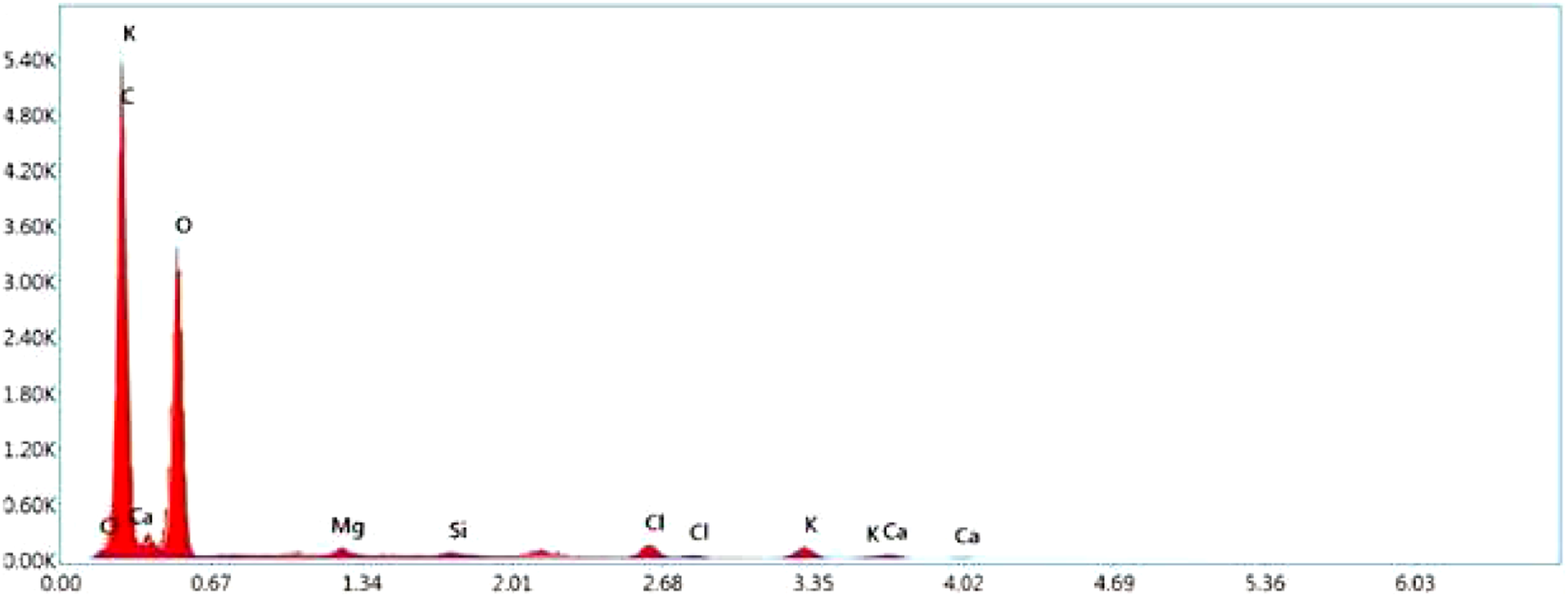
Conclusion
The physical, mechanical (tensile, flexural, and impact), and morphological properties of water hyacinth (Eichhornia crassipes) composite are investigated in this work. • The hyacinth plant fibers are extracted from the manually designed mechanical way of extraction machine in an effective way. Compared to the remaining extraction methods (retting, hot water boiling, and manual extraction) this mechanical-based method have gained 80% of efficiency. • A very large amount of cellulose content and a minimum amount of hemicellulose content of the fiber is a better option to use a better reinforcement of the matrix material and the composite mechanical strength also attained a very good result. • From the elemental mapping result, it is significant carbon and oxygen content is the main contents of the water hyacinth natural fiber composite. • The short water hyacinth fiber adhered to the matrix material and the composite surface is investigated with scanning electron microscopy. Some of the impurities are identified with the help of microscopy. • The density of the fiber is 1.33 g/cc and the density of the composite is 1.15 g/cc. This density is comparatively very minimum to the other artificial fibers. It is one of the best reasons to produce a lightweight material from the origin of water hyacinth natural fiber composite. • Based on the experiment results, the biological waste of water hyacinth plant fibers are the better reinforcement material of the polymer composite fields, and this hyacinth fiber–based composite is strongly recommended to lightweight materials and commercial product applications.
Footnotes
Declaration of conflicting interests
The author(s) declared no potential conflicts of interest with respect to the research, authorship, and/or publication of this article.
Funding
The author(s) received no financial support for the research, authorship, and/or publication of this article.
