




Abstract
The ever-increasing concern of air pollution triggered by broad-spreading contagious disease, bioterrorism, and release of dust particles in the air is targeted to be addressed in this paper by developing a novel personal respiratory equipment (PRE). For this purpose, polyamidoamine dendritic polymers (PAMAMs) were utilized not only for encapsulating tea tree essential oil (TEO), an antimicrobial material, but also for battling against perilous bioaerosols. Furthermore, TEO is encapsulated inside both PAMAM and polyacrylonitrile (PAN) electrospun nanofibers. Results clarified that electrospun samples containing both TEO and PAMAM possess thinner nanofibers with 440 nm reduction in their average diameter, and pursuantly higher filtration efficiency against both NaCl and paraffin oil mist particles about 98% and well above 99%, respectively. Herein, the electrospinning method is employed first for high porosity, enhanced surface area to volume ratio, and interconnected pores of resulted nanofibers, which are strongly useful in capturing the dust and allowing more air to flow and pass through, and creating a good air circulation. Second, the synergistic effect of using both electrospinning and PAMAM as the host molecules is also a promising approach for addressing the volatility of fragrances by producing a controlled release of TEO.
Keywords
Introduction
The air pollution which is defined as the release of either biological or chemical materials into the air culminates in adverse effects on residential, occupational, and ambient environments. 1 In this regard, an urge is emerged to introduce approaches capable of reducing people’s exposure to the ambient air pollution. Since the most hazardous airborne fine particles are likely to be PM2.5 (particulate matters with an aerodynamic diameter of 2.5 μm) and they are highly plausible to be captured via fibrous filters,2,3 facemasks are extensively deployed to reduce personal exposure. In fact, facemasks possess a considerable potential to abrogate the destructive effects of air pollution on people and alleviate some health issues such as cardiovascular events, heart disease, lung cancer, and so forth.4,5 On the other hand, a recent revolutionary improving trend of nanotechnology has emboldened the concern of air pollution and human exposure to nanoparticles. These particles might penetrate into the lower respiratory system because of their small size and cause detrimental effects on either the lung tissue or other target organs. 6 Moreover, the bioaerosols are akin to the nanoparticles in size and therefore their physical behavior in the air, 6 creating one of the greatest challenges in the field of producing facemasks. They could possibly accumulate in substantial quantities on filters in the filtration process and begin to reproduce under specific conditions, specifically the favorable presence of enough nutrients and moisture. Concomitantly, during the process of filtration, inorganic and organic materials tend to engage in microbial growth, culminating in filter media degradation, reduction in the filtration efficiency, and microorganisms and their byproduct aggregation and emission. In order to address the outlined obstacle, electrospun ultrafine fibers 7 and also antimicrobial air filters seem to be sustainable materials to be utilized in personal respiratory equipment (PRE). 6 Nanofibers have the advantage of owning improved chemical and physical properties compared to their bulk materials, along with their extremely good surface area, relatively high porosity, and small pore size.8,9 On the other hand, one of the prominent natural antimicrobial materials are essential oils (EOs) which are globally used fragrances obtained via extraction process of from flowers, fruits, herbs, and other plants. They are mostly known by their amazing features including antibacterial, antifungal, antiviral, and insecticides activities besides their pleasant odor. 10 Among various EOs, tea tree essential oil (TEO) possesses extensive economic potentials such as treating coughs and colds, remedy injuries when it is sprinkled on wounds after applying a poultice, and making an infusion, after being soaked, in order to treat sore throats or skin ailments. 11 Nevertheless, its antimicrobial activity has attracted the most attraction, 11 which is triggered by its antimicrobial components like terpenes and tertiary alcohols. 12 In fact, TEO is endowed with terpenoid hydrocarbons (monoterpenes, sesquiterpenes, and alcohols), more specifically, the terpineol-4-ol, terpineolene, α-terpinene, and 1, 8-cineole ingredients. 12 However, EOs’ volatility and insolubility in an aqueous system limit their application, and fragrant textile would be nominated for short-term goals. Encapsulation can be utilized in this situation to cover EOs as core material within a protective coating substrate to protect them from evaporation, reaction, and migration, or from external agents such as temperature, light, humidity, and oxidation, as well as controlling the release rate of EO. 13 An extensive range of commercially utilized encapsulation methods can be operated for fragrance encapsulation like spray chilling, spray drying or spray cooling, freeze-drying, extrusion, coacervation, and molecular inclusion. 13 However, in recent years, the fragrant capsules have been used immensely in textiles 14 to provide a durable existence and acceptable controlled release of EOs in textiles and diverse textile products such as fibers, fabrics, non-fabrics, and garments. 15 Herein, electrospinning is a sustainable technology for encapsulation, 16 owing to the fact that this is a relatively simple and inexpensive method for achieving submicron, high surface area, and nano-structure fibers from a wide variety of polymers17–19, and it is a potential solution for reducing the filter pressure drop and bulkiness. 20 In spite of the fact that conventional electrospinning technology tolerates the drawback of productivity limitation and the rapid burst release of embedded growth factors, the needleless electrospinning has been introduced to address these demerits by scaling up the production rate.21,22 Another promising way to control the release of EOs is usage of dendritic polymers because of their host–guest properties. 23 Tree-like structure of dendritic polymers consists of three basic components: one core, repeated units, and also multitude of surface functional groups, enabling them to act a host--guest molecule, in the favor of numerous functional groups besides hollow interior branches. More interestingly, amine-terminated dendrimers in pH below 7 are known as a biocide with desirable antibacterial activity belonging to their potential to bind to a negatively charged bacterial cell surface and disrupt cell membrane integrity. As an instance, 99.9% antibacterial activity of both Gram-positive and Gram-negative bacteria, S. aureus and E. coli, for the PLLA films modified with PPI-G2 dendrimer pertaining to the amine functional group takes place on the surfaces. 24 Deployment of second generation of polypropylene-imine (PPI) dendrimer culminated in long-lasting fragrant cotton fabrics with a much slower odor release compared to the samples without the dendrimer. 25
Herein, in order to manufacture the sustainable PRE, a long-lasting antibacterial fragrant face mask
26
was successfully obtained from needleless electrospinning of the solution containing polyacrylonitrile (PAN) as base polymer. PAN is widely used as a polymer in filtration manufacturing because of its desirable spinnability, and yields excellent mechanical and chemical resistant properties.5,8,19 TEO as bioactive antibacterial scent and PAMAM dendritic polymer as guest molecule for TEO inclusion were utilized. Concurrently, NaCl and paraffin oil mist particles were used to assess the produced RPE filtration efficiency against as aerosols with dispersed solid and liquid phase, respectively. BET technique was also employed in the purpose of samples-specific surface area evaluation. The antibacterial tests of manufactured samples against two common human pathogens, Gram-positive S. aureus bacteria and Gram-negative E. coli bacteria, were done as well. These manufactured nanofibrous facemasks can be used as a great PRE even in the alarming concern of the emergence pandemics.1,27 The whole process of PRE application and also evaluation is represented in Scheme 1 Manufacturing process of developed PRE.
Materials and methods
Materials
Polyacrylonitrile with Mw = 70 k Dalton was obtained from Polyacryl Co., Isfahan, Iran. As the polymer solvent for electrospinning solutions, N, N-dimethylformamide (DMF, 99.5%) was purchased from Merck. PAMAM dendritic polymer equal to second generation number was generously donated by Delta Co., Poland, abbreviated by PAMAM-G2 and was applied as a promising host–guest molecule. The tea tree essential oil (TEO) was received from Avicenna Company, Poland. All chemicals were used as received. The two outward protective layers of polypropylene spun-bond nonwoven layers with a weight of 25 g/m2 were utilized as an electrospinning substrate and top layer and were purchased from Baftineh Company, Iran.
Methods
Electrospinning procedure
The list and amount of different electrospinning solution components.

Fourier transform infrared spectroscopy
A Nicolet 670 Fourier transform infrared (FT-IR) spectrophotometer in the absorbance mode was used for FTIR analyses on all the samples in order to analyze the chemical alternations of neat PAN electrospun fibers in the control sample. The sample holder was cleaned with acetone, and immediately after that each flattened sample was solely placed on a KBr substrate and on the sample holder. To perform a valid evaluation of chemical changes in PAN electrospun nanofibers, the FTIR spectra for each sample were compared to the control sample. All of the sample spectra normalized by dividing the intensity of each spectra in all points to its intensity at 2240 cm−1 assigned to the stretching mode of –C≡N in PAN 8 by considering the PAN FTIR spectra as the reference.
Water drop contact angle
The degree of hydrophilicity of the given surface was determined by measuring the contact angles of water according to ASTM standard D 724-99 for the purpose of understanding the chemical functional effects of active agents on samples wettability
Samples preparation for filtration efficiency
Fourty pieces with the dimension of 15 × 15 cm2 of each sample were cut while 20 of them were considered for NaCl and the latter 20 for paraffin oil mist test. From each of the 20 samples, 10 were tested directly which were named new sample; however, the other 10 of them were conditioned according to EN143/149 in the following order: 1. 24 h in a heating chamber at 70 degree centigrade and 0% relative humidity; 2. 1 h at room temperature; 3. 24 h in a fridge at −30 degree centigrade and 0% relative humidity; 4. 4 h at least in room temperature before the first test; and 5. it is necessary to be cautious not to cause a thermal shock to samples.
All measurements have been taken for new and conditioned samples, respectively.
Filtration performance of samples against paraffin oil mist test
For filtration performance of electrospun nanofibrous mats evaluation against aerosols with dispersed liquid phase, 10 new pieces and 10 pre-conditioned ones from each sample were tested according to EN 143 standard. As stated in EN 143 for breathing filters, samples were placed in an FH 143/149 pneumatic holder with a diameter of 100 mm. Concurrently, the paraffin oil mist aerosols with 0.4 μm of diameter, generated by an Aerosol Generator AGW-F/Type BIA generator, were passed at a flow rate of 95 L/min through samples. A Lorenz AP2E laser photometer was utilized to gauge the aerosol concentrations upstream and downstream of the tested samples pursuant to EN 143/149 standard.30,31 The results of these experiments were also investigated with the statistical analysis at 95% confidence by comparing the obtained efficiency for sample P with all the other modified samples, namely, PT, PG2, and PTG2.
Filtration performance of samples against sodium chloride
Filtration efficiency of electrospun nanofibrous mats against aerosol particles was assessed using sodium chloride (NaCl) aerosol with the 0.6 μm diameter with a solid dispersed phase as stated in the European standards concerning FFR requirements and testing. Each of 10 new pieces and 10 pre-conditioned ones from each sample was tested within 3 min as they were placed in a pneumatic sample holder in the way of polydisperse NaCl aerosol to pass through them. The initial changes in filtration efficiency in the third minute of experiment as the initial filtration stage were measured by evaluating the aerosol concentration before and after passing through the samples. A flew of compressed, conditioned, purified, and dried by a system of filters was directed to an aqueous NaCl solution-containing atomizer in order to generate polydispersed aerosol by directing it to the chamber with the installed samples in a pneumatic sample holder. The concentration of 8 ± 4 mg/m3 for the test aerosol at the inlet was applied, and this amount in the outlet was first collected with a tube placed downstream of the sample holder and subsequently controlled with the photometer measuring the intensity of the light beam emitted by a hydrogen burner as an indicator of the aerosol concentration, with a measurement range of 0.001–100%. Percentage penetration (P, %) was directly announced as the amount of aerosol particles that passed through the filtering material in relation to the total amount of particles.30,31 The efficiency of filtration (F, %) against this particle was calculated and defined by equation (1) as follows
Moreover, a differential pressure gauge was connected to the inlet as well as the outlet of the sample holder chamber to weigh the airflow resistance. 32 The results of these experiments were also investigated with statistical analysis at 95% confidence by comparing the obtained filtration efficiency and pressure drop for sample P with all the other modified samples, namely, PT, PG2, and PTG2.
Brunauer–Emmett–Teller surface area test
The sample was cut into tiny pieces to be tested with Brunauer–Emmett–Teller (BET), which is an effective method to quantitatively estimate the surface area of materials.
33
An American ASIO00V002.1 apparatus with Quantachrome Boyton Beach, FL 33,426 model was employed for this purpose. The proportion of 1 g of each sample was placed in glass bulbs for 6 h and was heated till 80°C while all the residual gas in them was sucked as well. Subsequently, samples were posed under the exposure of nitrogen gas in an enclosed part of the device. All the results having been reported as the nitrogen gas adsorption by the samples in a range of disparate pressures. The dependence of the amount of adsorbed gas on the pressure at constant temperature is depicted as adsorption isotherm. The specific surface area is obtained from the outlined isotherm and equation (2) as follows
34

Scanning electron microscope
To examine the morphology of the electrospun nanofiber mats with and without the presence of active agents, a Cambridge scanning electron microscope (SEM) was used. A fragrant homogenous well-manufactured electrospun nanofibrous mat with long-lasting release of TEO is likely to be the main goal in this section 35 to achieve a viable PRE with long-lasting pleasant smell and its antibacterial effects. The samples were cut into 0.5 × 0.5 cm × cm samples and coated with gold using an automatic sputter coater. The SEM pictures were analyzed by Image-J Software by investigating 100 disparate sections of each sample’s SEM picture, in order to calculate both the fiber’s mean diameter and diameter distribution. 8
Antibacterial activity
The colony-forming count method pursuant to the ATCC100 standard test was utilized to assess the samples antibacterial activity against both Gram-positive S. aureus and Gram-negative E. coli bacteria. For this purpose, in the first step, the stacked sample swatches were placed into sterile containers. In the next step, one (1.0) mL of the 105 CFU/ml inoculum was placed onto the top swatch and given it time to wick through the entire sample stack. The incubation process for inoculated swatches lasted for 24 h. Afterward, the neutralizing broth was added to all containers separately, and the containers were shaken for 1 min in order to release the inoculum from the test swatches and to mix into the neutralizing broth (Sigma-Aldrich neutralizing broth). Serial dilutions were made, and the plates were incubated. The reduction percentage was determined after incubation, through counting the recovered colonies. 36
Results and discussion
Scanning electron microscopy analyses
Scanning electron microscopy images were utilized to reveal the morphology and dimension of electrospun fiber. These parameters directly affect the filtration efficiency. The SEM images of samples P, PT, PG2, and PTG2 are presented in Figure 1, owing to the fact that the nanofiber distribution as well as their average diameter has a paramount impact on obtained filters efficiency.
37
As figure depicts, uniform, smooth, and bead-free nanofibers have been obtained from all solutions. The neat PAN nanofibers (control SEM images and distribution diagram of fiber diameter of (a) pure PAN (P), (b) PAN/TEO (PT), (c) PAN/PAMAM-G2 (PG2), and (d) PAN/TEO/PAMAM-G2 (PTG2).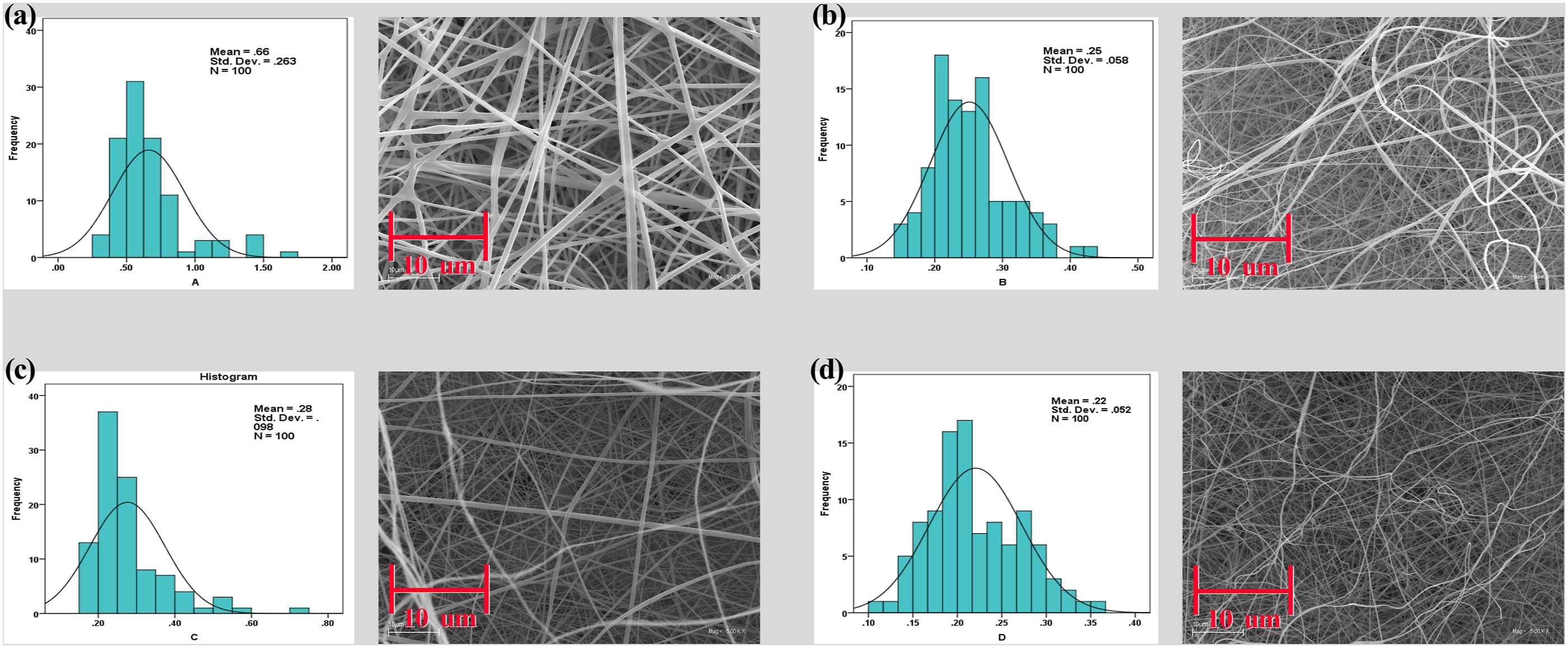
Obviously, owing to the higher price of EOs and the toxicity possibility of higher concentrations of TEO, its economical use was supposed as the main goal. In this case, production of proper, uniform, and fine diameter nanofibers, with the maximized smell of TEO is targeted in this section. 38 It is observed that adding 15% of the TEO, reduced the fiber diameter considerably from 660 ± 26 for sample P to 250 ± 5.8 nm for sample PT. Supposing the fact that morphology and fiber diameter of nanofiber are affected by surface tension, 38 herein, a reduction in surface tension of the polymer solution has apparently triggered a reduction in the diameter.35,38 As a corollary, since the smaller mean diameter of the fibers is followed by enhanced specific surface area, an increase in the release ability of the nanofilament surface is obtained. Samples are smooth, uniform, non-defect with the diameter of 660 ± 26 nm in an optimum condition.
Moreover, according to the reported numbers in Figure 1, an addition of 10% of PAMAM to the PAN solution culminates in a reduction in the fiber diameter from 660 ± 2 for sample P to 280 ± 9.8 for sample PG2. This reduction tends to be a potential result of decreased surface tension triggered by PAMAM as a polyelectrolyte material. Obviously, the surface tension competes with the tensile force for jet production in electrospinning process, and a lower level of surface tension, subsequently, enhances the entanglement and accomplishes narrower nanofiber diameters.38,39 The average diameter of samples with the synchronous presence of PAMAM and TEO was determined to be even smaller than that of samples with TEO or PAMAM only. The reason is that adding EOs and PAMAM to the solution could result in reduction in viscosity due to thedistance created between polymeric chains. 39
Wettability and surface area
The surface area obtained from the BET plot, contact angle measurement, and fiber diameter for pure PAN (P), PAN/TEO (PT), PAN/PAMAM-G2 (PG2), and PAN/TEO/PAMAM-G2 (PTG2).

PAN: polyacrylonitrile; TEO: tea tree essential oil; PAMAM: polyamidoamine dendritic polymers
Antibacterial test results for polyacrylonitrile/tea tree essential oil (PT).

Infrared spectrometry results for samples
As it is illustrated in Figure 2, in all the infrared spectrometry results for samples (FTIR) spectra of the samples, namely, P, PT, and PTG2, stretching vibration band of –C≡N at 2240 cm−1 is observed. This peak is the characteristic of the stretching mode of –C≡N in PAN which is specified as an internal standard. Furthermore, the peaks at 2930 cm−1, 1739 cm−1, 1096 cm−1, 2245 cm−1, 1450 cm−1, and 1070 cm−1 are, respectively, pertained to stretching vibration of the methylene (–CH2–) group, C = O, C-O bending, stretching vibration of nitrile (–CN–) group, bending vibration of methylene (–CH2–) group, and CC stretching36,43,44 which are observed in all samples spectra. Additionally, the newly appeared amide groups related peak at 1561 cm−1 in the PTG2 and PG2 spectrums supports the existence of PAMAM in this sample.
38
It is worth mentioning that the intensity of the methylene group which appears at 2930 cm−1 is reduced in the PT, PG2, and PTG2 samples. It might be related to cyclization procedure of –CN– groups in DMF solvent which reported by lots of researcher.41,42 FTIR spectra for pure PAN (P), PAN/TEO (PT), PAN/PAMAM-G2 (PG2), and PAN/TEO/PAMAM-G2 (PTG2).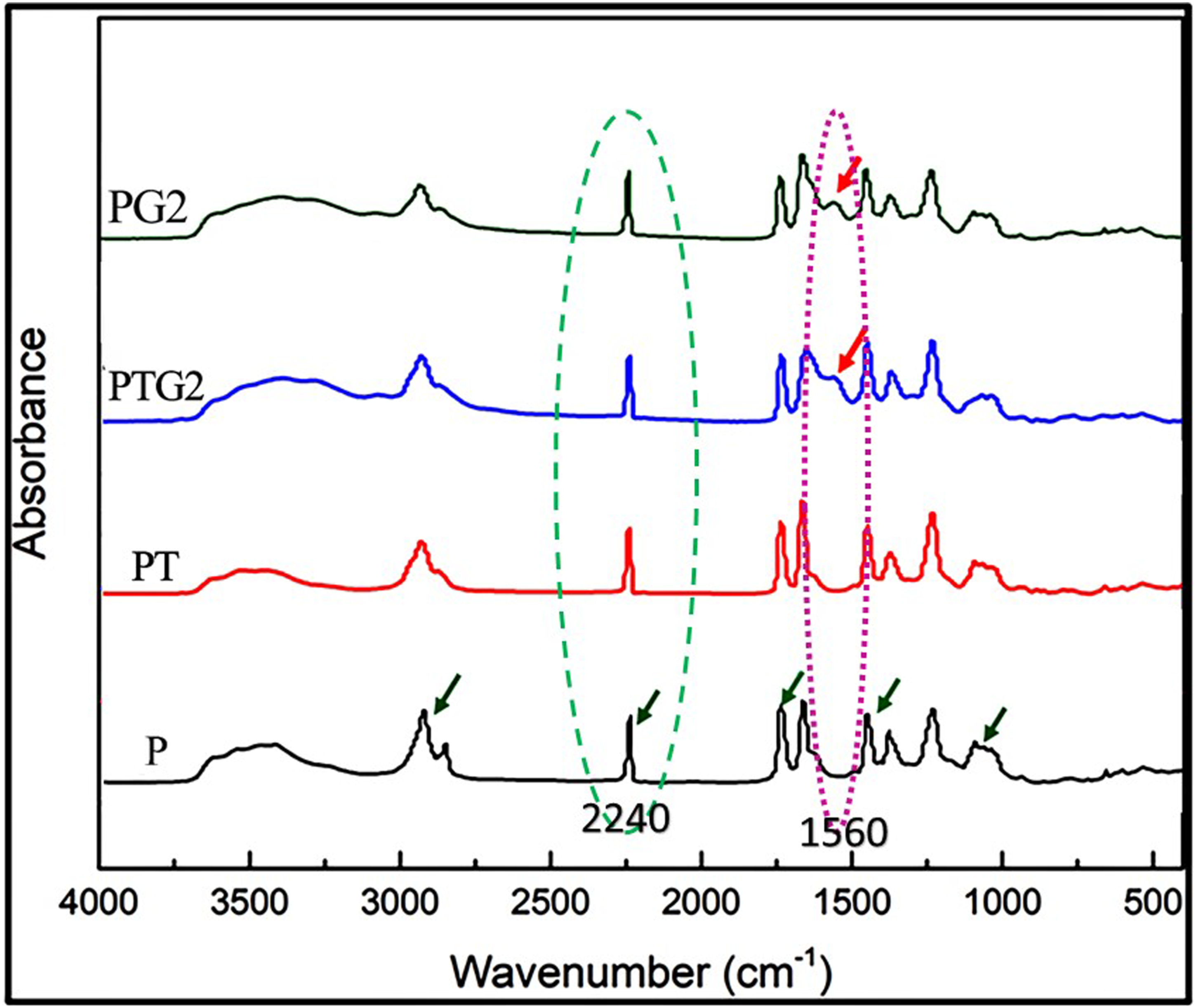
Samples antibacterial activity results
As it is obviously understood from Table 3 and Supplemental Figure S5(b), adding TEO triggered an antibacterial effect in samples PT, 1 day after electrospinning (PT1), referring to its bioactive components such as a-terpineol, a-pinene, and more importantly terpinen-4-ol,12,45 through destroying microbial lipid membranes of the microorganisms. 45 This property was quite strong, and the log microorganism reduction of sample PT is reported about 1.95 and 1.89 against S. aureus or E. coli bacteria, respectively. However, the unstable and fast release of the TEO culminates in gradual decrease in the samples’ antibacterial activity from 1.88 to 1.81 against S. aureus and E. coli bacteria only after 3 days (PT3). This amount decreased even further to 1.36 and 1.23, 7 days (PT7) after electrospinning, as it is obvious in Supplemental Figure S5(b).
Antibacterial test results for polyacrylonitrile/tea tree essential oil/polyamidoamine dendritic polymer-G2.

The filtration efficiency of respiratory masks
The paraffin oil mist and NaCl tests were employed to assess the number of transmitted oil and NaCl particles from the sample simulating the samples’ resistance against liquid and solid aerosols, respectively. Results are illustrated in Figures 3 and 4, respectively, representing the percentage of rejected paraffin oil mist particles from the samples and filtration efficiency of the samples against NaCl particles. All measurements have been done for new and conditioned samples. As it obviously obtained from Figures 3 and 4, the new samples generally caused a better level filtration compared to the conditioned ones mostly due to the electrostatic charge loss after the conditioning process.
47
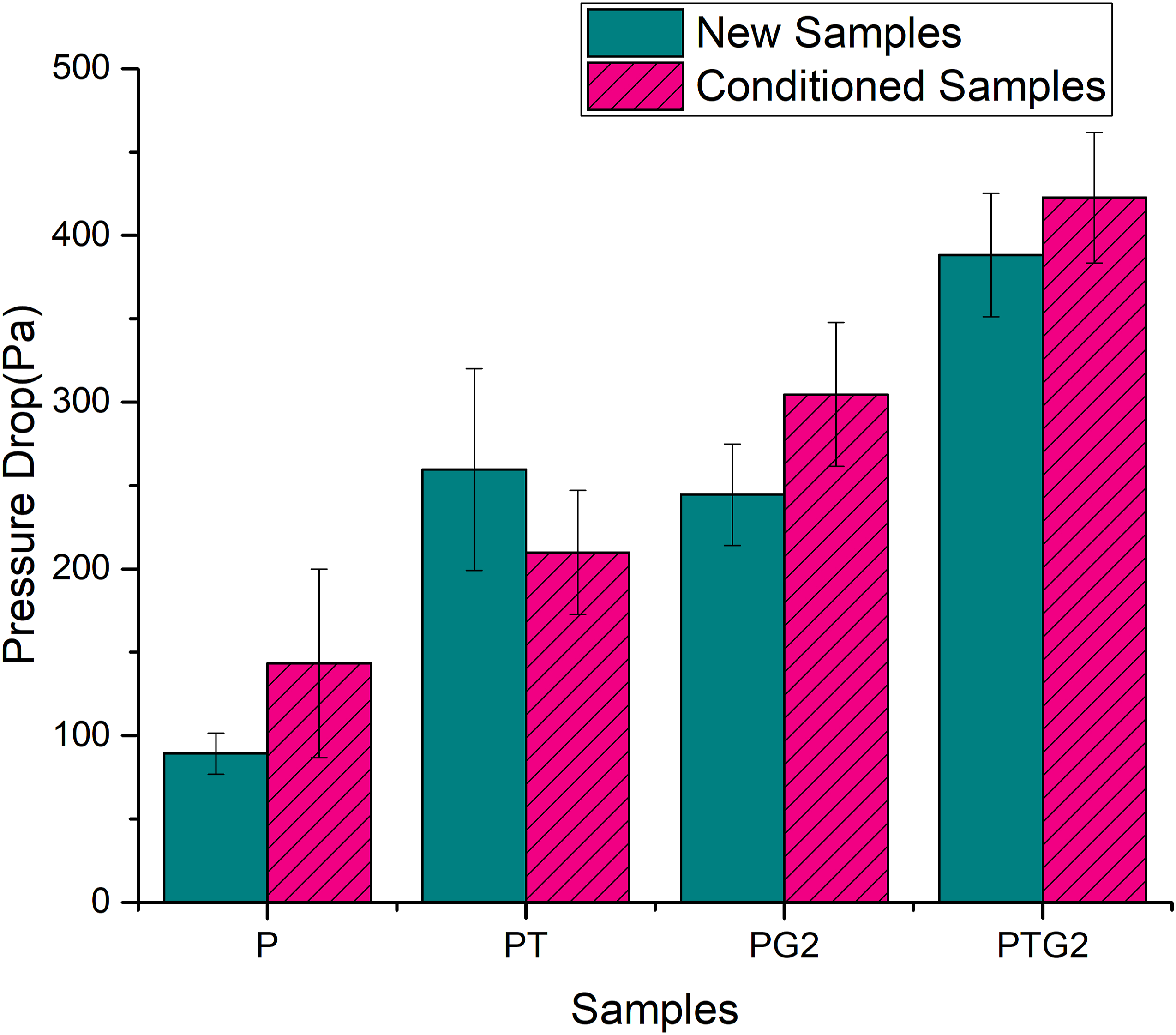
This charge, which has been generated as a result of the induction during spinning in an electrostatic field, is responsible higher grades of filtration. This is in fact because of an electrostatic field inside the nonwovens culminated in a significantly increased fiber activity on particles.20,48 Electrostatic charges are proved to be highly effective in reducing the pressure drop and also increasing the filtration efficiency as it is confirmed by the lower pressure drop and higher filtration efficiency of the new samples compared to the conditioned ones which is numerate in Figure 5.
49
Penetration percentage of paraffin oil mist to pure PAN (P), PAN/TEO (PT), PAN/PAMAM-G2 (PG2), and PAN/TEO/PAMAM-G2 (PTG2). Filtration efficiency for pure PAN (P), PAN/TEO (PT), PAN/PAMAM-G2 (PG2), and PAN/TEO/PAMAM-G2 (PTG2) against sodium chloride particles. Pressure drop test results for pure PAN (P), PAN/TEO (PT), PAN/PAMAM-G2 (PG2), and PAN/TEO/PAMAM-G2 (PTG2).

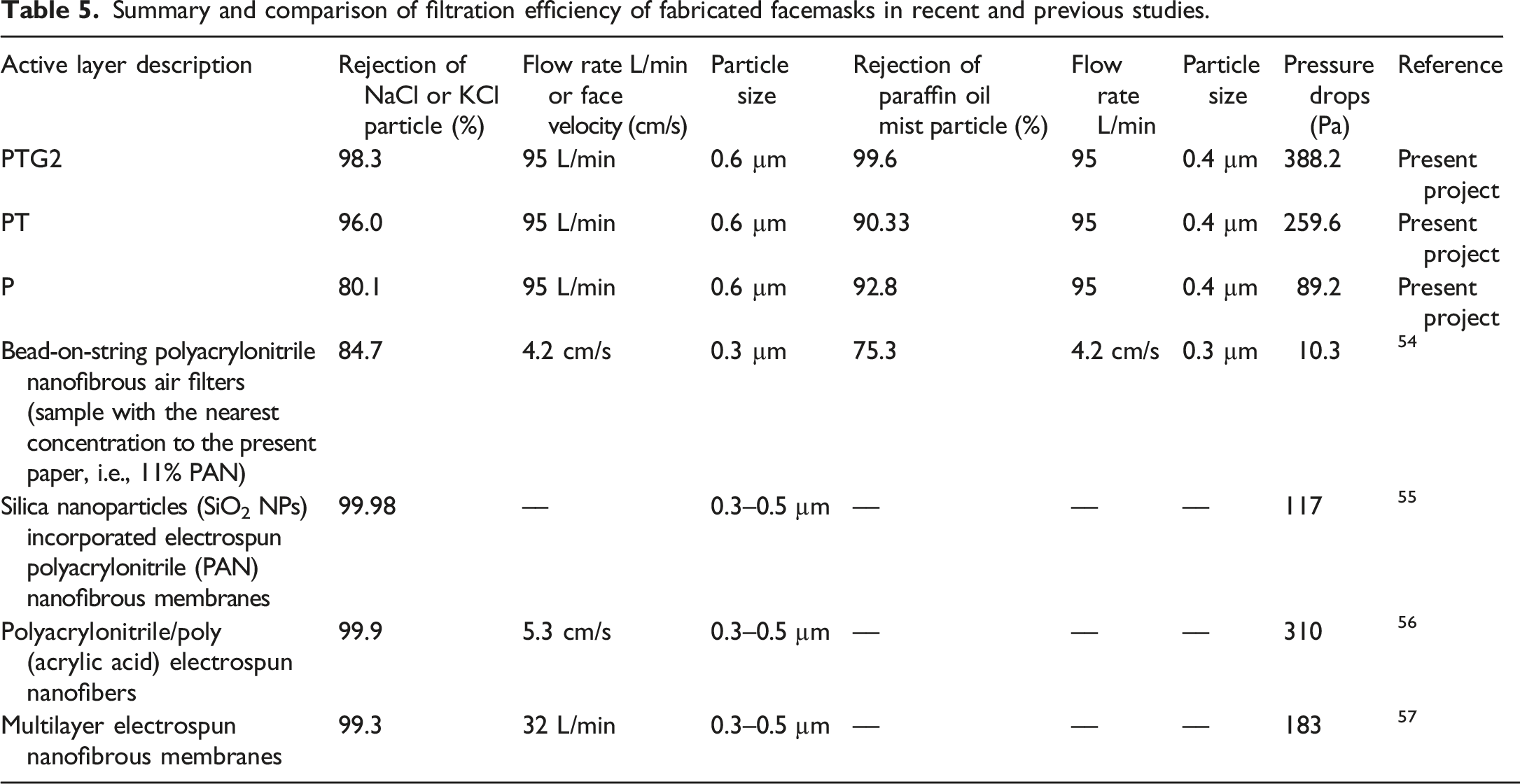
Summary and comparison of filtration efficiency of fabricated facemasks in recent and previous studies.
Conclusion
Due to the ubiquitous obstacle of increasing air pollution, use of an appropriate respiratory mask is essential. The production of aromatic masks with essential oils is ideally suited not only for a desirable smell, but also for physical, medicinal, and biological properties. Aromatic compositions are volatile materials, and their encapsulation into the dendritic compounds is deployed here, as a promising way to increase their active compounds stability inside the fabrics. A well-fabricated antibacterial scented PRE has been developed in this study for the first time, not only to extend release of TEO but also to offer long-lasting antibacterial properties and the quite promising filtration efficiency. This device promotes a versatile facemask to reduce personal exposure to biological and chemical materials, release pleasant odor to enhance the user’s mood and health level, and finally, abrogate any existing bacteria in human exhaled breath.
Herein, the antimicrobial long lasting scented with high filtration efficiency PRE was manufactured by electrospinning the prepared solution containing 13 wt.% of polyacrylonitrile polymer, 15 wt.% of tea tree essential oil (TEO), as well as 10 wt.% of polyamidoamine dendritic compounds (PAMAM).
The results of filtration efficiency of respiratory masks, in contrast to sodium chloride particles and paraffin oil, showed that the addition of TEO and PAMAM simultaneously reduced 93% of paraffin particle infiltration and 85% of sodium chloride particles penetration. The results obtained from the filtration efficiency test and SEM analysis results are completely consistent. All these results reveal that the active layer consists of dendritic materials and EOs could be a novel candidate for further application in face mask.
Supplemental Material
sj-pdf-1-jit-10.1177_15280837211048155 – Supplemental Material for Needleless electrospun mats based on polyamidoamine dendritic polymers for encapsulation of essential oils in personal respiratory equipment
Supplemental Material, sj-pdf-1-jit-10.1177_15280837211048155 for Needleless electrospun mats based on polyamidoamine dendritic polymers for encapsulation of essential oils in personal respiratory equipment by Maryam Mounesan, Somaye Akbari and Bogumil E Brycki in Journal of Industrial Textiles
Footnotes
Acknowledgments
The authors appreciate Nano Tar Pak for producing needle-less electrospun samples. We also would like to thank Dr. Nazanin Ezaz Shahabi for her valuable comments regarding statistical analysis.
Declaration of conflicting interests
The author(s) declared no potential conflicts of interest with respect to the research, authorship, and/or publication of this article.
Funding
The author(s) received no financial support for the research, authorship, and/or publication of this article.

Supplementary material
Supplementary material for this article is available online.
References
Supplementary Material
Please find the following supplemental material available below.
For Open Access articles published under a Creative Commons License, all supplemental material carries the same license as the article it is associated with.
For non-Open Access articles published, all supplemental material carries a non-exclusive license, and permission requests for re-use of supplemental material or any part of supplemental material shall be sent directly to the copyright owner as specified in the copyright notice associated with the article.
