




Abstract
This study focuses on the fabrication of an anisotropic textile brace that exerts corrective forces based on the three-point pressure system to treat scoliosis, which is a medical condition that involves deformity of the spine. The design and material properties of the proposed anisotropic textile brace are discussed in detail here. A case series study with 5 scoliosis patients has been conducted to investigate the immediate in-brace effect and biomechanics of the proposed brace. Radiographic examination, three-dimensional scanning of the body and interface pressure measurements have been used to evaluate the immediate effect of the proposed brace on reducing the spinal curvature and asymmetry of the body contours and its biomechanics. The results show that the proposed brace on average reduces the spinal curvature by 11.7° and also increases the symmetry of the posterior trunk by 14.1% to 43.2%. The interface pressure at the corrective pad ranges from 6.0 to 24.4 kPa. The measured interface pressure shows that a sufficient amount of pressure has been exerted and a three-point pressure distribution is realized to reduce the spinal curvature. The obtained results indicate the effectiveness of this new approach which uses elastic textile material and a hinged artificial backbone to correct spinal deformity.
Introduction
Bracing is a universal conservative treatment option for adolescent idiopathic scoliosis (AIS), and its main objective is to stop the progression of the spinal curvature or possibly even reduce the curvature [1]. There are two kinds of scoliosis braces, which are hard and soft braces. The former is traditionally and widely used with proven effectiveness in preventing the progression of scoliosis [2]. The most common characteristic of hard braces is that they have a convex shape or convex shaped pad that pushes the body in the perpendicular direction against the curvature to correct the deformity. The fundamental corrective principle of most orthotic devices is the three-point pressure system which involves exerting external lateral force onto the apical vertebra and contralateral force above and below the apical vertebra. However, hard braces limit mobility and cause discomfort, which lead to low compliance with the treatment.
Aside from hard braces, there are also soft braces [3–5] which are fabricated from textile materials with the aim to overcome the limitations of hard braces. The SpineCor brace is the most representative soft brace with a bracing mechanism that is based on physical therapy. The device uses straps to realign the orientation of the thoracic, thoracolumbar, and lumbar segments through dynamic movement in the form of clockwise and anti-clockwise rotation and tilting, shifts in posture, and lateral bending. According to Coillard, Circo and Rivard [3], the average in-brace correction of SpineCor is 7.1°. Liu et al. [6] developed a posture correction girdle in which semi-rigid ethylene-vinyl acetate (EVA) foam pads were inserted to reduce the convexity of the scoliotic spine. The average in-brace correction of the posture correction girdle in Fok et al. [7] is 3°. Chan et al. [8] further improved the posture correction girdle in Fok et al. [7] by inserting rigid shaped memory struts made of nickel titanium alloy to exert high circumferential compressive forces around the abdomen and reported an in-brace reduction of the thoracic curvature of 11.3°. Fung et al. [5] developed a textile brace for scoliosis with the aim to shorten the production lead time and enhance the quality of life during bracing. In their design, rigid straps and rigid pads in a knitted vest-like top are used to exert corrective forces based on the three-point pressure principle; however, its effectiveness for in-brace correction is questionable. Hui et al. [4] studied the effect of various textile braces that use the three-point correction principle through finite element modelling and found that a soft brace with textile fabric material as padding does not significantly correct the spinal deformity as the in-brace correction is only about 0.5–0.7°.
Undoubtedly, textile braces provide the advantages of wear comfort and patient compliance, while the three-point pressure system is the universal corrective principle of rigid braces. However, the integration of textile materials and the three-point pressure system in currently available soft braces does not seem to be an effective means to correct spinal deformity [9,10]. In this work, a hinged artificial backbone is fabricated and placed at the centre of the back of the textile brace to stabilise the corrective components and provide three-points of pressure to the scoliotic torso.
The aim of this study is to therefore address the inadequacies of existing braces by developing a novel textile brace for scoliosis. The main goal is to develop an alternative treatment option for moderate AIS patients which provides immediate in-brace correction and good wear comfort, and does not inhibit mobility at the same time. In our design, highly modulus elastic textiles with semi-rigid silicone pads are used to exert corrective forces asymmetrically onto the convexity of the apical vertebra, while a flexible hinged artificial backbone is used to sustain the counter forces.
This study presents the fabrication, material properties, biomechanics, and preliminary clinical results of a novel anisotropic textile brace for treating scoliosis. More importantly, this study demonstrates the possibility of using textile materials to provide immediate effects that treat spinal deformity.
Methodology
Study design
The design framework for this study is shown in Figure 1. The research idea was initiated according to user needs and the limitations of existing AIS braces. While the shortcomings of hard braces are mobility limitations and discomfort which result in low treatment compliance, the treatment mechanism of existing soft braces is still questionable. Therefore, the idea of applying the three-point pressure system, which is a universal corrective principle that has been proven effective, along with the use of elastic textile materials to offer flexibility and a soft hand feel was explored to fabricate a textile brace for AIS.

Overview of study design.
A case study was then conducted to determine the initial efficacy of the proposed brace. The primary outcome measure is the immediate in-brace spinal correction based on an x-ray examination. The subjects were required to undergo an x-ray examination before the intervention took place and then an in-brace x-ray examination after wearing the brace for 2 hours. Their Cobb’s angle was measured and compared.
The secondary outcome measure is the effect of bracing on changing the body contours which was evaluated by examining the changes in shoulder obliquity, shoulder rotation and posterior trunk asymmetry (by using a posterior trunk asymmetry index (POTSI)) of the 3 D scanned images of the body parts. The subjects underwent 3 D scanning with the Vitus Smart XXL 3 D body scanner (Human Solutions GmbH, Germany) of their body in the standing posture with and without the brace donned. The shoulder obliquity and rotation were determined by measuring the angle of the acromion in the frontal and transverse planes, respectively. Six sub-indexes were used to measure the posterior trunk asymmetry - three frontal and three height asymmetry indexes, and their sum was used to construct the POTSI, which is a simplified means of analysing the deformation of the dorsal trunk [11]. The six indexes were summed by using the differences in height between particular markers on the right and left sides of the body and the points of asymmetry from the central line with distance [11]. The POTSI values are positively correlated with the asymmetry of the dorsal trunk.
Moreover, the biomechanics of the proposed brace were investigated. The interface pressure exerted by the proposed brace was measured by using the Pliance®-xf-16 system (Novel, Munich, Germany) which has 6 single pressure sensors with a sensing area of 78 mm2 and measurement range of 0 – 60 kPa. The Pliance X system has a high-retest and inter-rater reliability (ICC≥ 0.995) with good linearity (adjusted R-square = 0.997) for measuring a standard weight. The sensors were placed onto the apex of the corrective component and the middle of the pelvis belt. The subjects stood in their habitual posture and the interface pressure was recorded for at least one minute. The mean pressure and standard deviation were subsequently calculated.
Subjects
Five female subjects with AIS were recruited to investigate the immediate effect and biomechanics of the proposed brace with the consent of their parents. The inclusion criteria are that the subjects: i) are between 10 and 13 years old, ii) have a spinal curvature angle(s) of 20° to 30°, iii) have a Risser grade of 0 to 2, and vi) are pre-menarche or less than one-year post-menarche. The exclusion criteria are contraindications of x-ray exposure, diagnosis of other musculoskeletal or developmental illness that might be responsible for the spinal curvature, contraindications of pulmonary or exercise tests, or a diagnosed psychiatric disorder. This study is registered on ClinicalTrial.gov (NCT02271256 – registration date 22nd October 2014) and approved by the Human Subject Ethics Application Review Committee of The Hong Kong Polytechnic University (HSEARS20151207001).
Study hypotheses
The study hypotheses are as follows. Hypothesis 1: The proposed anisotropic textile brace provides an in-brace reduction of the Cobb’s angle that exceeds 5 degrees. Hypothesis 2: There is significant correlation between the percentage of in-brace spinal correction and variables of the initial Cobb’s angle, POTSI and interface pressure. Hypothesis 3: There is significant difference in the interface pressure between the thoracic and lumbar corrective components.
Data analysis
Comparisons of the Cobb’s angle, shoulder obliquity and rotation, and POTSI values between in-brace and no brace conditions were made to investigate the immediate effect of the proposed brace. As the standard error of a Cobb’s angle measurement is 5° [12,13], the brace is considered to have a positive effect on spinal deformity when the in-brace reduction of the Cobb’s angle is more than 5 degrees. On the contrary, the brace is considered to have a negative effect on spinal deformity when the in-brace increase of the Cobb’s angle is more than 5 degrees.
A nonparametric Kendall’s Tau correlation test was conducted to examine the correlation between the percentage of in-brace spinal correction and variables such as the initial Cobb’s angle, POTSI and interface pressure. A nonparametric independent sample test, the Mann-Whitney U test, was conducted to compare the interface pressure at different parts of the body. The Statistical Package for Social Science Version 25 (IBM, New York, United States) was used, and the confidence interval was set at 95% (p < 0.05).
Design and development of proposed brace
The proposed brace is a tightly fitting compression garment that comprises a bra top, pants, pelvis belt, a hinged artificial backbone and corrective components (Figures 2 and 3). The bra top and pants provide the framework of the brace and Velcro was sewn onto the centre of the front of the bra top and pants which allows the attachment of the corrective components. An open design of using elastic straps instead of fabric for the construction of the bra top and pants provides the scoliotic spine with room to shift to the prescribed alignment. The corrective components are composed of a highly modulus wide elastic strap and convex shaped silicone pads with a hardness of Shore A40 which are attached to the convex part of the scoliotic spine. They have an important role in providing the corrective forces that push against the convex part of the spine to reduce the curvature. Rigid hinges that comprise an artificial back bone are used for the back of the brace to stabilise the asymmetric corrective component, allow the wearer to bend forward, and inhibit the rotation of the trunk and loss of suspension of the brace. Moreover, the pelvis belt is composed of two highly modulus wide elastic straps that control the end-points of the hinged artificial backbone as well as control the alignment of the base of the spine. Table 1 shows the material properties of the fabric and straps used in the proposed brace.

Proposed brace: (a) front and (b) back views.

3D structure drawing of the proposed brace.
Material properties of fabric and straps.

The corrective components of the anisotropic textile brace are critical as they provide the corrective forces that treat the scoliotic spine. The placement of the corrective components was customised for each subject based on her spinal curvature. During the fitting session, the corrective components were attached at the apex of the spinal curvature by referring to a pre-intervention x-ray, so that they created horizontal forces that pushed onto the scoliotic spine. Table 2 shows the location of the pads for each subject in this study.
Demographics, allocation of pads and Cobb’s angle: pre-intervention vs brace worn.

To develop the pattern for the proposed brace, 21 female subjects with scoliosis (age: 12.4 ± 0.7 years old, height: 153.5 ± 4.1 cm, weight: 44.5 ± 5.2 kg, BMI 18.9 ± 2.3, and Cobb’s angle: 17.2 ± 4.3°) were recruited to provide body measurements by using a 3 D scanner (Vitus Smart XXL 3 D body scanner, Human Solutions GmbH, Germany). Of the 21 subjects, 11 (52.4%) have a Lenke 1 curve, 3 (14.3%) have a Lenke 3 curve, and 7 (33.3%) have a Lenke 6 curve. The pattern was drafted with 25% shrinkage to provide a close fit with the use of elastic textile materials. Ten measurements are taken to create the pattern as shown in Figure 4. A Kendall’s Tau-b correlation test was done to determine the relationship between the BMI and all of the circumferential measurements among the 21 subjects. A highly positive correlation was found between the BMI and upper breast, under breast, underband, pelvis, and leg hole circumferences, which are all statistically significant at r = .415, p=.009, r= .478, p=.003, r= .498, p=.002, r= .478, p=.003, r= .612, p=.000, and r= .679, p= .000 respectively. Moreover, the Kendall’s Tau-b correlation test showed that there is a statistically and significantly positive correlation among the circumferential measurements of the upper breast, under breast, underband, pelvis, hip and leg hole. As the deviation of some of the measured items is quite large, it is difficult to create a one-size fits all prototype. However, the tailored production method is both time consuming and costly. Therefore, two sizes (small and medium) clustered according to BMI were created. Underweight patients whose BMI is below 18.5 were prescribed the small size prototype while normal weight patients whose BMI is between 18.5 and 24.5 were prescribed the medium size prototype. Table 3 shows the body dimensions of the two groups of participants.

Body measurements for novel anisotropic textile brace.
Body dimensions of participants clustered according to their BMI.

CIR denotes circumference; BMI: body mass index.
Results
Changes in Cobb’s angle
Five AIS subjects participated in this part of the study. Four of the subjects (Subjects 1, 2, 3, and 4) have right-thoracic-left lumbar curves which is an S-curve, and one subject (Subject 5) has a single left thoracolumbar curve which is a C-curve. The results of the changes in their spinal curvature after wearing the proposed brace is shown in Table 2. Of the 5 subjects, 3 of them (Subjects 3, 4, and 5) have reduced their spinal curvature by 5° with Subject 5 showing the highest reduction in curvature (Figure 5). Subject 2 shows an increase of 5° in her spinal curvature while Subject 1 has reduced her Cobb’s angle within 5°. The Kendall’s Tau correlation test shows that there is no significant correlation between the in-brace correction and the initial Cobb’s angle (p = 0.98). The results do not support Hypothesis 2 in this study which implies that the initial Cobb’s angle is not the factor that influences the in-brace spinal correction.

Standing x-ray of spinal curvature of Subject 5: (a) pre-intervention, and (b) brace worn.
Changes in body contours
The shoulder obliquity, shoulder rotation and posterior trunk asymmetry when the brace is worn and not worn are shown in Figure 6. After wearing the proposed brace, Subjects 3 and 4 show a reduction of more than 1˚ in their shoulder obliquity, Subject 1 does not show any obvious changes in her shoulder obliquity while the shoulders of Subjects 2 and 5 show an increase in obliquity.

Shoulder obliquity, shoulder rotation and posterior trunk asymmetry results.
As for shoulder rotation, Subject 4 shows a reduction in shoulder rotation of more than 3˚, Subjects 1 and 3 do not show any obvious changes while Subjects 2 and 5 show a substantial increase in shoulder rotation after wearing the proposed brace.
With regard to the posterior trunk asymmetry, Subjects 2, 3, 4, and 5 show more symmetry of the trunk from the back after wearing the proposed brace. The POTSI value when the brace is not worn ranges between 22.1 and 38.6 while the in-brace POTSI value ranges between 15.0 and 33.2. The percentage of reduction of the POTSI ranges from 14.1% to 43.2%. The results of the Kendall’s Tau correlation test show that there is no correlation between the changes in the Cobb’s angle and POTSI (p = 0.14). The results do not support Hypothesis 2 which implies that the posterior trunk asymmetry is not the factor that influences in-brace spinal correction.
Interface pressure
Figure 7 shows the distribution of the interface pressure for each subject. The interface pressure at the thoracic corrective component ranges from 6.0 kPa to 24.4 kPa and the lumbar corrective component ranges from 6.1 kPa to 9.7 kPa. The Mann-Whitney U test showed that the interface pressure at the thoracic corrective component is higher than that at the lumbar corrective component (p = 0.02). The results support Hypothesis 3 which implies that there is a significant difference between the thoracic and lumbar corrective components. The Kendall rank correlation test indicated that there is no correlation between the interface pressure value and the changes in the Cobb’s angle with the brace donned (p = 0.99). The results do not support Hypothesis 2 which implies that the amount of interface pressure is not the factor that influences the in-brace spinal correction.
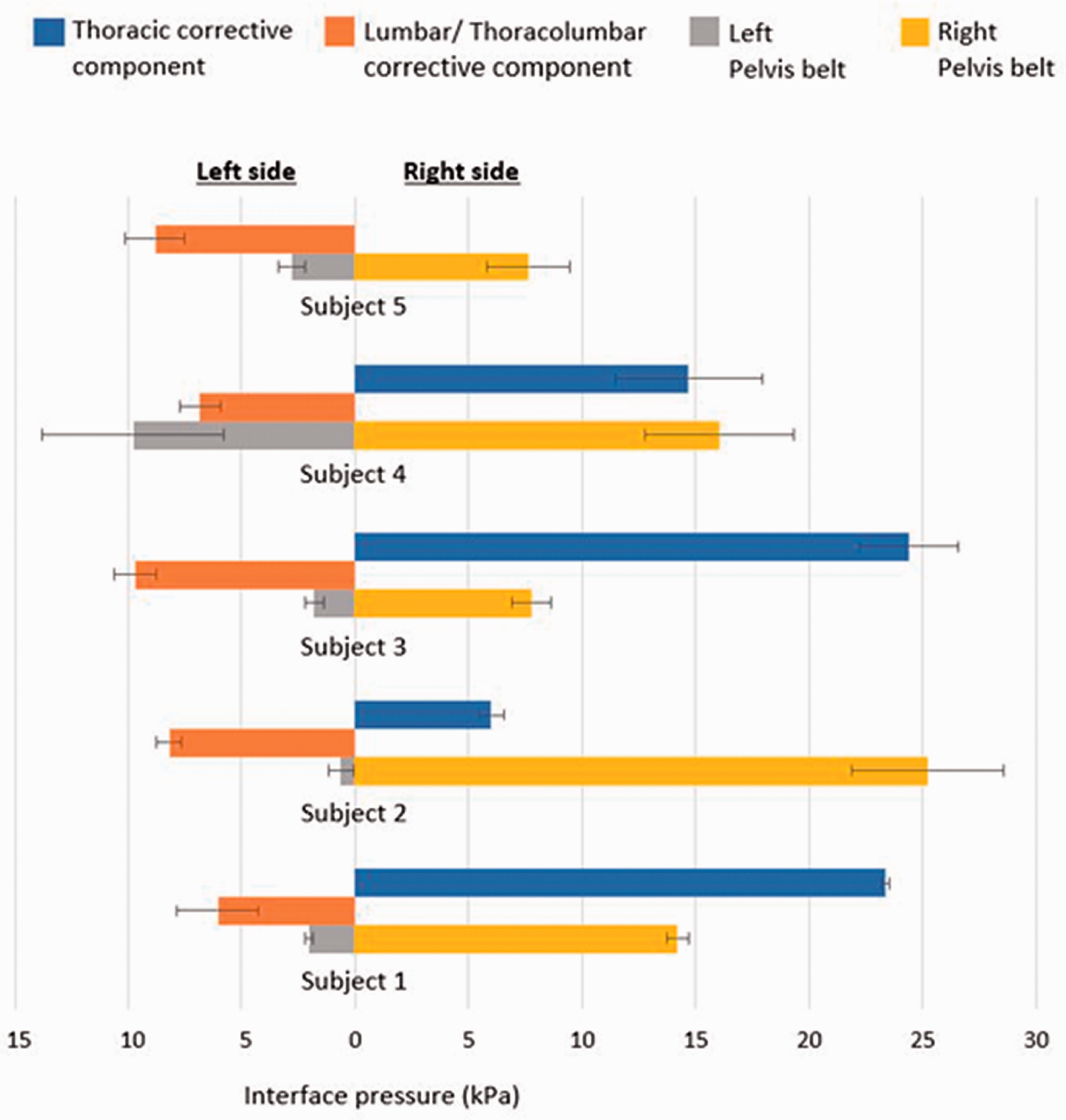
Interface pressure distribution of the proposed anisotropic textile brace.
Discussion
Three-point pressure system
Subject 2 was the first to be fitted with her prototype brace in the clinical study. The corrective components for the right thoracic and left lumbar curves were applied and, in addition, a silicone pad was inserted at the right side of the pelvis belt so as to apply three points of pressure for correcting her spinal curvature. However, the in-brace x-rays showed that her lumbar curve is increased about 5°. The results of the interface pressure measurements (see Figure 7) showed that due to the pad on the right side of the pelvis belt, the interface pressure is far higher than that at the left side of the pelvis belt and even higher than that at both the thoracic and lumbar corrective components. As the pressure from the corrective component for the left lumbar curve is much lower than that from the right side of the pelvis belt, this implies that the former cannot counter the force exerted by the latter, so the result is an increase in the lumbar curve. This finding demonstrates the importance of managing the pressure distribution of the proposed brace, or any brace for that matter. Therefore, pads were not used at the pelvis belt for the other subjects.
Without a pad, the interface pressure at the pelvis belt of the four remaining subjects ranged from 1.8 kPa to 16.0 kPa. However, an interesting finding emerged. Even without the pad, there is an uneven distribution of pressure between the right and left sides of the pelvis belt; see Figure 7. This is because the placement of the corrective components for the lumbar/thoracolumbar curves influences the pressure distribution of the pelvis belt as all of the corrective components and the pelvis belt itself are attached to the hinged artificial backbone. When attaching the corrective component for the lumbar/thoracolumbar curves, the pelvis belt on the counter side exerts a higher amount of tension on the hinged artificial backbone in order to maintain the equilibrium of the backbone so that uneven pressure distribution at the pelvis belt would result. Although no pad was inserted on the right side of the pelvis belt of Subjects 1, 3, 4, and 5, the right side still exerted a higher degree of pressure than the left side due to the attachment of the corrective component for the left lumbar/thoracolumbar curve. This finding of the three loading points is consistent with that in Pham et al. [12]. The result also shows that the proposed anisotropic textile brace and hinged artificial backbone provide three points of pressure.
Efficacy of proposed brace
In-brace correction is usually the initial factor for evaluating the quality of a new brace [13]. It has already been well established that the standard error of a Cobb’s angle measurement is 5° [13,14]. In this study, 3 of the subjects showed a change in their Cobb’s angle that is larger than 5° after donning the proposed brace and therefore, the change exceeds the standard error of measurement. Moreover, among these 3 subjects, one with an S-curve and one with a C-curve show a reduction in their Cobb’s angle of over 15° and the percentage of the in-brace reduction of the spinal curvature is 94.1% and 88.7% respectively. The results support Hypothesis 1 which implies that intervention with the proposed brace might reduce both the C- and S-curves of a scoliotic spine.
Nevertheless, the results showed that Subjects 4 and 5 have a substantially high in-brace reduction of their spinal curvature while Subject 1 does not show an obvious change in her Cobb’s angle so the differences in the results are substantial. Cheung et al. [15] suggested that the success of the in-brace reduction of the curvature depends on the inherent flexibility of the spine. However, in this study, supine x-rays are not done due to concerns around exposure to radiation, and thus information about the inherent flexibility of the subjects could not be obtained, which also constitutes as one of the limitations of this study.
Guo et al. [10] carried out a study on the efficacy of a hard brace and the SpineCor brace with AIS subjects whose Cobb’s angle ranges between 20˚ and 30˚ and stated that the initial in-brace reduction of the spinal curvature with the rigid and SpineCor braces is 15.9% and 21.3% respectively. Karol [16] investigated the effectiveness of various hard braces with male AIS subjects whose Cobb’s angle ranges between 18˚ and 45˚ and reported that the initial in-brace reduction of the spinal curvature with the Milwaukee, Boston and Charleston braces is 17.4%, 35.6% and 62.2% respectively.
Interface pressure from the corrective components
The corrective mechanism of the proposed brace originates from the use of elastic straps and silicone pads which exert external forces onto the surface of the torso. Wong et al. [17] examined the biomechanics of hard braces and found that the pressure from the pads of hard braces ranges between 4.9 kPa and 25.6 kPa. Mac-Thiong et al. [18] also investigated the interface force of a hard brace and reported that the interface pressure from the Boston brace ranges from 10 kPa to 30 kPa. In comparison to this study, the interface pressure from the corrective components for the thoracic and lumbar curves which ranges between 6.0 kPa and 24.4 kPa and 6.1 kPa and 9.7 kPa respectively is very similar to that exerted by a hard brace. This shows the possibility of using textile materials to provide adequate corrective force to treat a scoliotic spine.
Another surprising finding is that the pressure from the corrective component for the thoracic curve is significantly higher than that from the corrective component for the lumbar curve. This finding is in agreement with that of a previous biomechanics study on a rigid brace conducted by Wong et al. [17]. This difference between the corrective components for the thoracic and lumbar curves is due to the ribcage which can directly withstand the pressure from the corrective component for the thoracic curve and the fat around the waist which absorbs the pressure from the corrective component for the lumbar curve.
Based on the law of mechanics, it is anticipated that a larger corrective force would lead to a greater in-brace reduction of the spinal curvature [17]. Undoubtedly, a certain amount of corrective force is essential for in-brace spinal correction. However, the results in this study show that there is no significant correlation between the interface pressure and reduction of the Cobb’s angle which resonates with Pham et al. [12]. This implies that after a certain amount of corrective force is exerted, any more exerted force might not contribute to furthering the corrective effect. Further studies on the relationship between in-brace spinal correction and interface pressure with a larger sample size are however recommended.
Effect on shoulder orientation and trunk symmetry
Apart from controlling the progression of the spinal curvature, enhanced aesthetics due to postural improvements is another basic objective of conservative treatment for AIS [13]. In considering the changes in shoulder orientation and Cobb’s angle, Subject 5 surprisingly showed a more oblique and rotated shoulder after wearing the proposed brace despite an outstanding reduction in her spinal curvature. This finding is consistent with a previous study by Kotwicki et al. [19] who pointed out that the brace would sometimes introduce the involuntary imbalance of the shoulders and waist lines. Nevertheless, from the current data, no correlation between the changes in shoulder orientation and Cobb’s angle can be found.
Apart from the shoulder orientation, this study also examines the changes in the symmetry of the trunk from the back after wearing the proposed brace. The results suggest that the proposed brace has a positive effect on enhancing the symmetry of the body contours. Surprisingly, it was found that Subject 2 whose spinal curvature increased in severity based on her in-brace x-ray actually showed an increased symmetry of her trunk from the back. This finding concurs with that in Durmala et al. [11] who also found that there is no correlation between the POTSI value and spinal curvature angle.
Conclusions
This study provides a summary on the fabrication and properties of elastic textile material that are used to create a textile brace to provide an immediate effect for reducing the curvature of the spine. The proposed idea addresses the problems of current hard braces which are mobility limitations and discomfort. The preliminary results of the case series study demonstrate that the proposed brace can provide a certain degree of in-brace correction for the scoliotic spine and reduce the asymmetry of the trunk. In addition, the biomechanics study shows that the proposed brace offers a corrective mechanism based on the three-point pressure system. This study provides useful information on the design elements and biomechanics of textile braces to treat spinal deformities. Further studies with a larger sample size are however recommended to investigate the long-term effectiveness of the proposed brace.
Supplemental Material
sj-pdf-1-jit-10.1177_15280837211032619 - Supplemental material for Design and fabrication of anisotropic textile brace for exerting corrective forces on spinal curvature
Supplemental material, sj-pdf-1-jit-10.1177_15280837211032619 for Design and fabrication of anisotropic textile brace for exerting corrective forces on spinal curvature by Queenie Fok, Joanne Yip, Kit-lun Yick and Sun-pui Ng in Journal of Industrial Textiles
Footnotes
Acknowledgements
Some parts of the early prototypes were produced by the Hong Kong Polytechnic University, University Research Facility in 3D Printing.
Declaration of conflicting interests
The author(s) declared no potential conflicts of interest with respect to the research, authorship, and/or publication of this article.
Funding
The author(s) disclosed receipt of the following financial support for the research, authorship, and/or publication of this article: This research is funded by the Laboratory for Artificial Intelligence in Design (Project Code: RP1-4) Hong Kong Science Park, New Territories, Hong Kong.

Supplemental material
Supplemental material for this article is available online.
References
Supplementary Material
Please find the following supplemental material available below.
For Open Access articles published under a Creative Commons License, all supplemental material carries the same license as the article it is associated with.
For non-Open Access articles published, all supplemental material carries a non-exclusive license, and permission requests for re-use of supplemental material or any part of supplemental material shall be sent directly to the copyright owner as specified in the copyright notice associated with the article.
