



Abstract
Herein, Polyester woven fabrics as the matrices for the experimental group, while cotton knitted fabrics, cotton woven fabrics, and Polyethylene terephthalate (PET) mesh cloth used as the matrices for the control groups, at 40 °e, using 3,4-ethoxylene dioxy thiophene (EDOT)as the polymer monomer, FeCl3 as the oxidant, and poly(sodium-p-styrenesulfonate) (PSS) as the dopant, are separately coated with PEDOT:PSS polymer to prepare flexible conductive composite fabrics. The influences of the fabric pattern, oxidant concentration, and monomer concentration on the electrical performance of composite fabrics are optimized. The maximal electrical conductivity of PET-based composite fabrics (218 S/m) occurs when monomer concentration is 0.035 mol/L, the molar ratio of oxidant to monomer is 2.5, and the dopant concentration is 2.5 g/L. Moreover, bacteriostasis rate of this composite fabric reaches 71.8%. Furthermore, by electrocardiogram (ECG) simulated human body unit test as well as human body ECG test, the optimal PET-based composite fabric electrode both has a lower impedance which helps form the stabilized ECG signal. The resulting fabric electrodes retain the soft and breathable advantages from fabrics and reduce the discomfort for a long-term use of conventional electrographic gel, thereby validating the empirical evidence for mobile, portable, wearable ECG electrodes.
Keywords
Introduction
As a result of advancement of textile technology, textile materials have been commonly used in various fields. For example, nanofiber material are pervasively applied to the biomedical science [1,2], Sewage purification [3,4] and optoelectronic fields [5,6]. Flexible fabric electrodes have become an ideal option to substitute traditional electrodes, so the related technologies in these fields are combined to measure bio-signal in daily life. Electrocardiogram (ECG) is the major bio-signal used in the cardiology [7], and the collection of bio-signals depends on the contact between electrodes and the skin to detect the surface voltage [8]. Ag/AgCl electrodes are the most popular electrodes in the market [9,10] that are composed a silver base on which there is an ionic compound AgCl layer [11]. The lasting contact of electrodes and hydrogels that are used on the skin at the same time may trigger allergies [12], while the presence of hydrogels increases impedance [13] that adversely affects the signal sensitivity and signal to noise ratio [14]. In the meanwhile, the charge layer in the interface between the skin and electrode paste magnifies the signal noise, and sweat likewise interferes with the signal reception for the worse [15]. Subsequently, flexible electrodes fit the curves of the human body and enable the firm attachment. In particular, a textile structure helps flexible electrodes to exhibit an optimal pattern [16].
Conductive fabrics can be prepared with two measures. One is a combination of regular fibers and conductive fibers, and the other is the use of conductive polymers [17,18]. In-situ polymerization can be used for air filtration and conductive/smart material fields [19]. Dannilo et al. proved that deposition of polypyrrole (PPy) over the fabrics and the voids among fibers could provide composites with higher electrical conductivity [20]. Using the unique feature of graphene and the advantages of textiles based on biosensing applications, Yapici et al. firstly published the graphene-coated ECG development. The resulting ECG reduced the demands for gel while providing comfort, abrasion resistance, reclamation, and feasibility for garments [21]. The development of conductive polymers has achieved the goal of transforming non-conductive textiles and fibers into flexible and reliable conductors [22]. Besides, thiophene (PTh) and its derivatives serve as an important polymer material that possesses good stability and conductivity [23]. The cost of material is low and the manufacturing process is efficient. As a result, the acquisition of conductive fabrics by depositing PTh over the fabrics has been a popular study topic [24]. For example, Porntipetal et al. employed the interfacial micelle polymerization for the preparation of PTh/PET conductive composite fabrics, during which EDOT formed a surfactant micelle template over the fabrics and the yielded conductive fabrics had a surface resistivity of 8.5 × 10¹²Ω [25]. In 2012, Sacak et al. found that PET fibers that underwent the swelling pretreatment completed the polymerization in an acetonitrile solution. The weight was increased to 7.5% and the sheet resistances was 80KΩ/□. [26]. Jung et al. produced carbon nanotubes (CNT)/polydimethylsiloxane (PDMS) composites that were used for dry ECG electrodes. The electrodes could be linked to regular ECG facility efficiently and exhibited durability for long-term wearing to monitor despite sports activities and sweats [27]. In 2014, Zhou et al. [7] applied the electrochemical polymerization to coat cotton knitted fabrics with polypyrrole (PPy) in order to attain the electrical conductivity. Afterwards, the two-step electrochemical polymerization was used to develop ECG textile electrodes. In 2016, Pani et al. soaked fabrics in a dopant-contained PEDOT:PSS solution and then processed samples with extrusion and annealing. The resulting electrodes functioned well in a moist or dry environment without the requirement of electrolyte, and thus could effectively obtain ECG signals [28].
Current ECG materials primarily have downside of being prone to oxidation, which in turn causes the electrodes to have decreasing sensitivity and comfort. This study combined textiles that feature light, soft, comfortable, and air permeable and PEDOT:PSS mixture that is eco-friendly and non-toxic, and has simple structure, low energy gap, and high conductivity. The mixture is deposited over fabric matrices using in-situ polymerization. In this case, the resulting ECG electrodes have the advantages of both materials and realize the production of electrodes for portable ECG equipment. The resulting conductive fabrics are evaluated in terms of mechanical properties, electrical performance, antibacterial efficacy, and ECG application, thereby determining the optimal preparation techniques.
Experimental section
Materials
Polyester (PET) plain woven fabric (areal weight 160 g/m2), cotton woven fabric (areal weight 183 g/m2), and cotton warp-knitted fabric (areal weight 226 g/m2) and PET mesh cloth (areal weight 200 g/m2) are all used in this study. PET woven fabrics are used as the matrices for the experimental group, while cotton knitted fabrics, cotton woven fabrics, and PET mesh cloth used as the matrices for the control groups. 3,4-ethylene dioxythiophene (EDOT) is purchased from Shanghai TITAN Technology, China. FeCl3 and HCl are purchased from Tianjin Fengchuan Chemical Reagent Technologies, China. Sodium polystyrene sulfonate (PSS) and sodium hydroxide (NaOH) are purchased from Aladdin Reagent (Shanghai), China. Absolute ethanol (C2H5OH) is purchased from Tianjin Jiangtian Chemical, China.
Preparation of composite fabrics
Figure 1 describes the preparation process of PEDOT: PSS-coated PET composite fabrics. First, 20 mL of EDOT:PSS solution and 10 mL of FeCl3 solution are separately formulated in beakers. After the pretreatment, the PET woven fabrics are then immersed in a FeCl3 solution and then processed with the ultrasonic treatment at 50 °C for 30 minutes. Next, 20 mL of EDOT:PSS solution is then dripped gradually into the FeCl3 solution, the process of which is finished in one hour. The blend is then mixed using a magnetic stirring to incur the reaction at 40 °C. Afterwards, the matrices are removed from the mixture and then rinsed repeatedly using C2H6OH and deionized water (Wash away few monomers and oxidants remaining on the surface of the fabric) until the dripping liquid becomes transparent without any color. The rinsed matrices are dried at 80 °C in an oven for 60 minutes, and then sealed in a bag that is kept at room temperature. The experimental group is denoted as PEDOT:PSS-coated PET composite fabrics. In the meanwhile, cotton woven fabrics, cotton knitted fabrics, and PET mesh cloth are used as the matrices for the control groups otherwise.
Results and discussion
Characterizations
A scanning electronic microscope (SEM, TM-1000, HITACHI, Japan) is used to characterize the micro-structure of polyester fabrics. The Fourier transform infrared spectroscopy (FTIR, Nicolet iS50,Thermo Fisher Scientific, Waltham, MA, USA) is used to scan EDOT/PET composite fabrics at 400 ∼ 4000 cm−1 with a resolution of 0.5 cm−1, thereby determining the chemical bond. A 4 point prober (ST2253, Suzhou Jingge Electronics Co., Ltd.,China) is used to measure the conductivity of PET woven fabrics. Samples are trimmed into 2.5 mm × 2.0 mm pieces which allows the prober to be in good contact with PEDOT:PSS-coated PET composite fabrics.
The influence of EDOT concentration on the conductivity of PEDOT:PSS-coated PET composite fabrics
At room temperature about 23 °t, the molar ratio of the EDOT to oxidant is 1:2.5. The monomer concentrations are 0.014 mol/L, 0.028 mol/L, 0.035 mol/L, 0.07 mol/L, 0.087 mol/L, 0.105 mol/L, and 0.14 mol/L. The effects of EDOT monomer concentrations on the conductivity of composite fabrics are examined. The EDOT monomers are mixed using magnetic stirring for 24 hours. Figure 2(a) shows that an increase in the monomer concentration first increases and then decreases the conductivity. Specifically, with a monomer concentration of 0.035 mol/L, PEDOT:PSS-coated PET composite fabrics generate the maximal conductivity being 217.999 (S/m). Namely, the composite fabrics are highly conductive. However, when the monomer concentration exceeds 0.035 mol/L, the composite fabrics have a significant descending trend on the conductivity yet the conductivity still remains to a specified level. A low EDOT monomer concentration facilitates the polymerization between monomer molecules and the oxidant. There are more possibilities for the synthesis, and the quantity of PEDOT polymer also increases constantly. However, with the increasing monomer concentration, there is a lower amount of polymerized PEDOT that is deposited over the matrices and the deposition level then reaches equilibrium, demonstrated by the occurring of the characteristic peak. Afterwards, if the monomer concentration is continuously increased, monomers exhibit a poor decentralized in the suspension. As a result, PEDOT is no longer deposited over the matrices, and meanwhile the number of monomers that stop polymerization constantly increases. The accumulated PEDOT makes the suspension more cloudy eventually. To sum up, an excessive PEDOT concentration has a negative influence on the conductivity of composite fabrics [29], which validates that the optimal monomer concentration is 0.035 mol/L.

Manufacturing process of conductive composite fabrics.

EDOT as monomer and FeCl3 as oxidant to explore the effects of (a) monomer concentration, (b) molar ratio, and (c) fabric pattern on the conductivity of composite fabrics. (d) flexibility test of PEDOT:PSS-coated PET composite fabrics.
The influence of oxidant to monomer molar ratio on the conductivity of PEDOT:PSS-coated PET composite fabrics
At room temperature about 23 °o, a specified EDOT monomer concentration of 0.035 mol/L is used, the oxidant concentration is changed that provides different molar ratios of 1, 1.5, 2, 2.5, 3, 4, and 6. With 24-hour magnetic stirring at a constant temperature, the conductivity of composite fabrics is evaluated, thereby determines the effects of oxidant concentration as Figure 2(b). With a specified EDOT monomer concentration, when the oxidant concentration is increased, the composite fabrics exhibit an ascending trend on the conductivity. The characteristic peak of maximum conductivity occurs concurrently, suggesting the maximal conductivity. Furthermore, an increasing molar ratio means an increasing oxidant concentration, and subsequently the conductivity significantly decreases yet still maintains a specified level. A low oxidant concentration only allows a small portion of EDOT monomers to incur polymerization, and eventually there are a limited number of the PDEOT molecules as well as limited length of molecular chains, which adversely affects the conductivity. By contrast, the increasing molar ratio gradually increases the quantity of oxidant that is adsorbed to PET fabrics. There are thus more EDOT monomers participate the polymerization to form PEDOT, so conductivity is strengthened and resistivity is reduced. In particular, with a molar ratio of 1:2.5, the conductivity of composite fabrics is the maximal that is 220.58 (S/m). When the molar ratio is greater than 2.5, the corresponding conductivity is decreased. Because an excessive amount of oxidant that is adsorbed to the fabrics renders EDOT monomers with peroxidation, PEDOT:PSS-coated PET composite fabrics are generated with a non-conjugated structure [30], due to which the resistivity is enhanced and conductivity is decreased.
The effect of fabric structure on conductivity
At room temperature about 23 °t, a specified monomer concentration of 0.035 mol/L, a specified molar ratio of 2.5, and a 24-hour magnetic stirring are used, the conductivity of composite fabrics is compared in terms of the constituent matrices (i.e. PET mesh cloth, cotton knitted fabrics, cotton woven fabrics, and PET woven fabrics). Figure 2(c) shows that different matrices lead to distinctively different conductivity. The conductivity can be ranked from lowest to highest according to matrices as PET mesh cloth, cotton knitted fabrics/cotton woven fabrics, and then PET woven fabrics. This result may be ascribed to the fact that PET mesh cloth has an excessively loose fabric pattern and large pores among fibers. Meanwhile, PET is a hydrophobic material, demonstrating a poor swelling effect and thus preventing the adsorption of oxidant over PET mesh cloth and among the fibers. PET mesh cloth thus has a lower amount of polymerized PEDOT molecules, shorter molecular chains, and the lowest conductivity. Comparing to PET mesh cloth, cotton knitted fabrics are composed of more densely arranged fibers, and cotton as well has greater hydrophilicity and thus provides the composite fabrics with greater conductivity. With a higher fabric density than PET mesh cloth and cotton knitted fabrics, cotton woven fabrics thus have more deposited PEDOT and higher conductivity. Furthermore, the comparison between PET woven fabrics and cotton woven fabrics indicates that cotton fibers are easily oxidized with a high oxidant concentration, which in turn damages the molecular structure and dissipates some portion of oxidant; therefore, cotton woven fabrics have lower conductivity than PET woven fabrics.
The deposition of PEDOT: PSS on the matrices of PET mesh cloth, cotton knitted fabrics, cotton woven fabrics, and PET woven fabrics are observed and analyzed. Four types of fabrics are white and the reaction changes the color to different shades of blue. At the same time, there is a blue film over the fabric surface as well as pores among fibers (Figure 3). Cotton woven fabrics have an even and sleek surface, which is then changed to be rugged and convex after the reaction. Contrarily, the deposition does not change the sleek surface of PET woven fabrics, as is the case with PET mesh cloth. Conversely, cotton knitted fabrics exhibit the darkest shade of blue.

Conductive fabrics of different matrices of (a) cotton woven fabrics, (b) cotton knitted fabrics, (c) PET mesh cloth, and (d) PET woven fabrics.
The SEM is used to scan the composite fabrics after the polymerization in order to examine the micro structure, polymerization status, and conductivity as related to the oxidant concentration. Figure 4 shows the SEM images that have ×5000 magnification.
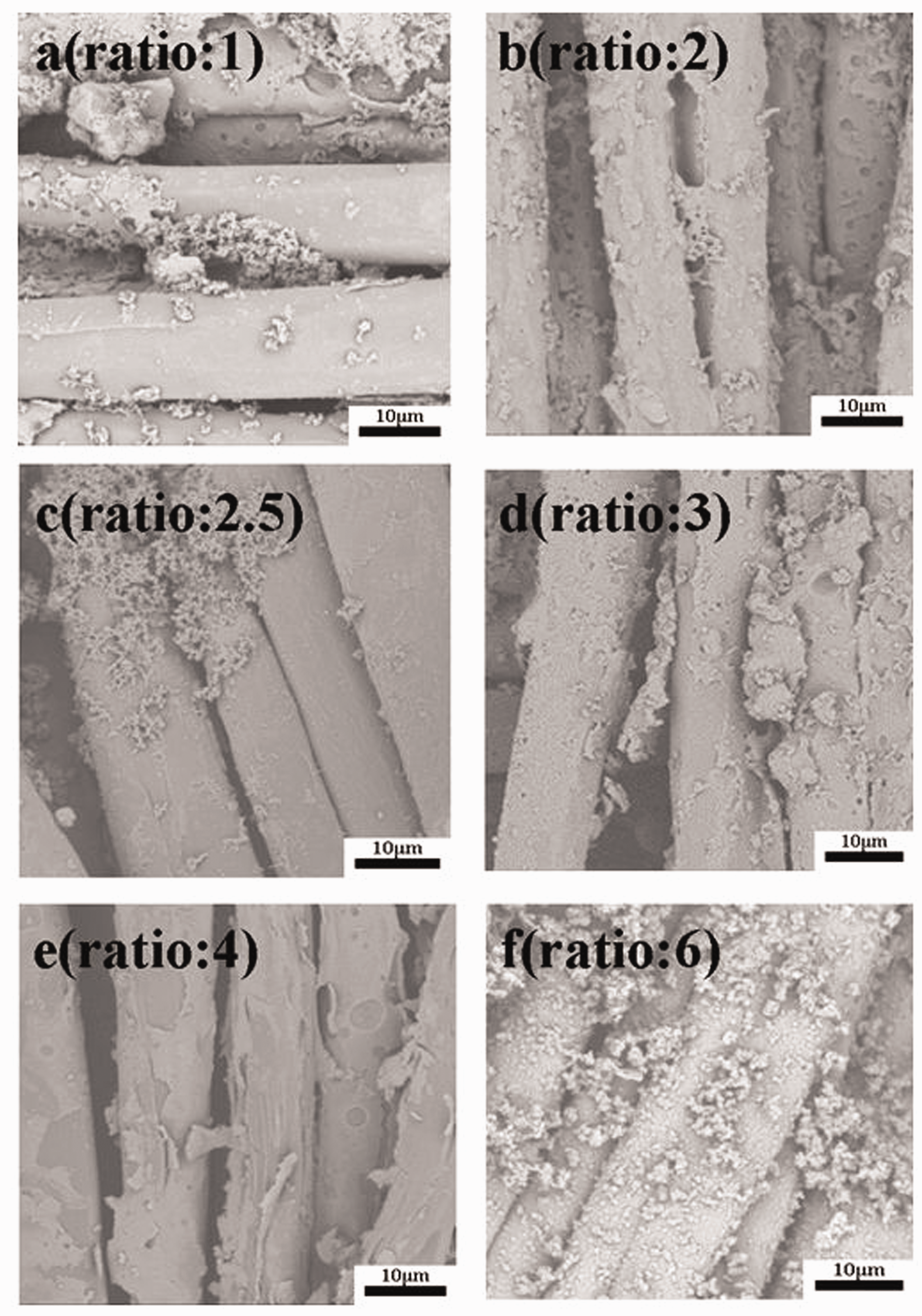
SEM images of composite fabrics with a monomer concentration being 0.035 mol/L and the molar ratio of oxidant to monomer being (a) 1, (b) 2, (c) 2.5, (d) 3, (e) 4, and (f) 6.
Figure 4 shows the SEM images of composite fabrics with a specified monomer concentration (0.035 mol/L) and different molar ratios (1, 2, 2.5, 3, 4, and 6). With different oxidant concentrations, all fabrics are deposited with PEDOT and the fibers become rugged. This result may be ascribed to oxidation of fibers caused by oxidant. Also, it may be ascribed to the polymer films over the fibers, which simultaneously provides composite fabrics with conductivity. There are significant differences in the adhesion effect of polymers over the fabrics due to various oxidant concentrations. It shows clearly that with a specified molar ratio being 2.5, the polymer adhesion over the fabrics is even and dense, which can be surmised that the optimal oxidant concentration being 2.5 contributes to the maximal conductivity.
Figure 5 shows the FTIR spectrum of PEDOT:PSS-coated PET composite fabrics made by the chemical oxidation. The spectra of PEDOT was tested with pedot particles peeled off the fabric. This experimental group retains the characteristic peaks for PET while the characteristic peaks (i.e. function group vibration) for PEDOT films are presented at 2162 cm−1, 2026 cm−1, and 1729 cm−1 concurrently [24]. By contrast, PET woven matrices do not exhibit new functional group vibration at the same frequency, which substantiates that PEDOT is successfully deposited over PET woven fabrics.

FTIR spectra of PET woven fabrics and PEDOT:PSS-coated PET composite fabrics.
PEDOT:PSS-coated PET composite fabrics has the highest electrical conductivity, and can serve as a conductive connector to light the LED at a voltage of 3 V,as shown in Figure 6.

The lighted bulbs by PEDOT:PSS-coated PET composite fabrics.
Figure 7 shows that compared to the control group with only culture medium, PET woven fabrics do not exhibit distinct antibacterial effect but the opposite is the case for PEDOT:PSS-coated PET composite fabrics. The number of colonies is statically counted using a manual counting mode (Scan 500, interscience, France) after the bacteria are smeared over the agar plate. Next, the antibacterial effect of samples is computed using the equation. After shaking contact for 18 h, compare the concentration of live bacteria in the flask of the control sample with the antibacterial fabric (or non-antibacterial treated fabric) according to the following formula to calculate the bacteriostatic rate.


Antibacterial efficacy of (a) blank group, (b) PET woven fabrics, and (c) PEDOT:PSS-coated PET composite fabrics.
In the formula:
Y–Antibacterial rate of sample.
Wt-The average value of the concentration of viable bacteria in the flask after 18 h shaking contact of 3 control samples (CFU/mL).
Qt-The average value of the concentration of viable bacteria in the flask of 3 antibacterial (or 3 non-antibacterial treated fabric) samples after 18 h shaking contact (CFU/mL).
Table 1 shows the number of colonies and antibacterial effects of different fabrics. The number of colonies and antibacterial effect are 3126 and 0% for the control group, 2902 and 7.16% for PET woven fabrics, and 904 and 71.08% for PEDOT:PSS-coated PET composite fabrics, respectively. Unlike PET woven fabrics, PEDOT:PSS-coated PET composite fabrics that have PEDOT deposition exhibit a bacteriostatic rate of 71.08, indicating a good antibacterial effect of refraining over 70% of E. coli. As specified in GB/T 20944.3-2008《Textile Evaluation of antibacterial properties The third part: oscillation technique》, materials with a bacteriostatic rate ≥70% have qualified antibacterial effect. Therefore, PEDOT:PSS-coated PET composite fabrics has better antibacterial effect. Two factors are attributed for the antibacterial efficacy of PEDOT:PSS-coated PET composite fabrics. One is the improved hydrophilic surface and the other is that the organic parts of PEDOT with positive charges interfere with the permeability of cell membranes [31,32]. As a result, the cell walls of bacteria are broken and the bacteria are eliminated eventually.
Application
A vital signs simulator (Prosim 3 Vital Signs Simulator, Fluke, USA) and Convenient multi-parameter monitor (MEC-1000, Shanghai Poly Medical Instruments Co., Ltd., China) are used in the ECG measurement as Figure 8(a). Figure 8(b) shows the participant who wears fabric electrodes in the measurement. The vital ECG vital signals are collected via fabric electrodes and simulated by the vital signs simulator, thereby generating the ECG in Figure 8(b).

The ECG vital signal of (a) fabric electrodes, (b) ECG test of the human body, and ECG diagram of the human body.
Figure 8 shows that the proposed PEDOT:PSS-coated PET composite fabrics are able to collect clear and stable ECG vital signals. The heart rate of the participant is 80, which is consistent with the results by using the vital signs simulator. Furthermore, the adoption of human body helps gather more stabilized ECG vital signals, which substantiates that the use of composite fabrics as the ECG electrodes can yield accurate and stable heart rate.
Conclusion
In summary, PEDOT conductive fabrics are prepared by means of the chemical polymerization using PET woven fabrics, cotton woven fabrics, cotton knitted fabrics, and PET mesh cloth as the matrices. The effects of the fabric pattern, oxidant concentration, and monomer concentration on the electrical performance of composite fabrics are explored. The employment of chemical oxidation provides the composite fabrics with good electrical conductivity. The optimal parameter for PEDOT:PSS-coated PET conductive fabrics include PEDOT concentration of 0.035 mol/L, molar ratio of the oxidant to PEDOT being 2.5, and the dopant concentration being 2.5 g/L yields an optimal conductivity of 217.9 S/m. A comparison between different fabric patterns and constituent materials, the conductivity can be ranked from highest to lowest as PET composite fabrics, Cotton woven fabrics, cotton knitted fabrics, and PET mesh cloth. Moreover, PEDOT:PSS-coated PET composite fabrics have antibacterial efficiency of 71.8%, meeting the antibacterial textile standard. The resulting conductive composite fabrics can serve as ECG electrodes that are able to detect stable human body analogy signals and collect a stable ECG signal for record.
The number of colonies and antibacterial effect of different fabrics.

Supplemental Material
sj-pdf-1-jit-10.1177_15280837211022637 - Supplemental material for Structure design of multi-functional flexible electrocardiogram electrodes based on PEDOT:PSS-coated fabrics
Supplemental material, sj-pdf-1-jit-10.1177_15280837211022637 for Structure design of multi-functional flexible electrocardiogram electrodes based on PEDOT:PSS-coated fabrics by Jia-Horng Lin, Xiangdong Fu, Ting-Ting Li, Xuefei Zhang, Bobo Zhao, Bing-Chiuan Shiu, Huiquan Wang, Qian Jiang and Ching-Wen Lou in Journal of Industrial Textiles
Footnotes
Declaration of conflicting interests
The author(s) declared no potential conflicts of interest with respect to the research, authorship, and/or publication of this article.
Funding
The author(s) disclosed receipt of the following financial support for the research, authorship, and/or publication of this article: The authors gratefully acknowledge the financial support provided by the Natural Science Foundation of Tianjin (18JCQNJC03400), the Natural Science Foundation of Fujian (2018J01504, 2018J01505) and the Program for Innovative Research Team in University of Tianjin (TD13-5043).

References
Supplementary Material
Please find the following supplemental material available below.
For Open Access articles published under a Creative Commons License, all supplemental material carries the same license as the article it is associated with.
For non-Open Access articles published, all supplemental material carries a non-exclusive license, and permission requests for re-use of supplemental material or any part of supplemental material shall be sent directly to the copyright owner as specified in the copyright notice associated with the article.
