




Abstract
Workers are exposed to skin frostbite in extremely cold environments, especially in contact with cold surfaces. They must wear cold-resistant clothing/gloves to avoid frostbites. However, there was a lack of an accurate method to evaluate the cold-contact protective performance (CPP) of fabrics. In view of this, a test device was developed to simulate the cold-contact exposure by controlling cold-contact temperature and pressure. Then, a frostbite prediction model was proposed to predict the time to skin-frostbite (TSF) as an index for characterizing the CPP. It was found that the standard deviation of cold-contact temperature fluctuated within 0.03°C to 0.51°C in the same second, and the coefficient of variations of the TSF were from 1.35% to 6.97%, indicating that the device presents good stability, reliability, reproducibility. The TSFs for different fabric systems ranged from 35 s to 419.33 s, mostly depending on the fiber type, the thermal resistance, the thickness of fabric and the air content in the fabric. Finally, it was concluded that the proposed device provides a scientific and realistic measurement of CPP of fabrics.
Keywords
Introduction
Frostbite may occur in daily life or during occupational exposure to environments or materials below 0°C. Cold exposure mainly includes exposure to cold air, immersion in cold water or contact with cold surfaces (cold-contact exposure). In the food processing industry, the frozen goods are processed at temperatures below –20°C [1], which means the related workers have to be in contact with frozen products. In addition, in extremely cold winter, workers engaged in construction, outdoor repairs and emergency rescue need to handle cold tools. Explorers traveling to poles and climbers often contact with frozen objects. It is reported that cold-contact exposure was more harmful to human body than exposure to cold air, and was more likely to cause skin frostbite [2].
When the skin temperature drops below the freezing point of skin (about −0.53°C to −0.65°C) [3], frostbite would occur, often at the hands, feet, head, nose, ears and other body parts far from the heart [4]. The first-degree frostbite is a superficial freezing of epidermis with minimal tissue necrosis. The second-degree frostbite is the partial systematic thickness injury caused by hypothermia (the body core temperature below 35.0°C) and edema (the buildup of fluid in the body’s tissue). The third-degree frostbite is the necrosis of entire skin’s thickness and may extend to varying depths of the subcutaneous tissue. The fourth-degree frostbite involves the full thickness of skin and underlying tissue and includes bones [5,6]. It may cause cold-stress damage to skin on hands during such contact with cold surfaces [1]. When the skin is exposed to cold surfaces, such as processing frozen products or handling cold tools with bare hands, the temperature of skin would drop, and discomfort, pain and numbness would gradually appear, eventually leading to skin frostbite [7]. Therefore, it is very important to wear cold-resistant clothing/gloves to protect the skin from cold injury.
Cold-resistant clothing/gloves can reduce the heat loss of skin. Most of the cold-resistant clothing/gloves are made of multi-layered fabrics, including an outer layer, a warm layer, and a lining [8,9]. The effectiveness of fabrics to protect the skin from frostbite under cold-contact exposure is called cold-contact protective performance (CPP) in this study. Time to skin-frostbite (TSF), which is the time when the skin temperature reaches the freezing point of skin [10], is used to characterize the CPP of fabrics. In the study made by Chen et al. [11], subjects wore cotton gloves or leather gloves to contact an aluminum surface with −7°C. It was found that the skin temperature dropped to 12°C, which reportedly impaired the flexibility and dexterity of hands [12]. Some subjects were at risk of frostbite. However, it is unsafe to predict skin frostbite through human experiments.
Some scholars used the data of skin frostbite from human experiments to establish numerical models to predict the TSF [3]. Manda et al. [13] developed a finger frostbite model to predict the TSF, and this model considered the effects of temperature of skin, heat input, thermal resistance of gloves, and environmental climate conditions on the TSF. Fallahi et al. [14] used the methods of analytical correlation to estimate the calculation expressions of TSF under cold exposures. The above studies only considered the influence of the thermal resistance of gloves. There were not detailed studies on the effects of fabrics’ fundamental properties on the CPP, especially in cold-contact exposure. Due to the complexity of fabrics’ fundamental properties, it was difficult to accurately simulate the CPP of fabrics using a numerical model.
The thermal insulation of cold-resistant fabric was measured using a guarded hot plate [15,16] or a thermal constant analyzer [17]. However, these instruments, which used for measurement of the retention of warmth, thermal resistance and thermal conductivity of fabrics, were not used to measure the TSF. Furthermore, the conditions of cold-contact exposure should be simulated first for characterizing the CPP of fabrics. Different cold-contact conditions, such as the material of cold surface, cold-contact temperature, pressure, area and time, exerted important effects on skin cooling. The common materials of cold surfaces (such as ice, wood, steel and aluminum) had different effects on the cooling of skin [18]. Geng et al. [19] studied the responses of finger when contacted with cold aluminum, stainless steel, nylon and wood, which found that aluminum was quicker to decrease skin temperature than other materials. Furthermore, the skin temperature decreased faster and the risk of frostbite increased dramatically with the decrease of cold-contact temperature. It is worth mentioning that, in previous studies, the materials for simulating the cold surface were usually put in the cold chamber to reach the required cold-contact temperature, while this method was greatly affected by the temperature of cold chamber [20,21].
In this research, a test device was developed to characterize the CPP of fabrics. A skin heat transfer model was proposed for predicting the TSF. Based on the calibrated test device, the accuracy, repeatability and reliability of the device were analyzed. In addition, the CPPs of single-layered and multi-layered fabric systems used for cold-resistant gloves were studied under cold-contact exposure.
Testing apparatus
Instrument design and configuration
In order to measure the CPP of fabrics, a test device for simulating the cold-contact exposure was developed, as shown in Figures 1 and 2. The test device consists of a refrigerating table, a skin-simulant sensor, a contact-pressure weight, a temperature controller, a data collection system and a water-cooling system.

Schematic of the cold-contact protective performance tester.

Picture of real product of cold-contact protective performance tester.
The refrigerating table, which can simulate the cold-contact surface, is composed of a 150 mm × 150 mm × 6 mm aluminum plate and four thermoelectric coolers (HT064189) attached under the aluminum plate. The refrigerating temperature is controlled by the temperature controller, and the minimum temperature for the refrigerating table reaches −35°C. A thermal resistor (NTC-10k-0.5%) is fixed on the surface of refrigerating table for monitoring the surface temperature. The thermoelectric cooler has two sides. When a DC (direct current) electric current flows through the device, it brings heat from one side to the other. Therefore, one side gets cooler while the other gets hotter. In order to enhance the cooling effect on the cold side, the hot side should remain low temperature by water cooling, air cooling and other methods. The water cooling increases the cooling rate of the hot side by controlling the temperature of circulating water, which is more effective than air cooling [22]. The water-cooling system, connected to the refrigerating table through a water pipe, consists of a chiller and a water-cooling radiator. The temperature of circulating water is set at 10°C to obtain a better cooling effect of the refrigerating table.
In this research, the temperature change on skin surface is simulated using a skin-simulant sensor under different cold-contact exposures. The skin-simulant sensor is composed of a skin-simulant element, a T-type thermocouple (Omega: HSTC-TT-K-24S), a sensor base and a handle (Figure 3). The skin-simulant element is installed in the sensor base and connected with a data collection system to measure the temperature change on the skin surface. The dimensions of the sensor base are 63.5 mm × 63.5 mm × 12.7 mm. The material of the sensor base is aluminum silicate ceramic fiber with a low thermal conductivity (0.085 W/(m
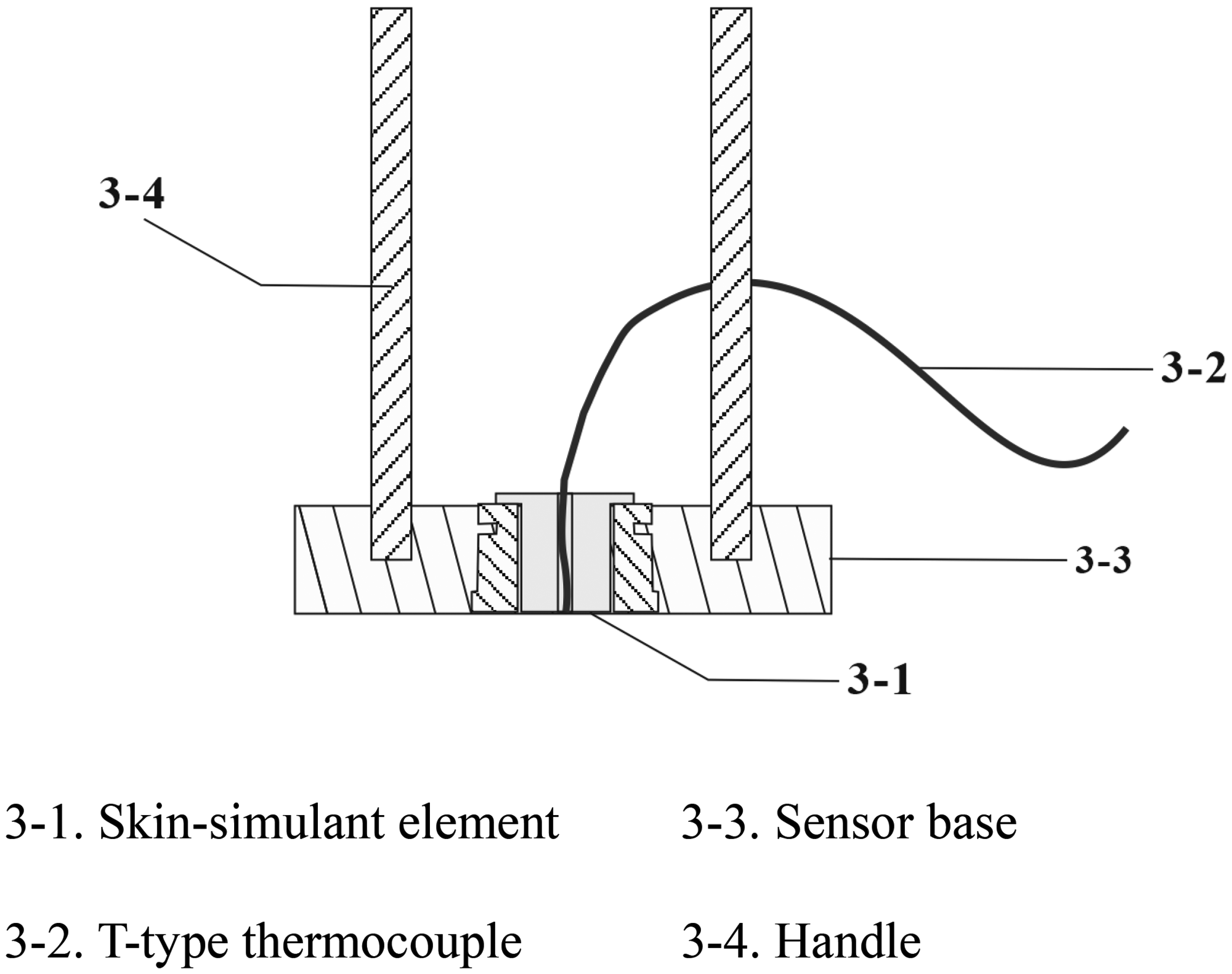
Schematic of the skin-simulant sensor.
Frostbite prediction model
The signal collected directly by the data collection system provides the change in temperature of the skin-simulant sensor. According to the Duhamel’s Theorem [24], the heat flux on the sensor is calculated using the temperature change, written as:

Pennes’ bio-heat transfer model, is used to predict the heat transfer in skin tissues [25]. This model considers the effects of blood perfusion and metabolic heat production on heat transfer. The heat transfer equation in the skin tissues is given by,

Thermophysical parameters of each layer of skin and blood flow [26].

Equation (2) is solved by the two boundary conditions, given by equations (3) and (4),


Through the above-mentioned bio-heat transfer model, the variations in temperature of different skin layers with time are obtained. The skin freezing point determined by Keatinge et al. [3] was found to be between −0.53°C and −0.65°C. Fallahi et al. [14] used −0.6°C as the skin freezing point for predicting the TSF in human fingers. Hence, −0.6°C was treated as a reference value of the skin-freezing point in this research. The time, when the temperature of each skin layer reached the skin-freezing point, was used to predict the skin frostbite in each skin layer.
Evaluation indexes
Evaluation indexes calculated using frostbite prediction model are temperature in each skin layer (°C), time to skin-frostbite (TSF) (s), heat flux (W/m2) and thermal energy (J/cm2), which are used to characterize the CPP of fabric, which are shown in Table 2.
Evaluation indexes.

Test procedure of test device
Firstly, the test specimens (100 mm × 100 mm) were conditioned in a standard atmosphere (20°C and 65% relative humidity) for at least 24 h, and sealed in a plastic bag before testing. Next, the skin-simulant sensor was heated to the skin surface temperature (32.5°C) [27] by a heating plate with a constant temperature (the temperature deviation is ±1°C), prior to positioning over the test specimens. After that, the specimens were placed between the refrigerating table and the sensor, and the temperature in surface of the skin-simulant sensor was collected using a data collection system during cold-contact exposure. Finally, the collected data was used to calculate evaluation indexes for evaluating the CPP of fabrics.
Experiments
Calibration of cold-contact exposure
The newly developed test device can simulate the cold-contact exposures by controlling various parameters, including cold-contact temperature (°C), cold-contact pressure (kPa) and cold-contact area (cm2). Such parameters need to be calibrated before the actual experiment.
Firstly, the temperature of the refrigerating table (i.e. cold-contact temperature) needed to be set and maintained at the desired temperature. The temperature of low-temperature cold storage is about −20°C to −30°C [28], while the lowest winter temperature in Mohe and other cities in northeast China can reach −25°C [29]. Therefore, the cold-contact temperature values were set to −30°C in sample testing. The base area of the skin-simulant sensor was 63.5 mm × 63.5 mm. In order to ensure sufficient contact, the cold-contact area was set to 63.5 mm × 63.5 mm in sample testing. When the cold-contact pressure was greater than 3.14 kPa, the difference in the cooling rate of fingers caused by different cold-contact pressures was not significant [30]. Thus, the cold-contact pressure was chosen to be 3 kPa in sample testing.
In order to verify that the temperature of refrigerating table could reach the required cold-contact temperature, a calibration procedure was performed. The cold-contact temperature was set to −20°C and −30°C. Then, the cooling data was recorded using a data collection system until it reached the setting temperature and remained stable. The initial temperature of the refrigerating table was about 11°C, and the cooling data of the refrigerating table was recorded from 10°C. For validating the reproducibility of refrigerating table, the calibration procedure was carried out three times.
Accuracy of test device
The accuracy of test device was analyzed by comparing with a human trial from the study of Geng [20]. In the human trial, the subjects’ bare finger touched a smooth surface of aluminum at −15°C, with a constant cold-contact force (0.98 N). The cold-contact areas between the finger and the aluminum surface were 2.37cm2 ± 0.46 cm2, which were not constant value. However, the cold-contact pressure is equal to the ratio of the cold-contact force to the cold-contact area. Hence, the cold-contact pressure between the finger and the cold surface was in the range of 3 kPa–5 kPa. For this case, the time for skin temperature to reach 0°C for male and female participants was 41.97 s and 74.39 s, respectively. The results of human trial provided a reference for the accuracy of the results measured by the proposed device.
Therefore, the proposed device was used to simulate the temperature changes in bare human skin when exposed to a cold surface of aluminum. Referring to the cold-contact condition of human trial, the median (4 kPa) of 3 kPa–5 kPa was selected as the cold-contact pressure, and the cold-contact temperature was set at −15°C. Then, the time for skin temperature to reach 0°C (started when the skin temperature was 25°C) was calculated, and the accuracy of the test results was verified by comparing with the results of human trial.
Calibration of test device
After the accuracy of the test device was verified, the test device would still have inaccurate test results due to improper operation, breakdown of parts and other problems in the future use. Hence, it was necessary to formulate a calibration method to verify the accuracy of the test results.
According to ASTM F1060-18 [31], six (and not previously tested) sheets of newspaper were chosen as the calibration specimen, which was easily accessible and with a total thickness of 0.53 mm ± 0.05 mm (mean ± SD), and a total mass per area of 256.53 g/m2 ± 0.25 g/m2 (mean ± SD).
To calculate the deviation of the test results, the calibration specimen was tested 10 times using the method described in section 2.4 with a cold-contact temperature of −30°C and a cold-contact pressure of 3 kPa. The TSFE and TSFD obtained from 10-time repeated tests were used as reference results. In the further fabric test, it will be necessary to test the calibration specimen first. When the test results are in the range of the reference results, it means that the test device is in good operation.
Measurement of CPP of fabric
Cold-resistant glove is composed of single-layer or multi-layer fabrics, including outer layer, warm layer and lining. These selected fabrics in this research are commonly used in the cold-resistant glove (Table 3). The outer-layer fabrics O1 and O2 have high windproof performance, and are widely used in the multi-layer glove. Besides, the fabric O1 has higher waterproof performance than the fabric O2. The outer-layer fabrics O3 and O4 are commonly used in single-layer glove. The PVC sponge (W1, W2) and Thinsulate™ (W3, W4) were selected as the warm layers for investigating the effects of fabric’s thermal insulation and type on the CPP. The warm layers for most of cold-resistant gloves are the nonwoven structure. This was because the structure provides higher thermal insulation for the multi-layer gloves. The basic specifications of the test samples are listed in Table 3. Considering that the test was performed at a pressure of 3 kPa, the thicknesses of fabrics were tested using a KES-FB3 tester at a pressure of 3 kPa. According to ISO 3801-1977, the mass per area of each test sample was tested. Single-layered fabrics are assembled into a multi-layered fabric system, and different fabric combinations are presented in Table 4.
Specifications of the single-layered fabrics.

Description of fabric systems.

The fabric testing was carried out according to the test procedure (as described in section 2.4). Each fabric system was tested thrice to verify the precision, reliability and repeatability of the test device and analyze the influence of fabrics’ fundamental properties of fabrics on their CPP.
Results and discussion
Calibration of cold-contact temperature
The calibration results of cold-contact temperature are shown in Figure 4. It was clear that the three temperature curves were generally consistent. When the temperature at 0°C to −5°C, all the temperature curves presented a slight increase. This was due to the reason that the water vapor condensed and released heat on the surface of refrigerating table at around 0°C. However, the water condensation could finish at around −5°C since there was not enough water for condensation. The time for the refrigerating table cooling to −20°C and −30°C was 257.33 s ± 8.08 s and 844.33 s ± 35.53 s (mean ± SD), respectively. The coefficient of variations (CV) for the two experimental conditions were found to be 3.14% and 4.23%, meaning that the refrigerating table had a good reproducibility according to the CVs of some standardized test devices [27,31,32]. Therefore, it was indispensable for taking at least 300 s and 900 s for the cold-contact temperature stabilizing to −20°C and −30°C, respectively. The stabilizing duration would be treated as reference values for future calibration of cold-contact temperature.

Change in temperature with time during the calibration.
Accuracy of test device
Table 5 presents the time for skin temperature to reach 0°C measured by the proposed device and human trial. It was found that the time to skin temperature reaching 0°C (started when the skin temperature was 25°C) obtained by the proposed device was 54 s ± 3 s (mean ± SD), which was in the range of the male’s and female’s test results.
Time for skin temperature to reach 0°C.

Note: F: female, M: male.
To a certain extent, the test results by the proposed device were validated to be accurate. The proposed device mainly provided a measurement means for the CPP of fabrics. Considering that human body would suffer cold injury when contacting with cold surface, there were some safety risks in human trial, so it was practical to evaluate the cold injury by the device.
Testing of calibration specimen
Table 6 shows the statistical results of the TSFE after 10 times repeated tests on the calibration specimen. It was clear that the TSFE lied within the range of 160 s to 181 s, while the TSFD was within the range of 168 s to 188 s. The corresponding CV values for TSFE and TSFD were 4.25% and 4.08%, which indicated that the testing results showed good stability. Therefore, the average values of TSFE and TSFD were adopted as reference results for calibrating the accuracy of test device.
TSFE and TSFD of reference specimen.

Before actual fabric testing, the calibration specimen should be tested with a cold-contact temperature of −30°C for validating whether the TSFE is within 170.22 s ± 7.24 s, and the TSFD is within 177.89 s ± 7.27 s (mean ± SD). If not, the calibration specimen should be tested 10 times. Then, the test results and the reference results should be tested by single-sample T test at the significance level of 95%. If P (Probability value) < 0.05, there will be a significant difference between the two results, which suggests that there may exist some problems in the device or the experimental procedure.
Application
Precision analysis of CPP of fabric
Table 7 presents the TSF for different fabric systems. The SD of the TSF lied within the range of 2.08 s to 30.61 s, the higher SD mainly corresponds to the higher TSF. The uncertainty of human’s operation, slight fluctuations in the room temperature, and the temperature deviation of heating plate might cause deviations in the results. Furthermore, the precision of data collection system and thermocouple were ± 0.05% and ± 0.4%, respectively, which might also cause uncertainty of testing results. The CV values of the TSF were from 1.35% to 6.97%, meaning that the dispersion degree of the three repeats was low. Reliability analysis was also used for explaining the experimental precision. The intra-class correlation coefficients of the TSF in the three repeats were all greater than 0.90. It demonstrated that the test results had excellent reliability and precision.
The TSF of fabric systems.

Note: ‘—’ means no frostbite during a exposure time of 900 s.
Figure 5 shows the temperature in epidermis for fabric S1–S4. It was observed that the temperature curves of three repeats presented a similar tendency of changing. The fluctuation range in the same second for temperature curves of S1–S4 was 0.099°C to 1.201°C, 0.143°C to 0.834°C, 0.003°C to 0.400°C and 0.013°C to 1.468°C, respectively. The intra-class correlation coefficients of temperature in epidermis in the three repeats were all greater than 0.99, suggesting that the test device was excellent in repeatability.

Temperature in epidermis under the protection of fabrics S1-S4.
Effect of fabric properties on CPP
The CPPs of single-layered, double-layered and tripe-layered fabrics were tested using the proposed device. As shown in Table 7, the TSF was proportional to the thermal resistance of the fabrics, indicating that the higher the thermal insulation performance of the fabric, the higher the CPP of the fabric.
Four warm layers were respectively recombined with fabric O1 and fabric L1 to form triple-layered fabric systems. When the sponges W1 and W2 were selected as warm layer, the skin frostbite did not occur under cold-contact exposure of −30°C. The fabric systems containing Thinsulate™ W3 and W4 prevented the hypodermis from frostbite under cold-contact exposure of −30°C. However, the dermis layer was still frostbitten under the cold-contact exposure for a long time.
The weights of sponges W1 and W2 were close to those of Thinsulate™ W3 and W4 respectively. The CPP of the fabric systems with sponge were higher than that of the fabric systems with Thinsulate™. In the unpressurized state, the thermal resistance of the sponge was slightly greater than that of the Thinsulate™. Furthermore, under a pressure of 3 kPa, the compression ratios of the Thinsulate™ and the sponge were 80.86% and 30.4%, respectively. Therefore, the content of still air in the Thinsulate™ was lower than that of the sponge due to the larger deformation, which led to a greater drop in the thermal resistance of the former.
Within 900 s, the triple-layered fabric systems (with the sponge as a warm layer) maintained the epidermis temperature above 0°C, and effectively avoided the skin-frostbite. When workers move cold-storage products, the flexibility requirements of hands are not high. Gloves containing the sponge can be used to protect the hands.
Under the cold-contact exposure in a windless environment, the CPP of fabrics was related to the material, tissue structure of the fabric to a certain extent [33]. The fabrics with the looser structure stored more still-air, which improved the CPP. The wadding was deformed when pressed, which resulted in the loss of still-air [34], and the deformation of wadding decreased the CPP.
Skin heat flux versus time
Figure 6 shows the heat flux of the skin during cold-contact exposure, as calculated by the proposed model. The heat flux was recorded as negative, since heat was transferred from the skin to the outer environment.

Heat flux of the skin versus time during cold-contact exposure.
In the process of cold-contact exposure, the heat loss of all fabric system firstly increased with time, then reached the maximum between 300 s and 400 s, and finally decreased.
Initially, the temperature of the skin was close to that of the fabric, provided that the fabric acted as an insulation between the skin and the cold surface. Once the fabric contacted with the cold surface, a temperature gradient (along the thickness direction) formed among the skin, the fabric and the cold surface. Meanwhile, the temperature of the skin and the fabric began to drop. Because the fabric was closer to the cold surface, its temperature dropped faster. According to Fourier’s Law [35], the heat flux was proportional to the magnitude of the temperature gradient. The temperature gradient between the fabric and the skin gradually increased, so did the heat flux. When the temperature dropped to a certain extent, the temperature gradient between the skin and the fabric gradually decreased, so did the heat flux.
The loss of heat for multi-layered fabric system was less than that for single-layered fabric. Meanwhile, the triple-layered fabric systems with a sponge layer had lower heat loss, while the single-layered rib-knitted fabrics had higher heat loss. The reason was that the fabric system with larger thickness and more layers stored more still-air, which improved the thermal insulation [33].
As shown in Figure 7, the accumulated thermal energy lost through the skin increased with time within 900 s. The loss of thermal energy during the exposure mainly depended on the fabric’s configuration, content of still air in fabric, the exposure time, the cold-contact temperature and cold-contact area.

Accumulated thermal energy loss of skin in 900 s.
Conclusions
In this research, a test device was developed to characterize the cold-contact protective performance (CPP) of fabrics. The proposed device can effectively simulate different cold-contact exposures by controlling cold-contact temperature, pressure and area. A frostbite prediction model was proposed to predict the time to skin-frostbite (TSF) as an index for evaluating the CPP of fabric. It was found from the calibration that the temperature of cold surface was relatively stable, and the SD of temperature fluctuated within 0.03°C to 0.51°C in the same second, when the cold-contact temperatures were set at −20°C and −30°C. This indicated that the test device provided a stable test condition. The average time for bare skin to reach 0°C simulated by the device was 54 s ± 3 s (mean ± SD), showing a good agreement with the human trial. Therefore, it was deduced that the test device might be used to simulate the heat transfer in skin tissues under the cold-contact exposure.
In addition, the CPPs of single- and multi-layered fabrics were analyzed through the test device. The results identified good repeatability and reliability for the characterization of CPP of fabrics. For a cold-contact exposure at −30°C in 900 s, gloves with a sponge layer effectively protect hands against frostbite, while the TSF for other cold-resistant gloves ranged from 35 s to 419.33 s, which was related to the fiber type, thermal resistance of fabric, thickness of fabric, air content in the fabric and cold-contact temperature. These findings suggest that the test device is an effective tool for characterizing the CPP of fabrics. Furthermore, the study contributes to the development of the evaluation standards of CPP, and engineering cold-resistant clothing/gloves to provide higher CPP for users.
Footnotes
Declaration of conflicting interests
The author(s) declared no potential conflicts of interest with respect to the research, authorship, and/or publication of this article.
Funding
The author(s) disclosed receipt of the following financial support for the research, authorship, and/or publication of this article: This work was supported by Chenguang Program supported by Shanghai Education Development Foundation and Shanghai Municipal Education Commission (20CG78), and Fundamental Research Funds for the Central Universities (2232019D-18 and 2232021G-08).
