




Abstract
Nonwoven aramid fabric is widely used as thermal barrier of fireproofing clothing due to its inherent flame retardancy and light weight. In fire or high temperature scenario, radiative heat transfer becomes the predominant heat transfer mode inside firefighters’ clothing. In this work, Fourier transform infrared spectroscopy (FTIR) was adopted to measure the spectral transmittance and spectral extinction coefficients of four aramid fabrics with different porosity in infrared wavelength range between 2.5 and 25 μm. It was found that the radiative properties of fibrous aramid fabric are strongly dependent on its bulk density or porosity. The spectral extinction coefficient decreases with increasing porosity or decreasing bulk density. The infrared optical properties combined with infrared imaging measurements demonstrate that aramid fabric may be used as infrared semi-transparent textile. A predicted model, combined the effects of conduction-radiation heat transfer, has been developed to calculate the effective thermal conductivity of aramid fiber materials. The model implemented the Rosseland diffusion approximation to evaluate radiative thermal conductivity, and the Parallel-Series structural model to evaluate tortuosity-weighted phonic thermal conductivity. The predicted results were also compared with experimental data obtained from TPS method. This work provides useful information for future studies of heat transfer mathematical modeling of firefighters’ clothing.
Keywords
Introduction
It has been long explored to develop engineered textile to exhibit desired thermal radiative properties for thermal function clothing. Thermal infrared radiation with the activated energy is generally divided into three ranges by wavelength, measured in microns: near-infrared (NIR, 0.75–2.5 μm), mid-infrared (MIR, 2.5–25 μm), and far-infrared (FIR, 25–100 μm). Therefore, the clothing radiative properties should be distinguished from different exposed heat sources or applications. In a typical fire or radiant heat exposure, the maximum temperature may reach up to 2000 K. Therefore, the spectral absorptivity in NIR range is mainly responsible for the conversion of radiative heat transfer coming from the flame or radiant source through the thermal protective clothing [1,2]. The solar energy absorbing and retaining fabric, incorporated with transition metal particles of group IV in the periodic table, can absorb visible and near infrared sunlights and converts them into thermal energy [3]. Anderson et al. investigated thermal radiative properties of ceramic-embedded textile fabric and found that in the NIR spectrum, human body will receive more infrared rays when wearing fabrics with no added ceramic. However, the garment composed of fabric with 1.18 wt. % added ceramic particles can absorb more solar NIR radiation, which is then re-mitted by the fabric [4]. The typical infrared spectrum associated with human physiological processes is roughly from 6 to 14 μm. There are two research directions related to the wavelength human body thermal radiation including infrared heating and passive personal radiative cooling (PPRC). The infrared heating fabric absorbs body heat and radiates far-infrared rays for greater heat retention [5]. The far-infrared rays also possess the promising property that are beneficial to an individuals’ health and can be extendedly utilized in thermal therapy functional textiles [6]. PPRC is an attractive strategy that an MIR transparent porous textile is used to dissipate the majority of human body heat to an indoor environment [7] or outdoor surroundings [8,9]. Therefore, it is essentially important to know the infrared radiative characteristics of clothing materials to develop new thermal function clothing.
Several studies of effective thermal conductivities (ETCs) of glass fiber battings and fibrous fireproofing materials [10,11] have shown that radiative heat transfer can be significant in these media and becomes a dominated mode of heat transfer within the fibrous batting especially when the temperature gradients are high. Therefore, combined conduction-radiation heat transfer model applicable to fibrous insulation have been developed by some researchers [12–14]. It is usual that the fibrous fabrics were regarded as homogeneous and continuous materials when the radiative properties were studied. Then, radiative heat transfer inside such a medium is described by solving radiative transfer equation (RTE) in conjunction with the energy conservation equation in the far field regime [15]. On the other hand, the Maxwell equations must be solved in the near-field regime [16]. All these equations are not commonly used due to their complexity. Moreover, the predicted results from these equations are still uncertain because not all of radiative properties have been measured [17].
Investigations of combined radiative and thermal properties for traditional fabrics have been conducted, but there is less information on aramid fabrics. To the best of our knowledge, previous studies have been focused on either determination of radiative thermal conductivity or evaluation of effective thermal conductivity of aramid fabrics. In the present work, FTIR is applied to measure the radiative properties of nonwoven aramid fabric, which could be used as fire-proofing clothing thermal barrier materials. Simultaneously, a theoretical model for predicting the effective thermal conductivity in nonwoven fabric materials is also developed. The estimated radiative properties from FTIR are used to calculate the ETCs, which are then compared with the measured data under transient state conditions.
Theoretical analysis
Radiative properties
The incident flux density Ii,λ is incident onto the fabric surface and transmitted (It,λ) into the sample, and then is absorbed and scattered inside the material (Figure 1).

Schematic illustrating the radiation transmission through a fibrous fabric.
Physically, spectral extinction coefficient

If the material is homogeneous and isotropic, then

In addition, since Rosseland mean extinction coefficient represents the overall effect of heat flux attenuate, it is a more frequently used parameter than the spectral extinction coefficient.
In order to investigate the radiative heat transfer within fibrous insulations, the knowledge of spectral and temperature dependencies of the extinction coefficient and the albedo of scattering is required. The Rosseland mean extinction coefficients

By integrating Planck’s law over the FTIR wavelength, over 80% of the thermal radiation lies in the wavelength range between 2.5 and 25 µm below 973 K, therefore equation (3) can be rewritten as

The Rosseland mean extinction coefficients
The effective thermal conductivity
Thermal energy passing through a participating medium may generally be represented by several heat transfer modes: convection, conduction and radiation through different phases (solid and gas) between fibers [11]: (1) conduction in the solid and gas phase; (2) convection and radiative transfer through the gas phase; (3) thermal radiation. It has been recognized that the solid heat conduction and gas heat conduction are coupled. In some studies, convection has been also reported to be negligible because convection motions are hindered due to the immobile interstitial gas [14], when the Rayleigh number Ra is less than 40 [20]. If a one-dimensional geometry is considered, the governing energy equation for a board of fibrous material by combined conduction and radiation is given by the following partial differential equation [21,22]

With the initial condition

The effective or equivalent thermal conductivity

Gas-solid coupled heat conduction conductivity

(a) A real structure, (b) a schematic diagram of a representative volume unit, and (c) thermal-electrical analogy structure of fibrous porous material.
The Parallel and Series models assume two extreme structure arrangements that the gas and solid phase are thermally parallel or perpendicular to the heat flux direction. The thermal conductivity in parallel
Parallel model

Series model

In absent of convection, the mixed model (Krischer and Kroll model) [24], which is a combination of the series and the parallel models, was applied to predict the thermal conductivity

It was assumed that the fibrous fabric is optically thick and radiation can only travel a short distance before being fully scattered or absorbed. Therefore, the radiative flux


In this equation, the refractive index of air at atmospheric pressure,
Experimental
Materials and characterization
Nonwoven, flame retardant Aramid fabrics with different porosities were selected in the experiments and their structural parameters are listed in Table 1. The sample is needle-punched type nonwoven fabric. Needle punching is a technique used to provide a web of fibers sufficient cohesion by mechanical bonding. Spunpond fabric is not used in the study since the fiber surface and cross-section will be destructed and become coarse in the thermally bonding process. The fibrous structures are illustrated in Figure 3, which are observed on a DXS-10ACKT SEM (Tianjing Electronic Optical Technology Co., Ltd, Shanghai). From these figures it can be seen that the fiber diameter is approximate 10 μm and the arrangements of fibers are inhomogeneous. The porosity and pore size distribution of fabric were determined by mercury intrusion porosimetry (MIP) analysis method (Figure 4). MIP tests are performed by using a Micrometritics Autopore IV 9500 instrument (Micrometrics, USA).The measurements were conducted by incrementing the pressure up to 30 MPa on a sample immersed in the non-wetting mercury. The fabric was previously dried in an oven at 85°C with 2 h until reaching constant weight. Its dry weight Wd was obtained by using a digital balance. Then, the sample was conditioned for 12 h in a ambient chamber with temperature of 20°C and relative humidity of 65%. The weight of fabric sample Wm after conditioned was obtained. Therefore, the moisture regain (MR) of a fabric samples can be calculated by the equation
Summaries of aramid fabric parameters.


SEM pictures of Aramid fibrous fabric at magnifications of (a) 200

Pore diameter distribution from mercury intrusion porosimetry of Aramid fabrics with different porosities: (a) 0.76, (b) 0.80, (c) 0.82 and (d) 0.88.
Measurements
Radiative properties
FTIR spectroscopy was adopted to measure the normal transmittance of fibrous fabric samples to obtain their spectral extinction coefficient by Lanbert Beer’s law [18]. In this study, transmittance spectra of samples are measured using Nicolet IS10 FTIR spectrometer (Thermo Fisher Scientific) with a resolution of 0.5 cm−1. Simultaneously, an integrating sphere and a MCT detector were also combined. Data were collected and studied in the infrared range of 400–4000 cm−1.
Thermal conductivity
In the present paper, a transient plane source (TPS) method (i.e. Hot Disk) was applied to determine the thermal conductivity of non-woven fabric samples through Hot Disk TPS-2500 thermal constants analyzer at room temperature. The Hot Disk technique provides a direct measure of the effective thermal conductivity of the materials and the approach has been demonstrated elsewhere [22,27]. The standardized TPS technique offers its advantage in simultaneously determining thermal conductivity, thermal diffusivity and specific heat capacity from a single measurement, with marginal effort on sample preparation. The basic technical principle of the approach was that a thin Kpaton film (25 μm in thickness) behaves as a transient plane heat source working simultaneously as a temperature sensor (double spiral nickel foil). The sensor was located between two pieces of identical samples with both sensor faces in tightly contact with the two sample surfaces. A constant force of about 30 N between the two samples was applied to reduce the thermal contact resistance. To make sure of the experimental accuracy, three repeated experiments were performed and the average value was acquired. The value of the standard deviation for these repeated tests was lower than 5% for all these samples.
Results and discussion
Spectral transmittance and extinction coefficient
The integrating sphere was used to measure the spectral normal-hemispherical transmittance of samples at room temperature. The spectral transmittances for these samples with different porosity are illustrated in Figure 5 (infrared wavelength range between 2.5 and 25 μm). Some bands at about 3850 and 2000 cm−1, which is water molecular fluctuation, can be seen in the spectra. The absorption peak at a near 3300 cm−1 is N–H stretching vibration in a secondary amide in trans from with a bonded hydrogen [28]. Other band assignments can be also made: For example, absorption peak at 1642 cm−1 (amide C=O stretching for hydrogen-bonded amide groups), 1604 cm−1(C=C stretching vibrations of aromatic ring).
All the four testing samples with different thickness exhibit similar dependence upon the wavelength. In general, the transmittance should increase with the increase of porosity. However, it should be noted that the thickness of fabric sample would also affect its spectral transmittance, and the spectral transmittance decreases with the increase of fabric thickness [29]. This is the reason why fabrics with higher porosity have a lower transmittance illustrated in Figure 5. For example, the spectral transmittance of AR2 is higher than that of AR4 although AR4 has higher porosity than AR2. This may be because AR2 is thinner and radiation ray is easier to pass through the pores. In the wavelength within 2.5–6 μm, the spectral transmittances stay rather stable and are not dependent upon the spectral wavelength. As a whole, the values of the spectral transmittance are more than 0.5. Shown in the work by Tong et al. [30], the traditional undyed cotton and polyester cloth samples exhibit a low transmittance in the entire IR wavelength range. This means that traditional fabrics block infrared waves, especially mid-infrared (IR) radiation in the wavelength range between 7 and 14 μm emitted from human body [7], and cannot provide passive radiative cooling effect. However, these fabrics, which are transparent or semi-transparent to the infrared waves emitted by the skin, offer an opportunity to shed energy via radiation. Obviously, compared with the polyester fabric from the perspective of the spectral transmittance (Figure 6), the Aramid fabric can help people feel cooler to some extent by allowing thermal infrared emission from the skin to pass through the clothes.
Also, the infrared imaging was also applied to the AR2 fabric and polyester fabric, which has the similar thickness with the AR2 fabric. The thermal measurements of the two fabric samples were conducted on a guarded-hot-plate (GHP) apparatus, which is a primary instrument for measuring thermal conductivity or thermal insulation of a cloth fabric (ISO 11092). The GHP apparatus consists of a guarded heater unit, the bottom heater unit beneath the test section, and an opposite, similarly-sized auxiliary heater. A fabric with a size of 15 cm × 15 cm was mounted on the square plate that was heated to a constant temperature that approximates body skin temperature (i.e., 36°C). The infrared imagings obtained from Fluke® Ti55 infrared imaging camera, was made after thermal equilibrium characterized with constant hot plate temperature [6]. As demonstrated in Figure 7, the thermal imaging of polyester fabric appears lower average surface temperature (33.65°C) than AR2 fabric’s surface temperature (35.11°C). As compared to the traditional polyester fabric, the AR2 fabric shows higher transparency to infrared radiation, hence the infrared camera receives the more amount of infrared radiation. The result indicates that the Aramid polymer has good infrared transparency. The main absorption wavelength of aramid fiber locates in the range of 6.1–6.8 μm (1640–1471 cm−1) (Figure 5 and Ref. [31]), which is below the mid-infrared human body radiation spectrum (7–14 μm).
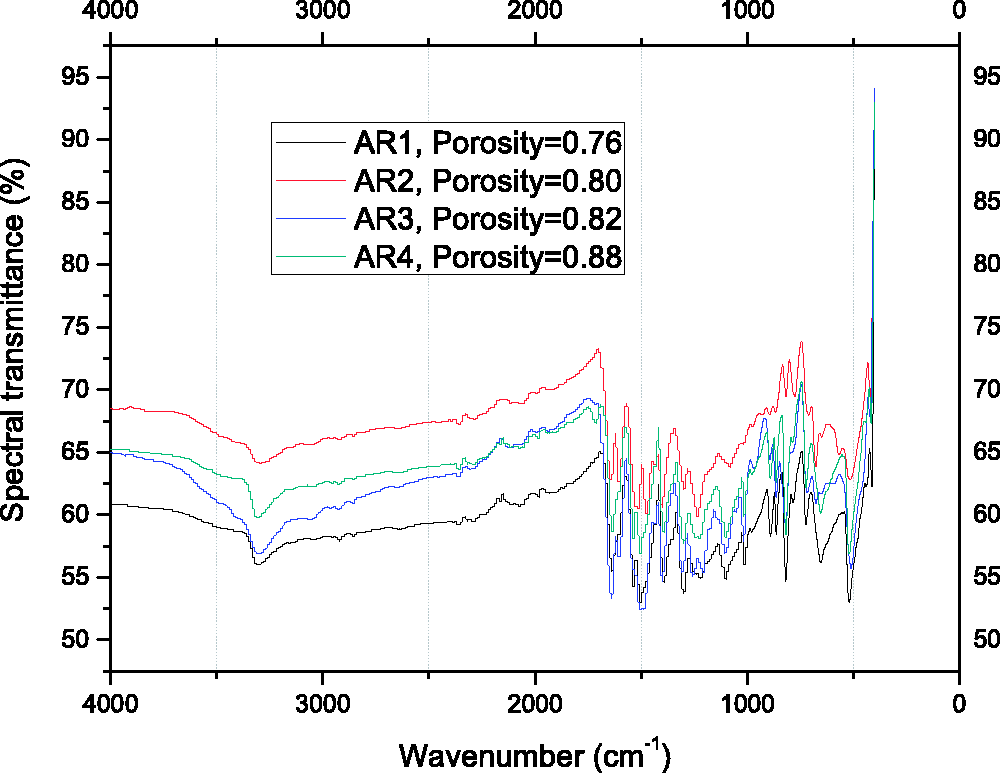
Spectral transmittance of the aramid fabric samples at IR wavenumber 4000–400 cm–1 (2.5–25 μm).
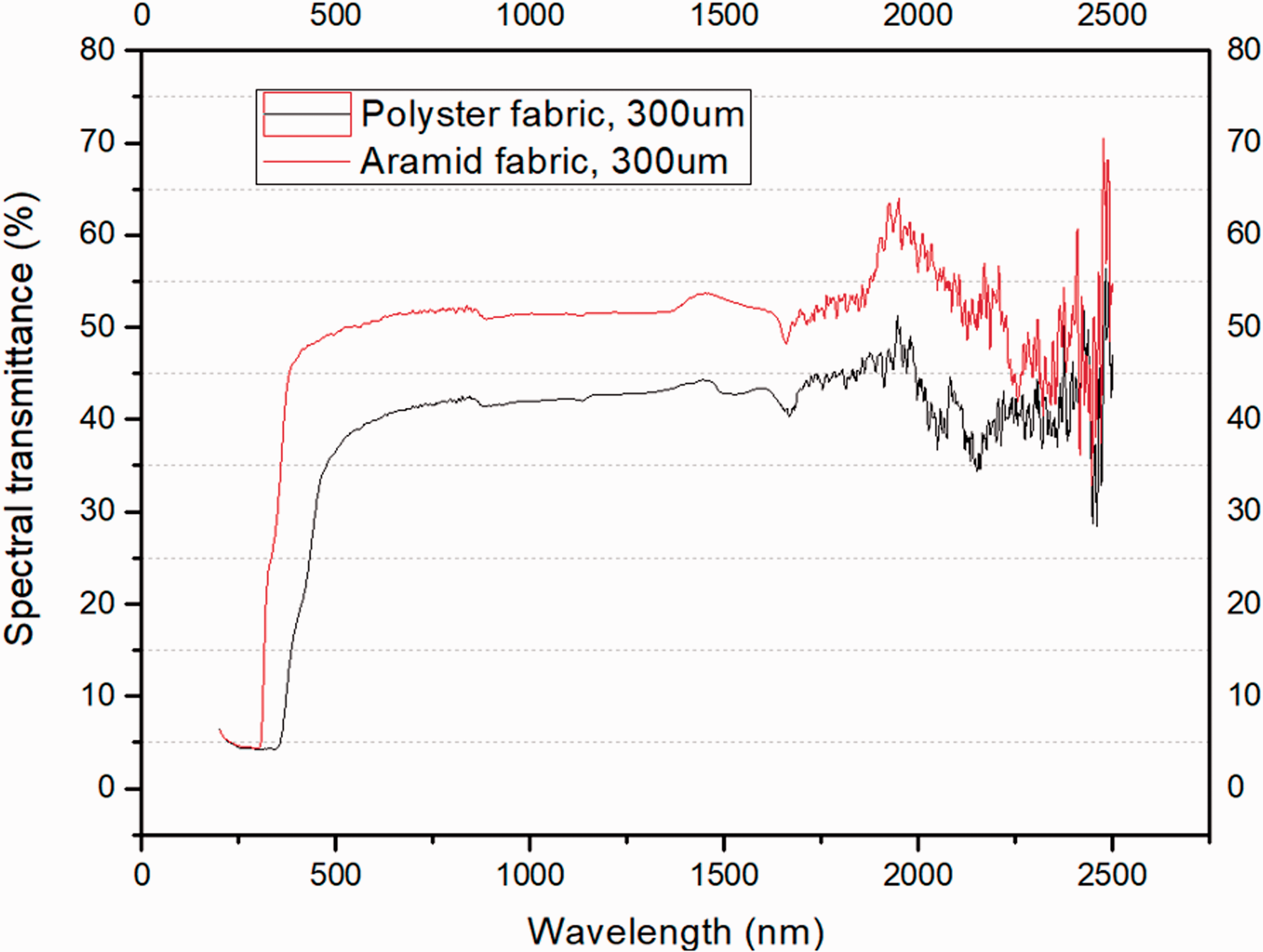
Spectral transmittance of AR fabric and polyester fabric at IR wavelength 2.5–25 μm.

Thermal images of AR2 fabric (a) and polyester fabric (b) on a GHP apparatus simulated human skin.
Figure 8 presents the spectral extinction coefficient, which was obtained from equation (2) using the spectral transmittance data presented in Figure 5. It is noted that these curves of extinction coefficient vary greatly. The Spectral extinction coefficient of aramid fabric with different porosity.

In the work, the structural model, which had been applied successfully on metal foam materials, was used in the calculation of extinction coefficient of fibrous porous materials. The AR1, AR2 and AR3 samples with different thickness were selected. These extinction coefficients (AR1/AR2 and AR1/AR3) were calculated by structural model. Figure 9 shows the comparisons among the calculating results from Beer law (equation (1)) and structural model (equation (13)). It can be seen that the deviation of extinction coefficient determined by the structural model was rather small.

Comparisons of extinction coefficients with Beer law and structural model by considering edge effect.
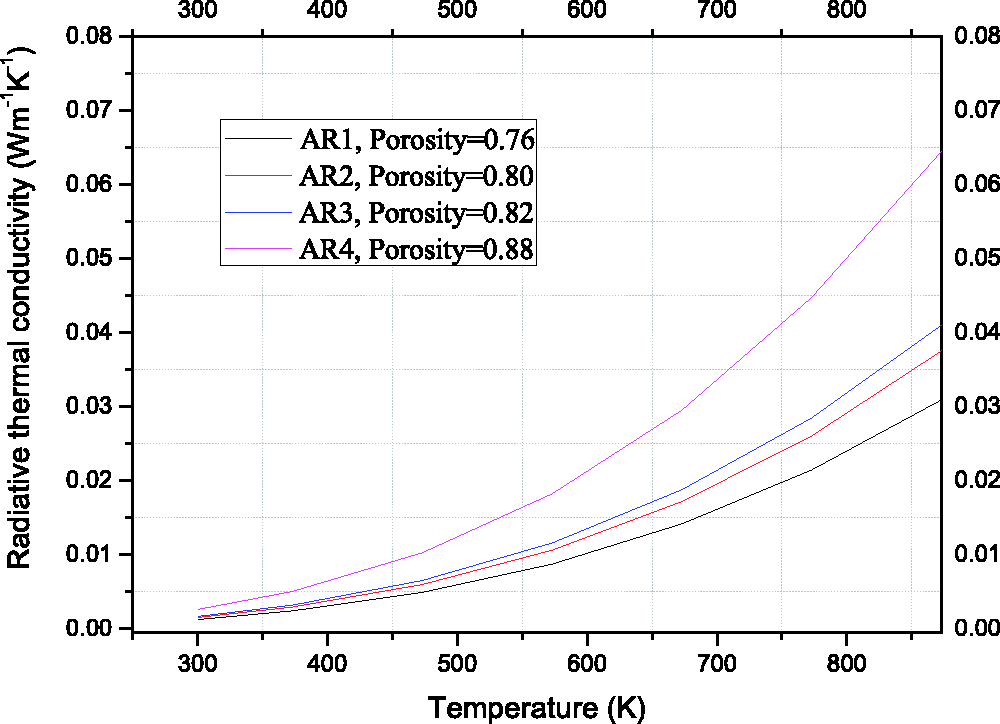
Radiative thermal conductivity of series of AR fabric samples vs. temperature.
Radiative thermal conductivity
The radiative thermal conductivities of these four samples at different temperatures are plotted in Figure 10. It can be observed that the radiative thermal conductivities of AR1, AR2, AR3 and AR4 at the temperature of 300 K are approximately 0.0015, 0.0026, 0.0013 and 0.0017 W/m−1 K−1. Since

Comparisons of effective thermal conductivity at 300 K.
Effective thermal conductivities
Thermal conductivity at room temperature
The heat transfer mechanisms in fibrous insulation consist of solid conduction, gas conduction, radiation, and air convection. In this study, convection heat transfer is negligible. This section will investigate the effective thermal conductivities, whereby the radiative part was first determined by the Rosseland model. The engineered model for the calculation of the thermal conductivity of fibrous porous fabric has developed in the “The effective thermal conductivity” section. Here, comparisons between the measurements from TPS method and calculations by the parallel, series model and mixed model were made at 300 K, which are shown in Figure 11. The variations of thermal conductivity with porosity can be also observed from this figure. The higher porosity leads to a lower thermal conductivity. As a whole, the mixed model yields the closest values consistent with experimental data, between the bounds estimated by the parallel and series model. Yet, the most accurate predictions from the mixed model are higher than the experimental results. Underestimated porosity maybe the reasons for higher predictions. There are many micro and nano-pores and grooves/cracks on the fiber surface (Figure 3(c) and (d)), which cannot be measured by MIP method. Therefore, the total porosity measured by MIP method is smaller than the actual one. The crack structure creates additional surface area and allows more air to be trapped into the nano-scale pores or channels, which will increase greatly the thermal insulation [34]. Another reason is that there is a certain amount of moisture content (about 3.3%, kg/kg, dry basis) in the hygroscopic fabric when measured in TPS testing environment with 65%RH, which will lead to the decrease of thermal conductivity of the fiber due to the heat of vaporization. The hygroscopic aramid fiber will hydrate in the transient heating test process (TPS). The dehydration is accompanied by an endothermic reaction and something of the energy should be involved [35]. The evaporation of absorbing water is one of these factors affecting the effective thermal conductivity. However, the effect of moisture content is not considered in the predicted model. But under high level of moisture content conditions, the predicted model would give an underestimation because of high thermal conduction of moisture.

Variation of effective thermal conductivity with temperature.
Also, the combined rules of the Parallel and Series thermal resistance mode have been applied to accurately predict the effective thermal conductivity of fibrous porous material in the previous work [11,36,37]. These studies presented the similar conclusions that models neglecting the contribution of radiative heat transfer are inadequate for modeling effective thermal conductivity at higher temperatures. This can be further confirmed in the case of series model, which overestimates the thermal conductivity at each porosity (Figure 11).
Variation of predicted thermal conductivity with temperature
In standard environment, the thermal conductivities of fiber solid phase 
The effective thermal conductivity of the fabric samples as a function of the average temperature is presented in Figure 12. The effective thermal conductivities are increasing non-linearly with the increase of the average temperature in the whole temperature range limited in this study. It can be seen that the three curves (porosities of 0.76, 0.80 and 0.82) ended at an approximate value of 0.077 Wm−1 K−1 at 873 K. However, the value of the thermal conductivity at 300 K is about 0.95 Wm−1 K−1 when the porosity of is 0.88. This phenomena maybe explained by the fact that at higher temperature, thermal radiation becomes the dominant heat transfer mode, resulting from higher porosity in the material (see equations (11) and (12)).
Conclusions
In this article, the radiative properties and thermal conductivities of nonwoven aramid fabrics with varying porosities were presented. Using Beer’s law, the spectral extinction coefficient was determined from the spectral transmittance data obtained from FTIR spectrometry in the wavelengths of 2.5–25 μm. For a given wavelength, the spectral extinction coefficient was significantly dependent on bulk density and porosity, increasing with the decrease of porosity or increase of bulk density. A theoretical model to estimate the effective thermal conductivity of fibrous fabric materials was developed based on the Rosseland diffusion equation to characterize radiative thermal transfer and the Parallel-Series structural model to describe heat conduction transfer. Results show that radiative thermal conductivity decreases with decreasing bulk density or increasing porosity. The increase of Rosseland extinction coefficient underperform that of the T3 term (equation (11)), causing the overall increase of radiative thermal conductivity and effective thermal conductivity with the increase of temperature. It can be expected that the radiative properties and thermal conductivities obtained in the present work will provide useful information in predicting thermal performance of firefighter protective clothing through solving heat transfer mathematical model equations.
Footnotes
Declaration of conflicting interests
The author(s) declared no potential conflicts of interest with respect to the research, authorship, and/or publication of this article.
Funding
The author(s) disclosed receipt of the following financial support for the research, authorship, and/or publication of this article: This study was financially supported by the National Key Research and Development Program of China (2017YFB0309001) and the Open Project Program of Fujian Key Laboratory of Novel Functional Textile Fibers and Materials (No. FKLTFM2009).
