




Abstract
Biolaminates of Ixtle and Henequen natural fibers reinforced bio-based epoxy resin were prepared using Vacuum Assisted Resin Infusion process. ZnO nanoparticles were added to the bio-based epoxy resin at 1, 2 and 3 wt. % content before impregnation process. The viscoelastic and mechanical properties, as well as the fracture behavior, were evaluated and related to the nature of the fibers and filler content. The viscoelastic results indicated the ZnO particles are effective fillers just at low concentrations, and induce different reinforcement mechanisms attributed to the interaction between the nature of fibers and nanoparticles. The mechanical properties of the Ixtle biolaminates decreased at higher filler concentrations, while Henequen biolaminates showed better mechanical properties just above the 2 wt. % of ZnO. The fracture behavior in mode I registered moderate changes in toughness, related to the ZnO fraction, which promoted different behaviors on the interlaminar adherence of the layers. The results point to the need to continue evaluating the potential application of these green composites for their use in construction and automotive industries.
Introduction
Laminates are composite materials of tong fibers reinforced thermoset resins. For decades, fiberglass laminates (GFRP) provide dimensional stability, low density, chemical stability, corrosion resistance and long service life. However, they contain toxic and hazard products that affect the workers’ health. In fact, the epoxy resins are prepared from the DiGlycidylEther of Bisphenol A (DGEBA), which is a reprotoxic substance that is under close monitoring.
One ecological alternative is the development of bio-laminates, which are formed by a bio-based epoxy resin and long natural fibers. Bio-laminates are currently emerging because of the growing need of more environment-friendly composites, maintaining properties like lightweight, but gaining in biodegradability and renewability. Besides, their manufacturing process is energy efficient (low temperature production), compared to synthetic laminates, and at the product end-of-life (EoL) the fossil carbon emissions can be reduced.
Natural fibers like sisal, jute, kenaf, flax or hemp have been introduced, instead of some synthetic fibers as glass fiber, to avoid abrasive effects and toxicity. Furthermore, the density of natural fibers (around of 1.2–1.6 g/cm3) is lower than glass fiber (2.4 g/cm3), which leads to the light-weight composites manufacturing [1,2]. Among natural fibers, plant fibers are one of the most abundant natural sources of reinforcement. For centuries, cultures have based their technological development on the use of natural fiber applications. As an example, the ancient navy had a strong support by using ropes and seals made of natural fibers [3]. The use of natural fibers has been mostly endemic, where inhabitants of certain regions take advantage of the endemic plants. Cotton has its origins in North America and Asia, before its expansion worldwide. Jute is commonly used in Bangladesh and India, and more recently, Kenaf has emerged as fiber reinforcement in southern Asia [4–8].
In the case of Mexico, agave plants (Asparagaceae/Agavaceae) have been used in textiles, because of their stiffness and simplicity to knit [9,10]. Two main agave species can be found in this country: i) Ixtle (Agave vivipara), and ii) Henequen (Agave fourcroydes). These plants have been widely used since Mexican ancient civilizations; and here now, their use as a reinforcement for synthetic plastics in diverse applications [9–14], although mechanical performance and fracture behavior of agave fibers reinforced bio-based epoxy composites are not documented, and that is the gap this work pretends to fill.
Bio-based epoxy resins are synthesized from different kinds of non-toxic precursors like aromatic or vegetable oils. In the last decade, several researchers have developed resins from different natural sources. Kuo et al. [15] synthetized bio-epoxy resins from pine bark, evaluating different catalyst amounts and temperatures to determine the optimal parameters. More recently, Cicala et al. [16] formulated bioepoxy based monomers with a cure inhibitor and a cleavable amine to obtain a recyclable epoxy system suitable for resin infusion. However, the low reactivity of the bioepoxy groups prevent them from competing with synthetic thermoset resins [17–19], reason some investigations detail the use of fillers to reinforce the bio-based epoxy resin.
Zinc oxide is an inexpensive, chemically stable and nontoxic material, which makes it suitable to be used in several applications, such as in piezoelectric, photocatalysis, sensors, or as reinforcement of laminate composites. Besides, it is relatively easy to develop new ways to synthesize ZnO nanostructures in order to improve its intrinsic properties and integrate it in composites for discovering diverse applications or multifunction’s [20–26]. Zheng et al. developed ZnO nanowires on the surface of fiber reinforced epoxy laminate composites, obtaining a considerable increase on the interfacial shear strength [27]. Yang et al. prepared functionalize zinc oxide nanoparticles to improve intramolecular interaction between root-like natural fibers and poly-lactic acid (PLA) matrix, finding an excellent interfacial adhesion compared to PLA/pristine natutal fibers composites [28]. Fique fiber–ZnO biocomposites were synthesized by a co-precipitation method, and Ovalle Serrano et al. mentioned the sonication time wield a strong influence on the amount, shape, size and distribution of ZnO crystals on the fique fibers [29].
The present work evaluates the mechanical and fracture properties of bio-laminates reinforced with ZnO nanoparticles. This research aims to encourage the use of henequen and ixtle fibers as potential materials for non-structural components in the automotive, construction and commodities industries.
Materials and methods
Materials
Ixtle and Henequen yarns with 19 and 18 denier, respectively, were obtained from cordeleria Santa Ines in Yucatan, Mexico. Both natural fibers were woven in a plain weave fabrics configuration by Mexican artisans from the state of Queretaro in Mexico, as presented in Figure 1. Henequen and ixtle fibers have an elastic modulus of 13 and 27 GPa, and tensile strength of 12 and 18 MPa, respectively. This values were previously calculated following the methodology of the ASTM C1557. Furthermore, both natural fibers have similar density values of 1 and 1.02 g/cm3 (ASTM D3822) corresponding to henequen and ixtle fibers, respectively. According to supplier, henequen fibers were extracted using mechanical extraction method that results in long fibers with a rough surface. The ixtle fibers are obtained by maceration process, which produce smooth surface.

Photographs corresponding to natural fabrics: (a) Ixtle and (b) Henequen.
Epoxidized Vegetable Oil (EVO) Surf Clear EVO with a bio-based carbon content of about 40% and SD EVO fast hardener from Sicomin Epoxy Systems® were used in a mixing ratio by volume of 2/1. According to the datasheet supplier, EVO is a bioepoxy resin with a tensile modulus and breaking strength of 3.4 GPa and 66 MPa, respectively.
ZnO nanoparticles were synthesized by coprecipitation method using zinc acetate (Zn(CH3COO)2·2H2O 99.4% from J. T. Baker®), sodium hydroxide (NaOH > 97.0% from MEYER Reactives®), distilled water and ethanol at 70%. Three weight percentages, 1, 2 and 3 wt. %, identified as ZnO1, ZnO2 and ZnO3, respectively, and selected as filler for the bioresin.
Synthesis, characterization and incorporation of ZnO nanoparticles
A solution of 0.2 M Zn(CH3COO)2·2H2O in 250 ml ethanol was prepared and stirred vigorously at 70 °C for 30 min in a refluxing system. In addition, 0.5 M NaOH solution was prepared in 250 ml ethanol (70% purity) and added to zinc acetate solution drop by drop in continuous stirring. Then, the mixture was heated at 75 °C for 2 h. The precipitate obtained was sonicated for 10 min at 50% amplitude (QSonica, Q700 Sonicator®), after that, nanoparticles were dried at 110 °C for 24 h.
The chemical and structural characterization of ZnO nanoparticles were carried out using Fourier-Transform Infrared Spectroscopy (Perkin – Elmer, FTIR Frontier®) and Field Emission Scanning Electron Microscopy (Jeol, JSM 7200 F®).
ZnO nanofillers where dispersed in 3-Animomethyl-3,5,5-trimethylcycloheylamine by using QSonica® Q700 equipment for ultrasonic processing at room temperature with 50% amplitude for 5 min. Then, the dispersed solution was added to EVO resin and hand mixed.
Manufacturing of biolaminate composites
Biolaminates were manufactured by Vacuum Assisted Resin Infusion (VARI). The vacuum pressure was fixed in -20 inHg. The curing reaction last 24 h at 25 °C. Biolaminates have two plane weave fabric layers stacking, and 300 × 300 × 2.5 mm as laminate nominal dimensions. During the layup, fabrics were aligned with a metallic angle guide. On the top of substrate, peel ply and distribution mesh were placed over fiber and the entire configuration were covered by vacuum bag and carried out using sealant tape. After air evacuation, nanofiller reinforced resin was infused at room temperature. The resin inlet and outlet positions were at the edges of the biolaminates, respectively. Figure 2 shows the schematics of VARI process for the biolaminates. The biolaminates prepared for this work were Ixtle and Henequen with EVO bioresin containing 1, 2 and 3 wt. % of ZnO nanoparticles (Ixt/EVO-ZnO and Hen/EVO-ZnO, respectively). For samples’ cutting, a grinding machine was employed to ensure correct fiber orientation. Possible fiber misalignment was less than 2° with respect of the axis of the samples. Table 1 presents the volume fractions of the composite consituents. The volume fraction of the ixtle biolaminates is higher than the henequen composites, which is attributed to the configuration of fabrics. Henequen is flat weave (wrap less thick than weft, Figure 1), meanwhile Ixtle have similar thick for wrap and weft, where more resin is place between weft and warp yarns.

VARI process: (a) schematic representation, (b) photograph during the infusion process and (c) photograph of biolaminate tensile specimens.
Volume fractions of the composite constituents.

Dynamic mechanical analysis
The storage (E′) and loss modulus (E″) are important viscoelastic properties in composite characterization because both measure the stored energy (elastic portion) and the energy dissipated as heat (viscous portion). The tensile storage and loss moduli are defined as follows:

The ratio between the loss and storage modulus is defined as damping factor, tan δ:
Dynamic mechanical analyzer DMA 850 from TA Instruments® in a single cantiliver configuration was employed to conduct measurements with a loading frequency of 1 Hz from 20 to 120 °C and a heating speed of 5 °C/min. Storage modulus (E′) and damping factor (tan δ) curves were assessed to analyze the viscoelastic properties promoted by the effect of the ZnO particles
Tensile test
Unidercctional tensile tests –weft parallel to the applied load- were performed following ASTM D3039-3039M to determine the tensile properties of each biolaminate. The nominal dimensions of the tensile specimens were 250 × 25 × 2.5 mm, with a gage length of 150 mm. Mechanical tests were carried out in an Instron® 647 universal testing machine with a load cell of 10 kN. Testing was performed under displacement control at a crosshead speed of 1.27 mm/min (equivalent to 0.5 in/min), and 5 repetitions were performed for each material. The load displacement-curve was recorded until failure of the specimens. Videoextensometer MTS Advantage Video Extensometer (AVX) with a 25 mm lens was employed to record elongation for each test by a non-contact technique. The videoextensometer recognizes patterns on surfaces to acquire measurement data for strain calculations, which were processed by MTS TestSuite™.
Mode I interlaminar fracture toughness test
Double Cantilever Beam (DCB) tests were carried out following ASTM D5528 to estimate mode I fracture toughness of biolaminates. All DCB specimens had 100 × 20 × 2.5 mm as nominal dimensions. A nylon foil with a thickness of 0.02 mm was positioned in the mid-thickness representing a pre-crack with an initial length of 25 mm. DCB tests were carried out in the universal testing machine cited above using a load cell of 1 kN. Testing was performed under displacement control at a crosshead speed of 2 mm/min until the fracture of one of the beams or until the crack path detours the middle plane of the laminate. Five repetitions were performed for each material configuration, and the specimens were connected to the testing machine by piano hinges. Crack growth was observed with the aid of a 20X magnifying lens. To ease the detection of the crack tip at any given time, specimens were painted with white color on the thickness of the laminate and marking the crack extension with a fine ball-pointed highlighter.
The Modified Beam Theory (MBT) method was employed method to calculate the critical energy release rate (GIC). The Mode I fracture toughness, considering a uniform delamination front, is described in equation (1) as follows:

Photographs corresponding to: (a) DCB test for interlaminar fracture toughness and (b) failed coupon by beam’s collapsing.
Results and discussion
FTIR technique is used to find out information about chemical bonding in nanoparticles surface and its elemental constituents, further it is helpful to complement information obtained from other techniques such as FESEM observations. The morphology of the ZnO nanoparticles was examined by FESEM micrographs and the images at different magnifications (× 35000 and × 15000) are shown in Figure 4. The ZnO nanoparticles were observed before the dispersion by the ultrasound process and their incorporation into EVO resin. In a first instance, it can be seen that all the particles were in more or less heterogeneously aggregated, resulting in the formation of a hierarchical sheet-like appearance. However, observations allowed to appreciate a wide particle size distribution of 50–100 nm hexagonal morphology typical of Wurtzite (Figure 4(b)).
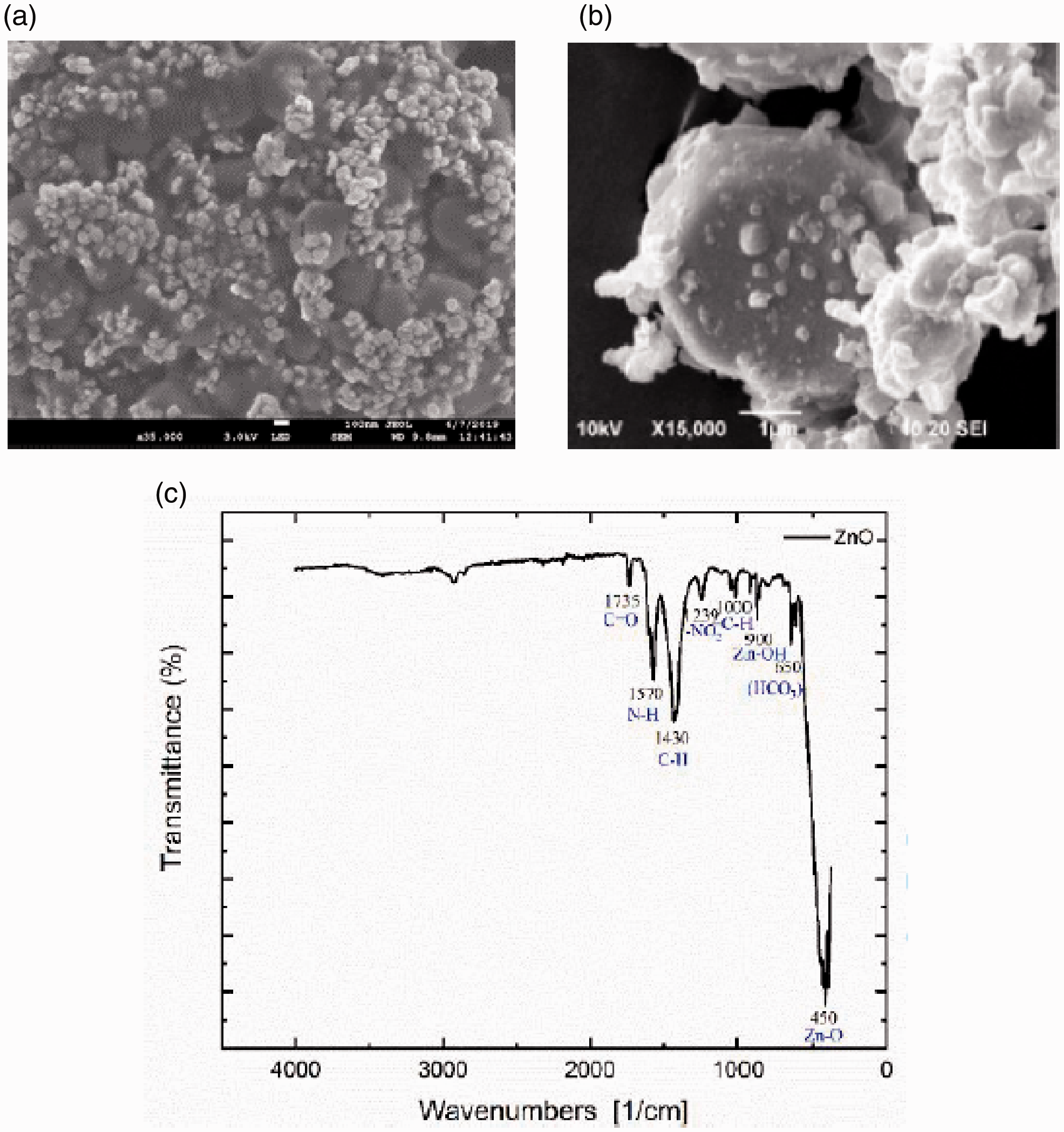
Synthetized ZnO nanoparticles used in the Ixtle and Henequen biolaminates: (a) representative FESEM micrographs, (b) close observation and (c) FTIR spectra.
The FTIR spectra measured in the range of 4000–400 cm−1 is presented in Figure 4(c). The as-prepared ZnO dispersion before adding to EVO shows a sharp peak around 450 cm−1, which is attributed to Zn–O stretching vibrations and is consistent with Kolodziejczak et al. [30]. Depending on synthesis and other experimental conditions, weak bands are also possible to appear in a FTIR spectrum. The 900 cm−1 band is assigned to Zn–OH vibration and some acetate bands and secondary elements are revealed in the spectra because they are residuals of the reaction such as 1735 cm−1 (C = O), 1430 cm−1 (C–H) , 650 cm−1 (HCO3). Remaining peaks can be attributed to the O–H stretching vibrations and bending modes of the adsorbed water [31]. On another hand, this technique was useful to prove substitution reaction between Zn(CH3COO)2 2H2O and NaOH according to equation (2), reported by Ha et al. [32] and Osman and Mustafa [33]:
The FTIR spectra corresponding to the Ixt/EVO-ZnO and Hen/EVO-ZnO biolaminates are presented in Figure 5.

FTIR spectra with different ZnO concentrations corresponding to: (a) Ixt/EVO-ZnO and (b) Hen/EVO-ZnO biolaminates.
It is possible to appreciate similar FTIR spectra for all materials analyzed in this work, which could represent that relevant modifications in the whole system (natural fibers/bio-epoxy resin/ZnO nanoparticles) were not developed during the manufacturing process of biolaminates. However, the bands corresponding to the Ixtle biolaminates are clearly more defined than the Henequen composites, which means an increase in the amount of functional group associated with the molecular bond [34]. The 900 cm−1 band is attributed to Zn–OH vibrations and 450 cm−1 to Zn–O, these are more intense as amount of ZnO increases.
The signals located between 2972 and 2843 cm−1 are assigned to C–H stretching vibrations, meanwhile the spectra from 1470 cm−1 to 1145 cm−1 are related to bending vibrations, both are attributed to polymer chain motions polymeric chains and the presence of other groups such as C–C (750–720 cm−1), R(CH2)4–OR (1485–1445 cm−1), alcohols R–CH2–OH (3400–3200 cm−1 and 1075–1000 cm−1).
Dynamic mechanical analysis
The dynamic mechanical properties of the biolaminates were obtained as a function of the temperature start from the glassy state to the rubbery plateau. The viscoelastic response of Ixtle and Henequen biolaminates reinforced with ZnO particles are shown in Figures 6 and 7, respectively. The results are addressed to evaluate the storage modulus, commonly referred as Young’s modulus, and the loss factor or tan δ, related to the glass transition temperature.

DMA single cantilever results of Ixtle/bio-based epoxy laminates with different as-prepared ZnO nanoreiforcement: (a) storage modulus and (b) tan δ.

DMA single cantilever results of Henequen/bio-based epoxy laminates with different as-prepared ZnO nanoreiforcement: (a) storage modulus and (b) tan δ.
Comparing the unfilled Ixtle and Henequen biolaminates, it is possible to appreciate the Henequen shows higher modulus (2260 MPa) than the Ixtle composites (1830 MPa) and the difference on the onset temperatures is 3.6 °C. Considering the biolaminates were prepared under the same manufacturing parameters, the results could be indicating the henequen has better molecular compatibility with the EVO resin than the ixtle fiber. However, other factors should be taking into consideration like volume fraction, which is higher in the ixtle biolaminates; or the maceration process that restrict the molecular adhesion with the bio-based resin, reducing the rigidity of ixtle biolaminates.
For the case of the Ixtle biolaminates presented in Figure 6(a), it is appreciate a notorious increment of the storage modulus that represents the reinforcement effect promoted by the presence of ZnO rigid particles. Regarding to the filler concentrations, the storage modulus was detected at 2600 MPa with 1 wt. % of ZnO nanoparticles. However, higher concentrations of this filler promote the noticeable reduction of storage modulus up to approximately 2200 MPa for 2 and 3 wt. %. Furthermore, the onset temperatures decrease from 47.6 to 40 °C as weight percentage of ZnO nanoparticles increases and the modulus tends to zero after the transition region. Because of the storage modulus at the glassy region is correlated to molecular rigidity of the polymer network, and the storage modulus at the rubbery plateau is dependent on crosslink density, it is possibly to suggest that by increasing the filler content, the stiffness of the ixtle biolaminates tends to decrease, which should imply an increase in the segment motion promoted by the reduction of the crosslink density [35].
Regarding to the loss factor shown in Figure 6(b), just one signal is detected. The position of Tan δ peak is notoriously displaced to lower temperatures as ZnO fraction increases, showing maximum peaks located at 66.5, 60.9 and 53.8 °C for 1, 2 and 3 ZnO wt. %, respectively compared to the Ixtle biolaminate signal located at 69.4 °C. The results indicate the ZnO particles are effective reinforcement just at low concentrations. Higher ZnO content hinders the filler interaction with the bio-based epoxy resin and Ixtle fiber. Besides, larger area under the tan δ curve is present at higher concentrations of ZnO filler, which indicates a great degree of molecular mobility, which translates into more energy dissipation. As a result, the onset of softening and reduction in modulus occurs, allowing the glass transition temperature is reduced.
The interaction between the Henequen biolaminates with ZnO nanoparticles shows some differences when compared to Ixtle. For Henequen biolaminates, the storage modulus is 2300, 3800 and 3300 MPa for 1, 2 and 3 ZnO wt. %, respectively, showing not clear tendency regards to the ZnO fraction, as observed in Figure 7(a). Furthermore, the onset temperature fluctuates between 63 °C to 47.5 °C; which is a tighter range compared to the filled Ixtle biolaminates. Another interesting behavior is observed in the rubbery modulus region, which increases with the presence of ZnO nanoparticles.
Figure 7(b) shows the intensity of Tan δ signal decreases dramatically for the Hen/EVO-ZnO2, although the Tan δ peaks remain close to each other being at approximately 60, 64 and 59 °C for 1, 2 and 3 ZnO wt. %, respectively. Some authors [36–40] relate the glass transition temperature of thermoset polymers is dependent on three factors: crosslink functionality, molecular weight between crosslinks, and chain stiffness. However, other factors should be taken into account because dispersion, size and surface modification of the particles play important roles in Tg changes [41,42].
The results showed by DMA tests allow to interpret the ZnO particles interaction with the Henequen biolaminates could be associated to some ZnO agglomerations above 2 wt. % content. Nevertheless, the presence of ZnO particles restricts the chain mobility irrespectively of the ZnO content, although lower dissipation energy with 2 wt. % is notorious. It is well-researched fact that high filler loading the ZnO tends to agglomerate, which deteriorates the properties of the composite [36,43]. Some investigations point out the optimum weight percent addition for ZnO nanoparticles for a uniform distribution within the polymer matrix is approximately around 1 to 2 wt. % concentration [44,45].
Tensile properties
Representative stress versus strain curves for Ixtle and Henequen biolaminates with different ZnO weight percentage are shown in Figure 8. All materials revealed similar mechanical behavior during the unidirectional tensile tests. Two regions were perfectly identified, first region comprises an elastic linear behavior, from the beginning of the test until reaching 2500 micro strains. Hereafter, the second region shows a non-linear behavior, due to the typical sticking-slipping mechanism of woven laminates. In woven composites, fibers are aligned to the load direction. If there are a misalignment between load direction and fiber orientation, fibers tend to slip over each other to follow the load. Then, an accumulation of fibers is followed, sticking, is observed. At this stage, matrix failure is already reached. These two mechanisms modify the woven architecture and end with the rupture of the fabric [46,47]. This progressive elasto-plastic behavior is exhibited, prior to sudden failure.

Representative stress vs strain curves for: (a) Ixtle/EVO-ZnO and (b) Hen/EVO-ZnO biolaminates with different ZnO concentrations.
Mechanical parameters such as Young’s Modulus and Ultimate Tensile Strength (UTS) are presented in Figure 9.

Uniaxial tensile properties for: (a) Ixtle/EVO-ZnO and (b) Hen/EVO-ZnO biolaminates with different ZnO concentrations.
Ixtle biolaminates reinforced with ZnO particles (Figure 9(a)) show a maximum elastic modulus and strength with 2 wt. % of ZnO concentration. Higher concentrations promote the slight decrement on mechanical properties of Ixtle biolaminates, even when compared with the unfilled biolaminate.
For the case of Henequen biolaminates (Figure 9(b)), the modulus remains almost constant at lower filler concentration. Higher ZnO, above 2 wt. %, promotes the modulus increases up to 47% and not further increments were observed respect to ZnO content. On the other hand, the strength increases notoriously up to 85% when ZnO nanoparticles are added to the Henequen biolaminates; however, not relevant variations are found about the ZnO concentrations.
We found that the addition of ZnO increases the elastic modulus and strength of the biolaminates. However, the nanofiller induces different reinforcement mechanisms that could be attributed to the interaction between the fiber nature and the ZnO nanoparticles. It is well-known the fiber-dominated properties in tension depend on the effective adhesion between fibers and matrix [47–49]. The adhesion of the ZnO nanoparticles into the Ixtle biolaminates favor the mechanical properties because this nanofiller acts as effective reinforcements. Nevertheless, high concentrations hinder the correct dispersion and the ZnO agglomerates, which promotes the failure of the specimens.
For the case of Henequen biolaminates the increase of mechanical properties just above the 2 wt. % of ZnO nanofiller could be attribute to effective mechanisms in assisting transfer of loads form matrix to fibers. Higher ZnO concentrations do not alter this mechanism because of the crosslinking density of theses biolaminates, as observed in the values of storage modulus at rubbery plateau beyond 90 °C. The more numerous the crosslinking are, the higher stiffness is obtained, as reported by Gu et al. [50] and Mittal et al. [51]. When a microcrack is nucleated, its propagation deals with hard particles, the ZnO particles. Microcracks has two ways to grow, first, to cleavage the particle, or second, to surround (decohesion) the particle. Both failure mechanisms demand a higher amount of energy, therefore, an increment of elastic modulus is seen and, as consequence, a retard on crack propagation. Therefore, the addition of ZnO particles in the bioepoxy network hinders microcrack growth and contributes to a diminution of the sticking-slipping failure mechanism. The previous agree with others authors [43,45,52] where mechanical improvements were found with 2 wt. % of ZnO concentration.
Mode I interlaminar fracture toughness
The force versus displacement curves for each natural fiber biolaminate with different ZnO content are compared. For all specimens, the slope of the force vs. displacement curve is linear till the maximum force was reached, like other woven fabric composites reported before [53].
On one hand, for the Ixtle biolaminates the maximum peak load decreases as ZnO wt. % increases (see Figure 10). The maximum peaks of each one is 18, 11 and 13 N for 1, 2 and 3 ZnO wt. %, respectively. Ixtle composites average peak load is five times lower than carbon-epoxy plain weave composites (85 N) reported by Torres et al. [54]. After the first delamination has grown, the average subsequent loading–unloading steps are fuzzy. The average subsequent loading–unloading steps are between 3 and 10 N, before failure by beam’s collapsing.

Average load vs crosshead curves using DCB for Ixtle biolaminates with different ZnO concentrations.
For the Ixtle biolaminates, by means of the modified beam theory, GIC depends inversely of ZnO weight fraction. Average GIC is 0.77 ± 0.23 Nmm/mm2, 0.56 ± 0.09 Nmm/mm2 and 0.80 ± 0.23 Nmm/mm2 for 1, 2 and 3 ZnO wt. %, respectively, according to Figure 11.

Average Mode I interlaminar fracture toughness (GIC) for Ixtle biolaminates with different ZnO concentrations.
On the other hand, for the Henequen biolaminates maximum peak load increases as ZnO weight percentage increases (see Figure 12). For the Henequen biolaminates, the maximum peak load is 31, 33 and 53 N for 1, 2 and 3 ZnO wt. %, respectively. Henequen composites average peak load is three times lower than carbon-epoxy plain weave composites (85 N) previously reported [54]. After the first delamination has grown, the average subsequent loading–unloading steps are well defined. The average subsequent loading–unloading steps are between 10 and 25 N, for the 1 and 2 wt. % of ZnO, and between 35 and 45 N for the 3 ZnO wt. % before failure by beam’s collapsing.
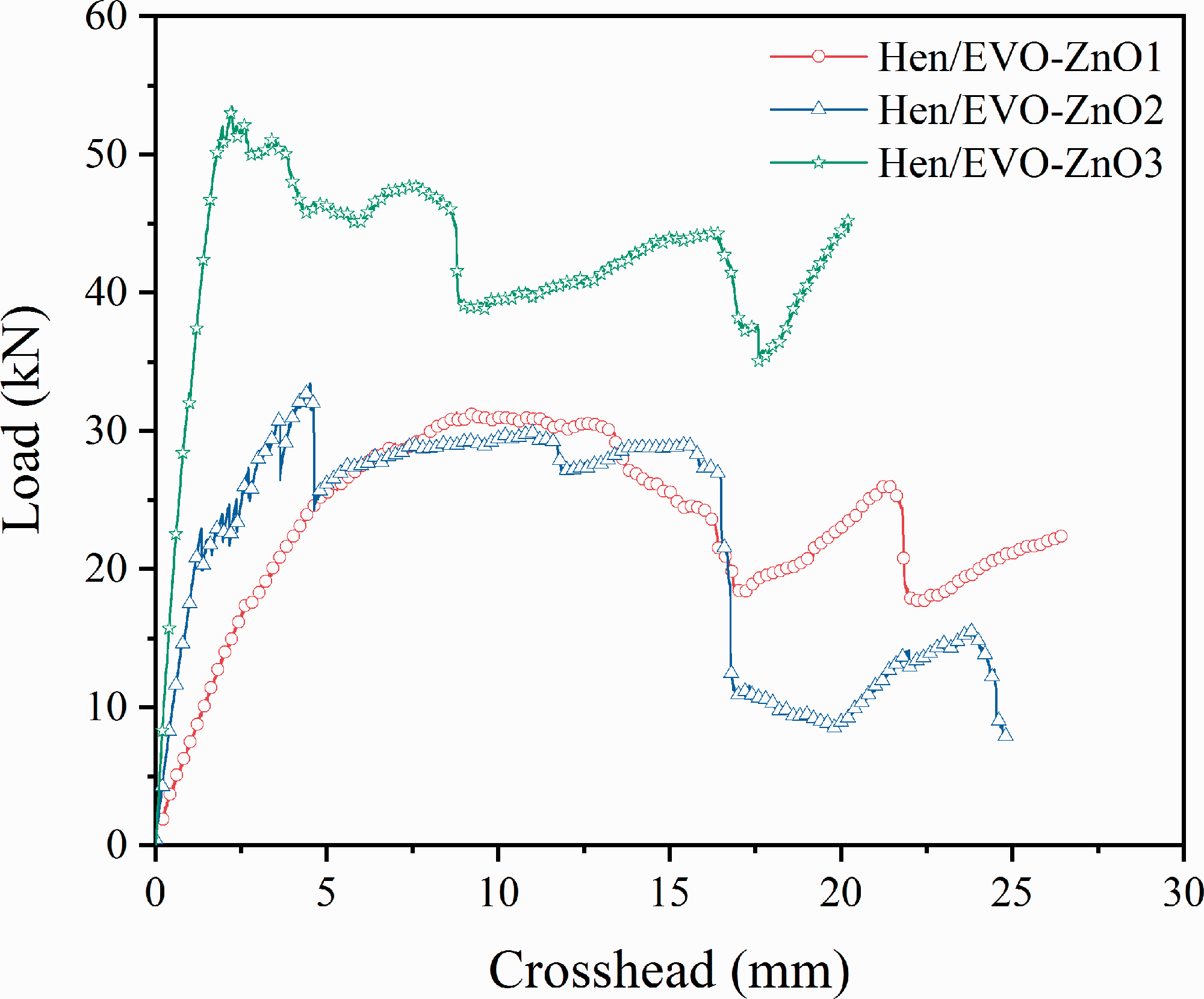
Average load vs crosshead curves using DCB for Henequen biolaminates with different ZnO concentrations.
For the Henequen biolaminates, by means of the modified beam theory, GIC depends inversely on ZnO weight fraction for short crack’s extensions (below 28 mm); however, this behavior changes for larger crack’s extensions (above 29 mm). Average GIC is 0.69 ± 0.14 Nmm/mm2, 0.62 ± 0.07 Nmm/mm2 and 0.74 ± 0.24 Nmm/mm2 for 1, 2 and 3 ZnO wt. %, respectively, according to Figure 13.

Average Mode I interlaminar fracture toughness (GIC) for Henequen biolaminates with different ZnO concentrations.
Woven composites have significantly greater scatter on fracture toughness compared to unidirectional composites. This behavior is associated with the interaction of crack with interlaminar resin pockets, fiber weaviness, fabric humps and matrix-fiber decohesion, as delamination grows [55–58]. Nonetheless, the GI average values are in the same order of magnitude, regardless the amount of ZnO nanoparticles.
Conclusions
Biolaminates of Ixtle and Henequen natural fibers impregnated with bio-based epoxy resins were successful prepared to evaluate their mechanical properties and fracture behavior as a function of as-prepared ZnO nanofiller content. ZnO nanoparticles were obtained by coprecipitation method using zinc acetate, with a Wurzite morphology and a particle size between 50 and 100 nm. FESEM observations revealed nanoparticles agglomerations with non-homogeneous between 50–100 nm and a morphology typical of Wurzite.
Similar FTIR spectra of Ixtle and Henequen biolaminates reinforced with ZnO nanofiller were observed, and Ixtle biolaminates showed more defined signals than Henequen because of functional group associated with the molecular bond. The addition of ZnO nanopartilces affects the crosslinking density of the Ixtle biolaminates, allowing the chain motions and promoting the stiffness reduction with temperature. Agglomerations of ZnO particles above 2 wt. % content deteriorated the properties of the composite.
The addition of ZnO increased the mechanical properties of both biolaminates. For Ixtle composites the nanofiller acted as effective reinforcement till 2 wt. %. In the case of Henequen composites, mechanical properties were favored just above the 2 wt. % of ZnO.
From the DCB tests, on one hand, Ixtle biolaminates’ maximum peak load decreases as ZnO weight percentage increases. After the first delamination has grown, subsequent loading–unloading steps are fuzzy, before failure by beam’s collapsing. On the other hand, Henequen biolaminates’ maximum peak load increases as ZnO amount raises. After the first delamination has grown, subsequent loading–unloading steps are well defined, and a larger crack extension is observed.
Motivation of this work is driven by the exploration of alternative composite solutions, as well as, by the integration of Mexico’s endemic natural fibers into the industrial market. As one of the principal produces of these fibers, alternative engineering applications need to be explored.
With these results, biolaminates with Agave fibers, bioepoxy resin and ZnO nanoparticles show promising features to be applied in automotive and construction industries as interiors’ materials.
Footnotes
Acknowledgements
V. Renteria thanks CONACYT for the scholarship to pursuit her master’s degree. Edgar Franco and Mauricio Torres convey their special appreciation to the “CONACYT Researchers Program (Cátedras CONACYT)”. Manufacturing procedure was inspected by M. Sc. Víctor Gómez. Mechanical tests were performed by Eng. Ricardo Lozada.
Declaration of conflicting interests
The author(s) declared no potential conflicts of interest with respect to the research, authorship, and/or publication of this article.
Funding
The author(s) disclosed receipt of the following financial support for the research, authorship, and/or publication of this article: This study was funded by the National Council for Science and Technology (CONACYT) of Mexico through the SEP-CONACYT program with grant number CB-2015-01-257458.
