




Abstract
Wearable antennas are usually designed and manufactured according to the selected substrates and then sewed into regular clothing in real-life applications. For some antennas, which their radiation and the ground plane are on the same side of the dielectric substrate, two-layer substrates made of the original substrate and additional clothing change its dielectric properties and further affect their performance. Previous works only demonstrate that single-layer fabric substrate has an effect on the design and properties of the certain antennas. However, dielectric properties of sewed multilayer fabrics have not been reported. In this work, the influence of the number of parallel sewing threads within 120 mm in the fabric along single direction (referred to as sewing threads trace distribution density) and sewing directions on dielectric properties of single-layer fabric are explored first. Next, the dependence of dielectric properties of sewed multilayer fabric on their components’ arrangement and volume fraction is mainly investigated. Common denim and nonwoven were used as samples. Sewed multilayer fabrics with different arrangement and volume fraction were fabricated, and their dielectric constants were measured by the split post dielectric resonators at 1.11 GHz. The results showed that sewing threads trace distribution densities, and sewing directions had little influence on the dielectric properties of single-layer fabric, whereas dielectric constants of sewed multilayer fabrics varied from their components’ volume fraction regardless of their laying. Furthermore, a parallel mixing model was built to describe the dielectric behavior, and the results showed that it agreed well with the experimental results.
Introduction
In recent years, wearable e-textiles have aroused people’s interest for their wide applications in sports, healthcare, and military applications [1,2]. As one component of wearable electronics, the substrate material for a wearable antenna design is of great importance. In general, wearable antennas require light, low cost, and no installation [1]. Thus, nonconductive textile materials are the favorable dielectric substrate or superstrate for its comfort and light-weight features [3–5].
In most of reported researches on the textile electronics, such as textile antennas or circuits, single-layer or multilayer fabrics are used as the substrate materials for their low relative permittivity and light weight [6–8]. Most of them focus on the effect of single-layer fabric substrate on the design and properties of wearable antennas. Tsolis et al. [9,10] demonstrate that the thickness and dielectric constants affect the geometric sizing of the antennas. Moreover, Hertleer et al. [11,12] indicate that the bandwidth and efficiency of a planar microstrip antenna are mainly determined by the dielectric constant and thickness of substrate. The low dielectric constant reduces the surface wave losses which are tied to guided wave propagation within the substrates. Therefore, lowering the dielectric constant increases spatial waves and hence increases the impedance bandwidth of the antennas, which allow the development of antennas with acceptable efficiency and high gain [6,13]. Hertleer and Vallozzi [10] also show that a thicker substrate allows a larger antenna bandwidth. The bandwidth is inversely proportional to the quality factor of the substrate. For thin substrates (h ≪
To obtain the sufficient thickness to enhance its bandwidth, three-layer polyester fabrics with two adhesive are stacked together using an isostatic lamination press [8]. Thus, it is a good choice to increase substrate thickness to enhance antenna bandwidth. Generally, there are several ways to increase its thickness, including 3D woven [15], stacking fabrics with adhesive [8], sewing multiple fabrics together [16], and so on. Among these, sewing is a good method to keep fabric flexibility and breathability and can be used to put the multiple fabrics together combining with their components’ thickness and dielectric properties. However, sewing can affect the compactness of fabric structure, which depends on the sewing process and the stacked structure of multiple fabrics. For sewed multilayer fabrics used as substrates, it is crucial to determine their dielectric properties before they are used in these applications. At present, the dielectric constants of multilayer fabric are mainly obtained by one-by-one testing. However, there is no systematic study on dielectric properties of sewed multilayer fabrics substrates.
In the present paper, the effect of the sewing on the dielectric properties of single-layer fabric was first studied. Two basic sewing parameters including sewing thread trace distribution density and its stitching structure were discussed. And then, to investigate the effect of their components’ volume fraction and arrangements on dielectric properties of sewed multilayer fabrics, the dielectric characteristics of sewed multilayer fabrics with different sewing structures and different stacked structures were measured and compared. In order to further describe their dielectric behavior, the parallel theoretical model was used to predict the dielectric constants of sewed multilayer fabrics. This work will build the relationship between dielectric constant of multilayer fabric and their component’s volume fraction, and this relationship will provide helpful guidance for the design of multilayer fabrics as the substrate of flexible radio frequency (RF) electronics.
Experimental section
Materials and methods
Polyester sewing thread 40 s/3 was obtained from Ningbo Guman Textile Co., Ltd. (Yinzhou, China), and it was used to sew multiple fabrics together through a computerized embroidery machine (Brother NV 950, Brothers (China) Commercial Co., Ltd.). This study took the common nonwoven and woven denim fabric as the example. Polyester nonwoven was purchased from Shandong Jiantong Eng. Tech. Co., Ltd. (Dezhou, China) with a mass per unit area of 79 g/m2. Denim (3/1 twill) was obtained from Burong Leather Co., Ltd. (Yiwu, China) with a mass per unit area of 263 g/m2. Then the fabric thickness was measured according to GB/T3820-1997 standard (Determination of thickness of textiles and textile products) by fabric thickness gauge (YG141N, the second textile equipment Co., Ltd., Changzhou). The thicknesses of nonwoven and denim fabric were 0.7342 and 0.6359 mm, respectively.
In this study, split post dielectric resonator (SPDR) was provided by QWED Co., Ltd. (Warsaw, Poland) and SPDR technique was used to measure dielectric properties of the fabrics [17,18]. The schematic illustration of dielectric properties measurement is shown in Figure 1. The test process was based on the method of IPC TM 2.5.5.13 (Relative Permittivity and Loss Tangent Using a Split-Cylinder Resonator) test standard. The test at 1.11 GHz was repeated three times, and the average values were reported.

(a) Schematic illustration of dielectric properties measurement; (b) measurement.
Preparation of samples
To make a variety of fabrics tightly form a multilayer fabric, the sewing threads were sewed into fabrics to form uniform grid structures (mesh spacing was 10 mm). The process of sewing multilayer fabrics by the computerized embroidery machine is shown in Figure 2. The embroidery parameters including stitch length and embroidery tension remained unchanged during the fabrication process, which were 5 mm and level 1, respectively. The size of fabrics sewed with a straight stitch was 120 mm × 120 mm, which could cover the cylindrical of the SPDR for measuring dielectric properties.

Fabrication process of sewed multilayer fabrics.
During the sewing process, many factors would affect the dielectric properties of multilayer fabrics, including their components’ dielectric constant, their components’ volume fraction, etc. For the single-layer fabrics sewed with sewing threads, it is a good way to investigate the effect of sewing on their dielectric constants to reduce interference from other factors. Thus, single-layer fabrics sewed with different sewing threads trace distribution densities in different directions were fabricated and measured in “Single-layer fabrics sewed with sewing threads” section. Sewed multilayer fabrics with different sewing structures and different stacked structures had been manufactured and measured on their dielectric properties in “Sewed multilayer fabrics” section.
Single-layer fabrics sewed with sewing threads
Single-layer nonwoven fabrics sewed with different sewing threads trace distribution densities were manufactured, and their structural parameters were listed in Table 1. These samples could be divided into two groups according to the sewing directions as well as placement direction. The placement direction was the direction in which the fabric was placed along the SPDR shown in Figure 1(b), and it was defined as Y-direction shown in Figure 3(a). The direction perpendicular to the placement direction was defined as X-direction. As for the orthogonal direction, it is grid structures which are the combination of X and Y directions.
Structural parameters of single-layer fabrics sewed with sewing threads.


Sketch of the sewing directions and fabric placement direction (a) sewing threads along X direction perpendicular to the placement direction; (b) sewing threads along Y direction parallel to the placement direction; (c) sewing threads along both X and Y directions.
Sewed multilayer fabrics
To investigate the dielectric properties of multilayer fabrics, two groups of multilayer fabrics were manufactured in terms of their component’s relative laying directions and component’s volume fraction. The sewed multilayer fabrics in group one consisted of the same kind of fabrics with different laying directions, and their structures were shown in Table 2. Nonwoven was cut into 120 mm × 120 mm along and perpendicular to the output of the machine direction, which was along the placement direction. Multiple pieces of nonwovens were stacked together along the output of the machine direction. For denim, it was cut into 120 mm × 120 mm along and perpendicular to warp direction. It was right (↗) when the denim was 3/1 twill. It was left (↖) when the denim rotates 90°. Two or more piece of denims were put to form multilayer laminating fabrics, and the relative positions of the upper and lower layers are 0° and 90°. It was 0° when the lower- and upper-layer fabrics were overlapped completely. It was 90° when one of them rotates 90° clockwise or counterclockwise on the basis of 0° overlapping. For example, two-layer denim fabrics consisted of the first top layer (↗) and the second layer (↗), and it was 0° or the first top layer (↗) and the second layer (↖) and it was 90°. For another group, they were manufactured with different kinds of fabrics to investigate the effect of their components’ volume fraction as well as relative laying directions on their dielectric constants. The multilayer fabrics in group two were shown in Table 3.
Structures of sewed multilayer fabrics made of the same kind of fabric.

Structures of sewed multilayer fabrics made of the two different kinds of fabrics.

Theoretical models
At present, a number of models have been proposed to predict the dielectric properties of two-phase composites [19–21]. These models are constructed on the basis of the electric circuit model proposed by Chin and Lee [20]. They have proposed an electric circuit to predict the dielectric properties of materials within an alternating electric field, and it composes of a parallel resistor R and a capacitor C as shown in Figure 4 [20]. The capacitor represents the dielectric constant, and the resistor represents the dielectric loss. To investigate the dielectric constant only, it is appropriate to model an equivalent circuit containing only capacitors. The connectivity of capacitors is modeled after the connectivity of the phases present in the composite. Two important assumptions have been made in these models. First, each phase is uniform and has the same characteristics throughout the composites. The second is that the third phase in the micro-scale composites, such as grain boundaries, interface, and sometimes even pores, can be neglected.

Equivalent circuit model for dielectric materials composed of parallel resistance and capacitance.
Based on the above assumption, these models based on the electric circuit model have been proposed, such as series, parallel, and cubic [19,20,22]. However, these theory and models are mainly used for composites. For sewed multilayer fabrics, there is a lack of models to predict their dielectric constants.
In this section, the sewed multilayer fabrics consisted of nonwoven and denim or nonwoven or denim, which are both dielectric materials. When an external alternating electric field is applied on a dielectric material, electric charges are accumulated within the dielectric material, and some energy loss occurs because of the frictional damping of electric dipoles [23]. Therefore, sewed multilayer fabrics within an alternating electric field can be modeled by the electric circuit model proposed by Chin and Lee [20]. For the sewed multilayer fabrics, some assumptions should be made to establish the model on the basis of electric circuit to predict their dielectric constants. Its assumptions based on the assumption of predicting the dielectric properties of two-phase composites were made: first, each kind of fabric is the same and uniform and has the same properties throughout the sewed multilayer fabric; second, the third phase in the multilayer fabric, such as the sewing threads, interface, and pores can be neglected. For the sewing threads volume fraction (≪5%), this assumption is valid; however, for the sewing threads volume fraction (≫5%), the sewing threads may be substantial and no longer negligible.
Before establishing the model, the effect of sewing threads patterns on dielectric properties of fabric should be studied first to verify above assumption. In this work, SPDR technique was used to measure the dielectric constants of fabrics. SPDR operates at the TE01δ mode that restricts the electric field component to the azimuthal direction, so that the electric field remains continuous on the dielectric interfaces [24]. Thus, the sewed multilayer fabrics subjected to a time varying electric field parallel to fabric width direction can be represented by the diagram in Figure 5(a). The thickness

(a) Schematic diagram of sewed multilayer fabrics when fabric width direction is parallel to electric field direction; (b) equivalent circuit model composed of parallel capacitances.
Therefore, for the sewed multilayer fabrics, their equivalent circuit capacitance 
The relation between the capacitance and the corresponding dielectric constant for each subunit was
And for the whole unit
where
Replacing all the capacitances in equation (3.3)

where
This was the general equation for calculating the dielectric constants of sewed multilayer fabrics subjected to a time varying electric field parallel to fabric width direction. For the sewed multilayer fabrics made of two kinds of fabrics, where each kind of fabrics had the same thickness and dielectric constant, the equation could be written as

Equation (3.4) was the equation of parallel mixing model. Thus, parallel model could be used to predict the dielectric constants of sewed multilayer fabrics.
Results and discussion
Effect of the sewing
The dependence of dielectric constants on the sewing threads trace distribution density of single-layer fabric sewed with different sewing is shown in Figure 6. Figure 6(a) shows the dielectric constants of single-layer fabrics sewed in single X or Y direction and Figure 6(b) shows that in both X and Y directions of grid structures, respectively. According to Figure 6(a), their dielectric constants are almost the same for the fabrics samples sewed in single X or Y direction. It was the reason that the same electric charges were accumulated within the same dielectric materials placed in different directions but parallel to the electrical field. Although the sewing threads volume fraction increased as the sewing threads trace distribution densities increased, the dielectric constant of single-layer fabrics samples sewed with sewing threads did not increase significantly. It was due do this reason that the sewing threads mainly filled the pores and gently squeezing the adjacent fibers in the sewed single-layer fabrics to slightly increase its compactness. As the sewing thread volume fraction increased, the fabric with less pores had slightly larger dielectric constant, while the effect of the little proportion of sewing material was not obvious. In addition, Figure 6(a) also shows that the dielectric constants of single-layer fabric sewed in X or Y direction are slightly larger than original fabrics. The sewing threads were sewed into fabrics to replace parts of the air in the fabric to slightly increase their dielectric constant, while the effect of the little proportion of sewing material was not obvious [25].

Dielectric constants versus sewing threads trace distribution densities in the X or Y direction of fabric with the sewing: (a) along single X or Y direction; (b) along both X and Y directions of grid structures.
It can also be seen from Figure 6(b) that their dielectric constants are almost the same when the fabrics samples are sewed in X and Y directions. It was due to the reason that the same electric charges were accumulated within the same materials placed in different directions but parallel to the electrical field. The results also showed the little effect of added sewing material on the dielectric property of fabric. Similar to the case of fabrics sewed in X or Y direction, the dielectric constants of single-layer fabric sewed in X and Y directions are slightly larger than original fabrics.
Compared with the single-layer fabrics sewed in single direction, the single-layer fabrics sewed in grid structure had a more complex structures direction. The sewing threads had a greater impact in whole trend on fabrics sewed in orthogonal directions than in the single direction. It could be concluded that the sewing threads sewed into fabrics in the orthogonal directions as well as the resulting compactness change of fabric leads to a slight increase of the dielectric constant. Therefore, the presence of sewing threads could be neglected, and the assumption was valid. The parallel model could be used to predict the dielectric constants of sewed multilayer fabrics.
Dielectric constants of sewed multilayer fabrics
The dielectric behavior of textile materials depends on the properties of the constituent fibers and polymers [26] and also on the fiber packing density in the fibrous materials [27]. Their characterization also depends on the electric field orientation [27]. In order to investigate the dielectric constants of sewed multilayer fabrics, the sewed multilayer fabrics with different components and structures were manufactured and measured. In terms of components’ arrangement, same fabrics were stacked together in different directions to form multilayer fabrics. In addition, to investigate the effect of their components on dielectric constants of sewed multilayer fabrics, two kinds of fabrics with different volume fraction were stacked together. The denim and nonwoven were taken as an example. For nonwoven and denim, their fiber and fiber packing density are different, and they are characterized by a different dielectric constant.
Based on above theoretical basis and models, the presence of sewing threads could be neglected, and the theoretical model could be used to predict the dielectric constants of sewed multilayer fabrics. To better verify the parallel model, the dielectric constants of sewed multilayer fabrics made of the same or different kinds of fabrics were measured and analyzed.
For sewed multilayer fabrics made of the same kind of fabric
The measured and predicted results of sewed multilayer fabrics made of the same kind of fabrics are shown in Figure 7. It could be seen that the measured dielectric constants were almost the same as their components’, which meant that their dielectric constants were irrelevant to number of layers on fabrics. For 1# (two-layer nonwoven) and 2# (three-layer nonwoven), the similar dielectric constants could be seen. It meant that the sewed multilayer fabrics made of multiple piece of nonwoven sewed together in the same direction had the same dielectric constant as the single nonwoven and were independent of number of fabric layers. For 3# (two-layer denims with different laying directions) or 4# (three-layer denims with different laying directions), the similar dielectric constants also can be observed. It demonstrated that the dielectric constants of sewed multilayer fabrics were irrelevant to the orientation in which the upper-layer and lower-layer fabrics were placed. It could be explained that the same electric charges were accumulated within the same dielectric materials no matter which layer it was placed on and the electric field in the cavity was still directed parallel to the fabric surface when a cavity was excited to resonance at 1.11 GHz in the fundamental or TM010 mode. Thus, the equivalent parallel capacitor circuit based on parallel model kept unchanged. The parallel model was used to predict the dielectric constant of sewed multilayer fabrics made of the same kind of fabrics. The negligible difference between the measured and predicted values was mainly due to the presence of a small amount of sewing threads. In order to obtain enough thickness, three polyester fabrics are glued together using the adhesive polymer sheet [28]. The dielectric constant of single-layer polyester fabric is 1.4, while the dielectric constant of the three polyester fabrics measured by SPDR is 1.9 for the influence of adhesive polymer sheet. Thus, the dielectric constant of sewed multilayer fabric made of the same kind of fabric is very close to their components’ dielectric constant, and the parallel model could be used to predict their dielectric constant.

Measured and predicted dielectric constants of sewed multilayer fabrics made of the same kind of fabric with parallel model.
To compare the prediction accuracy of predicted models, the error rate was calculated by the following equation (3.8)
According to Figure 8, the results show that the maximum error rate is less than 2.3%, and it meant that the parallel model had good prediction accuracy. For the multilayer fabrics made of nonwoven, the dielectric constants have the maximum errors about 2.30% and the minimum errors about 1.25%, respectively. In the case of multilayer fabrics made of denim, the dielectric constants have the maximum errors about 0.74% and the minimum errors about 0.12%, respectively. The reason for this deviation of denim (3# and 4#) and nonwoven (1# and 2#) may be attributed to two factors: (1) the sewing threads had a bigger impact on the sewed multilayer nonwoven fabrics due to its dielectric constant closer to denim and larger than nonwoven and (2) nonwoven had a higher thickness fluctuation than the denim for its structure characterization. However, the presence of all these factors led to the maximum error rate less than 2.3%. Therefore, it could be concluded that the dielectric constants of sewed multilayer fabrics made of the same kind of fabric could be predicted through the parallel model.

Error rate between measured and predicted dielectric constants of sewed multilayer fabrics with parallel model.
For sewed multilayer fabrics made of different kinds of fabrics
To further investigate the dielectric constant of sewed multilayer fabrics, the sewed multilayer fabrics made of different kinds of fabrics were fabricated and measured. Their dielectric constants mainly depended on their components’ dielectric constants as well as volume fraction, and the measured results are shown in Figure 9. The dielectric constant of single-layer nonwoven and denim was 1.13 and 1.97, respectively. It was obvious that the measured dielectric constants of the sewed multilayer fabrics made of two different kinds of fabrics were between the denim and nonwoven. As the volume fraction of nonwoven increased, the dielectric constants of the sewed multilayer fabrics decreased gradually and finally reached a level equal to nonwoven that were close to nonwoven. Conversely, as the volume fractions of denim increased, the dielectric constant of the sewed multilayer fabric also increased and finally reached a level equal to denim. Equation (3.6) could describe the trend of dielectric constants of sewed multilayer fabrics. Moreover, in the case of the samples (

Measured and predicted dielectric constants of sewed multilayer fabrics made of different kinds of fabrics with parallel model.
To compare the prediction accuracy of predicted models, the error rate is shown in Figure 10. The results show that the maximum error rate is less than 1%, and the minimum can reach 0.12%. It demonstrated that the parallel model had good prediction accuracy to predict the sewed multilayer fabrics made of different kinds of fabrics. Compared with the error rate of multilayer fabrics made of the nonwoven, the error rate of multilayer fabrics made of different kinds of fabrics was smaller. It was likely that nonwoven had more fluctuation in thickness than denim as well as fabrics made of nonwoven and denim. Therefore, it could be concluded that the dielectric constant of multilayer fabrics made of two different kinds of fabrics could be predicted through the parallel model.

Error rate between measured and predicted dielectric constants of sewed multilayer fabrics with parallel model.
In order to further decrease the deviation between the experimental results and the models, from equation (3.6), a linear fitting function, as given below, is tried to fit the data

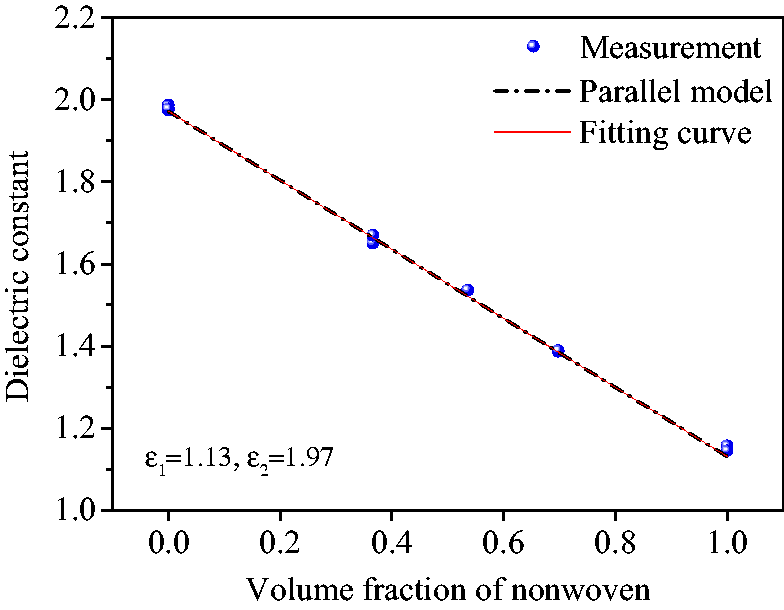
Measured and simulated dielectric constant of multilayer fabrics for the different nonwoven volume fractions.
Conclusion
By comparing the dielectric characteristics at 1.11 GHz of sewed multilayer fabrics made of the same or different kinds of fabrics, the following conclusions can be drawn. First, the sewing threads filled the pores of the fabrics and changed their structures, but they had little influence on the dielectric constant of sewed fabrics for their little proportion regardless of their sewing directions and sewing patterns. Second, for the sewed multilayer fabrics made of the same kind of fabrics, their dielectric constants were almost the same as their components’. For the sewed multilayer fabrics made of different kinds of fabrics, their dielectric constants were between fabric one with minimum dielectric constant and fabric two with maximum dielectric constant. Third, the calculation method of dielectric constant of sewed multilayer fabric has been determined. Both the components’ dielectric constant and volume fraction can determine the dielectric behavior of sewed multilayer fabric. The dielectric constant of sewed multilayer fabric increased gradually with the increase of volume fraction of components with larger dielectric constant. Fourth, the parallel model was verified by the experimental results and could predict the dielectric constants of sewed multilayer fabrics very well.
In this work, the sewing threads filled the pores of the fabrics to slightly increase their dielectric constants during the sewing process. For the fabrics with different sewing patterns, their structures have changed, and their dielectric constants also have changed although it is not obvious for little proportion of sewing materials. Thus, to predict the dielectric constant of fabric according to the structure of fibers, the more detailed model should be built in the future work. It would be very valuable for designing the dielectric constant of fabric according to the fiber properties and arrangements.
Footnotes
Declaration of Conflicting Interests
The author(s) declared no potential conflicts of interest with respect to the research, authorship, and/or publication of this article.
Funding
The author(s) disclosed receipt of the following financial support for the research, authorship, and/or publication of this article: the National Natural Science Foundation of China under Grant number 51405079 and the Fundamental Research Funds for the Central Universities (CUSF-DH-D-2018033).
