




Abstract
The feet, covered by socks and shoes during running, undergo an increase of temperature. The aim of this study was to reduce heat generation in the feet of athletes during running by wearing novel thermoregulatory socks impregnated with bioceramic materials. Thirty male athletes ran a half-marathon (21.0975 km) wearing polyester based with bioceramic fibres (zirconium silicate and titanium oxide) and control socks (polyester). The average temperatures were measured with a thermographic camera (FLIR e60bx) before and after the run. Nine regions of interests were evaluated in the plantar surface and eight in the dorsum. Before running, the plantar region with the highest temperature was the inner midfoot (plantar arch) with 30.3 ± 2.1°C on the control sock and 30.2 ± 2.1°C on the bioceramic one. After running, smaller temperatures were found at the plantar surface of five regions of interests: heel, inner midfoot, first and fifth metatarsal heads and first toe and all the dorsal regions of the bioceramic socks. The amount of temperature reduction from the bioceramic sock was between –1.1 and –1.3°C in heel, inner midfoot, first MTH and first toe (plantar) and 1.3°C at the dorsum of first and fifth toes. Polyester-based socks with bioceramic fibre materials, due to far-infrared radiation, promote cooler temperatures on the sock surface after running. This effect is more effective in heel, the inner midfoot and the first MTH and could help improve the behaviour of the sock to make it denser in bioceramics and preventing running lesions, like blisters.
Introduction
The human body is homoeothermic, i.e. it is able to maintain its core internal temperature within certain physiological limits regardless of the ambient temperature. Thermoregulation is the process by which excess heat is lost, with thermoreceptors in the skin playing a vital role in these mechanisms [1–3]. There are several such mechanisms in the foot, e.g. blood flow, sweating and metabolic heat production [4].
Infrared thermography is a technique used to detect the amount of infrared radiation emitted by a body’s surface [5,6]. In the medical field, it provides a non-invasive method of analysing the skin’s surface and its physiological functions [7] since it requires no direct physical contact with the object under study. The technique has been used to diagnose breast cancer as well as in rheumatology, gynaecology and other fields. For the lower limbs, it has mostly been used in the cases of diabetes [8], peripheral vascular alterations [9] and diabetic neuropathy [1] as well as in textile analyses [10].
Internal body heat increases during physical activity, and as a result, the skin exhibits increases in blood flow, sweating and temperature [11], which are all essential mechanisms for dissipating the heat generated [2,12,13]. Since during physical activity, the feet remain covered by athletic socks and shoes, and they undergo a rise in temperature [14]. The different mechanisms of heat transfer observed in the skin include conduction, convection, evaporation and radiation [15]. Socks can affect all of these mechanisms, with high-quality fibres allowing for better conduction of heat from the feet to the socks and shoes through direct contact.
Today, the incorporation of the fusion spinning system (manufacturing process used to produce polymeric or synthetic fibres) is characterized for the fibre-forming substance melts by extrusion through the row and then directly solidifies by using a rapid cooling system to transform molten core material into filaments. In this sense, synthetic fibres are fibrous materials produced from organic and inorganic raw materials in a chemical process. The organic materials may be natural or synthetic polymers, while the inorganic compounds include glass, metal, basalt, quartz and other composites. These synthetic fibres are manufactured industrially in the form of monofilaments, staple fibres and filament yarns [16]. Melt spinning is among the most widely used methods for producing polymeric filaments; in this sense, a range of polymers, namely poly(ethylene terephthalate), polyurethanes, polyolefines and polyamides are generally melt spun [17]. In this sense, textiles are available made of new fibres such as bioceramics, understood as being those inorganic, ceramic materials (such as silicon, calcium, aluminium, magnesium, sodium, zirconium silicate and titanium oxides [18]), which have interesting biological properties such as absorbing the body’s infrared radiation and returning it in the form of longer wavelength radiation which can stimulate the body to increase vasodilation [19]. These effects have been associated with such potential benefits as prevention of inflammatory processes, reduction of pain and improved circulation [19–21]. Also, polyester socks with bioceramic fibres provide better sweat evacuation and less bacterial growth than cotton-based ones [22]. With respect to the possible effect of the bioceramic fibres on thermoregulation, a literature review shows that using bioceramic garments (e.g. T-shirts and socks) helps to reduce body temperature during physical activity in general and sports activity in particular [18]. This effect can also have the potential benefit of improving performance and facilitating post-exercise recovery.
High-quality socks can be made of fibres especially designed to maintain optimal thermal conditions by being able to evacuate heat. This improves the internal environment, in particular by keeping the feet dry and thereby preventing the occurrence of certain skin conditions and lesions such as blisters, which are caused by excessive heat and moisture due to the lack of sweat evaporation [10,23]. There are different thermoregulatory fibres available, like a ceramic fibre whose exceptionally low thermal conductivity dissipates little heat from the furnace and has remarkable energy-saving properties [24], which prevent excessive increases in temperature. One of them is a polyester-based and bioceramic-impregnated fibre.
So, the objective of the present study was to evaluate the reflected foot temperatures on the dorsal and plantar surfaces of the foot in two different types of sock – one a control (polyester based) and the other polyester based with bioceramic impregnation of the fibres – the aim being to investigate the latter’s potential benefits.
Material and methods
The study participants forming the sample were 30 male athletes, mean age 38.7 ± 8.4 years, mean weight 69.4 ± 9.8 kg and mean height 171.9 ± 8.1 cm. They all signed an informed consent form to take part in the study in accordance with the Declaration of Helsinki. They were habitual runners, with a half-marathon (210975 m) test result of 5700 ± 540 s. The study was registered under number ACTRN12615000370505.
Inclusion and exclusion criteria
The study required the participant be able to run for at least 100 min at a speed of between 9.2 and 12 km/h. For inclusion, no participant could present any sign of skin lesions (painful bacterial infections, fungal infections or hyperkeratosis). Any potential participants who did not comply with the necessary requirements of hygiene were also excluded from the study.
Measurement protocol
The athletes were asked to clean their feet on the morning of the test and to come with clean socks, so that all the participants would start with equal conditions of hygiene, sweating and temperature.
Sample details
They were given two socks (provided by the manufacturer, Bionox Group Spain) with the following characteristics – composition: polyester 90%, polyamide 5%, elastane 5%; structure: high-yarn-twist terry-jersey fabric, mass per unit area 285 g/m2. Polyester is hydrophobic and well suited to avoiding excess build-up of moisture on the skin of a runner’s foot. Its thermal conductivity is 0.14 W/m/K. In one half of the set of socks (the bioceramic group), the yarn filament had been impregnated with 1% of bioceramics. The other half constituted the control group. The bioceramic fibres used contain inorganic materials such as zirconium silicate and titanium oxide (anatase and rutile). These materials are capable of absorbing heat and re-emitting it as far-infrared radiation (FIR). The benefits of FIR include blood vessel vasodilation, thermoregulation and antimicrobial effects [15]. The two sets of socks were of the same colour (white), thickness (3.5 ± 0.06 mm) and design. Each participant wore one sock of each group, with the foot on which to put the bioceramic sock being selected at random.
Thermographic imaging procedure
Pre-running analysis
Prior to taking the images, the participants spent 20 min acclimating themselves to the room’s temperature and relative humidity conditions (20 ± 0.5°C and 50 ± 5%, respectively), following the protocol set out in Gatt et al. [5] and in accordance with the standards and guidelines of the International Association of Certified Thermographers (IACT). The temperature analysis was performed using a thermographic camera (FLIR E60bx, FLIR Systems Inc., Wilsonville, Oregon, USA), a method whose validity is similar to that of the use of surface sensors to study cutaneous thermoregulation [25]. The camera’s infrared resolution is 320 × 240 pixels, its thermal sensitivity 0.05°C and its precision ±2% (FLIR E-60, Flir Systems), and it was calibrated against black body radiation. The emissivity factor for human skin was set at 0.98.
For the thermographic measurements of the plantar aspect of the feet in socks, the participant lays face-up on a stretcher, maintaining a slight dorsiflexion and with the feet 5–10 cm apart. The camera was fixed to a tripod one metre from the feet. After an image was taken of the bottom of the feet, the participant stood on two foot-shaped pieces of black foam in order to maintain consistent positioning of the feet from one participant to another. The dorsal aspect thermographic measurements were taken from one metre above the dorsum of the feet, with the examiner remaining in the same location for all participants (Figure 1).
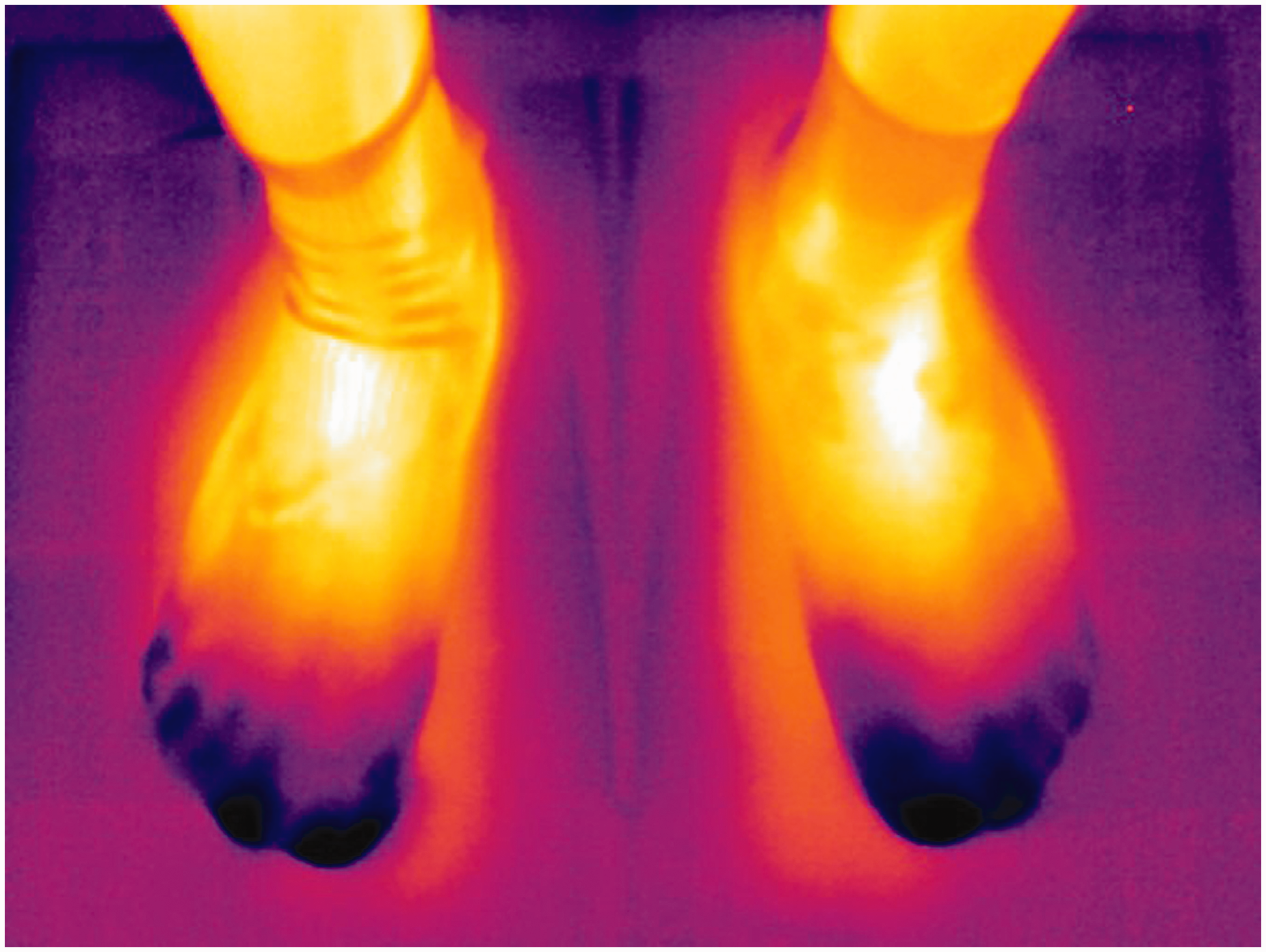
Thermography of the dorsal surface of the socks before running. Sock with bioceramic fibres (L) and control sock without bioceramic fibres (R).
After these measurements had been made, the participants ran laps around a track for 21.0975 km at a light intensity level (10.5 km/h), during which the ambient conditions remained the same (cloudy day, 16°C and 44% relative humidity). The participants’ runs and corresponding tests were staggered every 5 min.
Post-running analysis
After they had finished running the 21.0975 km of the half marathon, the participants’ shoes were removed, and immediately (in order to ensure that the measurements would correspond to the actual temperature microclimate between foot and sock), the same thermographic measurements were made as before running.
Data analysis
The thermography images were analysed using the FLIR tools software package. The foot was divided into nine plantar and eight dorsal regions of interest (ROIs) in order to obtain as much thermal information about the feet as possible. The average temperatures of the following regions were noted using the information provided by the software: (a) plantar surface: heel, inner and outer midfoot, first metatarsal head (MTH), middle MTHs, fifth MTH, first toe, middle toes and fifth toe and (b) dorsum: inner and outer midfoot, first MTH, middle MTHs, fifth MTH, first toe, middle toes and fifth toe (Figure 2).

Measurements of dorsal ROIs. E9 is the inner midfoot region, E10 the outer midfoot, E11 the 1st MTH, E12 the central MTHs, E13 the 5th MTH, E14 the 1st toe, E15 the central toes, and E16 the 5th toe.
A statistical analysis of the results was carried out using the program SPSS, version 15.0 (UEX licence). Descriptive statistics of the temperatures were evaluated for each of the regions studied. Student’s t-test for paired samples was used to compare temperatures between the different regions of the two feet. A 95% confidence level for statistical significance (p < 0.05) was established.
Results
Plantar and dorsal temperatures before running
Before running, the plantar region with the highest temperature was the inner midfoot (plantar arch) with 30.3 ± 2.1°C on the control sock and 30.2 ± 2.1°C on the bioceramic one (Table 1). The second highest temperature was for the outer midfoot with 28.4°C on both feet (Table 1).
Pre-running plantar temperature and differences between feet.

Student’s t-test for paired samples.
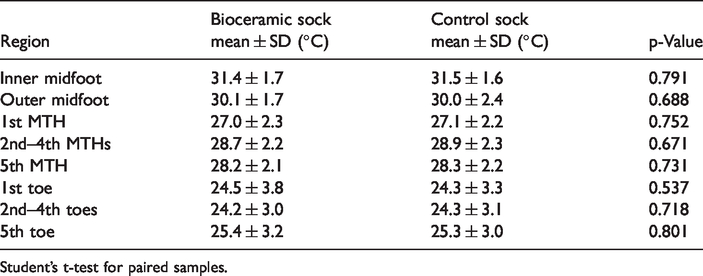
The coolest plantar region of the feet was that of the toes, with an average temperature of the first toe of 23.6 ± 3.0°C (control) and 23.7 ± 3.3°C (bioceramic) and of the middle toes of 23.4 ± 2.7°C (control) and 23.7 ± 3.5°C (bioceramic). The fifth toe had a slightly higher temperature: 24.4 ± 2.7°C (control) and 24.5 ± 2.8°C (bioceramic). None of the regions studied showed significant differences (p > 0.05 in all cases) in temperature between the left and right feet prior to running (Table 1). In the dorsal region (Table 2), prior to running, the inner midfoot was the region with the highest temperature at 31.5 ± 1.6°C (control) and 31.4 ± 1.7°C (bioceramic), followed by the external midfoot at 30.0 ± 2.4 (control) and 30.1 ± 1.7°C (bioceramic).
Pre-running dorsal temperature and differences between feet.
Student’s t-test for paired samples.
The coolest dorsal region was that of the toes (Table 2), with temperatures of 24.3 ± 3.3 (control) and 24.5 ± 3.8°C (bioceramic) for the first toe and 24.3 ± 3.1 (control) and 24.2 ± 3.0°C (bioceramic) for the lesser toes. The fifth toe had a slightly higher temperature than the rest of the toes, with a temperature of 25.3 ± 3.0 (control) and 25.4 ± 3.2°C (bioceramic). No statistically significant differences (p > 0.05 in all cases) were found between the temperatures of the control and bioceramic socks in the dorsal regions analysed prior to running (Table 2).
Plantar and dorsal temperatures after running
In the plantar surface, after running, the highest plantar temperature was found at the inner midfoot in the control sock, with 34 ± 0.8°C, where in the bioceramic ones was 32.7 ± 0.9, being the difference statistically significant (p = 0.001). Also, in the control sock at heel (p = 0.001), first (p = 0.001) and fifth (p = 0.030) MTHs and first toe (p = 0.001), the temperature after running was greater than in the bioceramic sock (Table 3). The bioceramic sock showed smaller temperatures than the control sock in all ROI, except in the fifth toe.
Post-running plantar temperatures and differences between control and bioceramic socks.

Student’s t-test for paired samples.
After running, the greatest increases in temperature in the plantar region were for the first toe, second to fourth toes and the first MTH with temperature increases of 8.7°C (control) and 7.6°C (bioceramic), 7.4°C (control) and 7°C (bioceramic) and 7.2°C (control) versus 6 (bioceramic), respectively (Table 4). The bioceramic sock showed a significantly smaller temperature increase than the control sock in all the ROIs, except in the fifth toe (Table 4). The temperature reduction from the bioceramic sock was –1.1 and –1.2°C in heel, inner midfoot, first MTH and first toe (Table 5).
Increase of temperature (Δ; mean post-mean pre) at plantar surface and difference between bioceramic and control.

Post-running dorsal temperatures and differences between bioceramic and control socks.

In the dorsal region, the greatest temperature after running was also observed in the inner midfoot of the control sock, with 31.9 ± 1.1°C, where in the bioceramic one was 31.5 ± 0.9°C, being the difference statistically significant for this zone (p = 0.022, Table 5). The rest of the ROI also presented higher temperatures in the control socks than in the bioceramic ones (Table 5).
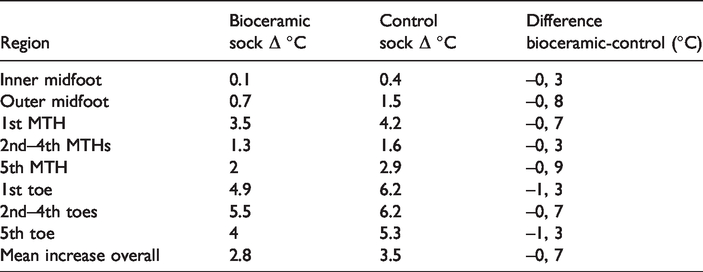
In the dorsal region (Table 6), the greatest increase in temperature after running was observed for the toes, especially the first toe with temperature increases of 6.2°C (control) and 4.9°C (bioceramic). The other toes, the second to fourth and the fifth toes, increased in temperature by 6.2°C (control) and 5.5°C (bioceramic) and 5.3°C (control) and 4.4°C (bioceramic), respectively. The temperature reduction from the bioceramic sock in the dorsal aspect was –1.3°C at first and fifth toes (Table 6).
Increase of temperature (Δ; mean post–mean pre) at the dorsum and difference between bioceramic and control.
Discussion
Plantar and dorsal temperatures before running
With regard to the temperature distribution of the feet prior to running, the inner midfoot (plantar arch) was the warmest region and the toes the coolest. These data are consistent with the findings of Nagase et al. [9] who observed a concentration of higher temperatures in the plantar arches, and with those of Sun et al. [26] who found the highest temperatures to correspond to the plantar arches of healthy patients (29.3 ± 0.9°C) and the lowest in the toes (26.2 ± 1.2°C). Although infrared thermography is strongly related to blood flow [27], this is less clear in sports performance in which skin temperature is also the result of ambient temperature, heat dissipation processes and biophysical characteristics [7,28].
It is difficult to identify a ‘normal’ temperature distribution. The angiosome concept is one proposed way of classifying it. As described by Attinger et al. [29], the foot comprises four angiosomes in its plantar aspect. These correspond to the medial plantar, lateral plantar, medial calcaneal and lateral calcaneal arteries. Thus, it would seem logical that the inner arch, whose blood is supplied by the powerful medial plantar artery, would have a higher temperature, while acral regions such as the toes, which are supplied by small capillaries, would have cooler temperatures.
Plantar and dorsal temperatures after running
Smaller temperatures were observed in the bioceramic sock than in the control in both the plantar and dorsal aspects of the foot. Also, overall increase of temperature was lower in the bioceramic sock. The bioceramic sock is more effective thermally, especially for the heel and the medial aspect of the foot (inner midfoot, first MTH, first toe, Table 3) at the plantar surface and all regions in the dorsal zones (Table 5). Similar results were obtained in diabetic population, where sock fabrication and design (different knitting structure, thickness and airspace ratio) reduce high plantar pressure in certain zones as well as major impact on the control of foot skin temperature and humidity [30].
This beneficial effect observed in our sample has also been observed in ceramic nanostructures (of titanium dioxide and silicon dioxide) similar to that used in the present study, with them enhancing metabolism and blood flow [31]. In this way, far-infrared radiating materials such as bioceramics seem to absorb heat from the human body, thus promoting better thermoregulation, and this could be related to the observed better recovery of fatigued tissues [31].
In specific areas of the sole of the foot (the heel, and the first MTH and first toe), there were higher temperatures observed after running. In addition to the physical activity, these may also be due to these regions being of particular biomechanical relevance. The heel is the area that receives the first impact, and the first MTH and first toe are the parts of the foot which are the most involved in the propulsion phase of each stride. In these regions, the bioceramic sock showed itself to be more effective at dissipating heat, with post-run temperatures 1.1–1.2 °C lower than those of the control sock. These cooler temperatures at high active zones at running could help to prevent prevalence of foot blisters, that are more frequent at toes, the ball of the foot (first MTH) and heel [32]. Other studies have observed lower levels of heat dissipation in socks made from cotton [33].
As the foot in humans is a region of the body that can sweat a lot, one would expect it to show smaller rises in temperature since zones with better sweating mechanisms generally present lower temperatures [34]. Our results therefore suggest that bioceramic socks could be capable to allow better sweat conduction, because the temperatures on both plantar and dorsal surfaces were lower than in the control case. In terms of the overall temperature increase generated by running, in the overall plantar surface that of the control sock was 6.3°C while that of the bioceramic sock was 5.6°C. This –0.7 °C difference in the thermal effect of bioceramic socks could help reduce sweating, and hence the blisters and chafing caused by heat and excessive moisture [35]. In addition, these changes were observed after running only 21,095 m. Long-distance competitions that take some hours to complete, such as marathons or fell running, result in even greater temperature increases, and thus the benefits of the bioceramic sock may be even more pronounced in such cases.
Improved sock technology can be of aid not only to athletes, but also to other people who are prone to foot problems, such as diabetics, since optimal thermal conditions allow wounds to heal early [36]. In this study, the running shoes seemed not to play any major role in influencing temperature. In our opinion, they did not bias the results because the shoes were the same for the two feet, so that the observed differences in temperature increases were solely related to the socks.
Application and limitations of the study
The moderation of heat build-up is known to be directly related to the amount of bioceramic additives, being more effective the greater the percentage [37]. In this study, we opted to investigate the potential decrease in the post-running temperatures of the feet of the athletes wearing a sock with just a single bioceramic content (1%). This is clearly a limitation of the study. The following steps in this line will be to investigate how the decreases in foot temperatures depend on the bioceramic content of the fibres. This could offer interesting insights into what might be the specific optimal bioceramic content to allow the best performance.
Conclusions
The polyester-based bioceramic socks promoted better thermoregulation of the foot after running, being 1.1–1.3°C cooler at four plantar ROIs and two on the dorsal surface. This effect depended strongly on the zone measured, being more effective in heel, the inner midfoot, the first MTH and the first toe. This observation could help improve the behaviour of the sock by just changing either the structure to make it denser in areas covering some specific zones of the foot or the amount of bioceramic incorporated into the fibre. As a result, such features could help prevent runners developing skin lesions such as blisters or dermatomycosis which are linked to excessive temperatures. The results of the study provide a reference for optimizing the design and functional performance of socks for running.
Footnotes
Declaration of conflicting interests
The author(s) declared no potential conflicts of interest with respect to the research, authorship, and/or publication of this article.
Funding
The authors disclosed receipt of the following financial support for the research, authorship, and/or publication of this article: The present study was funded by Consejería de Economía e Infraestructuras of Junta de Extremadura and Fonde Europeo de Desarrollo Regional (FEDER) by GR15073 and GR18178.
