




Abstract
Recent advances in self-powered electronic devices have urged the development of energy-harvesting technology. Batteries are gradually unable to satisfy the practical requirements for powering the different types of microelectronic devices owing to their drawbacks such as occupying a significant percentage and weight of portable products, the need to replace or recharge them, constructing an important environmental impact, and the probable seepage of electrolyte solutions. Various technologies for converting renewable energies into electricity have been reported. Particularly, energy harvesters based on piezoelectricity to convert mechanical energy into usable electricity have received considerable attention. Electrospun fibers from piezoelectric polymers and inorganic nanowires as emerging piezoelectric materials have shown great potential for energy-harvesting applications. This review paper summarizes energy-harvesting technology based on piezoelectric polymeric fibers, inorganic piezoelectric fibers, and inorganic nanowires. A comprehensive overview of fundamentals of piezoelectric effect, types of piezoelectric materials, energy harvesting from fibers, energy harvesting from inorganic nanowires, and energy harvesting from polymeric/inorganic fibers and nanowires composites are discussed.
Introduction
Energy harvesting (also known as “power generation” or “energy scavenging”) is defined as collecting different amounts of energy from the surrounding environment and converting them into electric power for later use. It commonly uses mechanical vibration, mechanical stress and strain, thermal energy from heat sources, and chemical or biological reactions as a power source. Energy harvesters typically generate milliwatt or microwatt levels of power which are much smaller in comparison to those generated by conventional power generation principles such as electromagnetic and hydroelectric conversion typically on the levels of kilowatt or megawatt [1].
Energy-harvesting devices together with power accumulation, storage, and modulation units form an integrated energy-harvesting system that can be used to perform diverse tasks such as powering a multiplicity of circuitry for intermittent duty applications and making self-powered electronic devices [2–5]. It has become an increasingly important field as evident from the rising number of publications and product prototypes. Several scientific papers have been published on this topic covering a variety of mechanisms and techniques [6–17]. Since mechanical energy is abundant in daily life, scavenging mechanical energy into electrical energy via “piezoelectric effect” has been a critical technology. A number of research works have been devoted to the development of piezoelectric materials and devices. Some nanomaterials were found to have much higher piezoelectricity than their bulk counterparts, and novel generator devices have been demonstrated. For example, the pressure from moving vehicles can be converted into electric power by piezoelectric Pb(Zr,Ti)O3 (lead zirconate titanate, PZT) ceramics and Pb(Mg,Nb)O3−PbTiO3 (PMN-PT) crystals and the energy generated is strong enough to power caution lights on the highways [18].
This review summarizes the recent progress in energy harvesting based on piezoelectric fibers and nanowires (NWs). Basic principles about the piezoelectric effect, state of the art of piezoelectric energy-harvesting materials, device structure, and performance are introduced in details.
Basic theory
A piezoelectric material can generate an electric field difference due to mechanical deformation. Conversely, a mechanical deformation (the substance shrinks or expands) can result when an electric field is applied to the material, which is referred to as reverse piezoelectric effect (Figure 1(a)) [2,19–22]. These effects were first found in crystals with no center of symmetry and later on, many more ceramic materials were observed to have piezoelectric properties [23]. These materials have a polarization structure depending on the atoms that make up the crystal and the way the crystals are formed. In a nanocrystal, the polar axes of all of the dipoles lie in one direction. The crystal is said to be symmetrical. In a polycrystalline, there are different regions of the material that have different polar axes [23,24]. The describing piezoelectric equations for a linear piezoelectric material can be written as [2,25]:
(a) Schematic illustration of direct and reverse piezoelectric effects and (b) schematic diagram on piezoelectricity for semicrystalline polymers [27].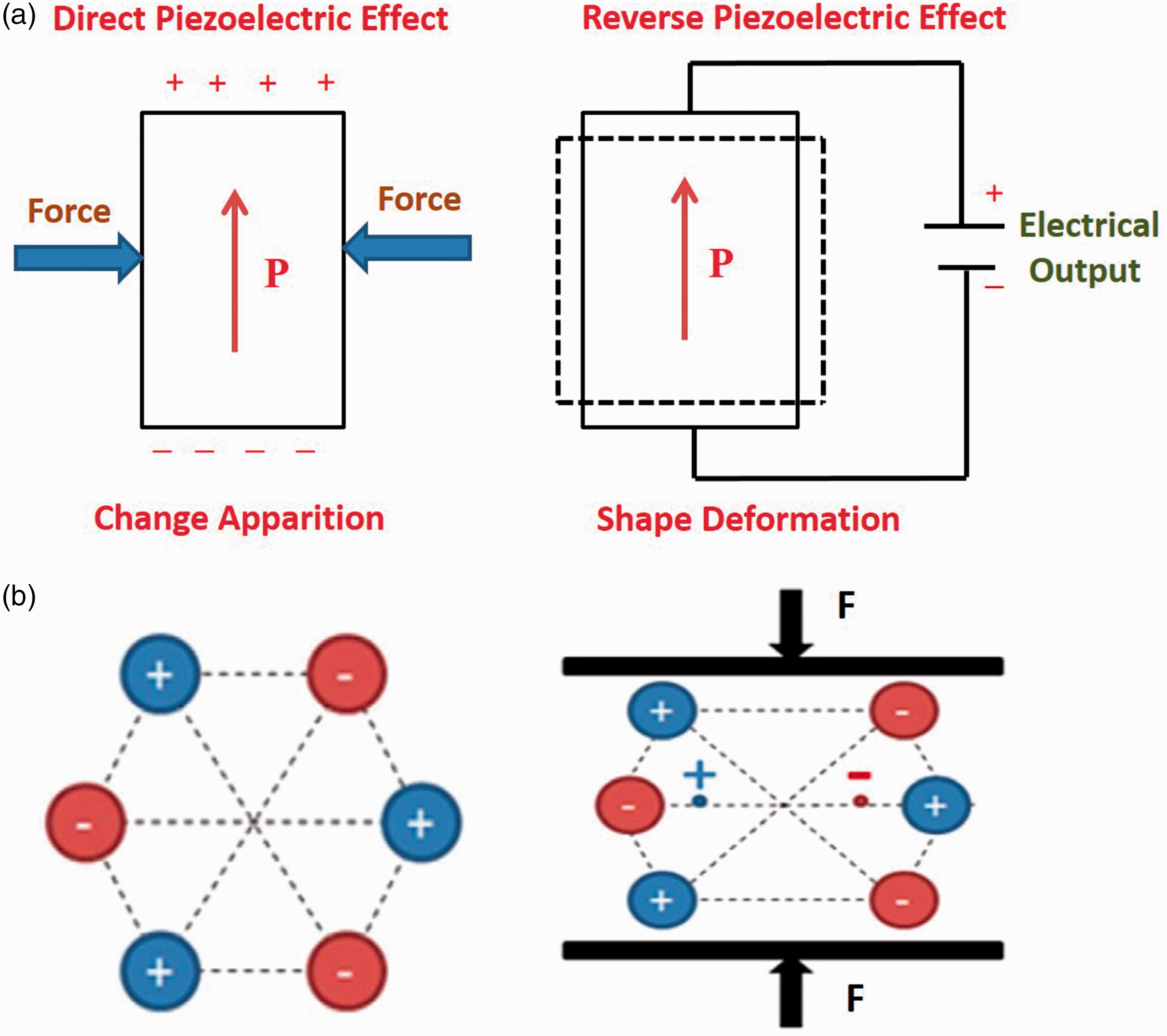
Direct piezoelectric effect

Converse piezoelectric effect

D: vector of electric displacement (C/m2).
d: matrix of piezoelectric strain constants (m/V).
σ: stress vector (N/m2).
β: permittivity (F/m).
ɛ: strain vector (m/m).
E: vector of the applied electric field (V/m).
S: matrix of compliance coefficients (m2/N).
Unlike piezoelectric crystals and ceramics, where the non-centrosymmetric nature of the material forms the piezoelectric effect, piezoelectricity in polymers originates from the distribution of polymer chains and its molecular orientation in the solid state (Figure 1(b)) [2,26]. Herein, the applied stress induces a change in the center of charge of the positive and negative ions, which means a change in the polarization that causes an effective electrical field [27]. In this regard, polar groups in polymers and their arrangement play important roles.
Piezoelectric materials
A list of common piezoelectric materials.

The most popular organic piezoelectric material is polyvinylidene fluoride (PVDF) owing to its high piezoelectric coefficients, chemical resistance, good mechanical properties, and excellent dielectric properties. PVDF has been used to prepare piezoelectric devices for various applications such as piezo-speakers, music instruments, wearable energy harvesting devices, and sensors [28–31].
PVDF is a linear semicrystalline polymer with the repeating unit of (CH2–CF2), whose structure is essentially head-to-tail i.e., CH2–CF2–(CH2–CF2)n–CH2–CF2 [28]. Solid PVDF has five possible crystalline phases: α and δ phases (TGTG′) trans–gauche–trans-gauche, β-phase (TTTT) all trans, and (T3GT3G′) for γ and ɛ phases [32–35]. In the semicrystalline polymers such as PVDF, there are regions where the chains exhibit a short- and long-term ordering (crystalline regions). A net dipole moment (polar phase) is obtained by applying a strong electric field at or above glass transition temperature and then is frozen in by cooling the material resulting in a piezoelectric like effect. The Curie temperature of PVDF is nearly 110℃, which also makes it useful for some elevated temperature applications [36]. The most common inorganic piezoelectric materials are PZT and zinc oxide (ZnO) ceramics. PZT is a polycrystalline ferroelectric material with a perovskite crystal structure—a tetragonal/rhombohedral structure very close to cubic [37–39]. It has the general formula of ABO3, in which A is a larger metal ion, usually lead Pb or barium Ba, B is a smaller metal ion, usually titanium (Ti) or zirconium (Zr) [23]. PZT has high electromechanical coupling coefficient (d33 of ∼500–600 Picocoulomb/Newton [PC/N]) as compared to PVDF (d33 of ∼30 PC/N) and ZnO (d33 of ∼12 PC/N) [2]. ZnO which is a wide bandgap semiconductor of the II–VI semiconductor group is crystallized in wurtzite crystal structures (a crystal structure for various binary compounds) is an example of a hexagonal crystal system. The wurtzite structure is non-centrosymmetric resulting in having properties such as piezoelectricity and pyroelectricity [40,41].
Piezoelectric ceramic materials have been used in various applications, such as sensors, actuators, nonvolatile ferroelectric memory devices, microelectromechanical systems (MEMS), and nanogenerators (NGs) [42–45].
Piezoelectric micro/macrofibers
Polymeric micro/macrofibers
In this section, the development of using piezoelectric polymeric micro/macrofibers in energy harvesting is discussed in details.
Fuh et al. [46] demonstrated a direct-write and in situ poled NG via near-field electrospinning (NFES) process to deposit PVDF fully encapsulated on a flexible substrate. This NG comprised 500 rows of well-aligned PVDF microfibers which are capable of producing a peak output voltage of 1.7 V and the output current reached up to 300 nA. These electrical outputs were two to three orders of magnitude higher than NFES setup of a single nanofiber and the similar amount of microfibers with post poling treatment.
Hadimani et al. [47] prepared PVDF microfibers from granules by continuous melt extrusion and in-line poling. After poling, the content of β phase in the poled fibers was improved. Piezoelectric fibers were tested using an impact test rig under an impact force of 1.02 kg dropped from a height of 5 cm. They generated a peak voltage of 2.2 V which was lower than that of commercial piezoelectric PVDF films.
Ceramic micro/macrofibers
Hu et al. [74] prepared BaTiO3 microfibers by the combination of sol–gel processing and gel-spinning technique. These sintered fibers with a diameter of 15 µm and length of 20 mm were aligned on the interdigitated electrodes and covered by epoxy resin. The periodic output voltages with a maximum value of 0.86 V were obtained under harmonic excitation by using a human finger.
Zhang et al. [75] used the spinning technique to prepare BaTiO3–polyvinyl chloride (PVC) single fibers with a diameter of 60 µm, and the fabricated power generators presented a good performance as a wearable device for harvesting the energy of human movement. The maximum output voltage and current of this generator reached up to 0.9 V and 10.5 nA, respectively, when it was bent by finger movements.
Piezoelectric nanofibers and NWs
When the diameters of fibrous materials are in the range of submicron or nanometers (which is that at least one dimension of a body is below 100 nm), these fibers show a greater practical and fundamental importance. The combination of high specific surface area, flexibility, sensitive response to mechanical stimulus, and superior directional strength makes them a preferred material form for energy-harvesting applications [76].
According to materials, piezoelectric nanofibers can be divided into ceramic nanofibers, NWs, and polymeric nanofibers. Details about these materials and their piezoelectric properties are described below.
Ceramic nanofibers and NWs
Piezoelectric ceramic nanofibers and NWs are the materials largely selected for piezoelectric elements used in energy-harvesting devices owing to their excellent piezoelectric properties, low cost, and ease to be integrated into energy-harvesting devices. Due to the fascinating properties of NWs (wires with a diameter less than 100 nm) compared with nanofibers (fibers with a diameter below 1 µm) represented by outstanding piezoelectric properties, excellent physicochemical properties, good mechanical properties, such as high hardness, high strength, and high heat resistance, the performance of NWs are more unique than performance of nanofibers in various applications [76–79].
Preparation of ceramic nanofibers and NWs
Ceramic nanofibers and NWs can be obtained by different techniques such as:
Energy harvesting from piezoelectric ceramic nanofibers and NWs
Piezoelectric ceramic nanofibers and NWs show high piezoelectrical outputs [28,100,101]. Perovskite-structured ceramic NWs, including (BaTiO3 [102], PbZrxTi1-xO3 [103], and (1-x)Pb(Mg1/3Nb2/3)O3–xPbTiO3 (PMN–PT) [104]), and wurtzite-structured ceramic NWs (ZnO [28], GaN [105], ZnS [106], and CdS [107]) have been integrated into NGs over the last 10 years. The NW-based energy-harvesting technology has taken hold the attention of researchers due to their great advantages, including large surface area, robust mechanical properties, almost free of dislocations, deformation under a very small applied force, and extraordinary sensitivity to characteristically small ambient vibrations [108,109].
Chen et al. [110] reported a direct measurement of single PZT nanofiber piezoelectric potential under bending using a nanomanipulator inside a scanning electron microscope chamber. The PZT nanofibers, with the diameter and length around 100 nm and 70–100 µm, were aligned across trenches on a silicon substrate with a thermally grown oxide diffusion barrier and evaporated gold electrodes. When a bending moment was applied to a PZT nanofiber with an effective length of 4 µm by a tungsten tip of the nanomanipulator, a potential of ∼0.4 mV was generated (Figure 2). Their experiments proved the feasibility of using these PZT nanofibers for nanoscale sensing, actuation, and energy harvesting.
(a) Schematic diagram of the measurement system of single PZT nanofibers using a nanomanipulator; (b) SEM image showing the bent single PZT nanofiber; (c) voltage output and discharging from the single PZT nanofiber during the bending test [110].
Chen et al. [111] introduced a piezoelectric nanogenerator (PENG) based on PZT nanofibers with an average diameter and length of ∼60 nm and 500 µm, respectively. The nanofibers were aligned on interdigitated electrodes of platinum fine wires and packaged using a soft polymer on a silicon substrate. The recorded peak voltage output and power under periodic stress applications to the soft polymer were 1.63 V and 0.03 μW, which were enough to power wireless electronics, portable devices, stretchable electronics, and implantable biosensors (Figure 3).
(a) Schematic view of a PZT nanofiber nanogenerator; (b) an optical image of PZT nanofibers aligned on the platinum electrode; and (c) voltage output garnered from the nanogenerator [111].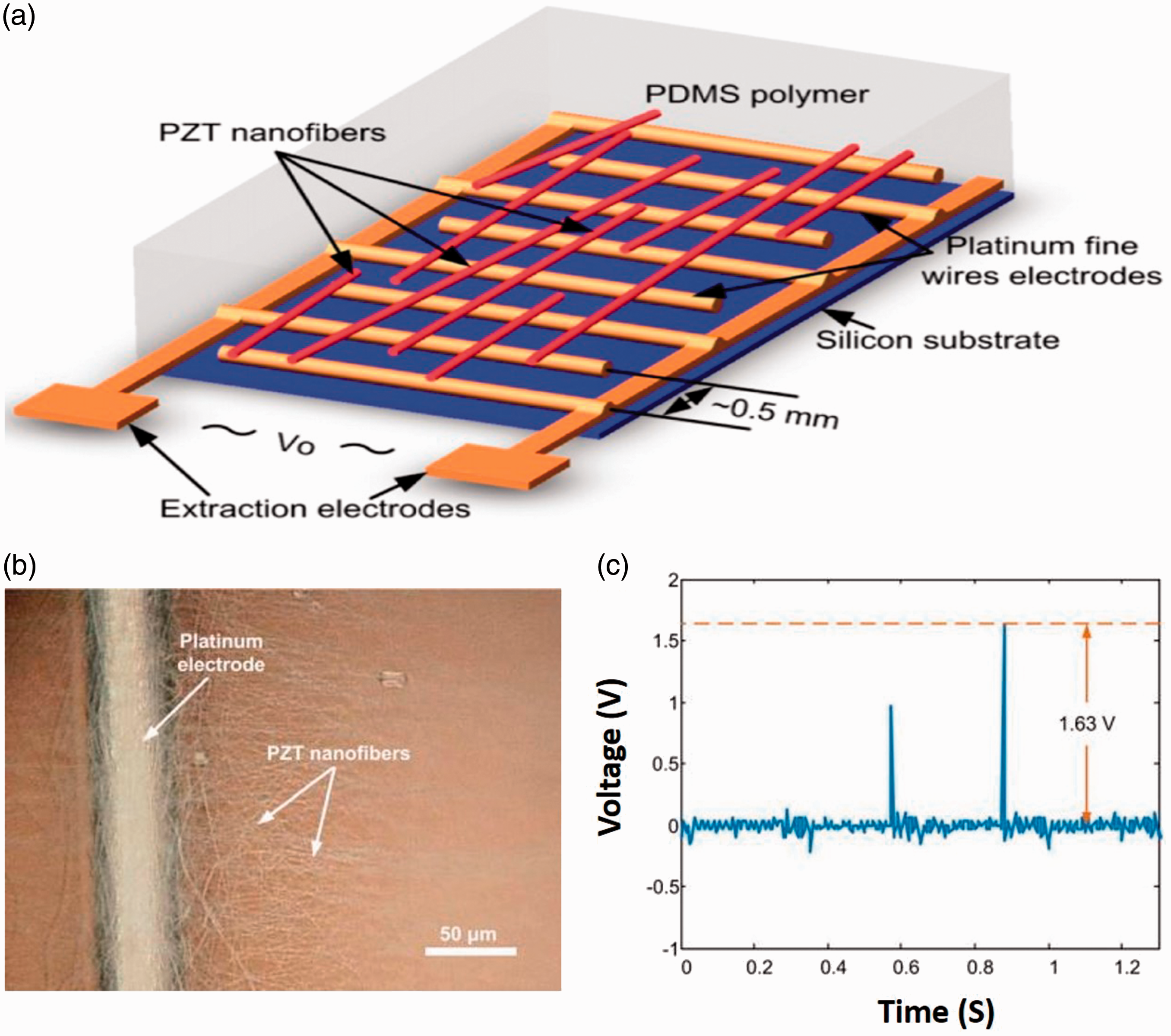
Kang et al. [112] prepared high-quality (Na0.5K0.5) NbO3 nanofibers containing small contents of Manganese (Mn) by electrospinning. They concluded that nanofibers with 3 mol% Mn-doping exhibited an effective piezoelectric coefficient of ∼40.06 pm/V, which is five times higher than that of Sodium potassium niobate (Na0.5K0.5)NbO3 (NKN) nanofibers without Mn and the resultant flexible NGs on a polyethersulfone (PES) films exhibited ∼0.3 V output voltage and ∼50 nA output current under a bending strain (Figure 4).
(a) Schematic of flexible PENG based on a Mn-NKN/PDMS structure on a PES film; (b) a real image of the nanogenerator; (c) voltage; and (d) current outputs of the PENG [112].
Lin et al. [113] demonstrated the first NGs of GaN with high output performance by utilizing the rational assembly of GaN NWs. The NG was fabricated by an assembly of GaN NWs on a flexible substrate, and its output voltage and current density could be up to 1.2 V and 0.16 μA/cm2, respectively.
Wu et al. [114] developed a suspending sintering technique of electrospinning NWs to fabricate a flexible, dense, and tough PZT textile composed of aligned parallel NWs. This fibrous structure was transferred onto a thick polyethylene terephthalate (PET) film and chemical fabric to make flexible and wearable NGs. The NG generated 6 V output voltage and 45 nA output current, which were large enough to power a liquid crystal display and an UV sensor (Figure 5).
(a) Schematic diagram of the process of fabricating a PZT textile; (b) photograph and (c) SEM images of the PZT textile; (d) voltage; and (e) current outputs of the NG [114].
Ni et al. [102] described a flexible NG based on single BaTiO3 NW. The output voltage and current of the flexible NG under periodical bending and releasing reached up to 0.21 V and 1.3 nA, respectively. The electrical output was found to be proportional to the strain and strain rate. Moreover, the electrical outputs could be enhanced by connecting two generators in series and in parallel with the correct polarity and sequence.
Jalalian et al. [115] reported a very large piezoelectricity in Ba(Ti0.80Zr0.20)O3-0.5(Ba0.70Ca0.30) TiO3(BTZ-0.5BCT) lead-free nanostructured thin films (d33 = 141 pm/V) and nanofibers (d33 = 180 pm/V). These values are comparable to or higher than those for PZT films and nanofibers, respectively (Figure 6). Strong reduction of the coercive field induced by interface stress and improved piezoelectric response makes BTZ-0.5BCT ceramics nanofibers a promising candidate for integration in piezoelectric nanodevices and power generator systems.
Comparison of piezoelectric coefficient d33 in nanostructured inorganic piezoelectric materials [115].
Malakooti et al. [103] directly grew vertically aligned PZT NWs on a conductive substrate. The feasibility of continuous power generation using the nanostructured beam was demonstrated by measuring the output voltage from the PZT NWs when the beam was subjected to sinusoidal base excitation. The results proved that applying about 0.7 gr root mean square (RMS) base acceleration on the NWs can result in about ∼350 RMS millivolts which are relatively high with respect to other nanostructured energy harvester devices. They concluded that piezoelectric NW arrays could be a great demand in piezoelectric NG devices.
Cui et al. [116] studied the electrical output of a flexible NG based on the oriented assembly of PZT NWs using the finite element method under the compression force of 10 MPa (Figure 7). The capacitance, charge density on the top electrode, and open circuit output voltage were dependent on the variety of PZT-7 A materials, the lengths, and the diameters of the NW. They discovered that the open circuit voltage decreased from 0.693 V to 0.251 V when the PZT NW’s diameter changed from 0.20 µm to 0.36 µm. In contrast, the open circuit voltage increased from 0.329 V to 0.693 V when the length of PZT-7 A NW increased from 2.0 mm to 4.0 mm, whereas the thickness of the device had a negligible effect on the output voltage. Moreover, using polydimethylsiloxane as a matrix material will improve the voltage output by 10% comparing with poly (methyl methacrylate).
The schematic illustration of the flexible nanogenerator. The bottom right shows the charge generation principle of the flexible nanogenerator under a compression deformation [116].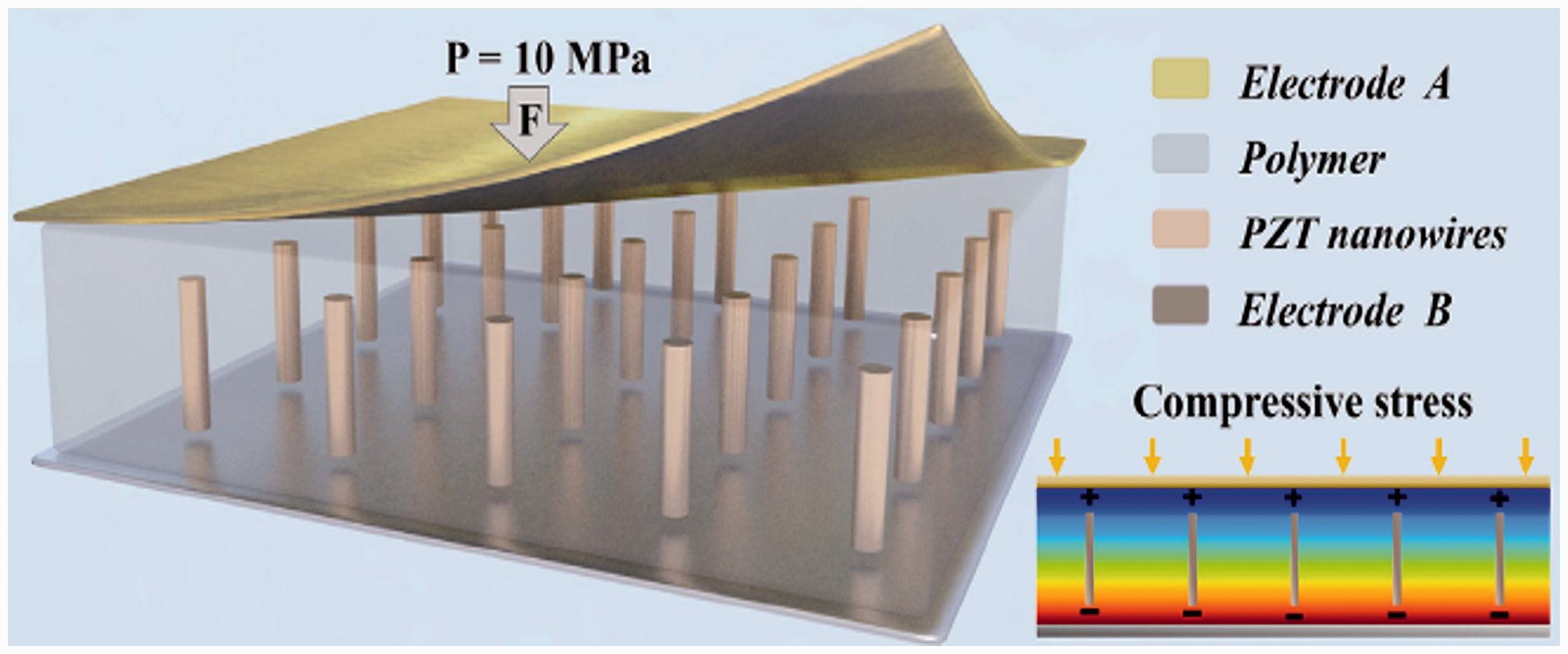
Moorthy et al. [117] fabricated a flexible piezoelectric energy harvester (PEH) consisting of a single 0.65Pb (Mg1/3Nb2/3)O3–0.35PbTiO3 NW (PMN–PT NW) using a facile transferring approach onto an Au electrode-patterned plastic substrate. The maximum output voltage and current generated from the single PMN–PT NW-based NG during periodical bending motions were 9 mV and 1.5 nA, with a power density of 175.4 W/cm3. Moreover, they fabricated a nanocomposite generator device with PMN–PT NWs and an elastomeric matrix. Under the same deforming conditions, the output voltage and current generated from this composite PEH was 4 V and 400 nA, respectively.
Baek et al. [118] vertically grew lead-free BaTiO3 NW arrays on a thin Ti substrate by a simple low-temperature hydrothermal method and characterized the electric signals generated from the BaTiO3 NW-based flexible PEH. The output voltage and current values of a lead-free BaTiO3 NW array-based PEH reached 90 V and 1.2 μA, respectively, when it was stressed by human fingers (Figure 8). Moreover, they investigated the piezoelectric energy production ability of single BaTiO3 NW by transferring NWs selected from well-aligned NW arrays onto a flexible substrate and connecting both ends of a single NW to Au electrode pads to measure the electric signals. During periodic deformation by a bending machine, a single BaTiO3 NW generated an output voltage from 6 mV to 10 mV and current peaks from 1 nA to 2.3 nA.
(a) Schematic illustration of whole fabrication process of vertically grown BaTiO3 NW arrays-based PEH; (b) SEM images of BaTiO3 NW arrays grown onto top and bottom surfaces of a Ti substrate; (c) Photograph of BaTiO3 NW arrays-based PEH (9 cm2) bent by human fingers; (d) voltage; and (e) current outputs generated from mechanical deformations by human fingers [118].
It is worth mentioning that by taking the outstanding advantages of ZnO NWs (excellent piezoelectric properties, high flexibility, lightweight, environmentally friendly, biocompatible, low cost, and the ability to integrate with technologically important materials such as polymers have been made a great demand for energy-harvesting applications) [28,119,120], they have been considered as the most preferable NWs for researchers in the field of piezoelectric NGs.
Wang et al. [121] developed a NW NG that is driven by an ultrasonic wave to produce continuous direct-current output. The NG was fabricated with vertically aligned ZnO NW arrays that were placed beneath a zigzag metal electrode with a small gap. The wave drives the electrode up and down to bend and/or vibrate the NWs. A piezoelectric semiconducting coupling process converts mechanical energy into electricity. The zigzag electrode acts as an array of parallel integrated metal tips that simultaneously and continuously create, collect, and output electricity from all of the NWs. The output current and voltage of the NG were ∼0.15 nA and ∼0.7 mV, respectively, when the ultrasonic wave was turned on, and the current and voltage immediately fell back to the baseline once the ultrasonic wave was turned off (Figure 9).
(a) Schematic diagram of the structure of ZnO nanowire nanogenerator driven by an ultrasonic wave; (b) zigzag trenched electrode; (c) aligned ZnO NWs grown on a GaN substrate; and (d) electrical outputs of the NG [121].
Zhu et al. [122] reported a simple and effective approach, named scalable sweeping–printing method, for fabricating flexible high-output NG with ZnO NWs, which were connected by parallel stripe type of electrodes. The output voltage and power density of the device reached 2.03 V and 11 mW/cm3, respectively. The generated electric energy was effectively stored in capacitors and used to light up an LED.
Li et al. [123] reported an in vivo NG based on ZnO NW that can convert mechanical energy from breath and heartbeat of a living rat into electrical outputs. Herein, the single-wire generator (SWG) acted as a “charging pump” that drove the electron motion in accordance with the mechanical deformation of the NW. The SWG generated output voltages of ∼1 mV and ∼3 mV, and output currents of ∼1 pA and ∼30 pA, respectively, from the diaphragm and heart of a rat (Figure 10).
(a) and (b) Real images of the harvesting energy of a live rat using an SWG from a diaphragm and heartbeat, respectively; (c) and (d) the schematic of the SWG and its connection configuration in reference to the measurement system, respectively; (e) current and voltage characteristics of the SWG; (f) current output generated from an SGW under in vivo conditions [123].
Hu et al. [124] demonstrated the first self-powered system driven by an NG that works wirelessly and independently for long distance data transmission. The NG was made of a free cantilever beam that consisted of a five-layer structure: a flexible polymer substrate, ZnO NW textured films on its top and bottom surfaces, and electrodes on the surfaces. When it was strained to 0.12% at a strain rate of 3.56%/S, the output voltage and current reached 10 V and up to 0.6 μA, respectively (corresponding to a power density 10 mW/cm3). A completed system was built up by integrating a NG, rectification circuit, capacitor for energy storage, sensor, and Radio frequency (RF) data transmitter (Figure 11). Wireless signals sent out by the system were detected by commercial radio at a distance of 5–10 m.
(a) Schematic diagram and (b) an actual image of the integrated self-powered system by using a nanogenerator as the energy harvester; (c) voltage and (d) current outputs of the NG [124].
Hu et al. [125] integrated an NG onto the inner surface of a bicycle tire. When the tire was turning and compressed during the moving of a bicycle, its deformation could be harvested and converted into output electric signals which were enough to light up a small liquid-crystal display directly. The output voltage and current of the NG with an effective working area about 1.5 × 0.5 cm2 under these conditions were 1.5 V and 25 nA, and the maximum output power density was 70 μW/cm3.
Polymeric nanofibers
Polymeric nanofibers have exciting properties such as the very large specific surface area (the specific surface area for a nanofiber can be as large as 103 times of that of a microfiber), higher flexibility, and better mechanical performance than any other known form of the material [76,126]. These outstanding properties make them optimal candidates for energy scavenging applications [127].
Preparation of polymeric nanofibers
Polymeric nanofibers can be obtained by various techniques such as mechanical drawing [128], template synthesis [129], phase separation [130], self-assembly [131], forcespinning [132], and electrospinning [133,134]. The electrospinning method is the most widely adopted technique for forming polymer nanofibers due to the ease of forming fibers with a broad range of properties and its unique advantages such as continues nanofibers formation, adjustable porosity of electrospun structures, and the flexibility to spin into a variety of shapes and sizes [135]. Practically in energy-harvesting application, electrospinning is one of the most preferred techniques for producing nanofibers due to its ability to produce fibers with outstanding properties (flexibility, variety of morphology and structure, high specific surface area, excellent mechanical properties) [76,136–138].
Energy harvesting from piezoelectric polymeric nanofibers
PVDF and its copolymers represent the most commonly used piezoelectric polymers with the highest piezoelectric coefficient among piezoelectric polymers in the range of 10–40 PC/N [139–141]. Herein, numerous studies about energy harvesting from piezoelectric polymeric nanofibers are reviewed.
Chang et al. [142] used NFES to direct-write PVDF nanofibers with in situ mechanical stretch and electrical poling characteristics to produce piezoelectric properties. They found that under repeated mechanical stretching and releasing, the typical electrical outputs of more than 50 tested NGs were 5–30 mV and 0.5–3 nA.
Fang et al. [143] demonstrated a one-step fabrication of piezoelectric PVDF nanofiber membranes that were used to convert mechanical energy to electrical power and the output voltage reached up to 6.3 V at frequency 10 Hz which was able to power electronic devices. They also illustrated the advantages of these membranes such as a simple, efficient, cost-effective, and flexible solution to self-powering of microelectronics for various purposes.
Mandal et al. [144] verified a way to prove the evidence of the preferential orientation of CF2 dipoles in the P(poly(vinylidene fluoride-trifluoroethylene) [VDF-TrFE]) nanofiber web during electrospinning. They concluded that there is a good possibility to obtain the desired amount of output power that might be very useful for portable electronic devices by simply changing the number of stacked layers and other parameters (like the active area, electrode area, frequency of the imparting pressure, etc.) (Figure 12).
(a) Schematic of the electrospinning experimental setup; (b) schematic diagram of a nanofiber web-based pressure sensor; (c) piezoelectric output signals of the P(VDF–TrFE) nanofiber from two different polarization structure (I) and (II) [144].
Liu et al. [145] proposed a miniature energy harvesting device for medical micro robot devised working in a blood vessel (Figure 13). This device used cantilever structure to collect kinetic energy transferred from outside of the human body in a wireless way such as ultrasonic wave by using aligned PVDF nanofibers with a coaxial structure which led to increasing the energy conversion efficiency and improved electrode fabrication.
(a) The diagram of co-axial nanofiber direct drawing device; (b) the structure of nanofiber film; and (c) lateral view of one single cantilever [145].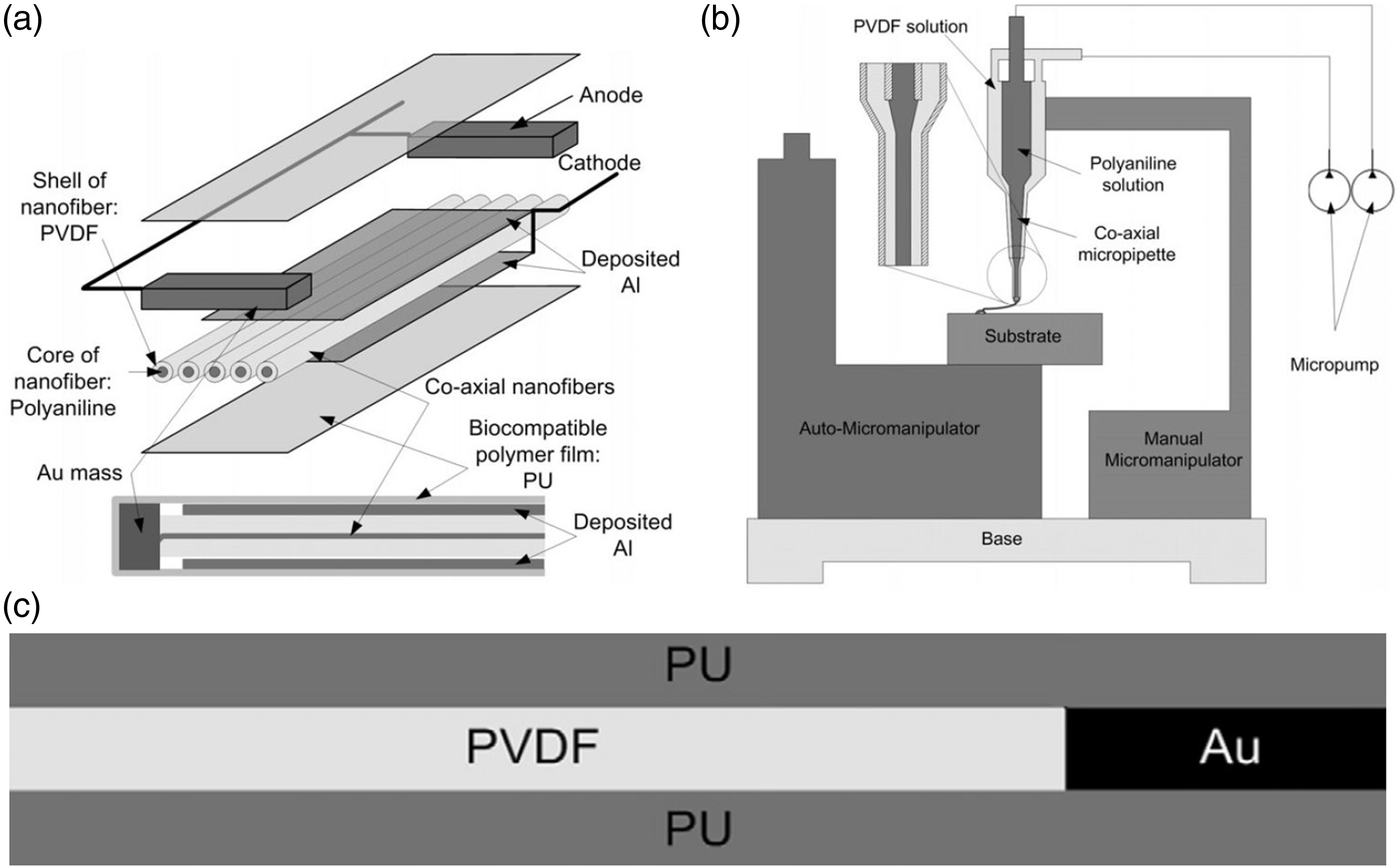
Chang and Lin [146] designed PVDF nanofibers fabricated using NFES as NGs in series and/or in parallel to amplify current outputs due to mechanical strain on a flexible substrate. A chemically resistive flexible polymer substrate has been used with patterned comb-shape gold electrodes made by a conventional lithography process. A total of 500 parallel nanofibers were fabricated and connected to amplify outputs current under repeated mechanical straining tests (Figure 14(a) and (b)). Peak current of 35 nA was collected with a 0.2 mV peak voltage (Figure 14(c) and (d)).
(a) Schematic diagram and (b) optical images of PVDF fiber structures with pattern comp shape electrode on top of a flexible substrate; (c) voltage and (d) current outputs generated from the device [146].
Fang et al. [147] also demonstrated that PVDF nanofiber webs produced by disc electrospinning can be directly used for making piezoelectric power generators and their electrical outputs were 2.6 V and 4.5 μA, at an applied voltage of 60 KV during fiber formation. The power generated can be used to run a thermoelectric cooler (Figure 15).
(a) Schematic structure of the nanofiber power generator; (b) digital photo of an actual nanofiber device; (c) voltage and (d) current outputs of the power generators made of different nanofibre webs; (e) energy harvesting circuit; (f) digital photo and (g–o) infrared thermal images of the miniature Peltier cooler driven by a nanofibre power generator [147].
Fuh et al. [148] presented a PVDF NG with in-situ poling fabricated by NFES. The maximum output voltage reached 20 V from the three layers piled NGs with serial connections, and the maximum output current can exceed 390 nA with the parallel integration setup. Nanofiber-based devices with a length of ∼5 cm can be easily attached on the human finger under folding–releasing at ∼45°, and the output voltage and current can reach 0.8 V and 30 nA, respectively (Figure 16).
(a) Schematic of the in-situ, direct-write and electrical poling PVDF fibers via NFES; (b) mode of deformation schematic; (c) schematic and (d) real image of the NG device integrated in parallel and serial with three layers; (e) a PVDF nanofibers device under folding–releasing at ∼45°; (f) voltage; and (g) current outputs of the device based on finger folding–releasing actions [148].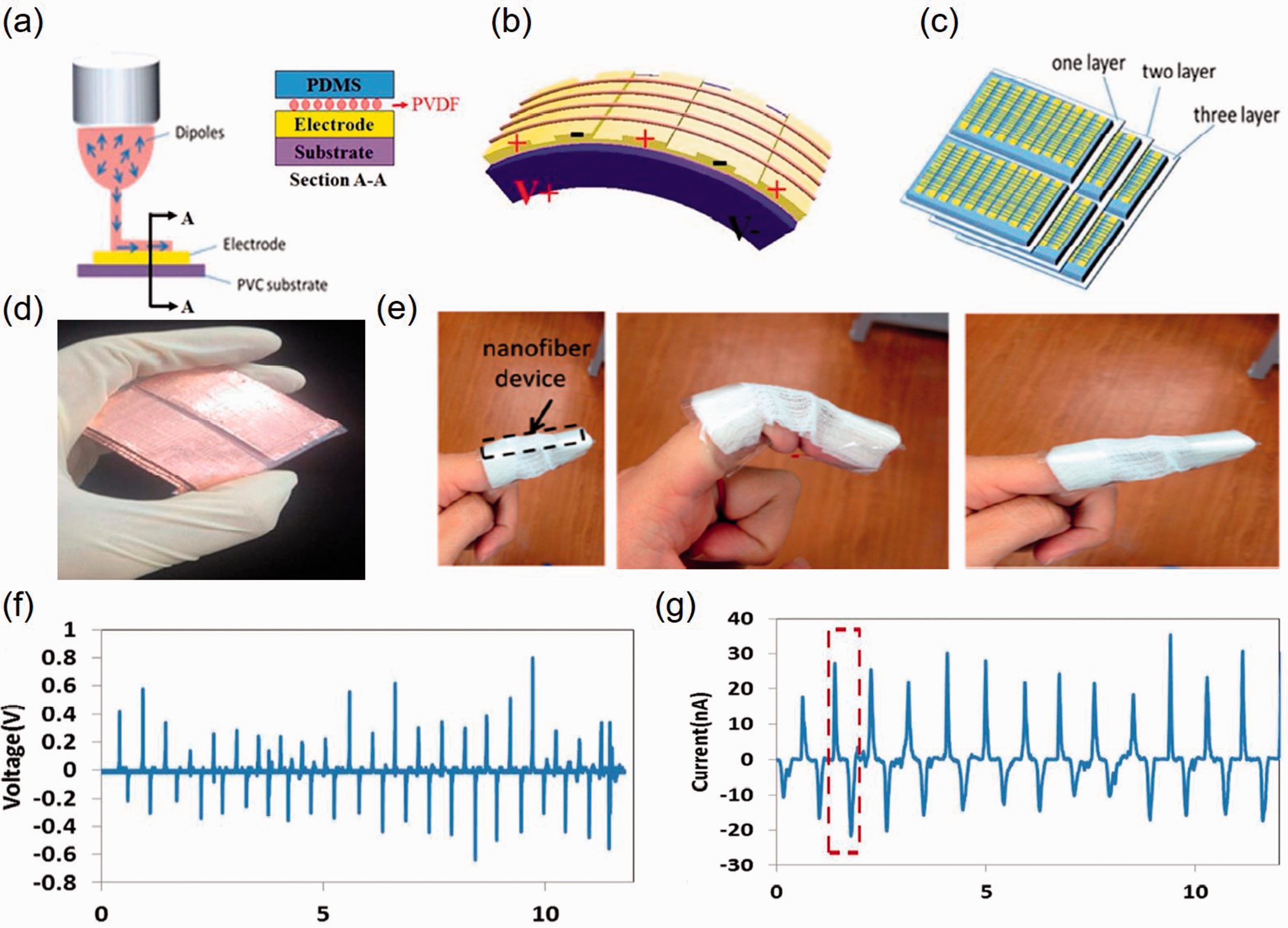
Liu and Wang [149] offered a novel contractile cardiomyocytes driven piezoelectric nanofiber biogenerator that was achieved by using a uniaxially aligned piezoelectric PVDF nanofiber mat (Figure 17(a) and (b)). The piezoelectric PVDF nanofibers can bend periodically, and produce an average voltage of 200 mV and current of 45 nA at the cell concentration of 1.0 million/mL, offering a biocompatible and scalable platform for biological energy conversion (Figure 17(c) and (d)).
(a) Schematic concept of cardiomyocytes driven piezoelectric nanofiber biogenerator; (b) fabrication process of the biogenerator device; (c) voltage; and (d) current outputs generated from the device under bending state and the release state [149].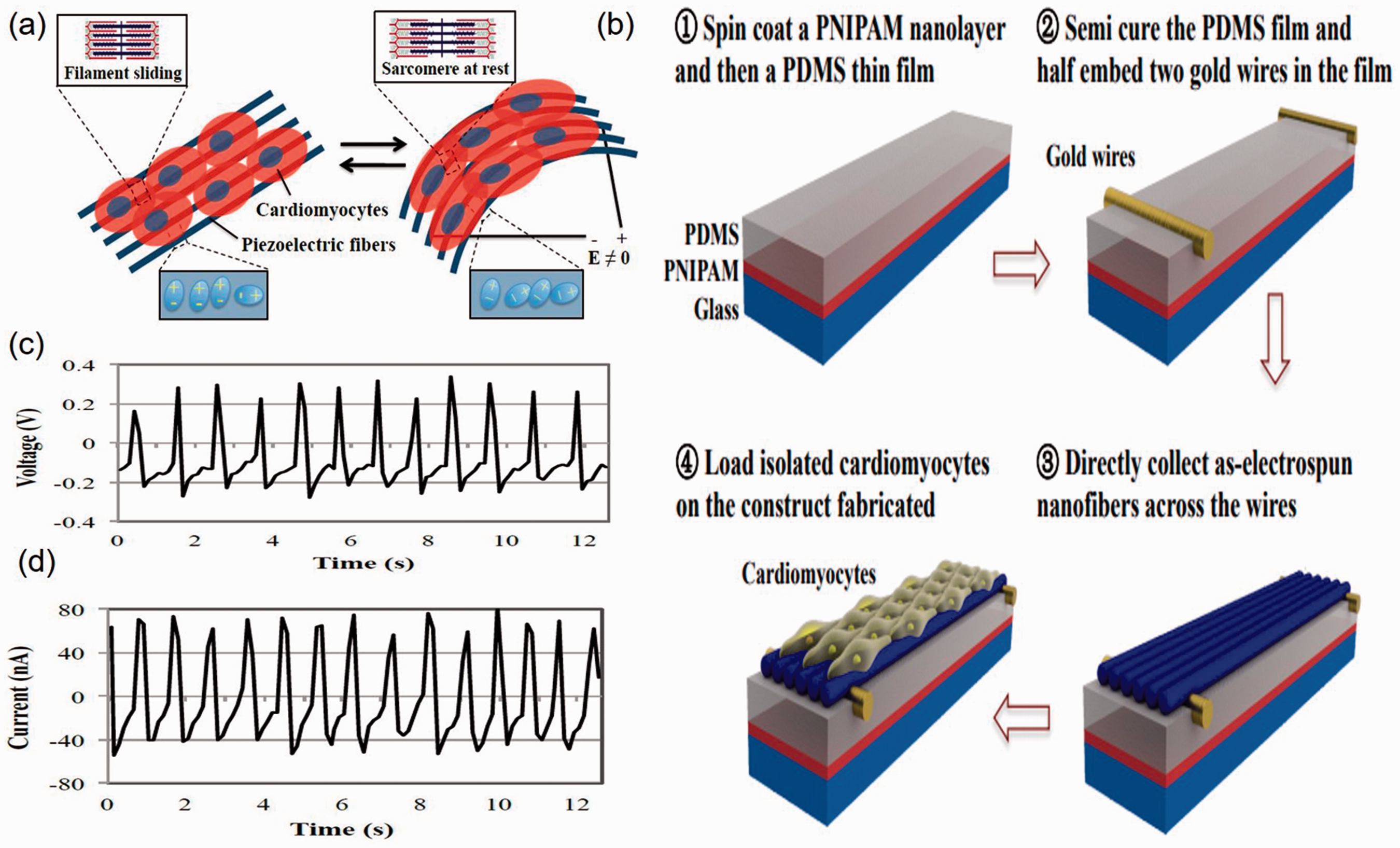
Kang et al. [150] demonstrated a uniaxial alignment procedure for fabricating PVDF nanofibers by introducing collectors with additional steps. The average output voltage and current of a PEH based on aligned oriented NFs with thickness of ∼60 µm under folding and releasing cycles were 1.1 V and 40 nA, exhibiting a twofold increase in the output voltage and a threefold increase in the output current as compared to the corresponding values obtained for the device manufactured from randomly oriented nanofibers.
Lang et al. [151] reported exceptionally high acoustoelectric conversion ability of randomly orientated electrospun P(VDF–TrFE) nanofiber nonwoven webs. The optimized device under sound was able to generate peak voltage and current of 14.5 V and 28.5 μA with a volume output power density of 306.5 μW/cm3 (5.9 mW/cm3 based on nanofiber web thickness), under a noise level of 115 dB. These values are all much higher than those of commercial piezoelectric P(VDF–TrFE) films (Figure 18). The electricity generated from this device can be used to directly drive microelectronic devices and conduct electrochemical reactions, without using any storage unit.
(a) Schematic illustration of an acoustic energy harvester device; (b) schematic illustration of the acoustoelectric conversion testing; (c) voltage and current outputs of the device under sound; (d) effect of sound wave frequency on the voltage output of the device; (e) peak voltage and current output changes with the external load resistance; and (f) peak power output change with the external load resistance [151].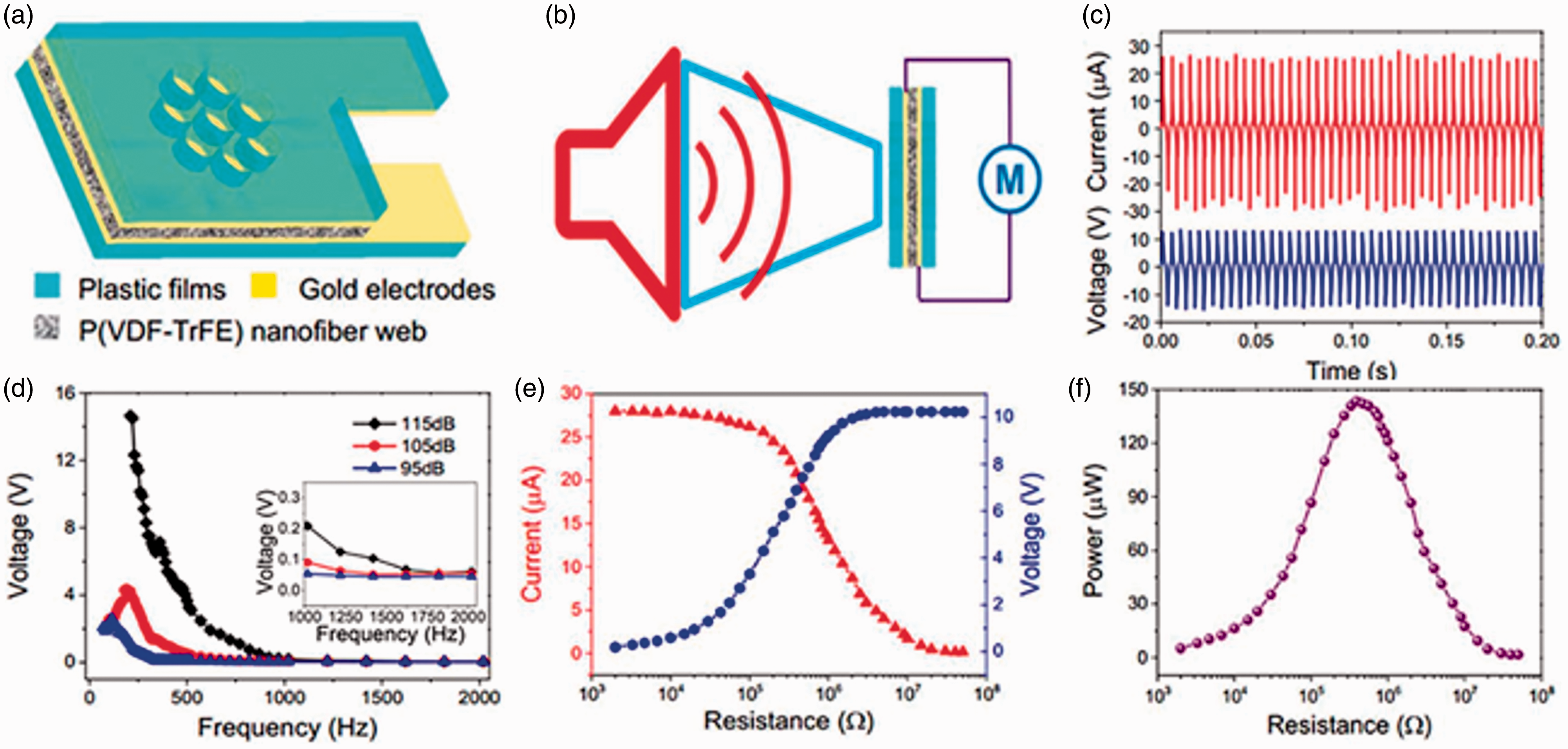
Zaarour et al. [152] fabricated PVDF nanofibers with comparable diameters and diversified surface morphologies (wrinkled, smooth, and porous) based on randomly oriented and aligned fiber webs. The piezoelectric NG based on aligned wrinkled fibers (working area of 15 cm2, impact frequency of 5 Hz) exhibited the highest electrical outputs (∼2.8 V and ∼3.9 μA), which had the ability to power a temperature and humidity sensor using an energy-harvesting circuit (Figure 19).
(a) SEM images of PVDF nanofibers with different morphologies smooth, porous, and wrinkled); (b) schematic structure of the PENG; (c) photo of the actual PENG; (d) voltage and (e) current outputs of the PENG obtained at different surface morphologies; (f) schematic diagram of the energy harvesting circuit; (g) digital photo of the powering a temperature and humidity sensor [152].
Zaarour et al. [153] fabricated a novel PVDF cactus-like nanofibers web via one-step electrospinning. This web was used as an active layer in the piezoelectric NG. The electrical outputs of this sensor (working area of 15 cm2, impact frequency of 5 Hz) reached up to 1.73 V and 2.79 μA.
Zaarour et al. [154] also investigated the effect of the molecular weight of electrospun PVDF fibers (180,000, 275,000, and 530,000) on their electrical outputs. The results proved that the electrical outputs of the piezoelectric NG (working area of 15 cm2, impact frequency of 5 Hz) increased from ∼1.97 V and ∼2.7 μA for the Mw of 180,000, to ∼2.55 V and ∼2.98 μA for the Mw of 275,000, to ∼2.92 V and ∼4.1 μA for the Mw of 530,000.
Furthering from using PVDF polymer as an active layer to directly make a piezoelectric generator, other polymers have shown great potential in the field of energy harvesting.
Lee et al. [155] combined ATR-IR and piezoelectric output signal data of constructively stacked poly(
Wang et al. [56] discovered that electrospun polyacrylonitrile nanofiber web exhibits unusually strong piezoelectricity. The piezoelectric NG (working area of 5 cm2; thickness 110 µm; impact frequency 2 Hz) can generate electrical outputs of 2 V and 1.1 μA, which can be used to power commercial electric units.
Polymeric/inorganic fibers and NWs composites
In order to combine the excellent piezoelectric properties of inorganic fibers and NWs with the flexibility of polymeric materials, their composites are the best choice. Therefore, the energy-harvesting abilities of polymeric/inorganic fibers composites have been studied comprehensively.
Energy harvesting from micro/macrofibers composites
Mohammadi et al. [156] investigated composites of several PZT fiber diameters (15, 45, 120, and 250 µm), with the fiber volume fraction fixed at ∼0.4 in the form of 1–3 composites under application of an external force was investigated. They concluded that the highest output voltage and power were obtained by decreased the diameter (15 µm) and increased the thickness of the transducer.
Churchill et al. [157] tested a composite consisting of unidirectional aligned PZT fibers of 250 µm diameter embedded in a resin matrix. The tested sample had the dimensions of 130 mm, 13 mm, and 0.38 mm in length, width, and thickness, respectively. They concluded that the composite structure could harvest about 7.5 mW of power when it was subjected to a 180 Hz vibration which caused a strain of 300 μɛ in the sample and the power harvested from piezoelectric fibers was enough for powering an embedded wireless sensors network.
Sodano et al. [158,159] used a commercial composite transducer called “Micro Fiber Composite” (MFC) for comparing the energy-harvesting performance with two other monolithic PZT transducers, an unpackaged PZT-5H sheet and a packaged PZT sheet called “QuickPack” (QP). The MFC was a composite consisting of PZT fibers embedded in a polymer matrix with interdigitated electrodes for 33-mode operation. The results showed that the MFC film had the lowest efficient among three and unable to charge a 40 mAh nickel–metal hybrid battery unless the driving vibration had very large amplitude, while the other two transducers were able to charge the battery within a few hours at a driving frequency of 50 Hz, or a random frequency ranging from 0 to 500 Hz.
Swallow et al. [139] invented a micropower generator using microcomposite-based piezoelectric materials for energy reclamation in glove structures. The device consisted of PVDF fibers with 90–250 µm in diameter, aligned in a unidirectional manner and incorporated into a composite structure and laid within a single laminate structure with copper interdigitated electrodes assembled on both sides, forming a thin film device. They concluded that the output voltage of this device reached up to 6 V which was enough for potential applications in powering wearable microsystems.
Usher et al. [160] presented two approaches for realizing control surfaces that incorporate piezoelectric microfiber composite actuators (MFCs). In the first approach, flap-like structures were formed by bonding MFCs to each side of a metal substrate. In the second one, MFCs were bonded directly to the wing. The flap approach showed large displacements that means when the mass load increases, the voltage actuation curvatures will increase, and showed that the DC displacements in the direct bonding are tension load limited, resulting in small displacements at higher wing pressures.
Shan et al. [161] presented a macrofiber composite PEH which was immersed into the water vortex field shedding from an upstream cylinder. It has been found that the water velocity plays a stronger role on the output power than the cylinder diameter does as well as the output power of the PEH rises with the increase of the water velocity and achieved a maximum output power of 1.32 μW with a power density 1.1 mW/m2 at the water velocity of 0.5 m/s and the cylinder diameter of 30 mm.
Lu et al. [162] demonstrated planar laminated piezoelectric generators and piezoelectric microstructured fibers based on BaTiO3–polyvinylidene and carbon-loaded polyethylene materials. The laminated piezoelectric generators were assembled by sandwiching the electrospun BaTiO3–polyvinylidene mat between two carbon-loaded polyethylene films and their electrical outputs reached up to 8 V and 40 nA. The microstructure piezoelectric fiber was fabricated via the drawing of the multilayer fiber preform and features a swiss roll geometry that has ∼10 alternating piezoelectric and conductive layers and its output voltage reached up to 6 V and output current reached up to 4 nA, with only several square centimeters of the active area. Both piezoelectric generators had excellent mechanical durability and could retain their piezoelectric performance after three day’s cyclic bend-release tests. They concluded that the piezoelectric fibers are advantageous as they can be directly woven into large-area commercial fabrics compared to the laminated generators. Potential applications of the proposed piezoelectric fibers include micro-power generation and remote sensing in wearable, automotive, and aerospace industries.
Energy harvesting from nanofibers and NWs composites
Lee et al. [163] established hybrid–fiber generators that showed high performance and feasibility as the power source for wearable electronics which converted low-frequency mechanical movements of human/animal activity into electricity. The hybrid–fiber NGs employed a unique piezoelectric layer, which comprised ZnO NWs and a PVDF-infiltrating polymer. The NW array served as the piezoelectric material and assisted the formation of PVDF on the outermost surface of the device. By attaching the hybrid–fiber device, with a length of ∼2 cm, on a human elbow, the output voltage, current density, and power density reached 0.1 V, 10 nA/cm2, and 16 μW/cm3, respectively, under folding–releasing of an elbow for ∼90° (Figure 20).
(a) and (b) Schematic 3D diagram depicting the structure of the hybrid device in cylindrical and plane shape, respectively; (c) SEM image of the NG; (d) structure of a hybrid fiber NG; (e) electrical measurements of a device attached on a human elbow [163].
Nour et al. [164] demonstrated handwriting driven piezoelectric composite NG based on ZnO NWs/PVDF polymer grown on the paper substrate. They showed that the highest electrical power output was achieved when the ZnO NWs/PVDF polymer ink was pasted and sandwiched between two pieces of paper with ZnO NWs grown chemically on the side of each piece of paper. The maximum voltage and current outputs reached up to 4.8 V and 14.4 mA, respectively. A maximum spatial output power density of 1.3 mW/mm2 was achieved for fast handwriting mode (200–240 letters/min). This NG exhibited good mechanical durability, high sensitivity, and provided scalable simple low-cost approach.
Chen et al. [104] designed a flexible acoustic emission sensor (AE) based on PZT nanofibers composite membrane (Figure 21). The electromechanical coupling effect was increased up to 370% after 90 min of polarization under an external electric field of ∼3 V/µm. The advantages of this AE sensor such as small size, flexible, and highly sensitive opened up new applications for monitoring small-scale structures, curved surfaces, and even living cells.
(a) Schematic view and (b) a real image of the flexible PZT nanofiber AE sensor on a curved surface [104].
Zeng et al. [165] proposed a novel all-fiber wearable electric power NG that could retain its performance after 106 compression cycles, demonstrating great promise as a wearable energy harvester that converts the mechanical energy of human movement into electricity. This NG consisted of a PVDF–NaNbO3 nanofiber nonwoven fabric as an active piezoelectric component, and an elastic-conducting knitted fabric, made from segmented polyurethane and silver-coated polyamide multifilament yarns, as the top and bottom electrodes (Figure 22(a) and (b)). The electrical outputs of the NG were 3.4 V and 4.4 μA in cyclic compression tests at 1 Hz and a maximum pressure of 0.2 MPa, which were comparable to the normal human walking motion (Figure 22(c) and (d)).
(a) Schematic structure of the all-fiber electric power nanogenerator; (b) digital photo of a fully packaged generator device; (c) voltage; and (d) current outputs generated from the device [165].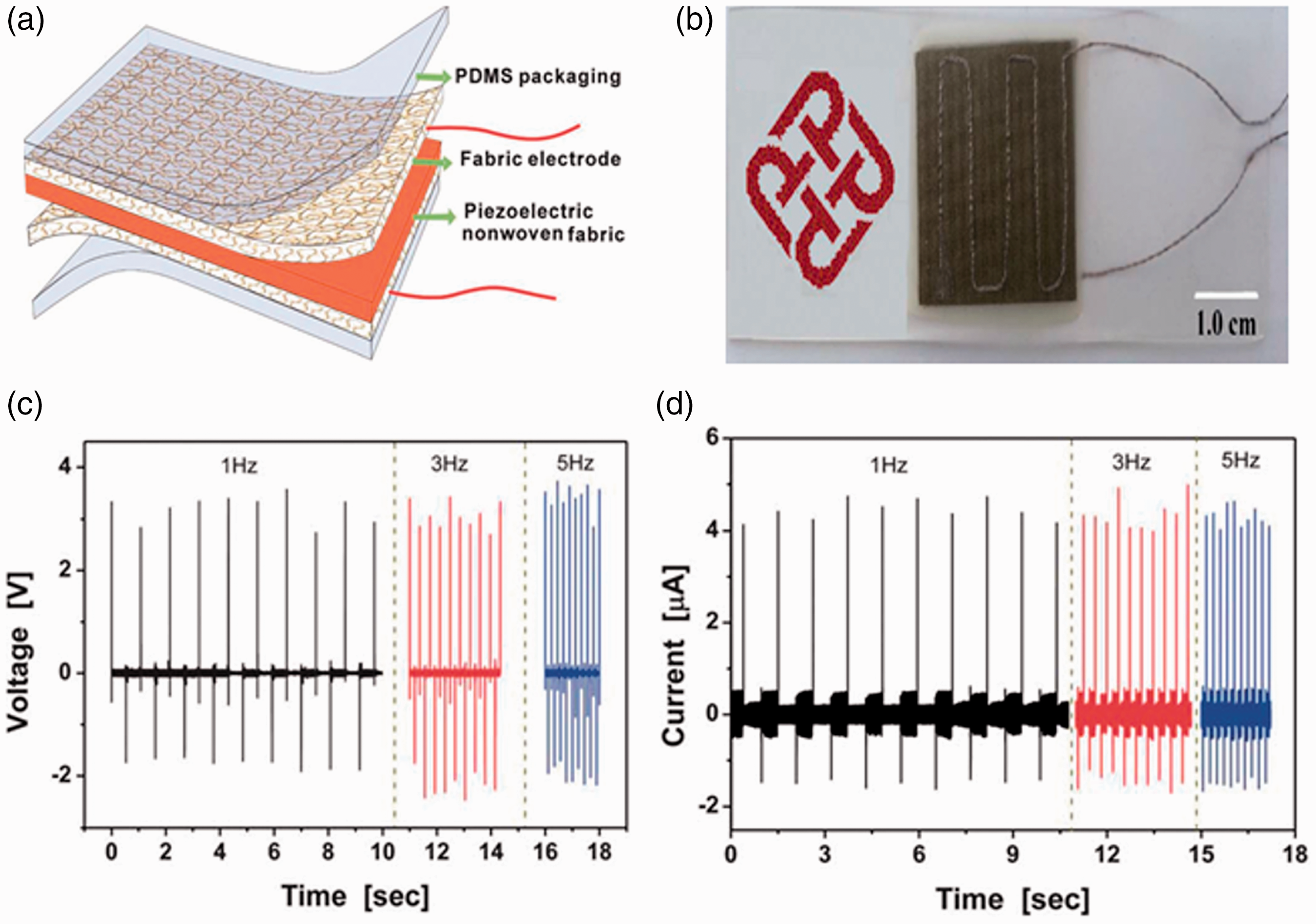
Lee et al. [166] developed highly aligned BaTiO3–PVDF composite nanofibers and demonstrated their potential utility as piezoelectric materials. They concluded that the output voltage of PVDF nanofibers with 16 wt% BaTiO3 NPs was 1.7 times greater than the output voltage of PVDF nanofibers without BaTiO3 NPs when subjected to the same degree of deformation, and uniaxially aligned BaTiO3–PVDF nanofibers had even higher piezoelectric response than randomly oriented PVDF fibers and thin films.
Bafqi et al. [167] improved the output efficiency of a flexible NG through a combination of a PVDF and NP ZnO, using the electrospinning process. The electrical output of composite samples was improved as high as 1.1 V compared with 0.351 V for the pure PVDF samples.
Kang et al. [168] studied the energy-harvesting characteristics of flexible NGs based on a (Na0.5K0.5) NbO3 NPs/P(VDF–TrFE) composite nanofibers. The output voltage and current of the flexible composite NG were ∼0.98 V and ∼78 nA, respectively, which were enhanced depending on the volume fraction of the NKN NPs dispersed in the polymer.
Siddiqui et al. [169] demonstrated the fabrication of a highly durable, stable, and high-performance lead-free nanofiber piezoelectric NG (nf-PENG) based on a nanocomposite of P(VDF–TrFE) nanofibers and barium titanate (BT) NPs. They discovered that when an nf-PENG was placed inside of a shoe and loaded with 15 wt% BT NPs, it could generate an output of 25 V at a walking frequency of 0.6 Hz with high mechanical durability under very high loads (600 N). They concluded that the output voltage and current of the nf-PENG were up to 200% in nanocomposite nanofibers (as compared to those of pristine P(VDF–TrFE) nanofibers).
Yun et al. [170] fabricated piezoelectric nanofiber composites of PVDF and PZT by electrospinning. They investigated the tensile properties (stress–strain curves) and electrical properties (P–E hysteresis loops) of the composite PZT/PVDF nanofiber as a function of PZT content from 0 wt% to 30 wt% and concluded that a PZT content of 20 wt% had enhanced tensile and piezoelectric characteristics.
Sun et al. [171] fabricated a piezoelectric acoustoelectric NG using PVDF–ZnO composite nanofiber membrane with hierarchical microstructure by electrospinning and hydrothermal methods. The prepared PVDF–ZnO acoustoelectric NG (working area of 3 cm × 3 cm × 40 µm) was able to generate voltage and current outputs of 1.12 V and 1.6 μA with a power density output of 50 μW/cm3 in optimized sound condition (140 Hz, 116 dB).
Deng et al. [172] fabricated the electrospun cowpea-structured PVDF/ZnO nanofiber webs as an active layer in the piezoelectric sensor for pressure sensing and bending motion monitoring. This sensor exhibited good flexibility and high sensitivity. The best pressing and bending sensitivity of the sensor reached up to 0.33 V/kPa with a response time of 16 ms, and 4.4 mV/deg with a response time of 76 ms, respectively. Furthermore, they implemented successfully a self-powered real-time gesture remote control system by wirelessly transmitting the pulse signal from human fingers to robotic palm on the sensor.
Summary of the previously reported piezoelectric fibers and nanowires.

PVDF: polyvinylidene fluoride; NG: nanogenerator; NFES: near-field electrospinning; PZT: lead zirconate titanate; NW: nanowire; PMN: Pb(Mg,Nb)O3; PT: PbTiO3; BaTiO3: Barium titanate; BT-P(VDFTrFE): Barium titanate- poly(vinylidene fluoride-trifluoroethylene).
Conclusions and outlook
This paper provides a comprehensive review of PEHs based on fibers and NWs. The basic theory of piezoelectric energy harvesting, different types of piezoelectric materials, piezoelectric harvesting devices based on piezoelectric polymeric/inorganic macro, micro, nanofibers, and inorganic NWs is discussed. According to our presentation, it can be concluded that:
Nanofibers have a higher specific surface area, more flexibility, and superior directional strength than micro/macrofibers, so they are a preferred choice for energy harvesting applications. Piezoelectric ceramic fibers have higher electrical outputs than polymeric fibers in spite of their disadvantages such as brittle nature, low strain, and toxicity of lead-based materials such as PZT. Piezoelectric polymeric fibers have some obvious advantages comparing with piezoelectric ceramics fibers including lower cost, higher flexibility, and lower density. NWs have been used widely in nano/microgenerator due to their great advantages such as high surface area, robust mechanical properties, standing large elastic deformation without plastic deformation or fracture, almost free of dislocations, bending under a tiny applied force, and excellent sensitivity to characteristically small ambient vibrations. NWs with wurtzite structure (especially ZnO) were widely studied due to their good advantages like the facile and cost-effective fabrication methods, whereas NWs with perovskite structure have more effective piezoelectric characteristic compared to the previous one. To overcome the disadvantages of piezoelectric ceramic and polymer fibers, piezoelectric ceramic–polymer composites are the best choice to form piezoelectric devices with high flexibility and outstanding piezoelectric properties.
In recent years, PENGs have shown marvelous attainments in the fundamental understanding and technological enhancements. As toward the future applications of PENGs, certain vital issues and problems need to be addressed:
Establishing a standard to standardize the performance of PENGs which will be the best choice for evaluating their performance. Developing effective packaging technology for PENGs.
The packaging of PENGs will be absolutely important to make them commercialized products especially for a variety of harsh environment applications because moisture or any surface pollutants can mainly affect the performance of PENGs. Furthermore, it can protect the human body from undesired electrical noises.
3. Finding a suitable approach for enhancing the electrical outputs of PENGs.
The electrical outputs of the PENGs are still too low comparing with the triboelectric NGs [173].
4. Enhancing the durability and output stability of PENGs.
This is always a main issue for the PENGs especially in comparison to the traditional generator based on electromagnetic induction. Herein, innovative piezoelectric materials and coupled modes of operations would be good choices.
In summary, starting from fundamental materials and physics effects, tiny mechanical energy can be efficiently converted into electricity using PENGs, which can be an essential approach for intelligent earth with applications in mobile/wearable electronics, internet of things, fabric electronics, health care, environmental protection, national security, and infrastructure monitoring. The PENG has the chance to be a new approach for harvesting energy from ocean wave, even though this is a long-term aim. It could be an innovative technology in comparison to the typical electromechanical generator with complementary areas of applications. We hope that our dream about harvesting energy from the surrounding environmental such as water bodies could be realized in the near future, so humans will have never-ending power supplied by nature.
Footnotes
Authors' note
All the correspondence can be made to the individual authors Bilal Zaarour at Bilalzaarour121@hotmail.com; Xiangyu Jin at Jinxy@dhu.edu.cn; and Lin Tong at Tong.lin@deakin.edu.au.
Declaration of conflicting interests
The author(s) declared no potential conflicts of interest with respect to the research, authorship, and/or publication of this article.
Funding
The author(s) disclosed receipt of the following financial support for the research, authorship, and/or publication of this article: The work is supported by the National Natural Science Foundation of China (51403033), “Chen Guang” Project sponsored by Shanghai Municipal Education Commission and Shanghai Education Development Foundation (14CG34) and the Fundamental Research Funds for the Central Universities.