




Abstract
Cellular composite, with an array of regular hexagonal cells in the cross section, is a type of textile composites having the advantage of being light weight and energy absorbent over the solid composite materials. However, when it is under the same energy level of low velocity impact with different tup mass and velocity, its behavior is yet unknown. In the experiment, four groups of samples, with twelve geometrical variants have been systematically created for the impact testing. The impact test is running in two categories with one type of low velocity impact with initial velocity of 5.5 m/s by the tup mass of 0.55 kg, and another testing under the similar impact energy but with a lower initial velocity around 2.0 m/s with heavier tup mass of 4.52 kg. The impact energies in the above cases are very similar about 8.5 J, which indicates that the impact energy is the same while the energy construction is different. After the test, it is found that composite with medium cell size has more stable mechanical performances under various exposed impact conditions. It is also concluded that composites with big cell size are much easier to be destroyed under heavier impact tup, therefore, under condition of more critical loading force, it is necessary to find a way to enhance the big cell sized composites’ wall material in order to strengthen their structure performances. The results of this work provide a reference for the researchers who are kneeing to investigate the impact mechanism of textile cellular composites.
Introduction
Cellular structures, which can be found in nature ranging from the spines of a porcupine to the stem of a plant of reed, have many features that are important for many of the composite applications as have been described by Gibson and Ashby [1]. Composites simulated by the nature cellular can be super light, energy absorbent, voluminous and strong [2,3]. For example, paper cellular structure has been studied by dynamic and static compression tests and the results showed that increasing the loading speed and number of the structural layers could increase the energy absorption accordingly [4]. It is also found that cellular structure is significantly more structurally efficient than their equivalent relative density metal foams [5–8].
Many researches focus on cellular sandwich panel for their energy absorption and protection against trauma impact and this could be applied to several impact scenarios ranging from low velocity impact (e.g. tool drop during construction work) to high velocity impact (e.g. runway debris) [9]. It is found that low velocity impact on sandwich structure will cause failure at the sandwich skin, core material and the interface between the core-skin and the damage results in a significant decrease in the structure load bearing performance [10–12]. Also, a number of investigations into cellular structures have been carried out using aluminum alloy materials and it is found that the compress strength and energy dissipating properties of cellular structures depend upon the topology and relative density which control the mode of failure during loading, and the strength of the material used to fabricate the structure [13].
Composite materials reinforced by fabric/resin have many desirable properties over the conventional metals and the most notable performances are their excellent stiffness and strength combined with low mass. It is reported that cellular cores are produced either by expanding the pre-impregnated sheets or by applying a corrosive resistant coating to the foil sheets firstly, then printing the adhesive lines with curing process, followed by yielding the corrugated sheets plastically at the node-free wall joints to retain their expanded geometric shape [14,15]. Cellular core made by the above two methods requires expensive, labor intensive manufacturing and is prone to delaminate due to the lack of through thickness reinforcement [16]. However, textile cellular composite can address the issue due to the binder yarns, which stitch the adjacent layers together to ensure the integration of the cellular structure [17] and the interlaminar properties of the cellular are improved greatly. Chen et al. have conducted a systematic study to engineer textile cellular composite from their weave design, weaving technology to characterize the composite mechanical performances [17–19]. Chen et al. worked on the mathematical modeling of the woven cellular preforms and developed a CAD tool to design the fabrics with various structural parameters [19]. Chen et al. also carried out quasi-static and dynamic finite element (FE) analysis and reported on the influence of the structural parameters on the mechanical behavior of the cellular composites [20,21].
The literature regarding the impact mechanism shows that a heavier impactor will cause an overall 30–50% more damages to the item compared to the light weight impact with same impact energy [22]. And both Delfosse et al. [23] and Ujihashi [24] explained this phenomenon by the fact that for heavier mass low velocity impact, there are many small superimposed oscillations due to the plate vibrating against the impactor during contact, therefore more damages occurred. Therefore, in this work, the author will conduct two low velocity impact tests with the initial impact energy of 8.5 J with various tups mass and impact velocities. And the results will be compared to seek out its mechanical performance variants. The aim of this research is to investigate how geometric and structural parameters of honeycomb composites would affect mechanical performances under low velocity impact. The outcome of the investigation could be useful to help design protection products against trauma impact, such as shields for improved protection.
Materials and testing
Textile cellular composites
In this research, textile cellular fabrics are produced by means of conventional loom and their cross-sectional view along warp direction is shown in Figure 1(a) with its finally manufactured fabric illustrated in Figure 1(b). The fabrics are constructed by cotton yarn with plain weave design and there are eight layers through the thickness direction. The warp and weft density of the fabric is 20 picks/inch (7.87 picks/cm).
Cellular fabric: (a) cross-sectional view of the cellular fabric and (b) photograph of the cellular fabric.
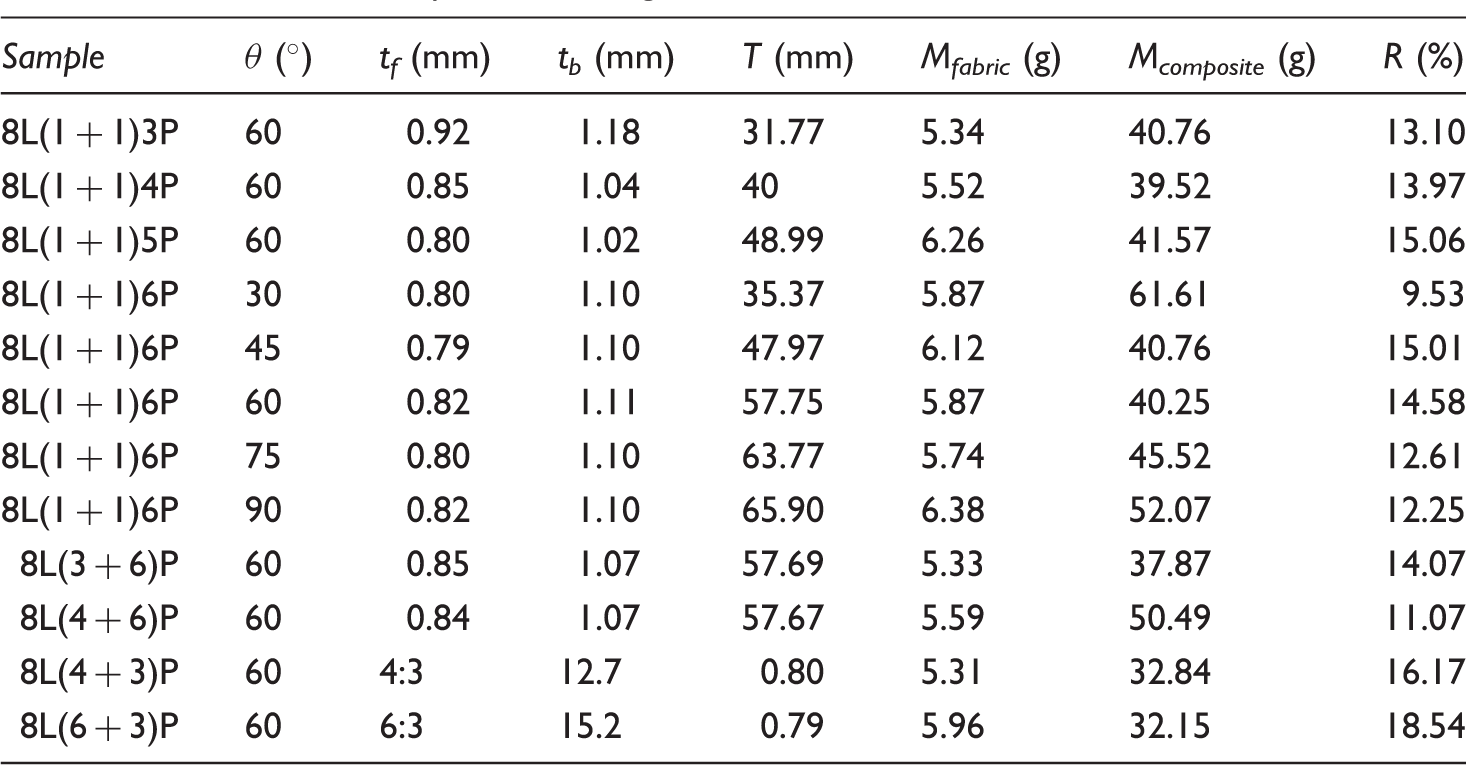
Cellular fabrics with different design parameters.

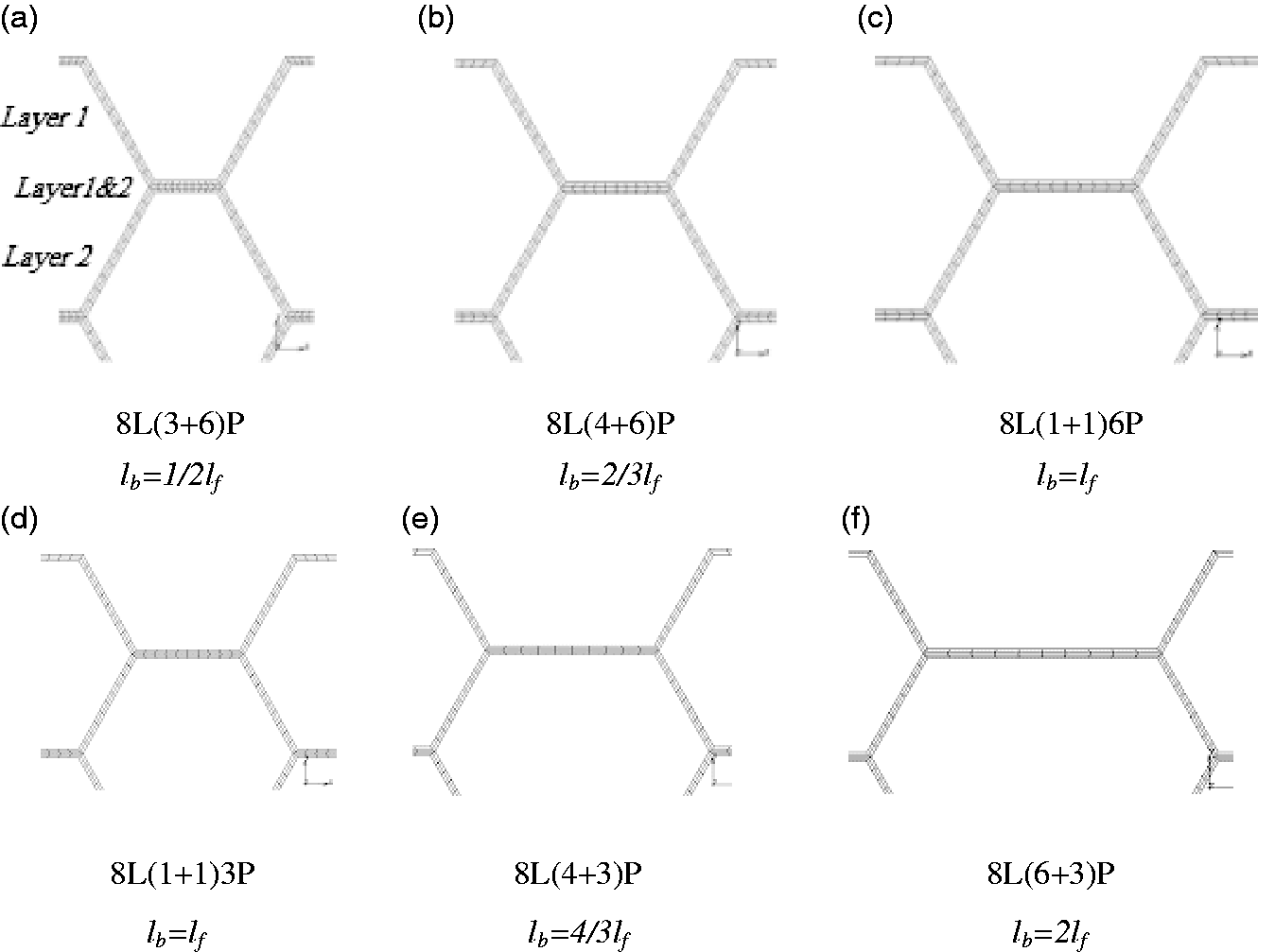
Cellular structure with different cell wall length.
After the cellular fabric is produced, it is in the form of flat shape and needs to be opened before impregnation. A self-designed simple metal frame was used to open the fabric and the solution maturing of resin (LY5152) and hardener (HY5052), with mixture ratio = 100:38 was impregnated into the dry fabric to consolidate the cellular composite, following the comparison of three major resin systems by Wu [25].
Outline of the experiment design.
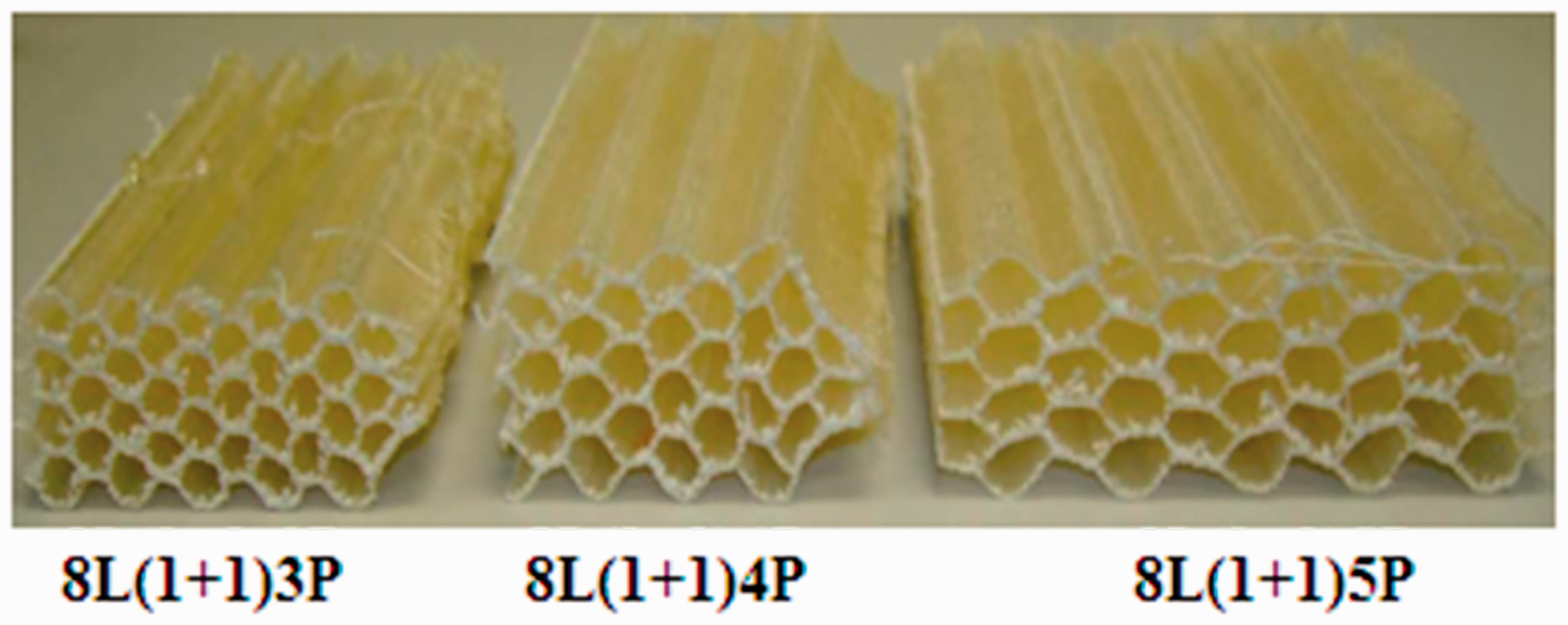
Photos of consolidated cellular composites.
Low velocity impact
Two low velocity impact tests with different impact tups are performed on a drop tower machine leading to the impact velocity of 2.0 m/s and 5.5 m/s. These are the measured velocities which are slightly lower than the theoretically predicted values due to friction losses at the carriage cylinders of the drop tower. The total mass of the impactor is 4.52 kg and 0.55 kg, leading to the impact energies of approximately 8.5 J. The impact energy in these cases is quite similar which indicates that the impact energy is similar while the energy construction is different. The impact test is conducted according to the test standard GB/T14153 and the assembled instrument is shown in Figure 4.
Drop tower impact testing machine.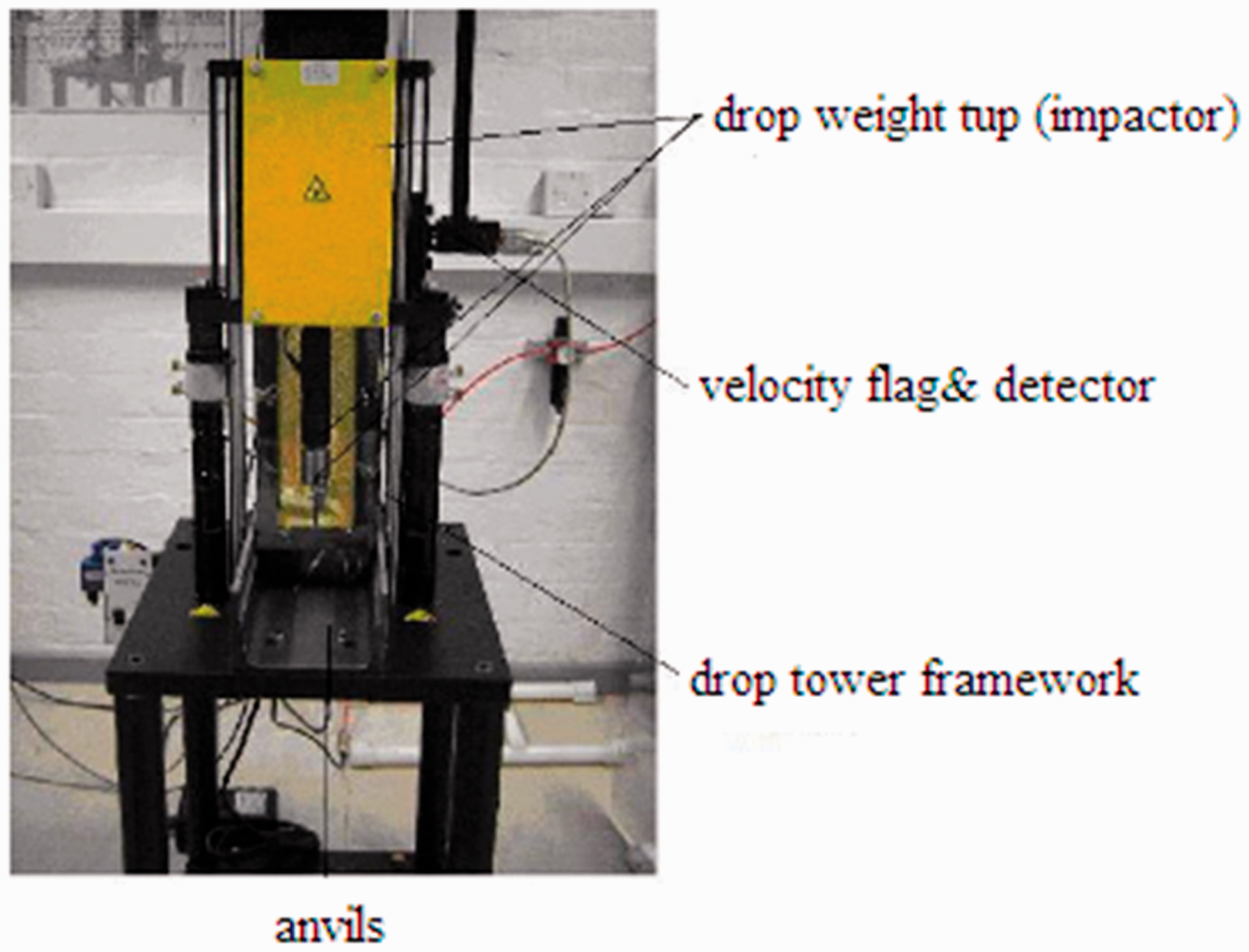
All the specimens were trimmed into approximate size of 60 mm × 120 mm. Then, the specimen is positioned on the specimen support fixture to prepare for the test. The instrument firstly needs to be set up to conduct a pre-test in order to match the initial kinetic energy of up to 8.5 J. Each test has been done three times and new samples were replaced each time. The drop weight impact testing machine is the hardware to conduct the testing and to amplify and capture the dynamic transducer output from a high speed impact event. All the raw data have been interpreted through the associated software. After the test has been done, the data need to be analyzed and the relationship among different textile cellular composites and their mechanical performances was found out.
Results and discussion
Twelve samples from Table 2 are divided into four groups according to their different geometric characteristics such as cell size, opening angle and ratio of bonded and free wall length. The samples are impacted under two kinds of impact tup with similar kinetic energy of 8.5 J. The contact force and energy absorption from each impact test are put together for comparison as follows.
Samples with different cell size (8L(1 + 1)3P60, 8L(1 + 1)5P60, 8L(1 + 1)6P60)
Samples with different cell sizes from small to big have been impacted under two loading conditions, and their contact forces were compared in individual cases (Figure 5(a) to (c)). For the sample 8L(1 + 1)3P60 (see Figure 5(a)), it seems there is a significant curve returning towards the end of the impact when the composites are under the heavier impact (M = 4.52 kg) with lower initial velocity, and this means, the impactor is bouncing back when the impact is towards the end. However, the red curve, which represents the contact responses under another loading condition does not show up this bounce process when the impact finishes.
Contact force of cellular composites with different cell size (a) 8L(1 + 1)3P60, (b) 8L(1 + 1)5P60 and (c) 8L(1 + 1)6P60.
Figure 5(b) shows the contact force responses of composites with medium cell size (8L(1 + 1)5P60) and it seems the composites under both loading conditions are capable of resisting the incoming forces. The depth of deformations for the samples under current impacts is deeper than those under light weight impacts and this can be explained by that the heavier impactor will strike deeper into the composites than the light weight impactor. From Figure 5(b), it can also be seen that the trend of both contact force curves is similar under two different loading conditions, this means, sample 8L(1 + 1)5P60 performances are stable under both impacts. And this phenomenon is ideal for the application in protective equipment as reliable mechanical properties for the cellular composites are requested in practice.
When samples with bigger cell size (8L(1 + 1)6P60) are impacted, under two loading conditions, their mechanical response is totally different. Samples under lighter impact (red curve in Figure 5(c)) show a ductile performance compared to the other sample. And it seems under heavier impact (blue curve in Figure 5(c)); there is a sharp peak forces accumulated when the sample is breaking. Therefore, it indicates that samples with big cell size are more sensitive to the loading conditions and tend to be easily damaged if the tup mass is increasing.
Regarding the energy absorption performances of the composites, the kinetic energy should be absorbed as much as possible to prevent damage underneath. Generally, the more impact energy is absorbed by the composite the lower the acceleration and damage of the protected item are. Figure 6 illustrates the influences of the composite cell sizes on their energy absorption performances under two different impacts. Assuming the composites are strong enough to resist the impacts, 8L(1 + 1)3P60 and 8L(1 + 1)5P60 both absorb more kinetic energy under heavier weight impacts.
Energy absorption under different impact situation (samples with different cell size).
Combined with composites’ contact force and energy absorption performances under both loading conditions, it is obvious samples with small and big cell sizes (8L(1 + 1)3P60 and 8L(1 + 1)6P60) show different contact force performances. This means, the discrimination of performances under different impact situations for the composites with small and big cell sizes is very significant and this is bad in their application. When the designer choose materials for protection purposes, it is vital the materials should have stable mechanical performances under all kinds of exposed impact situations.
Samples with different opening angle (8L(1 + 1)6P30, 8L(1 + 1)6P45, 8L(1 + 1)6P60, 8L(1 + 1)6P75)
Figure 7(a) to (d) shows the contact force under two different loading conditions individually and it seems that the contact forces from these two experiments are very much different. In the experiment, the author noticed that samples constructed by small to medium opening angle at 30°, 45° and 60° have encountered structure failure during the heavier weight impact while for the lighter weight impact, the same samples have experienced a ductile deformation and have generated a lower contact force for all the composites. Although composites at 75° opening angle (see Figure 7(d)) seem to have a closer peak contact forces under both loading conditions and they are sufficient to resist the incoming forces, the large opening angle significantly increases the thickness of the composites which makes them very bulky in practice.
Contact force for composites with different opening angles (a) 8L(1 + 1)6P30, (b) 8L(1 + 1)6P45, (c) 8L(1 + 1)6P60 and (d) 8L(1 + 1)6P75.
It seems, whatever the opening angles of the composites are, if the impact weight increases dramatically, and here from 0.55 kg to 4.52 kg, the cellular structure will lose their efficiency to resist the incoming forces. In other words, by only adjusting the opening angle of the cells to strengthen the honeycomb composite materials against the impact loading is not sufficient enough to resist the incoming forces, other methods should be found out to enhance the composite structure performances against impacts too.
Generally speaking, with a larger opening angle, the cell wall’s bending moment is less leading the structure of the cellular more difficult to deform and this results in less energy absorption correspondingly. From Figure 8, it can be seen that the energy absorption for the samples under lighter impact (M = 0.55 kg) is more than those under heavier impact (M = 4.52 kg). Especially, for the sample with 75° opening angle (8L(1 + 1)6P75), the difference of the energy absorption is much more obvious (55% different).
Energy absorption under different loading conditions (samples with different opening angle).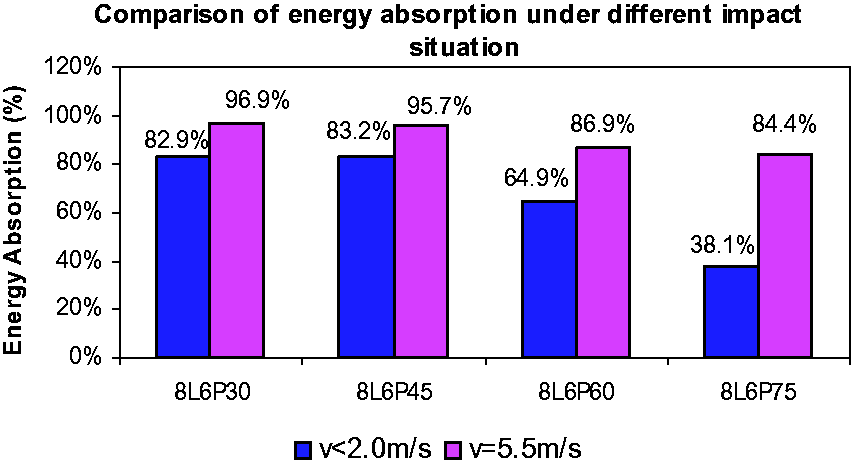
Samples with different length ratio of free and bonded wall (
: 8L(3 + 6)P60, 8L(4 + 6)P60, 8L(1 + 1)6P60)
Figure 9(a) to (c) illustrates the contact force for the samples with length ratio of free and bonded wall less than one ( Contact force and energy absorption diagram for the sample with different length ratio of bonded and free wall (
Samples with different length ratio of free and bonded wall (
: 8L(1 + 1)3P60, 8L(4 + 3)P60, 8L(6 + 3)P60)
Figure 10(a) and (c) lists the contact force for the samples with Contact force and energy absorption diagram for the sample with different length ratio of bonded and free wall (
However, from the shape of contact force in Figure 10(a) and (c), it seems that the structure of 8L(1 + 1)3P60 and 8L(4 + 3)P60 is capable enough to bounce back the impactor when it is under heavier impact (navy cure in the diagram) and therefore, the curves are returning backwards at the end of the impact. And generally, from Figure 10(d), it is seen that the energy absorption for the composites in the subgroup of
Conclusion
The present work has investigated the composites with different geometric parameters under two different loading conditions. Test results including contact force and energy absorption are compared and generally speaking, most of the cellular composites are impactor weight sensitive regarding their mechanical performances. Under heavier weight loading situation, only those composites with small to medium cell sizes or with larger opening angles are providing sufficient resists to the incoming impact forces.
From the experiment, it seems composites with medium cell sizes (8L(1 + 1)5P60) have more stable mechanical performances under various exposed impact conditions. Although samples with smaller cell size are capable of resisting the impact, it has encountered a higher loading force under heavy weight impacts and this will accelerate the composites and cause more damages to the item underneath. And from the test results, it seems that if the bonded wall length (lb) slightly increases, provided that the composites are strong enough to resist incoming forces, it can bring more stable performances to the composites when they are under various loading conditions.
And the test results also indicated that there are a few composites with free wall length of 6 picks such as sample 8L(1 + 1)6P60, 8L(1 + 1)6P30, 8L(1 + 1)6P45 and 8L(4 + 6)P60 which are all destroyed during heavier weight impact, this means, big cell sized composites are very easy to be destroyed under heavy weight impact. Therefore, if it is under more critical loading conditions, it is necessary to find a way to enhance the big cell sized composites’ wall material or its structures in order to strengthen their structure performances correspondingly.
The above studies achieved good experiences in practice regarding textile cellular composites under low velocity impact and it will be very helpful to carry out further investigations in the future to design protection products by using this kind of fabric.
Footnotes
Declaration of conflicting interests
The author(s) declared no potential conflicts of interest with respect to the research, authorship, and/or publication of this article.
Funding
The author(s) disclosed receipt of the following financial support for the research, authorship, and/or publication of this article: This paper is acknowledged by National Natural Science Foundation of China with Contract No. 51502209 and Natural Science Foundation of Hubei Province with Contract No. 2015CFB553.