




Abstract
Laser treatment is a high-efficiency coating process with many advantages of stable performance, convenient operation and environmental friendly. In this study, an efficient method for the pretreatment of polyester fabric, based on exposure to the output from a CO2 laser, is investigated. Polyester fabrics were treated by laser and then copper films were coated on the surface of treated polyester fabrics by magnetron sputtering method. Copper-coated polyester fabrics were characterized by XRD and SEM. Contact angle, heat generation and electrical conductivity of copper coated polyester fabric were tested. The electrical conductivity, UPF value and contact angle of copper-coated polyester fabric with pretreatment of 6.5 W lasers are 0.239 Ω/sq, 147.4, and 128.5°, respectively. The temperature of copper-coated fabric can be kept at 25.8℃ using only 5 V. The results suggest that the copper-coated polyester fabric with pretreatment of laser has excellent electrical conductive property, hydrophobicity, UV blocking, and heat generation properties. The adhesion strength between copper coating and fibers is improved after laser treatment. Laser can be potentially used in pretreatment of fabrics before coating in the future.
Introduction
Copper has been used as an electrically conductive material heat transfer systems, electromagnetic shielding products, wires, and electron devices [1–3]. Recently, much interest has arisen in depositing copper nanoparticles on fabrics to obtain multifunctional textiles [4,5]. The copper-coated textiles can be used in electromagnetic shielding, electrical conductivity, antistatic, UV blocking, and antibacterial textiles [6].
There are various methods for coating copper on fabrics such as electroless plating [7], plasma sputtering [8], and so on. Magnetron sputtering is an attractive technique of largescale fabrication of high-quality thin films due to its environmentally friendly, low operating temperature, and good reproducibility [9]. In addition, magnetron sputtering enables deposition of uniform copper films on various substrates [10–13]. The coated fabrics can be used as bullet-proof jacket, helmet, aerospace materials, electromagnetic shielding military clothing and home wearing.
However, the adhesion strength between coating and the smooth surface of fibers is relatively poor.
Currently, pretreatment methods of the fabric include chemical method and physical method. Alkali, silane coupling agent, dopamine, cationic surfactants, and plasma have been used for treatment of fabric prior to coating [14]. The treatment of fabric with laser is environmentally friendly; therefore, it is an alternative method to the conventional technologies and can be used in engraving fabrics before coating silver [15], melting alloy before coating TiN [16].
Until now, laser treatment has been applied in different areas of the textile industry in recent years [17–19]. Etching effect can be obtained onto the textile surface when laser intensity was selected precisely [20,21]. Etching surface of fiber prior to the metal coating is a new application to improve the final coating adherence by providing roughness on surface of fibers [22,23]. However, there is no report on coating of metal on fabric pretreated with laser by magnetron sputtering to improve electrical conductivity of fabric and adhesion strength between coating and fibers.
In this study, laser was used to pretreat the fabric for improving electrically conductivity of copper-coated fabrics and adhesion strength between copper coatings and fibers. Copper nanoparticles were coated on the surface of polyester fabrics with pretreatment of laser by magnetron sputtering. Copper-coated polyester fabrics were characterized by XRD and SEM. Contact angle, UV protection, surface resistance, and heat generation of copper coated polyester fabric were evaluated.
Experimental
Materials
Plain weave 100% polyester fabric ((120/inch × 115/inch, 50 s × 50 s (yarn count)) in white color was used. Copper target (purity: 99.995%) was purchased from Zhong Nuo New Material Technology Co., Ltd. All of the chemicals were of analytical grade and used without further purification.
Preparation of copper coated polyester fabric by magnetron sputtering
Prior to the sputtering process, polyester fabrics were initially cleaned in ultrasonic baths with acetone, ethanol, and deionized water for 15 min, respectively. The cleaned fabrics were then rinsed in distilled water for five times thoroughly. Temperature, power, and frequency of ultrasonic treatment are room temperature, 200 W, and 70 kHz, respectively. The fabrics were dried in an oven at 50℃ for 24 h.
The cleaned polyester fabrics were treated by laser. The used laser was a CO2 laser from TR-5030 (50 W) (Han’s Laser, China). The power used was 6.5 W and speed of laser was 500 mm/s.
Copper films were coated on polyester fabric at room temperature by magnetron sputtering technology (Zhao Qing Aoyi machinery manufacturing Co., Ltd).
Deposition parameters.

Characterization
Surface morphology of the copper coated polyester fiber was examined by a field emission scanning electron microscope (JSM-5900LV) with an acceleration voltage of 5 kV and 8 mm of working distance.
Thickness of the coated Cu film was measured by using a Tencor P-10 Surface Profiler.
Crystal structure of the copper coated polyester fabric was carried out by X-ray diffractometer (X’Pert Pro MPO) using copper Kα radiation (λ = 0.154 nm). XRD pattern was obtained at 2θ angle range of 10–90° with a scanning step of 0.02°/step and a scanning speed of 5°/min.
UV protective characteristics of original and the copper-coated fabrics were determined in accordance with the Australian/New Zealand Standard AS/NZS 4399:1996 by using UV-visible spectrophotometer (Varian, Cary 300 Conc) over wavelengths ranging from 280 to 400 nm.
The hydrophobic property was measured by a contact angle analyzer to determine the hydrophobicity of the original and copper coated polyester fabrics. Five points were chosen for each sample with 5 µL droplet. The average value was calculated by using the baseline of the droplet and the circle method with the HARKE-SPCA × 1.
Surface resistance of the copper coated polyester fabric was measured by four-probe method (ST-2258A, Jingge Electronics Co., Ltd, Suzhou). Five points were chosen for each sample and the average value was calculated as the result.
Copper-coated polyester fabrics with laser pretreatment were washed in 0.37% of detergent with 10 steel balls at 40℃ for 45 min for three times in accordance with standard method AATCC 61-2013 (Colorfastness to Laundering), and then rinsed in deionized water twice, and finally dried at 70℃.
Results and discussion
Chemical composition
EDX spectrum was used to determine elements of copper-coated polyester fabric with pretreatment of laser. As shown in Figure 1(a), C and O elements are ascribed to polyester fabric. Cu element can be detected in copper-coated polyester fabric without laser treatment and the content of copper is 86.9 wt.% as shown in Figure 1(b). In Figure 1(c), the content of copper in copper-coated fabric with laser treatment is 90.1 wt.%. A characteristic peak of C is attributed to the polyester fabric. However, elements of O from polyester cannot be detected due to thick copper film. The content of copper decreases slightly to 88.7% after washing as shown in Figure 1(d). The results indicate that copper is successfully coated on the polyester fabric with laser pretreatment and adhesion strength between coating and fibers is good after laser treatment.
EDX spectrum of (a) original polyester, (b) copper-coated polyester fabric without laser pretreatment and copper-coated polyester fabric with laser pretreatment (c) before and (d) after washing.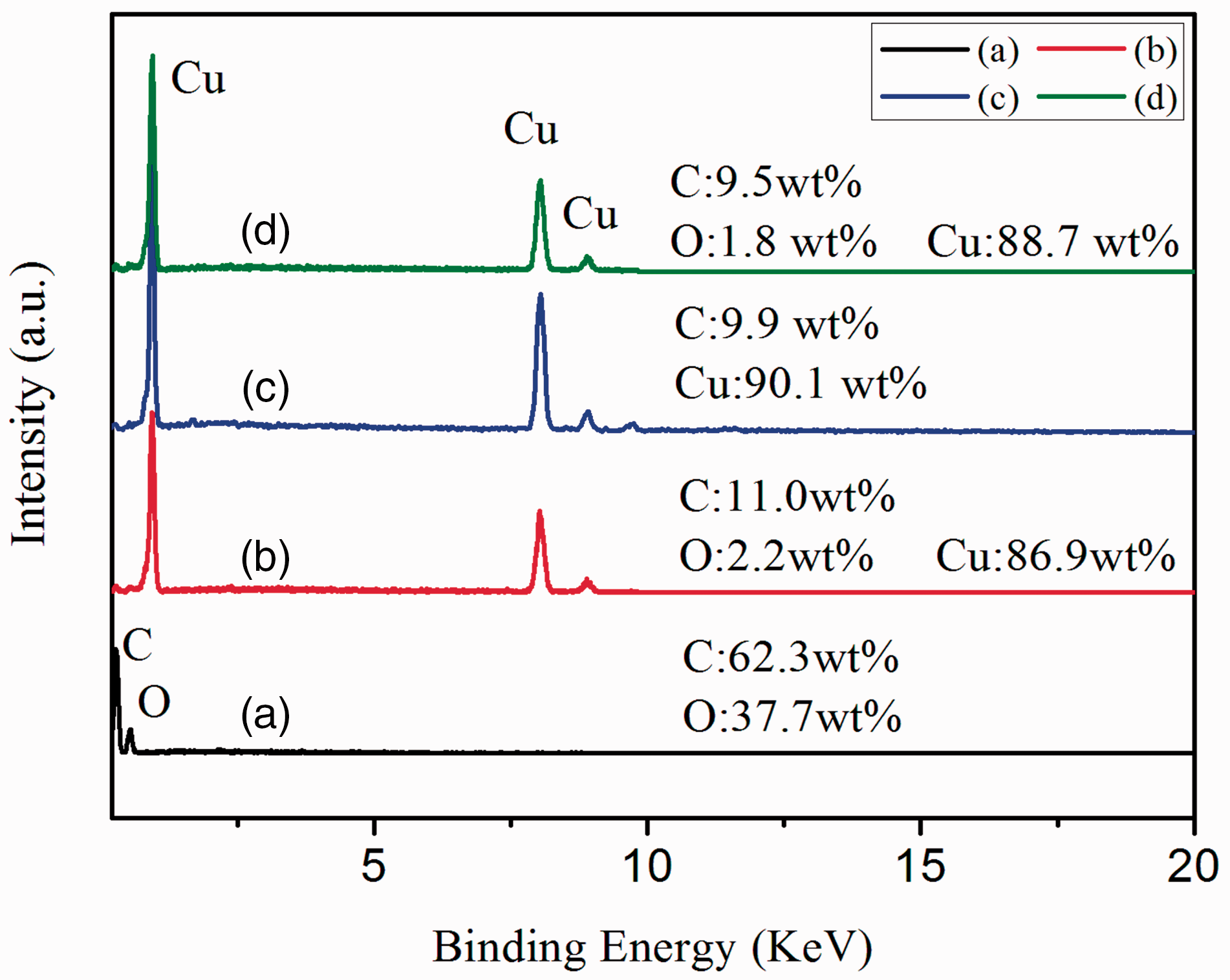
Surface morphology
SEM images of original and copper-coated polyester fibers are shown in Figure 2. Original polyester fiber is cylinder-shaped as shown in Figure 2(a) and (b). The surface of the original polyester fiber is smooth with some impurities distributed on it. However, the surface of the fiber after treatment with laser fiber was connected due to the etching of laser (Figure 2(c) and (d)). Besides, the surface of the fiber is still smooth without any impurities. It can be seen from Figure 2(e) and (f) that the fibers are connected together and the fibers are flat due to the melting of the fibers. In addition, the surface of the fiber is covered by copper nanoparticles. The copper nanoparticles are small and a layer of copper film is formed without any aggregations. The phenomenon can be explained by the fact that the fibers are etched after treatment with laser and the fibers are connected together. Accordingly, interspaces between fibers and fibers are filled by the melting fibers. The surface of the fibers is completely and uniformly covered with copper film. The thickness of Cu film is 600 nm.
SEM images of (a, b) original, (c, d) laser treated and copper-coated polyester fibers with laser treatment (e, f) before and (g, h) after washing.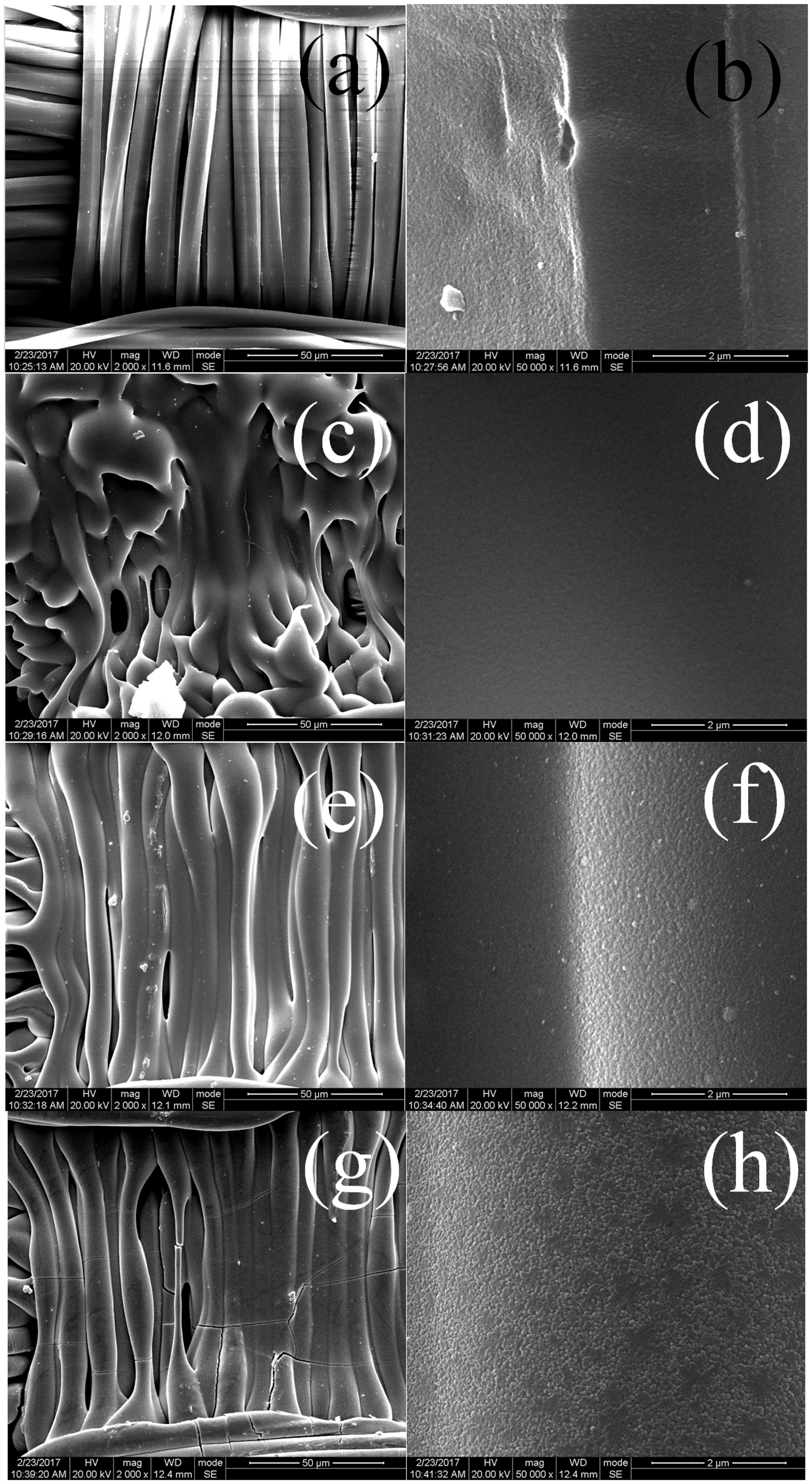
Adhesion strength between copper coating and polyester fabric was investigated by washing test and SEM images of copper-coated polyester fabric pre-treated with laser after washing are shown in Figure 2(g) and (h). Some cracks can be observed in Figure 2(g). Size of the copper nanoparticles after washing is bigger than that before washing (Figure 2(h)). Small amount of copper nanoparticles on polyester fabric are removed during washing, and the surface of copper films became rough. In addition, most copper nanoparticles are firmly entangled on the surface of polyester fibers with pretreatment of laser during washing due to mechanical entangling. The results show that copper-coated polyester fabric pretreated with laser possesses good fastness to washing.
Original polyester fabric is white. However, the copper-coated polyester fabric pretreated with laser of 6.5 W is red due to copper deposits on the fabric as shown in Figure 3. It is obvious that the textile structure of fabric is not broken. The result indicates that copper is successfully coated on the fabric pretreated with laser.
Images of (a) original polyester fabric and (b) copper-coated polyester fabric pretreated with laser of 6.5 W.
Crystal structure
Figure 4 shows XRD pattern of original and copper-coated polyester fabrics without and with pretreatment of laser. Weak diffraction peaks at around 2θ of 22.7°and 25.7°correspond to polyester fiber as shown in Figure 4(a). Figure 4(b) and (c) shows XRD patterns of copper-coated polyester fabrics without and with laser treatment, respectively. The strong peaks at around 2θ of 43.2°correspond to crystal faces of (111) of copper coating on polyester fibers. Weak peaks at 2θ of 50°and 74° are attributed to (200) and (220) crystal faces of copper. The intensity of characteristic peak of crystal faces of (111) copper with laser treatment is higher than that without laser treatment because more copper nanoparticles are deposited on the surface of the fibers pretreated with laser resulted from the roughness caused by laser.
XRD pattern of original and copper-coated polyester fabrics (a) original polyester fabric, and copper-coated polyester fabric (b) without and (c) with pretreatment of laser.
Hydrophobic property
Contact angles of the original and copper coated polyester fabrics are shown in Figure 5. The contact angle of the original polyester fabric is 114.1°, which indicates that the original polyester is hydrophobic due to its chemical structure. However, contact angle of copper-coated polyester is higher than that of original fabric and reaches 128.0°. The result shows that the copper-coated polyester fabric shows better hydrophobic property than original polyester. The phenomenon can be explained by the fact that copper films on the surface of fibers are rough. In addition, copper nanoparticles are not only deposited on the surface of the fibers, but also deposited in the spaces between the fibers, therefore decrease water penetration of the copper-coated polyester fabrics. It can be also seen from Figure 5(c) that contact angle of polyester fabric decreases to 95.7° after being treated by laser. The polyester fabric is thinner with more interspaces after laser treatment; therefore, contact angle decreases due to water penetration. The surface of the polyester fibers is full of holes and partially melted after laser treatment, indicating that the fibers are connected through melting. Copper particles are filled in the spaces between the fibers and the holes of laser-treated polyester fabric, which prevent water penetration. Therefore, water contact angle of the fabric with laser pretreatment before and after copper coating increases from 95.7° to 128.5°.
Contact angles of (a) original polyester fabric, (b) copper-coated polyester fabric without laser treatment, and laser-treated polyester fabric (c) before and (d) after copper coating.
Surface resistance
The surface resistances of original and copper-coated polyester without laser treatment are infinity, which indicates they are electrically non-conductive. Moreover, copper-coated fabric pretreated with laser treatment of 6 W power is not still electrically conductive because the fibers cannot stick together and a continuous copper film cannot be formed with 6 W laser treatment. However, average surface resistance of the copper-coated polyester fabric with 6.5 W power laser treatment is 0.239 Ω/sq. The result shows that the copper-coated polyester fabric pretreated with laser of 6.5 W power possesses perfect conductivity property. The phenomenon can be explained by that fibers are heated with laser of 6.5 W power and meltdown to stick together to form a flat for copper coating. In addition, copper nanoparticles are coated on surface of the fibers and filled in spaces between fibers. The copper-coated polyester fabric pretreated with laser treatment can be conductive as the fibers are melted together to form a flat surface after laser treating, and therefore the copper film can connect together. Therefore, conductivity of the copper coated polyester fabric pretreated with laser is very good. The results confirm that copper-coated polyester fabric with 6.5 W laser treatment possesses good conductive property.
Heat generation
Temperatures of the copper-coated fabrics over a period of 10 s at different DC voltages are shown in Figure 6. The initial temperature of the fabrics is room temperature (15.6℃). However, temperature of the copper-coated polyester fabric increases with the rise of the voltage. It is obvious that the temperature of copper-coated fabric can be kept at 25.8℃ using only 5 V. The result shows that the copper-coated fabrics can generate heat. In addition, temperature of fabric does not change when the fabric is charged over a long time at a constant voltage, indicating that resistance of the copper-coated polyester fabric remains unchanged and copper coating is stable during heating. The copper-coated fabrics with pretreatment of laser can be applied in many fields such as flexible heating pads and smart textiles.
Heat generation of copper-coated polyester fabric with laser treatment at different voltage.
UV blocking
UV transmittance was used to evaluate UV protection of copper-coated polyester fabric pretreated with laser. UV blocking properties of original and laser-treated polyester fabric, and the copper-coated polyester fabrics with pretreatment of laser are illustrated in Figure 7. The calculated UPF decreases from 37.6 for original polyester fabric to 24.5 for polyester fabric with pretreatment of laser. The phenomenon is explained by that the polyester fabric is etched by laser and the fibers become thinner after laser treatment. However, the calculated UPF increases from 37.6 for original polyester fabric to 147.4 for the copper-coated polyester fabric with pretreatment of laser because copper nanoparticles coating on the fabric enhances light reflection and scattering. In addition, copper nanoparticles are deposited not only on the fiber surface but also in the spaces between the yarns during copper sputtering. The coverage of the spaces can prevent the penetration of the UV radiation through the fabric and reach the skin. Thus, UPF value of copper coated polyester fabric pretreated with laser is much higher than that of original polyester fabric. The copper-coated polyester fabric pretreated with laser offers excellent protection from UV radiation as indicated by a UPF rating of 50+. The result indicates that copper-coated polyester fabric pretreated with laser possesses excellent ultraviolet radiation protection property.
UV transmittance of (a) original polyester fabric, (b) polyester fabric pretreated with laser and (c) copper-coated polyester fabric pretreated with laser.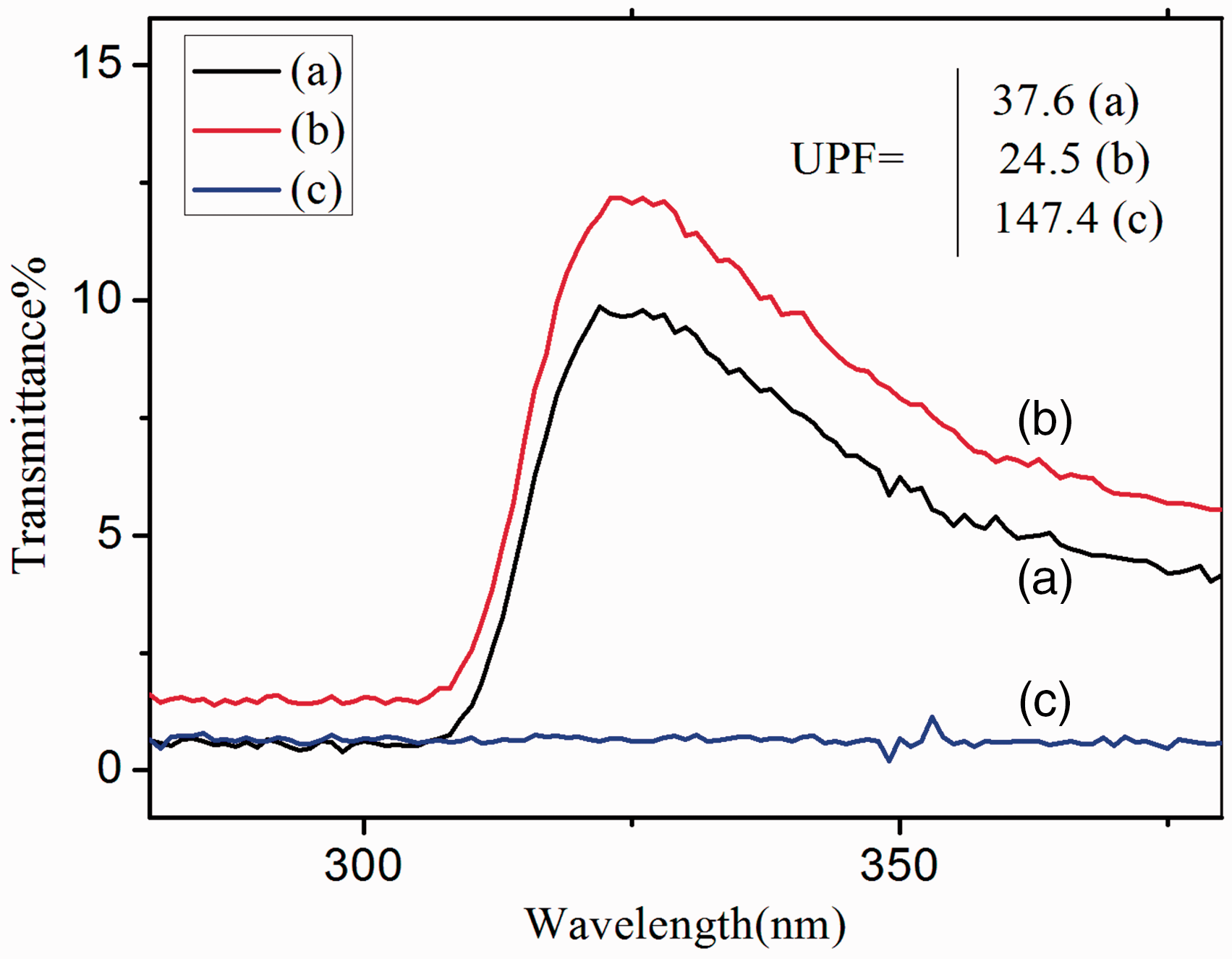
Conclusion
Copper films were successfully coated on polyester fabric pretreated with laser by magnetron sputtering. Morphology of surface of polyester fiber substantially changes after laser treatment, and consequently adhesion strength between copper films and the polyester fibers is improved. Contact angle and conductivity of copper coated polyester fabric pretreated with laser of 6.5 W power are 128.5°and 0.239 Ω/sq, respectively. The results suggest that the copper-coated polyester fabric pretreated with laser possesses excellent electrically conductivity, hydrophobicity, UV blocking, and heat generation properties. There is a potential application of treatment of laser before magnetron sputtering deposition of copper films on fabrics to improve adhesive strength, hydrophobicity, and conductivity for flexible conductive and hydrophobic textiles. Laser can be used in treatment of synthetic fibers prior to coating for improving functional properties.
Footnotes
Declaration of Conflicting Interests
The author(s) declared no potential conflicts of interest with respect to the research, authorship, and/or publication of this article.
Funding
The author(s) disclosed receipt of the following financial support for the research, authorship, and/or publication of this article: This work was financially supported by Ningbo Municipal Science and Technology Bureau (15H0640) and Chengdu Science and Technology Bureau (2015-HM01-00380-SF).