




Abstract
In the present research, the flame retardancy and pyrolysis mechanism of polyimide fibers were investigated by cone calorimeter, scanning electron microscopy, Fourier transform infrared spectroscopy, thermal gravimetric analysis, and pyrolysis–gas chromatography–mass spectrometry. As it turned out, the polyimide fibers possessed excellent thermal stability and flame retardancy. The onset thermal degradation temperature (Tonset 10%) of polyimide was 587℃ and 610℃ at nitrogen and air atmospheres, respectively. The polyimide fibers cannot be ignited at the heat flux of 35 and 50 kW/m2, while they can be ignited at the heat flux of 75 kW/m2 with the time to ignition of 33 s and peak heat release rate of 53.4 kW/m2. Moreover, the flame retardancy of woven and knitted fabrics was also discussed, which demonstrated that knitted fabric was easier to become thermally thick than woven fabric. Scanning electron microscopy analysis of the residual chars of fibers showed that the shape of fiber can be maintained irrespective of heat flux, but the chemical structure of the fiber was destroyed at the heat flux of 75 kW/m2. The pyrolysis combustible volatiles at 700℃ include benzonitrile, aniline, and phenol, which can interpret the ignition of polyimide fibers. The results obtained in the present research revealed the flame retardancy and pyrolysis mechanism of polyimide fibers, which can guide its application and further modification.
Introduction
In recent years, high performance fibers, possessing excellent mechanical properties, thermal stability, chemical resistance and flame resistance, have been attracted a lot of attention due to their wide applications, such as protective textiles, aerospace technology, microelectronics industry, and so on. Thus, some researchers made great efforts in the development of fibers with unique advantages, e.g. ultra high molecular weight polyethylene (UHMWPE) fiber [1,2], carbon fiber [3,4], polybenzoxazole (PBO) fiber [5], and polyimide (PI) fiber [6].
Among them, PI is significantly important and widely investigated due to its superior thermal resistance, mechanical and electrical insulation properties, as well as outstanding radiation and solvent resistance [7–11]. The main preparation methods of PI fibers include two-step and one-step ways. For the two-step method, the polyamic acid fiber is firstly produced by the mixing solvents of dimethylformamide (DMF) and N, N-dimethylacetamide (DMAC), then the obtained precursor fibers are transformed to PI fibers by chemical or heat treatment [12,13]. However, for the one-step method, PI can be directly prepared by wet spinning or dry-jet wet spinning with the solvent of m-cresol or p-chlorophenol [14,15]. Additionally, the mechanical and flame retardant properties of PI can be improved by the addition of nanoparticles, such as graphene [16,17], multiwalled carbon nanotubes (MWNTs) [18], and montmorillonite (MMT) [19,20]. For example, different amount of MWNTs were incorporated into PI through electrospinning, the mechanical and thermal properties of PI fibers were enhanced [21]. In the research of Dong et al. high strength PI fibers with functional graphene were manufactured, the strength of PI/graphene fiber was 1.6 times higher than that of pure PI fiber with only 0.8 wt% content of graphene [22]. Xu et al. improved the flame retardant performance of PI fabric by coating several layers of MMT on the surface. Thermogravimetric analysis (TGA) and cone calorimeter test showed that PI coated with MMT formed more char and released less heat than uncoated one [23].
However, as an inherent flame retardant fiber, understanding the flammability behavior of PI under different heat radiations and corresponding pyrolysis mechanism is urgent, especially for its application and further modification. As a bench-scale heat testing equipment, cone calorimeter can measure the flame retardancy of the textiles exposed to different heat fluxes based on the principle of oxygen consumption [24]. The data of time to ignition (TTI), heat release rate (HRR), peak heat release rate (PHRR), and total heat release (THR) can be recorded. Nazaré et al. evaluated the burning hazard of apparel fabrics using cone calorimeter, which can successfully rank their potential burning hazards [25]. Ceylan et al. studied combustion behaviors of loose cotton fibers by cone calorimeter, the reproducibility can be met through optimizing the parameters such as sample weight, heat flux, and grid type [26]. Bourbigot et al. compared the flame retardancy of polybenzazole and p-aramid fibers by cone calorimeter, and showed the excellent behavior of polybenzazole in comparison with p-aramid [27].
Pyrolysis–gas chromatography–mass spectroscopy (Py–GC–MS) was widely used to study the pyrolysis products and the pyrolysis mechanism of the materials [28–30]. Zhu et al. studied the thermal decomposition products of cotton and flame-retardant cotton fabrics by Py–GC–MS, which was helpful to understand the mechanism of flame-retardant cotton fabrics [31]. Cai and Yu investigated the thermal degradation of high performance fibers (Kevlar, Nomex, PBO) by Py–GC–MS under different pyrolysis temperatures, and revealed the pyrolysis process of these fibers [32]. However, to the best of our knowledge, the flame retardancy of PI fibers under different heat fluxes and the corresponding pyrolysis mechanism are limited, which is very important to guide the application and modification of PI.
With this purpose, the flame retardancy and pyrolysis mechanism of PI fibers were studied by cone calorimeter and Py–GC–MS. Firstly, the flame retardancy of PI fibers were characterized by cone calorimeter under the heat fluxes of 35, 50, and 75 kW/m2. Simultaneously, in order to study the effect of fabric structure on the flame retardancy, the flame retardancy of woven and knitted fabrics with different layers was compared. Secondly, the change of the morphology and chemical structure of the chars obtained under different heat fluxes were characterized by scanning electron microscopy (SEM) and Fourier transform infrared spectroscopy (FTIR), respectively. Finally, the pyrolysis products of PI fibers were analyzed by Py–GC–MS and the pyrolysis mechanism was proposed.
Experimental
Materials
PI fibers (38 mm, 1.67 dtex) and fabrics (woven fabric, 220 g/m2, thickness, 0.4 mm; knitted fabric, 248 g/m2, thickness, 0.75 mm) were kindly supplied by Jiangsu Aoshen Hi-tech Materials Co., Ltd, China. The woven fabric structure is plain weave, and the knitted fabric structure is interlock stitch. The fibers of woven and knitted fabrics are the same. The yarn number for woven fabric is Ne 36/2, and the twist for single yarn and ply yarn is 900 and 700 T/m, respectively. The yarn number for knitted fabric is Ne 40/1, and the twist is 750 T/m. The woven fabric is produced by rapier loop and the knitted fabric is fabricated by double-side circular knitting machine. The chemical structure of PI is shown in Scheme 1.
Characterization
Thermal degradation of PI fibers were characterized under both nitrogen and air atmospheres by Perkin-Elmer Pyris 1 TGA. With the weight of about 5 mg, a heating run ranging from 50℃ to 800℃ was undertaken with the heating rate of 10℃/min.
The flame retardancy of PI fibers and fabrics were investigated by cone calorimeter test (Fire Testing Technology Ltd.). The loose fibers were carded into uniform fibers mat by small-scale carding machine. The detailed information of the method to evaluate the flammability of fibers mat was described in our previous work [33], and the data of cone calorimeter test has good repeatability with the sample weight of 6 g. Therefore, in this research, the fibers mat with the weight of 6 g were fixed by a cross steel grid, with the final dimension of 100 mm × 100 mm × 3 mm (length × width × thickness). The cone calorimeter tests were carried out at the heat fluxes of 35, 50, and 75 kW/m2, respectively. The flame retardancy of woven and knitted PI fabrics was also tested at the heat flux of 75 kW/m2 by cone calorimeter, with the fabric sample of one layer and three layers. All the samples were exposed to the radiation for 300 s. The data of TTI (s), HRR (kW/m2), PHRR (kW/m2), and THR (MJ/m2) was obtained. For each sample, the test was repeated three times and the average data were employed, including TTI, PHRR, and THR.
Moreover, the flammability of woven and knitted fabrics was also characterized through vertical burning test. The method is based on the standard of GB/T 5455-2014 and the sample dimension is 300 × 89 mm2. The flame height is about 40 mm and the exposure time is 12 s. The flame exposure direction is from the bottom of fabric.
The raw PI fibers and the chars collected under different heat fluxes were coated by the layer of gold. The corresponding morphology of the chars was recorded by SEM (1000-fold magnification) with the acceleration voltage of 15 kV.
The chemical structure of the raw PI fibers and the chars under different heat fluxes were performed by FTIR analysis (Nicolet 6700 Fourier Transform Infrared Spectrometer) with the attenuated total reflection (ATR) mode. With the detector of mercury–cadmium–telluride (MCT), 32 scans were collected with the resolution of 4 cm−1. All spectra were collected with the same protocol.
The Py–GC–MS analysis was carried out by QP-2010Ultra from Shimadzu Corporation, which can obtain the products during pyrolysis of PI. The pyrolysis temperatures of 600℃ and 700℃ were selected under helium atmosphere. The fibers were grinded into powder and put into a platinum cup, then free fell into the quartz pyrolyzer. The procedure is described as follows. Firstly, the column temperature was maintained at 40℃ for 3 min. Then, with a rate of 10℃/min, a heating trace to 260℃ is undertaken. At last, it is kept for 5 min at 260℃. The mass spectra were scanned with range from 29 to 600 m/z and the collected data were searched in NIST library.
Results and discussion
TGA–DTG analysis
TGA results of PI at nitrogen and air atmospheres.

PI: polyimide; TGA: thermal gravimetric analysis.

TGA curves (a) and DTG curves (b) of PI at nitrogen and air atmospheres. DTG: derivative thermogravimetry; PI: polyimide; TGA: thermal gravimetric analysis.
Cone calorimeter analysis
The cone calorimeter testing data for the samples of fibers and fabrics.

CV: coefficient of variation; PHRR: peak heat release rate; THR: total heat release; TTI: time to ignition.
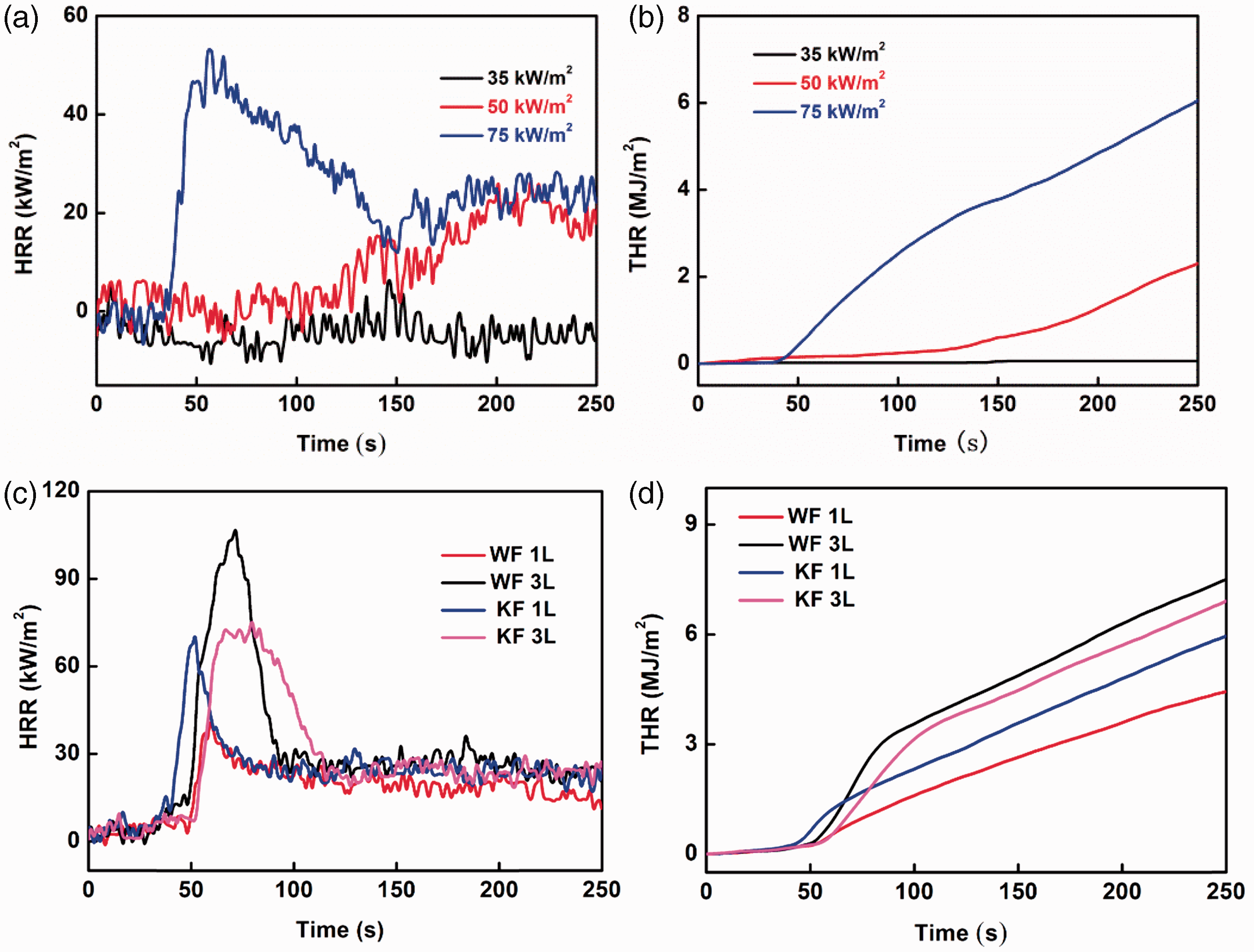
The curves of HRR (a) and THR (b) versus time for PI fibers under different heat fluxes; the curves of HRR (c) and THR (d) versus time for fabrics under the heat flux of 75 kW/m2. HRR: heat release rate; PI: polyimide; THR: total heat release.
For the samples of fibers, they cannot be ignited at the heat fluxes of 35 and 50 kW/m2, which demonstrate that the heat fluxes are lower than the critical ignition heat flux. Since PI possesses excellent thermal stability as discussed in the previous part, the fibers cannot produce enough gases to be ignited at the heat fluxes of 35 and 50 kW/m2. When the heat flux increases to 75 kW/m2, the sample of fibers can be ignited and the TTI is 33 s. The HRR quickly increases after ignition with the PHRR of 53.4 kW/m2. The THR of the fibers sample under 75 kW/m2 increases significantly with the time, with the THR of 7.2 MJ/m2 at 300 s, which is much higher than the samples generated under 35 and 50 kW/m2. It demonstrates that larger amount of heat can be released during combustion. The results of the flame retardancy of PI fibers indicate that PI possesses superior flame retardancy than many inherent fire retardant fibers, such as PMIA, POD, PSA, and polyamide-imide (Kermel). These fibers can be ignited under the heat flux of 50 kW/m2, and also PI has the largest TTI and the lowest PHRR under the heat flux of 75 kW/m2 (PI (33 s, 53.4 kW/m2), PMIA (16.5 s, 127.8 kW/m2), POD (8 s, 125.9 kW/m2), PSA (22 s, 107.3 kW/m2), Kermel (12 s, 136.9 kW/m2)), which has been revealed in our previous work [33].
Since the PI fibers are only ignited under the heat flux of 75 kW/m2, the woven and knitted fabrics were just measured at 75 kW/m2. For the fabrics with one layer, the TTI and PHRR of WF 1L are 43 s and 41.9 kW/m2, respectively, while the TTI and PHRR of KF 1L are 34 s and 72.3 kW/m2. The difference of PHRR between them may be attributed to the higher weight of knitted 1L (2.55 g versus 2.13 g), which can produce more combustible gases. When the fabrics increased to three layers, the TTI and PHRR of WF 3L are 42 s and 107.7 kW/m2, respectively, while the TTI and PHRR of KF 3L is 46 s and 75.7 kW/m2. Compared the PHRR between one layer and three layers for the same fabric, the PHRR significantly increases from one layer to three layers for woven fabric, while the PHRR is nearly the same for KF 1L and KF 3L. The interesting phenomenon is attributed to the heat transmission and thermal thin or thick performance of the samples. Since the thickness of woven fabric is 0.4 mm, while the thickness of knitted fabric is 0.75 mm. The fluffier and thicker structure of knitted fabric makes it easier to become thermally thick with the increase of layer. In this case, the different temperature in the vertical direction of the sample makes it burn continuously, resulting in the stable PHRR. In addition, PI can form char during combustion, the volatiles emerged in the beneath surface of the fibers were impeded by the top char, which can reduce the burning rate and the corresponding PHRR. Nazaré et al. reported that the char-forming fabrics can become physical and thermally thick with the increase of fabric layers, the PHRR can significantly increase from a single layer to 2–3 layers but stabilize with the further increase of the layers [25]. Therefore, based on the cone calorimeter test for woven and knitted fabrics, the thicker and fluffier structure of multi-layer knitted fabric can behave as thermally thick, which can decrease the burning rate and guide the design of flame retardant textiles.
SEM analysis for the samples of fibers
The digital and SEM images (1000-fold magnification) of the fibers after being exposed to different heat fluxes are displayed in Figure 3. Apparently, from Figure 3(a), (b), and (c), the destruction levels of fibers are gradually raised with the increase of heat fluxes. In Figure 3(a), the morphology of the fibers changes little and small amount of fibers become slightly black. However, in Figure 3(b), the surface of the fibers changes into black, but it cannot be burned suggesting that the concentration of flammable gas is insufficient to be ignited. In Figure 3(c), the fibers are seriously destroyed and large amount of char was left. Figure 3(d) to (f) are the magnitude morphology of the fibers after being exposed to different heat fluxes. From these figures, it can be seen that the all shapes remain almost fiber morphology irrespective of level of heat flux, but the diameter of the fibers gradually reduce (14 mm, 12 mm, 9 mm) with the elevated heat flux. From the residual char after burning, it can be speculated that PI fibers favor excellent flame retardancy and heat resistance even at high flux.
The morphology of the chars obtained under different heat fluxes, (a) 35 kW/m2, (b) 50 kW/m2, and (c) 75 kW/m2; the SEM images of the chars obtained under different heat fluxes: (d) 35 kW/m2, (e) 50 kW/m2, and (f) 75 kW/m2. SEM: scanning electron microscopy.
The images of fabrics after cone calorimeter test and vertical burning test
Figure 4 shows the morphology of residual char for woven fabrics and knitted fabrics. It can be seen that the samples of WF 1L and KF 1L are destroyed seriously with very few residue left. When the layer of the fabrics increased to three layers, the residual ash is significantly increased. However, the chars of WF 3L are broken into small pieces, while the chars of KF 3L can maintain the original shape with some shrinkage. The distinct morphology of the char for WF 3L and KF 3L can further explain the difference in the cone calorimeter results. The knitted fabric maintained the original shape may be attributed to two reasons. On one side, the knitted fabric is much thicker and fluffier than woven fabric, and the knitted fabric is easier to become thermally thick, which led to the lower burning rate of knitted fabric. On the other hand, the looped structure makes knitted fabric more elastic than woven fabric. The knitted fabric is easier to shrink under high temperature, resulting in the increased thickness of knitted fabric. Therefore, the thickness and looped structure of knitted fabric are responsible to maintain the original shape after burning.
The images of the residual chars of the fabrics after cone calorimeter test: (a) WF 1L, (b) WF 3L, (c) KF 1L, and (d) KF 3L.
Vertical burning test is a common method to evaluate the flammability of the fabrics. Therefore, the flammability of the woven and knitted fabrics is also characterized by vertical burning test. Both of them cannot be ignited with flame, which demonstrates the good flame retardancy of PI fabrics regardless of the construction. The images of the woven and knitted fabrics after vertical burning test are shown in Figure 5. It can be seen that the damaged length for both of them are very short with about 10 mm. Based on the vertical burning results, the comparison of flammability of the woven and knitted fabrics is difficult. However, the cone calorimeter test can distinguish the flame retardancy of them, which demonstrates that the cone calorimeter test can act as a method to investigate the flame retardancy of fabrics.
The images of the woven and knitted fabrics after vertical burning test.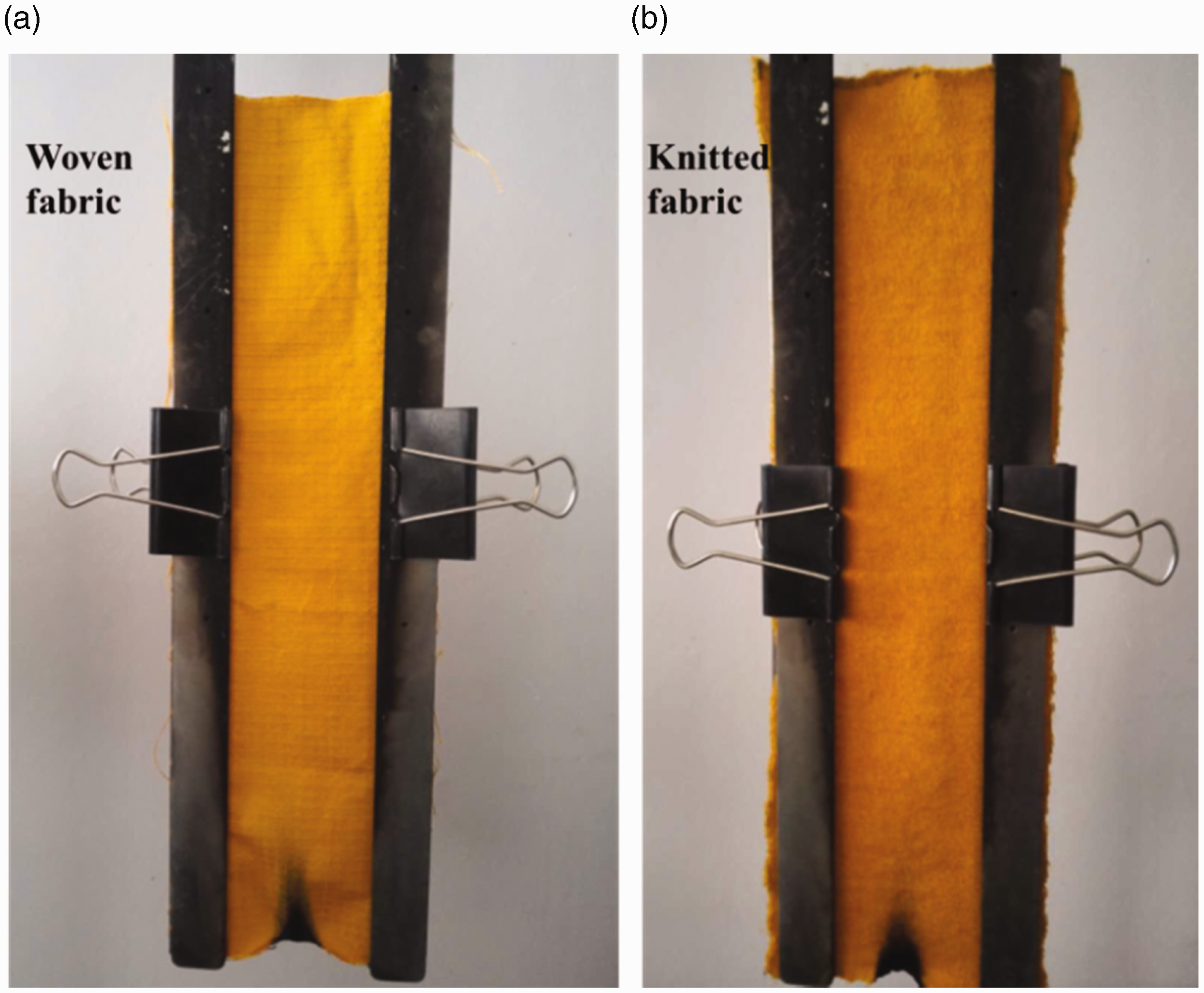
FTIR analysis
In order to investigate the changes of chemical structure of the PI fibers after being exposed to different heat fluxes, the FTIR spectra of neat PI fibers and the residual char under three heat fluxes are shown in Figure 6. It can be seen that there are many absorption bands in neat PI fibers, including the peaks of 1780 cm−1 (C=O symmetric stretching of the imide ring), 1490 cm−1 (phenylene), 1365 cm−1 (C–N stretching), and 1240 cm−1 (aromatic ether), which is similar with the previous report [39]. Apparently, the spectra of residual chars under heat flux of 35 and 50 kW/m2 are nearly the same with neat PI fibers, which suggests that the chemical structures of the fibers are not destroyed. The phenomenon maybe attributed to the high onset degradation temperature of PI, which cannot be degraded under the heat flux of 35 and 50 kW/m2. This also further interprets the failed burning of PI fibers at two fluxes. However, at heat flux of 75 kW/m2, the characteristic bands of PI fibers in the spectra disappear, leaving the typical feature of carbonaceous material. This indicates that only under high flux of 75 kW/m2 the structure of PI fibers can be changed and combustible gases emerge. However, the magnitude morphology of the fibers demonstrates that the residual can remain the fiber shape even that the chemical structure is changed at high flux of 75 kW/m2. This further proves the better flame retardant properties and heat resistance of PI fibers.
The FTIR curves of raw PI fiber and residual chars exposed to different heat fluxes. FTIR: Fourier transform infrared spectroscopy; PI: polyimide.
Py–GC–MS analysis
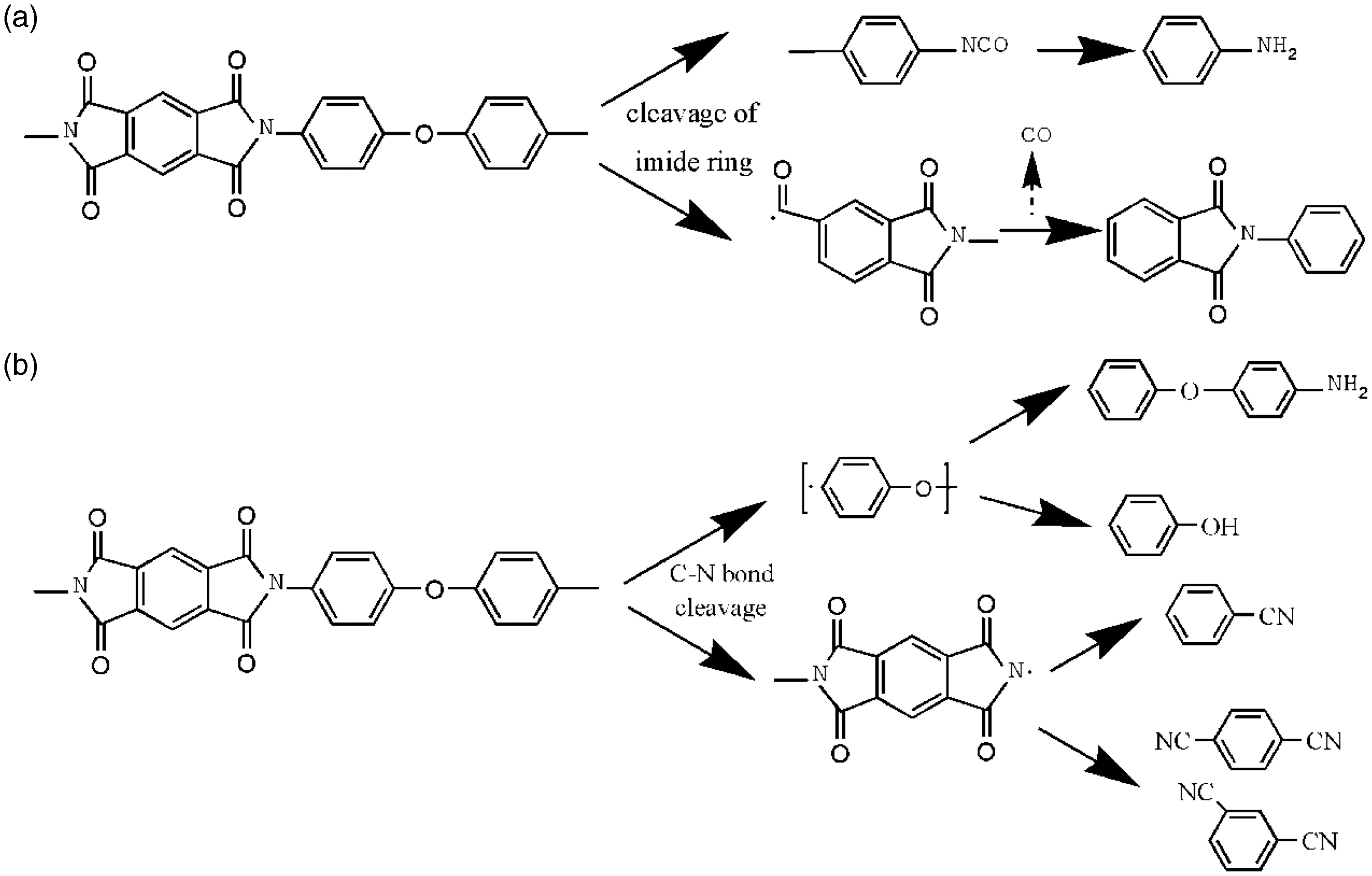
Based on the TGA analysis results, PI fibers begin to degrade at about 600℃ and degrade more completely at about 700℃. In order to confirm the pyrolysis products of PI during degradation, Py–GC–MS analysis was applied at the temperature of 600℃ and 700℃. The chromatogram is shown in Figure 7 and the corresponding information of the products is displayed in Table 3. Under the temperature of 600℃, nine chemical substances are detected, including carbon dioxide, aniline, phenol, 1,4-benzenedicarbonitrile (or 1,3-benzenedicarbonitrile), diphenyl ether, dibenzofuran, 4-aminodiphenyl ether, N-phenylphthalimide, and 4-aminophenol. Among them, the major products are aniline (13.67%) and phenol (44.57%). When the temperature was increased to 700℃, 4-aminophenol was not detected, while two new substances were detected, including benzene and benzonitrile. It can be seen that the percentage of carbon dioxide is the largest (37.50%), suggesting that carbon dioxide is the main pyrolysis product of PI under 700℃. Based on the pyrolysis products, the pyrolysis processes of PI may include the cleavage of imide ring and the cleavage of C–N bond. The generated intermediates of the cleavage of imide ring can further form aniline and N-phenylphthalimide by hydrolysis and CO evolution (Scheme 2(a)). The products of phenol, 4-aminodiphenyl ether, benzonitrile, and 1,4-benzenedicarbonitrile (or 1,3-benzenedicarbonitrile) are due to the cleavage of C–N band (Scheme 2(b)). The concentration of phenol (44.57%) is much higher than that of aniline (12.67%) under 600℃, which indicates that the cleavage of C–N bond is easier than that of imide ring. The substances of benzonitrile, aniline, and phenol are flammable, which can be ignited and explain the combustion of PI fibers at the heat flux of 75 kW/m2. However, PI can form large amount of char and small amount of combustible volatile is generated, which interprets the low burning rate and excellent flame retardancy of PI fibers.
GC chromatographs of PI fibers pyrolyzed at the temperature of 600℃ and 700℃. GC: gas chromatograph; PI: polyimide. The pyrolysis products of PI fibers at the temperature of 600℃ and 700℃.

Conclusions
The flame retardancy and pyrolysis mechanism of PI fibers were investigated by cone calorimeter and Py–GC–MS in this research, and the effect of fabric structure on its flame retardancy was also studied. The cone calorimeter results showed that PI fibers had outstanding flame retardancy, which was only ignited at the heat flux of 75 kW/m2. SEM analysis showed that the residual chars of the samples of fibers still remained the shape of fiber irrespective of heat flux, which further proved the excellent flame retardancy of PI. The chemical structures of the fibers were not destroyed under the heat flux of 35 and 50 kW/m2, which explained the failed ignition in the two heat fluxes. The distinct burning behaviors of woven fabrics and knitted fabrics demonstrated that the thickness and structure of the fabrics can significantly influence their flame retardancy. Knitted fabric with fluffier and thicker structure is easier to become thermally thick than woven fabric. Moreover, Py–GC–MS showed that PI fibers can generate carbon dioxide, benzonitrile, aniline, and phenol at the temperature of 700℃. Among them, combustible volatiles can be ignited, which explained the ignition of PI at the heat flux of 75 kW/m2. With this research, the excellent flame retardancy of PI fibers was successfully revealed and the pyrolysis mechanism was proposed.
The chemical structure of PI fibers. PI: polyimide. The probable pyrolysis process of PI. PI: polyimide.
Footnotes
Declaration of Conflicting Interests
The author(s) declared no potential conflicts of interest with respect to the research, authorship, and/or publication of this article.
Funding
The author(s) disclosed receipt of the following financial support for the research, authorship, and/or publication of this article: the Fundamental Research Funds for the Central Universities (CUSF-DH-D-2016012).