




Abstract
Sensitive skin diseases, including atopic dermatitis, skin inflammation and bedsores, leave patients vulnerable under hospital setting. It is important for the development of a hospital gown with “soft hand” properties and at the same time as a protector against nosocomial infections. Klebsiella pneumoniae has developed resistance to antibiotics in the carbapenem antibiotic class, known as carbapenem-resistant K. pneumoniae (CRKP). CRKP is resistant to nearly all antibiotics and can kill up to 50% of infected patients.
This work consisted in the development of a washable recycled silk fibroin-based gown covalently linked with an amino acid
Introduction
The microbiota comprises all microorganisms usually found in healthy individuals. These microorganisms live on skin and mucosae of all persons after birth and are renewed until their death. Indigenous microbiota benefits host through early stimulation of immune system, prevention of colonization of pathogenic microorganisms, and synthesis of essential compounds (e.g. Vitamin K). On the other hand, various studies suggested that the development of potential pathogenic microorganisms upon alteration of local conditions, antimicrobial therapeutics, and immunosuppresion may happen [1]. Healthcare-associated infections, such as pneumonia, bloodstream infections, wound or surgical site infections, and meningitis can provide conditions for Klebsiella pneumoniae establishment and infection development [2]. Klebsiella pneumoniae that belongs to Enterobacteriaceae family makes up comensal flora and causes opportunistic infections. It is a Gram-negative rod, non-motile, and it is characterized by a prominent polysaccharide capsule, which is responsible for its mucoid appearance and virulence [3]. Aside from colonization of gastro-intestinal tract, it colonizes skin and nasopharynx. One-third of individuals carry K. pneumoniae in stool; however, this number increases to 90–100% in hospitalized individuals and/or the ones taking antibiotics on a regular basis, as well as children [4]. These complications are likely to occur in immunocompromised patients under hospital settings, as elderly, malnourished, bedridden or paralyzed, and individuals who have a diminished pulmonary function [4]. The misuse of antibiotics has increased antibiotic resistance. Jim O'Neill stated that if nothing was done, 10 million annual deaths by infections caused by resistant bacteria would happen in the world, with an associated cost of 90 billion euros by 2050. One of contributing factors to emergence of resistance includes its widespread use in animals [5]. Hence, K. pneumoniae presents a risk of conversion to carbapenem-resistant K. pneumoniae (CRKP), especially in hospital settings. CRKP has become resistant to essentially all antibiotics, and can kill up to 50% of infected patients [6] Moreover, when it becomes established, it proliferates and can spread rapidly throughout the community, through its fimbriae and polyssacharide capsule to adhere and cause virulence [7]. These events add urgency to develop new strategies at the preventive level rather than at the curative level with antibiotics.
Gowns are a type of underwear worn by inpatients and should be changed once a day. The microbial contamination and probability of infection with CRKP increase as the day goes on, which implies microbial movement or transfer from gown to rashes or blisters developed in skin-sensitive patients. A gown can absorb an amount of sweat and microorganisms from human body and environmental contaminants in hospital settings, which is the ideal growth environment for microbial growth and K. pneumoniae transformation to CRKP.
Silk fibroin (SF) is a non-toxic hydrophilic natural textile, tissue compatible, with high tensile strength, being a product already approved under Food and Drug Administration (FDA) for clinical applications. In order to develop a silk recycled waste-based gown, four dimensions were considered: (i) material, where consumers have preferences for innovative raw materials; (ii) ecological, stimulating the rapprochement between cultures and nature as well as the criterious usage of resources; (iii) economic, with the use of recycled silk waste of cocoons as a low-cost process; (iv) antimicrobial, preventing K. pneumoniae establishment and colonization [8,9]. As antibiotics are ineffective and even counterproductive in fighting drug-resistant K. pneumoniae,
In this research,
The present research reports on the study of recycled SF gown that embodies antimicrobial properties. More specifically, its covalent linking with
Experimental
Materials
Bacteria cultivation
Klebsiella penumoniae (ATCC 4352) strain was cultivated on Nutrient Agar (NA) and was then grown on Nutrient Broth (NB) (Panreac).
Silk fibroin (SF) samples preparation
SF recycled waste was obtained from silkworm Bombyx morii (Brazil), Mn 30000, knitted at a rectilinear needle loom with seven needles per inch, with a Jersey knit structure and a linear density of 21.68 number metric (Nm). Its sericin was removed using a soxhlet apparatus with dichloromethane, as a standard procedure in our lab (Figure 1).
Silk recycled waste products (a) as raw materials for the development of Silk knitted structure (b).
Covalent modification on SF samples surface was performed via aminolysis with 1% (w/V) Schematic representation of the mechanism of covalent bonding of 
Five washing cycles were done according to standard EN ISO 105-C06:2010, in a 4 g/L solution of AATCC 1993 Standard Reference Detergent WOB for 30 min each, at 40℃, rinsed, and dried afterwards at 30℃ until used.
Methods
Minimal inhibitory concentration
The susceptibility of K. pneumoniae to
Energy-dispersive X-ray spectroscopy
Energy-dispersive X-ray spectroscopy.

Note: Control SF (A); SF-
Fourier Transform Infrared Spectroscopy
The chemical composition of native SF and SF functionalized with 1%
Contact angle
Contact angles were measured with an OCAH-200 set-up device (Dataphysics) outfitted with a high-speed video system with CCD video camera with a resolution of 752 × 484.
Free energy of adhesion
The surface tension of SF samples was determined (equation (1)) by the sessile drop contact angle method at RT, for three different types of components: the apolar diiodomethane and both polar water and ethylene glycol, whose surface tension components have already been determined.

The interaction between K. pneumoniae and SF was predicted in terms of total interaction energy, and it is represented in the equation 2 by KP and SF, respectively.

Antimicrobial activity
The antimicrobial properties of SF samples modified with
Briefly, a K. pneumoniae suspension of 1–5 × 10⁶ bacteria/mL was inoculated into SF samples, and added with NaCl plus surfactant. After 0 and 24 h of incubation, samples were vortexed for 20 s to release any adsorbed K. pneumoniae. The antimicrobial activity was calculated by a quantitative method in order to determine the percentage of bacterial reduced growth rate (% of reduction) at 0 and 24 h

In order to elucidate whether SF-

Scanning electron microscopy
Adsorbed K. pneumoniae were reticulated overnight with 1.5% glutaraldehyde under 4℃. Samples were then serial dehydrated with an increasing ethanol–water gradient (50–99% v/v) for 10 min each, and subjected to critical point drying (K850, EMITECH). Then, they were sputtered with a thin layer of gold and examined by scanning electron microscopy (SEM) (Hitachi S2700).
The magnifications used were 2000 × and 7500 × with accelerating voltage of 20 kV.
Transmission electron microscopy
The morphology of adsorbed K. pneumoniae was observed by transmission electron microscopy (TEM). They were stained with 2% uranyl acetate for 5 min, and mounted on a mesh with thin bar copper grids covered with formvar. Each sample was examined at a magnification of 30,000 × in a HITACHI HT7700 TEM with accelerating voltage of 80 KV.
Statistical analysis
SPSS Statistics software, version 21.0, was used for statistical analysis with comparisons between results (t-test). p < 0.05 was considered significant.
Results and discussion
The reduced functional capacity of immunocompromised patients and complex crosstalk between Enterobacteria make the phenomenon of multidrug resistance even worse [14,15] which can open the door to establish infection and bacterial proliferation resulting in patients fighting a losing battle.
This research paper describes the development and testing of a silk-based gown made from cocoon of silkworm Bombyx morii recycled materials, by focusing on prevention of disease, with the compound (
Bacteria cultivation
In order to perform the simulation of adhesion assays (1 × 10⁸ K. pneumoniae/mL), K. pneumoniae was grown in its optimal condition with vigorous shaking until reaching exponential growth. During this stage, the bacterial metabolic machinery is entirely adapted to the medium (Nutrient Broth), in which each bacterial cell divides into two cells.
Susceptibility testing
MIC results of
Silk fibroin (SF) samples preparation
Antimicrobial textiles show that besides protecting user, they can also prevent the formation of malodors released from bacterial growth. The developed silk fibroin (SF) gown was covalently modified by aminolysis, with the amino acid
Energy-Dispersive X-ray spectroscopy
Fourier transform infrared spectroscopy
The infrared spectra of unmodified SF is shown in Figure 3(a). Peaks at 3300 cm−1 and 3100 cm−1 are associated with amides B and A. At 1650 cm−1 vibrations are due to C = O stretching vibrations of amide I, and the peak at 1520 cm−1 is related to N–H in-plane bending together with the out-of-phase C–N stretching of amide II.
FTIR. Control SF (a). SF-
SF covalent structural modification before and after five washing cycles was also assessed by FTIR. IR spectra confirmed
EDS and Fourier transform infrared spectroscopy (FTIR) both showed that
Contact angle
The wettability of SF (silk fibroin) and SF covalently modified samples (SF-
This gown showed the capacity to transport moisture away from the skin, which improves the comfort in patients with sensitive skin [18].
Free energy of adhesion
A thermodynamic methodology of the free energy [12] was used to predict the K. pneumoniae binding potential to gown, according to van Oss [19,20]. SF altered from the hydrophobic–hydrophilic interface to hydrophilic character after its covalent treatment. Results showed that these modifications changed SF-
Antimicrobial assays - quantitative method (JIS L 1902 2002)
Antimicrobial assays were conducted under recommended conditions for evaluating antimicrobial finishes on textiles [13]. The SF- Percentage of K. pneumoniae reduction at 24 h (n = 6) – Control SF (a), SF-
Scanning electron microscopy
Fiber topography and adhered K. pneumoniae were observed for controls and SF- SEM images of control SF (a) and SF-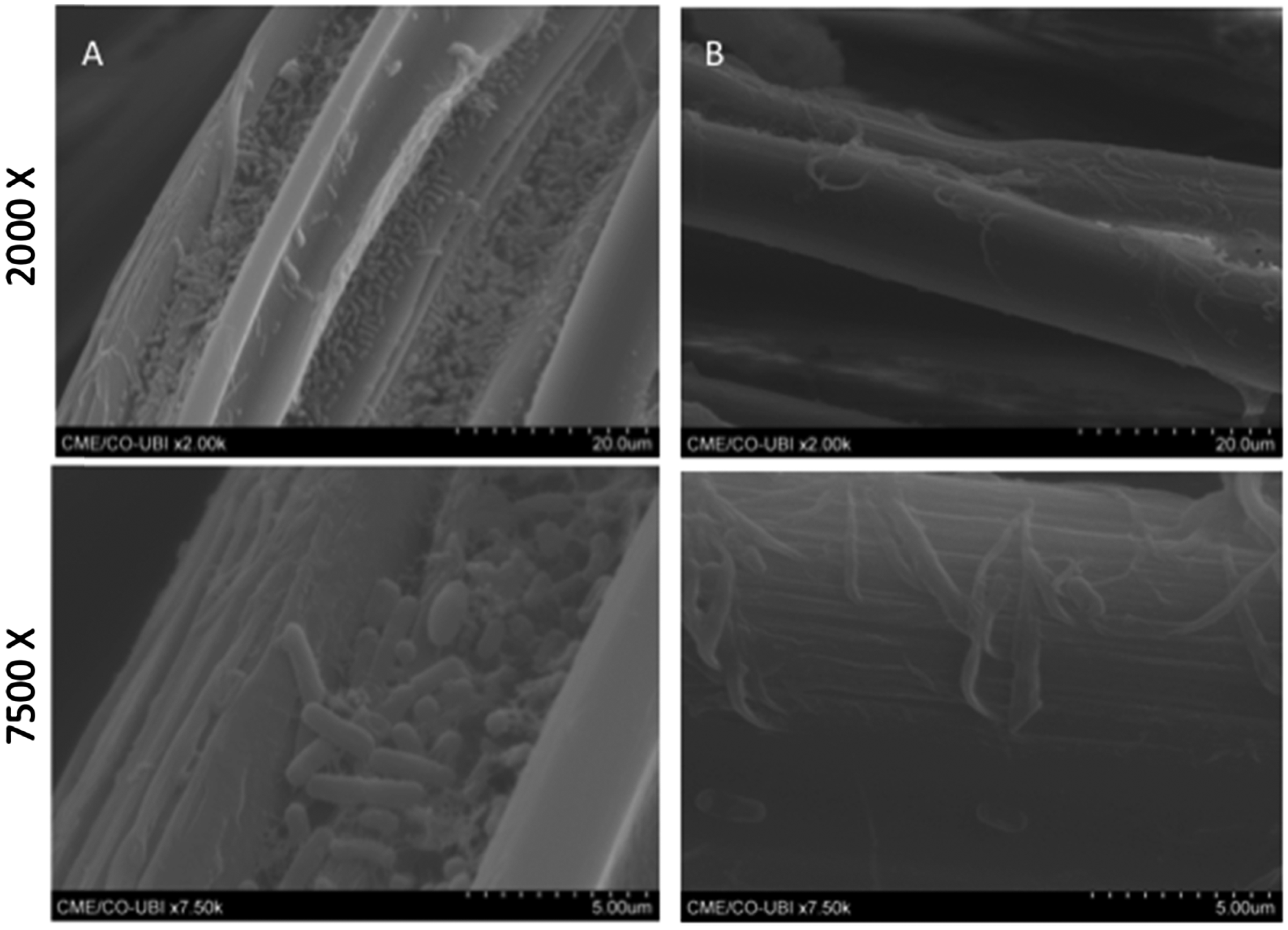
Transmission electron microscopy
The morphology of K. pneumoniae was also observed after five washing cycles under TEM. Results showed membrane-compromised K. pneumoniae when adsorbed to SF- TEM images of K. pneumoniae that was in contact with control SF (a) and SF-
People experiencing sensitive skin, including atopic dermatitis, skin inflammation, bedsores, and related diseases, can benefit from the “softer hand” properties unique to this silk-based gown. Furthermore, it addresses fluid retention and self-cleaning due to
Hence, this hospital gown was constructed so that the comfort of sensitive skin sufferers and healing of the patients’ skin were enhanced beyond the requirements that hospitals meet. Furthermore, it may help prevent rashes and other skin irritations, due to a unique combination of silk and
According to published work, fabrics treated with antimicrobial compounds, namely anthranic acid, copper, silver, triclosan, polyhexamethylen biguanid (PHMB), quaternary ammonium compounds, lavender oil and most nanoparticles, have demonstrated leaching over laundering and/or cytotoxicity for skin [26–30].
Conclusions
Hospital gowns are a type of underwear worn by inpatients which should be changed once a day. The microbial contamination and probability of infection of patients affected by the problem of sensitive skin, with carbapenem-resistant K. pneumoniae (CRKP), increase as the day goes on. CRKP has become resistant to essentially all antibiotics, and can kill up to 50% of infected patients. Moreover, when it becomes established, it proliferates and can spread rapidly throughout the community, through its fimbriae and polyssacharide capsule to adhere and cause virulence. These events add urgency to develop new strategies to prevent antibiotic resistance from spreading.
This research paper describes the development and testing of a silk-based gown made from cocoon of silkworm Bombyx morii recycled materials, by focusing on prevention of disease, with the compound (
Footnotes
Declaration of Conflicting Interests
The author(s) declared no potential conflicts of interest with respect to the research, authorship, and/or publication of this article.
Funding
The author(s) disclosed receipt of the following financial support for the research, authorship, and/or publication of this article: The authors would like to acknowledge the Fundação para a Ciência e Tecnologia (FCT) for the funding for the PhD grant SFRH/BD/91444/2012 and Programa Operacional Capital Humano (POCH) and European Union for the co-funding.