




Abstract
In the present work, polyester fabric with protective and magnetic properties is introduced using mixture of micro magnetic carbonyl iron powder and nano carbon black through pad-dry-cure method and sputter coating with aluminium (Al). This leads to X-band microwave absorbing properties as the great demand for protective garment. The morphology, static magnetic and X-band microwave absorbing properties of the treated fabrics were characterized by field emission scanning electron microscopy, vibrating sample magnetometer and vector network analyzer in the range of 8.2–12.4 GHz. Normal-angle X-ray diffraction was used to study the crystalline structure of treated PET fabric. Compared with the blank polyethylene terephthalate fabric without Al sputter coating, the presence of nano carbon black and carbonyl iron powder on the polyethylene terephthalate fabric sputter coated with aluminum exhibited higher microwave absorbing properties particularly in the primary range of 8.2–12.4 GHz. The results in the whole frequency range investigated were remarkable; however, the reflection loss was found to be lower than −5.9 dB in the entire frequency. The maximum reflection loss value was reached to −7.7 dB at the frequency of 8.2 GHz. Overall, the co-application of nano carbon black and carbonyl iron powders on the polyethylene terephthalate fabric opens up a new coating method for X-band microwave absorbing properties.
Keywords
Introduction
Recently, application of electromagnetic waves in cell phones, local networks and radar systems within gigahertz range causes electromagnetic interference problem [1–3]. The use of electromagnetic waves absorbers to overcome the problem has been considered by using magnetic and dielectric absorbers [4,5]. Application of magnetic and dielectric loss fillers could be appropriate in the wide frequency range with acceptable weight and thicknesses [6–8]. The physical structural pattern of the final absorber consisting of filler has a significant effect on the yield [9]. Carbonyl iron particle (CIP) is a conventional metallic magnetic loss absorber that is widely concerned due to its higher saturation magnetization and Snoke’s limit [10,11], and besides the appearance it has a vital effect on the absorbing properties [12]. Magnetic loss absorbers with high complex permeability usually exhibit good yield in low frequency range and their application is restricted because of narrow absorption bandwidth and heavy weight [13]. Carbon black (CB) as a representative of the dielectric loss absorbers with small absorbance peak and narrow absorbance bandwidth [14] offers good dielectric loss with very low density [15]. Moreover, heavy thicknesses are needed for dielectric absorbers.
However, high cost and complicated preparation process limit practical application. CBs are largely used as dielectric fillers in complex absorbers [16].
Producing protective garments with electromagnetic wave absorbing properties has increasingly been considered for protection of human exposed to radiation [17–19]. Choi et al. [20] investigated the shielding effectiveness and absorbing properties of electromagnetic waves on E-glass/epoxy composite dispersed with carbonaceous conductive particles to enhance the electromagnetic wave absorbing efficiency. The electromagnetic wave absorbing properties of the nanocomposites were characterized theoretically with considering the dielectric properties of nanocomposites in the X-band frequency to achieve the highest electromagnetic wave absorbing behavior. Chen et al. [21] studied graphene/Fe nanocomposites constructed through a facile and green method that possessed efficient dispersity of magnetic nanoparticles. They showed remarkable improvement in electromagnetic absorbance properties compared with other magnetic materials and graphene. Song et al. [22] investigated the polymer composite composed of polyurethane and epoxy resin as a matrix and flake carbonyl iron powder as absorbent. They introduced high impedance matching with low reflection loss besides the light absorber mass for polymer composite at Ku-band frequency range. Ding et al. [23] focused on woven fabric with Al2O3 fiber, and the influence of the pyrolytic carbon coating on complex permeability showed higher permittivity with more deposition time. Zhu et al. [24] investigated the radar absorbing properties of nonwovens containing carbon fiber, polyester, and wool fibers using far-field RCS (radar cross section) measurement in the frequency ranging from 8 to 18 GHz which indicates that the radar-absorbing capacity of the nonwoven is nearly proportional to the thickness of the nonwoven and the volume fraction of carbon fiber irrespective of the fiber type. Sano et al. [25] worked on nonwoven coated with multi-walled carbon nanotubes for a single-layer electromagnetic absorber with high absorption efficiency especially in the frequency of 60 GHz. Kardarian et al. [26] tried in situ synthesis of silver nanoparticle on the surface of textile through sintering of the nanoparticles to achieve conductive woven cotton fabric. Gupta et al. [27] also worked on microwave absorption in X and Ku band of cotton fabric coated with Ni–Zn ferrite and carbon formulation in polyurethane matrix to introduce a flexible protective fabric. Further, Wang et al. [28] used a type of magnetic carbon fiber with a composite coating composed of nickel/Fe3O4 nanoparticles fabricated via electrodeposition method. The prepared magnetic carbon fiber showed excellent electromagnetic interference (EMI) shielding effectiveness (SE). Ye et al. [29] applied silicon carbide fiber by deposition of boron nitride to enhance wave-absorbing properties. Haji et al. [17] coated polyethylene terephthalate (PET) fabric with carbon nanotube via plasma treatment to improve microwave shielding behavior. Esen et al. [30] focused on producing a textile electromagnetic absorber through coating of textile material via arc-physical vapor deposition and detected the fine structure of a textile absorber in the microwave area. Finally, An et al. [31] tried to prepare a flexible shielding fabric (EMI SE = 59.3–70.2 dB, within 300 kHz to 1.5 GHz) after electrical deposition of Ni–Fe–P alloy on copper-coated PET fabric.
To the best of our knowledge, there is no report on application of CIP and NCB together on the polyester fabric, especially sputter coated with aluminium. In this research, CIP and NCB were applied as magnetic and dielectric loss fillers on the polyester fabric along with additional one-sided sputter coating with aluminum. Nevertheless, two types of loss fillers were used on the PET fabric via a facile and inexpensive pad-dry-cure method besides the thin layer of aluminum with high reflective power through sputtering DC method for restoring the passed waves into absorbing layer to achieve higher attenuation in residual wave energy.
Experimental
Materials and preparation of wave- absorbing layer
Commercially available spherical carbonyl iron powders (average particle diameter <4 µm) were purchased from Alchemy Parsian Co., Ltd., Iran. To reduce the diameter, CIP powders were mechanically milled for 8 h in a planetary ball, and n-hexane was used as the process control agent to the milling tank with ball-to-power mass ratio of 25:1. Nano carbon black (NCB) powders were purchased from Micronize Co., Ltd. Hundred percent polyester woven fabric with 110 g/m2 were purchased from Hejab Shahrekord Co., Ltd., Tehran, Iran. First, NCB (20 w/v%) was dispersed with 0.1 w/v % cetyltrimethylammonium bromide (CTAB) in distilled water. In the second stage, CIP (40 w/v %) was dispersed in distilled water in association with sodium dodecylsulphate (SDS: 0.05 w/v %) and cetyltrimethylammonium bromide (CTAB: 0.05 w/v %). Using both SDS and CTAB at equal portion leads to prepare CIP dispersion with excellent stability for successful padding. In the final stage, 3 w/v % silicone-based softener was added to the remaining prepared dispersion. At the end of each stage, PET fabric (monolayer) was impregnated in the prepared dispersion and then passed through rollers (pick-up = 80%) and then dried at 80℃ for 7 min followed by curing at 220℃ for 10 min. The numbers of the treated fabrics as monolayers were fused at 130℃ to achieve the approximate thickness of 2.7 mm for preparing multilayer. In addition, aluminum was deposited on the outer side of the undermost monolayer with thickness of 50 nm through sputtering. In sputtering aluminum process, the aluminum target diameter, operating temperature, and argon gas pressure were 3 inch, 90℃ and 4.7 mbar, respectively. The schematic of the lowest mono-layer wave absorber is shown in Figure 1.
Schematic of mono-layer wave absorber.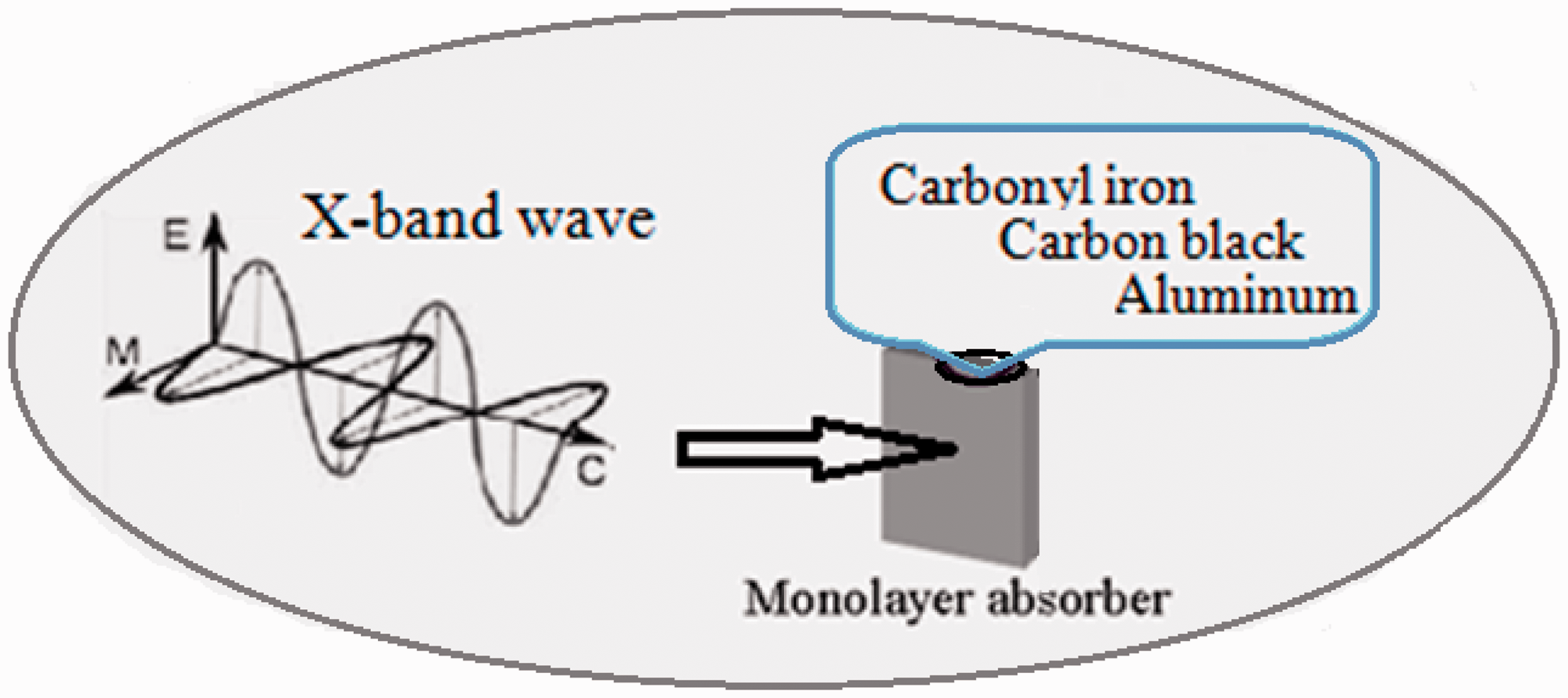
Testing
The morphology of the monolayer was characterized by field emission scanning electron microscopy (FE-SEM). The electromagnetic parameters and the reflection loss (RL) vs. frequency of the wave absorbing layer (thickness ≈ 2.7 mm) were measured by an 85071E vector network analyzer (VNA) within 8.2–12.4 GHz on a waveguide measurement system. The measurements were carried out by the waveguide type of transmission line on a 22.86 mm × 10.16 mm (mouth dimensions of WR90 Waveguide) rectangular piece of multilayer sample with 2.7 mm thickness. The scattering parameters were first obtained to use in calculation of complex permittivity and permeability. The static magnetic properties of the treated fabric were measured by vibrating sample magnetometer (VSM).
Results and discussion
Morphology
The FE-SEM image of the sample (Figure 2) shows spherical CIP particles with average diameter of 0.3–2 µm on the fabric surface.
SEM image of (a) blank PET fabric, and (b, c, d, e) FESEM images of monolayer treated with NCB and CIP.
Distribution of the particles on the fabric is uniform due to smooth surface of CIP particles and presence of dispersing agent. Figure 2 indicates the morphology of NCB particles with somehow spherical shape and diameter ranging between 30 and 40 nm that are very close to each other and agglomerated. Figure 2(a) and (b) shows that NCB particles were localized uniformly producing continuous coating on the fiber surface. Figure 2(c) and (d) indicates that the carbonyl iron particles were coated by carbon black nanoparticles, thus NCBs were placed on the surface of carbonyl iron particles. NCB particles in Figure 2(e) clearly show a linear structure by sticking together on the fiber surface of monolayer treated with NCB and CIP. The particle size of CIPs and NCBs is lower than 0.5 micron and 30 nm, respectively.
Magnetization and X-ray diffraction analysis
Figure 3(a) shows the field dependent magnetization of treated monolayer fabric measured with vibrating sample magnetometer at room temperature. The saturation magnetization (Ms) value of the monolayer has been found to be 111.6 emug−1 at an external field of 0.458 kOe with no coercivity, retentivity (Mr), and hysteresis loop indicating the super paramagnetic nature.
(a) Vibrating sample magnetometer plot of monolayer; (b) X-ray diffraction patterns of samples: (I) blank monolayer and (II) treated monolayer.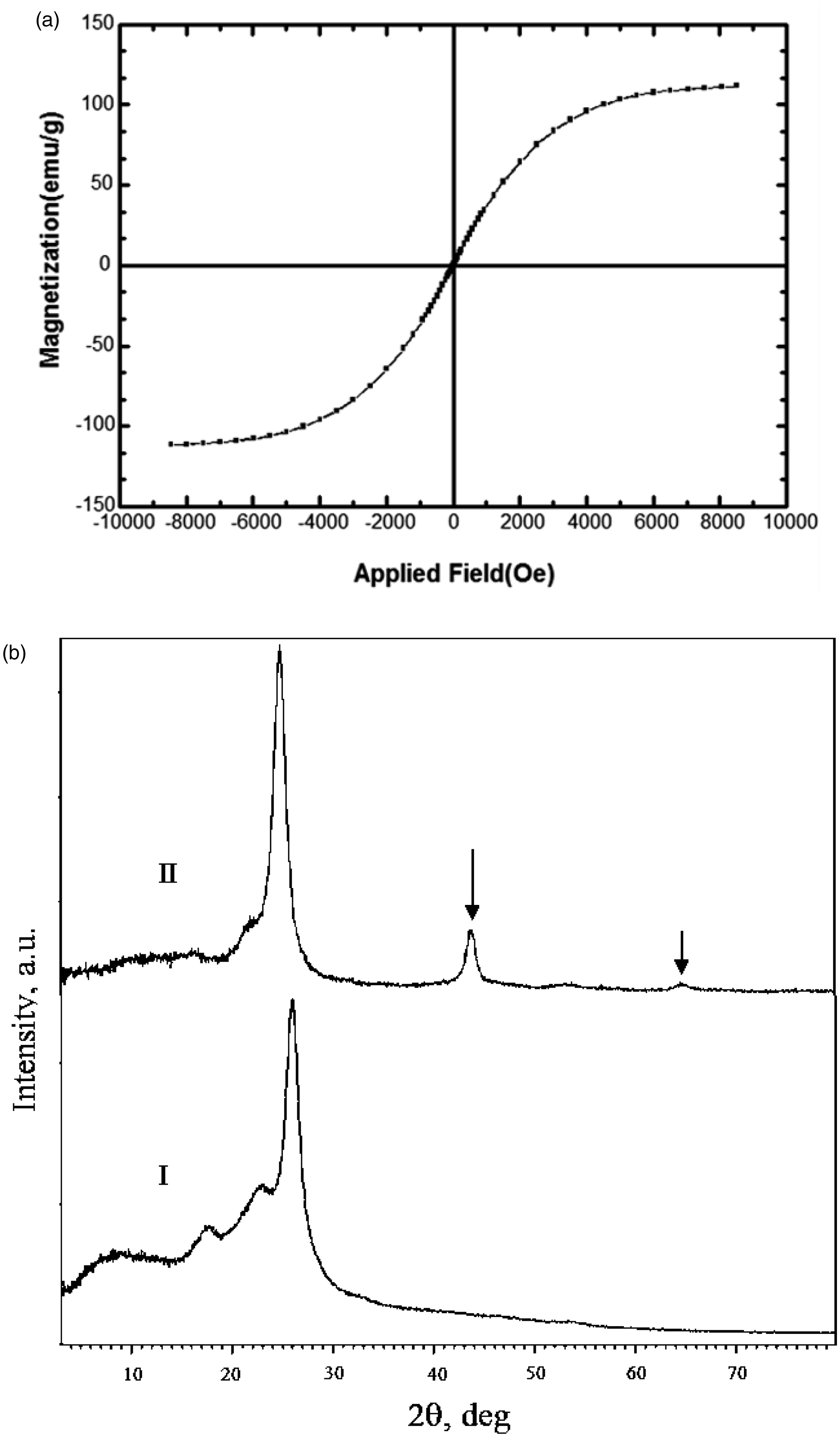
Coercivity (Hc,Oe) is an important physical parameter to describe hard (>100 Oe) or soft (<100 Oe) magnetic material properties [13]; thus the measured monolayer is a soft magnetic material. Figure 3(b) shows a typical XRD pattern of blank and treated monolayer. The main peaks of blank monolayer are observed at 2θ = 18–26°. The main peaks of treated monolayer with NCB and CIP are observed at 2θ = 44.56° (d = 2.03 Å) and 2θ = 65.03° (d = 1.43 Å) corresponding to (100) and (200) reflections which matches with the standard pattern of CIP powders (JCPDS 06-0692) [21].
Complex dielectric permittivity and magnetic permeability
Figure 4(a) and (b) depicts the frequency dependence of the real part (ɛ/) and imaginary part (ɛ//) of the complex permittivity measured, respectively. The real part of permittivity is relative to energy storage and the imaginary part implies the dielectric loss in particle [5]. The real and imaginary parts of the complex permittivity decrease with increasing frequency within 8–12 GHz. Figure 4(c) and (d) indicates that the real part (µ/) and imaginary part (µ//) of complex permeability are plotted as a function of frequency (8.2–12.4 GHz), respectively. Similar to the complex permittivity, the real part of permeability is relative to energy storage and the imaginary part implies the energy loss in particle [5]. Both the real and imaginary components of permeability exhibit variation with frequency as compared with the blank sample treated with Al, and there is an increment in the treated sample from 1.11 to 1.15 and 1.05 to 1.11 at the sharp peak frequencies of 9 and 10.2 GHz. The imaginary part of the complex permeability has also two sharp peaks including 0.13, 0.12 and 0.06, 0.05 for the treated and blank Al substrate samples at the frequencies of 8.7 and 9.9 GHz.
Complex permittivity and permeability vs. frequency of blank and treated fabrics.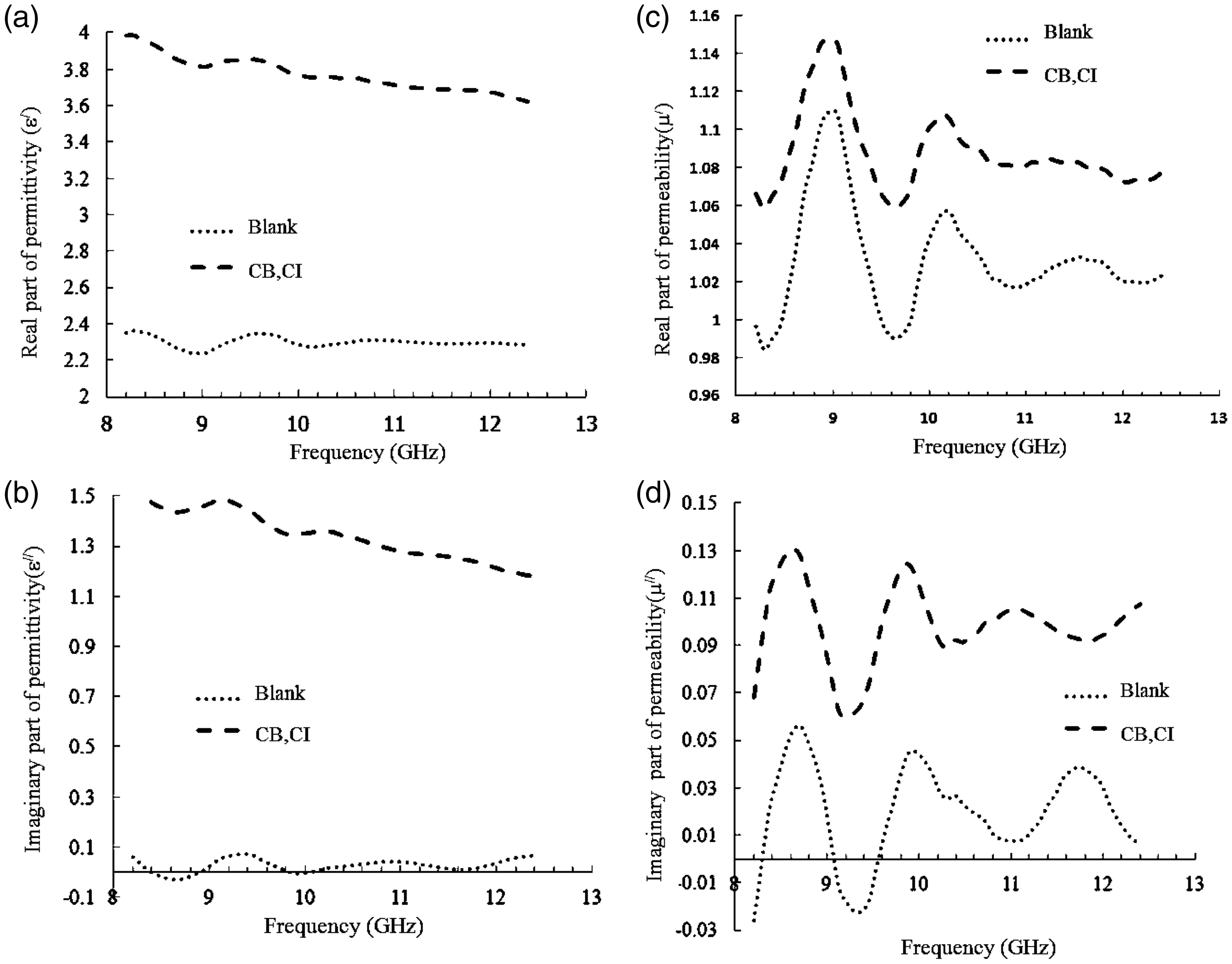
Reflection loss characteristics: Modeling based on absorber layer with aluminum substrate
The absorbing properties of microwave absorber are determined by the dielectric and magnetic losses. A simple mixing of two types of raw materials endows the composite specimen good microwave absorbing properties with magnetic loss and dielectric loss [32]. Thus, it is expected that the carbonyl iron with carbon black on aluminum-coated layer possesses high dielectric and magnetic loss, which results in good X-band microwave absorbing properties. Figure 5 shows the scattering parameter of blank and treated samples in the frequency of 8.2–12.4 GHz. The raw PET fabric with sputter-coated aluminum exhibited a little increment in the values of RL (−1.7<RL < −2.1), whereas reflection loss values increased significantly (−5.9 < RL < −7.7) after application of NCB and CIP. Therefore, the maximum RL enhanced from −2.1 to −7.7 dB for the raw PET with sputter-coated aluminum and the treated PET fabric with sputter-coated aluminum. On the other hand, the maximum value of absorbing percentage was 83.0% in the frequency of 8.2 GHz while the minimum was 74.3% in the frequency of 12.1 GHz. This implies that the power of absorbing and attenuation of incident wave increased. It should be noted that, coating of aluminum on one side of the fabric helps to restore the passed waves into absorbing layer to achieve higher attenuation of residual wave energy.
Scattering parameter of blank and treated fabrics with NCB and CI with and without Al substrate.
In general, the advantages and different positive points of this work could be clearly seen by comparison with other works. For instance, the main difference with the work of Liu et al. [13] is in the matrix of the work as the epoxy resin was chosen as a matrix, while here the polyester fabric as an inexpensive substrate was selected for applying on the materials. It is obvious that a homogeneous coating of materials such as CB and CIP with a paste, glue or a resin is easier than preparing a treated fabric with uniform surface of the applied materials. In addition, using CB particles in nano scale is more appropriate to show stronger absorbing properties. A single layer absorber involving tow filler (CB, CIP) was prepared by Liu et al., while in the present work, first NCB particles were applied on the fabric in a pad-dry-cure method and then CIP particles were coated on the pre-treated fabric using the same method. It is noteworthy that aluminum metal has a significant effect as the absorbing material, that was used here at back of the treated fabric as a monolayer to enhance the absorbing properties of the fabric. The absorbance bandwidth at best reached to 10.1 GHz (7.9–18 GHz), while in the present work, the frequency was 8.2–12.4 GHz with RL value in the whole range of more than −5.9 dB. The best results were seen in the initial frequencies; however, the maximum RL value reached to −7.7 dB in the frequency of 8.2 GHz. Although stronger absorbing properties were reported, it should be noted that the results in this research were reported for the treated fabric and not for the absorber alone.
Also, Yuping et al. [15] prepared the carbonyl iron composites coating based on Al sheet. They reported the maximum RL value of more than −12 dB; however, when the base changed to PVC, the maximum RL value in the X-band range decreased significantly to −7 dB. This shows the importance of the substrate besides the difficulty of enhancing microwave absorbing properties in polymeric composites and especially in fabric substrate. Therefore, RL value of −7.7 dB with intended fabric matrix can be considered as a reasonable result for absorbing purposes.
Conclusion
In this paper, the mixture of nano carbon black and carbonyl iron powders was successfully padded, dried, and cured on the polyester fabric in addition to aluminium sputter coating on one side to produce the fabric with absorbing physical waves, especially X-band microwave. NCB as a representative of a dielectric loss with excellent electrical conductivity, light weight, and low cost for electromagnetic wave absorbing is appropriate besides CIP as a metallic magnetic material to produce good microwave absorbing properties. Aluminum is a useful substrate to prevent interference of electromagnetic waves that pass through the absorber layer with effectiveness of the thickness. However, CIP and NCB separately and together have been used in many works with the aim of absorbing microwaves [5,11,13,15]; however, here the co-application of CIP and NCB in a simple and inexpensive method was carried out along with aluminum sputter coating given the X-band microwave absorbing properties. In the present study, the characteristics of the treated polyester fabric were analyzed, and the morphology, static magnetic properties, X-ray diffraction, and microwave absorbing properties within 8.2–12.4 GHz were reported. The application of the mixture of NCB and CIP on the PET fabric enhanced the microwave absorbing properties in the range of 8.2–12.4 GHz enhancing RL value to −5.9 dB at the whole range of the tested frequency and the maximum RL achieved −7.7 dB at the frequency of 8.2 GHz. This shows the ability of utilized materials and method to enhance the absorbing power of the product compared to the PET fabric. The crystal size and super-paramagnetic properties of the treated PET fabric were also determined.
Footnotes
Declaration of Conflicting Interests
The author(s) declared no potential conflicts of interest with respect to the research, authorship, and/or publication of this article.
Funding
The author(s) received no financial support for the research, authorship, and/or publication of this article.