




Abstract
Fire protective clothing worn by the emergency responders may be exposed to intensive heat condition time and time again during a firefighting work. In this research, the level of thermal protection retained by the fire protective clothing after repeated exposures to flash fire was investigated from bench-scale test to full-scale test. A thermal protective performance tester and an instrumented manikin with a transverse motion system device which was capable of simulating the action of running across the flame were used for the exposure test. Physical properties (mass, thickness, thermal shrinkage, tear strength) and thermal protective property of the test specimens were examined after each exposure. The results showed that repeated heat exposures resulted in continuous decrease of mechanical performance of the fabrics. The thermal protective performance of fabrics with good thermal dimensional stability such as polybenzimidazole/Kevlar and flame resistant cotton decreased after exposure. For the fabrics with severe thermal shrinkage such as Nomex IIIA and polysulfonamide, the thermal protective performance was improved due to the increase of fabric thickness induced by thermal shrinkage. However, this positive effect of thermal shrinkage diminished in the manikin test as it decreased the air gap size between the garment and flame manikin. The thermal protective property of Nomex IIIA garment exhibited continuous decrease after repeated exposures. This study was expected to provide new sights for the performance evaluation and application of fire protective clothing.
Keywords
Introduction
Fire protective clothing is designed to protect the wearer against the heat hazards such as the flames, hot combustion gases, steam, hot object, or any combination of these conditions. It should meet several requirements such as flame resistant (FR), thermally insulating, and with good mechanical property [1]. A number of evaluation standards and apparatus have been developed to test the performance of thermal protective fabric and clothing, including the bench-scale tests such as thermal protective performance (TPP) test and radiation protective performance (RPP) test as well as full-scale-instrumented manikin test. However, the performance is generally assessed for the new fabric combination. Test standards like NFPA1971 [2] usually specify the minimum performance requirement for new protective clothing. Actually, the thermal and physical properties of the fabric used to make protective clothing will change during use, which may reduce the level of protection and cause potential danger to users [3,4]. Vogelpohl and Easter [5] found that the used firefighter's turnout gear showed reduced tensile strength, flame, and water resistance. Day et al. [6] found that the ultraviolet radiation also reduced the fabric strength. Aidani et al. [7] stated that the aging of the moisture membrane must be considered carefully while estimating the service life of firefighters' protective clothing. It was confirmed that the heat exposure, ultraviolet radiation, laundering procedures as well as chemical hazards would influence the mechanical property and thermal protective property of the fire protective clothing [8–13].
Although some researches have been conducted on the durability of firefighters' protective clothing, they mainly focused on the performance retention after a long-term exposure to mild temperatures. The property changes after successive short-term exposures to severe conditions were seldom considered. The normal action of a firefighter or other emergency responders is to try to escape from the heat hazards by running away from the fire scene. During this process, they may run across or pass by the flame several times, which indicates that the fire protective clothing will suffer repeated exposures in a short time. The modern fire protective clothing generally provides good initial performance, but they may not show good performance after repeated exposure. The heat transfer property of the fabric may be changed through the mechanism of pyrolysis, char formation, and shrinkage [14,15]. Therefore, the thermal protection retention ability of fire protective clothing in a short time of intensive heat exposure is significant for the emergency responders.
Meanwhile, it is very important to evaluate thermal protective property in laboratory-simulated fire scenes as accurately as possible. Current TPP tests provide valuable information that is directly related to the end-use performance of thermal protective garments. However, these methods generally assess the heat transfers through the fabric in a static state [2]. The wind effects or body movement during a dynamic escaping from the flame is not considered. It has been proved that the fabric deformation due to body movement has a complicated effect on thermal protection [16]. A variation in the air gap between the fabric and skin caused by body motion was also reported to affect the performance of protective clothing [17]. Therefore, evaluating the thermal protective property of fire protective clothing under a dynamic condition is meaningful.
In this study, the level of thermal protection retained by the fire protective clothing after repeated flash fire exposure was investigated from bench-scale test to full-scale manikin test. To make the test closer to reality, an instrumented manikin which was able to move through a stationary flame was used to simulate the action of escaping from a fire. The physical properties and thermal protective property change of the exposed garments were examined. The work presented by this paper was expected to provide a basic understanding of the durability of fire protective clothing after successive short-term exposures to severe conditions and additional guidance for the performance evaluation of fire protective fabrics and clothing.
Experimental procedures
Materials
Description of the test samples.
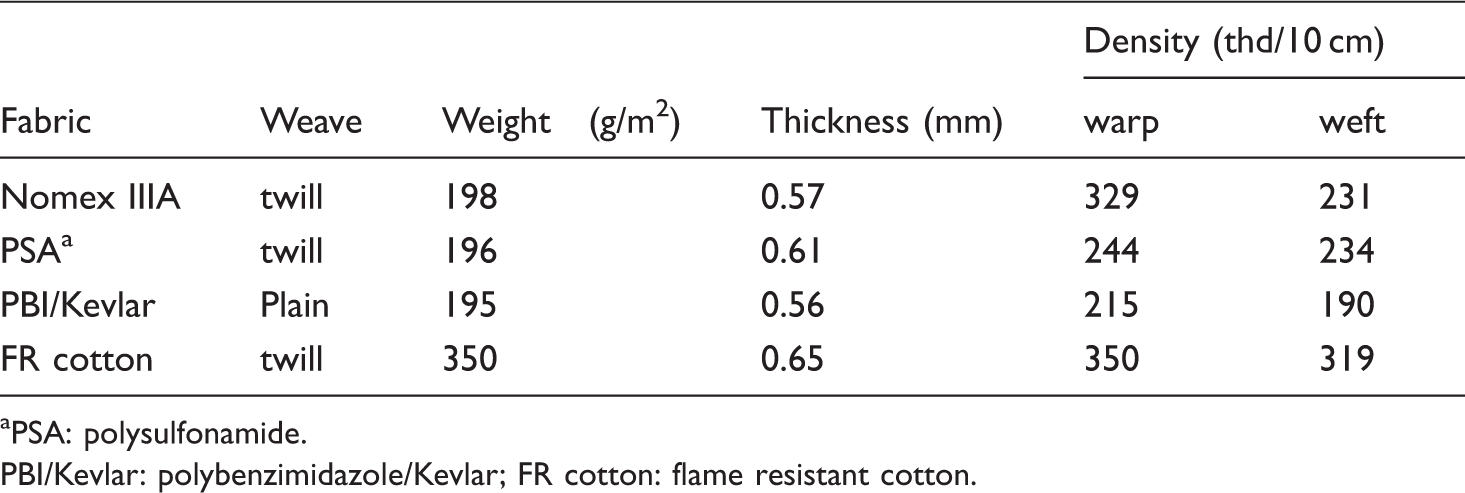
PSA: polysulfonamide.
PBI/Kevlar: polybenzimidazole/Kevlar; FR cotton: flame resistant cotton.
Method
Bench-scale test
The fabric specimens were exposed to a combined flame and radiant heat source with 84 kW/m2 heat flux intensity. This was conducted on a TPP tester ((CSI-206, Custom Scientific Instrument Corporation, USA)), which allowed precise control of heat flux level and exposure duration. The exposure area was 100 cm2 and the duration was 3 s. Each fabric specimen was exposed for three times. During the test, a square frame weighing 230 g was used to hold the four edges of the specimens to simulate a semi-restrained condition as that happened on the garment. It was proved that this weight could prevent the excessive shrinkage which might lead to the dropping down of the specimen from the support frame into the flash fire, but would not restrain the shrinkage of the fabric completely. The changes in fabric basic properties (mass, thickness, thermal shrinkage, tear strength) and surface morphology and thermal protective property after each exposure were measured using various techniques. The initial properties of the unexposed sample were also measured for comparisons.
Mass loss as a function of exposure times was determined by weighing the fabrics immediately prior to and after the exposure using an analytical balance with a precision of 0.1 mg. The thickness of the fabrics was measured according to ASTM D1777-96 [18] under a pressure of 10 gf/cm2. As the specimens may not be flat after exposure due to shrinkage, a smaller pressure foot with an area of 50 mm2 was selected. Tearing behavior of the fabrics was assessed as described in ASTM D 5587-08 [19] by trapezoid procedure conducting on an Instron model 3365 universal testing machine (Instron Corporation, USA). The average of the five peaks of the load–extension curves was used to calculate the tear strength of the test specimen. Thermal shrinkage of the fabrics was characterized by the change of the fabric surface area using an image processing technique. Potential changes in the fabric surface morphology due to heat exposure was measured by scanning electron microscopy (SEM) (NOVA NanoSEM 230, FEI Corporation, USA). Prior to scanning, the specimens were coated with a thin layer of gold to limit the charging effect. Thermal protective property of the fabrics was evaluated on a TPP tester as described in NFPA1971 [2]. The copper calorimeter was placed in contact with the fabric specimen or with a 6.4 mm distance behind the specimen to simulate the situation, where there was an air gap or not between the skin and clothing. The Stoll curve for skin burn was applied to predict the time required to reach a second-degree skin burn and the TPP rating was determined by multiplying by 2. Three specimens of a fabric were used in each test except the tear strength test which required five specimens.
Full-scale manikin test
Three coveralls made with Nomex IIIA as described in Table 1 were selected for the exposure test. The flame manikin testing system in Donghua University was used. Details about this manikin have been presented in a previous literature [20]. One added function of this testing system was the transverse motion system device, which enables the manikin to move across the flame at a velocity of 0.5–1.5 m/s with or without stop in the center of the flame to simulate an escaping from the fire. In this study, the sliding velocity was set at 0.5 m/s. The manikin started at one side of the chamber, advanced into the flame, stopped 0 s in the center of the flame and then retreated from the flames to the other side of the chamber. The total contact time of the clothed manikin with the flame was about 3 s during this process according to the video record. Figure 1 shows a fragment of the burning test scene. As the dynamic test has not been included in the standards for instrumented manikin test, the calibration test was performed in a normal mode with the manikin standing still in the center of the flame as described in ASTM F1930 [21] and ISO 13506 [22]. The average heat flux density calculated for all the sensors equipped on the manikin was calibrated to 84 kW/m2 with the standard deviation less than 21 kW/m2. With this fire size and distribution, the nude manikin could receive a total absorbed energy of 511.47 kJ in the dynamic test. Four repeated exposure tests were conducted for each coverall. Each repeated test was conducted when the skin temperature of the manikin decreased below 38℃ as required by the standards. Henriques Burn Integral [23] was employed to estimate the second- and third-degree burn injury at each sensor location. The initial thermal protection and the thermal protection provided by the garments after the first, second and third exposure were evaluated in terms of percent body burn and total absorbed energy.
Burning test scene with the manikin advancing into the flame.
Thermal shrinkage of the garment in each exposure test was also measured. A portable 3D body scanner (Fabrate, LLC, USA) was mounted into the flame chamber to capture the three-dimensional (3D) images of the manikin before and after exposure. Based on the 3D post-processing techniques provided by the professional software Geomagic Control (Geomagic, USA), the 3D images of the nude manikin, the clothed manikin pre- and post- exposure were compared and the thickness and volume changes of the air layers entrapped between the garment and manikin due to thermal shrinkage were calculated.
Result and discussion
Change in physical properties of the fabric
Figure 2 shows the photographs of the unexposed fabric specimens and specimens after repeated exposures. It was obvious that significant thermal shrinkage happened to both the Nomex IIIA and PSA fabrics and the shrinkage magnitude increased with the increase of exposure times. The fabric specimens were seriously deformed and many wrinkles and folds were generated. It was also observed that the PSA specimens experienced significant color fading and carbonization happened to most of the test fabrics especially the FR cotton, which showed large black area of the specimen after the third exposure. These characteristics revealed that repeated exposures caused increased physical and chemical changes of the thermal protective fabrics. The mass loss, thickness change, thermal shrinkage, and mechanical performance of the test specimens were further investigated.
Photographs of the unexposed specimens and the specimens after each repeated exposure. The letters a, b, c, d stand for Nomex IIIA, PSA, PBI/Kevlar and FR Cotton, respectively; the numbers 0,1,2,3 mean unexposed, first, second and third exposure, respectively.
Figure 3 presents the percentage of mass retention as a function of exposure times. Mass loss was observed in each exposure for all the test fabrics. Dramatic loss occurred in the first and second exposures and little further loss of mass in the third exposure except the FR cotton fabric which exhibited a continuous loss. The mass losses of fabrics made of different fibrous materials were different. In the first two exposures, PBI/Kevlar showed the largest drop of mass and FR cotton exhibited the least. Nomex IIIA and PSA fabric showed similar mass losses with the loss percentages between those of PBI/Kevlar and FR cotton. According to Barker's research, heat-induced loss of mass in highly stable systems, like PBI and blends of PBI and Kevlar, was largely a result of the heat driving moisture from the fabric. While for the fabric with less stability, the mass loss was likely both through moisture evaporation and by evolution of volatile degradation products [24]. As PBI was reported with higher moisture content and no significant degradation was estimated to happen in the first two exposures from the photographs of fabric specimens (Figure 2), the larger mass loss of PBI/Kevlar might be attributed to moisture evaporation. FR cotton kept a good mass retention in the first two exposures. However, in the third exposure, it showed sharp decrease of mass and the mass loss was much larger than those of other fabrics. Large area of carbonization was observed for the FR cotton specimens, indicating appreciable thermal degradation (Figure 2). In spite of this, for all the test specimens in this study, the mass losses after three exposures were less than 6%.
Mass retention after repeated exposures.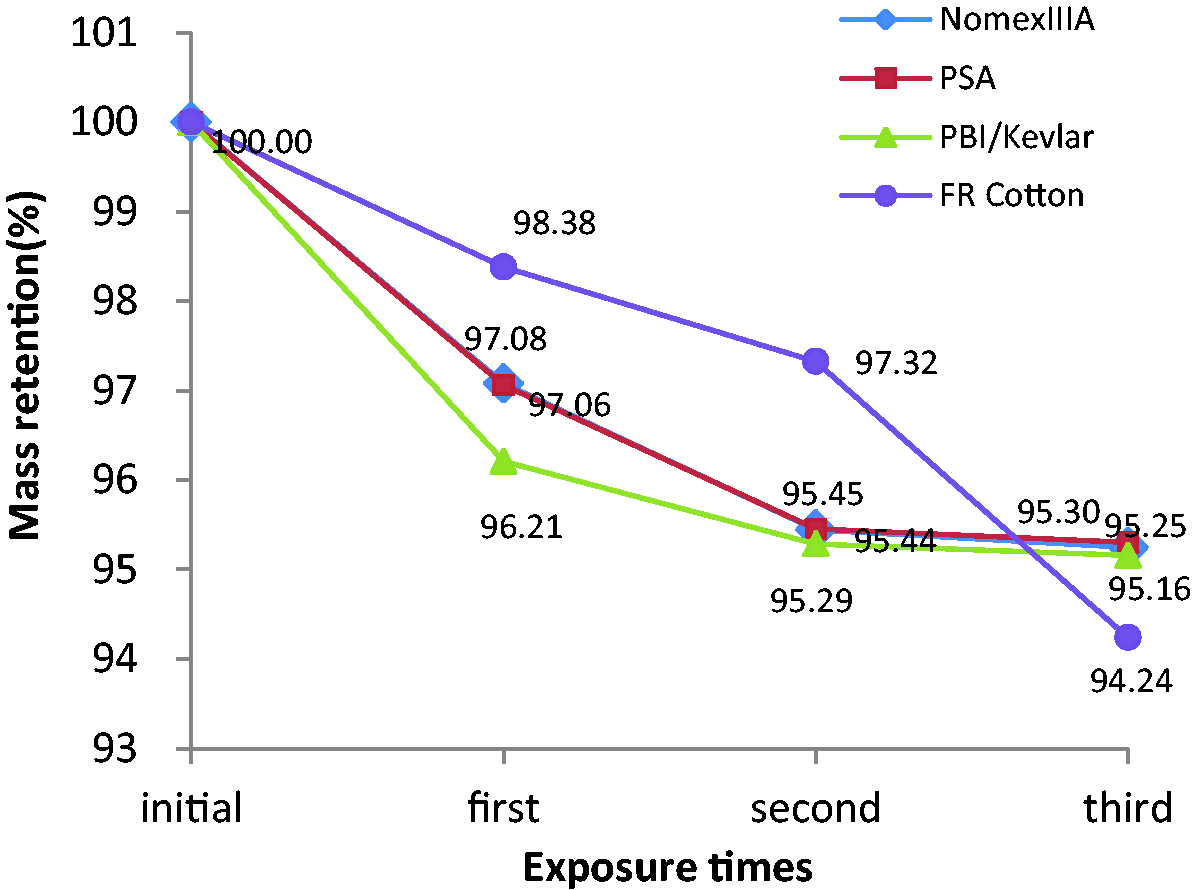
Thermal shrinkage of the fabric was characterized by the surface area change. Figure 4 illustrates the effect of repeated exposure on the thermal dimensional stability of the test specimens. Significant shrinkage occurred with both Nomex IIIA and PSA fabrics. The surface areas of the test specimens continued to decrease after each exposure. It was found that Nomex IIIA fabric specimens showed 20% surface area decrease and PSA fabric exhibited 24 % at the end of the third exposure. Compared with Nomex IIIA and PSA, the PBI /Kevlar and FR cotton fabric specimens showed excellent thermal dimensional stability. About 98% of the original surface area was retained after three repeated exposures. The Nomex IIIA, PSA, PBI/Kevlar fabrics are all composed of oriented polymer materials. When the materials are heated, the internal stresses resulted from the spinning and drawing processing during the fiber formation process tend to relax and the macromolecule chains tend to retract from extended conformation to random coil, resulting in shrinkage in the length direction of the fiber [25]. Glass transition temperature (Tg) and crystallinity are two key factors determining the shrinkage behavior of a fiber [26,27]. The higher Tg of PBI (400℃) and crystallinity (75.5% below the temperature of 350℃) of Kevlar might contribute to the lower thermal shrinkage of fabrics made of the blend of PBI and Kevlar [28,29]. Besides, the effect of fabric construction on thermal dimensional stability should not be ignored, although the design of the experiment in this research was not elaborate enough to discuss this point.
Thermal shrinkage after repeated exposures represented by surface area change.
The thickness retentions of the test specimens were shown in Figure 5. Both Nomex IIIA and PSA exhibited continuous increases of fabric thickness in each exposure. At the end of the third exposure, the thickness of Nomex IIIA fabric increased 21% and PSA fabric increased 29%.The PBI/Kevlar showed slight thickness change with 5% increase after three exposures. The FR cotton kept its thickness in the first exposure and exhibited a drop in the second and third exposure. As stated by Barker and Lee [24], the momentary thickness under high heat flux conditions might be determined by interplay of lateral shrinkage causing a simultaneous thickness increase and loss of material leading to a drop in thickness. In this research, the high degree of thermal shrinkage could explain the appreciable thickness increases of Nomex IIIA and PSA. The slight shrinkage and the significant loss of material might lead to the thickness decrease of FR cotton.
Thickness retention after repeated exposures.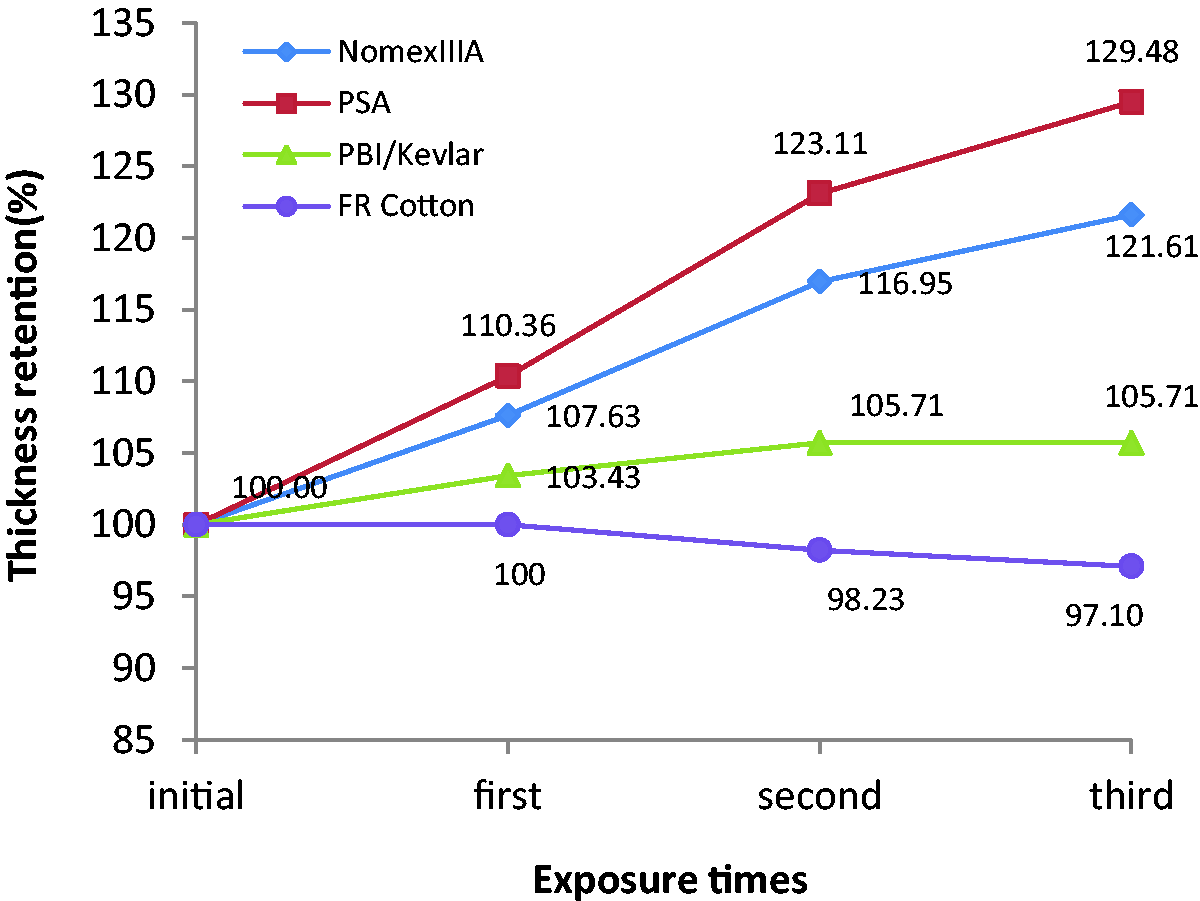
Figure 6 displays the tear strength retentions of the test specimens. A decrease in mechanical performance as a function of exposure times was observed for all the test fabrics. Although the FR cotton showed the minimal thermal shrinkage and weight loss in the first two exposures, it did experience a marked reduction in physical strength. A dramatic decrease of tear strength was observed in the second exposure and only 15% of the initial tear strength was retained at the end of the third exposure, ranking the largest tear strength loss of the four kinds of test samples. PBI/Kevlar behaved the best with approximately 73% of its initial tear strength retained after three repeated exposures. Nomex IIIA and PSA showed similar tear strength loss with the loss percentages between those of FR cotton and PBI/Kevlar. Therefore, successive short-term exposures to severe conditions appeared to have significant effect on the material's mechanical performance. Mechanical integrity is important for the overall thermal protective property of a garment. The loss of tear strength may cause the split of fire protective clothing in emergency operations, which will lead to the direct heat exposure of the wearer.
Tear strength retention after repeated exposures.
Based on the above analysis, repeated exposures caused continuous changes of the fabric basic properties. To understand these phenomena, the surface morphology of the fabric specimens was analyzed by SEM. Figure 7 displays the typical examples of pictures obtained for the unexposed Nomex IIIA specimen and specimens after repeated exposures. It was observed that the unexposed Nomex fibers displayed a very smooth surface (Figure 7(a)). After the first exposure, some fibers deformed into a more oval shaped cylinder and the fiber diameter had changed from an approximate 16 μm to 23 μm. In addition, the fractured fibers captured in Figure 7(b) indicated that the initially flexible fiber had turned brittle. After the second exposure, surface damages in the form of groove like openings, peel-offs, and material deposits were introduced as shown in Figure 7(c). And further deterioration of the fiber was observed from Figure 7(d) evidenced by the increased groove like openings, peel-offs, and deposits in number and magnitude. These observations from the SEM images were consistent with the measured increased mass loss, thermal shrinkage, and mechanical property deterioration of the test fabrics after repeated exposures.
SEM images of the unexposed Nomex IIIA specimen (a) and specimens after the first exposure (b), second exposure(c), and third exposure (d).
Thermal protection retention of the fabric
TPP values (cal/cm2) of the test specimens after repeated exposures.

PSA: polysulfonamide; PBI/Kevlar: polybenzimidazole/Kevlar; FR cotton: flame resistant cotton; TPP: thermal protective performance.
All values are means for three specimens with standard deviation (SD) in brackets.
a,b,c,dIn each column, means with the same superscript letter indicate homogeneous subsets (highest and lowest means are not significantly different) when subjected to the Student–Newman–Keuls multiple range test (P < 0.05).
Figure 8 shows the TPP retentions of the test specimens as a function of exposure times. For the contact test configuration, continuous increase of TPP was observed for most of the test specimens. Nomex IIIA and PSA even increased 35% of their initial TPP after the third exposure. This might be related to the significant increase of fabric thickness induced by thermal shrinkage. The blend of PBI and Kevlar also exhibited 17% increase in TPP after three exposures. The TPP of FR cotton was a little improved after the first two exposures and decreased after the third exposure. As mentioned before, the thickness and mass of FR cotton decreased a lot in the third exposure, which might account for the decrease of TPP. For the spaced test configuration, the result was a little different. The TPP increments of Nomex IIIA and PSA were smaller compared with those in the contact test configuration. PBI/Kevlar and FR cotton even exhibited a continuous decrease of TPP after repeated exposures. This might be due to the different thermal protection mechanism in the spaced test configuration compared with that in the contact test configuration.
TPP retention in contact test configuration (a) and spaced test configuration (b). TPP: thermal protective performance.
When the heat calorimeter was placed in direct contact with the test fabric, energy was mainly transferred by conduction. Therefore, fabric thickness was the controlling factor determining heat transfer rate. The increase of fabric thickness after repeated exposure would evidently increase the TPP value as demonstrated in previous studies [15,30]. When there was a 6.4 mm air gap between the fabric and heat calorimeter, heat transferred from burners and heated quartz tubes to the sensor was mainly by heat conduction of air, radiation transfer induced by heated fabric, and the radiation energy penetrating through the fabric. Due to the good thermal insulation of air, a large amount of energy would be stored in the fabric before the energy was transferred to the heat sensor as described in previous studies [16,31]. The continuous loss of mass and moisture in the fabric in each exposure would cause a continuous decrease of energy storage capacity, which might cause a decrease of TPP. Therefore, the TPP retention in spaced test configuration might be a balance of the positive effect of thickness increase and the negative effect of mass and moisture loss.
Thermal protection retention of the fire protective garment
Burn injury and total absorbed energy.

All values are means for three specimens with standard deviation in brackets.
a,bIn each column, means with the same superscript letter indicate homogeneous subsets (highest and lowest means are not significantly different) when subjected to the Student–Newman–Keuls multiple range test (P < 0.05).

Thermal protection retention after repeated exposures.
In the bench-scale test, the TPP value of Nomex IIIA increased with the increase of exposure times, indicating an increase of thermal protective property of the fabric. While in the full-scale manikin test, the thermal protection provided by the garment decreased after repeated exposures. The difference between bench-scale test and full-scale manikin test result might be related to the different work mechanism of shrinkage on thermal protection. In the bench-scale test, thermal shrinkage improved the TPP by increasing the fabric thickness, while in the manikin test it might reduce the air gap size between the garment and manikin. Figure 10 presents the 3D images of the superimposed nude manikin and clothed manikin. It could be found that the ease allowance of the garment was significantly reduced after flash fire exposure. Table 4 shows the air gap size change after repeated exposures. It was observed that the average air gap thickness and air volume of the garment kept decreasing and the decrements after the first exposure were the largest. The decrease of air gap size due to shrinkage would accelerate the heat transfer from the garment to human body, resulting in the decrease of thermal protection level of the garment. It could be seen that thermal shrinkage had a complicated impact on thermal protective property. The thermal protection retention of the garment was affected by the interplay of fabric thickness increase and air gap size decrease.
Ease allowance of the unexposed Nomex IIIA garment (a) and the garment after first exposure (b), second exposure(c), and third exposure (d). Air gap size retention after repeated exposures.

Conclusions
In this paper, the level of thermal protection retained by the fire protective clothing after successive short-term exposures to severe condition was investigated. Significant reduction on the tear strength was observed, indicating continuous deterioration on the mechanical property of the fabric and a decrease of mechanical protection. The TPP of fabrics with severe thermal shrinkage such as Nomex IIIA and PSA was improved due the increase of fabric thickness. While for the fabrics with good thermal dimensional stability such as FR cotton, the TPP was decreased due to the loss of thickness and mass. It was indicated that different FR fabrics exhibited different thermal protection retention ability. Although the TPP of Nomex IIIA fabric was improved after repeated exposures, the thermal protection provided by the Nomex IIIA garment exhibited continuous decrease in the manikin test. Thermal shrinkage was thought as a significant factor determining the thermal protection retention of fire protective clothing. On one hand, it might improve the TPP of fabric by increasing the fabric thickness; on the other hand, it might decrease the thermal protective property of the garment by reducing the size of air gaps entrapped between the garment and human body. In summary, repeated exposures to intensive heat would cause continuous reductions in mechanical and thermal protection provided by fire protective clothing, and increase body burn injuries of the wearer. Thus, the performance evaluation of fire protective clothing should include both the initial test and the retention test on the selected properties. As the bench-scale test results are in direct contradiction to the manikin test results from this study, more studies should be undertaken on system level or fully engineered garment to understand the complex influences of human body shape, movement, garment design, and other thermal protection parameters on the retention of thermal protective property in the future.
Footnotes
Declaration of Conflicting Interests
The author(s) declared no potential conflicts of interest with respect to the research, authorship, and/or publication of this article.
Funding
The author(s) disclosed receipt of the following financial support for the research, authorship, and/or publication of this article: This work was financially supported by the Fundamental Research Funds for the Central Universities (15D110713/16) and the Open Project of National Key Laboratory of Human Factors Engineering.