




Abstract
The present work deals with the identification of a new natural fiber from the Phoenix sp. plant and their characteristics were studied for preparing the fiber-reinforced polymer composites. This fiber was extracted by simple manual peeling process. Physico-chemical and mechanical properties are studied according to the standards. The morphology of the fiber was studied by using scanning electron microscopy. X-ray diffraction and Fourier transform infrared spectroscopy are used to identify the crystallinity index and chemical groups present in the fiber, respectively. The fiber has an average diameter of 577 µm and density of 1.2576 g/cc. The cellulose, lignin, wax, ash, and moisture contents present in the fiber are 76.13%, 4.29%, 0.32%, 19.69%, and 10.47%, respectively. The crystallinity index was 57%. The Griffith model was used to obtain the average values of diameter and tensile properties of Phoenix sp. fiber. The maximum tensile strength and Young’s modulus were around 348.95 MPa and 7.62 GPa, respectively. The Phoenix sp. fiber properties were compared with the properties of existing natural fibers.
Keywords
Introduction
Past three decades the industrial sectors have focused on the use of natural fiber-reinforced polymer-based products for industrial components, domestic applications like door panels, windows, furniture appliances, and automotive components like seat cover plate, door parts, dashboards, roof frame, back rest, etc. The natural fibers have been extracted from various parts of plants such as plant stems, leaves, seeds, fruits, petioles etc. The physical, chemical, mechanical, and structural properties of above fiber are varied based on climatic conditions, types of soil, and availability of water resources. The chemical compositions are cellulose, hemicellulose, wax, pectin, lignin, ash, and moisture contents. Physical properties like density and diameter plays an important role in making the polymer composites. The weight of the polymer matrix composite depends on the fiber density and volume fraction.
Many researchers have identified different natural fibers from a variety of plants growing in different parts of the world. The fiber characteristic studies were carried out to identify its potential to use it as reinforcement in polymer matrix composites. Boopathi et al. [1] extracted the borassus fiber manually from borassus fruit and its properties were studied for raw and alkali-treated fibers. To remove the impurities and unwanted substances from the surface of fiber, it was chemical treated with 5%, 10%, and 15% concentration of NaOH. The physical properties of the raw and treated fiber were determined using water displacement method and air wedge shearing interferometer. The chemical and mechanical properties of borassus fruit fibers were determined experimentally. Sathishkumar et al. [2] identified the new Sansevieria ehrenbergii fibers from snake grass plant available at Southern part of India. These fibers were extracted by using mechanical decorticator and its physical, chemical, mechanical, and thermal properties were investigated through Fourier transform infrared (FTIR), X-ray diffraction (XRD), single fiber tensile testing, and thermogravimetric analysis (TGA)/differential thermogravimetry (DTG), respectively. The tensile mechanical properties, chemical composition, and morphological aspects of pissava fibers were reported by d’Almeida et al. [3]. The pissava fiber was extracted from the leaves of a palm tree at the Brazilian Atlantic rain forest for the investigation. This fiber has cellulose and lignin contents of 31.6% and 48.4%, respectively. Da Silva et al. [4] studied the mechanical tensile properties of raw buriti fibers with 20 samples using EMIC DL2000 Universal Testing Machine. The average fiber diameter of 182 ± 12 µm and gage length of 50 mm was used for the investigation. The tensile strength and modulus of buriti fibers were 271 ± 72 MPa and 10.2 ± 2.2 GPa, respectively. This fiber has a density of 1.312 ± 0.009 g/cc and was measured by using helium picnometer.
Sarikanat et al. [5] extracted the Althaea officinalis fibers from its plant stem by immersing it in an acetone solution and heating to its boiling point temperature. The bundle of fibers was separated easily after 2 days of submerging it in water. The cellulose, hemicellulose, and lignin contents present in the fiber were determined by using Van Soest’s detergent method. According to ASTM E175, the ash content was determined. The moisture content was obtained through Sartorious MA45 moisture analyzer. The tensile properties of the fibers were measured by using Shimadzu Universal Testing Machine and its tensile strength and modulus values are found to be 415.2 MPa and 65.4 GPa, respectively. The TGA results revealed that the althaea fiber starts degrading at a temperature of 220℃ and fully degraded at 344℃. This fiber has a crystallinity index of 68% obtained through XRD analysis. Guimaraes et al. [6] presented the physical, chemical, mechanical, and thermal aspects of banana, sponge gourd, and sugarcane bagasse fibers. The moisture, lignin, and holocellulose were 8.57%, 17.44%, and 50.92% for banana, 4.79%, 15.46%, and 84.03% for sponge gourd, and 9.21%, 23.33%, and 71.39% for sugarcane bagasse, respectively. These properties were measured according to ABNT NBR 9656, TAPPI T13M-54, and TAPPI T19M-54 methods, respectively.
Davies et al. [7] studied the morphology, tensile properties, and chemical constituents of sea-grass fibers. In addition to this, sugar analysis was carried out using colorimetric method to determine the amount of uronic acids and total sugars present in the fiber. Fiore et al. [8] characterized the artichoke fibers as potential reinforcement in polymer composites. The artichoke fibers were extracted through water retting process and its physical, chemical, thermal, mechanical, and morphological characteristics were studied. The isora fiber was separated from the bark of Helicteres isora plant by retting process and their chemical constituents, morphology and physical properties have been studied by Mathew et al. [9]. The orka fibers were extracted from the orka stem and it belongs to malvaceae family from Egypt. Its reinforcement potential in polymer composites were analyzed by De Rosa et al. [10]. The morphology of the fiber was examined through SEM and degradation temperature of this fiber was 220℃ identified through TGA. The tensile strength of the fiber was determined according to ASTM D 3379-75. The extraction and tensile properties of natural fibers like vakka, date, and bamboo were presented by Murali et al. [11]. The vakka fibers were separated from foliage of tree through water retting process, date fibers were removed from their stems and scarped with knife to remove the impurities, and bamboo fibers extracted by manual decorticated process.
Reddy and Yang [12] reported the development of new natural cellulose fibers from hop stems belongs to cannabaceae family and its composition, structure, and properties were measured and compared with cotton and hemp fibers. The cellulose, klason lignin, and ash contents were measured according to AOAC 973, ASTM D1106-96, and ASTM E 1755-01, respectively. Silva et al. [13] identified that there was large difference in tensile strength and Young’s modulus of natural fibers due to uncertainties in the fiber cross-section measurements and chemical composition. The tensile strength of sisal fiber with different gage length like 10 mm, 20 mm, 30 mm, and 40 mm was obtained through microforce testing system. The interfacial adhesion of date palm fiber with epoxy matrix was investigated by Alsaeed et al. [14] and measured the tensile properties of fiber using single fiber pull out technique. The fibers were treated using NaOH solution with different concentrations from 0 to 9% and identified that 6% concentration of NaOH was the optimum solution through mechanical properties.
Fiore et al. [15] studied the possibility of using arundo donax as reinforcement of polymer composites. The fibers were extracted from its stem by mechanical separation and the following characteristics were studied. The pycnometer was used to determine the real density of Arundo donax fibers. The moisture content and tensile properties were determined according to ASABE S358.3 and ASTM D3379-75, respectively. This fiber starts degrading at a temperature of 275℃ and was identified through TGA. Rahman Khan et al. [16] conducted the tensile test for hemp fibers using Universal Testing Machine. The hemp grown at target seeding rates of 50, 100, and 350 plants per square meter were used for the experiment and its effect on the tensile strength and fiber finesse were investigated. Also, the variations on the fiber properties of the hemp grown under the same climate were evaluated.
Defoirdt et al. [17] measured the tensile properties of coir, bamboo, and jute fiber through mini tensile machine by assuming that the individual fibers have constant cross section over its length. Fidelis et al. [18] correlated the morphology of natural fibers with their mechanical properties through image analysis. A systematic study of tensile behavior of the sisal, jute, curaua, coir, and pissava fibers were presented. The imperfect circular cross section of all fibers was measured using SEM and image analysis system. Also the variability of the fiber properties was quantified using Weibull statistics, and the relationship between fiber strength and microstructure was discussed. When compared to all other fibers, curaua fiber has higher tensile strength and Young’s modulus of 543 MPa and 63.7 GPa, respectively.
Razali et al. [19] investigated the physical, chemical, thermal, and morphological characteristics of roselle fiber at different maturity levels. The results revealed that the 3-month-old fiber has higher strength and stability due to highest cellulose content, and 9-month-old roselle fiber has highest value of density and diameter due to maturity of plant. The physical, mechanical, thermal, and morphological properties of betel nut husk fiber at different levels of maturity were investigated by Yusriah et al. [20] and identified that the diameter of fiber decreased from raw to mature stage and the ripe stage fiber has higher moisture content and tensile strength. Ishak et al. [21] analyzed the recent advances in the sugar palm fibers, polymer from sugar palm and their composites. Moreover, the efforts made to enhance the properties of sugar palm fiber composites were investigated.
From the above literature survey, it is found that the natural fibers were extracted from different parts of plants like stems, leaves, petioles, fruits, seeds, etc. by various methods and their physical, chemical, mechanical, morphological, and thermal properties were investigated according to international standards. The demand for natural fiber in the world market needs to identify new fiber from the natural resource for better utilization. One such natural fiber is identified from Phoenix sp. plants. The fiber was extracted from the petioles of Phoenix sp. plants and their characteristics were studied to determine its suitability of using it as reinforcement in polymer matrix composites.
Fiber extraction
The Phoenix sp. plants are abundantly available in the forests and are growing in the countries like Africa, China, Turkey, Canary Island, India, etc. The fruit of this plant is very small and contains deep groove seed covered by thin layer of pulp, which is rarely eaten by humans. The pollination of this plant is by wind and insects. An average of 0.5 tonnes of fiber was obtained per acre annually. The yielding depends on fertility of soil and availability of water. The Phoenix sp. plant was identified in Coimbatore, Tamil Nadu, South India as shown in Figure 1(a). A plant consists of 15 to 25 petioles and the plant life is around 20 years. This plant yields 35 to 42 petioles per year. The length of the petioles is around 2.5 feet to 5 feet. These petioles as shown in Figure 1(b) is obtained by removing the leaves and are cut to required length by using knife and immersed in water for 15 to 20 days for extraction. During this water retting process each petioles are completely wetted, so that the gum-like materials present in between the fibers are separated, then it is washed in running water to remove the unwanted materials. After that, the single fiber is extracted by manual peeling process as shown in Figure 1(c). Again this fiber is washed in running water to remove the excess plant materials on the surface of fiber and then dried in sunlight for 8 to 10 h to remove the water content. Finally, the bundle of dried fibers is collected as shown in Figure 1(d) for further investigation.
Phoenix sp. fiber extraction: (a) Phoenix sp. Plant; (b) petioles immersed in water; (c) manual extraction of fibers; (d) bundle of extracted fibers.
Experiments
Physical properties
The density of the raw fiber was determined by using Archimedes method according to ASTM D 3800-9 [5]. A weighted quantity of raw fiber was fully immersed in water and the volumetric displacement of water was observed. The ratio between weights of fiber to the volume of water displaced gives the density of fiber. An image analyzer was used to measure the diameter of the raw fibers [13,18]. The images of raw fiber samples are taken and then post process is carried out in Image Pro-Plus software to determine its diameter.
Chemical properties
A known weight of raw fiber was immersed in diluted water which was prepared by using a mixture of 1.72% of sodium hypochlorite and few drops of sulphuric acid. After 1 h of soaking time the residue is collected, dried at room temperature, and weighed [1]. Then the percentage of cellulose content in the raw fiber is determined by using the following expression

The insoluble lignin present in the Phoenix sp. fiber was determined based on Klason lignin of APPITA P11s-78 method [2]. The samples of raw fibers were hydrolyzed with 72% of sulphuric acid in an ultrasonic bath for 1 h at a controlled temperature of 30℃. Then it is mixed with methylene chloride and placed in autoclave for 1 h at a temperature of 125℃. The percentage of lignin content present in the fiber was determined by using the following expression

Soxhlet apparatus was used to determine the wax content present in the Phoenix sp. fiber [1]. A known weight of raw fiber was immersed in a petroleum benzene liquid, which was at a temperature of 100℃. After 4 h of reflux time the fiber was dried and weighted. The weight difference gives the wax content in the fiber.
The moisture content present in the fiber was obtained by weight loss method. A known weight of fiber was placed in a hot air oven at a temperature of 105 ± 5℃ for 4 h. Then the fiber was taken out from the furnace and weighted. The difference in weight yields moisture content in the fiber. Then the percentage of moisture content present in the raw fiber was determined by using the following expression [2]

A known weight of raw fiber samples were kept in a muffle furnace. The temperature inside the furnace was kept around 650℃ for 1 h. The heating of fibers gives the ash content in it. The percentage of ash content was determined by weighting the sample.
The functional compounds present in the raw fiber were determined through FTIR (Thermo scientific NICOLET IS10) [1]. The spectral outputs in the range of 4000–500 cm−1 at a room temperature of 30℃ and relative humidity of 65% were recorded in absorbance mode as a function of wave number.
The powder X-ray diffraction method was used to determine the crystallinity of the raw fiber. The analysis was carried out at room temperature under the conditions of current 30 mA and voltage 40 kV with Cu anode. Continuous scanning mode with a range of 4°–90° and a scanning speed of 10°/min is used. The crystallinity index (Icr) was calculated by using the following expression [6]

Mechanical properties
The tensile strength of Phoenix sp. fiber was determined according to ASTM D 3822-01 [2,22]. Thirty samples of raw fibers in each gage length of 20 mm, 30 mm, 40 mm, 50 mm, and 60 mm were tested using INSTRON 5500 R Universal Testing Machine to determine its tensile strength at 65 ± 1.5% relative humidity and temperature of 21 ± 1.5℃ with a cross-head speed of 10 mm/min. A 1.0 kN load cell was used to measure the load. The compliance of the loading and gripping system was determined by obtaining the force versus displacement behavior of the fiber at various gage lengths [2,13,18]. The total cross-head displacement δt was expressed as follows

Morphological characteristics
The morphology of Phoenix sp. fiber was studied by using SEM model of JEOL-JSM-6390 [1,2]. The instrument scanned the surface with high-energy electron beam. The SEM produces very high-resolution three-dimensional images, which is very much useful for understanding the surface morphology of fibers.
Results and discussion
Physical properties
The density value of Phoenix sp. fiber was found to be 1.2576 g/cc. It has been noticed that the density value of this fiber is comparatively lower than artichoke [8], borassus fruit fiber [1], hemp, sisal, flax, sea grass, and oil palm fibers [2]. It was higher than Sansevieria ehrenbergii, Sansevieria rifasciata, bamboo, Sansevieria cylindrica, elephant grass, coir, date, and palmyrah fibers [2]. Moreover, it was closer to ferula communis [23], bagasse, agave, and henequen fibers [2].
The porosity of this fiber is as similar to coir, Sansevieria ehrenbergii, bamboo, elephant grass, date, palmyrah fibers, etc. This will increase the bonding area between matrix and fibers and reduce the water absorption when exposed to different environmental conditions. Moreover, the porosity has significant effect on tensile strength.
Any natural fiber does not have uniform diameter throughout its length. It depends on place and condition where the plant grows. Optical microscope was used to take the image of the fiber in longitudinal direction and these images were imported to image analyzer software to measure the diameter of 30 samples at five places. The diameter range of Phoenix sp. fiber for 30 samples was 316 µm to 1124 µm. The average diameter of this fiber was calculated to be 577 µm.
Chemical properties
Chemical composition of Phoenix sp. fiber and other natural fibers.

FTIR
The FTIR analysis was carried out to identify the chemical compounds present in the raw Phoenix sp. fiber. The FTIR spectrum for a Phoenix sp. fiber is shown in Figure 2.
FTIR spectra of a Phoenix sp. fiber.
The absorbance peak at 1034.20 cm−1 represents the presence of C–O and O–H stretching vibration, which belongs to polysaccharide in cellulose and the band at 1242.32 cm−1 and 1370.40 cm−1 corresponds to the C–O stretching vibration of the acetyl group in lignin and bending vibration of C–H, respectively [10]. The peak at 1607.33 cm−1 and 2360.60 cm−1 indicates the presence of C–O stretch of acetyl group of hemicellulose and O–H stretch of carboxylic acids, respectively [1]. The band at 2921.03 cm−1 represents the characteristic band for the C–H stretching vibration from CH and CH2 in cellulose and hemicellulose components [15]. The peak that appears in 3345.14 cm−1 corresponds to O–H stretching vibration and hydrogen bond of the hydroxyl groups [10].
XRD analysis
The X-ray spectrum corresponding to raw Phoenix sp. fiber is shown in Figure 3. The spectrum shows two peaks at 2θ = 18.50° and 2θ = 22.60°. These two peaks are attributed to (2 0 0) and (1 1 0) crystallographic plane family of cellulose I and IV [24]. The crystallinity index (Icr) is the measure of amount of crystalline cellulose and is determined as 57%, which is greater than that of banana, bagasse, sponge gourd, and Prosopis juliflora bark fibers [6,24].
X-ray diffraction patterns of Phoenix sp. Fibers.
Morphology of Phoenix sp. fiber
The morphology analysis for raw Phoenix sp. fiber is carried out using SEM. The surface of fiber is irregular and contains impurities, and organic materials are observed from Figure 4. The amount of impurities and organic materials present on the surface of fiber depends on extraction process used and condition under which the plant grows. The surface of the fiber should be such that it possesses good interfacial adhesion with polymer matrix. For this purpose, the impurities and other organic materials present on the surface of fiber must be removed by using various chemical treatments. This fiber needs chemical treatment before the preparation of polymer matrix composites to remove the impurities and also to enhance the interfacial adhesion with polymer matrix.
SEM images of Phoenix sp. Fiber: (a) 100× and (b) 300×.
Microfibril angle and tensile strength of Phoenix sp. fiber
This microfibril angle has a profound effect on stiffness of the fiber, i.e. greater microfibril angle results in low stiffness. The fiber should have the microfibril angle less than 20° for better properties. The microfibril angle of Phoenix sp. fiber is 11.67° comparable to Prosopis juliflora fiber [24].
The microfibril angle of Phoenix sp. fiber was derived from the global deformation. Let lf be the length of microfibrils of angle (α) with the fiber axis. The change in orientation of microfibrils occurs due to tension in fibers and a corresponding fiber lengthening Δl [15].


The tensile strength and Young’s modulus of Phoenix sp. fiber for different gage lengths are shown in Figure 5. The tensile test was carried out for 25 samples of Phoenix sp. fiber from each gage length and their maximum tensile strength were determined. Compared to all others, gage length of 20 mm has maximum tensile strength of 348.95 MPa and it possesses Young's modulus of 7.62 GPa with a strain rate of 1.66%. The shorter length has higher strength which is due to less number of flaws and porosity in the fiber.
Mechanical properties of Phoenix sp. fiber: (a) tensile strength and (b) Young’s modulus.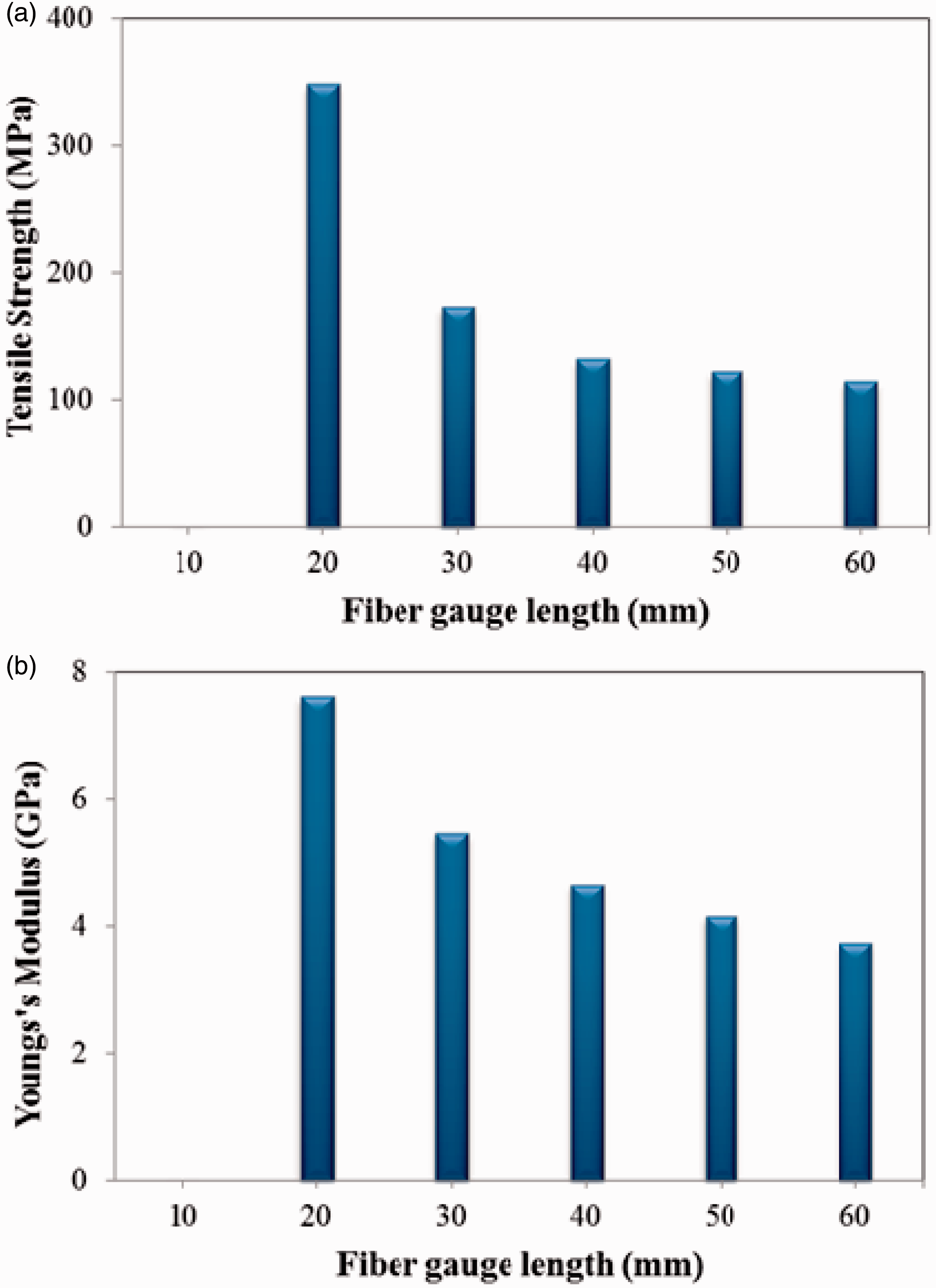
Figure 6 shows the maximum load-carrying capacity of the Phoenix sp. fiber for different gage lengths and its corresponding strain rate. It is observed that the load-carrying capacity of fiber with 20 mm is higher and it decreases corresponding to increase in gage length. This is because the increase in gage length results in more number of flaws in fiber and it tends to propagate quickly resulting in failure with less tensile load, which reduces the load-carrying capacity of the fiber. This shows lowest tensile strength and Young’s modulus.
Load vs strain for different gage length of Phoenix sp. fiber.
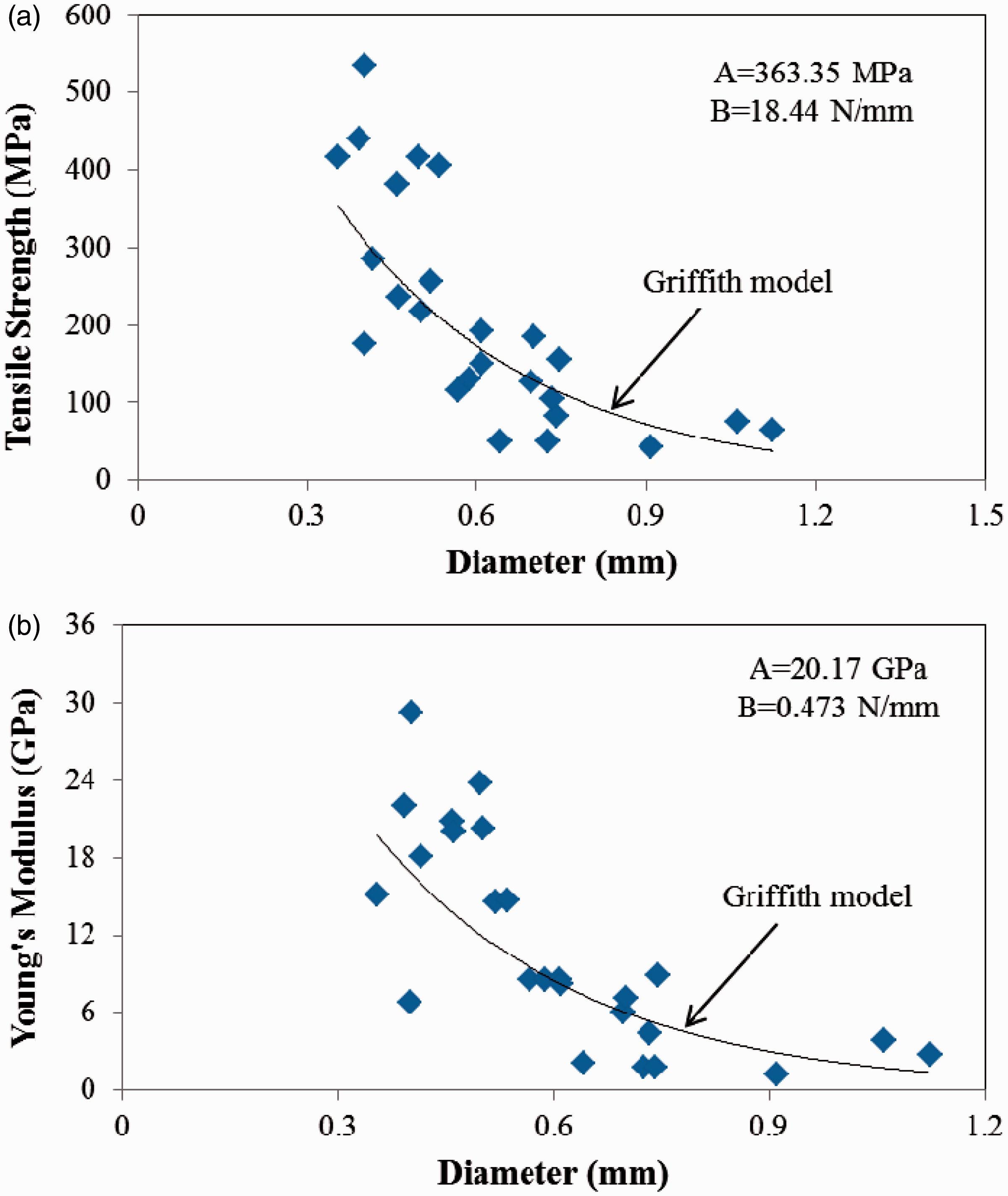
Figure 7 shows tensile strength and Young’s modulus of Phoenix sp. fiber as a function of diameter. An attempt was made to model the variation of tensile strength and Young’s modulus with fiber diameter using Griffith model through the following expression [8,10,15,25]
Experimental data and Griffith model for: (a) tensile strength and (b) Young’s modulus.
Conclusions
The new natural fiber from Phoenix sp. plant was extracted by manual peeling process and their physico-chemical, mechanical, and morphological characteristics were studied. The following conclusions were obtained from the above discussion.
The density of the Phoenix sp. was found to be closer with other existing natural fiber and it is favorable for preparing the lower weight polymer matrix composites. The average diameter of this fiber is found to be 577 µm. This fiber has higher cellulose content of 76.13 ± 3.8%, which provides high stability and rigidity. The other chemical properties are comparable to existing natural fibers. The mechanical properties of Phoenix sp. fibers with different gage length were determined by single fiber tensile test. The short fiber had maximum tensile strength of 348.95 MPa and Young’s modulus of 7.62 GPa. This was due to the presence of less number of flaws. Moreover, the microfibril angle was determined and Griffith model was used to fit the experimental datas. The Phoenix sp. fiber has a crystallinity index of 57% obtained from XRD analysis. In FTIR spectrum, the absorbance peak represents the presence of C–O stretching of acetyl groups and O–H stretching of hydroxyl groups and carbolic acids.
From the above conclusion, the Phoenix sp. fiber is one of the natural fibers that has potential as reinforcement for preparing polymer matrix composites. A further development of this research work is to investigate the properties of polymer matrix composites reinforced with Phoenix sp. fiber, and suggest it as an alternate reinforcing material for manufacturing of industrial and domestic products like automobile interiors, roof sheets, tables, chair, decorative products, toys, etc.
Footnotes
Declaration of Conflicting Interests
The author(s) declared no potential conflicts of interest with respect to the research, authorship, and/or publication of this article.
Funding
The author(s) received no financial support for the research, authorship, and/or publication of this article.