




Abstract
Sonic velocity of knitted fabric samples was measured by Dynamic Modulus Tester, and the relationship between changes in the mechanical properties and their sonic velocity was investigated. Through the measurements, sonic velocity was found to be highly correlated not only with fabric static elastic modulus but also with fabric breaking strength, breaking extension, and work of rupture. Sonic velocity, as found, depends on the direction of measurement, walewise or coursewise, and is a linear function of the number of wales and courses per centimeter and loop-shaped factor. Furthermore, the effect of applying dynamical loading on the fabric leads to changes in fabric mechanical and structural properties, which can be patterned through the measurement of their sonic velocity. The dynamic modulus tester measured the velocity of sonic pulses in materials. This technique will help in prediction of the change in mechanical properties of the fabric tensioned structures during their service life.
Introduction
Ultrasonic pulse velocity is a valuable technique for characterization of composites material for detection of defects in structures and assessment of damage as non-destructive testing [1]. Mechanical properties of a fabric tend to deteriorate more with the application of a dynamic tension. Industrial textiles, especially in the sophisticated engineered applications, appear to have a future potential; the general trend therefore towards high technical textiles is found extensive usages in aircraft wing and body structures, inflatable components of satellites, spacecraft, flexible reservoirs, geotextiles, construction textiles, and 3-D fabric composites. The sonic technique of measurement is widely used in several industries as quality control non-destructive test; it is applied for inspections not only to detect voids, cracks, inclusions, precipitates, etc., but also is applied for material characteristic’s evaluation.
Sonic velocity propagation through solid material is affected by its elastic modulus (E), density (ρ) and Poisson’s ratio (ν) [2]. Sonic modulus, which offers a quick way of testing the materials, was used to analyze the orientation parameters and related mechanical properties. Ballou and Silverman [3] and Hamburger [4] introduce acoustic pulse-propagation technique to measure the modulus of elasticity for fibers and yarns. The sonic technique was applied in chemical industry to evaluate the modulus of elasticity and the effect of fiber’s degree of polymerization and molecular orientation on their dynamical properties [5,6]. Precise measurement of sound velocity can provide much insight into the physical and chemical structure of materials. Saravanan [7] showed that the dynamic modulus of different fibers from the same polymers can be compared on the basis of an equal number of molecules passing through the fiber cross section rather than on the basis of unit cross-sectional area, reliance of sonic velocity on molecules orientation and is largely intermolecular. The randomly oriented fibers have low sonic velocities ranging of sound transmission. Charch and Moseley [8] indicate that sonic modulus convinced interpretations which believed to be related to both the physical and chemical structures of synthetic fibers over a broad spectrum. The sonic methods were used to investigate other properties than the elastic modulus of yarns, such as static and dynamic strength of yarns [9], bending stiffness of fabrics [10], recovery parameters of yarns [11], and abrasion resistance of the yarns and fabrics which were chemically treated [12,13]. Křemenáková and Militký [14,15] investigated the relationship of the acoustic dynamic modulus of yarns and their twist factor and fiber orientations. Sonic modulus was found to be affected by the blending ratio of the different components [16]. Yan and Postle [17] prove that dynamic moduli measurements are also dependent on the configuration of the individual fibers within a fabric, while Blyth and Postle [18] specify that the translation of fiber to yarn results into a reduction in the level of sonic modulus corresponding to a multiple of 0.05 to 0.6 times the fiber modulus and from yarn to fabric varies from as low as about 4:1 to about 60:1, which is a function of fabric structure. The inter-relationship between sound velocity, orientation of fibers in a fabric, and material anisotropy and such performance properties as strength, stiffness, elasticity, dye ability, resilience of materials have been described [18].
In all technical textiles applications, it is important to evaluate the mechanical properties of the textile component when it is in use [19].
The longitudinal wave velocity Vs for isotropic solids is expressed as follows according to Lyons [20]

Goueygou et al. [21] illustrate that ultrasonic waves are directly influenced by material elastic parameters. In homogeneous media, the compression and shear wave velocities are related to elastic modulus

As elastic modulus depends on porosity, it is possible that there is a relationship between porosity, permeability, and ultrasonic parameters. Moreover, the value of Young’s modulus is different than sonic modulus of the fabric, this is due to the fact that the fabric is a complicated structure, so the sonic wave will propagate differently than in the case of solid isotropic material, besides the creep effect [22].
Large number of parameters has been introduced to describe the physics of textile materials and often the parameters required for each model are different, such as in the case of blending fibers of different specifications. Sound velocity is given by [23]


A vast amount of parameters are required to describe the propagation of sound waves in textile materials. Figure 1 illustrates the main factors affecting the fabric sonic wave propagation velocity, which pointed out to the complexity of the function that governed it from the fiber, yarn, and fabric parameters. Therefore, equation (2) can be modified as
Analysis of main factors affecting sonic velocity of fabric.

The Young’s modulus is related to the other properties of material such as shear modulus, bulk modulus. Therefore, the measuring of the change in sonic velocity of material means a change in Young’s modulus and other mechanical properties.
The applied stress on the industrial fabrics affects the physical and mechanical properties of fabric, for instance as in the case of architect fabrics, and filtration fabrics, causing durability problems. Their properties cannot be easily studied using the common methods of testing, so the use of non-destructive techniques for determining the physical and mechanical properties of textile material during its service life is necessary. The dynamic modulus tester for measuring the velocity of sonic pulses in materials was used.
The aim of this work is to investigate the relationship between the sonic velocity and fabric tensile properties to estimate if the dynamic loading stress can be predicted applying the sonic technique.
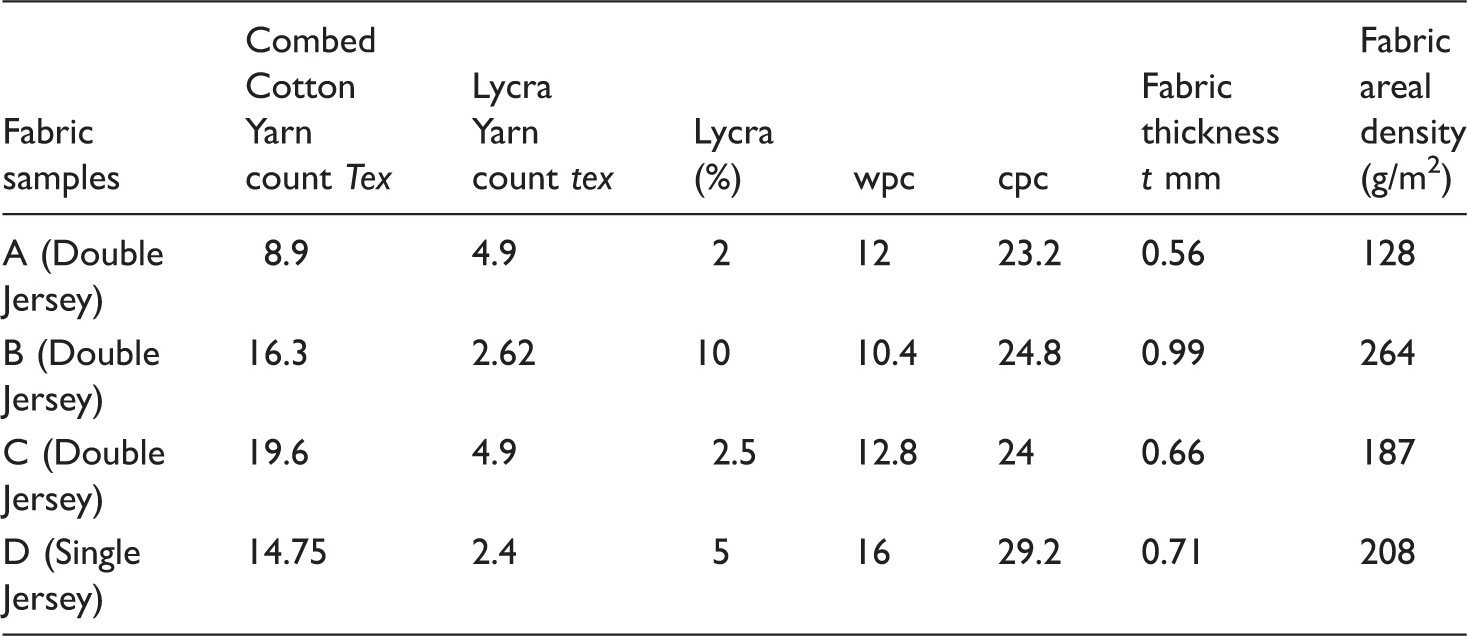
Materials and methods
Materials
Physical properties of knitted fabrics.
Face and back picture of the knitted samples.

Experimental procedures
The tensile tests were conducted on Testometric Universal Testing Machine – M250-2.5AT. Data collection was conducted through a computerized data acquisition system, and a load–extension plot was recorded to estimate the modulus of the specimen. From the four fabrics, five samples from every fabric were cut in the directions, wales and courses, with the dimensions 25.4 by 150 mm. Mechanical properties as well as sonic velocity were measured for each sample for all fabrics at different trials. For strength measurement, cut strip test was used (ASTM D5035-11), for thickness (ASTM D1777) and for fabric areal density (g/m2) (ASTM D3776).
Mechanical fatigue
Dynamic loading tester was used to change in the structure and mechanical properties, the samples of each fabric were subjected to cyclic loading with different initial extension 20%, 30%, 40%, and 50% and varied number of cycles 10,000, 20,000, and 50,000. Accordingly, the total number of treated fabric samples was 48.
Sonic velocity measurement
The fabric sonic velocity was measured on the apparatus Dynamic Modulus Tester (Lawson Hemphill) with piezoelectric crystal transducer. The acoustic dynamical modulus was calculated as function of sonic velocity and fiber mass density. The initial tensile modulus of fabrics was evaluated from smoothed stress strain curves measured on the tensile testing machine under standard conditions. The test on fabrics was contacted by two transducers at a distance “X” between electrodes, as shown in Figure 2. The time in micro second for the signal to propagate through the fabric for a distance X was measured at different values of X.
Sketch of the measuring principles of the Dynamic Modulus Tester.
Sonic velocity measurement procedure
At least eight measurements for each sample were carried out with different separation distance of 10 mm apart. The sonic velocity in km/s is determined as the slope of the straight line, as shown in Figure 3. The acoustic dynamical modulus was calculated as a function of sonic velocity and fabric mass density. Five samples from every 48 treated fabrics were tested to calculate the sonic velocity; the tests of sonic measurements were done according to the procedures given by the instruction of the MDT – system manual version 1.1. [14].
Results of the sonic wave measurements of knitted fabric.
Results and discussions
The sound wave propagation through the textile material is affected by the following factors: Fiber size, yarn structure [14,15], airflow resistance, porosity, tortuosity, thickness, and linear density [24,25]. Meanwhile, the elasticity of the material also affects the velocity of sound wave propagation. Lower material elasticity, higher Young’s modulus, results in higher sound velocity. Consequently, the positive correlation between the sonic velocity of the textile material and the Young’s modulus could be expected [4,5,7,8]. The materials of high Young’s modulus generally have high breaking strength. Accordingly, positive correlation between the fabric strength and the sonic velocity is anticipated [26].
Effect of knitted fabric surface morphology on sonic velocity
Surface morphology of the knitted fabric on the face and back depends on the weave structure and yarn physical and mechanical properties, twist factor, the use of Lycra yarn, and if it is full or half plated yarns, determining the porosity and tortuosity which may be different from back and front faces of the fabric. Sonic velocity is expected to decrease and attenuation to increase as the porosity increases [24,26]. The tortuosity is the influence of the internal structure of a material on its acoustical properties, and the structure of high tortuosity will reduce the sonic velocity [27]. The interaction between these fabric parameters will determine the sonic velocity.
Sonic velocity for face and back of fabrics A, B, C, D walewise.

Effect of the fabric geometry properties on measured sonic velocity
Sonic velocity for fabrics A, B, C, and D in walewise and coursewise.

Figure 4 illustrates the relationship between the sonic velocity and the number of wales/cm and courses/cm for the different fabrics with the correlation coefficient 0.8.
Sonic velocity versus the number both wales and course per cm.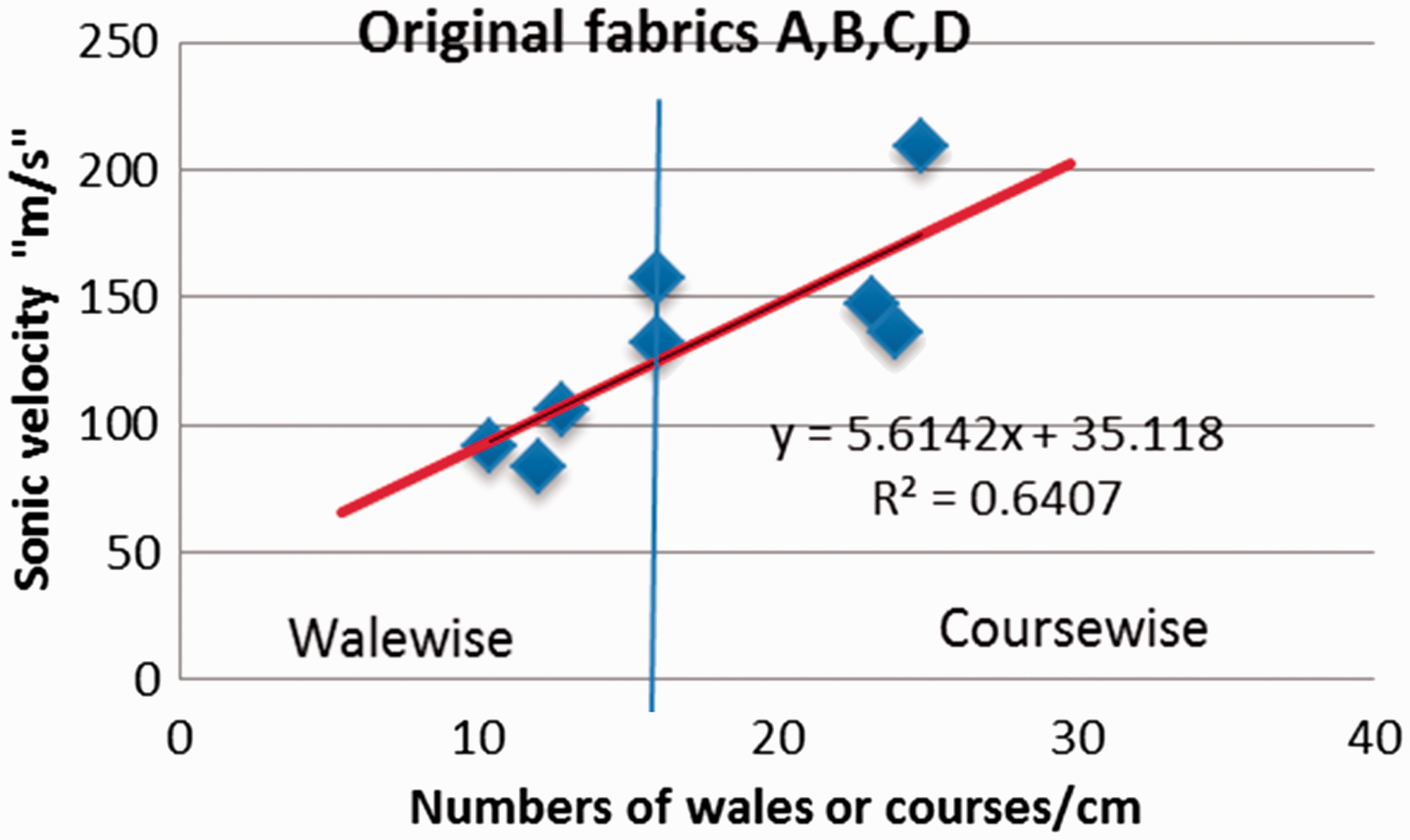
The ratio of sonic velocity in the course to that in wale direction is linearly related to the loop shape factor, as shown in Figure 5, with the coefficient of correlation 0.8.
Ratio “Vsc/Vsw” versus loop shape factor.
Relationship between sonic velocity and fabric mechanical properties
The mechanical properties of four fabrics A, B, C, and D were tested in both wale and course directions as given in Figure 6(a) and (b) which illustrates the relationship between the sonic velocity and fabric strength as well as breaking extension. In both cases, the correlation coefficient is found to be high. Consequently, it is potential to conclude that the value of sonic velocity is linearly related to the fabric’s mechanical properties.
(a, b) Strength and breaking extension versus sonic velocity of the original fabrics A, B, C, D.
Figure 7 illustrates the relationship between the static modulus of the original fabric samples and the square value of the measured sonic velocity. Young’s modulus and square of the sonic velocity has a correlation coefficient of 0.95, in spite of the difference in the fabric structure. However, the value of the constant C will be different for each fabric.
Static Young’s modulus versus square of measured sonic velocity (Vs2) of the original fabrics A, B, C, D walewise.
Influence of dynamic loading of the knitted fabrics on sonic velocity
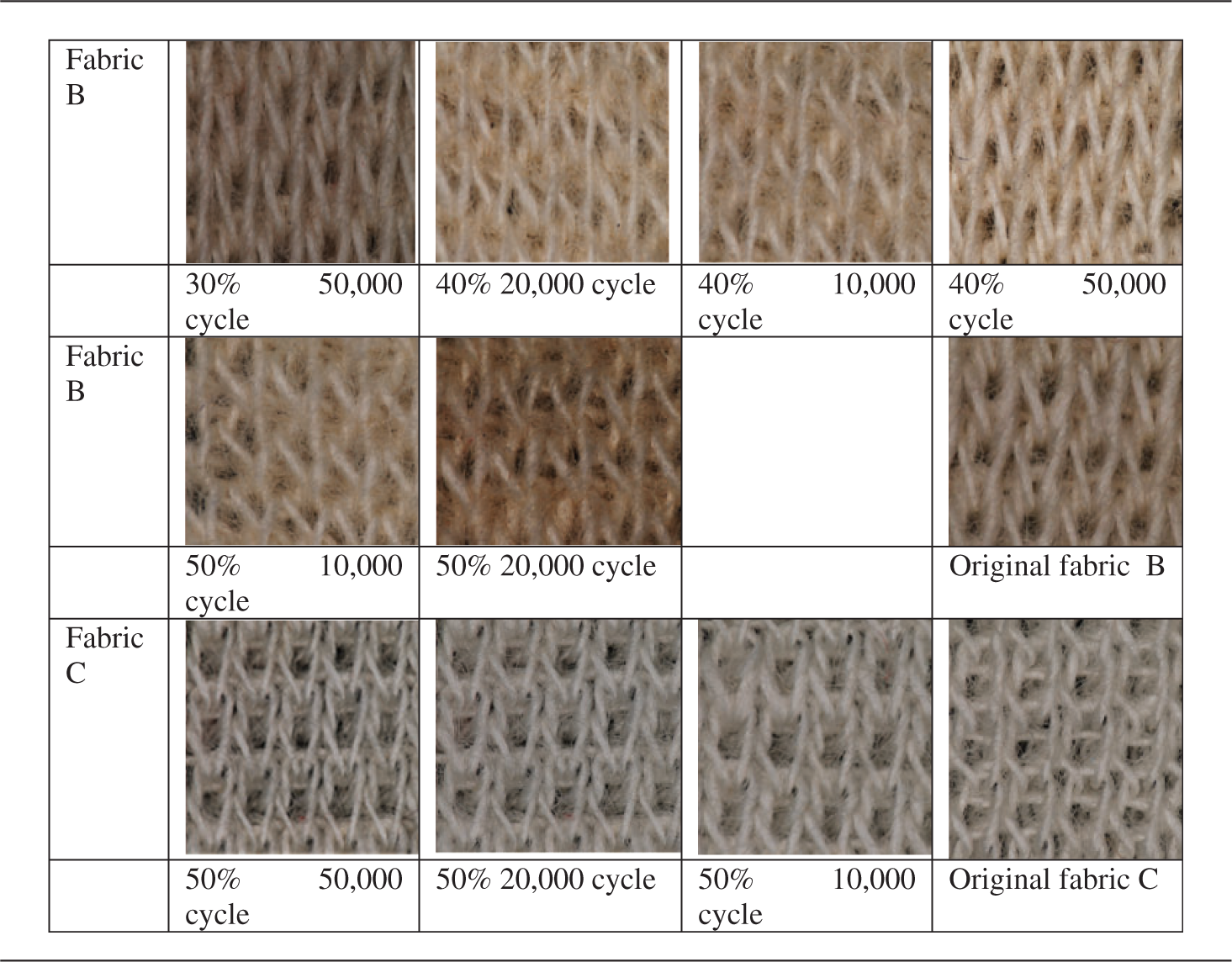
Change of fabric morphology due to cyclic loading.

Change of sonic velocity for different values of the initial extension and dynamic loading cycles for fabric D.
The analysis of the above results, Figure 8, indicates that the measurements of sonic velocity are sensitive to the change of the sample’s morphology and mechanical properties under the cyclic loading. For the detailed investigation of the relationship between the measured sonic velocity and the fabric mechanical properties, two fabrics were considered, fabric B and D.
The relationship between sonic velocity and deterioration of mechanical fabric properties under dynamic loading.
Results of fabric B
Figure 9(a) to (c) demonstrates the relationship between the sonic speed and fabric strength, breaking extension, and work of rupture. The coefficient of correlation is 0.897, 0.9, and 0.875 for strength, breaking extension, and work of rupture, respectively. Figure 9 (d) illustrates the relationship between the Young’s modulus and the square value of the measured sonic velocity which indicates the linearity of the relationship with coefficient of correlation 0.913.
(a, b, c, d) Analysis of fabric “B”. (a) Fabric strength versus sonic velocity, (b) fabric breaking extension % versus sonic speed, (c) fabric work of rupture versus sonic speed and (d) fabric Young’s modulus versus sonic speed.
The deterioration of the mechanical properties was due to the effect of dynamic loading on the samples which directly impacts on the change of the measured sonic velocity.
Results of fabric D
Figure 10 (a) to (c) demonstrates the relationship between the fabric strength, breaking extension, work of rupture and sonic velocity, coefficient of correlation is 0.925, 0.896, 0.925 for strength, breaking extension, and work of rupture, respectively, while Figure 10(d) explains the relationship between the Young’s modulus and the square value of the measured sonic velocity, indicating the linearity of the relationship with coefficient of correlation 0.9.
(a, b, c, d) Analysis of fabric D. (a) Fabric strength versus sonic velocity, (b) fabric breaking extension % versus sonic speed, (c) fabric work of rupture versus sonic speed and (d) fabric Young’s modulus versus sonic speed.
General relationship of sonic velocity and the fabric mechanical properties. Prediction of sonic velocity for fabrics B and D
The aforementioned analysis shows a definite linear relationship between the measured sonic speed and the fabric strength, breaking extension, and work of rapture, taking into consideration that these changes of the mechanical properties were due to the dynamic loading effect on the fabric at different conditions.
Figure 11(a) and (b) indicates that the calculated sonic velocity ( (a,b) Calculated sonic velocity 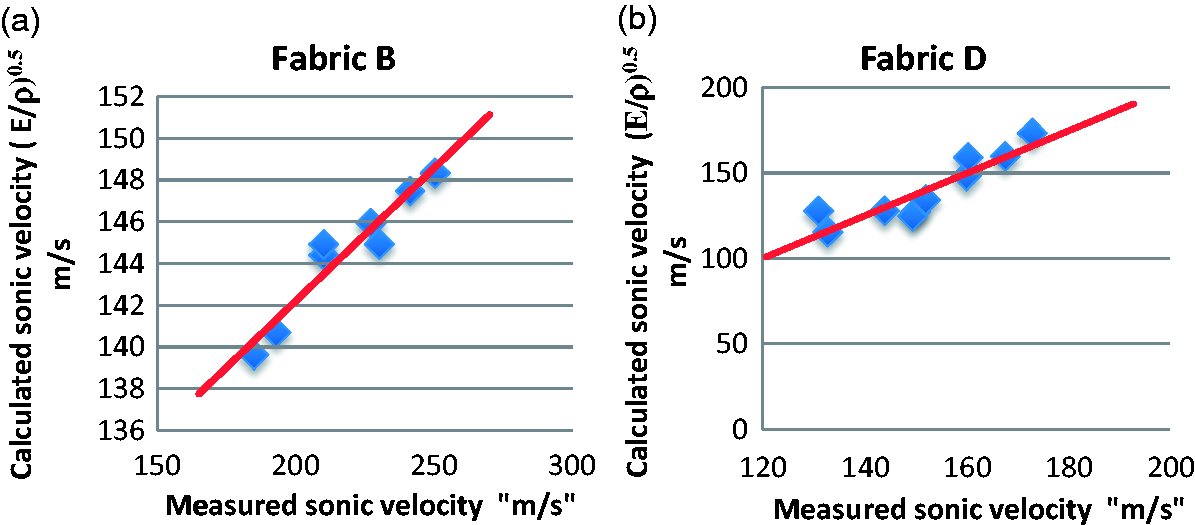
Fabric B

Fabric D

Figure (12) shows the relationship between the calculated sonic velocity by equations (4) and (5) and the measured one indicating that each fabric’s coefficient “C” is dependent not only on the Poisson’s ratio but also on fabric structure.

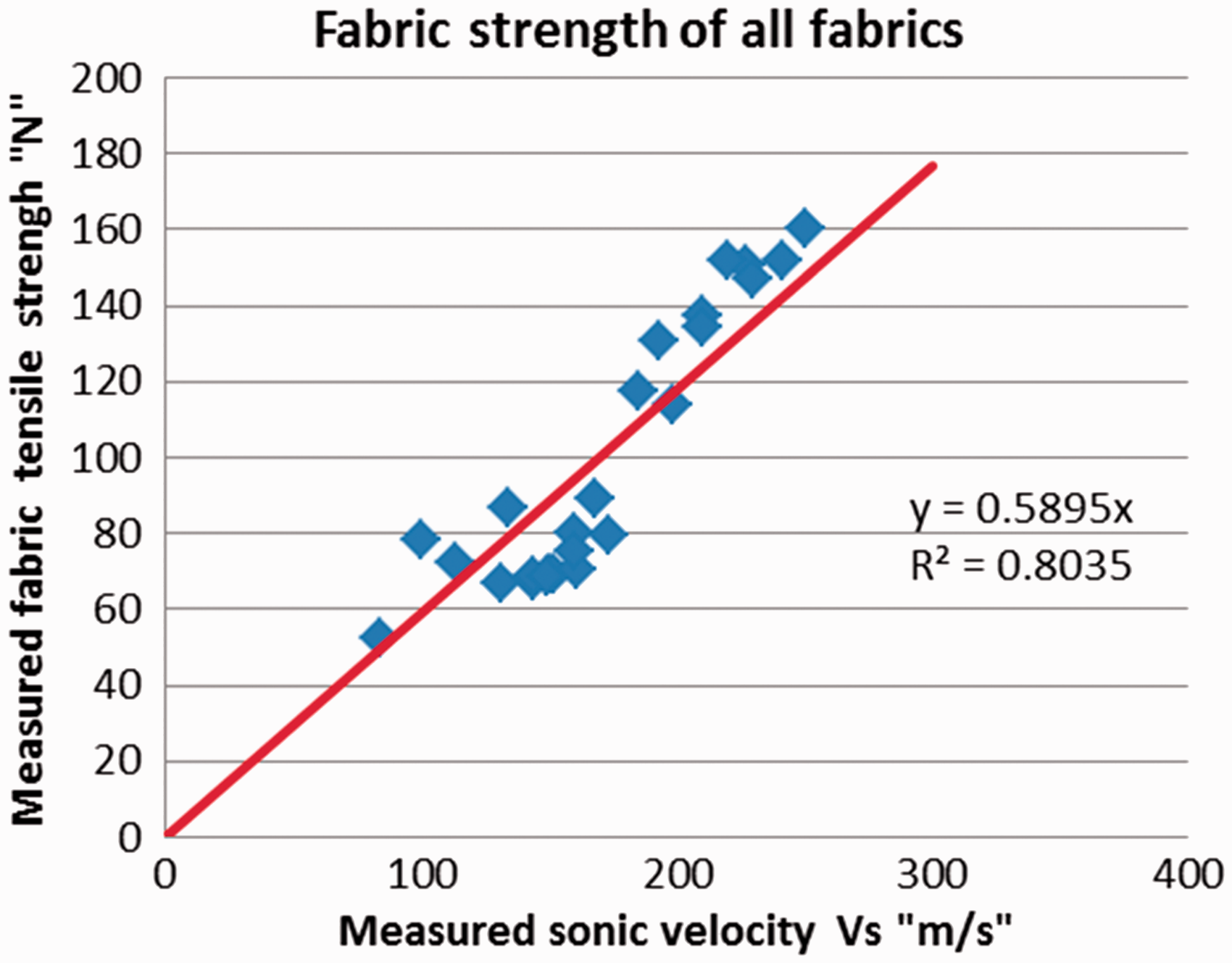
Relationship of sonic velocity and static Young’s modulus fabric strength for jersey fabric: From the aforementioned analysis, for Jersey-knitted fabric the sonic velocity reflects the complex of fabric specifications and properties. Figures (13) and (14) illustrate the relationship between the sonic velocity and the static Young’s modulus and the fabric strength for all tested fabrics.
Fabric static modulus versus sonic velocity “Vs2” for all fabric samples. Fabric tensile strength versus measured sonic velocity for all tested fabrics.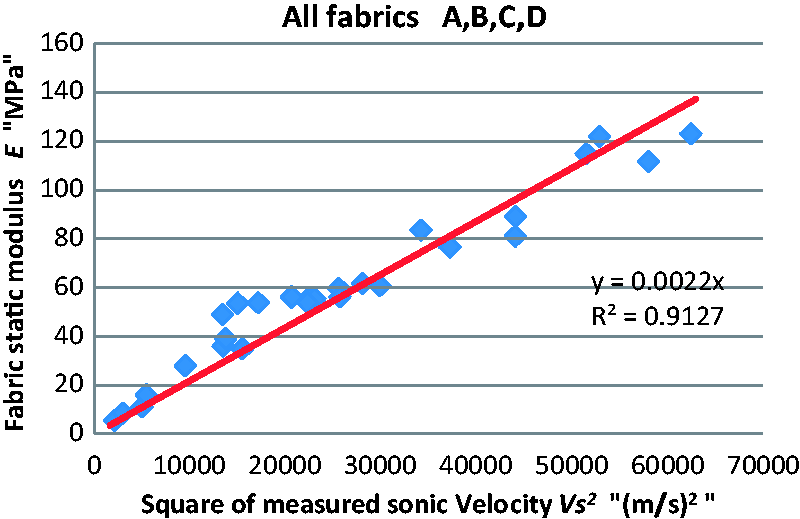
The average relationship between the Young’s modulus for all tested samples can be given by

Figure 14 indicates the relationship of the fabric tensile strength and the measured sonic velocity for all tested fabrics. The best fit is

Conclusion
The use of sonic measurement envisions the possibility to predict the mechanical behavior of a fabric. It is a valuable technique for characterization of mechanical properties of fabric and provides consistent results based on quick measurements.
In this work, it was proven that the sonic velocity can be used to predict the change in the mechanical properties of jersey fabric and, when the fabric is subjected to various types of loading conditions, similar results would be expected. That was confirmed by the achieved specific outcomes:
sonic velocity of fabric can be given by the equation Vs = sonic velocity is linearly correlated to the strength of the fabric, fabric extension, and work of rupture sonic velocity is linearly correlated with the “wpc” and “cpc” and loop shape factor.
The measurement of the sonic velocity could become the testing method for descent of textiles during their life cycle.
Footnotes
Declaration of Conflicting Interests
The author(s) declared no potential conflicts of interest with respect to the research, authorship, and/or publication of this article.
Funding
The author(s) received no financial support for the research, authorship, and/or publication of this article.