




Abstract
The objective of this research is to study the thermal comfort of simulated multilayered diaper structures in dry and wet conditions. To that end, a back sheet, breathable films, a superabsorbent core, and top sheets were provided and diaper structures were generated. In order to reveal their possible effects on thermal comfort, five different types of breathable films and two different types of top sheet layers were selected. Relative water vapor permeability, water vapor resistance, thermal conductivity, thermal resistance, and thermal absorptivity characteristics were analyzed and the results were evaluated statistically using analysis of variance tests. The test results indicated that the breathable film type and the top sheet type used showed significant changes on the breathability and thermal comfort of the diaper structures in dry state. Nevertheless, no statistically significant effects were observed in wet state.
Introduction
Aesthetics, appearance and fashion have been the main factors affecting consumer choice when selecting textile goods. In recent years, with the increase in consumer awareness, the comfort and functional properties of textiles have begun to play an important role in product selection. Comfort can be defined as “the absence of unpleasantness and discomfort” and comfort in textile products can be classified into three categories: thermal comfort, tactile comfort, and psychological comfort. Of the three, thermal comfort is generally related with the movement of heat, moisture, and air through textile materials and keeping the consumer dry while maintaining a constant body temperature [1–4].
The comfort characteristics including thermal behavior, water vapor transportation, liquid absorption, and drying ability are mainly affected by fiber type and properties (fineness, cross section), yarn properties (production method, linear density, twist), fabric structure (thickness, density, porosity etc.), and the finishing processes applied to the textile material. Many studies have been performed on the effects of fiber and constructional properties on the thermal comfort properties of knitted or woven fabrics [1, 2, 4–18]. Investigations about the influence of many processes such as wetting, washing, or embedding materials into fabrics on the thermal comfort properties of knitted or woven fabrics have also been carried out [3, 19–22]. Most of the studies about the thermal comfort properties of textile products have focused on knitted or woven fabrics. However, there are only a few studies about the thermal comfort properties of multilayered products such as diapers in dry and wet conditions despite the fact that babies or patients have to use diapers all day. Thermal comfort is a crucial property to consider designing better diapers and preventing potential dermatitis.
A typical diaper is composed of three main components: nonwoven layers (top sheet, back sheet (BS), and distribution layer), core layer, and breathable film. Each layer has a different contribution to the thermal comfort property of the multilayered diaper. Some studies have concentrated on the thermal comfort properties of one layer of diapers, i.e., breathable films by enhancing breathability with material loading. Of these, Vakili et al. [23] studied the thermal conductivity of a polypropylene-based nanocomposite containing zinc oxide (ZnO) and calcium carbonate (CaCO3) nanoparticles and they found that the thermal conductivity of the nanocomposite was improved by increasing the amount of nanoparticles. The thermal diffusivity of polyolefin composites filled with different particle sizes and amounts of CaCO3 was investigated by Jakubowska and Sterzyñski [24]. Some studies evaluated the thermal properties of multilayered hygienic products together. Yokura and Sukigara [25] evaluated the heat, air, and water transport properties of feminine hygiene products, namely pantiliners, in dry conditions by changing the top sheet material. Guo et al. [26] compared the heat and moisture transfer of commercially available disposable and reusable diapers in dry and wet conditions with the help of computer simulations. It was concluded that the briefs in pantiliners could be made from reusable and breathable materials.
As can be noticed from the literature, either the top sheet type of the commercial diapers was evaluated or the comparison of the commercial disposable diapers was made in terms of thermal comfort. In this paper, we present for the first time an analysis of the thermal comfort of simulated multilayered diaper structures. For this purpose, different breathable films that were produced in our laboratories including a commercial breathable film (CBF) for comparison purposes were used. Also different top sheet layers were used. Afterward, the thermal comfort properties such as breathability, thermal conductivity, and warmth–cool feeling of these structures in dry and wet conditions were investigated. In addition, the effect of top sheet type and breathable film type on the thermal comfort properties was evaluated using analysis of variance (ANOVA).
Experimental
Materials
Properties of top sheets and back sheet used in the study.

Properties of the breathable films used in the study.
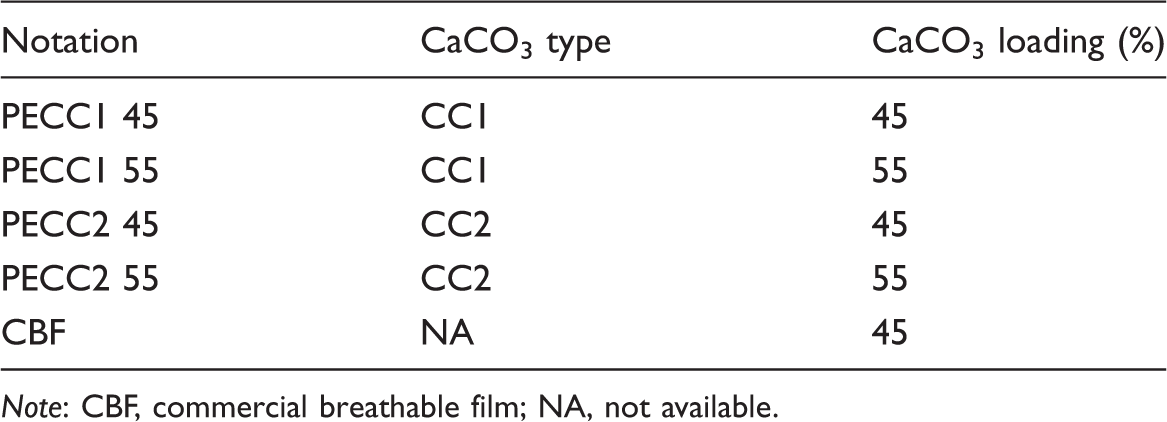
Note: CBF, commercial breathable film; NA, not available.
Methods
Formation of multilayered structures
In this study, disposable diapers are simulated by various layer combinations together in order to determine the effect of constituent layers on thermal comfort properties. Generally diapers are composed of many layers such as a top sheet, core, breathable film, and back sheet as shown in Figure 1.
Layers of a simulated multilayered diaper.
The types of top sheet and breathable film were changed and the effects of these layers on the thermal comfort properties of the multilayered structure were measured in dry and wet conditions. The core part and the back sheet of the structure were kept constant. Ultrasonic welding was employed to bring together the parts of the structure. The layers including different top sheets and breathable films were layered one after the other as shown in Figure 1 and welded together to form the simulation of a disposable diaper.
Characterization
Pore size analysis
The pore size and pore size distributions of the stretched films were determined using a capillary flow porometer 3 G zh through-pore size analyzer (Quantachrome Instruments, Florida, USA). In this method, described by ASTM F316-03 [28], increasing pressure is applied to one side of a wetted sample, while pressure and flow rate are monitored. As the pressure is increased, the pores in the sample are progressively emptied (largest through-pore first, then smaller ones). The flow rate through the emptied pores is recorded and used together with the pressure to provide information such as the maximum pore size, the mean flow pore size, and full pore size distributions. The wetting liquid used was Porofil, a fluorinated hydrocarbon wetting agent and the sample chamber had a diameter of 18 mm.
Water pressure resistance
Water pressure resistance tests were carried out according to AATCC 127 using a sample of 10 cm2 to evaluate the water pressure resistance of the structures to the penetration of water under hydrostatic pressure. An Atlas SDL Shirley Hydrostatic Head Tester Model M018 was used as the testing instrument. The water used was distilled and maintained at 20 ± 2℃; the rate of increase of water pressure was 6 ± 0.3 kPa/min. The water pressure was recorded at the point at which the water penetrated the fabric at the third place [29]. The average of five tests was given and the unit was expressed as kPa.
Thermal comfort properties
The water vapor permeability of the samples was determined using a Permetest instrument developed by Sensora (Liberec, Czech Republic) according to the modified ISO 11092. The instrument works on the principle of heat power sensing, and the temperature of the measuring head was maintained at room temperature for isothermal conditions. The heat lost from the measuring head due to the evaporation of water in bare conditions and with fabric sample was measured by heat power sensor in the instrument. The results of the measurements are expressed in terms of relative water vapor permeability (RWVP, %), and water vapor resistance (Ret). The relative vapor permeability was calculated by the ratio of heat loss from the measuring head with fabric sample (qs) to heat loss without fabric (q0) as expressed in the following equation [30, 31]

The water vapor permeability of the samples was measured in dry conditions and an attempt was made to measure it in wet conditions. However, it was not possible to conduct accurate measurements in wet state due to the inhomogeneous distribution of the SAP and pulp content present in the core layer, although the thickness of the samples was within the measurement limits of the instrument.
The thermal conductivity, thermal resistance, and thermal absorption were measured by using an Alambeta test device produced by Sensora (Liberec, Czech Republic). The working principle of the Alambeta relies on the mathematical evaluation of the heat transferred from the hot upper plate (32℃) through the sample to the cold bottom plate (22℃) adjoined to it [17, 31]. The thermal properties of the samples were measured in dry and wet states to determine the thermal comfort properties during usage of diapers. According to the information obtained from diaper companies, a 0.9 wt% sodium chloride (NaCl) solution was prepared to simulate urine and samples were wetted by applying 25 ml of solution from the topside of the samples. The measurements were carried out 1.5 min after the solution application to provide equal distribution of the solution.
The thermal comfort measurements of individual layers were also tried to be conducted for explaining their contribution on those of layered structures. Since Alambeta test device operates thickness based and does not allow to measure samples thinner than 0.25 mm, double-layered carded top sheet (TC), spunbond top sheet (TS), and back sheet (BS) were measured for obtaining reliable thermal conductivity values. And then the values were divided by 2. Unfortunately, reliable results were not able to be achieved for breathable films because of their very thin structure. All measurements were conducted under standard laboratory conditions (20 ± 2℃ temperature, 65 ± 2% relative humidity (RH)) and performed from the top sheet side, which is supposed to be in contact with the skin. Three replications were applied for each test to obtain average values as indicated in the related standard.
Light microscopy analysis
The top sheets were visualized by using an Olympus SZ61-TR optical microscope (Olympus Europa Holding GmbH, Germany, Magnification: 50×).
Statistical analysis
The results derived from the tests were statistically evaluated in Design Expert® 6.06 software by considering the type of top layer and breathable films as input variables and thermal comfort properties as output variables. In order to judge the statistical importance of the variations, ANOVA tests were applied. The “p” values were examined as to whether the parameters had a significant impact on the thermal comfort of the diaper or not. If the “p” value of a parameter is greater than 0.05 (p > 0.05), the parameter does not have a significant impact on the thermal comfort of the diaper.
Results and discussion
Pore size analysis and water pressure resistance of the breathable films
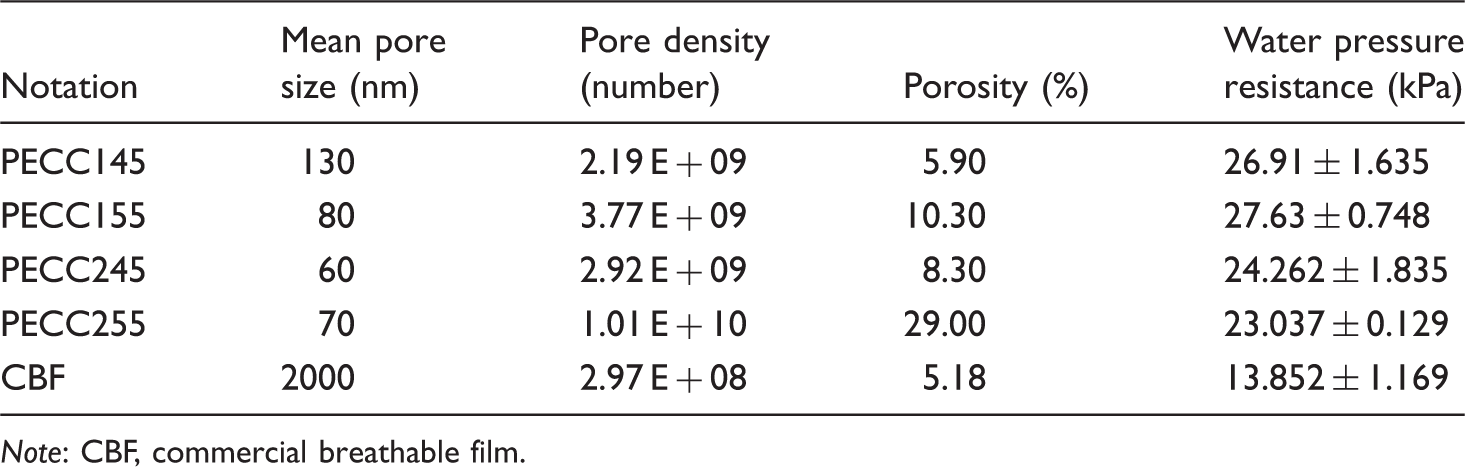
Pore size analysis and water pressure resistance data of the breathable films used.
Note: CBF, commercial breathable film.
It is indicated in the literature that breathability is meaningless without waterproofness. Products have to show a water pressure resistance value of at least 13 kPa of water to be defined as waterproof [32]. According to the water permeability tests, all films were determined to be waterproof since the results were above 13 kPa. However, the CBF showed a lower water pressure resistance value in comparison to the produced breathable films, which could be attributed to the very large pores of the CBF (Table 3).
Thermal comfort properties of the individual layers
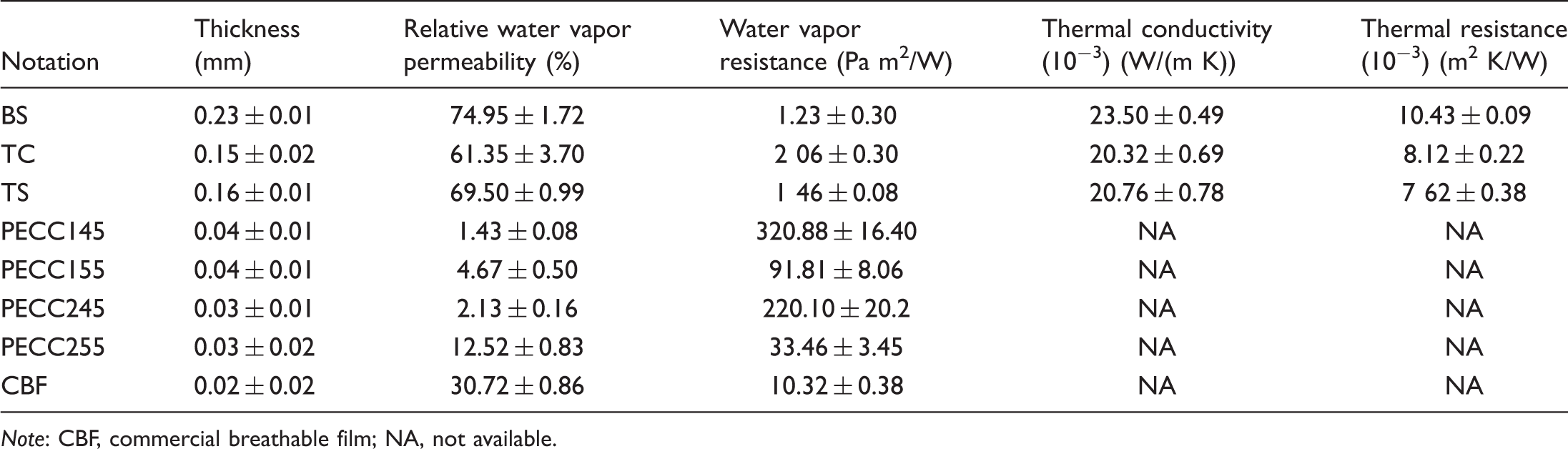
Water vapor permeability of the individual layers in dry state.
Note: CBF, commercial breathable film; NA, not available.
RWVP is the rate of water vapor transmission through a material and determines the breathability of a structure [33] and Ret is the resistance of the material to transmit water vapor from one side to another. These two parameters change inversely, for instance if the RWVP is high, the Ret is low and the thermal comfort of the material is better. The back and top sheets provided better water vapor permeability values due to their nonwoven structure possessing macro pores, thus enabling larger voids. TS showed a higher RWVP value than that of the TC. This could be due to the usage of higher linear fiber density and regional inhomogeneities in the TS nonwoven. The difference in RWVP values between the TS and the BS with the same structure, i.e., spunbond, might be attributed to the lack of hydrophilic substance in the BS, which prevents water vapor absorption by the material and thus simplifies the transfer of water vapor through the BS.
The very low moisture transfer properties of the films in comparison to the nonwoven structures originate from their microporous structure. As shown in Table 3, the pore number and porosity values of the films increased with increasing amount of CaCO3. In addition, it is known from our previous study [27] that the CC2 type of CaCO3 has smaller particle sizes in comparison to the CC1 type. Smaller particle size leads to smaller but more numerous pores and thus higher porosity values which, in turn, result in higher water vapor transfer. On the other hand, the CBF delivered the highest RWVP within the films although it showed a relatively low porosity. This fact could be related to the enormous pore sizes of the CBF, which enable more water vapor transfer through the pores.
Thermal conductivity is a phenomenon that indicates the capability of a material to conduct heat from one point to another point. Thermal resistance is an important parameter, which is relevant to thermal insulation. It is directly proportional to thickness and inversely proportional to thermal conductivity. The spunbond top layer (TS) showed a better thermal conductivity than the carded top layer (TC). As mentioned in the literature [34], this could be explained by the larger surface area of the continuous fibers in the spunbond structure, which reduces the air gaps. As shown in Figure 2, the TS has big gaps, while there are tiny but numerous gaps in the TC. Accordingly, it could be assumed that there should be more air within the TC structure because of the numerous gaps that probably lead to a continuous air layer. As a result, the thermal conductivity property of the TC structure will be lower since air acts as a thermal insulator. Thermal resistivity is inversely related with the thermal conductivity and, as expected, the thermal resistance value of the TC was determined to be higher than that of the TS.
Optical microscopy images of the top sheets used: (a) Carded (TC) and (b) Spunbond (TS) (magnification: 50×).
Comparison of the back and top sheet layers revealed that the BS delivered a higher thermal conductivity that originates from its higher areal density. As mentioned in the literature [34], when areal density increases, the air gaps become less and thus the effect of the insulating property of air will be diminished, thereby increasing thermal conductivity. The thermal resistivity of the BS is higher than that of the TS, although they have the same structure, i.e., spunbond structure. This phenomenon could be due to the lack of hydrophilic substance in the BS which could lead to a change in the thermal resistivity of the material.
Thermal comfort properties of the simulated multilayered structures
Thermal comfort properties of the multilayered structures in dry state.

Thermal comfort properties of the multilayered structures in wet state.

Note: CBF, commercial breathable film; NA, not available.
The test data were analyzed based on the ANOVA statistical tool and the results are given in Table 7. Contribution of the meaningful parameters is presented in Table 8. As can be seen, the contributions of breathable film type on the RWVP and water vapor resistance were determined to be 96.73% and 97.03%, respectively, while the top sheet type had no contribution. Furthermore, the contribution of top sheet type on the thermal comfort properties was found to be higher than that of the breathable film type. In order to give a deeper insight into statistically significant results (p < 0.05), the effect of chosen factors (top sheet type and breathable film type) on the responses (RWVP, water vapor resistance etc.) related to the meaningful results is also given in Figures 3–8. The RWVP test results in dry conditions showed that the breathable film type used was meaningful (Table 7), while the nonwoven type used as top layer showed no significance. It was observed that the water vapor permeability difference observed in individual layers disappeared after placing them in a multilayered structure. In other words, usage of CaCO3 with smaller particles and the high loading amount of CaCO3 led to high water vapor permeability, i.e., high breathability or better thermal comfort (Figure 3). Accordingly, low water vapor resistance values (Ret) were recorded (Figure 4). In addition, the highest water vapor permeability was achieved with the CBF.
The effect of breathable film type on relative water vapor permeability of the simulated multilayered diapers in dry state. The effect of breathable film type on water vapor resistance of the simulated multilayered diapers in dry state. The effect of breathable film type on thermal resistance of the simulated multilayered diapers in dry state. p Values of ANOVA tests for water vapor permeability and thermal comfort parameters. Note: ANOVA, analysis of variance; NA, not available. *Significant for α = 0.05. Contribution of meaningful parameters related to the water vapor permeability and thermal comfort.


Multilayered structures exhibited very high thermal conductivity values in comparison to the individual layers, which could be attributed to the complex structure of the simulated diapers. The TS containing multilayered structures showed slightly better thermal conductivities than those with TC. This could be explained by the larger surface area of the continuous fibers in the spunbond structure, as mentioned before. The substantially higher thermal conductivity values observed in the wetted structures are reasonable when the high thermal conductivity of the water is considered [35, 36].
According to the statistical evaluation of the thermal conductivity property in dry conditions, both the top sheet type and the breathable film type have a significant effect on the thermal conductivity of the simulated diaper (Table 7). It can be said that the film type has less impact than the top sheet type (Table 8). The effect of top sheet type and breathable film type on thermal conductivity in dry conditions can be seen in Figures 5 and 6, respectively. As mentioned before, the carded top sheet material (TC) showed individually lower thermal conductivities. The same tendency was observed in the multilayered diapers as well. Accordingly, the effect of individual layers was preserved when multilayered structures were generated.
The effect of top sheet type on thermal conductivity of the simulated multilayered diapers in dry state. The effect of breathable film type on thermal conductivity of the simulated multilayered diapers in dry state.

Wet conditions were found to deliver statistically insignificant differences between thermal conductivity and the factors (top sheet type and breathable film type). This may be explained by the different degrees of swelling throughout the structure due to inhomogeneous distribution of the SAP content. Therefore, it is likely to have meaningless results in wet conditions since thickness-based measurements are done in the Alambeta testing instrument. In spite of the ANOVA results, except for the CBF containing multilayered structure, it was observed that all samples with the spunbond (TS) top layer tended to have lower thermal conductivity values than those of the carded (TC) top layer in wet conditions. These results seem to be in contradiction with those of the multilayered structures in dry state. However, it should be kept in mind that the spunbond structure contains less air gaps to be replaced with water when wetted in comparison to the carded structure, which could result in lower thermal conductivity.
Multilayered simulated structures showed very high thermal resistance values in dry state when compared with those of the individual layers. All multilayered simulated structures consisting of TS as the top layer delivered lower thermal resistance values owing to the lower thermal resistivity of the TS alone. It was found that the thermal resistance values in wet state decreased to a large extent.
Statistical analysis of the thermal resistance values in dry and wet conditions showed the same relationships as in the case of the thermal conductivity results (Table 7). It would be reasonable to expect that when the thermal conductivity and thermal resistance are considered to be in a close relationship. Statistically significant differences were obtained in dry conditions between the thermal resistance and the top sheet material. The breathable film type also had a meaningful effect, though to a lesser extent (Table 8). The simulated multilayered diaper consisting of the carded nonwoven material as the top sheet showed a higher thermal resistance (Figure 7). The breathable film with small CaCO3 particles and high loading amount delivered more pronounced results (Figure 8). No statistically significant differences were observed in wet conditions. However, generally, it can be said that the thermal resistance values were lower because of the presence of water within the structure in spite of increased thickness due to the SAP material. The reduction in thermal resistance values could be explained by the replacement of the entrapped air with water. As mentioned in the literature [37], structures with increasing thickness do not necessarily exhibit higher values since thermal resistance is found to be dependent on the nature of material.
The effect of top sheet type on thermal resistance of the simulated multilayered diapers in dry state.
Thermal absorptivity is an objective measurement of the warm–cool feeling of the materials during the short contact of the human skin with the materials’ surface. The thermal absorptivity of a material changes depending on the density and specific heat of the simulated diaper, in addition to its thermal conductivity property. Materials with a low value of thermal absorptivity provide a warm feeling at initial touch due to better thermal insulation. On the other hand, materials with a higher value give a cool feeling. According to the ANOVA test results, no changes or statistically significant differences in thermal absorptivity were found in dry and wet conditions. The reason for obtaining meaningless results could be attributed to irregularities because of the individual layers and to the multilayered structure that contains different types of materials with different density and specific heat values. Despite the ANOVA results, generally the TS containing multilayered structures demonstrated a slightly cooler feeling in dry state probably because of the larger surface area of the spunbond structure and thus a smoother surface. As mentioned before [38], heat conduction transfer is higher in smoother surfaces and so they give cooler feelings.
Conclusions
It was revealed that the breathable film type used was the most important factor in water vapor permeability (RWVP), i.e., breathability, in diaper structures, which is directly related to its porosity. The porosity of the produced films was found to change proportionally to the CaCO3 particle number and inversely proportionally to the CaCO3 particle size. Accordingly, from the breathable films produced, the best RWVP value was obtained with the 55 wt% CC2 type of CaCO3 containing film. From the results obtained, it was also revealed that the produced films have both breathability and waterproofness properties, which are crucial for diaper applications.
It is apparent from the results that the thermal comfort properties of the diapers are dependent on top sheet layer type and breathable film type in dry conditions. On the other hand, wet conditions were found to change the thermal comfort property completely. Generally, it can be said that the multilayers containing the spunbond top layer (TS) showed better thermal conductivities and slightly cooler feelings in dry state than those with a carded top layer (TC). The top sheet type was found to be more effective in terms of thermal comfort properties (contribution on the thermal conductivity: 48.98%, contribution on the thermal resistance: 59.64%), while the effect of breathable film type was more pronounced in water vapor permeability (contribution on the RWVP: 96.73 %, contribution on the water vapor resistance: 97.03%).
Footnotes
Acknowledgment
The authors would like to thank Pelsan Tekstil Urunleri San. ve Tic. A.S. for providing the CBF, Telasis Tekstil Urunleri San. ve Tic. A.S. for providing the carded top sheet, and Mogul Tekstil Sanayi ve Ticaret Ltd Sti. for providing the spunbond top sheet and spunbond back sheet. We would also like to thank Prof. Hes from the Technical University of Liberec and Prof. Önal from Erciyes University for providing facilities (Alambeta and Permetest instruments), Dr. Tesinova from the Technical University of Liberec, and Mr. Arslan from Erciyes University for helping in the thermal comfort measurements, and Mr. Kaya from MEM-TEK (National Research Center on Membrane Technologies) for pore size analyses.
Declaration of Conflicting Interests
The author(s) declared no potential conflicts of interest with respect to the research, authorship, and/or publication of this article.
Funding
The author(s) disclosed receipt of the following financial support for the research, authorship, and/or publication of this article: This work was supported by the Research Fund of Erciyes University, Project Number: FBD-12-4184.