




Abstract
This work is a part of research carried out for the manufacturing and evaluation of riot helmet shells having continuous textile reinforcement. The paper is focused only on the effect of expanded polystyrene internal liner on the riot police helmet shells. Energy absorption and force attenuation at different position on the developed single-piece continuously textile reinforcement helmet shells have been studied. Low energy impact tests were carried out at different positions on the developed riot helmet shells. The result shows the internal liner plays a vital role in energy absorption and in force attenuation for a riot helmet shell.
Introduction
Historically, helmets are one of the objects of protective wear used as military kit in wars. The necessity for the helmet is to shield the head, face and at times the neck from the swords, arrows, spears and other blunt weapons [1]. Currently, helmets are used in daily life with the purpose of head protection depending on the needs and intensity of protection. Injury to the head can trigger symptoms such as skull disfigurement and brain contusions [2]. Head protection is one of the essential requirements for police officers who are exposed to thrown objects. To protect the head and the skull from impact and penetration of an object to the skull is one of the requirements of a helmet shell. The helmet shell distributes the energy to the foam liner and also it absorbs the impacted energy within itself [3]. Currently available riot helmet shells are both thermoplastic and composite shells and both these types of shell have different manufacturing techniques [4,5].
The protective liner (liners / foam or internal padding) is one of the important parts of a riot helmet after the helmet shell. The primary purpose of this padding is to absorb the energy from the shell before transmitting it towards the skull by collapsing the air-filled gaps in the constituent material [6,7]. The secondary purpose of protective padding is to give a comfortable and close fit [6,7] for the wearer. In another study [8], it was found out that along with the impact absorption properties of the helmet shell, the linings also play an important role in the pass and fail criteria of the helmet. This is also true for riot police helmets.
Different varieties of foam liners are available in the market like polypropylene, polyethylene, polybutylene, polyurethane foams and polyvinylidene chloride (PVDC) [3]. In this study, expanded polystyrene (EPS) foams are used due to availability. EPS foams are lightweight and have good performance characteristics [5]. They are rigid, inelastic with low flexibility and are manufactured by the injection moulding process. Nowadays, high density EPS are the most widely used foam liners. Basically the foams are porous in nature and their main purpose is to absorb energy per unit volume and restrict the energy transmitted towards the skull [3]. Currently high density EPS is used as the liner for police riot helmets [9].
Research background
The research was carried out for the manufacturing of single-piece continuously textile reinforced helmet shells for police. Special fabric has been made and converted into a helmet shell with a modified vacuum bagging processes [4]. Further, several analyses were carried out and the developed helmet shells can be viewed in Figure 1 [4,10].
Single-piece continuously textile reinforced helmet shell.
One of the research aims was to perform impact testing of the developed helmet shells along with the helmet internal linings. For this purpose, the in-house University of Manchester’s Dynatup drop weight impact testing instrument was modified and impact testings were carried out. The requirement was to calculate the impact energy absorbed by the helmet shells and the force attenuation factor. The low velocity impact tests were carried out on the developed continuous textile reinforced helmet shells at three different positions (top location, back location and side location) in order to analyse impact performance. Figure 2 shows the impact on the top location at riot helmet shell having EPS as internal lining [10]. Side and back impact locations can be seen in Figure 3.
Impact on top location at riot helmet shell. Helmet shell ready for testing for (a) side location and (b) back location.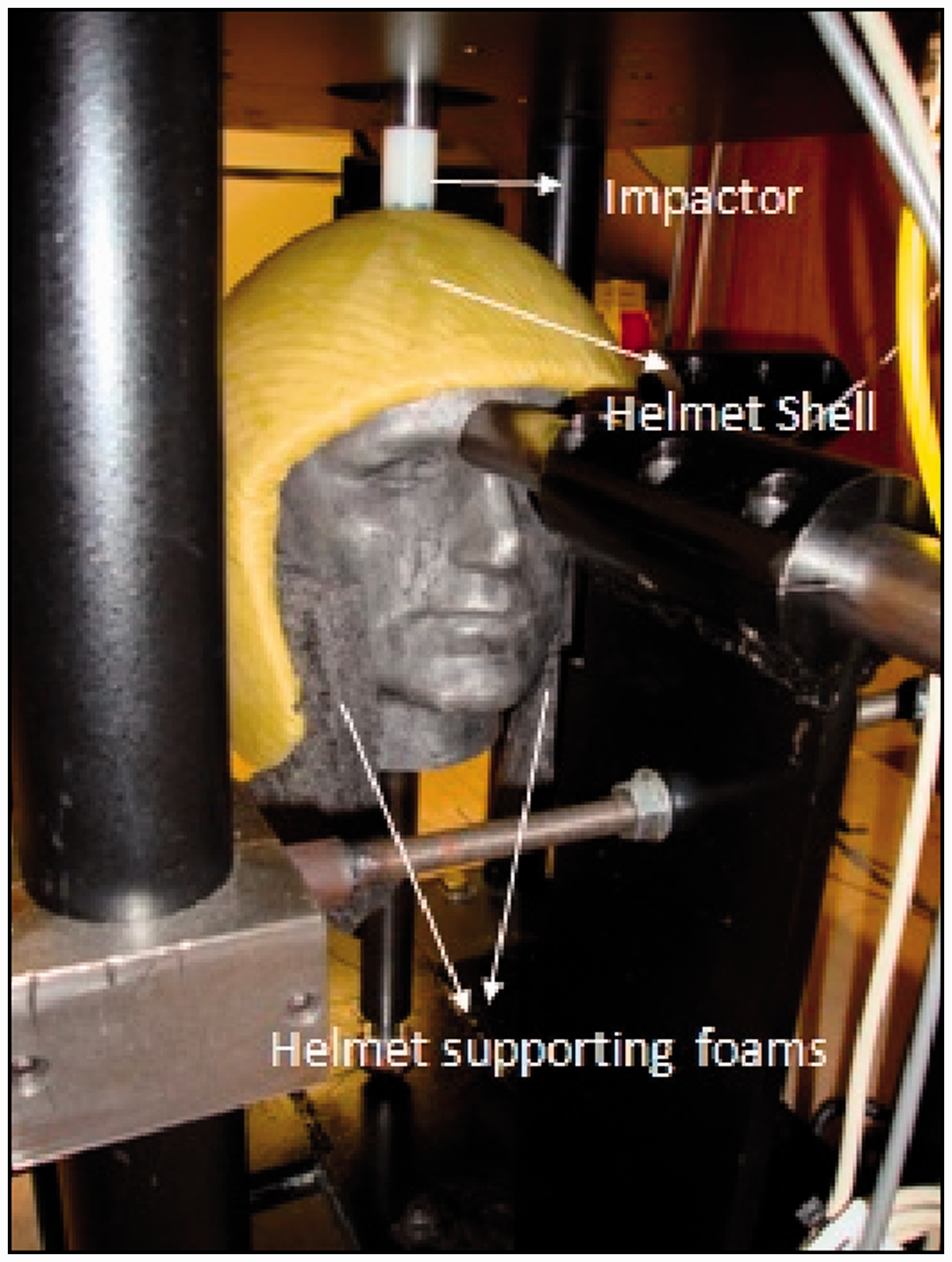

Prerequisite of data processing
The transformation of potential energy into kinetic energy is influenced by the drop height and mass of the impactor. The impact velocity and impact energy of the impactor when the impactor head first touches the specimen can be calculated from the following equations (1) and (2).


The embedded force sensor in the headform is capable of detecting the force transmitted Ft and the load cell in the Instron drop tester weight provides the impact force Fi. Force-blocking effectiveness, which is commonly expressed as the attenuation factor, fatt, for each impact can be calculated using equation (3):

A greater value of attenuation factor corresponds to a lesser amount of force being transmitted through the specimen, and a lesser value of attenuation factor indicates that much of the impact force has been transmitted through the specimen (100% means no force transmitted and 0% means all forces transmitted).
The impact force (load or contact force) trails Newton’s second law of motion, which is expressed as follows:

The area beneath the load displacement curve gives the absorbed energy shown in Figure 4. In the current study, the trapezoidal method was used. In doing this, the curve up to the maximum load was divided into many smaller trapezoids. The total sum of the areas of the small trapezoids gives the energy absorption value of a particular curve.
Trapezoidal method to calculate energy absorption.

Results and discussion
In order to study the influence of padding inside a single-layer helmet shell, impact testing was carried out at different locations on the helmet shell with approximately 25.6 Joules of impact energy. Due to its easy availability, EPS foam was used as internal padding for the helmet shells. EPS is commonly used in energy management for protective helmets [11]. Impact testings were carried out and the results are discussed below.
Influence of internal padding on energy absorption
The results for the energy absorption are shown in Table 1 and Figures 5–7. Three individual tests at each impact location were conducted by using around 25.6 J of impact energy.
Energy absorption performance with and without internal padding at helmet side location. Energy absorption performance with and without internal padding at helmet back location. Energy absorption performance with and without internal padding at helmet top location. Average results for the energy absorption at different impact locations.


It can be observed that the percentage energy absorption increases with the use of internal padding (EPS foam) at all the impact locations. On average, there is an increase in the results of energy absorption performance by 1.3 times at the side location, 1.3 times at the back location and 1.2 times at the top helmet location due to the use of internal padding. Internal padding always enhances the energy absorption in the protective helmets.
Influence of internal padding on force attenuated factor
The results for the force attenuation factor are shown in Table 2 and Figures 8–10.
Force attenuated factor with and without internal padding at helmet side location. Force attenuated factor with and without internal padding at helmet back location. Force attenuated factor with and without internal padding at helmet top location. Average results for the force attenuation at different impact locations.


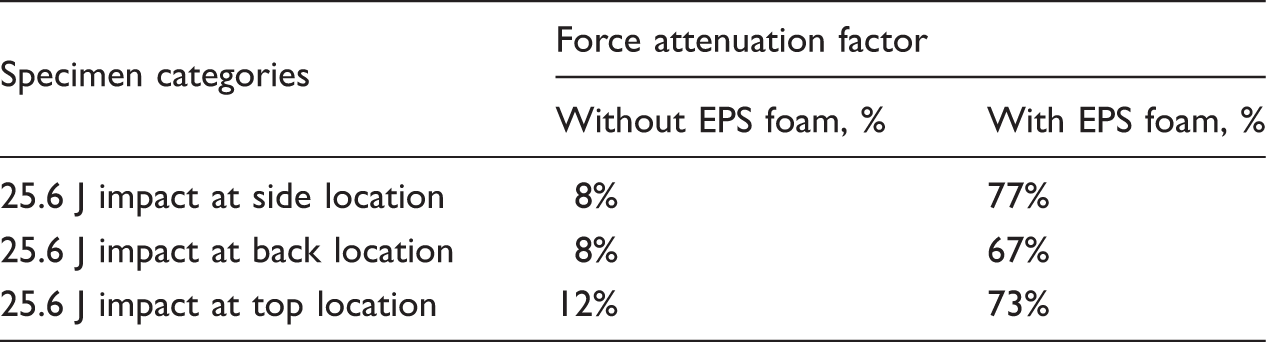
The force attenuation factor increases many times at all the impact location by the use of EPS foam. It can be observed on average there is an increase in the force attenuation factor at the side location by 10 times, at the back impact location by 8.9 times and at the top impact location by 6.2 times the value as compared to the same location without the use of padding. This result shows the importance of internal padding in a riot police helmet shell. The helmet shell coupled with internal padding provides vital force attenuation.
Suggestions for helmet shell protection
Impact performance of the continuous textile reinforced helmet shells is influenced by the internal padding. The use of linings at different impact location is analysed and found out that among the different location of impact at the helmet shells, trends for the energy absorption and force attenuation gives analogous trends. Energy absorption and force attenuation play a dynamic role in minimising the trauma for the helmet wearer.
From the results it can be clearly seen that lining is one of the vital protection layer against an impact. The helmet protection against an impact at any position on the helmet shell can be increased by selecting suitable high density foam as protective padding which can absorb a greater amount of impact energy per unit volume. Moreover, high density foam with single piece helmet shell will absorb more energy. Also, it will be capable of distributing impact energy throughout the helmet shell instead of transmitting it to the human head. Selection of internal lining is necessary for getting the optimum results.
Footnotes
Declaration of Conflicting Interests
The author(s) declared no potential conflicts of interest with respect to the research, authorship, and/or publication of this article.
Funding
The author(s) disclosed receipt of the following financial support for the research, authorship, and/or publication of this article: This study was financially supported by NED University of Engineering and Technology, Karachi, Pakistan.