




Abstract
In order to realize recycling of polypropylene selvages, polypropylene nonwoven selvages with different plied orientation were inserted between Kevlar/Nylon/low-melting polyester nonwoven fabrics forming composite nonwoven. Low-melting polyester content of nonwoven fabric and hot-pressing temperature of composite nonwoven were both optimized after static and dynamic puncture resistances. Moreover, effects of hot-pressing and plied orientation on static and dynamic puncture resistances, sound absorbing and thermal insulating properties of composite nonwoven were discussed respectively. Result shows that, optimal low-melting polyester fiber content was 30%, and best hot-pressing temperature for composite nonwoven was 180°C. Polypropylene nonwoven selvages improved static puncture resistance, sound absorbing and thermal insulating properties. Hot-pressing slightly increased puncture resistance and obviously improved thermal insulation, but decreased sound absorption coefficient significantly. Plied orientation affected static and dynamic puncture resistance insignificantly, but influenced on sound-absorbing and thermal-insulating properties significantly. When composite nonwoven was plied with 90°/90° polypropylene selvages and hot-pressed at 180°C, the static and dynamic puncture resistances reached 120 N and 80 N, respectively, and thermal conductivity was 0.047 W/mK. Five layers of composite nonwoven before hot-pressing had sound absorption coefficient of above 0.94 at frequency of higher than 1890 Hz.
Introduction
Nonwovens occupy the critical status in the whole textiles, because of their short processing, massive products, low cost and wide raw material. Of all over the world, fibers used for nonwoven contain 63% polypropylene (PP) and 23% polyester (PET). PP fibers could be processed into nonwoven structure by spunbond, meltblow or spunlace techniques. Therein, PP spunlace nonwoven has characteristics such as flexible, air permeability, fluffy and strong absorption. Therefore, it is widely used in health and medical fields, serving as health clad material, tourniquet bandage, wound dressing, disposable surgical clothing and operation covering etc [1].
As health care develops, there is a growing demand for PP spunlace nonwovens. Therefore, a large amount of PP nonwoven selvages are produced during manufacturing process. These selvages usually bury and incinerate as wastes or smash into fibers as fillings [2]. If these abandoned sources are utilized properly, it would bring about additional values and meanwhile achieve the source recovery. In recent years, PP spunce nonwoven selvages were wrapped with metal fibers forming functional yarns or weaving into functional fabrics [3–8] or needle-punched with other nonwovens to improve strength [9–12] or sound absorption [13]. This study aims to compound PP nonwoven selvage with nonwoven fabrics to improve puncture resistance, sound absorbing and thermal insulating properties for use as industrial wall covering in the future. Considering that wall coverings on building compartment are usually subjected to sharp-pointed objects, three properties including puncture resistance, sound absorption and thermal insulation are required to be demanded for. Sound absorption needs to reduce noise nuisance from machinery; thermal insulation property can save heat energy escaping from outside of the factory and plays role for saving thermal-prevision cost; and puncture resistance property is to prolong service life of wall covering. Therefore, all these three properties are important to be considered in the factory design. In previous study, effects of material parameters and manufacturing conditions on sound absorbing property [9,12,14–23] and thermal insulating [10,12,23–25] and puncture resistance [26–29] of nonwoven porous materials were discussed. However, effect of nonwoven pied orientation on puncture resistance, sound absorbing and thermal insulating properties was not studied in previous study. Nonwoven plied orientation affected the fiber distribution among composite nonwoven, thereby altering the contact pressure and friction between probe and composite nonwoven. Therefore, novel approach for recycling of PP nonwoven selvage was conducted in this study. Moreover, two layers of PP nonwoven selvages with different plied orientation were needle-punched between Kevlar/Nylon/low-melting PET nonwoven fabrics forming composite nonwoven. Moreover, comparative study of composite nonwoven before and after hot-pressing was also investigated.
Experimental
Materials
Recycled Kevlar® fibers acquired from unidirectional selvages (provided by Dupont Company, USA) had length of 50–60 mm. Nylon 6 fibers purchased from Taiwan Chemical Fiber Co. Ltd, Taiwan, had fineness of 6 D, length of 64 mm and tenacity of 10 g/d. The sheath-core low-melting PET fibers were offered by Huvis Chemical Fiber Corp., Korea. Their sheath material was low-Tm PET with 110°C melting point, and the core was PET with 265°C melting point. PP spunlace nonwoven selvages provided by Kang Na Hsiung Enterprise Co. Ltd, Taiwan, had width of 30 mm, tensile strength of 40 N and areal weight of 25 g/m2. Recycled Kevlar® and PP selvages are respectively shown in Figure 1(a and b).
Images of recycled Kevlar® selvage (a) and PP-spunlace selvage (b).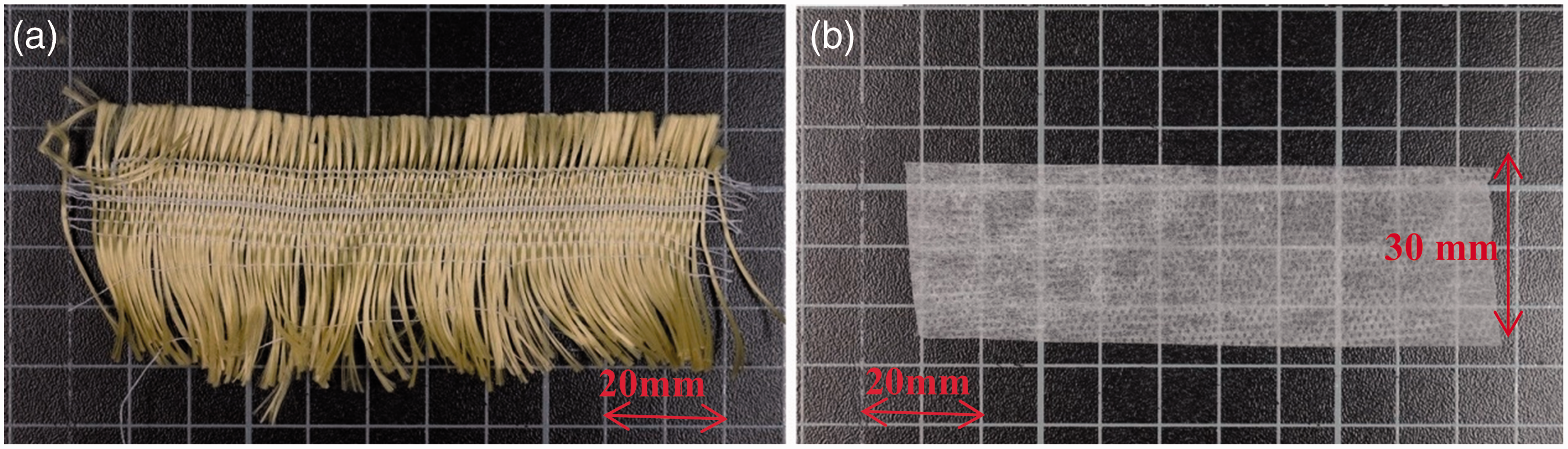
Sample preparation
Kevlar® fibers, Nylon 6 fibers and low-melting PET fibers were formed into Kevlar/Nylon/low-melting PET nonwoven fabrics through opening, blending, carding, lapping and needle-punching processes. Afterwards, nonwoven fabric went through 1-mm-gap Twin-Roller Hot-presser at 160°C at a speed of 0.5 m/min as indicated in reference [29]. During nonwoven fabrication process, the needle-punched frequency was constant as 167 needles/min, and low-melting PET fibers was changed from 10 wt%, 20 wt%, 30 wt% to 40 wt% when maximum addition of Kevlar® fibers was 20 wt%. The resulting nonwoven fabric had area weight of 200 g/m2. Nonwoven fabrics with different low-melting PET fibers before and after hot-pressing were comparatively discussed for the optimal process parameter by puncture resistances tests.
10 wt% of two-layer PP nonwoven selvages were placed between Kevlar/Nylon/low-melting PET nonwoven fabrics, forming composite nonwovens after needle-punching at 167 needles/min. Then composite nonwoven were hot-pressed at 140°C, 160°C, 180°C, 200°C and 220°C for seeking for optimal hot-pressing temperature by evaluations of static and dynamic puncture resistances. Plied orientation for two–layer PP nonwoven selvages was changed as 0°/0°, 90°/90°, −45°/45° and 0°/90° as shown in Figure 2. Effects of plied orientation and hot-pressing on puncture resistance, sound absorption and thermal insulation property were explored respectively.
Composite nonwovens with 0°/0° (a), 90°/90° (b), −45°/45° (c) and 0°/90° (d) plied orientations of PP selvages and two layers of Kevlar/Nylon/low-melting PET nonwoven fabrics. Red arrow shows cross machine of nonwoven fabric.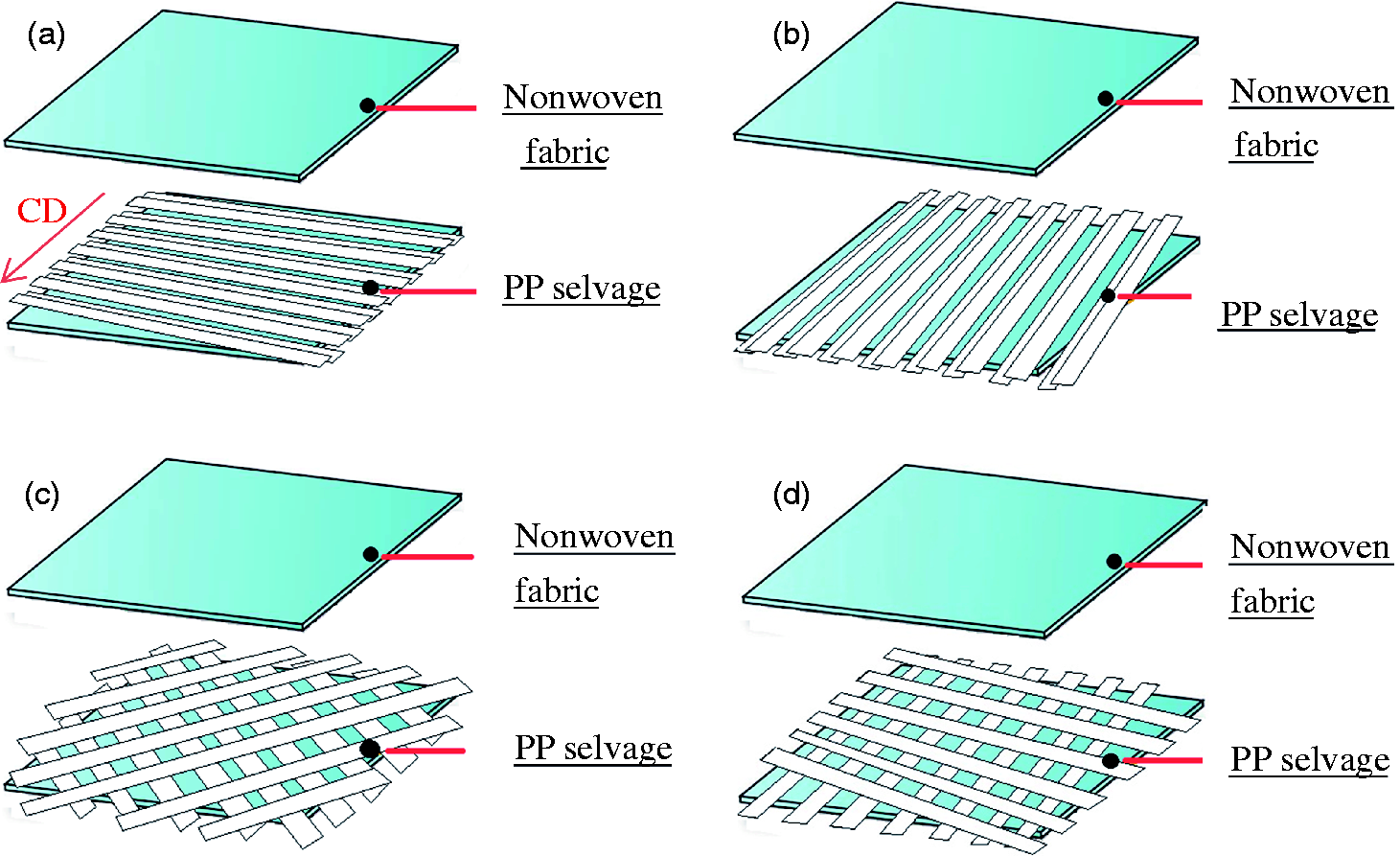
Testings
Static puncture was measured by Instron 5566 Universal Tester (Instron, USA) according to ASTM F1342-05. Probe with 0.25 mm shaft radius and 26° conical angle was fixed on the load cell and moved at 508 mm/min. Samples were in size of 100 mm × 100 mm, and placed between two circular plates with 10-mm diameter hole in the center. Ten samples were measured repeatedly in each group.
Dynamic puncture test was carried out by Drop-Tower Machine (GuangNeng Machinery Co. Ltd, Taiwan) attached with PCD300A data acquisition (Sanlien Corp., Taiwan) according to NIJ Standard 0115.00. For reach 24J Protection Level, probe with 0.07 mm shaft radius and 24° conical angle was dropped from 284 mm height onto surface of samples under load of 2.8 kg. Likewise, 100 mm × 100 mm samples were clamped between two square plates with 40-mm-diameter hole in the center. Six specimens were measured in each group.
Sound absorbing property was performed by twin-microphone tube According to ASTM E1050-12. The testing frequency was ranged from 125 Hz to 4000 Hz. Sample was circular with 30 mm diameter. The appropriate size of samples was inserted into impedance tube, and then conducted the first testing. After switching the position of two microphones, the second testing was initiated in order to adjust difference with before testing. Normal sound-absorption coefficient vs. frequency curve was plotted by procedure ultimately. Each group was repeatedly tested for three times.
Thermal insulation property was measured by DRX-I-SPB Guarded-Hot-Plate Apparatus (Xiangtan Huafeng Equipment Manufacture Co. Ltd, China) on the basis of ASTM C177-10. Sample was in size of 200 mm × 200 mm × 10 mm. Hot-plate temperature was 100°C. Sample was tested for 6 hours, and finally thermal conductivity of each sample was determined.
Results and discussions
Process parameter optimization of nonwoven fabric
Figure 3 displays static and dynamic puncture resistances of nonwoven fabrics. Figure 3(a) shows that before hot-pressing, static puncture resistance of nonwoven fabric tends to be down with increase in low-melting PET fibers. This is due to compactness of fiber assembles. The total nonwoven fabric became less compact with addition of low-melting PET fibers because nylon fibers were coarser than low-melting PET fiber. After hot-pressing, there is no significant difference of static puncture resistance among 10%, 20% and 30% addition of low-melting PET fibers. Comparatively, hot-pressing effect improves static puncture resistance when low-melting PET fibers contain less than 40%. The 20% and 35% improvement of static puncture resistance is found for composite nonwoven containing 10% and 30% low-melting PET fibers after hot-pressing. This is because fiber interspace among nonwoven became smaller after hot-pressing, resulting in bigger pushing-aside force when probe contacted with surface of nonwoven fabric [30].
Static (a) and dynamic (b) puncture resistances of nonwoven fabrics with various low-melting PET contents.
Figure 3(b) shows that, dynamic puncture resistance seems almost same for nonwoven containing from 10% to 30% low-melting PET fiber; 40% low-melting PET fibers had the lowest dynamic puncture resistance because Nylon fibers had higher tenacity than low-melting PET fibers. Moreover, its difference between before and after hot-pressing displayed smaller, indicating that hot-pressing cannot affect dynamic puncture resistance. This correlates with nonuniform characteristic of nonwoven fabric and insensitive data acquisition of testing machine. Additionally, a bigger error was found for dynamic puncture resistance. This is attributed to two factors. The first is that a number of needle-punching points left after needle-punching bonding process, leading to lower dynamic puncture resistance. The second is that Kevlar® fiber distributed in nonwoven nonuniformly. Considering the cost and protection level of puncture resistance, 30% low-melting PET fibers are used as the optimal parameter for fiber content.
Effects of hot-pressing and plied orientation on static and dynamic puncture resistances of composite nonwoven
Figure 4 shows that hot-pressing slightly promotes both static and dynamic puncture resistances. Moreover, with increase of hot-pressing temperature, static and dynamic puncture properties present first improving and then decreasing trend. The optimal hot-pressing temperature is chosen as 180°C. When surpassing 180°C, nylon fibers also happened to melt, and fiber containing declined simultaneously. Meanwhile, composite nonwoven plate-bonded together and became brittle. Therefore, composite nonwoven was easily broken after probe penetration due to smaller elongation, resulting in lower static and dynamic puncture resistances.
Effect of hot-pressing temperature on static (a) and dynamic (b) puncture resistances of composite nonwoven with 45°/−45° plied orientation.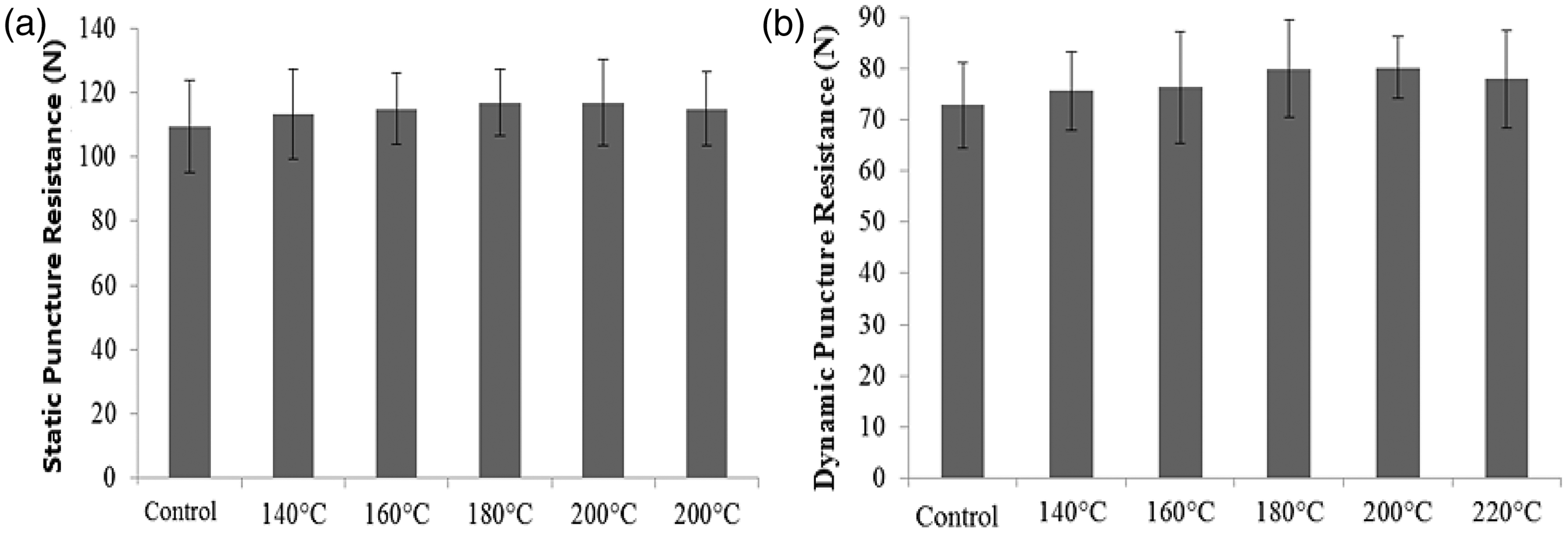
Figure 5 shows static and dynamic puncture resistances of composite nonwoven before and after hot-pressing at 180°C. 10% improvement for static puncture resistance would be found after hot-pressing as displayed in Figure 5(a). The maximum difference of static puncture resistance is about 20 N. For different plied orientation, 90°/90° plied composite nonwoven has the highest static puncture resistance, reaching 120 N. This is due to high orientation consistency between nonwoven fiber and PP selvage. It is found from Figure 5(b) that dynamic puncture resistance also increases slightly but not clearly after hot-pressing. Moreover, plied orientation affects dynamic puncture resistance insignificantly. The maximum dynamic puncture resistance is 73 N, and the minimum is 70 N for composite nonwoven before hot-pressing. After hot-pressing, the maximum and minimum of dynamic puncture resistance were 80 N and 76 N, respectively. The improvement of hot-pressing is not significant for dynamic puncture resistance. This is due to a small amount of PP plied amount. Fewer thermal bonding points produced after hot-pressing, pushing aside force of probe to composite nonwoven improved limitedly [30]. Additionally, the bigger deviation is found for static and dynamic puncture resistances. This is possibly due to position change of PP selvage during lapping and needle-punching process.
Effects of hot-pressing and plied orientation on static (a) and dynamic (b) puncture resistances of composite nonwovens.
Effects of hot-pressing and plied orientation on sound absorbing property of composite nonwoven
Figure 6 shows sound absorbing property of composite nonwovens with different plied orientations. “Non” group without containing PP selvages, that is, composite nonwoven was directly needle-punched by two layers of Kevlar/Nylon/low-melting PET nonwoven fabrics. It is found that PP selvage insertion significantly improves absorption coefficient from 1000 Hz to 4000 Hz. This is because composite nonwovens had compact structure after insertion of dense PP nonwoven selvage. As a result, intensity difference of sound between fiber and air turned higher, resulting in larger flow resistance and then higher absorption coefficient. After hot-pressing, absorption coefficient at the whole frequency becomes lower. The fiber interspace was narrowed and composite nonwoven became more rigid when low-melting PET fibers and PP selvages were hot melting and then pressed. Therefore, sound waves were incident into inner of composite nonwovens difficultly, and were absorbed less [31]. For different plied orientation, 0°/0° composite nonwoven has the optimal sound absorbing property. Plied orientation influences on the number of pores of small pore and connective channel of big pore among composite nonwoven. Sound waves produced friction with surface of fibers, and then dissipated by viscous and thermal loss. Therefore, 0°/0° plied PP selvages among composite nonwoven generated more connective channels and meanwhile many number of small pores existed among nonwoven fabrics [32], which became the main reason for significant reinforcement of absorption coefficient as compared to other plied orientations.
Sound absorption coefficient of composite nonwoven with different plied orientations before and after hot-pressing at frequency from 125 Hz to 4000 Hz.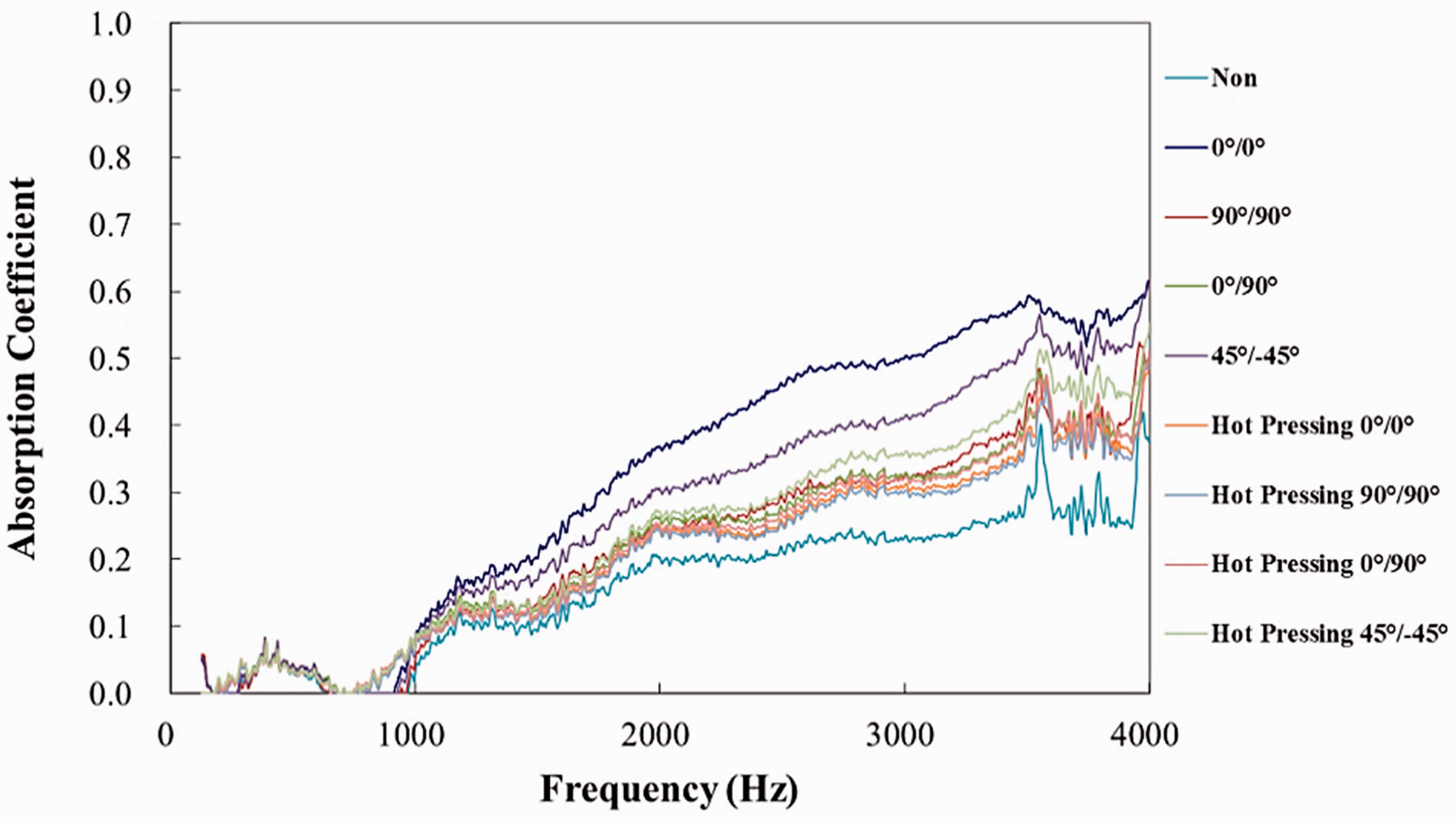
Figure 7 shows sound absorption coefficient of five layers of composite nonwovens with different plied orientations of PP selvages. Compared to Figure 8, sound absorption coefficient improves evidently after laminating five layers. Absorption coefficient of un-hot-pressed composite nonwovens reaches 0.9 over 1000 Hz, representing 90% absorption of sound waves. This is because layer lamination increases thickness of whole composite nonwovens, and sound wave easily diffracts across more fibers which consumes more sound energy. In addition, 0°/0°, 90°/90° and 0°/90° plied orientation exhibits similar sound absorption property for five layers of un-hot-pressed composite nonwovens. Differently, 45°/−45° plied orientation shows better absorption coefficient around 1000 Hz. This difference is due to fiber orientation distribution. Likewise, hot-pressing obviously decreases sound absorption property. Composite nonwoven becomes thinner and more rigid after hot-pressing. The number of pores is smaller than that being not hot-pressed, and vibration between layers neutralizes porous sound absorbing. Based on these factors, the sound absorption displayed lower after hot-pressing. Even so, PP selvages improve sound absorption at frequency of less than 2000 Hz compared to ‘non’ group, which is due to compact structure of PP selvages.
Sound absorption coefficient of five-layer composite nonwoven with different plied orientations before and after hot-pressing at frequency from 125 Hz to 4000 Hz. Thermal conductivity of composite nonwovens with different plied orientations before and after hot-pressing.

Effects of hot-pressing and plied orientation on thermal insulating property of composite nonwoven
Figure 8 shows thermal conductivity of composite nonwovens with different plied orientation. Hot-pressing and PP selvage addition both enhance thermal insulation property. Thermal conductivity of composite nonwoven without PP selvages is 0.070 W/mK before hot-pressing, and decreases to 0.064 W/mK after hot-pressing. This is attributed to the fact that PP selvages insertion increases thickness and static-air content inside of composite nonwoven. After PP selvages placement, thermal conductivity of composite nonwoven significantly declines to 0.046 W/mK. PP selvages and low-melting PET fibers were melting and then bonded adjacent fibers from nonwoven fabrics after hot-pressing. Consequently, some closed air space was formed preventing air convection and then improving thermal insulating effect. When PP selvages were plied with 0°/0°, thermal conductivity of composite nonwoven shows the lowest, 0.041 W/mK. These results from the fact that plied orientation of PP selvages were perpendicular to fiber distribution orientation, which contained more closed air space and higher content of static air [33].
Conclusions
A new approach for PP selvages recycling was explored in this study. PP selvages were inserted between Kevlar/Nylon/low-melting PET nonwoven fabrics forming composite nonwoven, for purpose of improving puncture resistance, sound absorbing and thermal insulating properties. Moreover, effects of hot-pressing and plied orientation on three properties were discussed respectively. Experimental results show that after PP selvages addition, static puncture resistance, sound absorption and thermal insulation were increased by 37.35 N, 0.2 (above 2224 Hz) and 0.026 W/mK. Hot-pressing slightly increased puncture resistance, decreased sound absorption and improved thermal insulating. Plied orientation affected static and dynamic puncture resistances insignificantly, but influenced on sound-absorbing and thermal-insulating properties significantly. When resultant composite nonwoven was plied with 90°/90° PP selvages and hot-pressed at 180°C, static and dynamic puncture resistances were 120 N and 80 N, respectively, and thermal conductivity was 0.047 W/mK. After laminating five layers, sound absorption coefficient of composite nonwovens reaches about 0.94 at frequency higher than 1890 Hz whatever for 0°/90° and 45°/−45° plied orientation. Up to the certain layers, the resulting composite nonwovens have excellent static and dynamic puncture resistances, sound absorbing and thermal insulating properties. Therefore, they can be used as wall coverings on building compartment in the future.
Footnotes
Declaration of Conflicting Interests
The author(s) declared no potential conflicts of interest with respect to the research, authorship, and/or publication of this article.
Funding
The author(s) disclosed receipt of the following financial support for the research, authorship, and/or publication of this article: The authors would especially like to thank Ministry of Science and Technology, Taiwan, for financially supporting this research under Contract MOST-103-2221-E-166-009.