




Abstract
Roller compacted concrete (RCC) is a kind of concrete that is used in pavement construction. RCC has the strength and performance of conventional concrete with the economy and simplicity of asphalt. Unfortunately, this type of concrete is less sensitive to cracking in relation with drying shrinkage and thermal stresses. In this way, reinforcement of RCC with fibers would be a useful solution. The main aim of this study was therefore investigating into thermal stress distribution in fiber-reinforced RCC (FRRCC) pavements. Firstly, the thermal stress induced in fiber-reinforced rigid pavements was modeled by using “thermal expansion law” in short fiber composite materials and “Eshelby’s model” extended from the “theory of elasticity”. Consequently, an instrument was developed to measure the heat gradient in FRRCC samples at different origin temperatures of 40℃, 60℃, and 80℃. Steel and polypropylene fibers were used to prepare FRRCC specimens. The analytical results showed that fiber modulus, fiber volume fraction, fiber Poisson’s ratio, and fiber coefficient of thermal expansion determine the induced thermal stress in FRRCC pavements. The analytical outcomes were straightly correlated with the experimental results.
Introduction
Roller compacted concrete (RCC) has the same ingredients as conventional concrete mixture including cement, water, sand, and aggregates [1–3]. But unlike conventional concrete, it is compacted by vibratory rollers [4]. RCC is typically constructed without joints. It needs neither forms nor finishing, nor does it contain dowels and/or steel bar reinforcing elements [5]. Today, RCC is used for any type of industrial or heavy-duty pavement because it has the strength and performance of conventional concrete with the economy and simplicity of asphalt. Compared to asphalt pavements, concrete pavements need lower maintenance [6,7], inferior energy consumption, and lower volume of aggregates used in construction [8].
Unfortunately, this type of concrete is less sensitive to cracking in relation with drying shrinkage and thermal stresses [9]. In this way, reinforcement of RCC with textile fibers would be a useful solution. For instance, researches show that adding fibers to concrete increases its ductility, tensile strength, flexural strength and resistance against dynamic, impact loads [10,11] and fatigue strength [12]; furthermore, adding fibers reduces the possibility of spalling and scabbing failures, prevents crack propagation, and extends the softening region in the concrete matrix [13]. Steel and polypropylene (PP) fibers are the most useful fibers in this field [14]. For instance, the effects of two distinct types of steel fibers on RCC pavements were studied by Nanni and Johari [15]. They concluded that the effects of fibers on compressive strength and elasticity modulus were beyond expectation. Even after initial cracks, tensile and flexural strengths were significantly increased as a result of adding fibers.
It has been reported that the effect of steel fibers on compressive strength was often more significant than that of PP fibers, but neither steel nor did PP fibers contribute to increase in the rupture modulus independently from pozzolanic additives. In addition, the toughness indices increased when steel fibers were used [16].
An experimental and numerical study has been investigated to extract the effects of steel and PP fibers on impact resistance of fiber-reinforced concrete. The results show that steel fibers are more effective on increasing impact resistance than PP fibers [17].
Behnood and Ghandehari [18] concluded that the addition of 2 kg/m3 PP fibers can significantly promote the residual mechanical properties of high strength concrete (HSC) during heating. PP fiber can also enhance residual strength and fracture energy of concrete subjected to thermal shock induced by air cooling from high temperatures up to 600℃ to room temperature [19]. It is important to know that PP fibers due to their low tensile modulus cannot prevent the formation and propagation of cracks at high stress level but they can bridge large cracks [20,21].
As it can be seen, RCC pavement has many advantages compared to other types of pavements. However, the main problem is thermal cracking that is induced by thermal stresses. According to some researches, using fibers would be useful in this case. The main aim of this study is therefore the investigation of thermal stress distribution in fiber-reinforced RCC (FRRCC) pavements. In other words, this paper is going to answer how fibers can control the thermal gradient and induced thermal tensile stresses in FRRCC samples.
Modeling of thermal stresses in FRRCC structures
Calculation of coefficient of thermal expansion in short staple fiber-reinforced composites
The generation of thermal stresses is a well-known and major cause of early-age thermal cracking of massive concrete structures [22]. In RCC structures, the low thermal conductivity of concrete can induce a high thermal gradient in the interior mass and exterior surface of the structure. Due to the presence of interior and external restraints, this thermal gradient can cause significant thermal tensile stresses. If these thermal tensile stresses, in addition to the tensile stresses, exceed the tensile strength of RCC, cracks will be developed in the structure [23].
In this analytical study, we will use three types of analytical models including: (1) mixture law in composite materials [24]; (2) Eshelby’s model extended from “theory of elasticity” [25]; and (3) thermal analysis of rigid pavements [26]. The first is applied to predict the elastic modulus of FRRCC pavement; while the second is used to derive thermal expansion coefficient of randomly distributed fiber-reinforced concrete. The outcome of this analysis is to investigate thermal stress distribution in FRRCC structures and pavements. An analytical model is shown in Figure 1, where reinforcing short fibers are 3D randomly distributed in the matrix. The whole composite body D is assumed to subject to uniform temperature difference ΔT. The short fibers with aspect ratio of Lf/df in this figure are assumed to manifest 3D random orientation.
An analytical model of 3D randomly distributed short fiber composite.
The first step is the derivation of the composite coefficient of thermal expansion (CTE). Let the domain of the composite body and fibers be noted by D and Ω, respectively. Therefore, the domain of the matrix will be D − Ω. The internal stress σ will be induced within the composite due to mismatch of CTE between reinforcing fibers and matrix under temperature difference ΔT. It is also assumed that fiber elastic modulus and coefficient of thermal expansion do not change with the environmental temperature invariants. Consequently, the volume average of σ which is shown by σav in the matrix domain D − Ω can be obtained through



By using Eshelby’s equivalent inclusion theory [25], we can convert the fiber with α* to the inclusion with Cm, e*, and α* in domain D in accordance with


It is noticed that e* is the fictitious strain called “eigenstrain” and/or “transformation strain” in “Eshelby’s theory”. This strain has some value in domain Ω, but vanishes in matrix domain D − Ω. Here


On the other hand, from equations (2) and (5), σ in domain Ω will be




Equation (10) provides a solution to calculate




Thermal stresses in concrete pavements
In concrete pavements, during the day, when the temperature on the top of the structure is greater than that at the bottom, the top tends to expand with regard to the neutral axis, while the bottom tends to contract. However, the weight of the slab restrains it from expansion and contraction; thus, compressive stresses are induced at the top, tensile stresses at the bottom. At night, when the temperature on the top of the slab is lower than that at the bottom, the top tends to contract with respect to the bottom; therefore, tensile stresses are induced at the top and compressive stresses at the bottom. These phenomena lead to curling stresses in concrete pavement that is shown in Figure 2.
Curling stresses in concrete pavements during the day (the right) and at night (the left).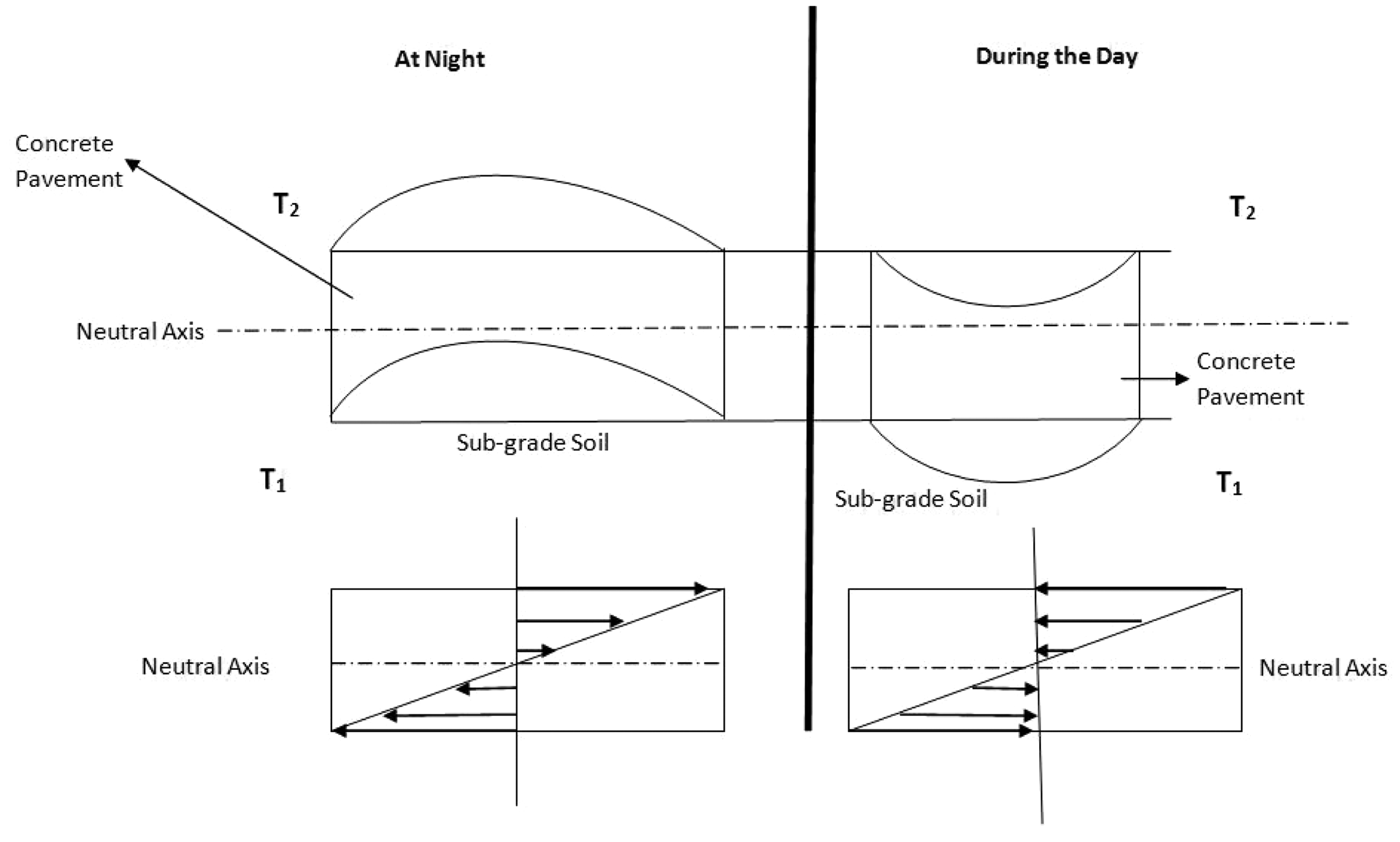
When planar bending occurs in both the x and y directions, as is the case for temperature curling in RCC pavement, the stresses in both directions (σx and σy) must be superimposed to obtain the total stress. Therefore, the maximum stress in an infinite slab due to temperature curling can be obtained by assuming that the slab is completely restrained in both x and y directions. Let ΔT = T2 − T1 be the temperature differential between the top and the bottom of the slab and αc be the coefficient of thermal expansion of fiber-reinforced RCC structure. If the RCC slab is free to move and the temperature at the top is greater than that at the bottom, the top will expand by a strain of “αcΔT/2” and the bottom will also contract by the same strain, as shown in Figure 2. This means that

Using the generalized Hooke’s law gives the strain in x direction ɛx


Merging equations (19) and (17) with equation (18) gives

Because equation (20) is also the stress in the y direction due to bending in the y direction, from equation (19), the stress in the x direction due to bending in the y direction

The total stress in the x direction σtx is the sum of equations (20) and (21)

It is clear that the total stress in the y direction σty is equal with σtx. Herein, αc can be derived from the previous section. It is proved that for most practical purposes, the elastic modulus of randomly distributed fiber-reinforced composites Ec can be approximated reasonably closely by [24]




Consequently, randomly distributed fiber-reinforced composites can be considered as an isotropic. Therefore, according to the elasticity theory, the Poisson’s ratio υc will be

On the whole, equation (12) and equations (22) to (27) give the total induced curling stresses in both x and y directions.
Materials
Chemical properties (%) of cement used in this study.

Well-graded steel slag aggregates finer than 25 mm was used. The aggregate grading is shown in Figure 3. Locally available potable water was used for mixing and curing of specimens.
The aggregate grading used in this study to produce RCC and/or FRRCC samples.
General properties of PP and steel fibers used in this study.

Experimental work
Sample preparation
Samples of RCC and/or FRRCC were manufactured as cubes of approximately 200 mm × 200 mm × 60 mm. A 4.536 kg compactor was used as a standard compacting technique. Compacting was conducted by dividing the sample into two layers of 30 mm thickness. Each layer was compacted by 145 knocks. Atmospheric curing was carried out in a temperature and humidity-controlled room (23 ± 2℃; 50 ± 5% RH) before casting for 28 days. Figure 4 shows details of the manufacture of samples using the vibrating compactor.
Manufacturing of RCC and/or FRCC samples using the vibrating compactor.
The experimental design used in this study.

Heat transition measurements
Various types of laboratory equipment have been invented since the early 1980s to reproduce thermal stress in simulated structures. In this study, a thermo-electrical device was originally developed to generate thermal stress under a prescribed temperature history. The schematic of the apparatus is shown in Figure 5.
The schematic of the thermo-electrical device developed to generate thermal stress in FRRCC samples.
Firstly, the heat generator was set to warm up the steel plate to achieve the prescribed temperature. In this way, three prescribed and/or primary temperatures were selected in experimental design including 40℃, 60℃, and 80℃ to simulate moderate, warm, and hot climatic conditions, respectively. All surface temperatures were measured by using a laser-base thermometer (Kiray, France) with the accuracy of ±0.1℃. After that, the RCC and/or FRRCC sample was put on the steel plate, and the laser-base thermometer was located above the sample to measure the thermal gradient. It is important to know that the chamber was isolated by an aluminum–wool stone–aluminum sandwich panel to prevent heat loss during the measurements. The temperature on the top of the sample was measured at five points (the middle and four corners) and reported each 10 min for time duration of 120 min. Therefore, a graph comprised of temperature increase rate on the top of the sample could be drawn based on the prescribed bottom temperature of the sample during the time of the experiment.
Results and discussions
Figures 6 and 7 show the plot of thermal stress σt versus fiber volume fraction vf and fiber modulus Ef, respectively.
Thermal stress σt vs. fiber volume fraction vf for PP fiber-reinforced RCC. Thermal stress σt vs. fiber modulus Ef for vf = 0.1 and νf = 0.3.

Equation (22) has been used to draw the plots at different temperature differentials of 10℃, 30℃, and 50℃. Figure 6 states that as the PP fiber volume fraction increases, the induced thermal stress will be raised in FRRCC pavement. The key point to explain this trend is the higher value of CTE for PP fibers compared to the concrete, i.e. 150 × 10−6 m/m/℃ for PP against 9 × 10⁻⁶ m/m/℃ for concrete. According to equation (22), the more the fiber CTE, the more induced thermal stress will be resulted in FRRCC pavement. In addition, by increasing the temperature differential ΔT from 10℃ to 50℃, the enlargement rate of the thermal stress increases specially at ΔT = 50℃. It is clear from Figure 7 that increase of fiber modulus leads to enhancement of induced thermal stress in FRRCC sample.
The growth rate of the thermal stress increases when the temperature differential ΔT increases from 10℃ to 50℃. It is important to know that the fiber modulus Ef influences directly both the coefficient of thermal expansion αc and tensile modulus Ec of FRRCC. For instance, the coefficient of thermal expansion of a unidirectional fiber-reinforced composite αcu can be obtained through [24]

As it can be seen, Ef is straightly correlated with αcu. On the other hand, combination of equations (24) and (25) with equation (23) gives

Based on the above equation, the composite elastic modulus Ec can be rewritten as a function of fiber modulus Ef in accordance with


Figure 8 shows the diagram of Ec against Ef for a randomly distributed fiber-reinforced RCC for vf = 0.1 and Em = 26 GPa.
Diagram of Ec vs. Ef for a randomly distributed fiber-reinforced RCC.
From the figure, it is interesting to know that by increasing the fiber modulus Ef up to the matrix modulus Em, i.e. concrete modulus (26 GPa), the FRRCC modulus will strictly increase. After that as the fiber modulus increases from 26 GPa to 210 GPa, the growth rate of FRRCC modulus will become so slowly.
The plot of thermal stress σt versus fiber CTE αf has been drawn in Figure 9.
Thermal stress σt vs. fiber CTE αf for vf = 0.1 and Ef = 20 GPa.
One can find out that increase in fiber CTE αf leads to more induced thermal stress. In this case, the same trend can be seen regarding vf and Ef. However, herein the plot of αf versus induced thermal stress is almost linear. This is due to the fact that is supposed the fiber modulus is constant to drawing the plot in Figure 9, i.e. αf is independent of Ef, meanwhile this assumption seems to be far from the real.
Figure 10 shows the maximum thermal stress induced in different RCC samples. It is important to know that the average between longitudinal and transverse CTE of the unidirectional fiber-reinforced concrete was calculated instead of using probability density function in calculations. The Poisson’s ratio of concrete was selected as 0.15 [26].
The maximum thermal stress (kPa) induced in different RCC/FRRCC samples.
The differential temperature ΔT has been also measured through the method described in previous section; consequently, the induced thermal stress was calculated by using equation (22). It can be found that by increasing the primary temperature at the bottom of the sample from 40℃ to 80℃, the thermal stress will rise in all RCC and FRRCC treatments. This trend shows good consistency with equation (22), where σtx is directly influenced by ΔT. Another outcome of taking an accurate look at Figure 10 illustrates that using both PP and steel fibers lead to more induced thermal stress in FRRCC samples compared to unmodified RCC and/or neat sample. This concept will be amplified as the PP fiber volume content increases from 0.1% to 0.4%. In addition, the FRRCC sample reinforced with 0.4% steel fiber comprised the most induced thermal stress among all samples. As it was previously discussed, the CTE is 150 × 10−6 for PP fibers; meanwhile, this parameter is 9 × 10⁻⁶ for the concrete. On the other hand, the modulus of elasticity is 210 GPa for steel fibers while that is 26 GPa for the unmodified concrete. Therefore, according to equation (22), the more tensile stress will be induced in FRRCC samples compared to neat concrete sample. The same trend will be found for the minimum induced thermal stress in RCC and/or FRRCC samples which is shown in Figure 11.
The minimum thermal stress (kPa) induced in different RCC/FRRCC samples.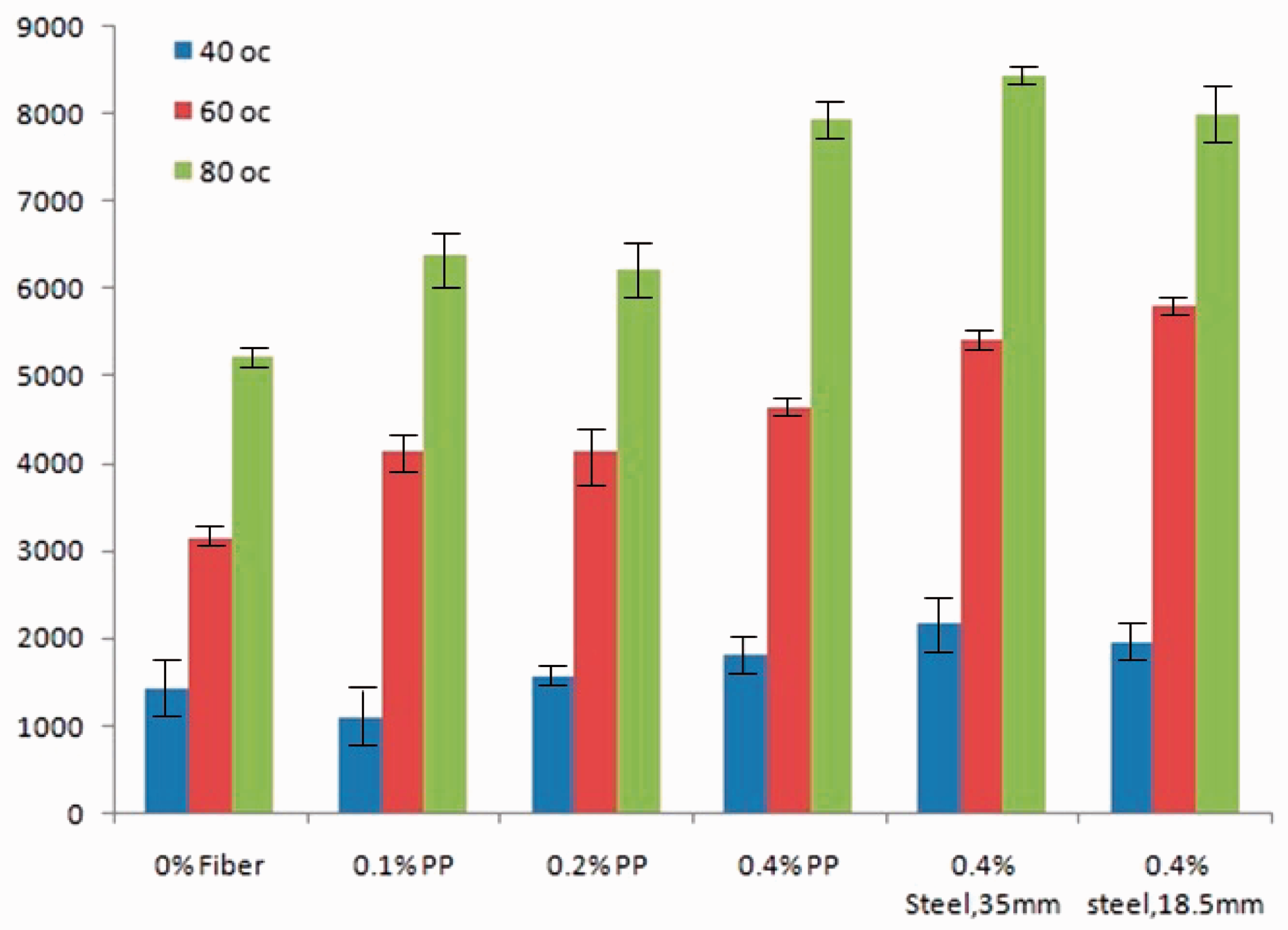
The minimum thermal stress is an important parameter showing the value of the curling stress at the final time of the experiment, i.e. after 2 h. Once more it can be seen that FRRCC samples contain more residual thermal stress with regard to the RCC sample. But the most vital point is that the bending stiffness (BS) of FRRCC samples is more than that of RCC sample based on the following formula [30]

Conclusion
The main aim of this study was the investigation of thermal stress distribution in FRRCC pavements. The study was divided in two sections including experimental part and modeling section. In the experimental section, two types of fibers were chosen to produce FRRCC samples including PP and steel fibers. The differential temperature between bottom and top of the samples was measured by a device developed in this study. In the analytical section of the study, three types of analytical models were used including: (1) mixture law in composite materials; (2) Eshelby’s model extended from “theory of elasticity”; and (3) thermal analysis of rigid pavements. Consequently, the induced thermal stress was calculated by using experimental results and model outputs. The insight research finding of this paper is that both PP and steel fibers induce more thermal stress within the FRRCC samples compared to RCC sample, meanwhile these fibers increase the bending strength and thermal cracking resistance of the structure. The key point to explain this phenomenon is the higher value of coefficient of thermal expansion for PP fibers compared to the concrete. On the other hand, the modulus of elasticity is 210 GPa for steel fibers while that is 26 GPa for the unmodified concrete. Therefore, more tensile stress will be induced in FRRCC samples with regard to neat concrete sample.
It is recommended to use and to investigate the role of other fibers, e.g. poly vinyl alcohol (PVA) fibers, in FRRCC structures in future works. In this work, the fiber volume fraction vf was limited to 0.1%, 0.2%, and 0.4%, therefore an effort seems to be required to determine the optimized vf in the future. Recycling of PP-reinforced RCC pavements is a novel idea that should be focused in the upcoming researches.
Footnotes
Declaration of Conflicting Interests
The author(s) declared no potential conflicts of interest with respect to the research, authorship, and/or publication of this article.
Funding
The author(s) received no financial support for the research, authorship, and/or publication of this article.