




Abstract
This paper investigated the hybridization effect of two chemically different fibers on the flexural behavior of cementitious composite. On this basis, polyvinyl alcohol and polypropylene fibers (polyvinyl alcohol/polypropylene fiber ratios: 75/25%, 50/50%, 100/0% and 0/100%) at different fiber volume fraction contents (1.2% and 2%) were considered as the variables. This study is especially focused on the influence of fiber types and their hybridization on composite deformability. The composite samples are subjected to the three-point bending test after 28 days of curing. The results showed that the fibers increased the flexural strength and ductility of cement matrix. It is revealed that the toughening improvement mechanism of polyvinyl alcohol and polypropylene fibers in cementitious composites are extremely different. Hybridization of polyvinyl alcohol and polypropylene fibers caused no significant improvement on flexural strength, but the strain capacity of composite under flexural load was increased. Finally, it was observed that the replacement of polyvinyl alcohol fiber with 25% volume fraction of polypropylene fibers can be considered as an important method for improving ductility of engineered cementitious composites.
Keywords
Introduction
Cementitious materials have inherently brittle behavior. To overcome this problem, many efforts have gone into attempt to improve the ductility of these materials [1]. Addition of various short, randomly distributed fiber reinforcement has found one of the main methods [2–4].
Two main groups of fiber reinforced cementitious composites which display different behavior after the first cracking appeared continually [5]. The first one showed the strain-softening behavior with the improved ductility, which the load decreases after the first cracking. Although, the fracture toughness of concrete can be increased by an order of magnitude, the tensile strain capacity usually remains little charged [6].
The second one has the strain-hardening behavior accompanied by the multiple cracking which resulted in higher strength and tensile ductility. These types of cementitious composites are usually called engineered cementitious composites (ECC), strain hardening cementitious composite (SHCC) or ultra high toughness cementitious composite (UHTCC) [7].
ECCs, in which an ultimate strength is higher than the first cracking strength, was recently developed Li [8]. These types of materials are the most significant developments in the field of strain-hardening fiber-reinforced cementitious composites with the tensile strain capacity of 3 to 7% [9]. The strain hardening behavior can be achieved by using high modulus fibers such as polyvinyl alcohol (PVA) with a moderate fiber volume fraction (typically 2%) [10].
The ECC materials with high ductility and flexible properties have a broad range of applications from repair and retrofit to seismic resistance structural elements [11].
The hybridization effect of two or more different types of fibers in length, diameter and modulus and fiber strength on the cementitious materials reinforcement was investigated recently [12,13]. The hybrid composite drives benefits from each of the individual fibers and exhibited improved ultimate strength and strain capacity compared to the mono-fiber composites [14–16].
The objective of this study is to elucidate the influence of hybridization on the flexural behavior of cementitious composite materials. The hybrid fiber with 1.2% and 2% matrix volume fraction was incorporated to the cementitious matrix and then subjected to the three-point bending test. In this research, PVA fiber is replaced with 25% and 50% of polypropylene (PP) fiber by volume.
Materials and methods
Materials
Two types of fibers were investigated: (1) PVA fiber (NYCON-PVA RECS15) with hydrophilic nature and (2) PP fibers with hydrophobic nature. The characteristics of the fiber used in this study are presented in Table 1. Both studied fiber have circular cross-sectional shape. The PVA fibers are insoluble in water, which was produced with the wet gel spinning method. Fibers added to the matrix were 1.2% and 2% of the total composite volume. Figure 1 shows the fibers longitudinal image.
Longitudinal surface of fibers: (a) PVA and (b) PP. Physical and mechanical characteristics of fibers.

Chemical and physical properties of cement.

Methods
Mix design
Mix design of cementitious composite.

Weight to cement ratio.
High range water reducer, weight to cement ratio.
F.A.: Fly ash.
Flexural strength test
The flexural strength was determined using a three-point bending test. The dimension of specimens for the flexural test was 230 mm × 100 mm × 9 mm. The test was performed under a displacement rate of 15 mm/min. The span length of the flexural loading was 200 mm. Load and mid-span deflection were recorded during the flexural tests.
Results and discussion
Flexural results
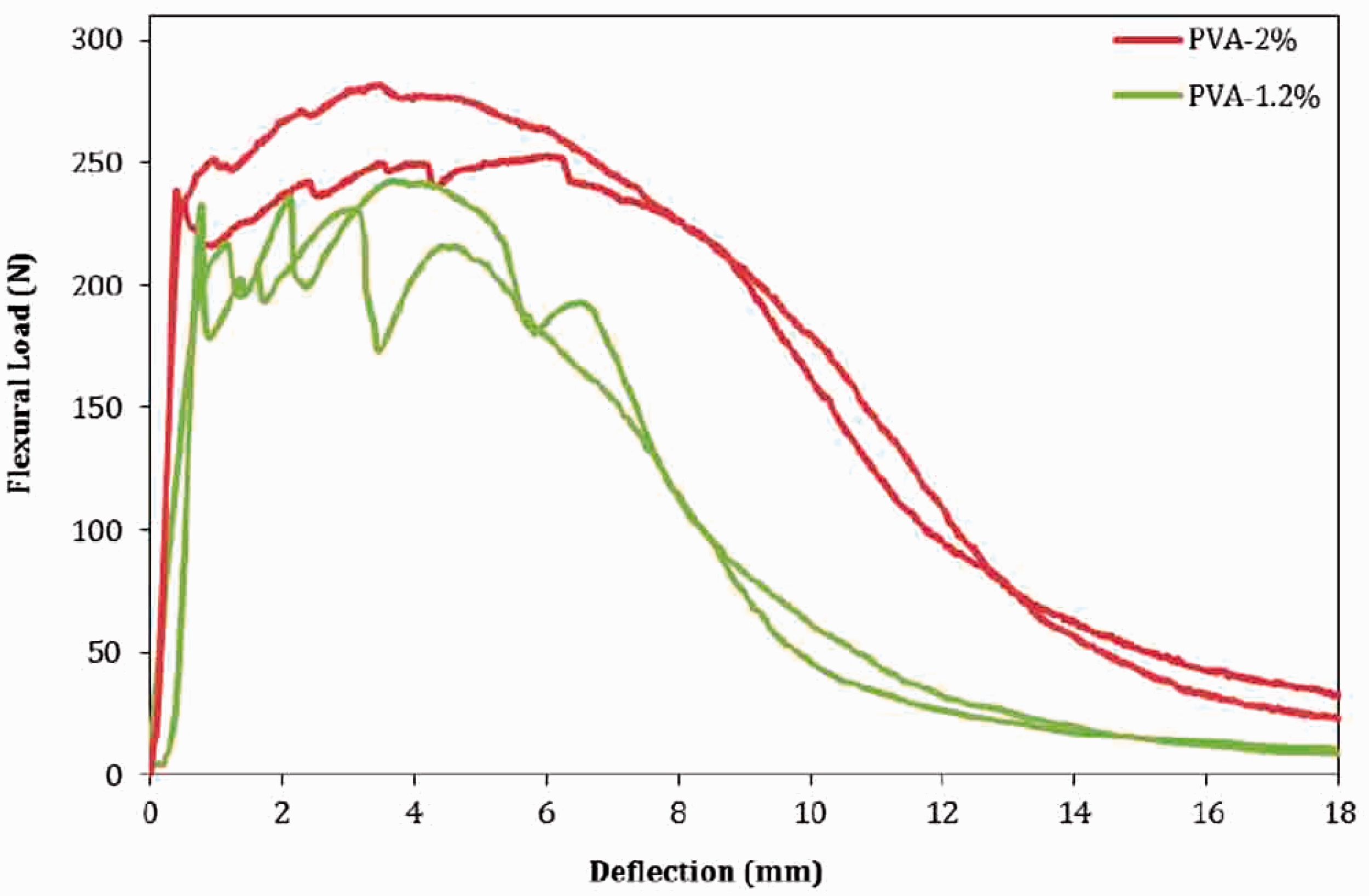
The flexural behavior of cementitious composites containing different fiber types at two fiber volume contents are illustrated in Figures 2–4. The flexural curves of each sample are the average of 4 or 5 measurements. Figure 2(a) shows the flexural behavior of 1.2% of composites sample containing PP fiber.
The flexural behavior of cementitious composite; (a) with 1.2% volume content of polypropylene (PP) fiber, (b) with different PP fiber volume content. The flexural behavior of cementitious composite with different polyvinyl alcohol (PVA) fiber volume content. The flexural behavior of cementitious composite samples containing polyvinyl alcohol (PVA) and hybrid PVA/PP fibers; (a) 75/25 and (b) 50/50. PP: polypropylene.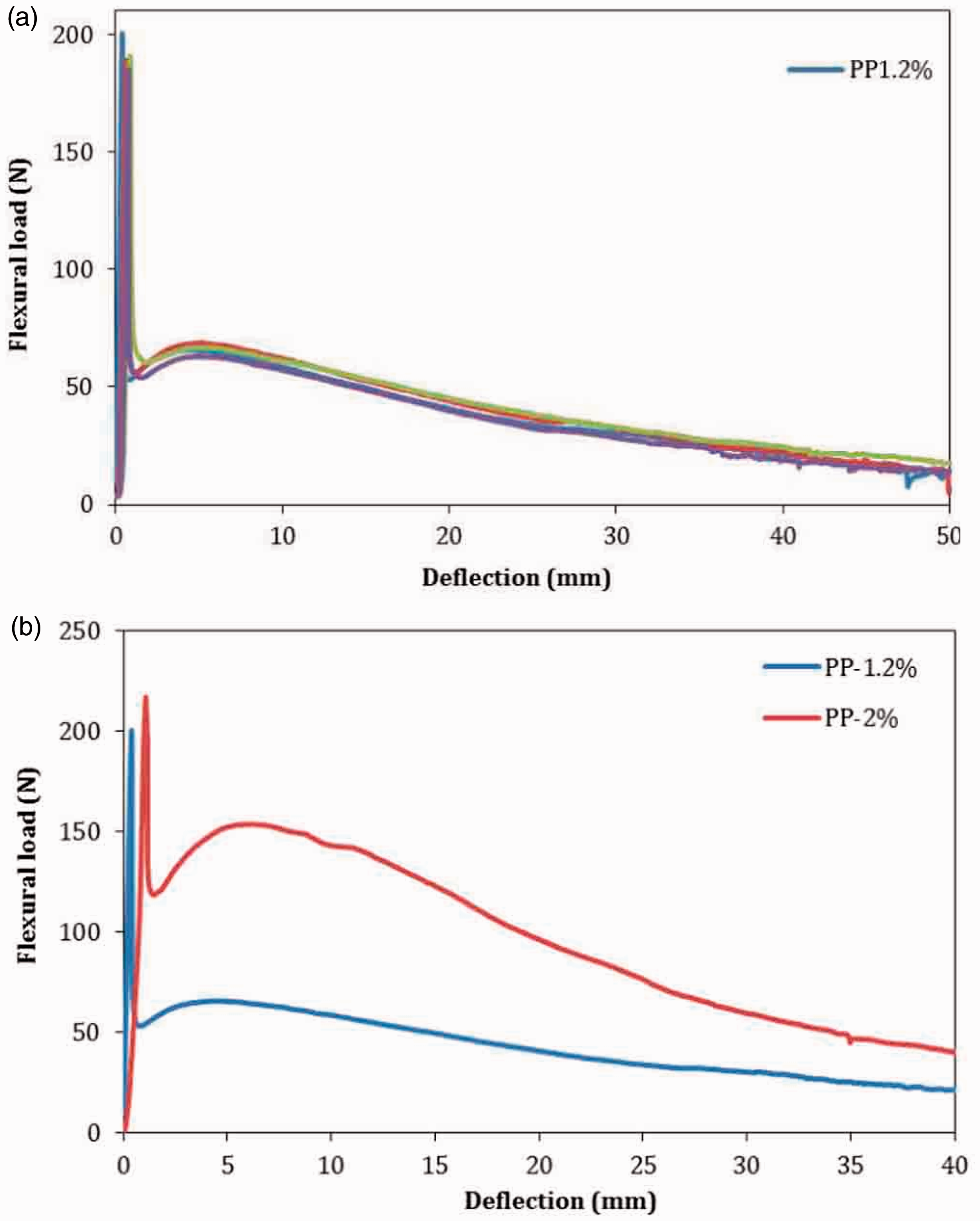

It is evident that these composites show the strain-softening behavior due to the fall of the load after the peak point. This is due to the low modulus of elasticity of PP fiber and low bonding strength to the cementitious matrix. The effect of higher fiber content on the flexural behavior of composite is shown in Figure 2(b). It can be seen that the flexural load of composite decreased again after the first crack. The results indicated that the post-cracking increased by increment in the fiber volume content fraction. Furthermore, the area under the curve is higher for the cementitious composites with 2% of fiber content.
Flexural test results of cementitious composite samples.

The results indicated that incorporation of PP fibers and PVA fibers by 2% of volume fraction increased the flexural strength of cementitious matrix up to 10% and 48%, respectively. The dominant effect of fibers was observed in increasing the ultimate deflection and the area under the load-deflection curve. The ultimate deflection for composite containing PP and PVA fibers were 195 and 72 times higher than control matrix, respectively.
The toughness and energy absorption of the composite during the fracture test are directly related to the area under the load-deflection curve. The area under the curve is increased by 108 and 75 times for PP and PVA fiber reinforced matrix, respectively. In here, the area under load-deflection curve is calculated up to the complete fracture of composite.
Although the PP fiber is weaker in bonding to the cement matrix and has lower modulus of elasticity, its ability in the energy absorption or/and energy dissipation during the bridging process shows better area under the curve compared to the PVA fiber. However, the flexural strength is rather lower than PVA reinforced composite samples.
As a result of high bonding strength of PVA fiber to the cementitious materials, premature fiber rupture occurred rather than slippage at the stage of loading and therefore the strain capacity of composites containing PVA fiber becomes limited. Consequently, the decrease in the bonding strength at fiber/matrix interface is essential to achieve sufficient load-carrying capacity at higher deflection values [6].
Hybridization effect of fibers on the flexural behavior of cementitious composites is shown in Figure 4. The PVA fiber content in samples was replaced with 25% and 50% of PP fibers by volume. It was observed that the flexural load decreased by incorporation of 25% of PP fiber, but an increase in greater deflection approximately around 7 mm was evident (see Figure 4a). It was mentioned that in hybrid composites, the toughness in post-cracking region is related to the flexible fibers, while the stiffer fiber provides reasonable first cracking strength [17]. In post-cracking region, PP fibers can arrest the macro-cracks and can substantially improve the ductility of the composite.
Figure 4(b) shows the effect of replacement of PVA fibers with 50% of PP fiber. The load-deflection curve shows a considerable decrease in the post-cracking area. The strain capacity of composite was improved by replacement with low-modulus fiber. The flexural behavior of hybrid composite with higher amount of PP fiber was very similar to the sample containing 1.2% of PP fiber as demonstrated in Figure 2(a).
The first and post-cracking load for different samples containing 1.2% volume of fiber are presented in Figure 5. The results show that there is no significant difference between the first cracking strength of hybrid composites. Up to 10% decrease on the first cracking strength was obsreved with the hybridization of fibers. It was shown that the post-cracking strength decreased 17% and 36% for hybrid composite with replacement of 25% and 50% of PVA fiber with PP fiber, respectively.
The first-cracking and post-cracking load of ECC-PVA/PP composite samples (volume fraction = 1.2%).
Figure 6 shows that the load at deflections greater than 10 mm increased by replacing PVA fibers with PP fibers. When the PVA fiber replaced with 25% of PP fibers, the increase in loads at deflection of 10 mm and 15 mm were up to 58% and 158%, respectively, compared with composites containing pure PVA. This is mainly due to the crack-bridging action of PP fibers on major cracks formed in the matrix. Also, the longer length of PP fiber can allow higher energy dissipation during the fiber pull-out.
The flexural load at different deflection of ECC-PVA/PP composite samples (volume fraction = 1.2%).
The area under the load-deflection curve up to 10 mm and 15 mm deflection under three-point bending test was determined for different samples. The results are shown in Figure 7. Although the area up to 10 mm deflection was decreased 8% for sample with 25% of PP fiber, an increment up to 6% in the area up to 15 mm was observed. According to the results, the higher decrease in the area under curve due to the increase in PP fiber content was evident.
Calculated area under the load-deflection curve up to 10 mm and 15 mm deflection of ECC-PVA/PP composite samples (volume fraction = 1.2%).
The hybridization effect of composite sample containing 2% volume of fiber was investigated and shown in Figure 8. The hybrid composite shows a reduction in load-bearing capacity around the 6 mm deflection. This is due to lower amount of high modulus PVA fiber in the composite. The strength of composite is directly related to the modulus of elasticity of fiber and its bonding strength to the cementitious matrix. According to the previous hybrid composite samples, the main effect of PP fibers is on improvement of strain capacity of cementitious composite under flexural load.
The flexural behavior of cementitious composite samples containing 2% PVA and hybrid PVA/PP = 75/25 fibers.
The flexural properties of the specimens with 2% of fiber volume fraction including the first cracking and the post-cracking load were determined and are shown in Figure 9. It was obtained that the replacement of 25% of the PVA fiber with PP fiber in 2% of fiber volume has a small effect in reduction of the first cracking and the post-cracking load up to 4% and 10%, respectively. The area under the curve is determined for mono fiber composite and hybrid composite in fiber volume fraction of 2% and is presented in Figure 10. The results present that the hybrid composite has lower value of area in studied deflections compared with control samples. Although the PVA fiber was replaced by 25% of volume with PP fiber, the decrease of area for the deflection up to 10 mm and 15 mm is 13% and 11%, respectively. According to the relatively small effect of PVA fiber replacement with a portion of PP fiber on the flexural properties of composites, it can be concluded that this method can be considered a promising method for improving composite’s deformability.
The first-cracking and post-cracking load of ECC- PVA/PP composite samples (volume fraction = 2%). Calculated area under the load-deflection curve up to 10 mm and 15 mm deflection of engineered cementitious composites (ECC)- polyvinyl alcohol/polypropylene (PVA/PP) composite samples (volume fraction = 2%).

Composite containing high modulus PVA fiber presented high ultimate strength and low strain capacity, while those containing low modulus PP fiber exhibited low ultimate strength and high strain capacity. It was observed that a combination of these fibers with different stiffness provided a cementitious composite with moderate ultimate strength and strain capacity.
Figure 11 shows the cracking pattern of composite samples at 28 days. The composite containing PVA fiber showed multiple cracks as shown in Figure 11(a). The number of micro-cracks depended on the amount of PVA fiber in the composite. It was reported that multiple cracking and deflection hardening behavior can be achieved by incorporation of high-strength fibers to the cementitious matrix [18]. Figure 11(b) shows that the composite containing higher amount of PP fiber has less multiple cracks than the samples with PVA fiber. Based on the cracking pattern in Figure 11(b), the composite specimens with 1.2% volume of fibers fractured with the first crack due to the low modulus of the used PP fibers.
Cracking pattern of composite samples, (a) with polyvinyl alcohol (PVA) fiber, (b) with polypropylene (PP) fibers and (c) hybrid composite (volume fraction = 1.2%).
The number of micro-cracks decreased by reduction in the PVA fiber content for hybrid composites, as shown in Figure 11(c). Formation of multiple micro-cracks on the matrix surface can enable a high energy absorption ability of cementitious composite and contribute to a higher fracture resistance by preventing crack localization.
The fracture zone of mono-fiber reinforced composites is shown in Figure 12. After the breakage of composite, the PP fibers remained at the fracture zone, but the PVA fibers were ruptured. This is due to the fact that the PVA fiber has superior bonding to the cementitious materials which causes fiber fracture instead of fiber pull-out.
Fracture zone of cementitious composites containing; (a) polypropylene (PP) fiber and (b) polyvinyl alcohol (PVA) fiber.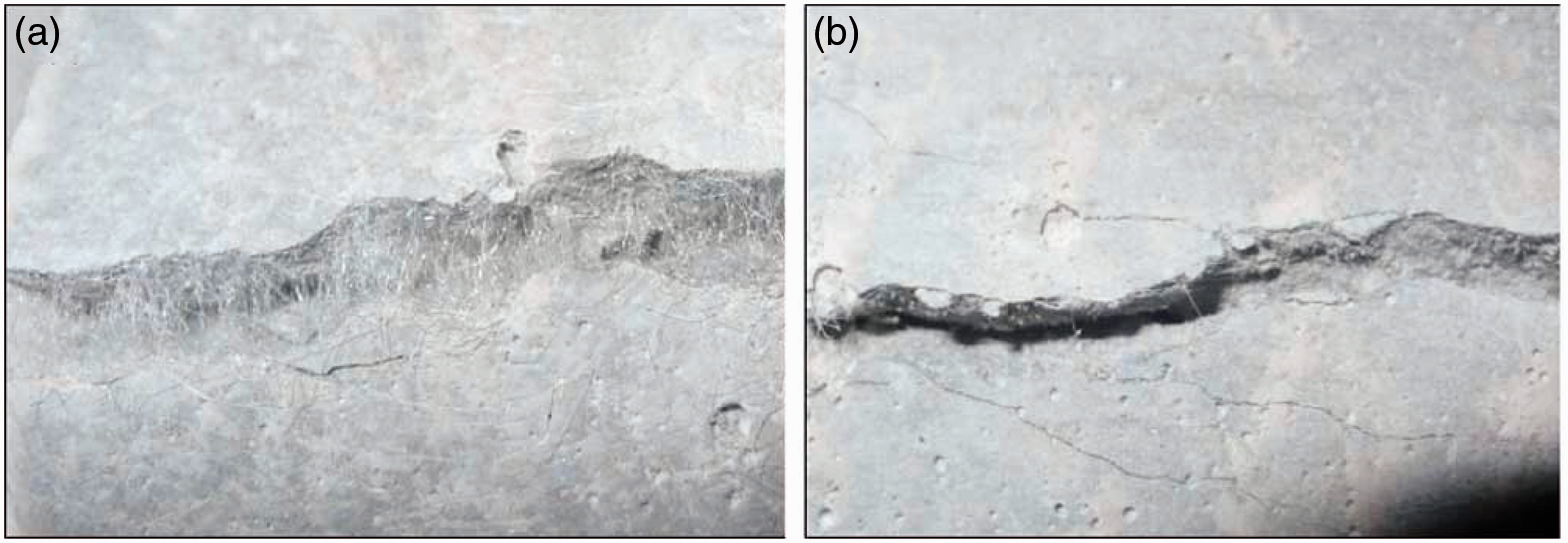
Figure 13 shows the fracture zone of a hybrid composite. The most of PVA fibers during the crack opening are ruptured beacasue of their greater bonding to the cement matrix. Therfore, the main fiber that remained in the fracture zone are PP fibers. This remaining fiber can carry out the flexural load at higher deflection of composite.
The fracture zone of hybrid composite (volume fraction = 2%).
Conclusion
The following results have been concluded from the flexural test of cementitious composites:
Fibers in each chemical composition and surface properties (hydrophobic and/or hydrophilic nature) improved the flexural strength and flexural toughness of the reinforced cementitious composites. Incorporation of PVA fiber to the cementitious composites exhibited strain-hardening behavior, while the behavior turns to pseudo-strain hardening for PP fiber-containing specimens. The flexural strength of the composites at 2% of PP and PVA fibers improved about 10% and 48% in comparison to the control specimens. The specimen’s deflection was improved considerably in both fiber-containing samples, but PP fiber-containing specimens showed higher deflection. It should be attributed to the low modulus of elasticity and tensile strength of these fibers, which cause elongation at the crack tip during the pulling out. The replacement of PVA fiber with an optimized portion of PP fibers can be considered a promising method for reducing the costs of production and amount of PVA fiber. It was concluded that in general, the concrete containing hybrid fibers, i.e. combinations of PVA and PP fibers, gave better performance in strain-capacity and energy absorption ability compared to the concrete containing single type of fibers.
Footnotes
Declaration of Conflicting Interests
The author(s) declared no potential conflicts of interest with respect to the research, authorship, and/or publication of this article.
Funding
The author(s) received no financial support for the research, authorship, and/or publication of this article.