




Abstract
Cellulosic fibers, which are widely available in Iran, can be used as convenient materials for cement panel matrix reinforcing with respect to adequate mix design. This paper at the first stage presents a simple model for predicting the fiber reinforced cement panel behavior during flexural loads by implementing “Equal Cross-section Theory”. At the second stage, experimental study was carried out to validate the proposed theory. In order to do the experiment, different types of cellulosic fibers were used as cement replacement of 1% by weight. In addition, to solve the problem of swelling of cellulosic fibers within cement matrixes, fibers were treated by UV/ozone and coated with sodium silicate. Compressive strength, flexural strength and density of cement composite samples were investigated in terms of different cellulosic fiber types including viscose, Leafiran, milkweed and hemp and the sodium silicate consumption amount. The results revealed that the use of cellulosic fibers diminished the density and compressive strength of the cement panel specimens. Improvement of flexural strength was only achieved by adding the hemp fibers into the cement panels which showed a good agreement with “Equal Cross-section Theory” outputs. Moreover, the reductions in the compressive and flexural strength of cement panels contained sodium silicate were much smaller than the cement panels with uncoated fibers.
Introduction
In the recent years, by increasing the variety and numbers of the building materials many significant efforts have been done on implementation of different types of fibers particularly in concrete and cement panels. Many cement boards have been used as building partitions for over one century [1,2]. However, the specific gravity of cement boards is still high, more than 2000 kg/m3. In order to adapt the varieties of the functions and the space for high-rise structure, the partitions to separate building space demand to be lightweight and improved by its mechanical properties [3].
The purpose of fiber reinforcement is fundamentally to improve the properties of a building material, specially the mechanical ones, which would be otherwise unsuitable for practical applications. Consequently, the major advantage of fiber reinforcement of a material such as cement paste, mortar and/or concrete is a development in flexural behavior of the composite [4].
There were many studies which illustrate the various characteristics of fiber-cement boards with different fiber origin. Excellent mechanical properties, economical advantages and eco-friendly concepts are the most important reasons to use cellulosed fibers in building industry. For instant, regarding the mechanical properties of the hemp fibers reinforced cement, Sedan et al. stated that bending strength was increased to a certain extent by an increase in fiber’s load [5]. In addition, alkaline treatment of hemp fibers improved bending strength of composite panel about 94% in contrast with the fiber-matrix adhesion [5,6].
Wang et al. observed in their work that the toughness and tensile behaviour of building materials can be improved by adding a small fraction of cellulosic fibers [7], even there was a significant implementation of randomly distributed fibers of recycled waste in thin-sheet cement products [8].
The properties of cellulosic fibers are not only limited to the mechanical ones, since their use is extended in other fields such as energy saving and acoustic performance. Acoustic performance and damping behavior of cellulose fiber reinforced cement composites have been investigated by Neithalath et al. They concluded that the acoustic absorption coefficient of composite samples increases with an increase in fiber volume [9]. From the point of view of energy saving, excellent power insulation has been reported for composite panels reinforced with cellulosed fibers [10].
In developing countries, where the lack of housing as well as the lack of commercial, industrial and public service buildings is considerable, the introduction of these materials can help increasing the production of buildings with suitable performance. Cellulose fibers can be a good alternative in these countries due to low cost. Besides, in some regions, asbestos–cement is still the sole composite in use, although health hazards are becoming an increasing concern [4].
As it can be seen, many studies have been experimentally done on using different types of cellulosic fibers in cement composite panels. However, there is a lack of mechanical model proposing the fiber properties which determine flexural strength of fiber reinforced panels. The main aim of this paper is therefore to produce cellulosic fiber cement panels considered as building partition. In this way, four cellulose fibers including viscose, Leafiran, milkweed and hemp were used to investigate the effect of fiber parameters on the flexural strength of the composite panel in accordance with “Equal Cross-section Theory”.
Bending stiffness modeling of fiber reinforced composite panels
“Transformed Area” and/or “Equal Cross-Section” is a famous theory that is related to the analysis of steel reinforced concrete structures; thus in this way, the occupied area (cross section) by fibers will be replaced with composite, like the steel bars which are replaced by concrete [11]. Figure 1 shows this phenomenon in accordance with “Equal Cross-Section” theory.
Gradation curve for sludge, cement and sand.
Consequently, this transformed/equal area Snew can be obtained from the basic equilibration for the “Strength of Materials” and/or “Mechanics of Materials” in Refs. [12] and [13]:
“Equal Cross-section Theory” applied to fiber-cement panel.




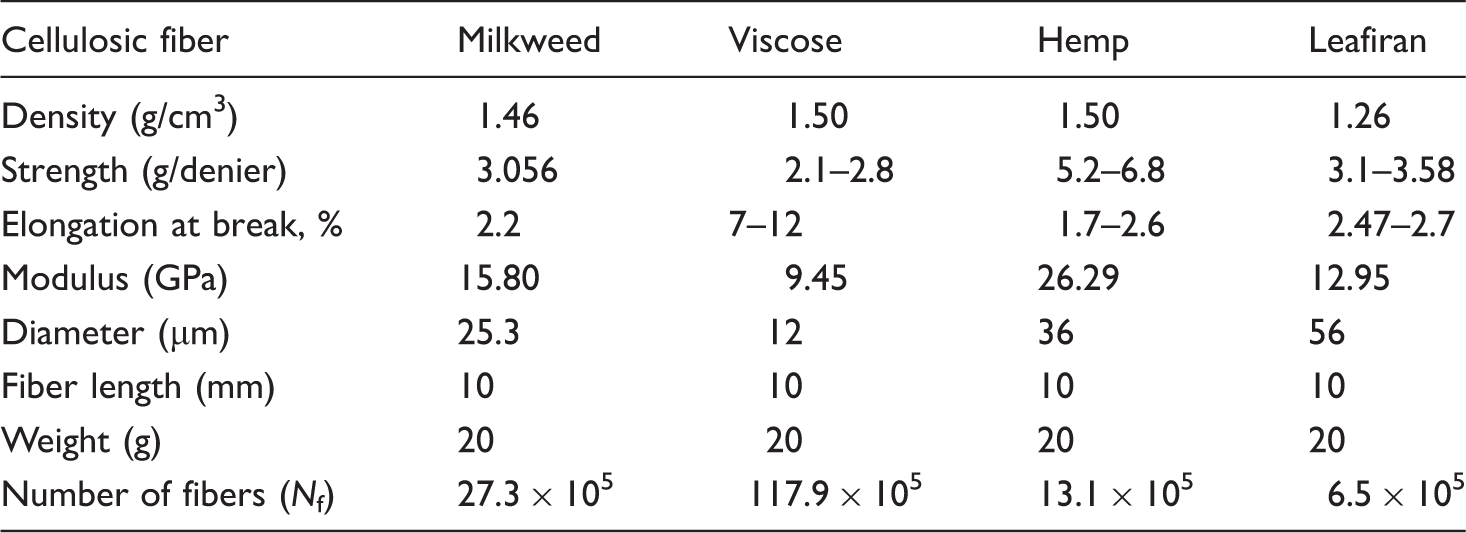
The properties of cellulosed fibers used in this study.
The outcomes of equal cross-section theory.

The data from Table 2 were based on the following assumptions:
All fibers have been paralleled to the main cement panel longitudinal axis and they have been arranged as a square matrix nf × nf in accordance with Figure 2; The distribution of fibers in specimens was uniform therefore the neutral axis was remained at the same position (h/2); The cross sections of all fibers were circular and they had the same length; Fibers were linear elastic; The sizes of supposed cubic were: 40 mm × 40 mm and 10 mm in depth due to the fiber length; Total weight of cement matrix (cement + sand + sludge + water) was 2000 g per specimen and the total weight of fibers added to each sample was 20 g; The void content is the same for all samples.
Increasing or decreasing the equal cross section and consequently the compression stress is in accordance with the fiber to composite Young’s modulus ratio (Ef/Ec). Since from equation (4), by injecting the fibers (Ef/Ec > 1) causing a larger TCR and/or TTCR, the compressive load P will be inserted to a wider equipollent area, thus, with the same load insertion of P for both comparative structures, a less compressive load will be inserted to the surface unit of the structure which has a bigger TCR and/or TTCR.
On the other hand, the bending stiffness of a structure BS can be calculated through [14]:

in which L is the span length in bending test. So, an increase in the moment of inertia of cross section makes a stiffer structure against the loads, which will lead to bending. Therefore, when the moment of inertia rises, a greater compressive load of P will be needed to decompose the structure. It is also clear that the Young’s modulus E of a fiber reinforced composite structure can be obtained based on fiber elastic modulus Ef and matrix elastic modulus Em in accordance with [15]:


Equation (7) presents the parameters that determine the bending stiffness of a fiber reinforced composite structure. Thus, fiber modulus Ef, fiber volume fraction vf, single fiber cross section sf and the ratio of fiber modulus to matrix modulus Ef/Em influence the bending strength of the composite panel reinforced with cellulosed fibers.
Experimental work
Materials
Cement panels consists of cementitious matrix and cellulosic fibers. Four cellulosic fibers as well as viscose, Leafiran, milkweed and hemp were added to cement panels (see Table 1).
Leafiran fiber is generally derived from the leaves of a plant called Typha australis which belongs to the family Typhaceae. The fiber is widely cultivated in Iran obtained by chemical retting. Leafiran is a lignocellulosic fiber having a cellulose content of 54%, a moisture regain of 8–10%, and a tenacity of 29 cN/tex [16]. Mortazavi and Kamali showed that Leafiran fibers could be an ideal replacement for some widely used natural textile fibers. Therefore, this fiber was used in this work as a reinforcing fiber in cement composite panels.
The milkweed fiber (Asclepias syriaca), often called “vegetable silk,” is a seed floss that is similar to the Rux fiber (Caleotropis gigantea) of Southeast Asia. The physical properties of the milkweed fiber, its morphology, and the properties of the blended yams and fabrics can be found in Refs. [17–19]. However, using milkweed fibers to reinforce composite materials seems to be a novel field. Consequently, milkweed fibers because of excellent mechanical properties and high economical advantages were used in this work.
Hemp fiber was used in experimental design due to economical advantages (low price), while viscose was selected as an ideal regenerated cellulosed fiber to compare its performance with hemp, leafiran and milkweed within the composite cement panels.
The contentious of cementitious matrix include: (1) ASTM Type 1 portland cement (28 days compressive strength of 50 MPa) supplied by Sepahan Cement Inc. (Iran); (2) waste sludge from cutting stone factories which were generated from slurry sludge by losing significant amount of water and settlement at the bottom of the basin [20]. The implemented waste sludge has a maximum particle size of 0.15 mm supplied by cutting stone factories in Mahmoodabad (Iran); (3) river sand having a specific gravity of 2.67 and a maximum particle size of 2 mm, fineness modulus of 1.4; and (4) fresh water.
Generally particle size determination and distribution of soil are measured by implementing sieve analysis and hydrometer analysis (particle-size finer than No. 200 sieve size (0.075 mm)). In this work, sieve analysis for sand and hydrometer analysis for cement and waste sludge were carried out. The gradation curves for cement, sand and waste sludge are indicated in Figure 3.
Cross section of a “nf × nf” matrix of fibers injected in cement panels.
Specimens preparation and test methods
First composite mix proportions.

Second composite mix proportions.

One of the major steps to prepare the composite sample is to develop the performance and mechanical properties of fibers prior to adding to the mixture. Using water repellent agents and/or fiber impregnation with sodium silicate, sodium sulfite, or magnesium sulfate is an approach reported by some researchers [21]. This leads to coating natural fibers to avoid water absorption. For this reason, fibers used in this study were modified by combination of UV treatment and ozone irradiation in one hand and fiber sodium silicate coating on the other hand.
For mixing the cementitious material with cellulosic fibers, two mix procedures are available: dry and wet. The mixture methods here for cement composite panel is dry which is conducted as follow:
Weight the constituents according to reference mix design (sample No. 12); Mix the cement, waste sludge and sand with determined proportion for 2 min at dry condition, and then pour 75% water into the mixture, and finally blend for 2 min by middle speed of the mixture. Turn off the mixture, add natural fibers as cement replacement of 1% by weight into the mixture material, and then blend one minute by middle speed of the mixture. Turn off the mixture again, pour the remaining 25% water into the mixture, and then blend for 10 min by middle speed of the mixer.
The 50-mm cubes for compressive strength test and the samples with the size of 160 × 40 × 40 mm for flexural strength test were cast from each batch and compacted by a vibrating table. The surface of cement specimens was level to be smooth by the trowel, and then 1 h later, a surcharge with 30 g/cm2 were loaded to confine the size of samples. The specimens were demolded 24 h after casting and then water cured for 7 days. Thereafter, the specimens were kept in a room at a temperature of 21℃ until the time of testing [3].
The properties were required to be evaluated include density, compressive strength and flexural strength. The compressive strength was carried out according to the ASTM C10-9-900. The specimens were tested at the age of 8 days. The rate of application of loads was in increments of 25 kN. Flexural strength test was evaluated in accordance with ASTM C348-86. The specimens with the size of 160 × 40 × 40 mm were prepared properly and tested at the age of 8 days. The dry flexural strength of samples was determined by using the two-point bending test apparatus. Consequently, composite panel samples were subjected two points loading till failure of the specimen. Thus, the flexure strength SF (MPa) was determined by the formula [22]:

Experimental results and discussions
The data from cement panels made with various types of fibers and sodium silicate content (%) in terms of different mechanical properties are summarized in Figures 4, 5 and 6. The density of cement panel specimens ranged from 1.16 to 1.9 g/cm3 depending on the type of cellulosic fibers used in different samples. By increasing the fiber content, the density of the composite samples was also reduced resulting in lighter panels. Meanwhile adding the fibers to the samples can cause the void between the cementitious part and fibers and subsequently decrease the unit weight. As illustrated in Figure 4, at 1% viscose fiber content, the density diminished to as low as about 61% of the specimen without fiber.
Mutual effect of fiber types and sodium silicate on density. Mutual effect of fiber types and sodium silicate on compressive strength. Mutual effect of fiber types and sodium silicate on flexural strength.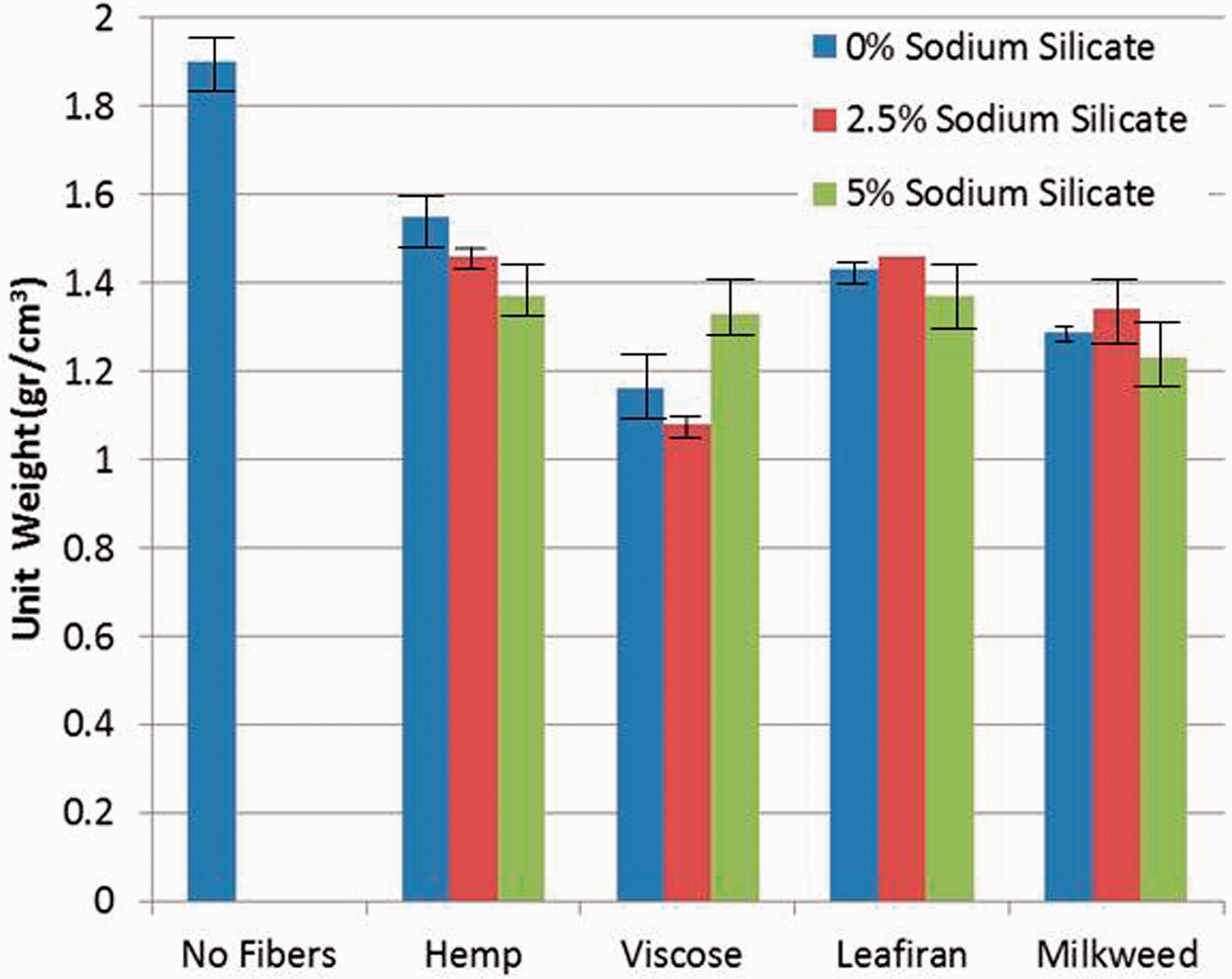


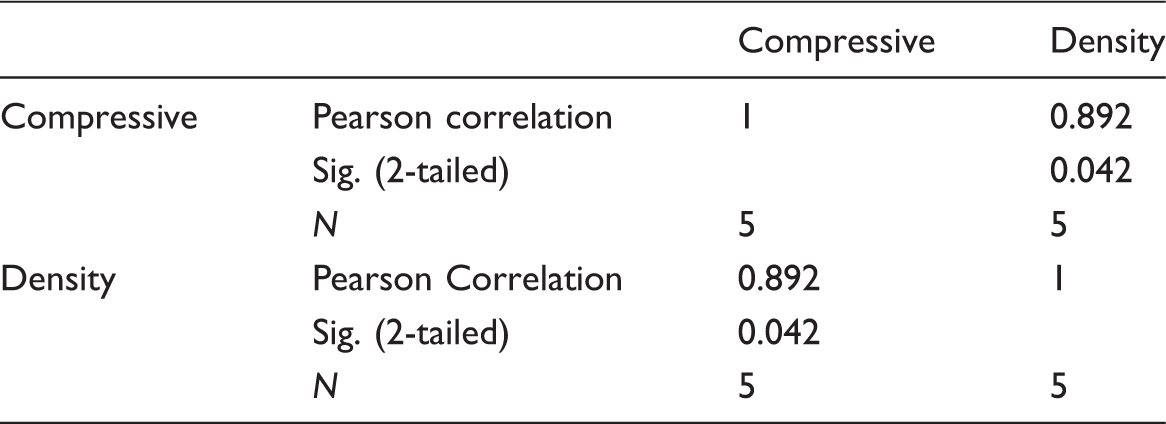
Density and compressive strength correlation.
The data from Figure 6 exhibited that hemp fibers increased the flexural strength of samples up to 170% of the reference sample. However, there was about 65% reduction in compressive strength when 1% of the cement weight was replaced by viscose, Leafiran and milkweed fibers. The effect of sodium silicate at varying content in flexural strength of cement panel is well observed. The figure indicated that the beneficial effect of sodium silicate was more pronounced for Leafiran in flexural strength, since by coating the fibers by sodium silicate at 2.5 vol% and 5 vol% about 55% of flexural strength was increased. To detail study of the beneficial effect of sodium silicate coating on compressive and flexural strength behavior of Leafiran fiber, the Fourier transform infrared spectroscopy (FTIR) analysis was applied. Three FTIR spectra of Leafiran fibers with and without sodium silicate are shown in Figure 7. Adding sodium silicate in different volume content to Leafiran resulted to present vibrations located at 616.5 cm−1, 838.7 cm−1 and 1040.9 cm−1 which are attributed to SiO2, CO and OH, respectively, causing the crystallization effect and subsequently development of adhesion between cement matrix and fibers. Consequently increasing the compressive and flexural strength is conformed to the results from FTIR analysis.
Effect of sodium silicate on FTIR spectra of Leafiran.
On the other hand, experimental results also show that the flexural strength for cement panels containing hemp fiber was increased in comparison with the neat sample. This phenomenon shows a great agreement with the bending stiffness modeling of fiber reinforced composite panel, in which 1.19% increase in the moment of inertia of cement panels reinforced by hemp fibers was observed. Conversely, reinforcing the cement composite with viscose, Leafiran and milkweed resulted in decreasing the moment of inertia 1.53%, 3.40% and 2.39%, respectively.
Altogether, Table 2 presents the outcomes of the model. As it can be seen the model predicts the bending stiffness of composite cement panels, which gives a comparative index ΔI% based on fiber parameters. The model does not directly predict the bending strength of composite samples. Since, “equal cross-section theory” was used to calculate the new transformed area of fiber-reinforced composite panel; therefore, it was assumed that all reinforcing fibers were parallel to the longitudinal direction. This assumption was unique for all composite panels that could show the trends in bending strength of fiber-reinforced panels.
Conclusions
This paper attempted to choose the most appropriate cellulosic fibers between hemp, viscose, Leafiran and milkweed to make cement panels as the suitable material for building partitions. In this way, “Equal Cross-Section” theory was used to model the bending stiffness of fiber reinforced cement panels (FRCPs). Consequently, the following conclusions could be drawn from this study:
Substituting 1 weight% of cement with cellulosic fibers decreased the density and compressive strength. Experimental results also show that the flexural strength for cement panels containing hemp fiber was increased in comparison with the neat sample. This phenomenon shows a great agreement with the bending stiffness modeling of fiber reinforced composite panel, in which 1.19% increase in the moment of inertia of cement panels reinforced by hemp fibers was observed. Conversely, reinforcing the cement composite with viscose, Leafiran and milkweed resulted in decreasing the moment of inertia 1.53%, 3.40% and 2.39%, respectively. Sodium silicate consumption up to 5% could retrieve the flexural strength of samples with Leafiran fibers considerably; however, the retrieve in flexural strength of cement panels with milkweed is not significant.
Therefore, the mechanical feasibility of the following fibers as a replacement by 1% weight of cement was proven and with respect to the priority of use in partition panels and exterior walls are listed: 1 – untreated hemp; 2 – pretreated Leafiran fibers by sodium silicate up to 5%. In other words, in this study the performance of FRCP in the middle of the exterior wall, where the bending moment induced by wind or earthquake loads is significant, was investigated and the most appropriate types of cellulosic fiber with respect to their use was identified.
However, to investigate the mechanical properties of FRCP an effort has been carried out by the authors; further studies need to be undertaken on this issue. For instance, equal cross-section theory could be extended for randomly distributed FRCPs.
It is suggested that the use of fibers in cement panels should be approached with consideration to economic feasibility and caution to the assumptions taking into account. For instant applying scanning electron microscopy (SEM) technique and/or image processing methods will be useful to investigate the distribution and the orientation of fibers within the cement panels for future study. Also the investigation of fibers characteristics in cement panels in terms of sound isolation, heat transformation and impaction is recommended.
Footnotes
Funding
This research received no specific grant from any funding agency in the public, commercial, or not-for-profit sectors.