




Abstract
Experimental investigations were carried out to determine the flexural behaviour of reinforced concrete beams strengthened with basalt textile-reinforced concrete under monotonic and low-cycle fatigue load. Reinforced concrete beams strengthened with basalt textile-reinforced concrete were tested under four-point bending. The behaviour of the strengthened beam was compared with that of un-strengthened reinforced concrete beam. It is observed that there is an enhancement in energy absorption for reinforced concrete beams strengthened with basalt reinforced concrete even though there is no considerable increase in load carrying capacity. It is observed that when the strengthened beams are subjected to monotonic loading, the increase in ultimate load carrying capacity is marginal but the increase in ductility is 84.5% and the increase in energy absorption is 162% compared with un-strengthened beam. Reinforced concrete beams strengthened with basalt reinforced concrete were also tested under low-cycle fatigue load. It is observed that there is about 20% reduction in ultimate load carrying capacity and 27% reduction in ductility compared to monotonic case. But the cracking and failure patterns are similar in both the cases.
Keywords
Introduction
Upgrading civil structures with cement-based bonding agents and high-performance fibre materials give a more compatible repair or strengthening system with the base concrete. Consequently, the use of cementitious bonding agents should prevent some of the disadvantages with the organic resins. Substituting the epoxy adherent with a cement-based bonding agent will render a strengthening system with improved working environment and better compatibility to the base concrete structure. Consequently, if it is possible to use a cement-based matrix instead of an epoxy matrix, cementitious composites could be used wherever fibre-reinforced polymers (FRP) are used for concrete strengthening today. Studies related to cement-based composites for flexural strengthening and repair of reinforced concrete (RC) beams are very limited in literature [1–4]. The strengthening technique using textile-reinforced concrete (TRC) comprises a cementitious matrix as the bonding agent and a textile fabric as reinforcement [5]. This cementitious matrix has a maximum aggregate size of 0.6 mm. The reinforcing fibres are predominantly made of alkali-resistant glass produced into a textile fabric. There can be many designs of the textile fabrics and positioning of the fabric onto RC beams depending on the load requirement. Fabrics with relatively complex architecture, such as short weft knit, enhance the bonding and improve the composite performance [6–8]. Triantafillou and Papanicolaou [3] suggested that textile-reinforced mortar (TRM) may be considered as an alternative to FRP, providing solutions to many of the problems associated with the performance of strengthened members. Based on the experimental response of RC members strengthened in shear, it is concluded that textile-mortar jacketing provides substantial gain in shear resistance; this gain is higher as the number of layers increases and, depending on the number of layers, is sufficient to transform shear-type failure to flexural failure. Larbi et al. [5] studied the strengthening method using TRC for the performance. The objective was to assess potential alternative solutions based on TRC mainly in the control of cracking in reinforcement (un-damaged beams), or hybrid solutions combining TRC and rods (carbon, glass or both) when it is important to satisfy the two limit states (ultimate and service) as part of the repair (previously damaged beams). The experimental part brought out the positive factors of TRC hybrid solutions in the repair of RC beams, in terms of both ultimate and service behaviour, with very similar performances to that of traditional solutions such as carbon fibre reinforced polymer (CFRP).
Sim et al. [9] investigated the applicability of the basalt fibre as a strengthening material for structural concrete members. The basalt fibre manufactured in Russia exhibited the tensile strength less than 1000 MPa, which was about 30% of the carbon fibre and 60% of the high-strength glass (S-glass) fibre. When those three different fibres were immersed into an alkali solution, the basalt and the glass fibres lost their volumes and strengths producing a reaction product on the surface while no significant strength reduction was observed from the carbon fibre. In this case, the basalt and the glass fibres demonstrated certain degree of strength reduction, but the rate of the reduction was slower in the basalt fibre comparing to the glass fibre. When the fibres were exposed to a high temperature at over 600℃, only the basalt fibre maintained its volumetric integrity and 90% of the strength. From the bending tests on the specimens strengthened with the basalt fibre sheet, it is noted that the strengthening effect was not that noteworthy with one layer but as the number of layer increased, the effect was improved more significantly. When three layers were applied, however, the failure occurred with an interfacial debonding causing a catastrophic strength drop. Therefore, from the test results presented herein, two layers of the basalt fibres are thought to be better strengthening scheme for enhancing efficiency of material. In addition, it was observed that the strengthening does not need to extend over the entire length of the flexural member. Dias and Thaumaturgo [10] investigated the influence of the volumetric fraction of the fibres on the fracture toughness of geopolymeric cement concretes reinforced with basalt fibres. The values of fracture toughness, critical stress intensity factor and critical crack mouth opening displacement were measured on notched beams tested by three-point bending. It was observed that the addition of 1.0% of basalt fibres resulted in 26.4% and 12% reductions in the compressive and splitting tensile strengths.
Xu et al. [11] studied the mechanical properties of basalt fibre-reinforced geoploymeric concrete under impact loading including the dynamic compressive strength, deformation and energy absorption capacity. It was observed that the addition of basalt fibre can significantly improve deformation and energy absorption capacities of geopolymeric concrete while there is no notable improvement in dynamic compressive strength. Ludovico et al. [12] investigated the opportunities provided by a new class of composites based on basalt fibres bonded with a cement-based matrix as an innovative strengthening material for RC members. The effectiveness of the proposed technique is assessed by comparing different confinement schemes on concrete cylinders: (1) uniaxial glass-FRP laminates; (2) AR fibreglass grids bonded with a cement-based mortar; (3) bidirectional basalt laminates preimpregnated with epoxy resin or latex and then bonded with a cement-based mortar; and (4) a cement-based mortar jacket. The study showed that confinement based on basalt fibres bonded with a cement-based mortar could be a promising solution to overcome some limitations of epoxy-based FRP laminates. Carmisciano et al. [13] studied the flexural and electrical properties of basalt woven fibre-reinforced vinyl ester composites and made a comparative study of basalt and E-glass woven fabric-reinforced composites. The results of this preliminary investigation showed that there is scope for extensive use of basalt fibres as an alternative to glass fibres as reinforcement in polymer composites.
In the present paper, investigations were carried out to find the effectiveness of basalt TRC as a flexural strengthening material. Strengthened beams were tested under monotonic load as well as under low-cycle fatigue load. The cracking details, failure pattern and enhancement in structural performance were studied in detail.
Basalt TRC
Basalt TRC investigated in this paper is one type of TRC, which uses basalt textiles as reinforcement and a fine-grained cementitious matrix as binding material.
Basalt textile as reinforcement
Details of basalt mesh.

PVC: Poly Vinyl Chloride.
Cementitious matrix
To develop better composite action between concrete and basalt textile mesh, cement-based material was used as binder. The cementitious matrix consists of cement, fly ash, silica fume, water, super plasticiser, quartz sand and quartz powder. The details of mix composition can be found elsewhere [14]. The matrix has a cylindrical compressive strength of 34 MPa and split tensile strength of 4.2 MPa.
Experimental investigations
Casting of RC beams
RC beams of size 1500 mm (long) × 100 mm (wide) × 150 mm (deep) as shown in Figure 1 were cast by adopting a mix proportion of 1:2.12:2.23 with a water–cement ratio of 0.45. The average cube compressive strength of concrete used in RC beam is 46 MPa. Two 10-mm diameter steel rods were used as compressive reinforcement and tensile reinforcement, and 6-mm diameter reinforcement bar was used as stirrups at 100 mm c/c spacing.
Details of RC beam.
Strengthening of RC beams with basalt TRC
The wet layup method was used to cast the strengthening layer on the tension face of the RC beam. No additional surface preparation was made for RC beams while applying basalt TRC. While casting the strengthening layer, first the cementitious matrix was applied as a first layer. Then, five layers of basalt textile mesh were placed one over the other in a staggered manner and again the cementitious matrix was applied over mesh by maintaining the total thickness of 15 mm. A typical schematic representation of the placement of mesh in strengthening layer is shown in Figure 2.
Placement of mesh in strengthening layer.
Experimental set-up and testing
Monotonic loading test
A compression testing system with data acquisition facility was used as the loading frame to test RC control beams and strengthened beams. Four-point bending test was carried out under static load using compression testing machine as shown in Figure 3. The beam surface was coated with plaster of Paris for visibility of noticing crack the formation. The beams were placed in the testing machine and tested under displacement control at the rate of 0.5 mm/min. The data acquisition was used to record the load and mid span displacement.
Details of RC beam strengthened with basalt TRC.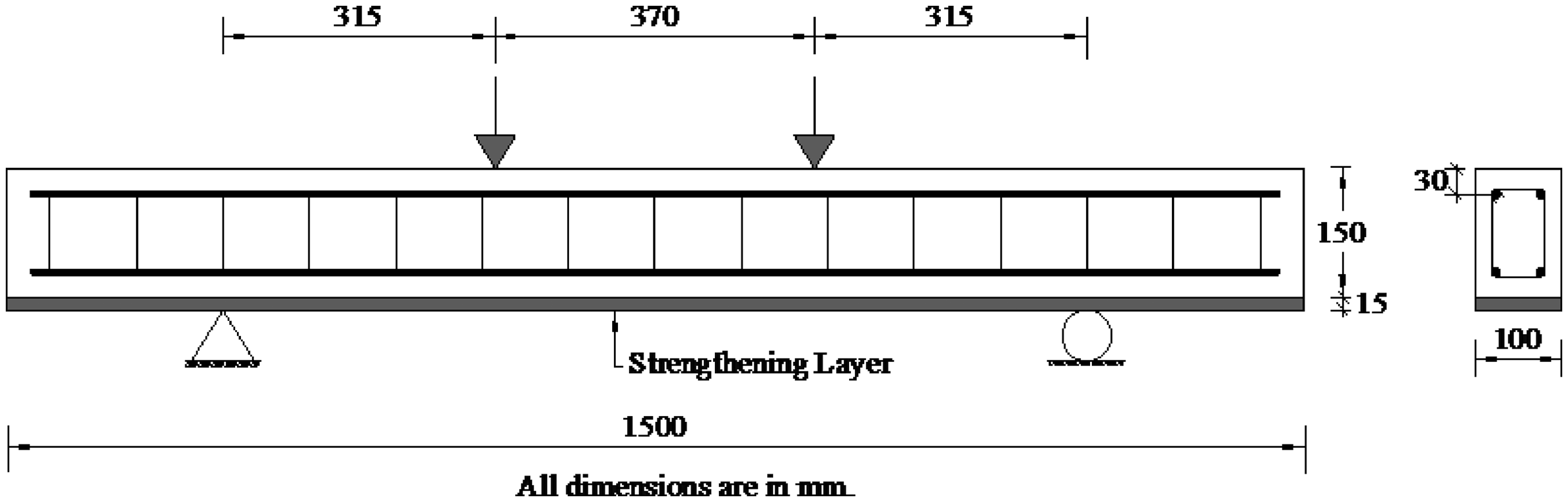
Results and discussion
The load versus deflection behaviour of RC control beams and strengthened beams are shown in Figure 4. It can be observed that the maximum load carrying capacity of RC control beam is 58.8 kN and the maximum deflection is 16.5 mm. The RC control beam started to yield at the load of 53.3 kN. Furthermore, from the load versus deflection behaviour of RC beams strengthened with basalt RC, it is observed that the ultimate load carrying capacity is almost same as that of un-strengthened/control beam. But the strengthened beam is sustained to undergo a maximum deflection of 30.2 mm before failure.
Comparison between load versus deflection of control and strengthened beam under monotonic loading.
From the Figure 4, it can be noticed that the load versus deflection of RC control beams and RC beams strengthened with basalt TRC is similar up to the peak load of 59 kN. When the peak load concrete cannot take the load, sudden load drop is observed in RC control beam. Whereas, in strengthened beam after reaching, the ultimate load fabric action is predominant and it prevents the sudden load drop. In the post-peak region, it is observed that strengthened beams possess good ductility sustaining a load of 45 kN. The final failure of beam is by crushing of concrete at the compression face in both RC beams and strengthened beams.
Crack pattern
During testing, it is observed that one of the control beams start cracking at the load of 16 kN and then propagated through the beam depth; a through beam crack formation is observed at the load of 21.10 kN; furthermore, the cracks widened at the load of 24.5 kN and shear crack formation took place at the load of 41.5 kN. For second control beam, it is observed that first cracking occurred at the load 14.19 kN and then after reaching 23.56 kN load crack growth is observed. Shear crack was formed at the load of 48.3 kN and then the cracks widened up to failure.
For strengthened beam, it is observed that first cracking initiated at 19.20 kN; after that it is observed that multiple crack formation took place throughout the beam at an average crack spacing of 110 mm c/c and average crack width is 14 mm. The cracks propagated further after reaching the load of 33.28 kN and started to widen after 40.33 kN. Shear crack formation was noticed at 52.3 kN and then further crack distribution took place up to the maximum load of 59 kN. Crack patterns developed in un-strengthened and strengthened beams are shown in Figure 5.
Crack pattern. (a) control beam and (b) strengthened beam.
Ductility and strength index
Ductility factor (Δmax/Δyield) and strength index (Mmax/Myield) for control beam and strengthened beam were calculated. Ductility factor of control beam is 1.16, whereas for strengthened beam it is 2.14. It is observed that there is a ductility increase of 84.5% due to strengthening of RC beams with basalt TRC. In strengthened beam, it is noticed that there is no significance increment in strength index and only 2% of strength index is obtained.
Energy absorption
Energy absorbed by control and strengthened beams were determined by calculating the area below load deflection curve and obtained as 0.45 kNm and 1.2 kNm, respectively. There is about 10.58% increase in energy up to yield load for the strengthened RC beams. Maximum energy absorption of strengthened RC beams increased up to 162.58% when compared to control beam.
Failure mode
From the testing, it is observed that control beam failed by compressive crushing with maximum load carrying capacity of 58.8 kN; the strengthened beam failed by compressive crushing as well as with multiple crack formation on the strengthened side. The final failure mode indicates that in the reinforced beams tested, concrete fails first then steel started to take load up to yield point and after reaching the ultimate load basalt RC takes the load and undergoes large elongation before failure. This behaviour shows more ductility for strengthened beam whereas control beams failed in a brittle manner after reaching the ultimate load.
Low-cycle fatigue loading test
RC beams strengthened with basalt TRC with simply supported boundary condition were tested to failure under low-cycle fatigue loading. The load was applied in 10 cycles using two-point loading. The initial applied load was 20 kN and thereafter the load was in 5 kN increment up to ultimate load. A minimum load of 10 kN was kept constant in all cycles. The load history adopted is shown in Figure 6.
Low-cycle fatigue load history.
Results and discussion
The load versus displacement behaviour obtained is shown in Figure 7. It is observed that there is only 3% reduction in ultimate carrying capacity when the strengthened beam is subjected to low-cycle fatigue compared to its monotonic behaviour. However, the displacement corresponding to ultimate load is reduced by 20% in strengthened beam. Furthermore, it is observed that failure pattern in both the cases are similar. In the case of low-cycle fatigue test, the experiment was stopped after tenth cycle. It is observed that there is a considerable reduction in ductility under low-cycle fatigue when RC beam is strengthened with basalt RC compared to its monotonic behaviour. Hence, more experiments needs to be conducted to check again the applicability of basalt TRC as a strengthening material.
RC beam strengthened with basalt textile-reinforced concrete under low-cycle fatigue and monotonic load.
Conclusions
The present study examined the applicability of basalt TRC as an alternative strengthening method for concrete structural elements. Effectiveness of basalt textiles as reinforcement for strengthening of RC beams were studied under monotonic and low-cycle fatigue loading. It is observed that for the RC beams strengthened with basalt TRC of 1% basalt textile, there is 162% increase in energy absorption and 84% increase in ductility for strengthened beam compared with un-strengthened. When the strengthened beam was subjected to low-cycle fatigue load, there was about 20% reduction in the ultimate load carrying capacity compared to monotonic case, and also the there is 27% decrease in ultimate deflection compared to monotonic case. But the failure mode obtained from both the investigations was same. The results obtained from the investigations opens up possibilities of further investigations to prove the efficiency of basalt TRC towards structural strengthening.
Footnotes
Funding
This research received no specific grant from any funding agency in the public, commercial, or not-for-profit sectors.