




Abstract
High thermal resistance of thermal insulating fabrics is a major factor in the decision to use them in protective apparel applications, sleeping bags and other functional textiles. New standards and new applications of fibre layers in industrial textiles require more accurate methods of testing of their thermal resistance and conductivity, which minimise the dependence of the measured parameters on the testing conditions, such as the temperature drop between the plates of testing instrument and infrared radiation properties of these plates. In this article, the use of a testing method based on two different temperature drops between the plates of the ALAMBETA testing instrument revealed that the portion of heat transferred by radiation through the tested woven fabrics reached 12–17%. From the second series of measurements it follows that decrease in surface emissivity of the plates of the mentioned testing instrument influences the level of heat transfer by radiation between the plates of the ALAMBETA testing instrument and may cause the changes in the experimentally determined thermal conductivity and thermal resistance of certain porous fabrics. These changes presented up to 8% for the studied non-woven fabrics with low density.
Introduction
Thermal insulation property of non-woven and other textile fabrics is a frequent reason for their applications in protective clothing, sleeping bags and related technical textiles [1,2]. New standards [3] and new fields of application of industrial textiles result in an obligation to determine the thermal resistance of the insulation layers with higher precision. Therefore, several new measuring instruments appeared recently on the market to serve these purposes [3,4]. Majority of them is based on the evaluation of steady heat flow passing between two plates held at different temperatures, which embrace the measured fabric. Recently, instruments based on the so-called hot disc transient plane source or flash method measuring principle appeared on the market, but these new devices do not measure directly thermal resistance of the fabrics and materials, they enable the determination of their thermal conductivity and diffusivity only. The determination of their thermal resistance requires the knowledge of the fabric thickness, which should be achieved by other methods. As the fabric thickness can depend on the locally applied pressure, the resulting precision of the calculated thermal resistance might be affected by this thickness measurement precision. Detailed explanation of the above-mentioned methods is beyond the scope of this study.
When thin or low-density fabrics are measured by means of the common two plates instrument, the portion of the heat transferred between the plates by infrared radiation can reach 10–30% of the total heat flow. Most of the heat is then transferred by conduction. Convection is generally negligible [1].
The first objective of the study is to determine the effect of mean temperature of the measured sample on the amount of heat transferred between the plates by infrared radiation. The second objective of the article is the experimental determination of the effect of the surface emissivity of the measuring plates of the measuring instrument, on the measured thermal conductivity and thermal resistance of the selected relatively thin woven and non-woven fabrics made from different raw materials.
The experimental procedure is based on the ALAMBETA computer-controlled measuring instrument, which measures the steady and transient thermal characteristics of fabrics and compressible materials within one step [5].
Theoretical
Thermal conductivity of textile fabrics
Thermal insulation properties belong to the basic properties of textiles fabrics and they have been studied and measured very thoroughly. Similarly, the theoretical analysis of heat transfer through fabrics was carried out by many investigators [6–8]. It was found that the mechanisms of transfer of heat through textile fabrics depend mainly on thermal conduction and radiation. Thus, the total heat flow in Watts per square metre, shortly called heat flux qtot, will consist of heat flux transferred by pure conduction qcond and by radiation qrad:

This was confirmed during an extensive investigation of heat transfer through woven and non-woven fabrics [8], where the dimensionless Grasshoff number Gr, describing the effect of free convection, was always <1000, thus neglecting the presence of free convection in the studied fabrics. On the basis of the theory in Mohhammadi et al. [8] and the use of precision measuring instrument [5], the following formula for thermal conductivity λ of textile fabrics with low density was developed:
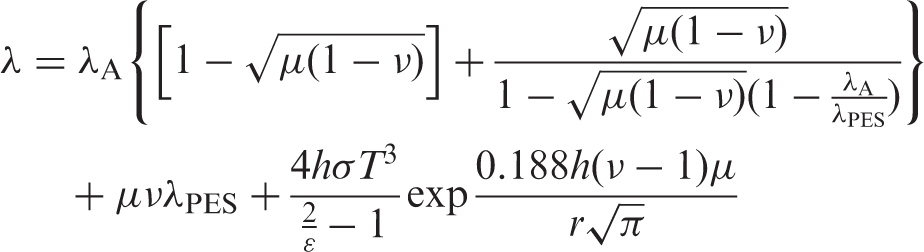
Here, the first term on the right side expresses the transmission of heat by conduction in air gaps (proportional to thermal conductivity λA of air) and through the polyester fibres (with a thermal conductivity λPES 15 times higher than that of air) oriented parallel to the surface. The second term shows the heat conduction through the fibres oriented perpendicular to the fabric surface. The term μ represents the filling coefficient of the fabric, and ν is the (idealised) portion of fibres oriented vertically to the isotherms in the fabric. The terms h and σ present the thickness and the radiation constant, and ɛ and r mean emissivity and radius of fibres.
For the purpose of this article, the more important factor is the last term on the right side, expressing the heat transferred by radiation, where the dependence of heat flux q, for example, between two plates with emissivity levels ɛ1, ɛ2 is given by the generally known equation (see, e.g. in Sparrow [6] and Farnworth [7]) characterised by the fourth power of temperature:

This relationship can be approximated by a linear one [6], with the use of the mean temperature T = (T1 + T2)/2

For the radiation conductivity λrad of textile fabrics with low density according to equation (2), equation (4) will receive the form:

The above equation (2) developed by Hes and Stanek [9] applies to fibre layers of low density, but in certain approximation the first part of this equation will also serve well for the purpose given in the next sentence. A systematic analysis of heat transfer in woven fabrics was later presented by Kothari and Debarati [10]. Their thermal model for heat transfer in fabrics by pure conduction is very complex and their results were confirmed by extensive measurements on the Alambeta instrument. However, they did a small mistake when quoting the commonly known equation (3) describing the heat transfer between two plates by radiation. Nevertheless, they confirmed that the heat flux transferred by radiation is much lower than the heat transferred by conduction, which allows the expression of the total thermal conductivity λ as sum of pure thermal conductivity λcond and radiation conductivity λrad.

The above-mentioned instrument ALAMBETA developed by Hes [5] enables the measurement of both steady-state thermal properties of fabrics, and also their transient thermal characteristics, where one of these characteristics called thermal absorptivity b (Ws1/2m−1K−1) can be used for objective evaluation of warm or cool feeling – see Hes and colleagues [11,12]. This characteristic can be important during short contact of human skin with the fabric, or when wearing some fabrics (like trousers) which come into intermittent thermal contact with our skin. However, research on thermal absorptivity of fabrics is not an objective of this study.
Experimental equipment used in the research
This computer controlled instrument, called ALAMBETA, works in the semi-automatic regime, calculates all the statistic parameters of the measurement and exhibits the instrument autodiagnostics, which checks the measurement precision and avoids any faulty instrument operation. The whole measurement procedure, including the measurement of thermal conductivity λ, thermal resistance R, contact heat flow qmax, sample thickness h, thermal absorptivity b and the results evaluation lasts <5 min [11].
The principle of this instrument depends placing of the fabric sample between two plates maintained at different temperatures and the consequent evaluation of transient and steady – state heat power passing through the tested fabric. All the data are then processed in the computer according to an original programme, which involves the mathematical model characterising the transient temperature field in thin slab subject to boundary conditions of first order [11]. To simulate better the real conditions of the fabric wear and warm–cool feeling evaluation, the instrument measuring head is heated to 32℃ (305 K), which corresponds to the average human skin temperature, while the fabric is kept at the room temperature 22℃ (295 K). The full signal response of the system is achieved within 0.2 s.
Theoretical background of the experimental procedure
The method of determination of the radiation conductivity of fabrics is based on the fact that λrad increases with third power of the mean temperature T in the layer – see equations (4) and (5). Therefore, for two different mean temperatures T (supposing T1 = 300 K and T2 = 315 K, which can be adjusted at the instrument) and after applying equation (4) we get the next relationships resulting also from simple analysis of equation (1):


Subtracting both equations, we obtain

The above-presented effect of the increased mean temperature on thermal conductivity λair of the air trapped in fabrics was considered by increasing λcond in equation (9) by

Experimental
Description of the specimens
In the first part of the experiment, originally six woven and six non-woven fabrics were used, made from PAD, PAN, PES, PP, PVC and viscose fibres. The mass per square metre of woven fabric varied from 0.24 to 0.33 kg/m2 and the non-woven ones weighed 0.150 kg/m2. All woven fabrics were made in plain weave, the non-woven were prepared by carding, crosslapping and needling (29 stitches per square centimetre).
In the second set of measurements, commercial chemically bonded EUROFLEECE (Portugal) PES thermo-insulating non-wovens were used, with mass per square metre ranging from 0.040 to 0.200 kg/m2. The fibre fineness in the first part of table was common (70% consisting of 2.5 dtex and the rest of 11 dtex), in the last part the microfibre webs were measured. The results were statistically evaluated and tabled.
Results and discussion
The effect of the medium temperature of the samples on thermal resistance
The woven and simple non-woven samples (always 10 samples of every kind) were measured under 250 Pa pressure and in the first set of measurements the samples were heated from 22℃ (295 K) to 32℃ (305 K) and to 62℃ (315 K) at their surfaces. The surface emissivity of the measuring plates of the testing instrument was about 0.95. The effect of influence of temperature drop (mean temperature) across the textile layer on thermal characteristics of woven fabrics between the measuring plates was presented in Table 1 and Figures 1 to 4. From the results for woven fabrics it follows that the highest value of thermal conductivity achieved the PES fabric and the lowest ones the PVC fabric. However, differences in these values did not exceed 18% both for the temperature difference ΔT1 = 10 K and ΔT2 = 40 K (Table 1 and Figure 1).
Influence of temperature drop across the textile layer on thermal conductivity of woven fabrics. Influence of temperature drop (mean temperature) across the textile layer on thermal characteristics of woven fabrics. CV: Coefficient of variation.

Thermal resistance R depends on fabric thickness h (mm) and thermal conductivity λ (Wm−1K−1):

To determine the radiation thermal conductivity of the samples, the values of the total thermal conductivity for various mean temperatures in the samples were inserted in equation (9). The calculated values are shown in Table 1 and Figure 3. The highest value of the radiation conductivity was observed for PES fabrics and the lowest for PAD fabric. The range of differences was about 40%.
As can be seen from Table 1 and Figure 2, the lowest effect of higher temperature drop on thermal resistance was observed at PP and Viscose fabric, whereas the PES and PVC fabrics exhibited the highest effects. Note that the thermal resistance in Figure 2 is not inversely associated with the thermal resistance due to the effect of the fabric thickness, as given by equation (10).
Influence of temperature drop across the textile layer on thermal resistance of woven fabrics. Radiation conductivity of woven fabrics.

As the portion of heat flow by radiation is between 12% and 17% only (Figure 4), the total thermal conductivity can be considered as a simple sum of pure thermal conductivity and radiation conductivity, according to equation (6).
Relative radiation conductivity of woven fabrics.
The results for non-woven fabrics showed substantially higher increase in thermal conductivity with temperature than woven ones, due to strong free convection effects caused by high-temperature drop (40 K) between the layers. Therefore, these results were not used in the next research.
The effect of the surface emissivity of the measuring plates on thermal conductivity and resistance of the non-woven samples
In the second experiment, the temperature drop between the plates was kept at 10 K, i.e. the medium temperature of the sample was ∼300 K, but the emissivity of the plates ɛ1 and ɛ2 was alternatively 0.05 and 0.85. All other measurement conditions were identical for both kinds of measurement. The results are presented in Table 2 and Figures 5 to 7. This research has shown that the increase in square mass practically does not affect the level of thermal conductivity of PES non-woven fabrics. However, a slight increase (from about 1% to 5%) was observed in the thermal conductivity with an increase in emissivity of the plates (Figure 5). This result proved that the thickness of PES non-wovens affects their thermal resistance. This relationship was linear in both cases of the emissivity of the plates (Figure 6).
Effect of the emissivity of measuring plates on thermal conductivity of PES non-woven fabrics. Effect of the emissivity of measuring plates and thickness of samples on thermal resistance of PES non-woven fabrics. Effect of the emissivity of measuring plates on thermal conductivity of the non-woven needled webs. Effect of the emissivity of measuring plates on thermal characteristics of measured non-woven fabrics. CV: Coefficient of variation.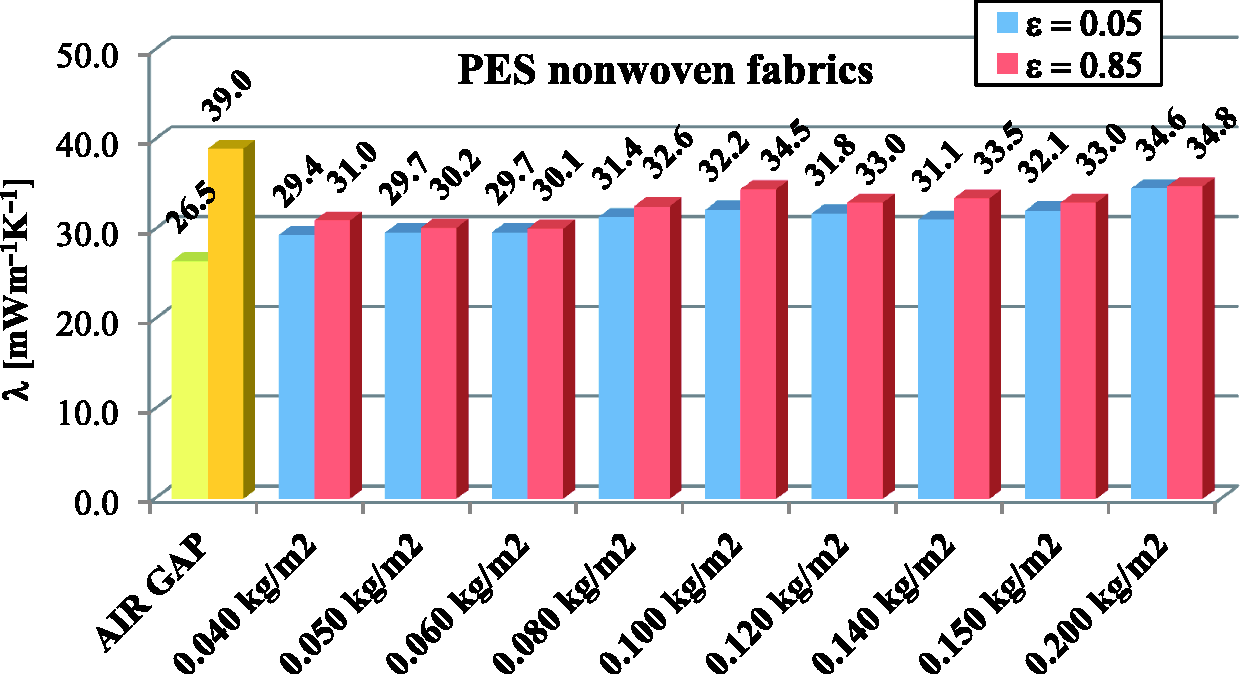


Comparing the webs of PET, wool and flax, it can be concluded that flax non-woven had the high value of thermal conductivity and the lowest by wool webs (Figure 7). In the case of PES microfibre webs there was no apparent effect with the mass per metre square on the thermal conductivity (Figure 8).
Effect of the emissivity of measuring plates on thermal conductivity of PES microfibres non-woven fabrics.
The data for PES webs made of standard fibres from Table 2 were statistically treated by the MATLAB program and the following regression curve for the λ0.05/λ0.85 (which also meant the measurement error) as the function of mass per square metre M and thickness h was found:

The obtained results are presented in Table 2 and Figures 9 to 11. From the above equation it follows that the error of measurement increases with the web thickness and decreases with the web mass. The maximum level of this error according to Table 2 may reach ∼10%. For this error value for some kind of light sleeping bags and light thermal protective clothing, the difference between the web thermal resistance measured between dark and rough measuring plates and smooth and reflective ones can be significant.
Effect of square mass on relative level of thermal conductivity of the PES non-woven samples measured at different emissivity levels of the plates. Effect of the emissivity of measuring plates on the relative level of thermal conductivity. Effect of the emissivity of the plates on the relative level of thermal conductivity of the microfibre PES web.


For other fabrics made of PES with standard fineness fibres, given in the middle of Table 2, the above-mentioned conclusions are fully valid. Only for the special microfibre webs shown at the bottom of Table 2, the measurement error is lower, which could be due to larger surface (and hence lower IR radiation permeability) of these webs.
Conclusions
In this research work, a set of woven and non-woven fabrics of different mass per area made of various materials and maintained at different mean temperatures was subject to measurement of their thermal resistance between two plates with low and high surface emissivity levels of the ALAMBETA instrument. The first series of measurements at the temperature drop 10 and 40 K and high level of emissivity revealed the portion of heat transferred by radiation through the tested woven fabrics reached 12–17%. From the second series of measurements, it follows that decrease in surface emissivity of the plates of the mentioned testing instrument influences the level of heat transfer by radiation between the plates of the ALAMBETA testing instrument and may cause the changes in the experimentally determined thermal conductivity and thermal resistance of certain porous fabrics. These changes presented up to 8% for the studied non-woven fabrics with low density.
The highest level of radiation conductivity was observed for PES fabrics and the lowest for PAD fabric. Thermal conductivity is lower in the case of reflective surfaces of the contacting plates, compared with the conductivity found for the ‘dark’ surfaces.
Unfortunately, producers or users of the instruments for the measurement of thermal insulation properties of fabrics, which are at least partially permeable for the infrared radiation, mostly know or mention the surface emissivity of the plates used for these purposes. As regards the standard temperature difference between the plates, the 10 K temperature difference is the most used one, but no standards concerning the recommended temperature differences between the contact plates and emissivity properties of these contact plates of the mentioned measuring instruments are available.
This statement indicates that results of measurements of thermal resistance of low-density fabrics may be considered less precise, unless the applied temperature drop and emissivity properties of the measuring plates of the related instrument are available. Thus, the preparation of an ISO standard determining the surface properties of thermal measuring instruments is recommended, as well as the preparation of new standards on measurement of thermal comfort properties of fabrics in real conditions of their use [13], as some garments like underwear are sometimes worn in wet state.
Footnotes
Funding
This research received no specific grant from any funding agency in the public, commercial, or not-for-profit sectors.