




Abstract
This study investigates the effect of hybridization on tensile strength of woven fabric glass/epoxy composite laminates with two different notch sizes of 5 mm and 10 mm. Tensile tests are performed on notched [0°/90°]3s specimens of woven fabric C-glass/epoxy composite laminates and their hybrid reinforced with woven fabric 3K-carbon layers in order to measure tensile strength and characterize damage mechanisms. The results suggest that hybridization has a considerable effect on the improvement of the tensile strength of C-glass/epoxy composite laminates but also has reduced the rupture strain of the composites. Microscopic observation of specimens after tensile loading reveals the existence of transverse and longitudinal cracks, delamination and transverse fiber damage in hybrid composite laminates.
Introduction
In recent years the use of woven composites in structural applications has increased rapidly due to the advantages it offers such as easy handling, dimensional stability, deep drawing shape-ability, enhanced toughness and increased impact resistance [1]. The use of woven glass fabrics for secondary, low load-carrying aircraft structure is traced back to early use of glass polyester radomes for airborne radar sets. From 1980, use of woven fabric began to draw attention with application in low-temperature environments where glass fabric shows good electrical, thermal insulation and permeability barrier. Application of woven fabric in primary aerospace structure has been even more extended with development of carbon fabrics and aramid fiber [2].
Extensive studies have been conducted to improve mechanical properties of composites under different loading conditions. Previous studies showed that composites made of one type of reinforcement fiber cannot give all desired properties but hybrid composites which have a combination of two or more types of reinforcement material system turned out to be a good solution. Hybrid composites are usually used when a combination of properties of different types of fibers wants to be achieved or when longitudinal as well as lateral mechanical performances are required [3].
Hybridizing glass fiber with a sensibly placed carbon fiber has been proved to be promising by previous studies [4–13] in which unidirectional, multidirectional or non-woven fiber composite laminates were mostly examined. Not many studies have investigated the tensile strength of woven hybrid composite laminates especially with consideration of the effect of notch. Zhang et al. [14] investigated the influences of stacking sequence on the strength of hybrid composites comprising varying ratio of glass woven fabric and carbon woven fabric in an epoxy matrix. They realized that hybrid composite laminates can effectively improve tensile strength with glass/carbon (50:50) fiber reinforcement either by placing the carbon layers at the exterior or by placing different fiber types alternatively. Pandya et al. [15] studied the tensile strength of hybrid composites made of 8H satin weave T300 carbon fabrics and plain weave E-glass fabrics with two layup configuration of [G3C2]s and [C2G3]s. It was understood that hybrid composite having outer carbon layers and inner glass layers show higher tensile strength and ultimate tensile strain. Li et al. [16] took advantage of finite element method to determine the stress and strain distribution around a failed link in a carbon layer in a woven fabric carbon/glass epoxy laminate under tensile loading. They also found that the volume fraction of the two types of fibers and their stacking sequence can influence the hybrid effect.
This article aims to improve the previous studies by investigating the effect of hybridization on tensile strength of notched woven fabric glass/epoxy composite laminates when it is reinforced with woven fabric carbon plies. Damage mechanisms in hybrid composites are examined. Microscopic instruments are used to facilitate damage observation.
Experimental studies
Fiber architecture of the woven laminate
What makes the mechanical properties and damage modes of woven fabrics different from multi-directional laminates is the woven nature of the fiber and crimp regions. There are five important parameters, which characterize this important region, namely, inter-crimp length, average bundle width, bundle width at crimp region, crimping length and bundle thickness [2]. These parameters for plain woven fabric are shown in Figure 1. The inter-crimp length is the distance between two adjacent crimps while the crimping length is defined as the length of the undulating region. The average bundle width is considered as one-eighth of the inter-crimp length and the bundle width at the crimp is the width of the orthogonal, interlacing bundle at the crimp. The bundle thickness is taken as the average thickness of the orthogonal tows [2]. Listed in Table 1 are the data for the measured parameters on the woven glass and carbon fibers.
Definition of distances for defining the fiber architecture in a single woven layer. Measurement on the detailed fiber architecture of woven carbon and glass fibers. CVs: coefficient of variation. The average bundle width is considered as one-eighth of the inter-crimp length [2]

Specimen preparation
Summary of mechanical properties for C-glass/epoxy and 3 k-carbon/epoxy 200 g/m2.

Carbon fibers are used to provide stiffness and load-bearing qualities, while glass fibers, having higher elongation, are used to make the composite more damage tolerant and keep the cost low [6]. For hybrid laminates, a configuration with carbon fibers placed at the exterior and C-glass in the core was chosen. External carbon fibers contribute to increase in the tensile and compressive strength and stiffness of the laminate while reducing material density. Glass fibers are used for the internal layers owing to being cheaper and showing better thermal insulation and impact strength [18].
In a single ply of woven fabric, 0° is considered to be parallel to warp fibers (longitudinal axis) and 90° in the direction of the interlaced weft fibers (transverse axis) [19]. To prevent the composite laminate from bending and/or twisting when applying a load, the layup order is considered to be symmetric about the thickness center.
[0°/90°]3s laminate coupons, 210 mm long, 50 mm wide and 3 mm thick, were cut out of 5 laminated plates of 250 × 350 mm2 . These plates were manufactured using hand lay-up method and cured at the room temperature. Two notch sizes of 5 mm and 10 mm hole diameters were considered to investigate the amount the strength will be reduced by doubling the notch size and how much hybridization can compensate this loss. In fact, in the previous study Afaghi-Khatibi et al. [20] has performed testing mainly on holes with 0, 4, 8, 12 and 20 mm, which can give us an indication of the failure trend. We have chosen 5 mm and 10 mm in order for the middle and upper limit trend to be established at least with our material supply. Carbide drills were used to make circular holes at the center of specimens. The notched specimen geometry is shown in Figure 2.
Specimen geometry for two notch sizes of 5 mm and 10 mm [22].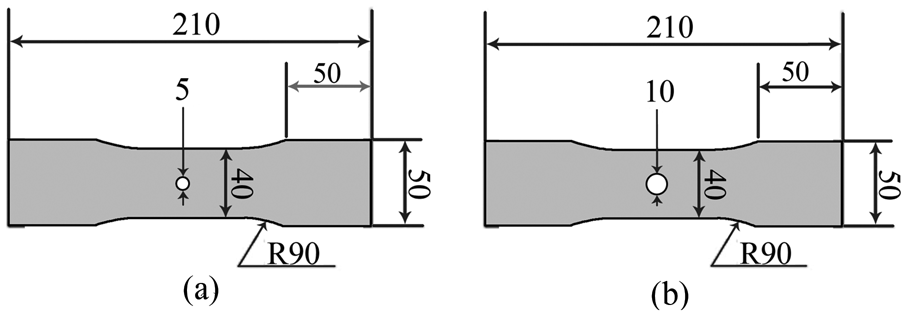
Mechanical testing
Uniaxial tensile tests, up to failure, have been carried out on specimens. Tests were performed at room temperature, in an Instron 8802 servo-hydraulic testing machine, with a constant crosshead displacement rate of 1 mm/min. To increase the level of confidence, at least five specimens were tested for each notch to reach a certain number.
Average amount of obtained tensile test results.

Damage observation
Damage modes only in hybrid composite laminates are investigated. Optical microscopes are used to examine damage mechanisms after tensile loading.
Result and discussion
Comparison of composite laminates under tensile loading
The average notch strength, σc, of [0°/90°]3s cross-ply woven fabric glass /epoxy composite laminates and hybrid woven fabric glass, carbon /epoxy composite laminates with a circular hole subjected to monotonic tensile loading, are shown in Figures 3 and 4, respectively. It can be clearly seen that the strength decreases with increasing hole diameter from 5 mm to 10 mm for both woven fabric glass/epoxy composite and hybrid composite laminates. This decrease can be up to 29.23% for glass composite laminate while it is 19.74% for hybrid composite laminate. As expected, tensile strength of hybrid composite laminate is higher than that of glass composite laminate. This is in agreement with the previous study of Zhang et al. [14] on glass/carbon woven fabrics.
Tensile strength of two 5 mm and 10 mm notched woven fabric glass /epoxy composite laminate. Tensile strength of two 5 mm and 10 mm notched woven fabric hybrid composites of laminates.
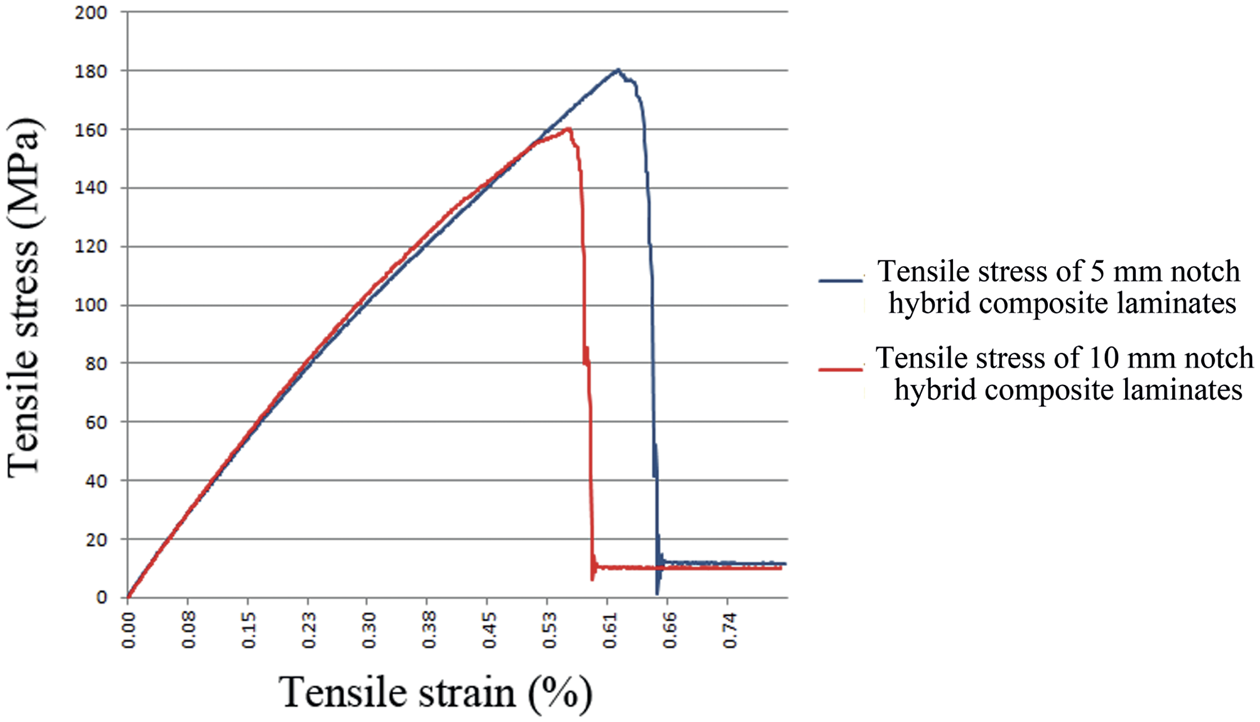
Results show that hybridizing can improve the tensile strength of 10 mm and 5 mm notched glass fiber composites up to 135.77% and 101.90%, respectively. This means hybridizing has more improving influence on tensile strength of 10 mm notched glass composite laminate than 5 mm notched one.
In Figure 3, both 5 mm and 10 mm glass/epoxy stress–strain curve show a similar trend starting from non-linearity and developing into a more linear slope. The initial nonlinearity is basically ascribed to deformation of the matrix resin. After that the curve slop becomes more linear reflecting the deformation of glass fiber. Gradual slope reduction of stress–strain curve for both 5 mm and 10 mm notched glass composite laminates represents a gradual stiffness reduction as the applied load increases. Of course, more stiffness reduction can be seen for 10 mm notched glass composite than 5 mm one. Comparison of tensile strength of both 5 mm and 10 mm notched woven fabric hybrid composite laminates, represented in Figure 4, shows lower tensile strength for 10 mm than 5 mm notched ones. Both notched hybrid composite laminates exhibit a non-linear stress–strain behavior, which can be described by matrix microcracking, interfacial debonding in carbon layers along with progressive fracture of fibers (both carbon and glass) at higher stresses.
As shown in Figure 3, 5 mm notched woven fabric glass/epoxy composite laminate underwent larger inelastic behavior than 10 mm notch one. This is what can be seen in Figure 4 for hybrid composite laminates, too. These results are suggestive of higher capability of energy absorption by 5 mm notched woven fabric glass/epoxy composite laminates and hybrid composite laminates, where the energy absorbed is given by the area under the load–displacement curve. Also the comparison of rupture strain in glass woven composite laminates with hybrid composite laminates shows 20–22% reduction for hybrid ones. This can be explained by the fact that the rupture strain of hybrid composites was governed by the carbon fibers, which are stiffer but more brittle [11].
Schematic representation of tensile damage in half (the first six layers) of a hybrid composite laminate.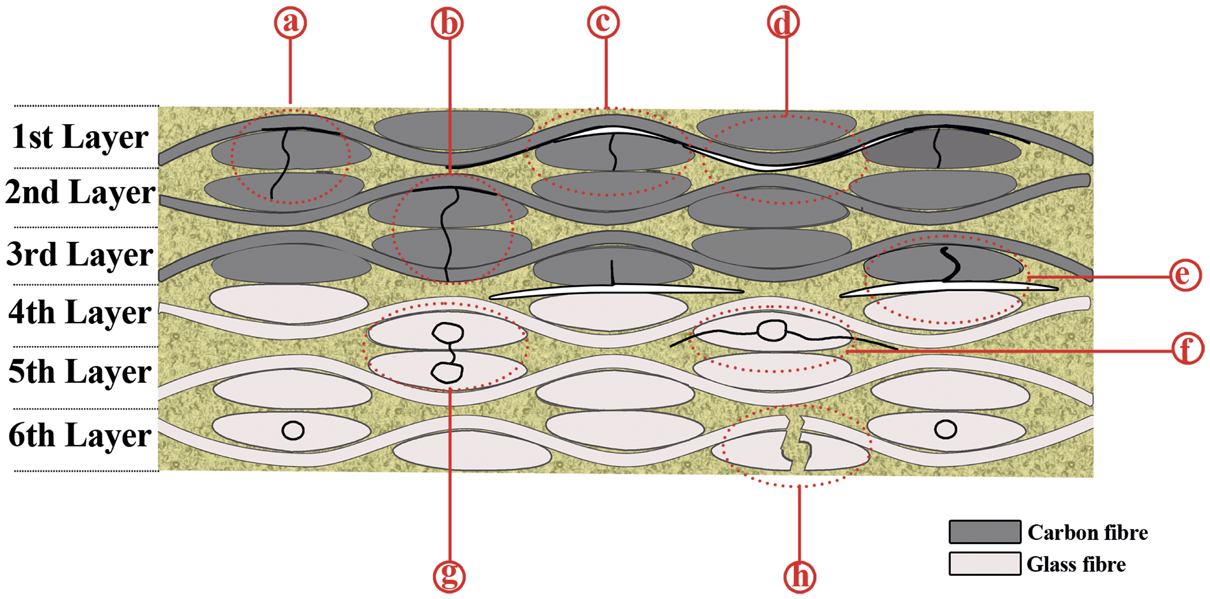
Damage observation after tensile loading in hybrid composites
Damage observed in the hybrid composite laminates as a result of tensile loading was in the form of transverse cracks, longitudinal cracks and delamination in outer carbon layers, delamination between carbon layers and inner glass layers, and transverse fiber damage in inner glass layers. In Figure 5, the schematic representation of tensile damage in the first six plies of [0°/90°]3s notched hybrid composite is illustrated. Each marked phenomenon is explained as follows.
Transverse cracks are microcracks that occur in transverse fiber bundles (weft). Some of the cracks spanned a part of the transverse fiber bundle but mostly observed to pass across and either deflect into the interface between transverse and longitudinal fiber bundles causing interfacial debonding (Figure 5(a)) or go through longitudinal fibers damaging them (Figure 5(b)). The microscopic observations of these phenomena are shown in Figure 6(a) and (b). It was noticed that number of cracks affecting the longitudinal fibers in 5 mm notch hybrid composite laminates was not as many as those found in 10 mm notch ones. This can be explained by lower transverse stiffness of 10 mm notch. Delaminations in the crimp regions make transverse fiber bundles completely unloaded resulting in the longitudinal fiber bundle within that region carrying the applied load alone. Furthermore, delaminations have the effect of reducing local constraint on longitudinal fibers, so that the crimped bundles can elongate additionally which results in a lower effective Young’s modulus [2]. Therefore, lower stiffness and more delaminations in 10 mm notch size are factors that contribute to appearance of more longitudinal cracks in these laminates compared to 5 mm notched hybrid composites.
Transverse cracks in carbon fiber bundle and its following debonding and longitudinal fiber damage. (a) Transverse crack deflected into interface between warp and weft causing debonding to occur. (b) Transverse crack grows into longitudinal fiber bundle and damage its fibers.
As a consequence of tensile loading, extensive delaminations – partial separation of two adjacent layers – were also seen in carbon layers of hybrid woven fabric composite laminates (Figure 5(c)). In Figure 7, delaminations in the outer carbon fiber layers of notched hybrid laminates can be seen near the crimp regions along the interface between 0° and 90° fiber bundles. As mentioned above, some of the cracks in transverse fiber bundles deflected into interface between transverse and longitudinal fiber bundles and caused debonding to occur. Furthermore, 2D woven fabric architecture caused non-uniform distribution of strain in the axial and width directions of individual plies. To accommodate the non-uniform strain between adjacent plies, delamination between individual plies occurred [21]. Joint of delaminations in the one crimp region to the next one caused extensive delamination along the longitudinal fibers of carbon plies (Figure 5(d)). More delaminations were noticed in the case of 10 mm notched hybrid composite laminates, which can be attributed to less transverse stiffness in these composites. The measured length of delaminations at the crimp regions appeared to be almost the same as crimping length. The similar phenomena were reported by Gao et al. [2] for woven-fabric CFRP laminate under tensile loading.
Delamination in the region of crimps. Joint of delamination from one crimp region to the next one causes extension of delamination along the crimp regions in hybrid composite laminate.
Also some delaminations between carbon fiber layers and inner glass layers were observed (Figure 5(e)). This phenomenon, represented in Figure 8, can be explained by high difference in strength of carbon and glass due to their different Young’s moduli, which may lead to debonding between the fibers and matrix at the interface of two plies [11].
Occurred delamination between outer carbon layer and inner glass layer.
However, no delamination was observed in inner glass plies of hybrid composite laminates. One type of damage observed in some parts of the inner glass layers of both 5 mm and 10 mm notched hybrid composite laminates was the partial elimination of transverse fiber bundles accompanied by the resin surrounding those fibers leading to the appearance of a hole in the transverse fiber bundles. This damage is shown in Figure 9. These holes appear near kinks, where the fiber bundles cross over one another. Because of the stress concentration at these locations, extension of fibers near kinks cause fiber debonding and matrix fracture. Another contributing factor is the non-uniform stress and strain distributions along the axial and width directions within individual plies as a result of woven 2D fiber architecture, which is in agreement with previous study done by Shuler et al. [21] as well. Owing to the non-uniformity in stress and strain near the crossover points of fiber bundles, extensive fracture and spallation of matrix at these locations occurred. As shown in Figure 5(f) and (g), each hole – the damage to transverse fibers plus the resin surrounding them – affects the next transverse fiber bundles and accelerates its damage or goes through the resin-rich area between transverse fiber bundles. The development of transverse fibers’ damage caused debonding and rupturing of transverse fiber bundles near the final fracture location (Figure 5(h)). This is almost in line with the damage in woven fabric glass/epoxy composite under static loading reported by Fujii and Amijima [22]. The rupturing of transverse fiber bundles caused significant reduction of transverse stiffness so that the longitudinal fibers left to carry the load alone were affected and failed. Hence, the final failure in inner glass plies occurred.
Partial elimination of transverse fiber bundles in inner glass layers of hybrid composite laminates as a consequence of tensile loading.
Conclusion
Cross-ply [0°/90°]3s glass/epoxy composite laminates with two different notch sizes of 5 mm and 10 mm underwent monotonic tensile loading. It was realized that strength was reduced by presence of notch. To effectively improve the tensile strength of plain glass fiber composite, glass/carbon (50:50) fiber reinforcement was used by placing the carbon plies at the exterior. It was found that strength was significantly improved by as much as two times. However, rupture strain of hybrid composites was reduced compared to that of woven fabric glass/epoxy composites.
Microscopic observation of damage revealed the existing transverse cracks, longitudinal cracks and delamination in outer carbon layers, delamination between carbon layers and inner glass layers and transverse fiber damage in inner glass layers. The transverse cracks in outer carbon layers of notch hybrid composite mostly resulted in delamination in the crimp regions, which was more significant in 10 mm notch hybrid laminates. The measured length of delamination in carbon layers was almost equal to crimping length. Like delamination, more longitudinal cracks were noticed in 10 mm notched hybrid composite laminates, which can be ascribed to lower stiffness and more delaminations in these laminates.
These results were also compared with the relevant reported works and found to be in agreement. Accordingly, this research is believed to broaden the scope of studies done in the area of woven fabric composites. The study can pave the way for other researchers to examine different notch sizes and stacking sequences of hybrid composites under tensile and other types of loading.
Footnotes
Acknowledgements
I would like to record my gratitude to UPM for providing research grant and UITM for support throughout the work.
Funding
This article is based on a research which was entirely funded by University Putra Malaysia.