




Abstract
Aramid and aramid copolymer fibres are used in a wide variety of military and civilian applications; however, the effects of environmental exposure on mechanical properties are still not well understood. This paper analyzes the changes of Aramid 1414’s mechanical properties after its exposure to high temperatures, chemical solvents and sunlight, and then compares them with the properties of poly (p-phenylene benzobisoxazole) as-spun and polysulfonamide fibres. The experimental results suggest that the overall environmental resistant performance of aramid filaments is better than poly (p-phenylene benzobisoxazole) as-spun and polysulfonamide materials, some conclusions are put forward for the applications of aramid filaments.
Keywords
Introduction
In 1960, Du Pont Company developed a new type of aromatic polyamide fibre called Nomex fibre. The following year, Nomex (Aramid 1313) was first introduced as a new product of aramid fibre in commercial applications. In 1972, the company launched another aromatic polyamide fibre—Kevlar fibre, namely Aramid 1414. To distinguish the three traditional synthetic fibres—aliphatic polyamide fibre, the US Federal Trade Commission in 1974 named all aromatic polyamide as aramid or aramid fibres.
Aramid is a long-chain synthetic polyamide in which at least 85% of the amide linkages, (-CO-NH-) are attached directly to two aromatic rings, with less than 50% of amino bonds the derivatives of amide. Aramid fibres were first used in aerospace and military applications. They were not used in civilian applications until the cold war was over [1].
In aromatic polyamide fibre, the molecular chains become more flexible and their rigidity is enhanced because aromatic bases replace the adipose bases. The fibre is thus improved considerably in its performance in terms of its heat resistance and initial modulus and classified as a main type of organic heat-resistant fibres. Aramid 1313 is a meta-position aramid fibre arranged in hackly molecular chains with excellent high temperature resistance, low flammability and insulation. Therefore, it can be used to produce flame retardant fabrics. Aramid 1414 is a para-position aramid fibre arranged in molecular chains linearly with good strength, bulletproof performance, puncture resistance, mainly used in the bulletproof vest, brake pads, tires and optical fibre cable systems. The chemical structure of aramid fibres of both 1313 and 1414 is similar, but their performances and applications are greatly different.
The performance comparison of aramid filament with other fibers [2].

HM: high modulus; LOI: limiting oxygen index; PBI: polybenzimidazole; PSA: polysulfonamide.
ASTM D3822 - 07 Standard Test Method for Tensile Properties of Single Textile Fibers.
Table 1 shows that Aramid 1414 (Kevlar) obviously has the characteristics of high strength, high modulus and low elongation. Under the same environmental conditions, the degradation temperature of the Kevlar fibre is lower than that of the poly (p-phenylene benzobisoxazole) as-spun (PBO) fibre by 100°C, but still as high as about 550°C with good heat resistance. The fibre is flame-retardant with its limiting oxygen index (LOI) 29, lower than the average value listed in the table. By comparison, the LOI of PBO fibres is 68, which is the highest among the organic fibres without melting point.
PBO fibre is classified as high-performance polymer fibre with remarkably high mechanical properties. Polysulfonamide (PSA) fibre is a kind of newly developed flame retardant material with excellent heat resistance, flame resistance and thermal stability. In this case, we selected PBO-AS and PSA fibres as the reference materials to investigate the environmental effects (high temperature resistance, chemical stability and sunlight resistance) on the mechanical behaviour of Aramid 1414.
Experimental design
In this study, comprehensive tests are designed on the evaluation of the mechanical properties of Aramid 1414 under different environmental conditions. The changes of its mechanical performance are analyzed when the fibres are exposed to high temperatures, chemical solutions (acid, alkali and organic solvents) and ultraviolet radiation. These variations are compared with those of PBO and PSA yarns in the analysis of the test results.
Materials
Aramid 1414
The yarns prepared for the testing were, respectively, 1100 TWARON twistless filament of aramid fibre, supplied by Akzo Nobel Co., Ltd.
PBO-AS
The PBO filament used for contrast tests, regular twistless filament [3] B-A1000 ZYLON-AS (PBO fibre are classified into three types, namely spinning ordinary wire (AS), high-modulus silk treated at high temperatures (HMs) and ultra high modulus silk that has an even higher modulus (HM +) [4], supplied by Toyobo Co., Ltd.
PSA
The PSA thread whose filament (fibre thickness: 2 denier, yarn count: 40×2s) was supplied by Shanghai Tanlon Fiber Co. LTD.
Conditioning and standard strength testing
The processed filaments or threads were placed in the lab for 48 hours for cooling and balancing before being tested. Filament or thread was tested by the YG (B) 021 D electronic single-yarn strength tester, and the single fibre was tested by YG001 electronic strength tester; all samples were tested 20 times.
As reported, twistless aramid filaments, when twisted to 100 twists per meter, had the highest value in tensile break strength. Before strength testing in the experiment, preparation was made for its critical twist. The results showed that PBO filament for 130 twists per meter was advisable if the highest tensile break strength and the stable twist were ensured. This is different from commonly recommended formulas [5] twist factor (take 10) = 0.131 × twists (twists/inch) × denier 1/2.
High-temperature resistance testing
This experiment was done to detect the changes of the mechanical properties of filaments or threads under different temperatures with different time settings. In consideration of the actual operation and the capacities of experimental equipment, the temperatures ranged from 100°C to 300°C. The temperatures at 25°C, 150°C, 200°C, 250°C and 300°C were set in the test (slightly different from temperature setting for the PSA), at each of which the heating time was set for 1 hour, 4 hours and 8 hours, respectively. Afterwards, tensile break strength of filaments and yarns were measured when natural cooling was completed.
After the heating process prior to the tests, the filaments were twisted to ensure that the highest breaking strength could be achieved.
At first, the filaments or threads were cut into the length required for testing, then fixed in a roll and placed in the oven at a constant temperature for the time set and then they were taken out and cooled naturally for 48 hours. Twist was made before the tensile test. Finally, yarns and the filaments both twisted and untwisted were tested in the electronic single-yarn strength testers and the values of their tensile break strength were measured.
Chemical resistance testing
For the chemical resistance testing of the two kinds of filaments, references were made to “Twaron Filaments and the Standard Testing Method” and the data from some relevant documents [6]. Aramid and PBO filaments were immersed in acid, alkali and organic solvents, which contains 60% sulfuric acid, 37% sodium hydroxide and 100% carbon tetrachloride. The fibres were dipped in each solution for 100 minutes, long enough for chemical reactions.
Once the set times were up, the reagents that remained on the fibres were washed away. The fibres were then dried at the low temperature, and the filaments and yarns, together with the filaments previously untwisted that had to be twisted, were finally tested in an electronic single-yarn strength tester.
Light-resistant testing
One weakness of the high-performance fibres is their sensitivity to light. The light-resistant test is conducted to evaluate the fibre’s resistance to ultraviolet radiation or sunlight, namely ultraviolet radiation resistance or sunlight resistance.
The light-resistant test was carried out on the fabric color fastness measuring instrument under a simulated condition of sunlight. The tester of Model ATLAS CI5000 was used with the testing time of 10 hours, 20 hours and 40 hours.
After 48 hours of stable exposure to the simulated light, the processed filaments were twisted (not for thread or monofilaments) and then tested in the electronic single-yarn strength tester.
Result analysis
Heat resistance analysis
Heat resistance means the ability to maintain its integrity when the material is heated. Usually, the fibre strength will change at high temperatures, but the variation may be affected by the temperatures, heating time and fibre types.
At high temperatures, polymer material may produce two contrary reactions, namely cracking and cross-linking. Cracking means the rupture of the main chain of polymer with molecular reduction. The heat cracking and chemical cracking (oxidation, hydrolysis, etc) tend to be occurring simultaneously with the decline of mechanical properties as a general characteristic. In contrast, cross-linking can produce chemical bonds between large molecules of the materials, thus to increase its molecular weight. The moderate cross-linking may improve the mechanical properties and heat resistance of the fibre. Excessive cross-linking, however, can make the fibre hard and brittle, leading simultaneously to deterioration in mechanical properties. The cracking and cross-linking of polymer are relevant to fracture and the generation of chemical bonds. Therefore, the larger bond energy of chemical bonds of polymer it has, the more stable heat resistant it can remain [7].
Heat-resistance of aramid, PBO filament and the polysulfonamide monofilament (unit: %). a

PBO: poly (p-phenylene benzobisoxazole) as-spun; PSA: polysulfonamide.
20 tests with the coefficient of variation less than 10%
Our pervious research [8–10] shows that the PBO filaments demonstrated higher tensile break strength after the heat setting at the temperature of 125°C for an hour as illustrated in Figure 1. This indicates that an appropriate high temperature and proper heating time can make interior molecules of the fibre produce certain cross-linking with molecular weight increased and subsequently the tensile break strength improved. When the temperature transcended 150°C, the strength started to decrease significantly. After the exposure to this temperature for an hour, the percentage decrease of the Aramid 1414’s strength is about 6.4% and that of the PBO filament is about 17.1%. As the temperature continued to rise, the tensile breaking strength of aramid and PBO filaments was both in a downward trend. As illustrated in Figure 2, the Aramid 1414 filaments' tensile breaking strength decreased in the form of convex parabola with a steady trend in the prophase. However, the decline of the PBO filaments in their tensile break strength was in the form of a concave parabola with an initial sharp downward trend. Heated at 200°C for an hour, the Aramid 1414 filaments' fracture tensile strength decreases to be 91.9% of its original, and the PBO filaments to 64.8%, 35.2% reduction totally. Heated at 300°C for an hour, the Aramid 1414 filaments' fracture tensile strength decreases to be 74.4% of its original while the PBO filaments to 45.4%, 54.6% reduction totally.
The heat resistance curve of the poly (p-phenylene benzobisoxazole) (PBO) filaments. Heat resistance curves of Aramid 1414 and poly (p-phenylene benzobisoxazole) (PBO) filaments.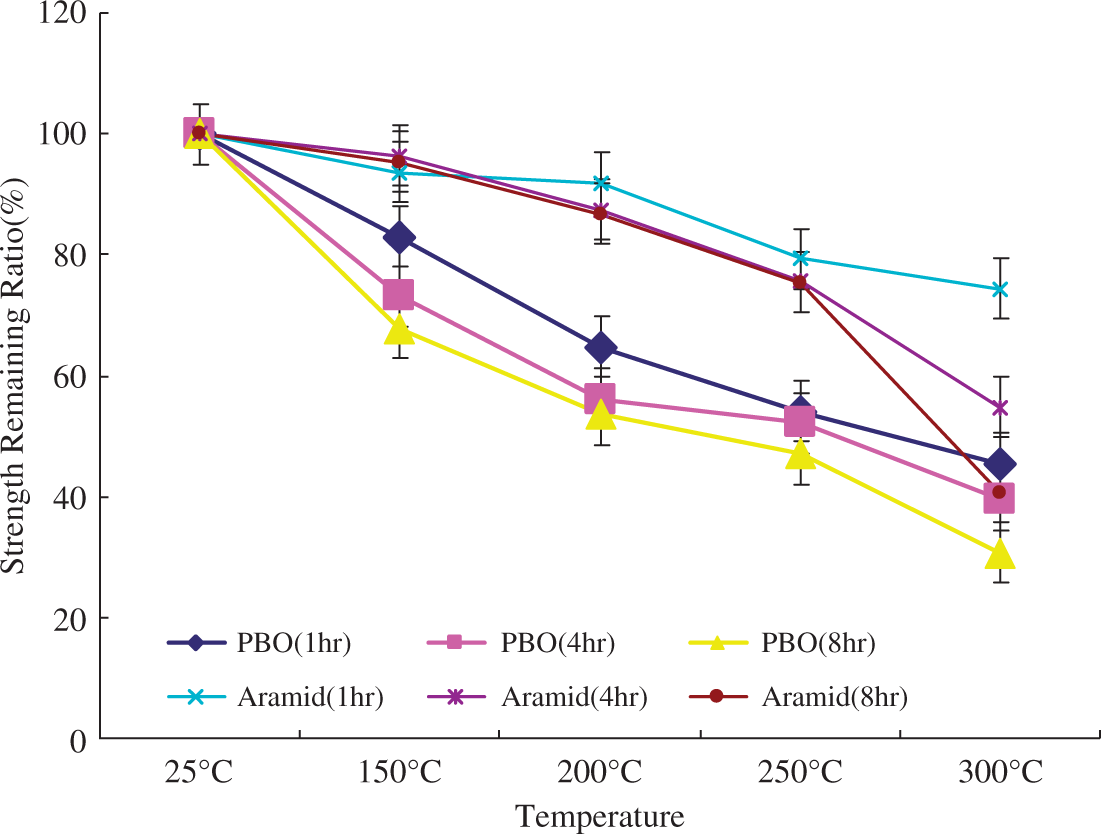

After the heating process at 200°C–300°C for relatively a long time, the breakage strength loss of the PSA monofilament was moderate. Heated at 200°C and 250°C for 12 hours, the tensile breakage strength of the PSA monofilament remains at 79.3% and 76.7% of the original monofilaments, respectively. At the temperature of 300°C, the breaking strength of PSA fibres shows some variance with the timesetting, not obviously, though, with the lowest strength 75.2% of that at the room temperature. Our previous report shows that when heated at 350°C for 12 hours, the monofilaments' tensile break strength was still as high as 54.2% of the original. It suggests that the PSA fibre has a good thermal stability [8].
In Figure 2, within the temperatures ranging from 200°C to 250°C, the decline of Aramid 1414 filament tensile breakage strength is obvious, while the decreasing of PBO filament’s strength slows down. This is identical with the current knowledge that Aramid 1414 filament can be applied at the temperature of 232°C for a long time. It is also observed that it is possible that the tensile breakage strength of PBO filament is lower than that of Aramid 1414 filament, when the heating temperature was anywhere between 200°C and 300°C. For example, after the heating process at a high temperature of 200°C for 4 hours, the measured strength of Aramid 1414 is about 10% higher than that of the PBO filament; and at 250°C, 5% higher. It is not until at 300°C that the strength of both is about at the same level.
Although the tensile breakage strength of the Aramid 1414 filament untreated at high temperatures with same fineness is significantly lower than that of the PBO filament, the decomposition temperature of the PBO filament is higher than that of the Aramid 1414 filament. The mechanical performance of PBO filament would be lower than that of the Aramid 1414 filament when they are used in the environment of high temperatures between 200°C and 250°C for a long time. If only good tensile breakage strength is required with the application environment at temperatures between 200°C and 300°C, the Aramid 1414 filament is preferable to the PBO filament, because the former is less costly than the later.
Chemical resistance testing
The mechanical durability against chemical finishing (unit: %). a

20 tests with the coefficient of variation less than 7%.
Table 3 indicates that the Aramid 1414 filaments, after being treated in a solution of 60% concentration of sulfuric acid for 100 minutes, loses its strength by about 58.3%. The strength loss of the PBO filaments is about 70.6%, which is more sensitive to acid than aramid. In alkaline or carbon tetrachloride solutions, neither the Aramid 1414 filament nor the PBO shows a considerable decrease in strength. Obviously, the Aramid 1414 filament is better than the PBO filament in terms of the chemical resistance. It is recommended that PBO filaments should be used in full consideration when it is exposed to the acidic environment.
It is reported that the PSA fibre is less sensitive to acid and of good stability. The fibre can retain good fabric integrity after its immersion in the solutions with 30% concentrations of sulphuric acid, hydrochloric acid and nitric acid at the temperature of 80°C, although the fibre strength did decrease in the sulphuric acid solution. At the same temperature, however, the fibre in the solution with a concentration of 20% NaOH aqueous lost its strength by more than 60%; the fibre also retains its stability in organic solvents at the room temperature except for several strong solvents, such as 10-channel Dimethylacetamide (DMAc), Dimethylformamide (DMF), Dimethyl sulfoxide (DMSO), six phosphorus amine, N-methylene 2 pyrrolidone and the like. So the PSA has good chemical resistance to acid and organic solvents. However, it is sensitive to alkaline.
Light resistance testing
Textile fibres exposed to the sun tend to degrade in one way or another. The reason is that in the fibre exist some of the impurities or other substances that can absorb ultraviolet radiation and result in oxidation reaction, forming hydroxyl that can absorb ultraviolet ray in a wavelength between 280 nm and 320 nm. Ultraviolet energy spreads to the whole chain, and thus it is easy to destroy those substances that do not directly absorb ultraviolet, weakening the tensile breakage strength and others of the fibre.
Light resistance tests of the Aramid 1414, poly (p-phenylene benzobisoxazole) as-spun (PBO) filaments and polysulfonamide (PSA) threads (unit: %) a

20 tests with the coefficient of variation less than 7%.
It can be seen from Table 4 and Figure 3 that the Aramid 1414 filament strength decreases relatively slowly after the exposures to the light with 7.7% loss after the exposure for 10 hours, 9.9% loss after 20 hours exposure and 18.5% loss after the exposure for 40 hours. The PBO filaments, however, decrease relatively fast in strength after the treatment, with 35.2% loss after 10 hours, 54.1% loss after 20 hours and 62.5% loss after 40 hours. The experimental data show that lighting can damage the filaments' structure obviously so that the Aramid 1414 filaments' strength decreases under ultraviolet lighting. Compared with the PBO filaments, however, the Aramid 1414 filaments are less sensitive to the lighting. The Aramid 1414 filaments can maintain about 80% of it original tensile break strength after 40 hours' sunlight exposure, while the PBO filaments maintain less than 40% of the original value. Therefore, the Aramid 1414 fibre has better resistance to lighting than the PBO filaments.
Light resistance curves of polysulfonamide (PSA) compound yarn, Aramid 1414 and poly (p-phenylene benzobisoxazole) (PBO) filaments.
Table 4 lists the remaining breakage strength of PSA thread when it is exposed to the sunlight for different periods of time [9]. The mechanical properties of PSA thread seem to be improved after 10-hour exposure, then start to decrease under the lighting. Initially, the polymer materials absorbed xenon arc energy when the PSA threads are exposed to radiation of xenon arc. They are in high energy state, showing improvement in mechanical properties of the threads. As the time of the xenon arc radiation increases, the molecule or atom is in the state of high energy. When this energy level is higher than its key energy, some of its chemical bonds could be ruptured, and part of the material starts its degradation. Consequently, its mechanical properties decrease with the increase of exposure time [10].
Error analysis
Generally, our laboratory testing instruments and the test conditions were basically stable, However, some small errors could occur due to the following factors:
All the tests were not conducted simultaneously, which could affect the accuracy of final test data; The filaments' twisting was done manually, which may affect the uniformity of the twist. During the testing, the initial intension of the yarn could also be different, resulting in certain errors; Errors that may result from the differences in the performances of sample filaments and yarns; In terms of the differences in the sample sources and their production dates, there are some inconsistent factors existing in the experimental results.
Although these factors of the tests may have some effects on the results to some extent, the accuracy of test results was convincing judging from the low statistical dispersion.
Conclusions
At 150°C–300°C, the tensile breakage strength of the Aramid 1414 filament decreases in a convex parabolic curve, while the strength of the PBO filament decreases in a concave parabolic curve, with a moderate fall initially for the former and a sharp decrease for the latter. In consideration of the tensile breakage strength at the above-mentioned temperatures, the Aramid 1414 may be even more suitable and more economical than the PBO. The breaking strength of the PSA monofilament has a small increase initially, but, a gradual and modest decrease afterwards. The chemical resistance behaviour of the Aramid 1414 is similar to that of the PBO. Both of them have a stronger resistance to alkali or organic solvents and maintain their good strength. However, the Aramid 1414 has a stronger resistance to acidic environment than the PBO filament. Therefore, the PBO filament should not be applied in acidic environment. The PSA shows a good stability in acidic and organic solvents but a little weak in the alkaline environment. With the exposure time increasing, the tensile strength of the Aramid 1414 and the PBO filament decreases significantly. The experiments show that the tensile strength of the Aramid 1414 filament decreases by about 27.5%, more slowly than that of PBO does. In the initial stage of radiation exposure, mechanical performance of PSA thread seems to be improved modestly, and then it decreases afterwards with the exposure time.
Based on the above analysis, the Aramid 1414 filament has good environmental stability than the PBO although aramid filament is not as good as PBO in some mechanical properties. The environment has less effect on the mechanical properties of the aramid fibre in actual applications than it does on that of the PBO filament. At temperatures higher than 200°C, or exposed to acidic solution or strong sunlight, the PBO filament should be used carefully with the suggestions discussed above.
Footnotes
Funding
This research was supported by the project “Light-resistant and flame-retardant Testing on PSA (Polysulfonamide fibre) and Result Analysis” (D-6000-09-020) and partly by the Shanghai Municipal Education Commission Project “Testing on PBO Poly (p-phenylene benzobisoxazole) performance and its Applications” (Sep.1999–Sep. 2002).