




Abstract
Hypo-atmospheric-pressure plasma was utilized to pretreat 8-shape three-dimensional (3D) woven fabric of glass fiber. After that, the bending property of composite reinforced by the 8-shape 3D woven fabric was researched. The results showed that the composite of pretreated time 1 min had maximum onset fracture load, while the composite of pretreated time 3 min had minimum onset fracture load. Moreover, the displacement of all samples was over 4 mm. By observing the scanning electron microscopy images of the fibers peeling from the composites, it could be found that the surface of the fiber became coarse after the 8-shape 3D woven fabrics were pretreated by atmospheric-pressure plasma. The coarse surface improved interfacial adhesion between fibers and resin; consequently, the onset fracture load of the composite was improved.
Introduction
In recent years, resin, metal, and ceramic matrix composites reinforced by three-dimensional (3D) fabrics are more and more widely used in automobiles, building infrastructures, surgical implants, aircrafts, and space structures [1]. Composites reinforced by 3D fabrics were created and studied recently [2]. Aircraft manufacturers utilized composites to facilitate the fabrication of wings with aerodynamically optimum profiles and reduce weight [3]. The mechanical properties of 3D composites were researched widely. Tong et al. [4] analyzed benefits of 3D woven composites including increasing through-thickness mechanical properties, delamination resistance, improved impact damage tolerance, and lower manufacturing cost. Sun et al. [5] conducted the compressive properties of 3D angle-interlock woven composites at quasi-static and high strain rates, as the result, they obtained the rate-dependent properties. Luo et al. [6] focused on transverse impact behavior of 3D woven composite, and the energy absorption and damage modes at different impact velocities were studied. Stig et al. [7] presented the first attempt to measure and evaluate the mechanical properties of truly 3D woven fiber composites. The four-point bending has been utilized to analyze the properties of materials. Edward et al. [8] designed a system of four-point bending of small bone samples, which allowed rapid analysis with minimum intervention from the user and gave results. Hsueh et al. [9] presented the closed-form solution for the steady-state interface energy release rate of elastic arbitrary multilayered beams subjected to four-point bending. Lagunegrand et al. [10] designed a four-point bending test method on a sandwich beam, which was helpful for delamination studies.
In these composites, composites reinforced by 8-shape 3D woven fabric were developed and researched. The composites reinforced by 8-shape 3D woven fabric had excellent characteristics, such as light weight, easy installation, and low cost, and were often used for separating walls in aircraft, shipbuilding, and apartment houses. The producing methods and parameters of composites reinforced by 8-shape 3D woven fabric were analyzed and introduced in detail [11]. Vuure et al. [12] studied the properties of composite panels, pile, pillar shape, and resin distribution model of woven sandwich-basic based on finite element (FE) analysis, and a special adhesive foil stretching process was proposed to control accurately the thickness of the panel. A new analytical solution for the bending response of a web-core sandwich beam has been presented [13]. Liu et al. researched the bending property of the composite using four different supporting methods [14,15].
Fang et al. provided a surface modification of polyester fabrics using plasma, which offers a potential way to fabric pretreatment for pigment inkjet printing [16,17]. However, few works can be found in the scientific literature devoted to the influence of 8-shape 3D woven fabric pretreated with hypo-atmospheric-pressure plasma. The composites considered in this article were designed and introduced in our previous studies [11]. In this article, first woven fabric made from glass fiber was pretreated with hypo-atmospheric-pressure plasma. Then, the composites were fabricated by pouring resin to 3D woven fabrics. At last, bending property of the composites, pretreated with hypo-atmospheric-pressure plasma, was compared with unpretreated composites using four-point bending measurement.
Experimental
Glass fiber–woven fabric
8-shape 3D woven fabric in the composite is composed of two surfaces and piles. The surfaces were constructed by plain woven fabric, respectively. The piles comprised of two groups of the binder yarns. The binder yarns connect two surfaces and give 8-shape 3D woven fabric a steady structure.
Plasma pretreatment
The surface modification equipment of hypo-atmospheric-pressure plasma (Corona Laboratory of China: HPD-2400, 2 kPa) was used in this study. The experimental facility, as shown schematically in Figure 1, had an active exposure area of approximately 38 cm × 50 cm between the two quartzose electrodes, with 1–5 cm gap separation in the reactor. The device was powered by a range of Pp-p0–1000 kW power supply operating in 2 kPa. The sample (width × length: 25 cm × 25 cm) was directly put into the exposure area. The plasma system was first evacuated hypo-atmospheric pressure (2 kPa). The entire dielectric barrier discharge was performed for a period of time. The total power was about 270 W. After plasma treatment had been finished, samples were removed and carefully handled in order to avoid possible surface contamination on the fiber.
Schematic and equipment view of experimental setup.
Moulding composite
The moulding of composites was completed by pouring epoxy to 3D woven fabrics. The specimen was cut along the cross section of warp direction as shown in the Figure 2. The 8-shape could be found clearly in the finished composite. Two layers of fabric formed two skins of composites, respectively: top skin and bottom skin that the thicknesses were 0.2 mm while the thickness of the composite was 2 mm. The piles of two layers in the fabrics made the 8-shape core of composite that the core constitutes 3D structure and stabilized the structure of composite. The composite was lighter than solid composite on account of its hollow structure. The composite was steadier than sandwich composite because there were the binder yarns that not only constituted the cores but were also woven with the yarns in two skins.
Specimens of composite cut along the cross section of warp direction [11].
Scanning electron microscopy
The morphology of the composites was observed with a Hitachi S-3400 N (Tokyo, Japan) mode scanning electron microscopy (SEM) at an accelerator voltage of 20 kV. The coarse surface of glass fiber was coated with a thin Pt-Pd sputtering before observation.
Measurement of mechanical properties
A four-point bending test was performed in order to measure the load and displacement for the specimens by universal testing machine (Shimadzu Co.: AUTOGRAPH, 20 kN). The scene of four-point bending test was shown in Figure 3. According to ASTM C 393-00 [18], the parameters of measurements were selected as listed in Table 1. The cross section of the bending test specimens was rectangular (length × width: 96 mm × 25 mm). The thicknesses were 2 mm. The width was not less than twice (4 mm) the total thickness 2 mm, not less than three times (6 mm) the dimension of a core cell, nor greater than one half of the span length. The specimen length was longer than the span length plus one half of the thickness of the sandwich. The distance between the two support points was 66 mm, which was less than the length minus 0.5 times thickness. A load cell of20 kN was selected at a room temperature. The applied velocity was v0 = 2 mm/min. Arrange the loading fixtures as shown in the appropriate Figure 3. Apply the load to the specimen through steel bars. Round steel bars were used as supports with a diameter of 5 mm.
Two-point loads during four-point bending test. Parameters of material

The displacement of 8-shape 3D woven fabric was measured by the displacement of the round steel bars recorded automatically by the testing machine. Load data were collected from the load cell. Load-displacement data were recorded and plotted using standard experimental techniques.
Results and discussion
The results of load with respect to displacement are shown in Figure 4. The results showed that the composite of pretreated time 1 min had maximum onset fracture load, while the composite of pretreated time 3 min had minimum onset fracture load. Moreover, the displacement of all samples was over 4 mm. It was also observed to be approximately linear up to onset facture for all samples. The onset loads were 31 N, 112 N, 82 N, and 72 N for pretreated time 0, 1, 2, and 3 min, respectively. This was followed by ending with sample failure immediately for pretreated time 0, 1, and 2 min. For the sample of pretreated time 3 min, it could also be observed that it was approximately linear up to onset fracture. This was followed by a change to nonlinear behavior that leads to large deformation. This was because the stress of fibers' surface was decreased by pretreated with plasma.
Load-displacement curves of bottom-warp supporting.
Three photos of the composites after failure are shown in Figures 5 and 6, respectively. The Figures demonstrate that the 8-shape composites were stretched on one side and compressed on another side. There is no apparent damage seen on the stretched side in Figure 5. Inverse local fiber breakage and separation are presented on compressed side in both samples in Figure 6. The parts of breakage of fibers and separation between fibers and resin construct random curves for pretreated time 1 min. The types of curves are caused by the evenness affinity between the fiber and resin. Meanwhile, there are few curves on the surface for pretreated time 3 min. The results are because the fibers are pretreated excessively and the fibers are damaged.
Stretched side of failure composite. Compressed side of failure composite; (a) pretreated time: 1 min and (b) pretreated time: 3 min.

The results could be explained by morphological analysis. Glass fibers were peeled off from resin in the composites. After that, the appearance of fibers was observed by SEM. The interaction between the fiber and resin was clear from SEM images of typical surfaces of glass fibers separated from composite, as shown in Figure 7. It could be seen (Figure 7(a)) that the fiber surfaces were smooth with little adhering resin. This was due to the poor affinity between the fiber and resin without pretreatment by atmospheric-pressure plasma. As shown in Figure 7(b), the surfaces of fibers pulled out of composites with plasma pretreatment were relatively coarse, and plenty of resin remains on the rough fiber surface. It was clarified that there was good adhesion between glass fiber and resin sticking to the surfaces of the fibers. It could also be ascribed to the better transfer of frictional shear stress across the interface until the frictional resistance over the entire embedded fiber length was overcome. Thus, with observing the SEM images, the improved interfacial adhesion with the addition of plasma pretreatment could be clarified. Therefore, the onset fracture load became larger if the woven fabric were pretreated with pressure plasma with a short time. Meanwhile, if the woven fabrics were pretreated with pressure plasma excessively, for example, 2 min, the onset fracture load would become smaller than 1 min. This was because the fibers were damaged step by step by the plasma. If the woven fabric are pretreated excessively with pressure plasma for a long time, some parts of fibers will be fractured.
Scanning electron microscopy (SEM) micrographs of glass fiber surfaces peeled from composites; (a) without plasma pretreatment and (b) with plasma pretreatment.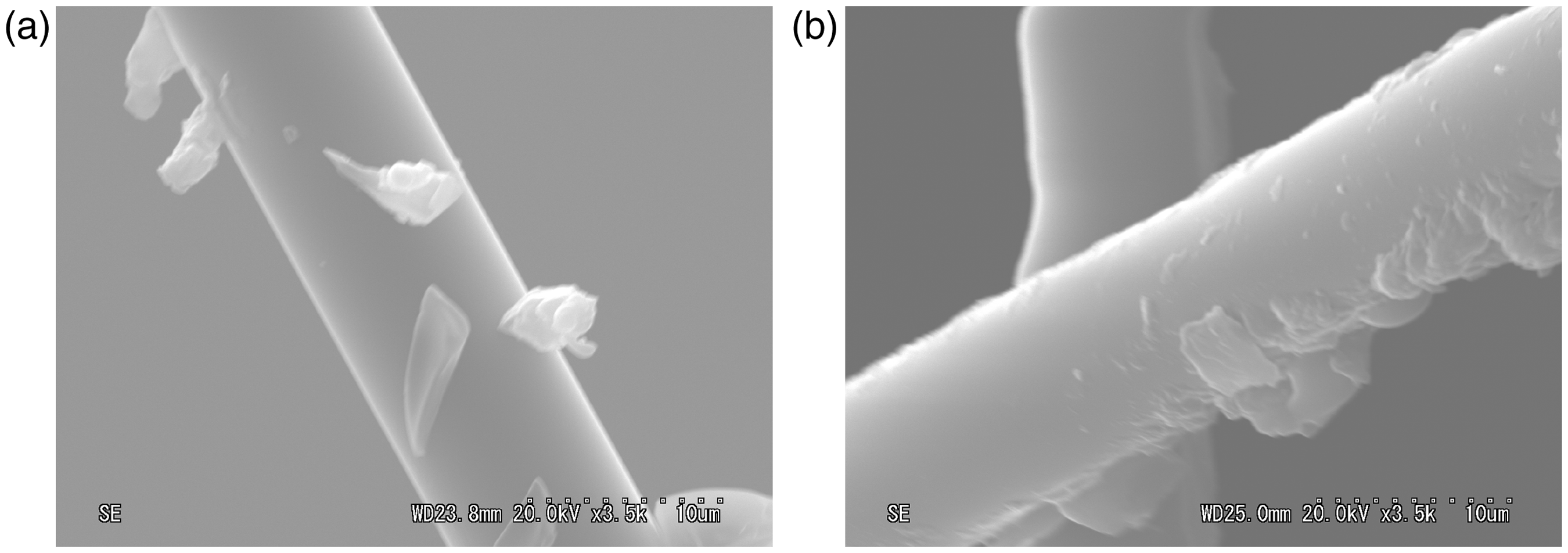
Conclusion
The bending property of composite reinforced by 8-shape 3D woven fabric, pretreated with hypo-atmospheric-pressure plasma, was researched. The pretreatment effect of atmospheric-pressure plasma on the 3D woven fabric of glass fiber was investigated. Based on the experiments, the composite of pretreated time 1 min had maximum onset fracture load, while the composite of pretreated time 3 min had minimum onset fracture load. Moreover, the displacement of all samples was over 4 mm. On observing the SEM images of the fiber peeling from the composites, it was clarified that the surface of the fiber became coarse after the woven fabric was pretreated by atmospheric-pressure plasma. The coarse surface improved interfacial adhesion between fibers and resin, consequently the onset fracture load of the composite was improved.
Further analysis is needed to research how the thickness of composite influences the property of composite and how the measurement direction affects the results of bending property of composite.
Footnotes
Acknowledgement
The authors are grateful for the financial support by China Postdoctoral Science Foundation (20100471378), Jiangsu Planned Projects for Postdoctoral Research Funds (1001039B), and the Jiangsu Natural Science Foundation (BK2009511). The authors would like to thank professors Q.Q. Ni and L.M. Bao of Shinshu University who provided experimental condition partly.