



Abstract
Cultural and creative industries are often perceived as progressive, yet gender inequalities persist across various sectors. Using data from IMDb on 12,820 episodes and 524,406 credits, this study investigates gender disparities in Italian TV serial production from 2000 to 2023, focusing on women’s involvement and employment trends across various professional roles. Our findings reveal a significant gender gap, with women constituting only about one-third of the workforce. Despite a slight increase in female employment over the years, particularly in below-the-line roles, the overall trend remains marginal. Comparisons with broader Italian audiovisual and economic sectors show that TV serial production is less inclusive. This study highlights the persistence of gender disparities and calls for a reevaluation of cultural labor practices to increase women’s meaningful participation. As part of ongoing research, we aim to explore additional factors influencing the gender gap, offering insights for fostering equality in media production and guiding policy interventions.
Keywords
Introduction
The cultural and creative industries, often celebrated as progressive and inclusive, remain fraught with significant gender inequalities. Media production, a field heralded for its innovation and ability to respond to societal values, is no exception. Numerous studies have documented the persistence of gender segregation across occupational roles. Women are predominantly positioned in coordination and support roles, such as production management and public relations, while men dominate leadership and creative positions. Additionally, technical roles also exhibit notable signs of gendered segregation, further reflecting structural inequalities. Within this landscape, television production offers a powerful opportunity to examine gender dynamics, given its persistent work patterns and episodic nature, which allows for longitudinal analyses.
Italy presents a compelling case for studying these inequalities. Despite policies aimed at promoting gender balance in audiovisual production, such as Law 220/2016, the Italian television industry has been underexplored in academic research, especially when compared to the robust studies of the cinema or audiovisual sectors in the United States and the United Kingdom. Existing analyses have largely overlooked the long-term trends and structural barriers that shape women’s participation in television serial production.
This study addresses this gap by using a data-driven approach to analyze gender disparities in Italian TV serial production from 2000 to 2023. Using a dataset of 12,820 episodes and 524,406 professional credits extracted from IMDb, this research examines the extent of women’s participation in different professional roles, as well as the trends that shape their employment over time. By situating these findings within broader national and sectoral contexts, this paper aims to provide a comprehensive assessment of gender inequalities in Italian TV serial production and their implications for cultural labor practices and policymaking.
Women in Media Production: Vertical, Horizontal, and Longitudinal Inequalities
Media industries are commonly regarded as cool, creative, and egalitarian compared to other occupational sectors (Gill 2002) and open to cumulative cultural evolution (Tinits and Sobchuk 2020). However, much academic research and many statistics on the workforce have highlighted tremendous inequalities in relation to ethnicity, class, disability and, more often, gender (e.g., Lauzen 2023; Rocchi et al. 2023; Smith et al. 2021).
Gender inequalities under the form of segregation persist at both vertical and horizontal levels in many economic activities, that is, in leadership positions and across specific occupations (Levanon and Grusky 2016), and audiovisual sector is not exempt. From a vertical segregation perspective, research has shown that above-the-line roles, that is, prestigious, leadership, and creative roles, are extremely difficult to enter for all professionals (Ashton 2015) but above all for women (Bielby 2009; Christopherson 2008; Conor et al. 2015; Mehta 2023), yet men outnumber women also in more craft and technical positions, the so-called “below-the-line roles” (Dodd 2012; Hesmondhalgh and Baker 2015; Nixon 2003; O’Brien 2015). From a horizontal segregation standpoint, some studies have focused on women in women- or men-segregated below-the-line roles, such as casting directors (Banks 2009) and stunt performers (Banks and Steimer 2015) respectively, finding that jobs dominated by women are devalued and that women’s presence in men-dominated labor is “erased.”
An additional crucial aspect for understanding gender inequalities in television production lies in the “intermittent” or “project-based” nature of work. Unlike more stable or institutionally structured environments, TV series often revolve around short production cycles and fixed-term contracts that may span only a few episodes or a single season (Ashton 2015; Gill 2002). This setup drives intense competition and fosters an informal recruitment culture based on personal networks, which historically favors men in decision-making positions (Christopherson 2008; Conor et al. 2015). Moreover, as Ursell (2000) illustrates in the British context, increased contractual flexibility can create precarious working conditions, income discontinuity, and difficulties in balancing work and family commitments—problems that disproportionately affect women, particularly in technical or managerial roles (Wreyford 2013). Such a combination of job insecurity and informal hiring practices underpins “short careers” or early exits from the field, perpetuating a systemic underrepresentation of women in the creative and decision-making phases of TV production (Percival 2020). This dynamic reveals how vertical segregation intersects with labor practices that are inherently precarious and shaped by masculine-coded professional norms.
To theorize these empirical patterns—vertical and horizontal segregation, precarious contracts, informal networks—Acker's (2006) concept of inequality regimes proves particularly illuminating. Rooted in theories of social stratification, this framework posits that workplace inequalities are not incidental but systematically embedded in organizational practices, from recruitment to career advancement. Within media industries, this theoretical perspective aligns with production studies scholarship, which emphasizes examining media industries as workplaces subject to the same labor dynamics, power relations, and structural inequalities that characterize other economic sectors (Caldwell 2020; Mayer 2011). Rather than treating cultural and creative industries as exceptional or exempt from broader labor market forces, this approach reveals how their distinctive features—project-based work, network-dependent hiring, creative autonomy—may intensify exclusionary mechanisms. This framework guides our analysis by directing attention not only to whether gender gaps exist, but to how the organizational structures of Italian TV production may perpetuate them over time, and whether patterns observed align with or diverge from those in other industrial sectors.
While a dichotomy between above- and below-the-line roles risks being simplistic and neglecting the collaborative efforts of media labor (Mayer 2011), many policies and interventions have been introduced to allow women’s entrance into top professional positions. International frameworks, from the UN Fourth World Conference on Women (United Nations 1995) to the EU Gender Equality Strategy 2020 to 2025, have prioritized women’s access to decision-making positions in media. 1 While evidence shows that women-led productions employ more women overall (Fanchi 2021), attention should also be directed to lower-level occupations, both for their inherent value and as pathways for career progression.
Data collection and monitoring are paramount to establish benchmarks for improving diversity (Kerrigan et al. 2023). While data-driven research on gender inequalities in audiovisual production has proliferated, studies have privileged US and UK contexts and cinema over television (Lauzen 2023; Nwonka 2021), despite marked inequalities in television production (Milner and Gregory 2022; O’Brien 2014). Most studies converge on a 30 to 70 gender split at aggregate production levels, suggesting systemic imbalances. Moreover, gender discrepancies can be expressed also considering the different volume of working activity undertaken, which is especially manifest in power positions: in particular, studies have observed that cinematic productions directed by women are by far less than those directed by men (Simone 2019; Smith et al. 2021).
Focusing on the Italian landscape, the interventions supporting gender equality in media production have been implemented following the 220/2016 Law that disciplines film and audiovisual production under the form of financial contributions for productions that holds 50 percent upward of female workforce in, but not limited to, creative positions (Direzione Generale Cinema e Audiovisivo 2024). Media production studies in Italy have only recently begun to flourish compared to other national contexts (Barra et al. 2016: 10), and the gap widens when focusing on studies examining gender inequalities in production. Moreover, the low number of data-driven production studies conducted in Italy has mainly pivoted around cinema (Fanchi 2021; Fanchi et al. 2023; Fanchi and Tarantino 2019). Regarding television, research has focused on crime TV series (Re and Spalletta 2023) or on a comparison between generalist and pay TV series production in a restricted timespan (Rocchi 2023).
TV series production is particularly suitable for research on the gender gap in audiovisual production, given their extension in time, the succession of cast and crew members across episodes and the more continuous labor patterns compared to film production. TV serial production enables longitudinal analyses, which are fruitful to unravel whether the introduced measures at both European and national levels are producing positive effects.
To leverage these analytical advantages, this study examines Italian TV series production from 2000 onward. This starting point is grounded in both industry evolution and methodological feasibility. As Cardini and Brembilla (2025: 219) document, the turn of the 1990s-2000s marked the emergence of domestic long-form seriality in Italian television, with landmark productions such as Un posto al sole (1996–), Vivere (1999–), Il Commissario Montalbano (1999–), and Centovetrine (2001–). This shift toward sustained and continuous production modes established the stable industrial infrastructure necessary for the kind of longitudinal analysis of labor patterns that this research requires. Concurrently, 2000 represents the point at which data collection became significantly more feasible through digitization and the availability of online databases, enabling systematic tracking of cast and crew across the extended timelines that characterize serial production.
Based on these premises, we formulate the following Research Questions (RQs):
Data and Methodology
To isolate Italian TV seriality distributed from 2000 to 2023 and the respective credits, we relied on Internet Movie Database (IMDb, https://www.imdb.com/) as data source, which has been extensively used in data-driven media studies on gender inequalities (e.g., Kagan et al. 2020; Matei et al. 2023; Rocchi 2023; Rocchi et al. 2023).
To include serial productions that began airing before but continued to be produced after 2000, an advanced search for TV Series and TV Miniseries was conducted in April 2024 on IMDb, using 1980 as the lower time threshold. The data was extracted through a data mining process. Several pre-processing interventions were then carried out as part of the data cleaning phase: first, we excluded all serial titles whose production had ended before 2000; second, we manually filtered out non-fiction and animated serial productions from the fiction ones; third, we separated TV serial productions (covering both linear and non-linear TV) from web series. Additionally, two more advanced searches with similar parameters were conducted—one excluding the Italian language and the other excluding the Italian country tag. These results were cross-referenced to ensure coverage of any items lacking one of these tags and were annotated accordingly. The results of the data mining and cleaning processes are available at https://doi.org/10.5281/zenodo.18782643.
The IMDb data shows that 522 Italian TV serial productions broadcast at least one episode between 2000 and 2023. However, since our aim is to conduct a longitudinal study, we considered the episode as the unit of analysis rather than the series. For these 522 serial productions, IMDb provides data for 12,820 episodes. To estimate the full scope of episodes, we cross-referenced additional sources such as VOD platforms, Wikipedia, the Italian website dedicated to audiovisual products MYMovies (https://www.mymovies.it/), and the Italian newspaper La Repubblica (https://www.repubblica.it/). From these sources, we determined that the total number of episodes aired from 2000 to 2023 across the 522 serial products is 26,101. Thus, the IMDb dataset covers 49.12 percent of the total episode population (hereafter referred to as the episode sample). From the episodes in this sample, we extracted a total of 524,406 credits, representing the professional contributions listed in the cast and crew, which are available at https://doi.org/10.5281/zenodo.18783426. These contributions were filled by 25,538 unique professionals, that are individuals who worked on at least one episode.
While our episode sample includes all available episodes on IMDb rather than a randomly selected subset, we consider it sufficiently representative for analyzing aggregate national trends in gender employment. This assessment rests on several considerations. First, the sample size of 12,820 episodes substantially exceeds the minimum required (379 episodes) for a 95 percent confidence level with a 5 percent margin of error, enabling robust statistical inference at the population level. Second, although IMDb is user-generated, entries undergo review processes that enhance data quality (IMDb Help Center n.d).
However, we acknowledge potential coverage biases in the IMDb dataset. Comparing the episode sample with the total population across available metadata, we observed some systematic differences: soap operas appear underrepresented (comprising approximately 30% of the sample vs. an estimated 60% in the population), while more recent productions show higher coverage rates. These patterns suggest that IMDb coverage may vary by genre and production period, likely reflecting differences in user interest and documentation practices.
Despite these limitations, we maintain that the sample adequately supports our research objectives for three reasons. First, our analysis focuses on aggregate temporal trends in gender employment across the entire Italian TV serial industry, rather than on comparisons between specific subgroups (e.g., genres, production companies, or broadcasters). For such aggregate analyses, sampling theory indicates that large non-random samples can yield valid estimates of population-level trends, provided that coverage biases remain relatively stable over time and do not systematically correlate with the outcome of interest (Groves and Lyberg 2010), in our case gender composition. Second, we found no theoretical or empirical evidence suggesting that IMDb coverage systematically favors productions with specific gender compositions in their crews. Third, the margin of error calculated for our main findings (±0.59%, see Table 1) demonstrates that sampling variability remains minimal given the sample size.
Aggregated Data About Gender Distribution for Credits and Unique Professionals, Including Margins of Error (MoE) with Respect to the Episode Population.
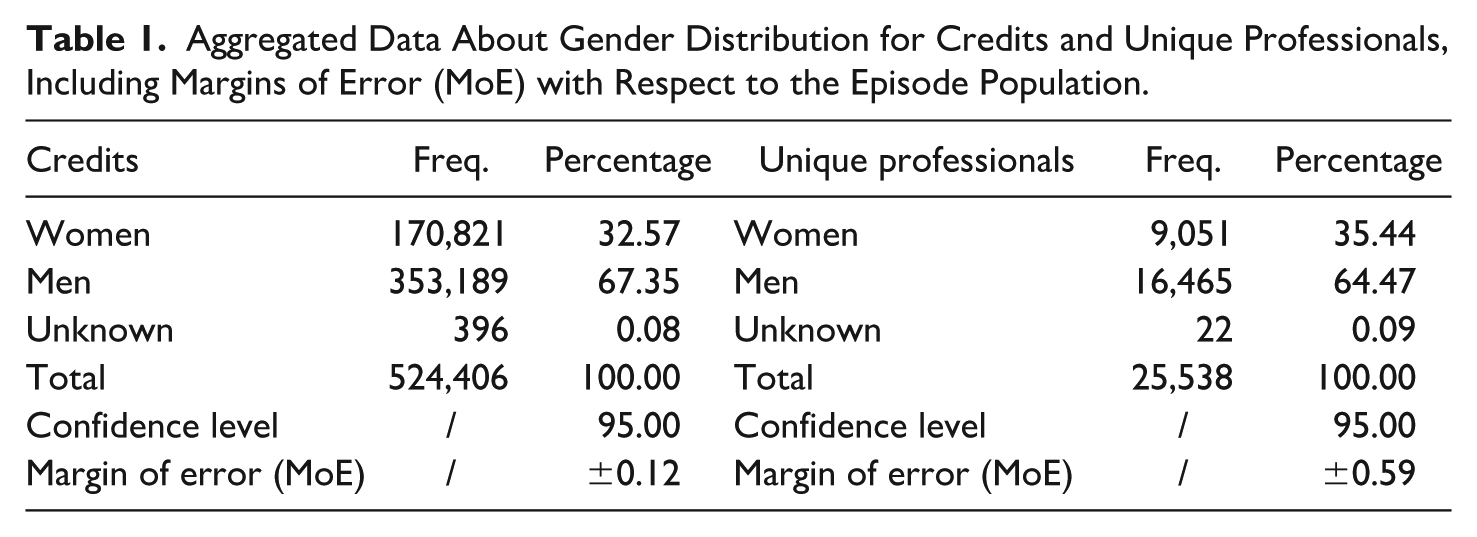
We emphasize that our findings should be interpreted as estimates of overall trends in the Italian TV serial production sector, rather than as precise measurements for specific production contexts or subgroups. Analyses requiring representativeness across multiple stratification criteria (genre, production company, broadcaster, etc.) would necessitate a stratified sampling design rather than the convenience sample employed in this study. Such stratified approaches, while enabling more granular analyses, involve trade-offs in terms of sample size and analytical scope. Our current study prioritizes breadth and temporal coverage to establish baseline patterns of gender inequality, while future research using stratified sampling could examine variations across production contexts more precisely.
As for the assignment of a gender to cast and crew members, IMDb does not release information on the gender identity of the professionals, except for cast members, whose profession is inserted as either actor or actress. For the other professionals, we relied on Genderize.io (https://genderize.io), which assigns a gender to a person based on their first name. Although name-to-gender inference tools like Genderize.io could potentially carry out misclassifications, previous studies (Menéndez et al. 2020; VanHelene et al. 2024) have shown that these tools, and particularly Genderize.io, can be utilized for research because they introduce a limited error gender bias in a sample, that is “[. . .] the direction of the bias in the gender prediction, indicating whether there are more females misclassified as male, or vice versa” (Santamaría and Mihaljević 2018: 12).
Results
Women’s Involvement in Italian TV Serial Production
To understand how many women were involved in the production of Italian TV seriality from 2000 to 2023 (RQ1.1), we assigned a gender to all the 25,538 professionals identified (Table 1). The results show a high gender gap, which is close to a ratio of one woman for two men, corroborating the figures issued from previous studies on gender inequalities in Italian media production (Fanchi 2021; Fanchi et al. 2023; Fanchi and Tarantino 2019; Re and Spalletta 2023; Rocchi 2023). The low margin of error (MoE) of ±0.59 (Table 1), estimated with a confidence level of 95 percent, enables a generalization of these findings to the overall episode population.
Although it would be preferable to dispose of data on the worked hours to analyze workload volumes, we relied on the number of episodes to infer discrepancies pertaining to labor activity based on gender, achieved by performing a ratio between female credits and unique women professionals (RQ1.2). This operation shows that women worked an average of 18.87 episodes, 12.03 percent fewer than the 21.45 episodes worked by men.
Female Employment in Italian TV Serial Production, Audiovisual Industry and All Economic Sectors
Female employment in Italian TV serial production
The statistical office of the European Union, EUROSTAT, defines a person as employed if they worked for at least one hour during a reference week (EUROSTAT Statistics Explained 2021). To be consistent with this census data processing, we considered a woman professional employed in a reference year if she had been involved in the production of at least one episode.
We decided to analyze female employment in Italian TV serial production not only considering all productive roles, but also specific professional typologies, which were established based on their final impact on the production. We grouped the professional roles that IMDb surveys 2 into cast, above-the-line roles (i.e., creator, 3 director, producer, and writer), and below-the-line roles (all the remaining roles). 4 Although cinematographers are typically considered above-the-line in film production due to their creative influence, we decided to acknowledge them as below-the-line in TV serial production, due to the more technical and standardized nature of their work. This is because television series, especially genres like sitcoms or long-running dramas, require consistent visual style across multiple episodes to maintain a strong identity, which limits the cinematographer’s autonomy.
To carry out the analysis, we relied on linear regression, which is a statistical method used to examine the relationship between one or more independent variables (in this case, time) and a dependent variable (in this case, the female employment rate). By fitting a linear equation to the observed data, linear regression helps determine whether there is a statistically significant trend—in this context, whether there has been an improvement in gender balance over time (RQ2.1). The method tests two hypotheses: the null hypothesis (H0), which asserts that no significant relationship exists between time and the female employment rate (indicating no trend), and the alternative hypothesis (H1), which suggests that a significant relationship does exist (indicating a trend).
To assess the pace of change in female employment over time, we begin by calculating the slope coefficient of the linear regression model. This coefficient estimates the rate of change in the dependent variable (female employment) for each unit increase in the independent variable (years), and it is used to define the regression line. To establish the statistical significance of the results, we calculate the p-value, which represents the probability of observing data at least as extreme as the actual data, assuming the null hypothesis (H0) is true. If the p-value is less than or equal to a predetermined significance level (typically p ≤ .05), we can reject H0, indicating a statistically significant relationship between the variables. Moreover, if the slope coefficient is greater than 0, we can conclude that the trend is statistically significant and positive. Another important measure is the R2 value, which estimates the proportion of variance in the dependent variable that the independent variable can explain. The R2 value ranges from 0 to 1, with higher values indicating a stronger explanatory power of the model. In addition to these standard procedures, we also computed bootstrap confidence intervals for the slope coefficient. Bootstrap confidence intervals are particularly valuable when dealing with small sample sizes, as they tend to be more robust and accurate than normal confidence intervals. The confidence interval provides a range of values within which we expect the true slope coefficient to lie, with a given level of confidence (95% in our case). If the confidence interval includes 0, the null hypothesis cannot be rejected, indicating no significant trend in female employment over time. However, if the entire interval lies above 0, this suggests a positive and statistically significant relationship between time and female employment.
As can be seen from the positive slope coefficients reported in Table 2, female employment tends to increase across all roles and professional typologies selected. However, considering all roles, female employment rises only 0.168047 (0.17%) per year. As for professional typologies, the increase is extremely low for cast (0.08%), slowly higher for above-the-line roles (0.22%) and by far higher for below-the-line roles (0.40%). Standard and bootstrap confidence values include 0 for cast, which suggests that there is not enough evidence to assess a positive trend in the employment of actresses. This is consistent with the p-value for cast roles (.145000), which is above the .05 significance threshold, indicating that the trend is not statistically significant. All the other trends are statistically significant.
Summary of Regression Analysis Results with Respect to Female Employment Across All Roles, Cast, Above-the-line and Below-the-line Roles.
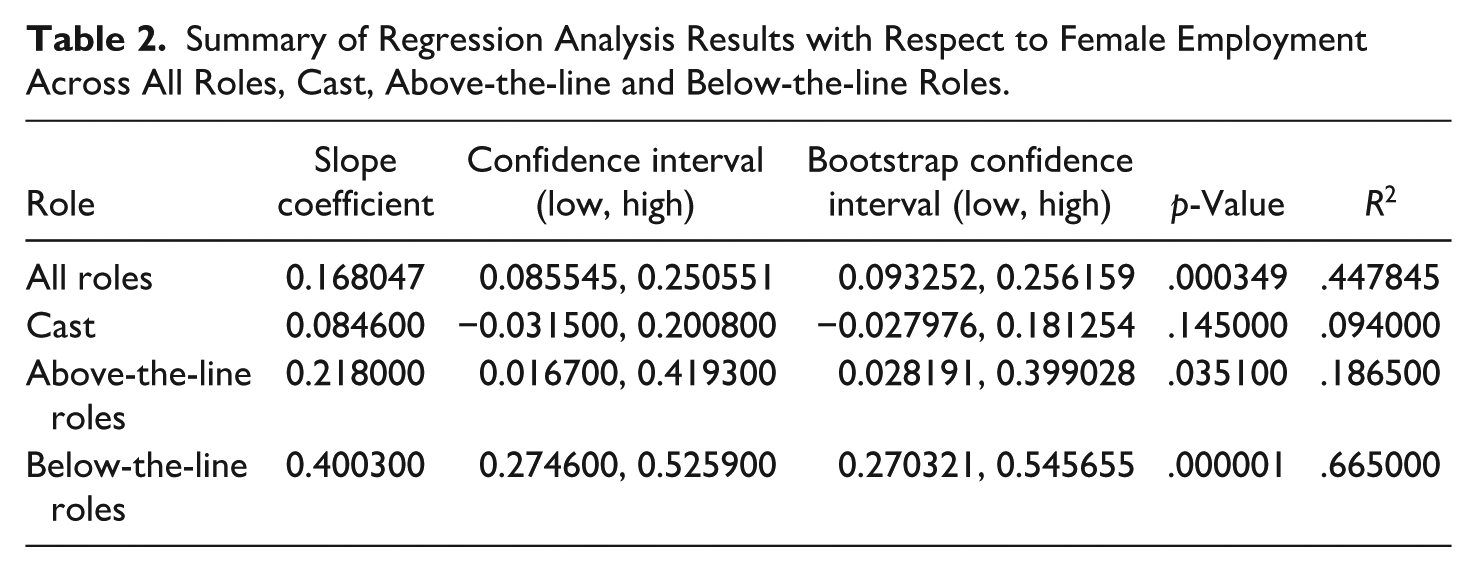
If we dive deeper into the relationship between dependent and independent variables by looking at R2 results (Table 2), we can see that time is a high responsible factor for an increase in female employment in all occupations (.447845) and even greater for below-the-line positions (.665000), yet limited for above-the-line roles (.186500). 5
Based on the limited effect of time on female employment across all roles and the non-significant result pertaining to cast—whose off-screen gendered presence has furthermore more to do with on-screen representation patterns than with societal schemes—we report only the regression plots for above- and below-the-line roles in Figure 1. The other plots are available at https://doi.org/10.5281/zenodo.18783820.
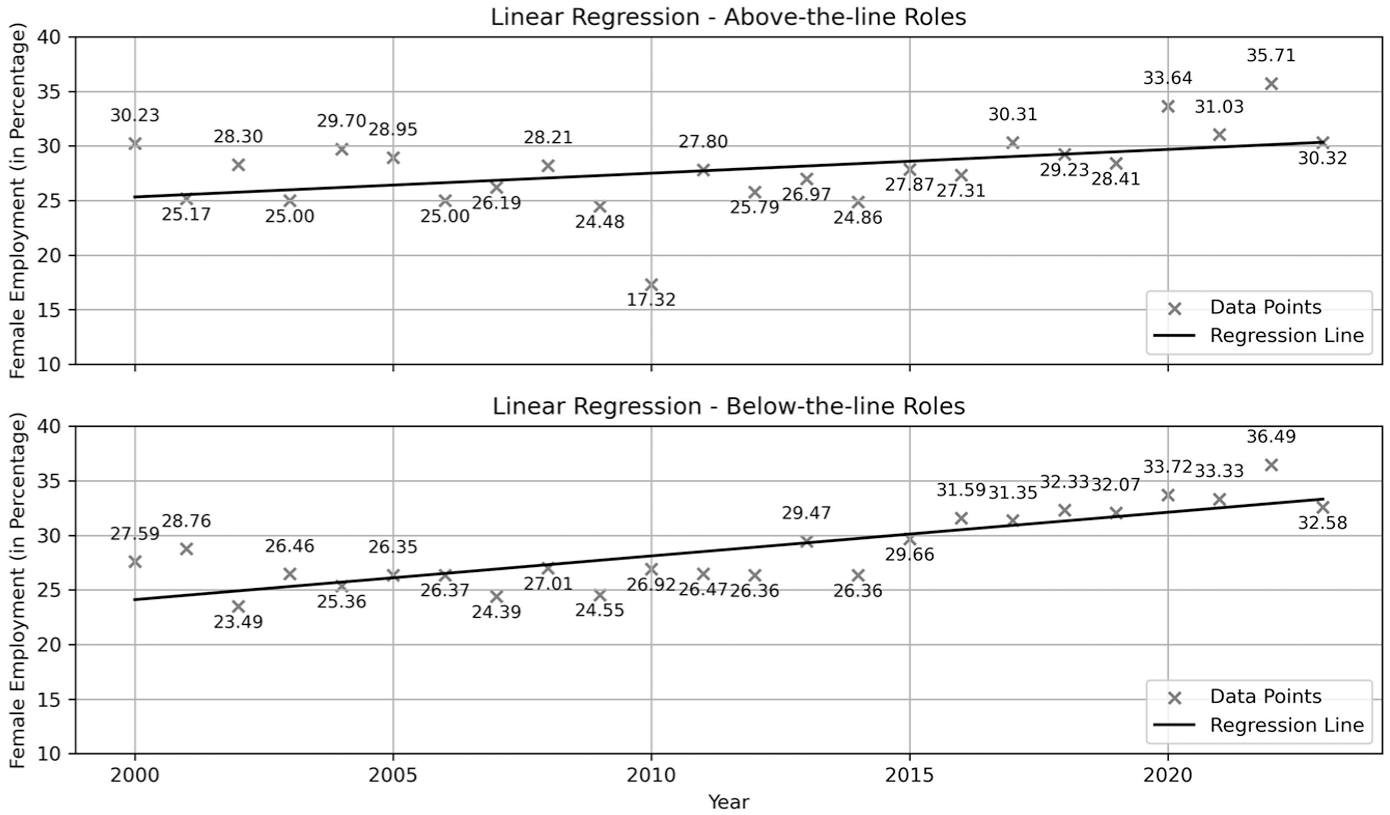
Linear regressions showing the evolution of female employment in the production of Italian TV Seriality from 2000 to 2023, across above-the-line and below-the-line roles.
Female employment in Italian audiovisual industry and all economic sectors
Aimed at observing whether Italian TV serial production represents a more progressive employment sector in terms of women’s participation than the Italian screen industry and the overall Italian workforce (RQ2.2), we isolated relevant EUROSTAT data. As mentioned before, EUROSTAT data are collected weekly rather than yearly and are available from 2008 to 2022 because of a major revision of the classification of the economic activities in the European Union, NACE codes, that make incomparable employment data related to the audiovisual sector before and after 2008 (EUROSTAT 2008). Besides these limitations, it is worth comparing these data with ours to identify potential alignments or misalignments as regards women’s employment.
From the list of NACE codes (EUROSTAT 2010), we isolated Motion picture, video, and television programme production, sound recording, and music publishing activities (J59), and Programming and broadcasting activities (J60) to identify Italian audiovisual industries, whereas to determine employment in all Italian economic activities we selected all the NACE sectors. To perform regression analysis, we used the same independent and dependent variables as above (respectively, time, and female employment) and the same H0 and H1.
Considering first the Italian media industry, the female employment evolution is almost flat, with a rise of 0.08 percent per year. Yet, the percentages of female employment are slightly higher with respect to the ones illustrated in TV serial production in all years considered, close to 40 percent. The standard and bootstrap confidence intervals including 0, jointly with a p ≥ .05, however, do not enable to affirm the significance of this limited progression.
As for female employment in Italy in all productive sectors, a positive trend emerges. Moreover, the gap between women and men in terms of employment is by far lower compared to the one identified in TV seriality production, reaching a split of approximately 43 to 57 in 2022. However, the slope coefficient (0.14%) is lower compared to below-the-line roles (0.40%) and to all professional serial roles (0.17%). The low p-value confirms the statistically significance of the trend and the high R2 of .780048 indicates that time is the main responsible factor for an increment of women within the workforce.
For space reasons, the table and the plots related to this part of the research are available at: https://doi.org/10.5281/zenodo.18784193.
Discussion
The results of our research confirm the idea that women are more frequently trapped in “typical feminized parts of routinized service sector work” (McDowell 2008), while having difficulty gaining access to occupations in the audiovisual sector whose work tasks require more autonomy and creativity. If decision-making roles have traditionally been seen as male (Bielby 2009), women’s access has been considered as possible and ongoing, due to the attention given by European and national policies and a greater awareness of gender inequalities. Creative positions are currently undergoing a process of professionalism, which implies “[. . .] routine practices, membership in above-the-line guilds or associations, and predictable goals to the extent that a ’hit’ program would secure ongoing employment as well as contribute to the industry’s bottom” (Mayer 2011: 66). However, the difference in contracts between the two occupational groups remains large: most below-the-line contracts are negotiated on standardized terms and through recognized guilds and craft unions, unlike those for creative workers (Carman and Drake 2015). The precariousness of key roles in media production may act as a barrier to women entering these professions, or contribute to their departure after entering (Percival 2020). Conversely, craft roles may have become more accessible to women as a result of the professionalization of the field. Our findings corroborate the persistence of vertical segregation patterns in cultural labor and indicate that, when occupations undergo a process of gaining prestige and economic value—as is the case with cultural and creative labor—women will likely encounter difficulties in accessing these roles (Light 1999). This phenomenon does not refer to the so-called “crystal ceiling” issue (Baxter and Wright 2000), but rather to a process that involves the potential impact of the structure of the social stratification system on the female employment.
These empirical patterns can be interpreted through the lens of social closure mechanisms. The modest 0.17 percent annual increase in female employment across all roles, alongside the finding that below-the-line roles show considerably faster progress (0.40% annually) compared to above-the-line positions (0.22% annually), reveals differential access barriers across occupational hierarchies. In particular, the less pronounced professionalization of above-the-line positions and the informal, network-dependent arrangements of cultural labor enable social closure (Mackert 2025; Weber 1978)—exclusionary mechanisms through which privileged groups maintain monopolistic access to valued resources through “any externally identifiable characteristic” (Weber 1978: 342), in this case gender, to restrict competition and preserve insider advantages. The slower progress in creative positions, where R2 values indicate that time explains only 18.65 percent of variance in female employment compared to 66.50 percent for technical roles, suggests that above-the-line work remains more resistant to temporal trends and external pressures for inclusion. Recognizing that television labor, especially above-the-line positions, operates through social closure mechanisms means acknowledging that television production does not follow distinct industry-specific logics but remains embedded in broader labor market patterns. The quantitative parallels found in this study between the audiovisual sector and all Italian economic sectors empirically support this interpretation. This suggests that cultural and creative industries exhibit structural heteronomy, meaning they are embedded in and shaped by external forces ranging from business cycles to systemic gender stratification (Garnham 2005; Hesmondhalgh and Sarah 2011; Miège 1989). What distinguishes the audiovisual industry, then, is not its exemption from these forces but how the specific precarious and informal organization of cultural labor mediates and often intensifies their effects. This argument aligns with production studies’ emphasis on understanding media industries as workplaces subject to the same labor dynamics, power relations, and structural inequalities that characterize other economic sectors (Caldwell 2020; Hesmondhalgh and Sarah 2011; Mayer 2011).
Analyzing and disseminating data on the gender gap within the media industry production is a first step in overcoming inequalities, but it is ineffective per se. Likewise, policies can serve as a starting point, but if they do not identify specific reasons for inequalities and do not include concrete practices, they risk being “empty shells” (Holgate and McKay 2009; Sarikakis and Nguyen 2009). As we have seen above, women’s underrepresentation in the sector might be due to broader organized exclusionary practices rather than sector-specific barriers. However, creating conditions for women’s access to cultural production may be a starting point to enhance women’s presence in the field. In particular, job features such as precarious contracts, project-based work, freelancing, high hourly flexibility, homophily, and informal recruitment based on personal networks have historically dominated the cultural labor market and therefore established a gendered work environment, potentially hindering women’s full access—as several studies have observed (e.g., Eikhof and Warhurst 2013; Lutter 2015; Wreyford 2013). Although difficult, rethinking some of the cultural labor practices is essential to facilitate women’s meaningful participation in the industry (Thynne 2000).
Conclusions, Limitations, and Directions for Future Research
In this paper, we have analyzed the presence of women professionals in the production of Italian TV seriality from 2000 to 2023. To the best of our knowledge, this is the most comprehensive data-driven study on gender inequalities in Italian audiovisual production, offering a longitudinal perspective over more than two decades with a particular focus on methodological accuracy. By leveraging data from IMDb and applying statistical analyses, we have gained valuable insights into the low presence of women in the sector.
Findings related to RQ1 have shown that women are not only significantly underrepresented in the Italian TV serial industry, but they also have fewer work opportunities in terms of episodes. The statistical analysis of the results related to RQ2.1 has shown that slightly more women have worked in Italian TV serial production over the considered period and that the increase has been mainly driven by below-the-line work, highlighting gendered vertical segregation patterns in Italian media production.
The comparison between our results and EUROSTAT data (RQ2.2) has confirmed that (i) Italian serial sector is less inclusive compared to both the broader audiovisual industry and the Italian economic sectors and (ii) that the—slow—increase in representation that we have illustrated is related with a low starting point compared to the other sectors analyzed. Thus, the increasing percentage of women employed in Italian TV serial production is attributable to their greater marginalization within the industry, which calls for a reconfiguration of the creative labor schemes to promote women’s meaningful presence in the field.
By situating the analysis within sociological theories of social closure and structural heteronomy and the academic and industrial framework of media production studies, this research indicates that the audiovisual sector—and television production specifically—exhibits similar gender stratification dynamics and responsiveness to external economic forces that characterize broader labor markets. These findings challenge narratives of cultural industries as “cool, creative and egalitarian” (Gill 2002), revealing instead that informal work arrangements and network-dependent hiring intensify rather than ameliorate exclusionary mechanisms, especially in decision-making positions.
The innovative character of our study lies in its comprehensive quantitative analysis over an extended period. Besides the contributions of our research, it is important to acknowledge its limitations, which are consistent with those identified by previous data-driven Italian media studies on gender inequalities (Rocchi 2023). First, regarding data representativeness: our reliance on IMDb introduces coverage biases, as discussed in Section 2. Specifically, certain production types (e.g., soap operas) and older productions appear underrepresented in the dataset. While we argue that these biases do not invalidate our main findings regarding aggregate temporal trends, they do constrain the generalizability of our results to specific production subgroups. Future research employing stratified sampling designs would enable more precise analyses of gender patterns across different genres, production companies, and broadcasting contexts. Such stratified approaches would complement our broad temporal analysis by providing deeper insights into variation across production contexts. Despite these limitations, utilizing IMDb data for research remains fruitful due to their granularity, compared to other sources such as the International Standard Classification of Occupations (International Labour Organization 2008). Second, our analysis focuses on gender disparities by adopting a binary approach and without incorporating an intersectional perspective that considers other intersecting identities such as race, age, or socioeconomic status. This is largely due to the lack of available data on these dimensions. Future research could benefit from qualitative analysis or alternative data sources to explore these aspects, providing a more comprehensive understanding of inequalities. Third, using the number of episodes as a proxy for workload may not fully capture the nuances of labor contributions across different roles, as roles vary significantly in time commitment and responsibility. Fourth, our aggregation of professional roles may mask significant variations in gender representation within specific occupations, potentially overlooking areas with extreme disparities. More granular analysis is especially required for directors, creators, producers, and writers. Lastly, a time linear regression analysis may impose linear patterns on a process that is not necessarily continuous. Further preliminary observation of the data indicates a significant turning point in female employment in above- and below-the-line roles around 2010, which notably strengthens the model and marks the start of a steeper increase in women’s participation. Testing for a shift in 2016 to 2017—possibly tied to the 220/2016 Law or the #MeToo movement—did not show a significant effect. It is difficult to identify internal industry causes that might explain a 2010 change; one plausible interpretation could be the broader economic repercussions following the 2008 crisis. Clarifying this pattern requires considering additional variables and likely complementing quantitative findings with qualitative research.
In addition to addressing these limitations and as part of the Research Project of National Interest E|Quality – Strategies for meaningful inclusion in Italian cinema and television [Grant Number: P2022K3LJA], our future research aims to explore other variables that may influence the evolution of the gender gap in Italian television production beyond time—such as production companies, networks, the typology of serial products (e.g., mini-series, series, or serials), the genre of titles, and the gender of top-position holders—which could offer further insights to guide policy interventions. Employing more sophisticated statistical methods and including control variables may help isolate specific factors contributing to the observed trends.
Footnotes
Declaration of Conflicting Interests
The authors declared no potential conflicts of interest with respect to the research, authorship, and/or publication of this article.
Funding
The authors disclosed receipt of the following financial support for the research, authorship, and/or publication of this article: The authors received financial support from two Research Projects of National Interest: E|Quality. Strategies for Meaningful Inclusion in Italian Cinema and Television [Grant Number: J53D23016410001] and Narrative Ecosystem Analysis and Development framework (NEAD framework). A systemic approach to contemporary serial product. The medical drama case. [Grant Number: 2020JHRZCJ], funded by the Italian Ministry of University and Research (MUR). Funding supported data collection, methodological development, and validation procedures presented in this study
Ethical Considerations
All data used in this study were obtained from publicly accessible sources. No personal or sensitive information was collected.
Consent to Participate
Not applicable.
Consent for Publication
Not applicable.

Data Availability Statement
The study adheres to ethical guidelines for research involving publicly available data. The datasets are available as open data on the Zenodo repository, in accordance with FAIR (Findable, Accessible, Interoperable, and Reusable) principles.