



Abstract
TV POWWW! was a television program built around a technology which allowed viewers to control televised videogames over the telephone. This article chronicles its history while analyzing its technology, social contexts, aesthetics, and impact on game design and development. We situate TV POWWW! at the nexus of several developments during the late 1970s and early 1980s. These include new perceptions of mediated interaction facilitated by computerization and technical communication networks, experiments in participatory television, ideas about simplified videogame design for televised play contexts, and forms of gendered spectatorship and play.
Keywords
Introduction
It’s 1978 and Southern California’s top-rated morning program, A.M. Los Angeles, is on the television. Sitting on a cream-colored studio sofa are Sarah Purcell (later a host on the early reality show Real People) and Regis Philbin (who as of 2025 still held the world record for most hours on television). Purcell and Philbin talk excitedly about a game technology they will premiere this very morning. Hinting at recent technical difficulties, Purcell admits “three people came into the makeup room this morning saying ‘it works, it works!’ So we’re going to find out.” Purcell picks up a controller for the Fairchild Channel F, a pioneering home videogame system, adding “we have to have a demonstration.” The show moves into a split-screen format, with the Channel F game Shooting Gallery appearing below the hosts. Purcell uses the plunger at the top of the controller to fire a square bullet at a moving target while Philbin clarifies, “I want you to know at home that in lieu of you pushing this, you’re going to say ‘pow,’ and when you say ‘pow’ you will activate that bullet.” The demonstration complete, Philbin greets a caller: “Good morning Orange County—you’re on TV POWWW!” The caller repeatedly shouts “pow” as bullets fly across the screen. Purcell exclaims “it works, it works! I don’t believe it!”
This was the first broadcast of TV POWWW!, a technology and program where viewers controlled televised videogames over the telephone. From 1978 until the mid-1980s, TV POWWW! variants were inserted into talk shows, children’s programming, and morning shows; it even appeared briefly as a standalone game show, SAY POWWW. TV POWWW! has been mentioned in fan histories (Smith 2014), as a precursor of streaming videogame play (Taylor 2018), and as an early form of televised esports (DeSpira 2017; Kerttula 2019; Zhouxiang 2022). In this article we extend these conversations by developing three key lines of analysis. First, we explore how TV POWWW! emerged in the relationship between television and videogames. Second, we ask why a technology for voice recognition was deemed pivotal in the first place—when an offstage technician could (and sometimes did) simply push a button. Third, we examine how TV POWWW! transformed videogame design and development. Through this analysis, we situate TV POWWW! at the nexus of several sociotechnical developments of the late 1970s and early 1980s. These include new perceptions of mediated interaction facilitated by computerization, experiments in participatory television, and ideas about simplified game design for televised play contexts and game development as a service. It also included new forms of gendered spectatorship and play that situated TV POWWW! as a potentially counter-hegemonic site, allowing access to videogames for more diverse players.
As media scholar Murphy (2011) has argued, television helped invent new media, and TV POWWW! exemplifies this dynamic. During the 1970s and 1980s new media, television, and the emerging videogame industry were intimately entwined (Boellstorff and Soderman 2024; Newman 2017). Hobbyists were using kits to build interfaces to type on their televisions. Videocassette recorders allowed recording shows for later playback. Cable television was expanding, promising two-way networks for home banking, shopping, and communication. Meanwhile, television shaped how home videogame systems were designed, marketed, and played. Influential experiments included sports videogames simulating TV sports broadcasts, and downloading videogames through cable television. Atari was running advertisements commanding audiences, “Don’t watch TV tonight, play it!”
Analyzing TV POWWW! deepens our understanding of television’s importance to early new media and videogame cultures. It also provides historical context for early experiments with broadcast play, such as Starcade, a game show using arcade videogames that ran from 1982 to 1984. One key dimension of this is what Taylor (2018) termed “techniques of simultaneity,” where live television worked to “bond people together, and create a shared set of experiences and identities around which they cohere” (p. 24). For viewers of the prerecorded Starcade, shared experiences of videogame literacy, arcade culture, and digital play could cohere as nascent gamer identities. TV POWWW! also created such shared experiences, but through the use of live interactivity mediated by telephones and computer technology, it also functioned to articulate the simultaneity of the emerging networked society. Indeed, television helped to represent—and broadcast—new visions of computerized connectivity.
Our analysis is based on documentary evidence from the period, drawing on our extensive study of Intellivision, which largely replaced Channel F as the TV POWWW! platform (Boellstorff and Soderman 2024). During our research we discovered many documents related to TV POWWW! We were able to interview programmers and managers involved in adapting Intellivision games for TV POWWW!, as well as Sidney Cohen, who directed the SAY POWWW shows discussed below. Through Cohen, we discovered the two known surviving episodes of SAY POWWW. Our connections with Intellivision technical experts and videogame historians aided our understanding of TV POWWW!’s technical functioning. We focus on TV POWWW! as it was developed and broadcast in the United States from 1978–1984, but we note a few television stations in Europe, South America, and Australia used TV POWWW! into the late 1980s. Our primary documents address TV POWWW’s marketing, distribution in the US, and links with Intellivision game design, documentation which did not cover the wider history of TV POWWW!’s global dissemination.
Origins of TV POWWW!
By the late 1970s coin-operated arcade games were a cultural phenomenon in the United States, primarily located in stores, gas stations, bars, and arcades themselves. Home videogame systems were also emerging. Television was central to domestic life, but relatively few households had more than one. Viewing was thus predominantly a family affair, with the television in a shared space like the living room. Videogame consoles transformed the television into an interactive display. Since revenue was not based on quarters inserted into slots, play could extend far longer than in the arcades. Home videogames emerged requiring complex strategy and extended play times—for example, completing an entire game of baseball where all the players could be controlled.
This was the period when “second-generation consoles” emerged, separating videogames from hardware in the form of cartridges. For the first time, new games could be developed and sold after a console was released, enabling a variety of home play rivaling that offered in the arcades (Boellstorff and Soderman 2024, 13–14). The earliest second-generation console was the Fairchild Video Entertainment System (renamed the Channel F), released in 1976 and developed by a team headed by Jerry Lawson, one of the earliest Black engineers in the world of videogames (Whalen 2012). The dominant second-generation console was the Atari VCS (Atari 2600), released in 1977, and its main competitor was Intellivision, released in 1980. Intellivision was the product of Mattel Electronics, a division of the toy company Mattel. Its name blended “intelligent” and “television.” This portmanteau reflects how the target of early videogames was not just fun and play, but making the “idiot box” smart and interactive.
TV POWWW! was an example of such interactivity, combining videogames with the history of audience participation television shows. It was developed by Marvin A. (Marv) Kempner, an entrepreneur who had been involved in radio and television syndication since the 1940s. Kempner had created audience participation shows: for example, syndicating “Dollar Derby” in 1952, where viewers used fake money to bid on supermarket items shown on television (Smith 2014).
In his memoir, Kempner recalled how “in the spring of 1977, two men approached me with an idea for... a new half-hour game show” using a home videogame system (Kempner 1998, 198). Kempner pitched the idea to a network executive, who “loved the concept with one very big exception. It would not play as a half-hour game show. Rather, [the executive] felt it was the ‘Dialing for Dollars’ of the eighties and should be presented as an insert, whereby television stations could put it into their talk programming” (Kempner 1998, 199). Kempner named this proposed programming “TV POWWW!” After approaching several videogame companies Kempner reached an agreement with Fairchild, who agreed to create the “black box” that would accommodate modified Channel F cartridges and “recognize the sound of a voice so that a viewer at home, speaking into the telephone, could activate the game cartridge” (Kempner 1998, 200–201). 1
This technology behind TV POWWW!, named the POWWW BOX, had to do two things: use a caller’s voice saying “pow” to activate changes in a game, and generate a quality broadcast signal from the Channel F output (Figure 1). The voice activation was developed by Richard Olney, while other Fairchild engineers handled the issue of video broadcast (Olney 2020). In terms of the game interaction, Kempner noted that the TV POWWW! name emerged “because voice activation was in its infancy and we needed a very strong sound into the telephone” (Kempner 1998, 203). At first glance, the voice technology was simple. Olney emphasized that the POWWW BOX “was looking for a sharp increase in amplitude of the telephone signal. There was no voice recognition involved. Any sharp sound would have worked. You could have banged two pans together” (Olney 2020, 3).
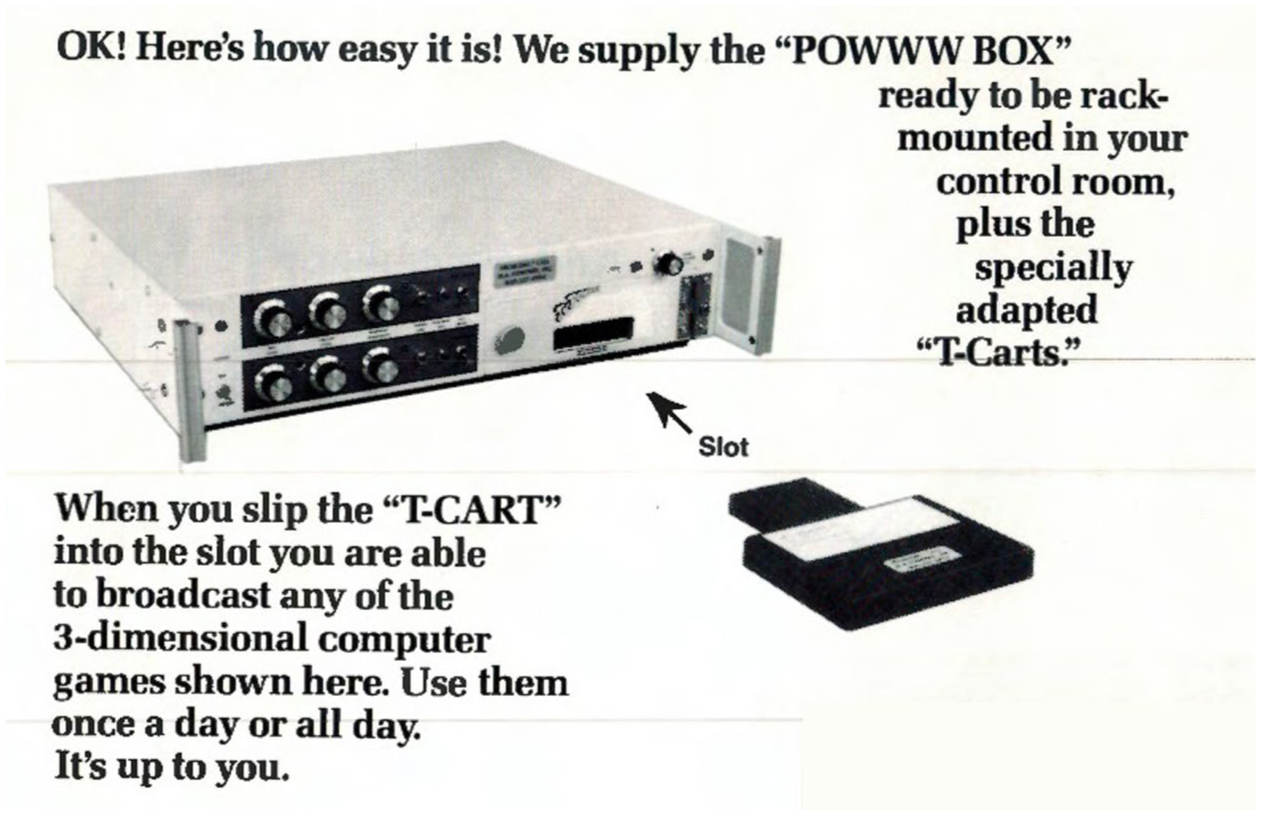
The POWWW BOX. 2
However, this technology also had to account for using a telephone within the broadcasting situation. Analog telephone systems provided both the “maintone” sound of the other caller and “sidetone,” the sound from one’s own voice sent to the speaker’s earpiece to stop people from talking too loudly. Some of this sidetone would leak down the line back to the other caller. This was typically not a problem for normal conversations. However, because the POWWW BOX was listening to the caller’s line, the returning sidetone signal could activate the game, compromising gameplay (decle 2020). TV POWWW! always involved a studio host conversing with a contestant while they played—drumming up excitement, reacting to game events, coaching the player—which could become detected sidetone signals. As Olney explained, “the complicated circuitry was designed to keep the announcer’s voice from triggering the video game” (Olney 2020, 4). In other words, the POWWW BOX managed interactivity by removing sidetone, allowing a videogame console to be operated via telephone in the chaotic environment of a live TV studio.
In his memoir, Kempner emphasized that TV POWWW! sales took off following the debut on A.M. Los Angeles, with it slated to appear in markets including Denver, Atlanta, and Phoenix (1998, 207). Kempner recalled great excitement when TV POWWW! started appearing in October 1978—describing telephone networks overloaded and shows using TV POWWW! reporting higher ratings (Kempner 1998, 210). Broadcasters began inserting the programming into youth-oriented programs including The Six Million Dollar Man on KBTV in Denver, Bozo the Clown on WGN in Chicago, and Barney’s Army on WPTF in Raleigh (Kempner 1998, 210; “TV POWWW! 2019). In October 1979, KTTV in Los Angeles made the original idea for a half-hour game show a reality (Kempner 1998, 217). SAY POWWW was produced by Willie Stein and ran for thirteen episodes. Sidney Cohen directed, recalling flying from his Montreal studio on Sunday mornings to do the “show live in L.A. on Sunday night and get on the first plane back to Montreal on Monday morning.” 3 At its peak between 79 and 100 stations in the United States subscribed to TV POWWW!, and it was also used by broadcasters in Australia, Brazil, Columbia, Italy, the Philippines, and the United Kingdom. 4
A Gimmick with Appeal
Before TV POWWW! went on air, Kempner demonstrated the idea at a meeting of broadcasters in Las Vegas. Because the POWWW BOX was still in development, Kempner recalled “I was going to have to fake the whole thing.... I started the game cartridge and told them to shout ‘POWWW’ into the telephone when they felt they could hit the target. When they said ‘POWWW’ I pushed the buttons” (Kempner 1998, 203). Despite the trickery, Kempner’s gimmick was a hit. Yet this anecdote begs the question: why was voice activation needed at all? Why not have a technician behind the curtain listen for “pow” and then push a button?
In fact, this occurred sometimes, though the POWWW BOX worked on most occasions. There are instances of TV POWWW! gameplay that could only be due to the POWWW BOX, for instance, multiple firings activated by laughing or elongated “pows” (decle 2020). Existing footage with the Channel F appears to show voice activation, Cohen recalled it working on SAY POWWW, and TV POWWW! station staff from the period remember its use (“Barney’s Army”). Engineers from various stations also remember voice activation, though one explained that the POWWW BOX would sometimes fail and an audio operator would assist by using the firing button. 5 Throughout TV POWWW!’s history there were occasional claims that hidden technicians pushed a button, for instance, at WPIX in New York (Green 2015; Smith 2014; WPIX 2022). 6
Regardless of the degree to which voice activation was faked, the more interesting question is why the technology was deemed crucial from the beginning. A Vice-President of a television station in Salt Lake City said that it was “just another gimmick, but it has appeal” (Silver 1980, 1F). A gimmick is a trick or gadget, perhaps dishonest, that is meant to attract attention—a good word to describe the POWWW BOX. TV POWWW! was a gimmicky way to build on the long history of mediated game shows in the United States, offering something new to the audience participation genre.
But this gimmick had appeal because it allowed viewers to control a videogame over the phone while watching television. Cohen put it frankly: “it was voice activated. That was the interesting part of the whole thing.” 7 During TV POWWW!’s heyday, another producer in California exclaimed “when they say POW and see it shooting on the screen—that’s exciting!” (Silver 1980, 1F). During TV POWWW!’s debut, when Purcell exclaimed “it works, it works! I don’t believe it!,” she was telegraphing the excitement of this technical marvel to the audience. In fact, Kempner related in his memoir how the debut was canceled fifteen minutes before the Monday show began because the equipment failed (Kempner 1998, 205). Engineers rushed to fix it. It failed again on Tuesday and Wednesday. Finally on Thursday it worked and the segment ran. These details explain Purcell’s excitement: the technical success was preceded by days of failure. It also reveals that a big part of TV POWWW! was the working gadget. A.M. Los Angeles would not fake it. The gimmick would lose its appeal.
Given the spectacular fallout in the 1950s from the revelation that television quiz shows like The $64,000 Question were rigged, faking it could have been risky for TV POWWW! and SAY POWWW in the 1970s. When asked about faking voice activation in the context of this history, Cohen explained “it’s stupid. You were going to get caught if you did something like that. You were thinking about showing the technology and legitimizing this is working. You can’t hide some things.” However, TV POWWW! never came close to reaching the cultural impact of quiz shows. Scholarship in the 1970s noted the “muted and transient” outrage in response to the quiz show scandals, mentioning pervasive public “skepticism” and “cynicism” concerning the media (Tedlow 1976, 492). If TV POWWW! sometimes faked technical interaction—especially later in its life cycle—any fallout was likely worth the risk.
Nevertheless, while Kempner highlighted the ability of the technology to broadcast videogames on television, a feat in itself, he promoted voice activation as the “amazing, fantastic, Star Wars-of-the-future-type-part!” (Kempner “Interactive”). The POWWW BOX and Olney’s circuits to remove sidetone indicate the lengths to which Kempner’s collaborators went to ensure the magical technology of the computer revolution was on display, not just the older telephone technology. Crucially, TV POWWW! was not just a gimmick with appeal: it promoted videogames, computerization, and new forms of digital, distanced interaction. This was TV POWWW!’s public appeal, to embrace the coming network society.
TV POWWW! as Interactive Television and New Media
Kempner’s promotional materials hyped TV POWWW! as “tomorrow’s version of the local, live, viewer-participation program!” (Kempner 1979). As an audience participation show, TV POWWW! was new but also familiar. For decades, radio and television shows had leveraged audience participation to build local audience share, bump ratings for established programs, collect information about audiences through mail-ins, advertise local businesses through prizes and promotions, and drive store traffic for sign-ups—all key components of the TV POWWW! format (Holmes 2008; Silver 1980, 1F). Despite its innovative videogame components, TV POWWW! aligned with cultural expectations of the game show in the 1970s and early 1980s. Typically, such shows (like The Price Is Right) abandoned the serious tone, primetime slot, and big prize money of the scandalized 1950s quiz shows. Instead, they shifted to “smaller monetary prizes, merchandise, and the centrality of audience participation” that emphasized “playful games” (Hoerschelmann 2006, 92, 96).
However, this was also the age of intelligent television. Innovations in electronics and computers were transforming television into a participatory medium (Boellstorff and Soderman 2024; Newman 2017). Videogames were part of this transformation. For example, in the late 1970s Mattel worked with General Instrument, the company that created Intellivision’s hardware, to produce PlayCable (Banfi 2024; Boellstorff and Soderman 2024). This technology allowed Intellivision owners to download games over a cable television network without using a cartridge. By 1983, similar competing systems appeared, including GameLine (for the Atari VCS) and The Games Network (which used its own settop computer). 8 As a one-way service, General Instrument envisioned PlayCable as preparing users for a networked future where they would engage in two-way services beyond entertainment, like banking and online shopping (Boellstorff and Soderman 2024; Dages 1980). Kempner also promoted TV POWWW! as “TWO-WAY TELEVISION” where “The viewer actually PLAYS. . . really PARTICIPATES,” foregrounding the pleasures of interacting at a distance (Kempner 1979). Like PlayCable, Kempner embraced a future of online computerized interactivity through the integration of telephone and television networks. For instance, he developed TELEPHONE POLL, an automated, digital polling application which could be incorporated into television news and talk shows to display call-in responses. Both PlayCable and TV POWWW! connected play to sociotechnical networks outside the home. While PlayCable took Intellivision “online,” streaming videogames into the home, TV POWWW! put Intellivision “on-air,” connecting home players to virtual spaces of play while pioneering forms of videogame spectatorship that now appear on platforms like YouTube and Twitch (Taylor 2018, 27).
TV POWWW! rode the wave of excitement around videogames and participatory experiences. Promotional materials announced it was “NOT just a call-in show.... Video games have swept the country. Now television viewers can join the fun” (Kempner 1979). Kempner created brochures with images of viewers pointing at or controlling their television, framing TV POWWW! as “interactive television” that represented “the wave of the future” (Figure 2; Kempner “Interactive”). By 1980 Kempner had full-page advertisements in industry publications like Broadcasting, and six sales staff visiting television stations around the United States (Kempner 1998, 240). Interested stations could buy a POWWW BOX, and Kempner’s company provided resources to help design their preferred TV POWWW! format—including scripts, electronic graphics, logos, and music. TV POWWW! was a flexible platform that could be adapted to the needs of each program.
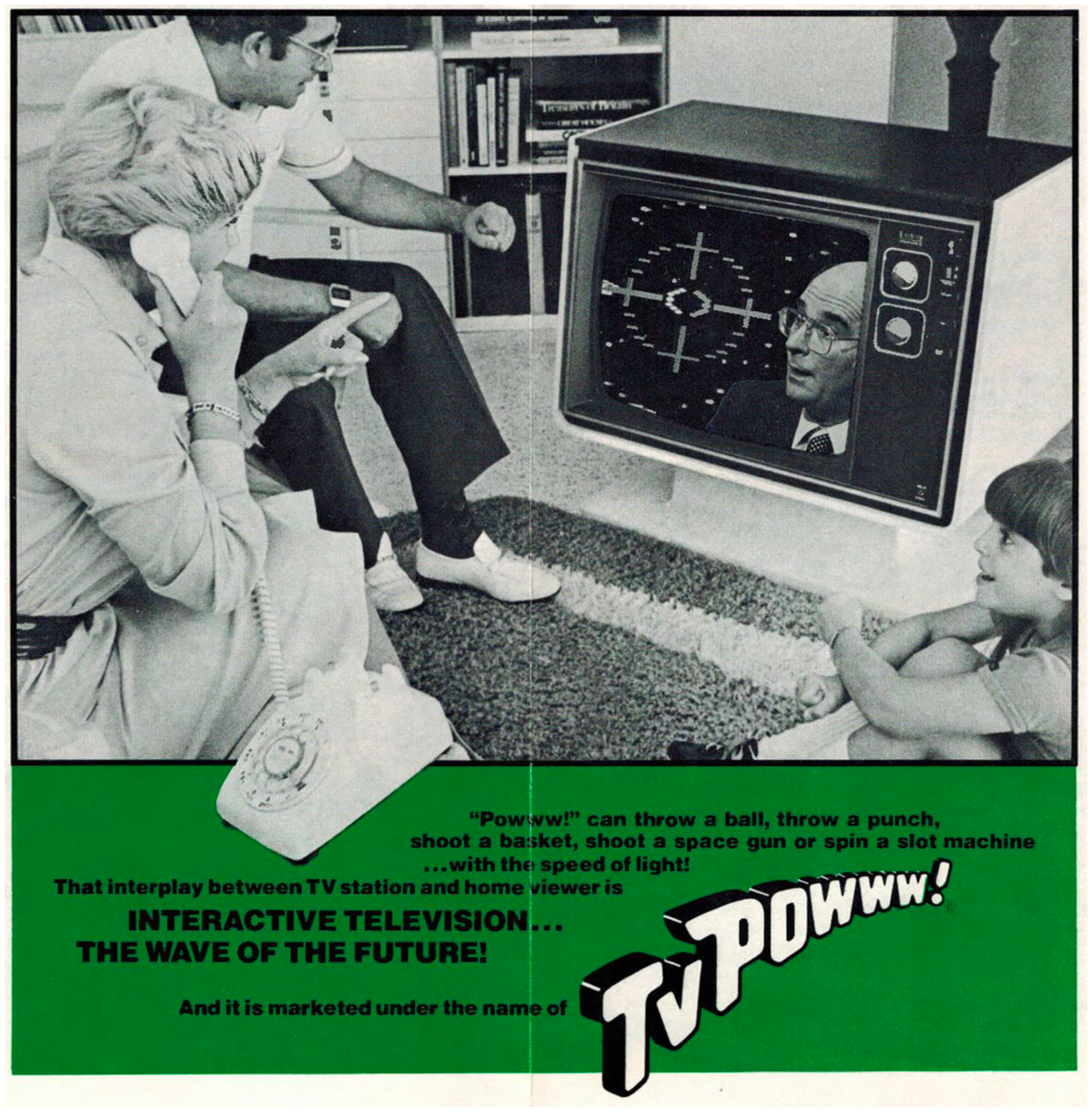
Image from TV POWWW! marketing brochure. 9
Stations were left to their own devices, but common practices emerged. Broadcasts involved a studio host greeting the telephone callers, asking general information about them and often showing prizes they could win. Hosts sometimes held a handset to emphasize the telephone’s role, even though the caller’s voice was broadcast. Gameplay usually took only fifteen to thirty seconds, and often appeared on a television next to the host, demonstrating the new media of videogames. In other cases gameplay would appear split screen, or even fill the screen with the host superimposed. The cut to fullscreen gameplay emphasized new media and progress from telephone and television to videogame—focusing viewer attention on remote, computerized interactivity.
Interaction with a studio host was critical, because the host not only commented on gameplay but linked the studio and home audience in a conversational space (Hilu 2015). The host’s encouragement, commentary, and “coaching” highlighted the interactive moments of gameplay and the caller’s distant manipulation of the game. For example, WKEF, a television station in Dayton, Ohio, ran two versions of TV POWWW! The first, Clubhouse POW, appeared as inserts in Clubhouse 22, a children’s afternoon show. 10 In one example, the host, Malcolm MacLeod, sat in front of a brightly painted wall with a television embedded in it, next to his sidekick “Duffy” in a dog costume. MacLeod picked up the phone to speak with a girl, only to find her brother “Jason” on the line. When Jason said he was twelve years old McLeod responded, “you’re eligible, you’re going to be playing for your sister.” Cutting to fullscreen gameplay, Jason got the required minimum score of 5 during thirty seconds of Shooting Gallery to win toys and movie tickets. MacLeod congratulated him, “I’m sure that your sister will be proud of you” while the camera panned to a studio audience of children. The second version, “Evening POW,” featured a host in suit and tie, in a living-room environment with the television in a wooden cabinet, a bowl of fruit underneath. The host, holding a Channel F controller, pitched an inning of Baseball against an adult man saying “pow” to swing the bat. In both contexts, the host created a space for play at a distance, linking home and studio, particularly in the second example where a live game is enjoyed between host and home player.
SAY POWWW’s thirty-minute game show format also foregrounded interactivity and connections between studio and home. The show featured Jack Clark, a well-known television game show host. Viewers called in from home, but SAY POWWW also included studio contestants accompanied by a “rooting section” of 8 to 9 family and friends. 11 To play, studio contestants would get up from their rooting section—with couches and lamps—and approach a yellow telephone on a pedestal in the center of the studio. Behind the telephone, a television showed gameplay, ensconced in a wood-paneled cabinet that included bookshelves. Thus, SAY POWWW invoked the warmth of a living room and the context of domestic social play. Moving from the couch to the play area foregrounded interactivity and participation instead of passive spectatorship. This setup emphasized connections between studio, home player, and home viewers, suturing them together into a technical network maintained by telephone, television, and videogame.
SAY POWWW would begin with a home contestant playing on their own for a prize, followed by three studio contestants. Clark would then invite another home viewer to play, with the goal of beating the top studio contestant’s score. When directing each episode, Sidney Cohen would cut to different views of Clark, the audience, and the inserted gameplay. Since digital and profilmic images could be placed side by side, Cohen could mix images of gameplay with shots of the playing contestant, their rivals, or audience members in order to augment the emotional impact and suspense of play next to the rudimentary and rather unexciting graphics of the games. Such shots prefigure the common practice of using inserts of a streamer during contemporary forms of game streaming to augment excitement and create mediated, “performative play” (Taylor 2018, 86). Cohen recalled “it made for interesting staging and direction. We had to come up with a different way of doing things.... It sure was a learning curve, and it was very exciting because it was live.” 12
Live images of the telephone, television, and split-screen gaming dynamics created an intense suturing of contexts, forging a virtually connected public and a visual representation of the coming network society. Inserting shots of contestants next to enlarged game footage—often suggesting that they were gazing at the screen next to them—worked metaphorically to decrease the distance between player, game, and home audiences. Like PlayCable, both TV POWWW! and SAY POWWW thereby acclimated audiences to computerized interactivity at a distance. These programs were thus different from a show like Starcade (1982–1984) where contestants were quizzed about games and competed playing arcade games (Taylor 2012, 4–5; Voorhees 2015, 80). While Starcade and TV POWWW! were early examples of televised gameplay, the former was not interactive television and did not exhibit a similar relationship to networked play. TV POWWW! was not only educating players and viewers about the new medium of videogames, nor offering simply “an antidote to television” and its passivity (Newman 2017, 51). It was preparing them for a future of networked interaction.
The Gendering of TV POWWW!
The flexibility of TV POWWW!, and its conjoining of television and videogames, suggests an intriguing relationship between television audiences and videogame demographics. While videogame play was being codified as a male domain, game shows in the 1960s and 1970s were shifting toward the female consumer (Hoerschelmann 2006, 97). Kempner’s promotional materials even emphasized that “TV POWWW! adapts for housewives, children, sports fans, insomniacs... any time slot you choose,” linking potential players to more diverse television audiences, including “housewives” (Kempner “Introducing TV POWWW!”).
An estimated “20 percent of the competitors on the video gaming game show Starcade were girls and women” (Kocurek 2015, 19), but TV POWWW!’s distribution as an insert makes it harder to know the precise composition of participants. Existing footage suggests many female players. For example, in both existing SAY POWWW episodes studio contestants included two women and one man (but for phone-in contestants, men outnumbered women five to one). In other cases, such as the examples from WKEF above, males were the key players, including a situation where a twelve-year-old boy assumed the role of player instead of his sister.
Indeed, gendered play and discourse subtended the A.M. Los Angeles debut of TV POWWW! Three of the four home contestants were women, and the prize was a salon makeover. Regis Philbin immediately assumed the role of coach and critic, lambasting the first woman player (who missed every target): “Lady, you are absolutely terrible at this!” He continued to criticize the other women players. The final contestant, a woman, ended up hitting a target and Philbin remarked “that was the only one a woman got.” He glanced nervously at co-host Sarah Purcell and added “don’t get crazy; just saying that it might be a little difficult for women to play this game.” Purcell replied sternly, “they don’t hang out in bars like men do.” Purcell and Philbin then informed the male contestant that he had won the makeover, which he said he would give to his wife.
Videogames were seen as boys’ toys by the late 1970s, and arcades were becoming male-dominated spaces (Boellstorff and Soderman 2024). Purcell’s witty retort implied that women were excluded from, or avoided, places where they might improve their digital play, since bars were a location for arcade coin-op play at the time, and for predatory male “players” as well. Purcell’s comment criticized the gendered access to gaming leisure while also implying that morning television might be a safer place for women’s engagement with new technologies of play—that is, if toxic commentary like Philbin’s was curtailed. Hence, her playful but forceful admonishment of Philbin’s mansplaining and sexism. Philbin’s derogatory comments reveal that while television might allow diverse players to participate, the publicity of this play could put them at risk. 13 It is sadly foretelling that one of the first broadcasts of gameplay was also one of the first examples of gendered harassment of broadcast play, reflecting an emerging masculine videogame industry “that was exclusionary of the women who were there and made for an uncomfortable working atmosphere” (McDivitt 2020, 68). Nevertheless, it was not necessarily so. For example, in a clip from Bob Zappe’s Cleveland morning show ZAP!, four contestants competed in Channel F’s Bowling. Three were women. One woman contestant, Lori, won with two strikes in a row, causing Bob to exclaim “Holy Cow!” followed by raucous audience applause.
The social contexts and spaces of play have always been gendered, with videogame consoles and computers coded masculine (Bryce and Rutter 2003; Prescott and Bogg 2014, 86). TV POWWW! represented a space on the margins of videogame culture where overlooked forms of interactive play could welcome different audiences, contestants, and contestations. As Kocurek has noted, understanding the history of women and videogames requires re-centering these margins, so as to “understand the complex systems and diffuse networks of labor that go into the production of games, the sprawling communities that form gaming culture, and the subcultures and pockets of resistance that work to reform it” (Kocurek 2017, 55). TV POWWW!’s connection to game shows and daytime talk shows linked it to potential space for gendered subversion and resistance, where women could “give public, noisy acclaim to skills that are ordinarily silenced”—like Lori’s two strikes and exciting victory (Fiske 1990, 136). While further research is needed, and while far from utopian, these televised and telephoned spaces of play offer a different, expanded history and context of play that potentially contests the hegemonically masculine (Fron et al. 2007; Nooney 2020).
Transforming Games for TV POWWW!
TV POWWW! did not only transform traditional contexts of videogame play. It transformed game design and development as well. Like its expansion of play to diverse audiences, TV POWWW!’s design practices expanded play experience away from the complexity and absorption codified by the arcades and home consoles and toward gameplay experiences that were more accessible and casual. These practices required new forms of game development aligned with voracious television production. Today, videogame companies are undergoing servitization, shifting focus from new products to service provision (Banfi 2024; Dubois and Weststar 2021). Platforms like Playdate or live service games like Fortnite or Destiny 2 release new content in “seasons,” embracing a delivery format typical to television, while programmers labor to modify older games, create sequels, or update persistent games instead of developing new titles. TV POWWW! was an early instance of servitization emerging through an encounter with television’s distinct temporalities, creating production tensions but also opportunities for designing unique products.
Kempner charged television stations $2,500 for the POWWW BOX, and another $2,500 for a subscription that included games redesigned for TV POWWW! (Kempner 1998, 207). Reworking Channel F games was not a significant challenge, due to the system’s arcade-like game designs and simple controllers. In January 1979, Kempner was forced to pivot to the Intellivision system after Fairchild sold Channel F to another company. However, reworking Intellivision games for TV POWWW! was more complicated. Most Intellivision games involved detailed strategy and turn taking; some could take more than an hour to complete. Intellivision’s hand controllers had two action buttons on each side, a directional wheel offering sixteen movement directions, and a twelve-button keypad, complexity that saying “pow” could never capture. Kempner’s contract with Mattel Electronics obligated them to “simplify and re-program game cartridges” (Kempner 1998, 213).
Around a dozen Intellivision games were reworked for TV POWWW!, although only four are known to have been used: Football, Soccer, Space Battle, and Slots. 14 For example, the original Space Battle was a complicated game featuring a “fields of play” design alternating between a “strategic” field where players deployed fleets, and a “battle” field where players moved a cursor to shoot enemy ships with unpredictable flight paths (Boellstorff and Soderman 2024, 76–79). The TV POWWW! version dispensed with the strategy field, and simplified the battle field by centering and fixing the cursor, so the only command was “pow” to fire. This meant simplifying enemy ship flight paths so as to regularly cross the screen’s center. These modifications enabled the addition of a new feature. Space Battle was a one-player game, but the TV POWWW! version included a two-player mode with two cursors onscreen, thus signifying an early form of competitive, “online” play mediated by television.
While sophistication was the guiding design principle for many Intellivision console games, simplification was the guiding principle of the redesign process for TV POWWW!, thus creating “afterlives” where “[g]ames may occupy or perform various palimpsestic roles across their life history” (Guins 2014, 13). This radical process was, perhaps, an early form of “demaking”—when a contemporary game is redesigned for an older console or aesthetic, or simplified for mobile like Square Enix’s GO series (Thomasson 2023). For example, programmer David Stifel was tasked with reworking a TV POWWW! version of Soccer. Design documents noted that the modification “looks very good” but “it is a little too elaborate for a POW game” (Hawley 1982). Stifel recalled being told “we got this POWWW game that’s too hard for the contestants to make a goal. It’s really boring because nobody ever scores.” Stifel tweaked the Soccer version so it was easier to score. 15
Even Kempner and his staff would suggest games to simplify and what their redesign might entail. For instance, one memo identified the Intellivision games Horse Racing, Frog Bog, Astrosmash and Space Hawk as promising candidates (Nagel 1983). They recommended simplifying the scoring for Astrosmash, and for Horse Racing, “we need only the race itself and a few embellishments” (Nagel 1983). Often their suggestions referenced interaction: for Frog Bog, “the telephone player’s ‘Pow!’ should cause the Frog to jump at an insect,” while for Space Hawk, “the only control executed between the telephone player is the firing of the Hunter’s Ray Gun by saying ‘Pow!’” (Nagel 1983). Programmers would respond to these suggestions with regard to feasibility and timeline. For example, a month after these suggestions, programmer Mike Winans provided a “description of the modifications to Astrosmash for Powww that can be made and delivered by the required date” (Winans 1983; see Figure 3).
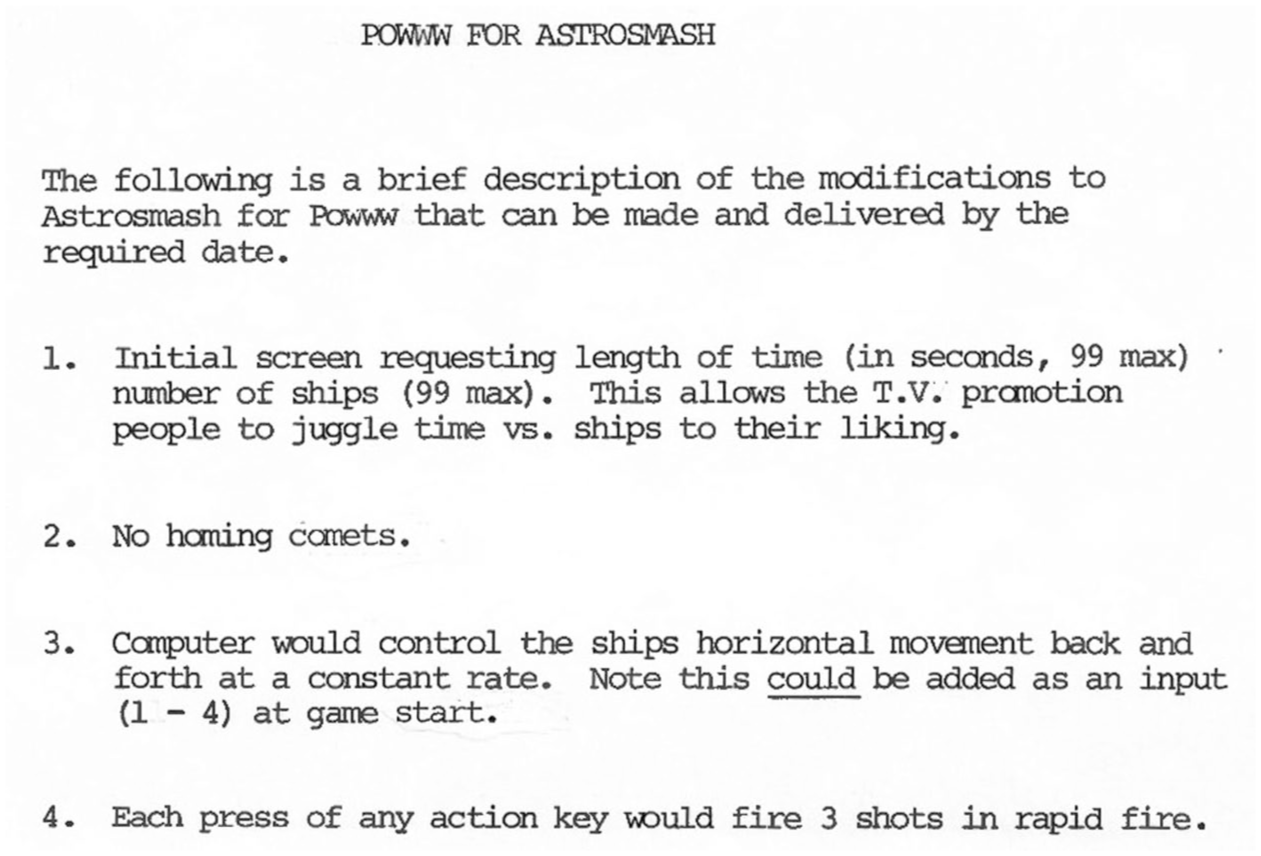
Excerpt from Winans (1983).
Indeed, the temporality of production was crucial to TV POWWW! Second-generation videogame systems promised an endless variety of new games. Theoretically, such variety would be perfect for TV POWWW! Given its endless temporality and flow, television worships variety. Kempner understood this, noting that “television eats up materials quickly. In order to get renewals, we would certainly have to have new games made available to us” (Kempner 1998, 211). His promotional materials often featured games not yet available. Mattel’s role was to provide this content, but this became Kempner’s primary dissatisfaction. New content was not being delivered fast enough.
This friction is observable in communications between Mattel Electronics and APh Technological Consulting, a Pasadena-based firm hired to help develop Intellivision and its games. For example, in February 1983 Mattel Electronics’ Director of Product Development, Harry Farrell, sent a letter to APh noting a delay in obtaining games and a desire to receive them “as quickly as possible. We understand that APh is busy, but because of contractual obligations, we need to supply these. . . to Marv Kempner no later than the middle of March” (Farrell 1983). At Mattel Electronics, programmers working on TV POWWW! versions of Astrosmash and Space Hawk asked for “feedback” on March 15, emphasizing that “we would like it quickly, since we will be shipping them out very soon” (Ettinger 1983). In May a manager complained to Farrell that it “would be of help to us in prompt completion of the POWWW games if your staff could issue a Product Data Sheet for Baseball, Bowling, Skiing and Star Strike” (Daglow 1983).
Tensions arose because Kempner wanted a game service for voracious television audiences. Simplifying games for TV POWWW! meant that Mattel Electronics was not only in the business of inventing new Intellivision videogames but continuously laboring to modify existing ones. However, APh and Mattel Electronics largely saw videogames as new products to be sold in stores, relegating the TV POWWW! service to a secondary position and annoying Kempner (1998, 216). Servitization “is not simply a matter of doing things differently; it is also about seeing oneself and one’s role differently” (Dubois and Weststar 2021, 2,347). Mattel Electronics was figuring out its role as a new videogame developer, and its identity as a service provider was marginal—hindering their work on TV POWWW! and other services like PlayCable.
Yet, the encounter with television and this new service paradigm spurred innovative ideas concerning game design and new forms of play, including using the TV POWWW! service to buttress product development. APh convinced Mattel Electronics to repurpose TV POWWW! content for an Intellivision game cartridge—Sharp Shot, a collection of simple games for children or anyone. Sharp Shot included TV POWWW! versions of Football and Space Battle, adding new simplifications of Sea Battle and Advanced Dungeons & Dragons (Robinson 2023). APh staff saw these games as both “a demonstration of some other Kempner POW style games that could be easily and quickly done” and also a stand-alone cartridge (Edison 1982). Perhaps it is not surprising that APh—already providing a service of delivering games to Mattel Electronics—would innovate in this area.
Sharp Shot was not TV POWWW!, but it was an extension of the idea to create new forms of gameplay, imagined for “anyone who can push an action key” (“Sharp Shot” 1982). It was an experiment in creating simpler, accessible games, suggesting new opportunities for casual play, recalling how TV POWWW! expanded gameplay into different social contexts. While the videogame industry would largely remain focused on difficulty, mastery, and challenge, experiments like TV POWWW! and Sharp Shot reveal possibilities to expand beyond hegemonic forms of gaming (often gendered) to diversify play experiences. Later manifestations of videogame design including pink games, casual games, party games, and mobile gaming would expand similar ideas, percolating in the margins of mainstream gaming (Boellstorff and Soderman 2024). TV POWWW!’s imbrication in this history reminds us to attend to these margins of play.
Deaths and Afterlives of TV POWWW!
TV POWWW! was not to last. In 1982, Barney’s Army out of North Carolina ran a two-minute segment where a game of Space Battle self-destructed, causing the cartoon studio to collapse and the announcer to conjecture, “I think the POW game is gone forever” (“TV POWWW!” 2019). By 1983 subscriptions for TV POWWW! had stalled and stations were canceling their contracts; Kempner later contacted Nintendo and Sega to see if they would develop TV POWWW! for their third-generation systems, “but they showed no interest” (Kempner 1998, 217). By 1984 TV POWWW! was largely defunct in the United States. However, footage exists of TV POWWW! from Brazil as late as 1986, and Kempner claimed that TV POWWW! continued in Italy and Australia until 1990 (Erickson 2002).
While largely forgotten, TV POWWW! linked digital games with the legacy platforms of telephones and television to imagine the future. It was a key experiment that revealed television’s substantial influence on new media, shaping new communities and preparing the public for online, digitally mediated forms of interactivity. Its experimental nature provided glimpses of new forms of spectatorship, play, game design, and economic production. TV POWWW! extended home videogames into a televised public sphere, developing techniques to surround and imbue digital gameplay with excitement and competitive tension—methods that esports would later elaborate into a massive business model. Its odd format, brief spurts of play controlled by one action, led to new ideas about game design concerning simplification, accessibility, and expanding play to new players and social contexts. Meanwhile, TV POWWW!’s imbrication with television created tensions between television’s ongoing live persistence and creating a stream of product for its audiences.
When TV POWWW!’s demonstration first aired and Sarah Purcell exclaimed “It works! It works! I can’t believe it!” some viewers might have heard an allusion to Mary Shelly’s Frankenstein, “It’s Alive! It’s Alive!” Indeed, TV POWWW! was a mashup of technologies, mediums, businesses, and forms of social entertainment that sparked into a brief existence. Yet, this motley form, this gimmick, had appeal—likely because it sketched future forms of interactive pleasures and entertainment that needed more time to mature.
Footnotes
Acknowledgements
We thank all of the Intellivision programmers and others we interviewed. We thank as well “decle,” Kevin Bunch, and the three anonymous reviewers whose comments were enormously helpful in our revisions.
Declaration of Conflicting Interests
The authors declared no potential conflicts of interest with respect to the research, authorship, and/or publication of this article.
Funding
The authors received no financial support for the research, authorship, and/or publication of this article.
