



Abstract
This article analyzes “The Politics Episode” of One Day at a Time, an animated very special episode produced and aired during the onset of the COVID-19 pandemic. I focus on two aspects that prompt broader considerations about the role of scripted television in responding to pressing social issues. First, I demonstrate how the episode’s narrative structure appeals to democratic deliberation as an idealized form of conflict resolution. Second, I consider how its production and airing timeline responded to—and failed to account for—the current events its narrative attempted to incorporate. Although the disjuncture between these two elements demonstrate the pitfalls for fictional television to address social issues in a time of constant crisis, I conclude by proposing that these “failures” can also serve to illustrate a specific “post-pandemic” structure-of-feeling, one where futures are perpetually deferred and where dealing with new social realities requires constant speculative iterations.
Keywords
“This is it / This is life / The one you get / So go and have a ball,” sings Gloria Estefan in her rerecording of the theme song for the multicam sitcom One Day at a Time (ODAAT), a 2010s reboot of the 1970s Norman Lear series of the same name. For four seasons, this sense of making the most of one’s circumstances suffused the stories and life lessons of the Cuban-American Alvarez family living in the Los Angeles neighborhood of Echo Park, including Penelope (Justina Machado), a single mother and U.S. Army veteran dealing with PTSD, her two kids Elena (Isabella Gomez) and Alex (Marcel Ruiz), and her outspoken mother Lydia (Rita Moreno). The series ran for three seasons on Netflix (from 2017 to 2019), before being canceled by the streaming service, and found a home for a shortened (and final) fourth season on the basic cable channel Pop TV during 2020. The series distinguished itself for tackling social issues such as immigration policies, teen sexuality, and mental health in a direct and heartfelt manner.
The ODAAT episode discussed in this essay aired on June 16, 2020, on Pop TV. In a departure from its usual format, this episode was entirely animated, co-produced by Canadian animator Smiley Guy Studios. 1 Like all other television shows at the time, One Day At A Time shut down production on its fourth season back in March 2020 because of the global onset of the COVID-19 pandemic. At the time, ODAAT had only completed six episodes of the season, so the creative team decided to turn one of its scripted yet still unfilmed episodes into an animated special simply titled “The Politics Episode.” The plot of the episode concerns the visit of the Alvarez’s cousins from Miami: Lydia’s sister Mirtha (Gloria Estefan), Mirtha’s daughter Estrella (Melissa Fumero), and Estrella’s husband and son. Because the Miami cousins are radically conservative, Penelope tries to figure out how to avoid fighting with them about their differing political views, which were bound to arise during their stay. Throughout the episode, the Alvarez family plays out different possible scenarios in their imagination (through cutaway scenes) and the episode ends with the arrival of the cousins (Figure 1).
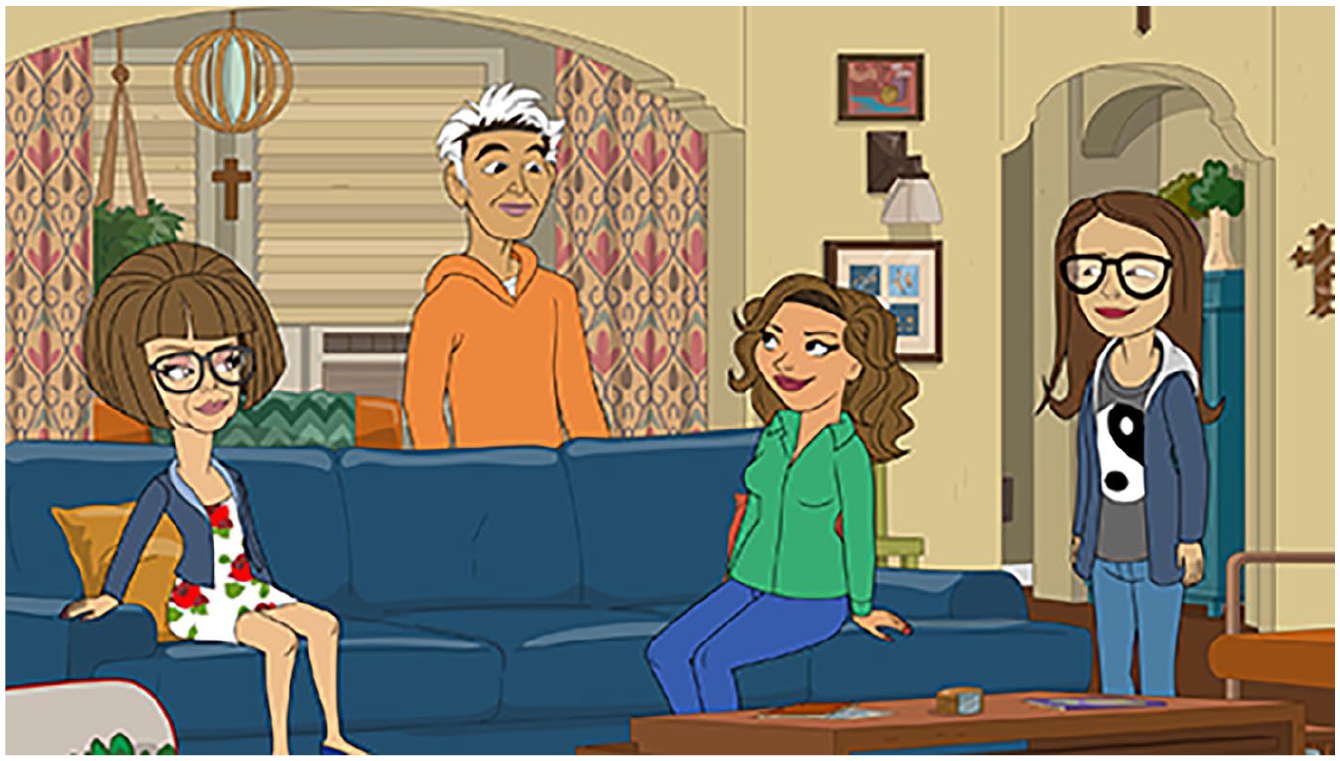
The animated versions of the Alvarez family (from left to right: Lydia, Alex, Penelope, Elena) sit around the living room imagining possible scenarios of how to deal with their cousins’ visit.
“The Politics Episode” is a prime example of what is colloquially known as the “very special episode” (VSE). In the history of U.S. broadcast television, the very special episode has become associated with a kind of corny, albeit well-meaning, television programming (found usually in family- and teen-oriented sitcoms) that addresses topical and challenging social issues in overly simplistic ways. TV series would introduce the topical issue as a self-contained episode narrative, usually by way of secondary or guest characters, in order to confront the show’s protagonists with the main aspects of that issue. The self-contained narrative allowed shows to reach some sense of closure at the end of the episode and offer insights or takeaways for their audience. As Jennifer Porst and Jonathan Cohn argue in their collection on this unique episodic form, VSEs have long carried dismissive and pejorative connotations. Such simplistic characterization ignores the complexity and cultural specificity of VSEs, their value within the political economy of television, and—crucially—the fact that often what made these episodes “special” was their ability to consider racism, classism, sexism, and other social ills in ways that television ordinarily did not. Porst and Cohn helpfully redefine the VSE as characterized by the following three features: One, in the VSE there is a noticeable rupture in the series’ text, whether visually, thematically, narratively, or socially. The VSE is a series’ attempt to do something that stands out and rises above the flow of its “normal” diegetic world. Two, VSEs are often educational, since the episode’s narrative is constructed around offering a lesson that responds to major social traumas and provides a road map for how to think about and deal with a particular social and cultural issue. Three, VSEs raise questions and provoke discussion, in the process enabling non-normative and more engaged modes of spectatorship, and encouraging audiences to view the episodes with family, friends, and sometimes even in classroom settings (Porst and Cohn 2021, 6–7). The pedagogical bent of VSEs explains why they are commonly found in multicam family sitcoms, where they hope to model for parents how to structure discussions about sensitive or controversial social issues.
For those familiar with ODAAT, the series’ regular approach to storytelling probably makes every episode a worthy candidate for the honorific of VSE. As Betancourt (2019) notes in his review of ODAAT’s third season episode “Nip It in the Bud” (in which Penelope witnessed Alex smoking marijuana at a concert), the show was regularly “crammed with heart-to-heart discussions” that evoked the tradition of VSEs and the series’ writers themselves often attempted to work within and around the genre. While ODAAT joined other family sitcoms like Black-ish and Fresh Off the Boat as part of a wave of “diverse” programming in the late 2010s, the show stood out given its legacy as a reboot of a Norman Lear series and its status as a multicam sitcom distributed through Netflix’s binge model of releasing an entire season’s episodes at once. The persistence of the series, briefly surviving Netflix’s infamous two-season cancellation practice (Lee 2020) and then finding a second life on Pop TV, was rather exceptional for a multicam reboot in the streaming economy. ODAAT’s enduring popularity owed much to its presentation as a politically progressive and ethnically specific show, a stylization achieved by including discussions about pressing social issues in almost every other episode. If one were to consider only the narratives of the series, then ODAAT should qualify as a very special series and the framework of the VSE would have little explanatory purchase.
Yet, in this essay I follow Porst and Cohn’s theorization to posit the VSE not only as a break in the diegesis of a series or as an episode with a distinct “social issue” but also as an extra-textually presented mode of exception meant to address pressing social events in such a way that furthers the series’ cultural standing. In other words, the specialness of the VSE lies not only in the diegetic treatment of a social issue but also in the extra-diegetic discussions around the show’s decision to address such an issue. During the first year of the pandemic, as Porst and Cohn (2021) point out, “VSEs recognized the uniqueness of this global moment and worked to return a sense of normality, audiences, and all-important ad buys that typically come with the television schedule and the shared communal experiences and catharsis that it can generate” (p. 4). During this time of social isolation and economic and industrial disruption, the VSE ironically became a symbol of normality. The reunion specials of previously concluded series, such as 30 Rock or Parks & Recreation, and the at-home specials of running series like SNL meant to restore rather than disrupt a sense of familiarity by returning beloved characters and actors to the television screen.
ODAAT’s “Politics Episode” was “very special” during these first months of the pandemic in a different sense. It was scripted before the pandemic, with the intention of addressing the impending 2020 U.S. presidential election and the polarizing issues that permeated that campaign season. In a manner typical of the series, the discussion of these electoral politics within the narrative plays out in a fully didactic manner, unabashedly expresses its main protagonists’ center-liberal leanings, and refuses to name the 45th U.S. president by name. Despite the universalizing gesture of its title, the politics of ODAAT’s “The Politics Episode” are very narrowly defined as 2020 U.S. electoral politics, a feature that gave the episode its urgency and prompted the creators to find a way to move forward with it despite the general shutdown in television production.
In what follows, I focus on two key aspects of this particular episode that, I argue, prompt us to ask broader questions about the role of scripted television in responding to pressing social issues at the current conjuncture. First, I analyze how the narrative structure of the episode iterates a series of confrontation scenarios as a way to appeal to democratic deliberation as an idealized form of conflict resolution. Second, I consider how the episode’s production and airing timeline responded to—and failed to account for—the current events its narrative attempted to incorporate. The disjuncture between these two elements, the diegetic and the extra-diegetic, demonstrate the pitfalls for fictional television to explicitly address social issues in a time of rapid response and organizing around contentious topics. At the same time, I propose that what initially seemed like a failure of ODAAT’s “The Politics Episode” can also serve to illustrate a specific “post-pandemic” structure-of-feeling, one where futures are perpetually deferred, where adhering to old norms and ideals hinders more than enables conflict resolution, and where dealing with new social realities requires constant speculative iterations.
“People believe what they want to believe”: Speculative Recursive Narratives and Idealized Political Deliberation
At the outset, two features of “The Politics Episode” shape audience expectations about what to make of this episode. First is the title. ODAAT episodes often had one- to three-word titles, including several using the definite article “The” to signal a significant event in the story (e.g., “The Turn,” “The Man,” “The Funeral”). As opposed to shorter options like “Politics” or “Family Politics,” titling this VSE as the politics episode suggests a more definitive take on the subject. The redundant inclusion of the word “episode” in the title also signals that politics is not only about the events of the story but also about the topical purchase of the episode itself. 2 The second notable feature about this episode is its use of animation. While other television comedies have used animation in the past, the most immediate point of reference nowadays for this creative decision would be the irreverent primetime animated sitcoms in the late twentieth and twenty-first centuries that use sarcasm and irony as their dominant comedic style: The Simpsons (Fox, 1989-present), South Park (Comedy Central, 1997-present), Family Guy (Fox, 1999-present), American Dad (Fox/TBS, 2005–present), to name a few. As Tueth (2003) explains (p. 135), domestic sitcoms that took up animation distinguished themselves by offering a “subversive view” that combined the normative with the deviant aspects of family life. The contrast between these two features—the announced self-importance of the title and the implied irreverence of the animation style—already signal the frictions and conflicting affective reactions inherent in the episode.
The majority of “The Politics Episode” takes place in the minds of the Alvarez family members. The protagonists sit around their living room imagining how their interactions with the cousins might play out, and the episode shows us these scenarios in cutaway scenes. For most of the first act, Lydia works through her animosity to her sister Mirtha by imagining how to torture her during the visit, whether that is forcing Mirtha to sleep on the floor or beating her at a singing competition hosted by Gloria Estefan (an even more absurd scenario since Estefan plays competitor and judge and rules against her character). The second act features Penelope’s attempts to visualize how to counter any reactionary comments and conspiracy theory falsehoods her cousin Estrella might bring up during the visit. A recurrent gag throughout the episode has Alex interject with an example of how, every time he pretends to agree with Tio Juan, his uncle gives him money. The final act consists of Penelope trying to appeal to her cousin’s sense of family responsibility in order to find common ground. The episode ends with the cousins standing outside the door with Estrella reminding her own nuclear family that, despite the political differences, the important thing is that they are there to visit family, implying that the cousins themselves may have had their own version of speculatively working out how to (re)act once they arrived at the Alvarez’s home (Figure 2).
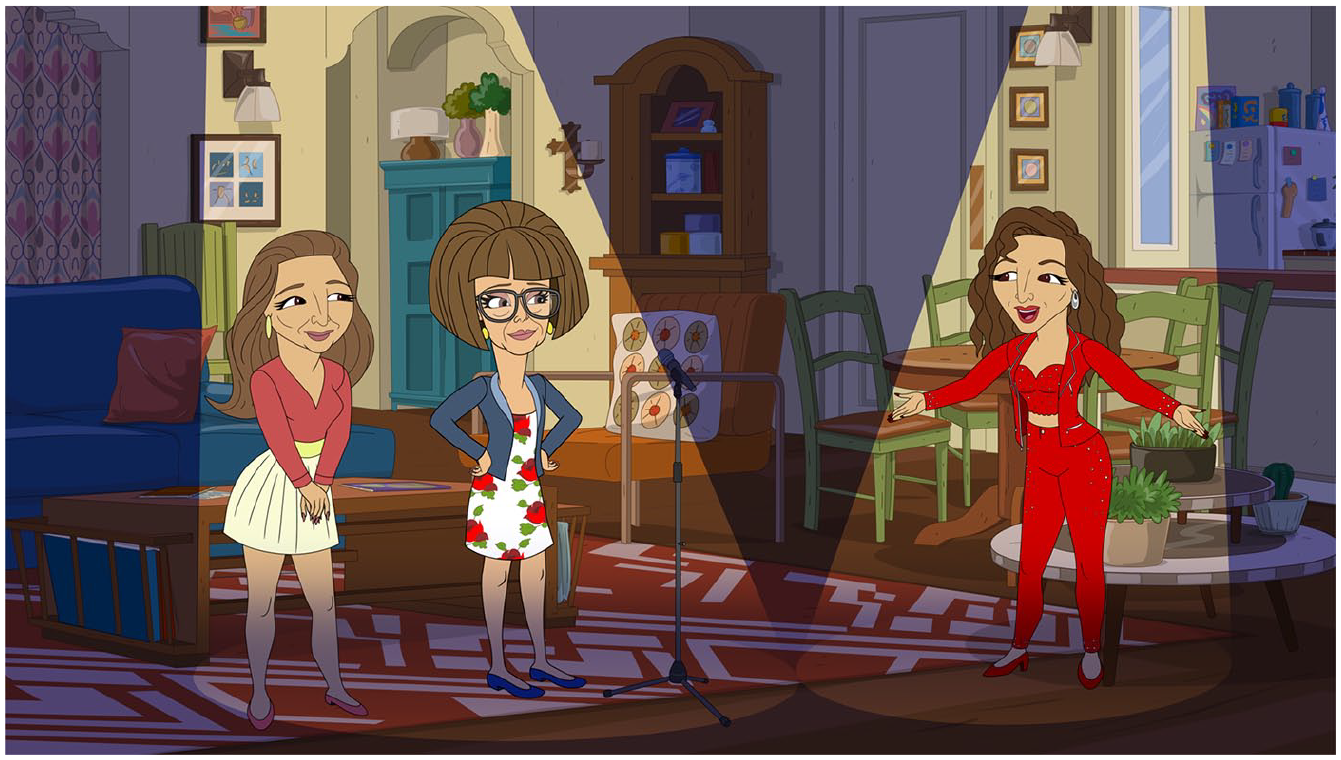
Lydia beats Mirtha in a singing competition judged by the real-life Gloria Estefan. Both characters look eerily similar because Estefan also voices Mirtha, but the animated version of the musician has a more angular face.
In its three-act structure, the sitcom episode lays out several scenarios of what political disagreement can look like, from an idealized fact-based discussion to physical altercation, and imagines these scenarios first as surreal comedic gags and later as heartfelt sincere conversations. In a scene from the second act, Penelope imagines persuading Estrella away from the most radical right-wing beliefs by presenting her with facts: Hillary Clinton won the popular vote in the 2016 presidential election; the polar ice caps are melting and sea levels are subsequently rising; and that even Trump admitted that his predecessor Barack Obama was born in the United States. In each of these scenarios, Estrella responds with the right-wing conspiracy theories commonly found on platforms such as QAnon and Fox News: Clinton has been secretly running a pedophile ring out of a DC pizza parlor; climate change cannot be real if there is first a drought and then too much water; a devious wink to suggest she still believes Obama is not a U.S.-born citizen. The series of imagined scenarios concludes with Elena explaining to Penelope that “facts don’t matter anymore” and “people believe what they want to believe.” Confronted with such a frustrating impasse, in the next imagined scenario Penelope, Estrella, Lydia, and Mirtha engage in a bloody MMA-style physical fight. The next scene presents a fake out as if the cousins have arrived but when Penelope opens the door and says, “Let me take a good look at you!” laser beams come out of her eyes and pulverize the extended family members, revealing this arrival to also be a hypothetical scenario in Penelope’s mind. The ridiculousness of these animated tiffs provide such effective comedic sight gags—at one point we literally see Estrella with her head up her ass—that, as one reviewer noted, it is difficult to imagine that the episode was ever written to be recorded live (Keller 2020). At the same time, the extreme irreverence of these earlier scenarios instructs us to contrast them as the opposite of the democratic deliberation championed in the episode’s last act.
VSEs work best when they use the existing connection between the viewer and the main characters to show the audience how to confront and make sense of topical (and potentially taboo) social issues. For sitcom VSEs in particular, such engagement may come off as artificial given the affective dissonance between eliciting laughter through cheesy jokes and laugh tracks and building empathy through serious conversations. Usually, the “special issue” in VSEs is directly faced by a secondary character so that the series’ main characters can engage in the didactic lesson without disrupting the overall continuity and episodic nature of the television series in the following weeks. Such is the case in ODAAT’s first season episode “Strays,” which famously addressed the issues of ICE raids against and deportation of migrants by focusing on the (never seen) undocumented parents of Elena’s friend. Indeed, around the same time several other TV shows, such as Jane the Virgin, The Fosters, Superstore, and Unbreakable Kimmy Schmidt, variously adopted the VSE format to bring attention to the stories of undocumented migrants and the abuses of ICE in single- or multi-episode arcs (Lee 2018). In “Strays,” ODAAT was able to address the topic and present the main characters’ support for immigration reform and still avoid delving into the logistical problems of deportation by the next episode once these secondary characters have disappeared.
The iterative structure of “The Politics Episode” shifts and amplifies this feature of didacticism without disruption. Rather than having another set of characters face the right-wing relatives, the episode has the main characters do so themselves, albeit in a speculative fashion. Each scenario repeats a possible future or an alternative timeline for our protagonists themselves, the consequences of which they imagine before deciding on a course of action to “solve” the episode’s problem and return the sitcom form to stability and family harmony. The disruption from confronting their relatives remains as pure potential and the episode diffuses this potential by ending without showing the actual encounter.
In an allegorical sense, this iterative narrative structure also invokes the ideal of democratic deliberation: in many of the Alvarez’s possible imaginings, all parties are equally valued and listened to and, with enough time and goodwill, a solution is found. In the final imagined scenario during the third act, Penelope and Estrella reach a sort of shared understanding when Penelope admits that “we have to stand up for one another” in the event of a global catastrophe where the current government leadership would not protect its citizens. This scenario succeeds where all others have failed because it departs from the premise that the two sides of the political debate have a common set of shared concerns: the sense of duty to protect their loved ones, which for Estrella means only her own family while for Penelope (a proud Army veteran) means the national polity at large. The characters’ disagreements are attributed to a different approach to the same set of concerns, precluding any consideration of an instance where each faction’s divergent interests are in conflict with, and dependent on the failure of, the concerns of the other. In this sense, ODAAT celebrates rational deliberation as the best strategy to achieve the kinds of truces that enable society (and extended families) to function. This idealized version of democratic deliberation supports a long-standing tradition, extending from the pre-cable network days to the contemporary era of niche programming, that sees U.S. television as a space to sort out collective concerns (Hendershot 2013).
The expedient way in which the narrative arrives at a sense of closure as imagined common understanding is in part a feature of the restricted length of the episode: there can only be so much that can be covered in twenty-five minutes. More broadly, the inability to consider a scenario where the cousins’ right-wing views explicitly propose undoing the progressive ideals supported by the Alvarez represents a consistent tendency in ODAAT to fold the particularities of its Cuban-American characters into the umbrella of Latinx identity. In the final sequence, Penelope’s speech mentions the fact that, in racist acts of violence such as the 2019 El Paso, Texas, mass shooting, it would not have made a difference whether the victims were of Mexican or Cuban origin, since the shooter’s motivation was to annihilate an undifferentiated “Latino Other.” Still, as several scholars have demonstrated, there are reasons why the Miami relatives would be radically anti-immigration and could assume that such racist attacks did not apply to them, such as the tendency for U.S. citizens of Latinx descent to reject ethnic affiliations and identify as Americans only or the long history of Cuban exiles’ anti-socialist stance presenting as conservative pro-capitalist, anti-government sentiment (Cadava 2016). The series’ failure to explain why the conservative Cuban diaspora in the United States may actively refuse solidarity with others within the broad umbrella of “Latinx politics” means that these speculative scenarios abstract historical political differences and flatten them into personal differences.
The politics addressed in “The Politics Episode” are further abstracted because of the episode’s production timeline and the series’ inability to adapt its script to the rapidly changing social realities of summer 2020. Upon its June 2020 broadcast, some critics lauded the spirit of the episode as addressing the gaps between liberal and conservative viewpoints generally (Keller 2020; Sumerel 2020), while for other critics, the unintentional ruptures resulting from the outdated examples in the narrative’s imagined scenarios ultimately undermined the goals of the intentional ruptures set up by the animated special. For instance, in Vulture’s review of the episode, critic Leeds (2020) argues that “since the episode still takes place in a world where COVID-19 doesn’t exist and George Floyd’s death and subsequent protests occurred in the midst of production, [its examples] feels like something out of a bygone era.” Certainly, the episode’s examples did feel like they were out of a bygone era. But, as a reboot of a 1970s series and a multicam sitcom on a streaming platform, ODAAT itself has always invited and thrived in a sense of datedness. Rather than categorize such datedness as a failure of the episode, I hold that it is far more generative to think through the productive friction between the didacticism of the diegetic narrative of “The Politics Episode” and the extra-diegetic discussions about the world the episode attempts to address.
“Something on a global scale that shuts everything down”: Production Time Shifts and the Stakes of the Present
The temporal gaps between the writing of “The Politics Episode,” its production as an animated special, and its airing present an exemplary case to consider the stakes and pitfalls of creating very special episodes at a moment of rapid or unprecedented social changes, including a global crisis such as the COVID-19 pandemic. When promoting the episode, ODAAT’s showrunner Gloria Calderon Kellett explained their quick decision to turn to animation rather than waiting for a return to in-person filming as crucial to getting the episode to air before the November 2020 election. Making the episode an animated special would allow the actors to record their lines separately in isolation and enable the animators at Smiley Guy Studios to work remotely to create the characters and scenes. Because animation is both time- and labor-intensive, the episode still took two months to animate, hence its June release, which represented a six-week gap after the six preceding episodes of the fourth season Pop TV had aired so far. The rapid succession of social movements during the summer of 2020—including the widespread Black Lives Matter protests re-ignited by the murder of George Floyd by Minneapolis police officers as well as the reactionary protests against government-mandated lockdowns—meant that the animated special itself was unable to engage with the distinct politics that structured the first pandemic year and that informed the landscape of the November U.S. election.
For Porst and Cohn (2021), a central characteristic of VSEs is the fact that these episodes “confront and often contain ruptures between the diegesis of a series, the production culture, and the larger world that surrounds it” (p. 11). For ODAAT, only the rupture within the diegesis of the series was intended from the beginning. Ruptures in production came as a response to the unexpected new reality brought about by shutdowns in Hollywood. Ruptures from the larger world (such as the Black Lives Matter uprisings) came later, and even more starkly, given that the world changed faster than Hollywood could keep up. Given such disruptions, “The Politics Episode” offers an exemplary take on the affective and narrative forces of the VSE. Watching the episode makes the viewer intensely aware of how significant shifts within and outside of the diegesis can occur in a short period of time. In retrospect, it is notable not only that the episode appears dated but also that this dated feeling emerges from the confluence of several rapidly evolving real-world social changes. The lessons offered by the Alvarez’s rational deliberation with their disagreeing cousins arrive all too late both because there are suddenly even more pressing issues in the larger (real) world than those discussed in the episode and because the episode’s strategies for addressing such issues act as a form of “cruel optimism” (Berlant 2011), a yearning for a certain order that hinders the possibility of engaging with the much more chaotic and uncertain world of the first months of the pandemic. The fact that the episode seems ill-equipped to address the social realities of summer 2020, in fact, resonates with the continuous feeling of being ill-equipped to adapt to and contend with the social reality of the COVID-19 world.
Even more pointedly, “The Politics Episode” now stands as ODAAT’s series finale since Pop TV canceled production on the rest of series’ fourth season in November 2020. Sony Pictures, the studio that produced ODAAT, indicated that it would be shopping the series to other outlets, as it had after its cancellation by Netflix the year prior. However, on December 8, 2020, Sony announced that there would be no more new episodes, ending the series for good. In many ways, “The Politics Episode” is an inadequate series finale for ODAAT. For one, after years of keeping the multicam format alive, the show was unable to grant the cast and crew one explicitly final live recording, where a studio audience could give the production team an ovation after filming. Despite the ridiculous animated sight gags, the episode likewise lacks any big iconic stunts emblematic of a series finale. Even narratively, the end of the episode—cutting off when both families finally face each other at the door—does not feel like an end at all.
While the sudden end to the series meant that “The Politics Episode” failed as a series finale, that disruption allows us to re-evaluate the episode’s status as a VSE. VSEs offer a series the opportunity to escape the normal bounds of its narrative or aesthetic world, but they also assure the audience that soon, and most likely by the next episode, things will return to normal. For the diegetic world of ODAAT—and for our world at large—that never happened.
As such, I propose to read the iterative narrative structure of the episode along with the temporal disjuncture of its production and airing as a structure-of-feeling akin to waiting for a version of 2020 in which COVID-19 never arrived. This sense of missing closure and its resulting unease make ODAAT’s final episode an apt text to think through the post-pandemic moment, where “post-” does not mark an end nor a break, but instead a conjuncture or a re-evaluation. The episode’s iterative narrative structure and the outdated feel of its content work in tandem to produce the sense that the old ways of dealing with social topics—summarizing a complex issue into a twenty-three-minute lesson, offloading the brunt of that lesson to secondary characters—seem greatly inadequate and that figuring out new ways requires speculative thinking and trial-and-error. In looking back at this summer 2020 episode from the vantage point of 2024, we can also identify the sense of simultaneously being stuck in a dual world where “everything has changed” but at the same time being trapped by the same political impasses that structured U.S. society before the pandemic and that have since been exacerbated. Likewise, many of those in the series’ intended audience remain stuck, like the fictional Alvarez family, trying out different (imagined) ways of dealing with antagonistic agents and finding the usual modes of interacting or coping with such antagonism insufficient. Appropriately for a show that stuck with the “dated” format of the multicam sitcom for so long, the production and airing of its (unintentional) series finale dwells extensively on the question of extraordinary circumstances and the promise of a return to normalcy, emblematic of both the VSE specifically and the sitcom generally.
At the same time, this “dated-ness” highlights the political stakes of adjusting to this brand-new reality and temporality, and of finding new ways to use the particular mix of continuity and rupture that the VSE offers for these ends. The dated feel on “The Politics Episode” in June 2020 (which continues to feel like so today) signals a long-lost social reality, and perhaps a long-lost capacity for U.S. television to address compellingly specific real-world social realities because they happen faster than TV’s production schedule can respond. For ODAAT, making COVID-19 hypothetical dilutes the impact of the arguments presented by Penelope, so the episode’s characterization of “something happening on a global scale” that “shuts everything down” works better as a meta-gesture to the narrative structure proposed by the VSE: a shutting down of the regularly scheduled narratives to attend to “something (important) happening.” In fact, the structure-of-feeling of the VSE’s conventional narrative structure feels like that temporality that we sometimes refer to as “pandemic time”: a disruption of the heretofore assumed ordinary that leaves us ill-equipped, stuck in cycles of deferral and incompleteness, and yearning for a return to normalcy. Rewatching “The Politics Episode” in the post-pandemic moment reveals how the affects of fear, frustration, and anxiety omnipresent within the pandemic everyday permeate the episode even if these remain untethered to specific events.
So what do we make of television’s capacity for both engaging everyday issues and imagining different political formations today? In a time of twenty-four-hour news cycles and constant online engagement, it proves difficult for fictional television series to engage with specific current events issues in a way that seems timely given the medium’s longer production turnarounds, which are lengthier and more volatile as a result of COVID-19 protection measures and possible production shutdowns. Series that pursue ripped-from-the-headlines storylines (such as network staples like Law & Order: Special Victims Unit) do not aim to discuss the issues at play so much as they derive entertainment from re-narrativizing an event’s lurid details for their audiences. Still, shows may rely on a fictional example of a recurring social issue to explicate the broader structural, institutional, historical forces at play. For instance, the black-ish episode “Hope” about police brutality originally aired on ABC in February 2016 yet found renewed resonance on streaming platforms during the summer 2020 Black Lives Matter uprisings. To be sure, fictional television series, including VSEs, are not substitutes for collective activist organizing or other long-term forms of social participation. 3 But such episodes can successfully function as the site for articulating and mobilizing collective affects by concretizing these affects in self-contained narratives.
Ultimately, however, I contend that the formal qualities of televised serialized fictions, including their reliance on recurring characters and their uses of episodic continuity and rupture, can be mobilized to interrogate how structures-of-feeling emerge and resonate at specific historical conjunctures. The issues addressed by future VSEs could move beyond the topical to the diagnostic—for example, less focused on teen drug use and more exploratory of failures of public health programs to deal with addiction. Rather than reaffirming the centrist case for rational deliberation as the democratic ideal, VSEs can serve to capture emergent affects, fashion them into compelling narratives, and mobilize these towards a collective reckoning. The case of “The Politics Episode” captured a specific moment of social disruption and its attendant feelings of unease, even if partly due to unforeseen disjunctures between the production timeline and the rapidly changing world of the early pandemic months. In the end, the untimely finale of One Day at a Time demonstrates that perhaps there may still be some re-uses for the formal strategies of the “very special episode” in this moment in which everything everywhere seems to be on fire all of the time.
Footnotes
Declaration of Conflicting Interests
The author declared no potential conflicts of interest with respect to the research, authorship, and/or publication of this article.
Funding
The author received no financial support for the research, authorship, and/or publication of this article.