



Abstract
Music videos continue to be one of the most adaptable forms of media due to their unique ability to remediate everything from Western films to Zoom meetings. Their relatively low budgets and ever flexible assemblages of audiovisual components make them sites for experimentation, and they regularly recombine generic conventions from a range of media. This essay makes the case that studying music video demands a multifaceted approach to genre: if we accept that music video is a moving assemblage of genres and media, we can move toward unpacking the unique configurations of genre and medium in a given music video or subset of music videos. This method might suggest a shift in the way we think through genre in the future, moving away from single genre studies (however expansive or changeable a given genre might be) and toward studies that treat genre in a more recombinatory way.
Music video might appear to be a bygone television genre that briefly peaked in popularity before being replaced, at least on MTV, by the ascendant reality TV genre in the 1990s. But music videos never died: they just moved online. In fact, they helped to establish YouTube as a viable commercial enterprise (Kim 2012), and they continue to wrack up billions of views online. 1 As Mathias Bonde Korsgaard (2017, 2019a) and others have argued, music videos have been and continue to be one of the most adaptable forms of media due to their unique ability to remediate everything from television laugh tracks (e.g., Weezer’s “Buddy Holly”) to video game mechanics (e.g., Portugal. The Man’s “Feel It Still” interactive game). In a period during which we have all had to adapt to new social and technological realities wrought by the COVID-19 pandemic, media change and adaptation have become particularly pronounced and necessary, and music videos are a key site for such experimentation due to their relatively low budgets and ever flexible assemblages of audiovisual components. This flexibility extends to their recombination of generic conventions from a range of media.
Take Thao & the Get Down Stay Down’s “Phenom” music video, released in April 2020, at the dawn of COVID lockdown. “Phenom” begins much like my class sessions had that spring: with the opening of a Zoom meeting. Singer Thao Nguyen carefully shares her computer sound, looking a little anxious (See Figure 1). The video goes on to both reinforce and challenge our expectations for Zoom meetings, music videos, and their possible intersections. In some ways, the video feels unmistakably like a Zoom meeting: we see the Zoom start-up screens and meeting interface, as well as the participants’ home environments, and hear desktop click noises as Thao starts the meeting. Yet the tight synchronization of the song and the elaborately choreographed Zoom dance routine that unfolds, as well as the fact that we’re not expected to interact as we would in a Zoom meeting, make this unmistakably a music video. “Phenom’s” play with our expectations were not arbitrary: rather, these generic features communicated powerfully to listener-viewers at the time about thwarted social experiences, our use of new technologies to overcome them, and our need for levity and joy during a difficult time. In other words, Thao and her friends were able to convey a complex experience in an innovative way through familiar conventions.
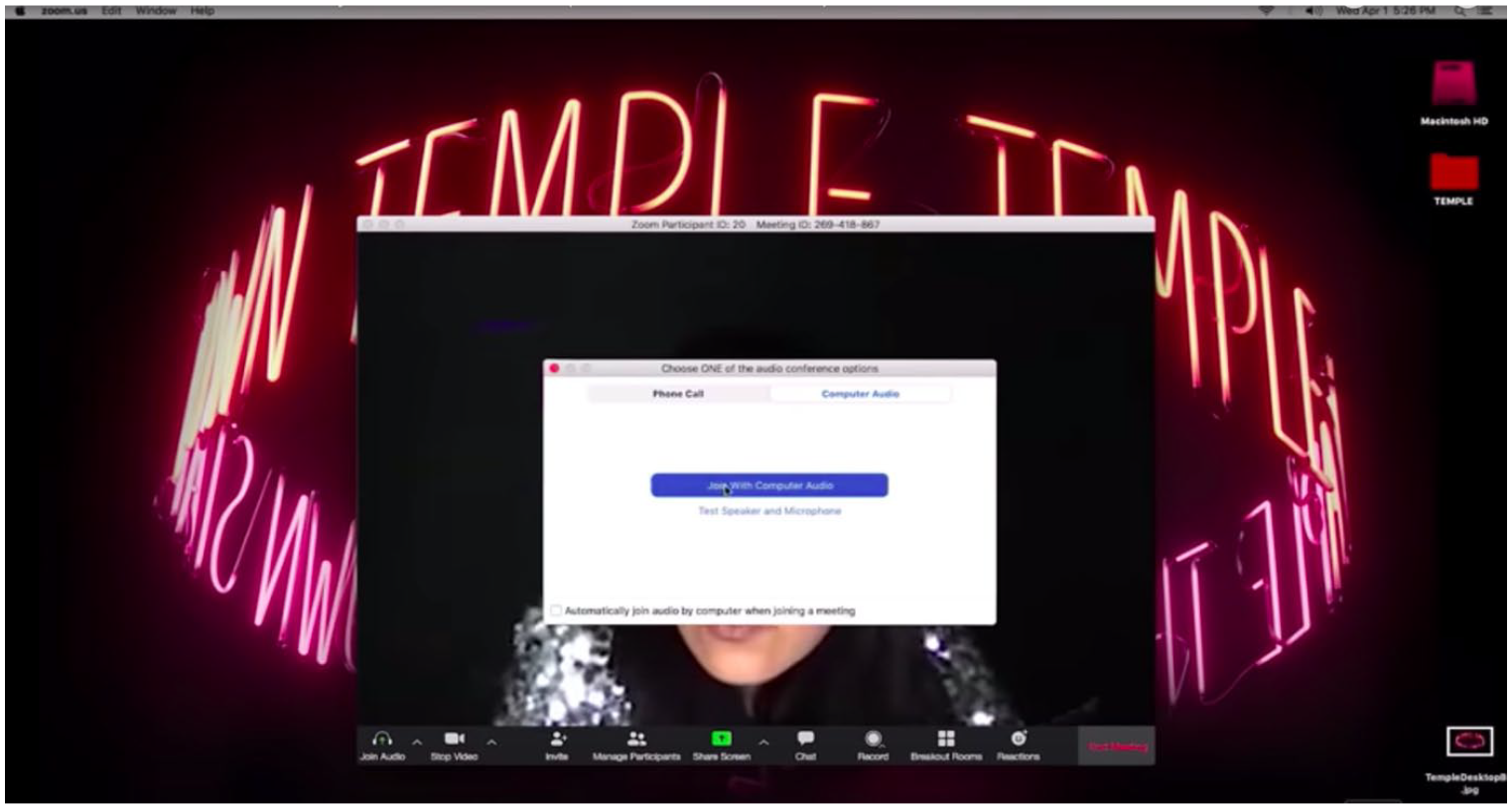
Zoom meeting or music video? Thao & The Get Down Stay Down play with generic expectations in “Phenom” (2020). Screen shot.
Scholars have long theorized genres in just this way: as means of communication that change with the times. In her seminal article, “Genre as Social Action,” rhetorician Carolyn Miller (1984) proposes an understanding of genre that relies not on theoretical categories but on rhetorical situations, where “genre can help account for the way we encounter, interpret, react to, and create particular texts” (p. 151). Genres thus constantly change based on the needs of their “communities of practice,” as Christine Tardy (2016), another genre theorist, calls them. Tardy acknowledges that “without conventions, we would not have genres,” and yet, “variation and fluidity are also essential characteristics of genre that must be accounted for” (p. 8). Film scholar Rick Altman (1999) and TV scholar Jason Mittell (2004) have similarly articulated the need to view genres as flexible, ever-changing concepts. Mittell (2004) asserts that “genres work as discursive clusters, with certain definitions, interpretations, and evaluations coming together at any given time to suggest a coherent and clear genre. However, these clusters are contingent and transitory, shifting over time and taking on new definitions, meanings, and values within differing contexts” (p. 17). As we see in the “Phenom” video, one of the ways in which genre can change is through recombination with other genres. The addition of timely Zoom conventions to existing music video conventions makes “Phenom” especially relatable to its 2020 audience. Our recognition that the Zoom meeting and the music video have differing audiovisual conventions that we might not expect to work together make the video’s pleasurable combination of these conventions all the more innovative.
“Phenom’s” unexpected generic cross-pollination is not that unique for music videos, though. As Jirsa and Korsgaard (2019) argue in a piece on music video’s transformations, current conceptions of music video foreground “transmedia and genre hybridity” (p. 119). 2 Sometimes, as in “Phenom,” music videos adopt conventions of other genres or media for the sake of expediency (Zoom was one of the only safe ways for people to dance together in Spring 2020), relevancy (the Zoom meeting was relatable in 2020) and novelty. In other cases, music videos reference existing film and television genres as a means of narrative economy that allows them to tell a simple story within the generally limited temporal framework of the video and while still foregrounding the song. We see this, for instance, in many of Spike Jonze’s intertextual music videos from the 1990s. In yet other cases, music videos take up the visual iconography associated with particular music genres (either straightforwardly or against the grain) to hail particular audiences. In all of these cases, we might note how frequently and variously music videos play with genre as a resource. In this essay, consequently, my goal is not to define a music video genre, but rather to use music videos as a lens through which to demonstrate that generic formations are not only flexible in and of themselves, but also in their capacity for recombination.
The Ever-Mutating Music Video
Music video’s relationship to genre and medium has changed frequently over the years. “Music video” first became a generic formation in the 1980s and 90s, when it was primarily a form of television programing. At this time, as Mittell (2004) notes in the introduction to Genre and Television, music video could be considered a TV genre. However, as music videos have moved online, and the framework of TV genres no longer adequately characterizes their industrial or reception contexts, we need new approaches to thinking about music video, medium, and genre. Korsgaard’s (2019a) work has been crucial in this regard. He has suggested that we divide our discussion of music videos into three phases: pre-televisual, televisual, and post-televisual. He notes that “Those pre-televisual phenomena that can be considered music videos avant la lettre were of course not called music videos” since such a term did not yet exist (Korsgaard 2019a, p. 15). Nonetheless, we can recognize these earlier texts, which range from animated experiments in visual music by artists like Oskar Fischinger and Mary Ellen Bute, to “jukebox films” like Soundies and Scopitones, to promotional films like the Beatles’ Strawberry Fields Forever as music videos. Like more recent interactive forms (music video games, virtual reality music videos, music video apps), these works share a fundamental focus on visualizing music, often with a shorter runtime than feature films or television episodes.
While the texts that we might characterize as music videos certainly have commonalities that we can point to, they also resist easy categorization. Drawing on and extending a definition from Bente Kristiansen, Korsgaard (2017) lists seven main music video traits: “(1) brevity, (2) a combination of music and visuals, (3) pop and rock music as the soundtrack, (4) the song precedes the visuals—the song is pre-recorded, (5) dual scope—both commercial and entertaining, (6) no incisions are made in the song’s structure—the song’s length determines the video’s length, (7) the image illustrates features of the song in order to sell it” (p. 26). However, as soon as he has offered this definition, he methodically charts exceptions to every one of these traits. 3 He concludes, “rather than comprising a unified field, music video is actually defined by its very heterogeneity, its wide range of different audiovisual expressions,” and consequently, it might not be fruitful to think of music video as a genre (Korsgaard 2017, p. 30). Music video’s essential combination of music and image—its audiovisuality—and its recombination of material from film, television, and musical recordings make it an inherently hybrid, but also an inherently adaptable form. As Korsgaard (2017) writes, “Indeed, this is one of the strengths of music video and one of the reasons it has been able to outlive itself so many times—its capacity to remediate other media, to morph itself into something else time and time again, and its ability to follow or perhaps even anticipate changing times” (p. 198). Music video’s incredible adaptability, its indeterminancy, and its innovative qualities are its core features, and these make it difficult to define and consequently to speak about as a single genre.
Nonetheless, generic formations have been crucial to theorizing music videos from the 1980s on, whether as a means of tracking music video’s intertextuality or as a means of identifying subgenres of music videos. These various approaches demonstrate scholars’ attempts to understand music videos as complex forms of audiovisual media that intersect with genre in many ways. Early approaches began to lay groundwork for more contemporary ideas about music video genres and generic features. 4 One of the most influential was Marsha Kinder’s study of three central “components” of music video. Two of these three components are guided by genre: the “performance” component is tied to musical genre, and the “narrative” component “turns the video into a minifilm with specific generic identification (e.g., horror, gangster film, screwball comedy, western, noir, melodrama, women’s picture)” (Kinder 1984, p. 4–5). 5 Kinder’s (1984) work importantly (1) points to music video’s remediational nature with regard to both popular music and film genres and (2) indicates that while performance, narrative, and abstraction are distinct components of music video, they are also often “combined with different emphases to create considerable variety within the form” (p. 4). 6 In his study of 138 videos from “greatest” and “most requested” lists, Gow (1992) extends Kinder’s focus on performance, placing musical performance as the key feature of music video and the aspect that the MTV-era audience was most drawn to. He identifies five types of performance video, while also noting a couple outlier videos that do not center performance. Taking a more rhetorical approach than Kinder, Gow shows how a key music video convention, performance, can be recombined with other generic elements to communicate to viewers.
The legacy of this early work is evident in Railton and Watson’s (2011) discussion of genre in Music Video and the Politics of Representation. Drawing on Kinder and Gow, they enumerate four music video categories: pseudo-documentary videos (which portray the “working life” of the artist), art music videos (which emphasize creative expression), narrative music videos, and staged performance music videos. Speaking to the significance of genre to our understanding of music video, Railton and Watson (2011) argue that their categories are not “just an exercise in drawing lines in different places”; rather, they want to emphasize “the inextricable linkage between genres of music video and the range of ways any given artist or band’s appeal to authenticity can be sanctioned” (p. 48). 7 Like Gow, they are interested in how music videos might communicate particular values through their generic conventions.
While the approaches I’ve discussed so far attempt overarching systems of classification, some scholars have instead used genre as an analytical tool to group and discuss particular trends in music video or to describe their unique communicative value. For instance, Davis (2015) discusses “charity music videos,” which use the resources of music video to cut through what she calls “compassion fatigue” on the part of viewer-listeners. Korsgaard (2019b) and McLaren (2019) have both written about lyric videos—a genre which, like music videos more broadly, exist before, during, and after the “televisual” era. By identifying and defining subsets of music videos, scholars are able to articulate specific functions without accounting for all music videos.
Of course, we can also think about music video genres as aligning with popular music genres, and a growing body of scholarship examines the conventions of music videos in this way. In Arnold et al. (2017) Music/Video: Histories, Aesthetics, Media alone readers can find work on hip-hop videos, industrial videos, and (most specifically) British yacht rock music videos. Country music video has been theorized from Fenster’s (1993) early work to Andsager and Roe’s (1999) piece on country videos and gender, to Watson’s (2019) recent work on space and place in country videos. Doré and Pugsley (2019) have explored the conventions of K-pop video while Unger (2015) has focused even more specifically on “deconstructing” K-pop girl group videos. Metal, punk, and indie rock videos have also been written about extensively. 8 While all of these authors seek to investigate the relationship between a musical genre and its visual expression in music videos, they are not united in their approach. Some of the work focuses on industrial or production angles, some on audience expectations and reception, and some on notions of the artist, creativity, and authenticity. Most of the work explores the musical characteristics, visual iconography, and broader remediation of the music genre in question.
Although this is a rich vein of scholarship, Railton and Watson (2011) caution against any simple equivalence between musical genre and music video genre, in part because music genres can themselves be difficult to define and in part because approaching music video via music genres can serve to essentialize or stereotype particular genres. They note scholars’ focus on the objectification of women and related iconography (the swimming pool, the strip club) in hip-hop videos, responding that “While it is undoubtedly true that many videos which promote hip hop music do contain these elements. . . it nevertheless remains the case that many do not” (Railton and Watson 2011, p. 46). It is important not to essentialize a given genre, lest we think of it as fixed rather than fluid, and music genres also hybridize as often as any other kind of generic formation.
None of these approaches to music video and genre is more or less apt. Rather, the range of these approaches indicates how flexibly music videos interact with generic formations. Studying music video demands a multifaceted approach to genre: if we accept that music video is a moving assemblage of genres and media, we can move toward unpacking the unique configurations of genre and medium in a given music video or subset of music videos. This method might suggest a shift in the way we think through genre in the future, moving us away from single genre studies (however expansive or changeable a given genre might be) and toward studies that treat genre in a more recombinatory way.
Remediation and Generic Recombination From Kenneth Anger to Lil Nas X
To demonstrate this approach, I briefly examine two notable texts that center queer masculinity and that share conventions of music video, but that otherwise diverge (in terms of release date, production and reception contexts, medium, etc.): Kenneth Anger’s experimental film Kustom Kar Kommandos (1965) and Lil Nas X’s music video for “Old Town Road” (2019). While examining both of these texts as music videos helps us reach a deeper understanding of their unique audiovisual relationships and perhaps, by extension, their cultural significance, I argue that understanding the multiple genres that each text remediates—and the particular ways in which these genres are recombined—is equally important.
While it is rarely discussed as such, Kenneth Anger’s classic experimental film Kustom Kar Kommandos is a good example of a “pre-televisual” music video. “Music videos” did not exist in 1965, of course, and even “promotional films” like the Beatles short Strawberry Fields Forever (1967) were quite different in industrial context. Kustom Kar Kommandos was not intended to promote the song that forms its backdrop: the Paris Sisters’ rendition of “Dream Lover” (written and originally recorded by Bobby Darin) came out the year before the film. Comparing the film to the commonplace music video tenets Korsgaard enumerates, Kustom Kar Kommandos not only doesn’t sell a song, but it arguably doesn’t satisfy the “dual scope” of being both entertaining and commercial. It is certainly entertaining, but a short experimental film released in the 1960s could hardly be seen as commercial, given that it would have had limited distribution, and exhibition would have been primarily in galleries, educational institutions, and cinematheques, none of which are “commercial” on the scale of a feature film release or even a music video release in the televisual era. Nonetheless, Kustom Kar Kommandos exhibits the fundamental audiovisual relationships that music video scholars consistently point to: the musicalization of images and the visualization of music. 9
While Anger does not rigorously synchronize the images with the structural components of the song (verses, choruses, bridge, and refrain), his audiovisual pairing of the Paris Sisters’ “Dream Lover” with imagery of a man lovingly caressing every inch of his customized car with a soft poof is highly intentional. The music is not underscore but an equal participant in the composition. The sparseness of the musical arrangement plays off the simplicity of the images, and the pairing focuses our attention on sonic and visual textures (the reverberation of the cymbal, the reflective chrome and sensuous leather of the car). The film’s focus on a solitary figure also picks up the lyrical emphasis on solitude (“I want a dream lover/So I don’t have to dream alone”). The sounds and images resonate with one another, and in this regard Kustom Kar Kommandos feels like a music video.
At the same time, the generic interplay in the film—which is as much about dissonance as resonance—bolsters its cheeky commentary on masculinity. The softness of the Paris Sisters’ vocals, and the song’s connotations of “bubblegum pop,” are matched by the man’s gentle caresses and the bright pink backdrop of the scene. And yet these are not our expectations of 1960s hot rod culture. The machismo we might expect of “greaser” films like The Wild One (1954) and Rebel without a Cause (1955) is still present—we hear an engine revving both before and after the song and the main figure sports slicked back hair, an unsmiling expression, and macho driving posture—but the other generic associations work to queer these markers of car culture. We might also note that the Paris Sisters’ version of “Dream Lover” changes Darin’s original lyrics, which focused on a female lover, to a male love interest (“a boy to call my own”). This alteration maintains heterosexuality when sung by the Paris Sisters, but, when paired with the male protagonist of Kustom Kar Kommandos, becomes more radically open. YouTube commenters have read the film as alternately masturbatory or as an eroticized relationship between man and car, thus calling into question the nature of the eponymous “dream lover.” 10 These readings are supported by Anger’s other work, which frequently queers popular culture in innovative ways.
On the surface, Lil Nas X’s “Old Town Road” video might seem to have little in common with Kustom Kar Kommandos. Its musical references (country and trap music) are wholly different, as is its focus on a star performer (actually two: Nas and country icon Billy Ray Cyrus). “Old Town Road” is also much more conventionally a music video by the standards previously discussed, insofar as it is designed to market a song and performer and to circulate widely as such. However, “Old Town Road’s” genre bending is, like its predecessor’s, crucial to its articulation of queer masculinity. In his music videos, Nas has experimented widely with genre from sci-fi (“Panini”), to jail break narrative and prison sexploitation film (“Industry Baby”), to fantasy/mythology/ biblical epic (“MONTERO (Call Me By Your Name)”). Like Kenneth Anger before him, Nas often also plays these popular genres against the grain: see, for instance, the Brokeback Mountain-esque gay Western scene in “That’s What I Want.” Nas is also a transmedia creator who has frequently used Twitter memes and TikTok videos to help promote his work. 11
“Old Town Road’s” generic hybridity begins with the music. It started with a sample called “Ninety” from Dutch producer Young Kio that combined a fairly standard trap beat with a banjo playing Nine Inch Nails’ “34 Ghosts IV.” Lil Nas X purchased the track and, inspired by the twangy banjo and the trap beat, wrote rap lyrics that combined country iconography with hip-hop bravado (“Hat is matte black/Got the boots that’s black to match/Riding on a horse, ha/You can whip your Porsche”). In April 2019, Nas remixed the song with additional vocals by Cyrus, after which he made both an “official video” and a longer “official film” to accompany the song, both released in summer 2019. 12
The video builds visually on the song’s unlikely combination of musical elements. As we hear the solo banjo that starts the track, we see a series of shots of residents in a predominantly Black neighborhood looking toward the camera with perplexed expressions. Soon Cyrus begins the chorus (“I’m going to take my horse to the old town road”) offscreen, and we see Lil Nas X riding down the street in classic cowboy get-up. After the trap beat drops, the video moves through several scenarios that directly figure the mashup between standard country and hip-hop visual elements. In one scene, Lil Nas X and a resident engage in a dance battle that features country line dance steps and hip-hop moves. In another, Lil Nas X, still on horseback, races a car (driven by rapper Vince Staples) while we hear him on the soundtrack rapping “My life is a movie/Bull riding and boobies.” Given that Nas had come out publicly a couple weeks before this video was released, the line contributes to the parody. 13 This parody of masculinity is much more overtly humorous than Anger’s, but it similarly mobilizes generic conventions against the grain. The long tradition of the cowboy, which travels through Hollywood Westerns and country songs, meets the long tradition of the drag racer, which travels through 1950s teen pics into contemporary blockbusters (think the Fast & Furious franchise) and hip-hop videos. The mashup of these two macho cultures renders both ridiculous, and makes the subsequent entrance of Cyrus, who pulls up in a convertible, decked out in fringed bright pink Western wear, less surprising. He and Nas perform for a rec room full of country line dancers wearing cowboy hats and boots (perhaps an ode to the many “Old Town Road” TikTok videos that preceded the official video) before they finally take some photos with the locals to wrap things up (Figure 2). As Nas and Cyrus smile for the camera, the possibility of a queer Black country-trap artist seems not only possible, but plausible.
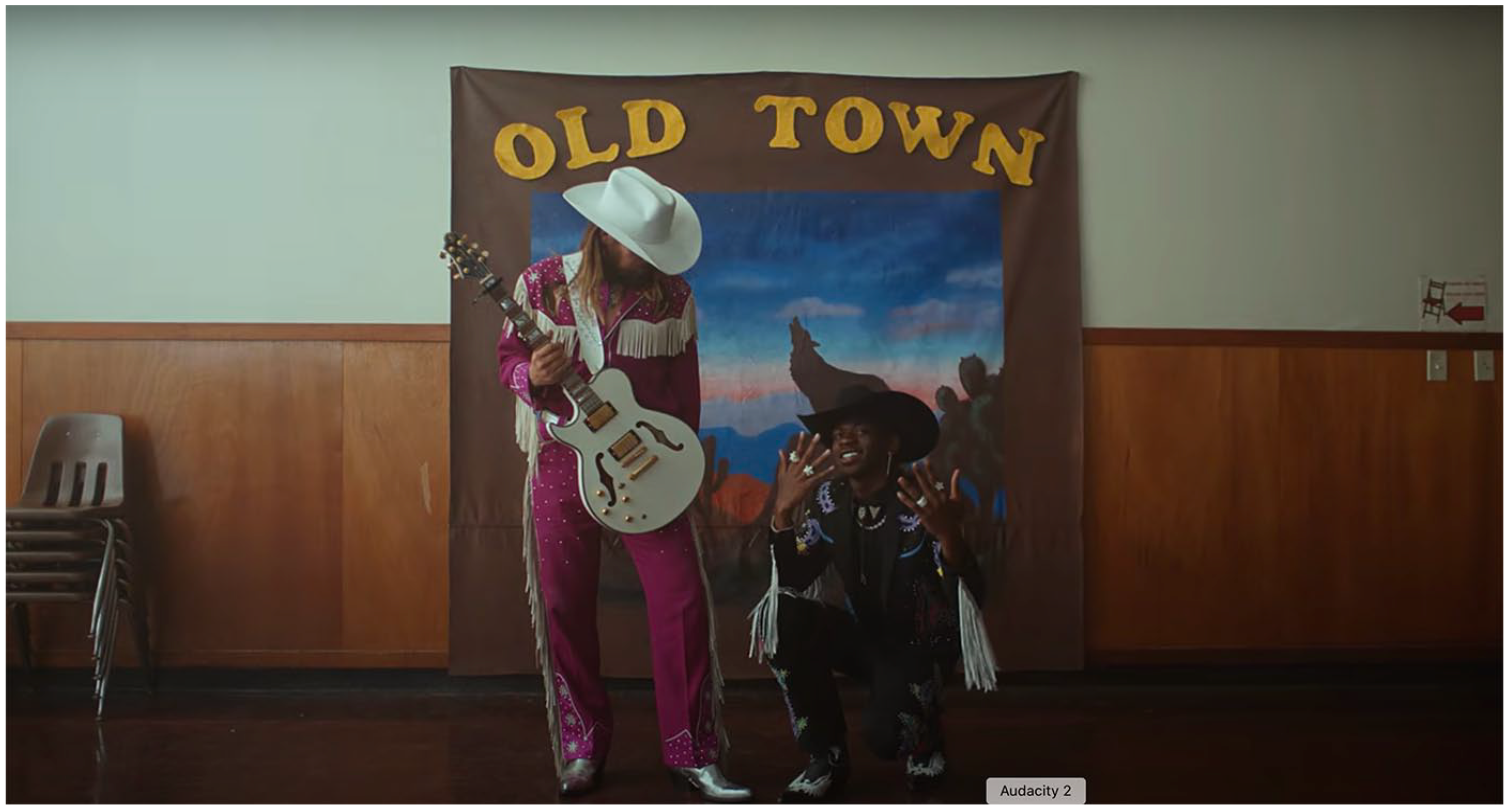
Country parody with a hint of trap bling: Lil Nas X and Billy Ray Cyrus in the official music video for “Old Town Road” (2019). Screen shot.
However, Nas’s genre bending did not immediately meet with success. The whiteness of the country genre and the homophobia of some hip-hop communities actively worked against his vision. The country establishment initially rejected “Old Town Road,” pressuring Billboard to remove it from their country chart, which they did in March 2019. Only after Cyrus added his vocals (and his sway as a successful white country singer) did the song reenter the country chart. As Time writer Andrew Chow (2019) puts it, “There aren’t many black stars in country music; there aren’t many queer stars in hip-hop. There aren’t many queer black stars in American culture, point-blank.” Nas’s battles to make “Old Town Road” a success recall Tardy’s reminder that genre innovation is not always easy: “To be deemed ‘innovative,’ a text must not only depart from convention but also be perceived as effective and successful by the text’s intended audience or community of practice. . . The extent to which such innovative texts lie at the ‘outer boundaries’ of a genre category or frame may ultimately have some effect on how readers judge them, as might various social and political features of the community in which the genre is produced and distributed” (Tardy 2016, p. 11, italics hers). Nas’s race was clearly at odds with the “social and political features” of the country music community, while his sexuality proved similarly challenging for some audiences. And yet, “Old Town Road” so sufficiently charmed a wide variety of viewer-listeners that it became a defining hit of its era.
Perhaps its popularity is partly due to the ways in which it does feel familiar. For all its generic innovation, “Old Town Road” is typical of many music video conventions discussed previously. Gow (1992) would probably classify it as an enhanced performance video—the most common type in his sample—for its integration of vocal performance and other thematic footage, and Railton and Watson (2011) would likely classify it as a narrative video, as it “position[s] the performer(s) within the symbolic landscape associated with the specific musical genres” (p. 58). Thus, while “Old Town Road” is innovative in its recombination of music genres and their visual associations, its strategies for combining music and image fall squarely within our expectations for music video’s audiovisuality. The video challenges our generic expectations in some ways, but it also satisfies them in others. Here, a multifaceted approach to genre is necessary because if we looked at this video only in terms of “music video conventions,” “country music conventions,” or “trap music conventions,” rather than the specific intersection of these various generic clusters at this time, we might miss what Kai Arne Hansen (2021) describes as the “ongoing struggles concerning genre boundaries, social divisions, and margin-center dynamics” evident in “Old Town Road” (p. 97).
These are just a couple examples of the complex intersections of genre and media that occur in music videos. While Korsgaard and others have demonstrated the radical reconfigurations of music video that have occurred in the digital era, these innovations exist alongside other types of generic recombination and innovation like those we see in “Phenom,” Kustom Kar Kommandos, and “Old Town Road.” Each text we examine might activate particular generic formations of music video as well as additional genres (music genres, media genres) in order to communicate to a particular community of viewer-listeners at a particular moment. In each case, these works call upon and challenge our existing generic knowledge as we watch, listen, analyze, and enjoy the media we encounter. To the extent that the recombination of disparate generic elements is often where innovation occurs, studies that prioritize generic hybridity and recombination can help us analyze individual videos’ industrial, social, and aesthetic complexities to uncover novel connections between texts. Music video’s inherent tendency toward remediation need not preclude discussion of genre. Rather, it requires us to think genre in a hybrid, intermedial manner well attuned to historical exploration and future innovation alike. It requires us to adapt, as music videos have done throughout their existence.
Footnotes
Acknowledgements
Thank you to the editors of this issue, Jonathan Cohn and Lauren S. Berliner, for their invaluable suggestions on earlier drafts of this essay. I am also grateful to students in my undergraduate music video seminars and my graduate writing pedagogy across the curriculum seminars: their questions and insights about genre have deeply informed my own.
Declaration of Conflicting Interests
The author declared no potential conflicts of interest with respect to the research, authorship, and/or publication of this article.
Funding
The author received no financial support for the research, authorship, and/or publication of this article.