



Abstract
Despite the successful transition of the Paralympics from relative obscurity to global mega-event, we still know little about how it is consumed by audiences. Using a methodological approach that draws on survey (n = 2008) and focus group (n = 216) data from Paralympic audiences across the UK, this study provides the first mixed method and integrated empirical analysis of Paralympic audiences to date. We attempt to identify who the UK Paralympic audience is, before examining audience perceptions of Paralympic coverage, and the impact of watching the Paralympics on audience sentiments toward disabled people in sporting and everyday contexts.
Introduction
Historically viewed as a sporting pastime for the rehabilitation of disabled people, the Paralympics has transitioned into a commercially successful global sporting mega-event with extensive broadcast coverage. Indeed, the 2016 Rio Paralympic games was the most successful in broadcast history with over 500 hours of coverage across mainstream media platforms and reaching a global audience of 4.1 billion (IPC 2016). Whilst the development of electronic and digital media and concomitant shifts in audience consumption trends have created new challenges for broadcasters, the appeal of live-ness and immediacy mean that sporting mega events continue to be dominantly consumed through live television broadcasting and attract huge global audiences (Whannel 2014). This is increasingly the case for the Paralympic Games.
Whilst studies have focused on audience consumption patterns of the Olympic games and other sporting mega events (e.g., Devlin and Billings 2016; Tainsky et al. 2014; Tang and Cooper 2012) there remains a significant knowledge gap in audience research in the context of the Paralympics. Excluding a handful of small-scale studies, a comprehensive, empirical analysis of audience reception of the Paralympics, patterns of consumption, attitudes, and effects, is absent from academic debate. This is important to develop for a number of reasons. Firstly, unlike other sporting mega-events, the Paralympics maintains an important political and cultural role as a vehicle for the empowerment of disabled people through sporting success centered on a vision for a more inclusive and equal society (Howe 2008). This, in turn, makes the production context and practices in Paralympic broadcasting somewhat different to Olympic broadcasting (see Pullen et al. 2019). This is particularly the case in the UK since 2010 which saw Channel 4 (C4)—a public service broadcaster (PSB) with a distinct statutory remit—become the UK’s official Paralympic broadcaster. Whilst C4 brought unprecedented media exposure, successfully elevating the profile of the Games, capturing huge audience numbers (a 400% increase since the 2008 Beijing Paralympics), and establishing its commercial success, they remained committed to a public service remit that centered on the “normalization” of disability (see Pullen et al. 2019). This included promoting media content that aimed to challenge dominant disability stereotypes, inspire progressive social change with respect to public attitudes toward disability, and promote inclusivity and equality; an ambition aligned with the Paralympic movement.
Given this context, knowledge on the Paralympic audiences is essential to more fully understand the impact of media content on the (re-)production of disability knowledge and attitudes and the role of public service broadcasting commitments in the representation of typically marginalized sports. Using a methodological approach that draws on survey and focus group data from Paralympic audiences across the UK, this study provides the first mixed method empirical analysis of Paralympic audiences to date, that includes an insight into audience perceptions of Paralympic broadcast coverage, the idiosyncrasies of audience engagement with regard to disability and gender demographics, and the sentiments and attitudes of audiences toward disabled people in sporting and everyday contexts.
Disability, Media, and the Paralympics
Since the first hosting of the Paralympics in 1960, it has faced a long struggle for visibility, recognition and commercial investment (see Kell et al. 2008). Only since 1992 has the Paralympics been televised and for much of its subsequent history, it has existed on the fringes of primetime TV schedules, typically only through highlights programs. Despite its recent commodification and increasing commercial success (particularly since 2012), the global picture of Paralympic broadcasting is still very uneven, with some countries fully invested in making it a mega sporting event and others barely recognizing its existence.
Compared to the Olympics, the Paralympics has received relatively limited scholarly attention as a media spectacle (Howe 2008). Whilst across wider media content and broadcasting disability continues to remain significantly underrepresented, the Paralympics provides what we have previously termed a “hyper-visible” space of disability representation on television (Pullen and Silk 2020). Indeed, given its position on primetime schedules in many countries, it is arguably the most dominant mediated space in which non-disabled audiences “see” disability. Unsurprisingly then, Paralympic scholarship has typically been directed toward a critique of disability representation focusing on how para-athletes and disability are portrayed through Paralympic media content. Predicated on a number of dominant disability stereotypes historically seen across wider media, scholars (Beacom et al. 2016; Bruce 2014) have pointed to the marginalization of para-athletes; the reinforcement of medicalized and individualized understandings of disability; and the framing of para-athletes as particularly heroic, inspirational, and having triumphed over adversity. This latter framing, defined as the “supercrip” (Silva and Howe 2012), has been critiqued for its seemingly positive representation of disability, whilst remaining centered on successful technologically enhanced para-athletes given their approximation to normative (able-bodied) expectations of sporting success and corporeality. This modicum of studies has highlighted the extent the “supercrip” attempts to make disability palatable in a commercial media culture that privileges aesthetic labor (Pullen et al. 2019). This is particularly pronounced in the sport media economy framed on the legitimization of media narratives for capital accumulation (advertising, sponsorship revenues), normative production practices, preferred narratives of nation, and a non-disabled sporting corporeality (see, e.g., Jhally 1989).
However, important as these studies are in critiquing Paralympic representation, there continues to remain a scholarly absence of Paralympic research on the wider production context and audience receptions. Here, and excluding our own work in this area (see Pullen et al. 2019), less than a handful of studies have paid attention to Paralympic production, the conditions that impinge of cultural production, and the logics and practices of Paralympic broadcasters. This is a concern given the significant cultural shifts—particularly though not exclusively in the UK—in the production landscape since 2012, marking an important social and cultural shift in Paralympic broadcasting and, subsequently, reception and representation. Moreover, despite a corpus of studies on representation (e.g., Beacom et al. 2016; Howe 2012) few focus on live sporting coverage and the distinctive organizational and cultural practices of sports broadcasting that shape content.
C4’s practices in Paralympic broadcasting are relatively distinct when compared with other broadcasters and their approach forms an important contextual backdrop to this paper. In the words of their Disability Executive, Alison Walsh, “Our ambition was simple: two years to change attitudes to disability and disability sport. We wanted to create a nation at ease with disability” (Walsh 2015, 27). They pursued this through (a) unprecedented exposure of para sport, including over nine hours a day of live sport, plus extensive build-up programs, (b) a “no-holds-barred approach to portrayal of disabled people” (Walsh 2015, 49) which included incorporating their own extra (multilateral) cameras to supplement the (unilateral) footage provided by the host Olympics Broadcasting Service (OBS) in order to show the disabled body (c) marketing Paralympians to the British public with an emphasis on athlete backstories in order to familiarize audiences with GB para-athletes, and (d) developing disabled talent both on screen and in production. All of these practices formed a significant shift from those of the former Paralympic broadcaster, the BBC (See Pullen et al. 2019).
At the Rio 2016 Paralympic Games, 58 percent of C4 presenters and more than 15 percent of the production team were disabled (Channel 4 2016). This is significant in the sphere of media where, despite the passing of legislation and policy focused on disability inclusion in the workplace, disabled people remain significantly underrepresented both on and off screen. On average, in the UK, only 3 percent of employees across the five main broadcaster networks are disabled compared to 18 percent of the UK population (Ofcom 2017). This lack of diversity and representation has been a concern for both the communications regulator in the UK, Ofcom, who encourage the promotion of greater diversity, and disability media scholars (see Ellis and Goggin 2015), who argue that the absence of disabled people in the process of producing disability related media content contributes to marginalization, disempowerment, and problematic “ableist” representations. Under the auspices of broadcasting regulation, the Paralympics provided C4 an opportunity to include disabled people in Paralympic production and representation in a commitment to greater diversity and more inclusive and progressive disability content. C4’s practices are therefore important to consider, not only in the context of representation, but for audience research where disabled people—alongside other marginal groups—will form part of the audience.
Sporting Audiences and the Paralympics
Despite audiences being integral intermediaries in the process of cultural production they have often been neglected, or largely seen as a by-product, in the cultural critique of media texts (Whannel 2002). Unsurprisingly then, analysis has typically been directed toward content or the process of production (Crawford 2004). Whilst this has certainly been the case in Paralympic scholarship, across the sport media and communication field, audience research continues to remain relatively limited. Despite a wealth of research in the area of mediated sporting mega events, only a small number of studies pay attention to audiences and the interaction of various demographics and identity politics on media consumption patterns and trends. These studies are based on major sporting events such as the Olympics (e.g., Brown et al. 2019; Tang and Cooper 2012); NFL Super Bowl (e.g., Clarke et al. 2009; Cooper and Tang 2013), and World Cup Football (e.g., Devlin and Billings 2016).
Studies have focused on the interaction of gender on viewing and audience experiences (Clarke et al. 2009) as a predictor or motivator to viewing certain sports/events (see Jeffery and Ridinger 2002; Tainsky et al. 2014; Tang and Cooper 2012). Indeed, whilst sports fans have historically been male, and sport consumption a more male dominated form of leisure (see Gantz and Wenner 1991), recent research by Tang and Cooper (2012) on audience consumption of NBC’s coverage of the 2008 Olympics identify a relative gender balance. This, they argue, is predicated on the amount of coverage of Women’s sport across Olympic events when compared with traditional male dominated sports (e.g., the NFL) (see Angelini and Billings 2010; Billings et al. 2010) with the variety of sporting coverage on offer in Olympic broadcasting as a key predictor of viewing habits. More recently, work by Devlin and Billings (2016) have focused on the relationship between feelings of nationalist sentiment and fan identification on consumption of the 2014 FIFA World Cup Football. These authors highlight how media consumption influences patriotic and nationalist sentiments amongst World Cup audiences and particularly in established fans reproducing public collective perceptions of national identity (Billings et al. 2013). However, the authors caution that such findings are highly contextual given the World Cup is a singular competition (unlike the Olympics) and “functions differently, as a series of “team versus team” singular competitions within a much more limited framework of “nation versus nation” (Devlin and Billings 2016, 59). Indeed, following Devlin and Billings (2016), sporting fanship and fan identification is likely to foster different effects and determine different motivations in viewing amongst audiences of specific sporting mega events such as the FIFA World Cup compared with the Olympics and Paralympic Games; an important caveat in audience research focused on a single sporting mega event. Despite the above studies identifying patterns of interaction between audiences and consumption of mega events, they reveal less about audience attitudes, perceptions, and the wider effects of such media on cultural discourses. This, following Whannel (2002), has been the challenge in sport media audience research and requires a more nuanced, integrated analysis in order to develop a knowledge base that can go beyond identifying trends to a more careful consideration of media influence.
Whilst a plethora of studies have started to pay attention to the Paralympics since its rapid commodification, audience research continues to remain significantly limited with the exception of one or two quantitative (see Bartsch et al. 2018) and qualitative studies (Fitzgerald 2012; Hodges et al. 2015). Yet, understanding how audiences consume and engage with the Paralympics is an important indicator of public attitudes toward disability (Schantz and Gilbert 2001). Rooted in communication psychology and based on an experimental design, Bartsch et al (2018) find that exposure to Paralympic broadcasting that emphasizes empathic themes toward the athletes can stimulate both audience interest in para-sports and attitude change about disabled people in general. They suggest, unlike other media entertainment and sporting events, exposure to Paralympic broadcasting can elicit both hedonic (e.g., immediate gratification, mood regulation and arousal, or distraction from negative thoughts) and eudaimonic (more complex and sustainable social and cognitive experiences that foster a sense of insight, meaning, and social connectedness) spectatorship practices. A more contextually relevant and qualitative examination of Paralympic audiences was conducted by Hodges et al. (2015); to our knowledge the only prior study analysing audiences’ perceptions in the context of C4’s broadcasting. Based on interviews in the lead up to, and immediately after, the 2012 London Paralympics, they document a shift in attitude by audiences from the more widely stereotypically sympathetic positioning of disability to one expressed through a “triumph over adversity”—narrative. However, in considering the effects of broadcast media coverage, Hodges et al (2015) caution that a significant proportion of the audience experienced discomfort in watching disability sport and felt that Paralympic sport was a “second rate games.”
Research by Bartsch (2018) and Hodges et al. (2015) identify how Paralympic broadcasting can impact on audience perceptions of disability and para-athletes. Whilst in the case of Hodges et al. (2015) the use of qualitative interviews provides an important insight into the impact of the Paralympics on audience attitudes, it remains only a partial and limited insight into the Paralympic audience. Indeed, notwithstanding the small sample size, audience research conducted in the context of the London 2012 Games—where Great Britain was the host nation—brings a unique set of highly contextual viewing behaviors. From the insights offered through extant literatures, it is apparent that additional research is required to enhance understanding of the multiple ways in which the Paralympic Games are experienced by different audience demographics and the reach and effect of Paralympic media on disability attitudes; the intent of this paper is to offer one such contribution.
Research Focus and Questions
First, despite some qualitative insights (e.g., Hodges et al. 2015), there exists no knowledge to date on the demographic makeup of the Paralympic audience. We therefore ask:
RQ1: Who is the audience for the Paralympics in the UK?
While this is a manifestly descriptive question, it has important value as a baseline for this study and future research. Where previous research suggests that in contrast to most highly celebrated sports, the Olympics attracts a gender balanced audience (Tang and Cooper 2012), we cannot assume this is also the case for the Paralympics. Furthermore, disabled audiences are of particular interest given the role of the Paralympics and as a broad indicator of media practices that include a greater proportion of disabled people in production. Here, we build on previous research that has implied differences in viewing practices amongst disabled and non-disabled audiences prior to the London 2012 Games (Hodges et al. 2015). Finally, developing a broader understanding of the Paralympic audience base and their consumption of sporting mega events, we ask whether the Paralympic audience is interested in disability sport outside of the Paralympics.
Next, we address the key question of the role of Paralympic broadcasting—as an important intermediary in the pathway toward social change—in shaping attitudes toward disabled people. Given the joint ambitions of both the International Paralympic Committee (IPC) (Howe 2008) and the UK’s Paralympic Broadcaster (C4) to use sport to advance the cause of both elite disabled athletes and those who live with an impairment, we ask:
RQ2(a): How has watching the Paralympics shaped interest in the achievements of disabled athletes?
RQ2(b): How has watching the Paralympics shaped perceptions toward disabled people in everyday life?
Finally, given that previous research has implied residual barriers to engagement with Paralympic spectatorship for some people (Hodges et al. 2015), in this study we take this further by asking to what extent these sentiments still exist after two Paralympic cycles where C4 has been the host broadcaster.
RQ3: What barriers exist amongst UK audiences toward engaging with Paralympic broadcasting?
Method
Drawing on national survey and focus group data from Paralympic audiences across the UK, this study provides the first mixed method and integrated empirical analysis of Paralympic audiences to date. Given no quantitative Paralympic audience research exists, our research design sought to engage audiences in a qualitative setting in the first instance so as to inform the quantitative survey design.
Audience Focus Groups
Eighteen focus groups lasting approximately ninety minutes were conducted with 216 members of the public between June and December 2017. Focus groups were held in sites across England and Wales, including London, Bristol, Cardiff, Liverpool, Bournemouth, and Nottingham and were held in publicly accessible meeting rooms (e.g., university seminar rooms, hotel meeting facilities). Participant numbers were spread relatively equally across each location (ten participants per group at each site) and the demographic spread (age, race, ethnicity, social class, gender) and geographical spread was diverse and captured a range of experiences and voices. At each site multiple focus groups were conducted with groups who self-identified as disabled and non-disabled, with approximately half of our participants self-identifying as disabled. Recruitment involved the use of a recruitment agency through a purposeful sampling technique against an inclusion criteria that required the following: for participants to be aged over eighteen years; able to provide full informed consent; and have watched the Rio 2016 Paralympic Games. The dataset contained self-selection bias that resulted from the inclusion criteria with the most visible being an interest in Paralympic sport.
The focus group guide was structured around three topics which respond to the RQs. This included: (1) audience backgrounds and experience of disability; (2) interest, perceptions and opinions of Paralympic broadcast coverage; (3) the impact of the Paralympics on their perceptions of elite para-sport and their wider attitudes toward disability and disability rights progress. Focus groups were audio recorded and transcribed verbatim by an internal university transcriptions service before being entered into QRS NVivo data management program. Full anonymity has been given to all participants with assigned pseudonyms with only the gender of each participant marked throughout the transcripts. A process of manual interpretive coding was undertaken followed by a closer reading of themes and sub-categorization of dominant themes through a process of meaning condensation (Coffey and Atkinson 1996). Themes were discussed between colleagues as “critical friends’ establishing empirical validity in the process of qualitative analysis.
Audience Survey
An online survey with a UK-based commercial research agency (DJS Research) on a UK representative sample of sixteen plus year olds (N = 2008) was conducted through a web interface between the 16th and 28th February 2019. The questionnaire was sent out to a sample of those registered on the DJS Research database (over 40,000 individuals), and where stratification (by age, ethnicity, gender, region, and social class) was used to ensure representativeness.
Survey Variables
In lieu of existing measures from previous studies of Paralympic audiences, survey measures were developed from the focus group findings and grounded in the literature. To establish who is interested in following Paralympic broadcasting in the UK (RQ1), we asked (on a four point scale) the extent to which they followed the three Paralympic events since 2012: the Summer Paralympics in Rio 2016 (Brazil) and the Winter Paralympics in Sochi 2014 (Russia) and PyeongChang 2018 (South Korea). To gauge the extent to which Paralympic audiences are just general mega sporting event audiences (see Hodges et al. 2015) we asked (on a five point scale) whether participants “enjoy watching programs featuring disability sport, other than the Paralympic Games themselves, when they are on TV.” We also asked various demographic questions (e.g., age, ethnicity, disability, gender) of participants.
To measure interest in Paralympic athletes (RQ2a) we asked participants to rate (on a five point scale) their agreement with two statements: “I am interested in the sporting achievements of Paralympic athletes” and “I am interested in the backgrounds of Paralympic athletes (including how they deal with their disability).” The latter question responds to an emergent finding from focus groups alongside interviews conducted with C4 and an analysis of their Paralympic broadcasting (as part of the wider project, see Pullen et al. 2019) which established the importance of athlete backstories in engaging audiences with disability.
To explore the impact of Paralympic broadcasting on perceptions of disabled people (RQ2b), we developed four measures (on a five point scale) that ask participants whether they agree that the Paralympics have “had a positive impact on the lives of people with disabilities,” “have challenged my attitudes about people with disabilities,” “have inspired me to engage with other media content that features disability,” and “have given me more confidence in interacting with people with disabilities in everyday life.”
Finally, emerging from focus group themes and previous research (Hodges et al. 2015), we asked three questions that explored different barriers to engagement with the Paralympics (RQ3): “The Paralympic Games don’t really represent elite sport,” “I don’t like the way the media portray people with disabilities at the Paralympic Games,” and “I feel uncomfortable watching people with disabilities at the Paralympic Games.”
Findings
Who is the Paralympic Audience?
As a baseline for future research, RQ1 asks who the audience for the Paralympics in the UK is. Figure 1 shows us that around half of UK adults have followed Paralympic sport to some extent in the past five years. While no comparative UK audience data exists for the Rio 2016 Olympics, our data implies that the Paralympics is squarely in the mainstream of public consciousness and is followed by a considerable portion of the UK population. Statistical tests to examine demographic influences on these figures suggest that there are no statistically significant differences by disability status or gender, but Spearman correlation tests show that the younger you are, the more likely you are to follow the Paralympics, albeit with a modest effect size (rs[2008] = 0.127, p < .001).
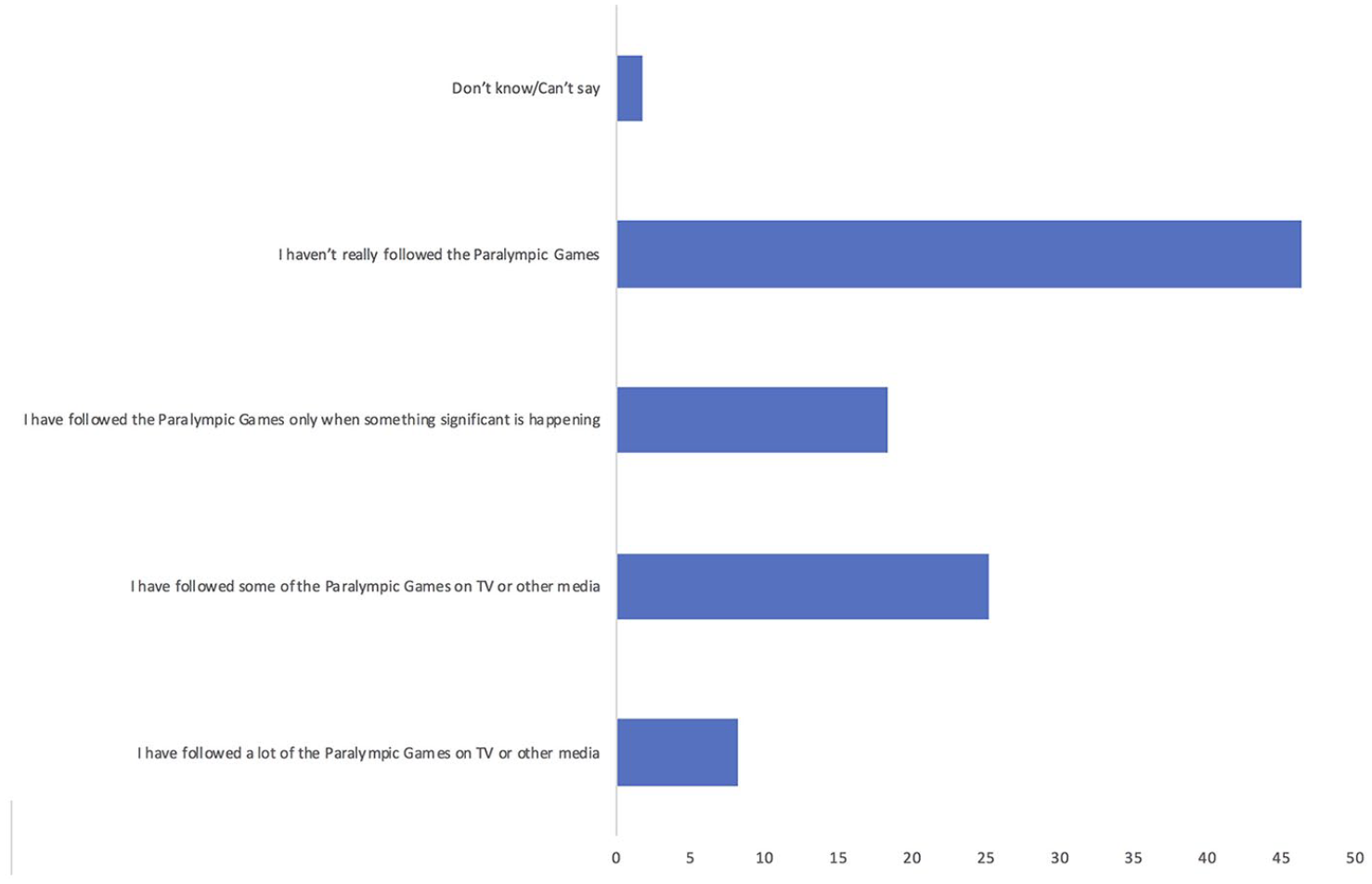
Extent to which the UK public follow Paralympic Games post-2012 (%).
Another dimension of the Paralympic audience is the extent to which they would identify as Paralympic fans genuinely interested in para-sport, or whether these were just general mega sporting event audiences (see Figure 2). To do this, we only present the data for participants who have followed Paralympic events since 2012
1
(N = 1047) as those who have not cannot be considered a Paralympic audience. Findings suggest that there is a considerable para-sport audience in the UK that exists outside of the Paralympics, with only 7.5 percent of survey participants disagreeing with this proposition, and 49.7 percent agreeing. When the same question was asked regarding the Olympics, the main difference is in the number of undecided, with 42.9 percent for the Paralympics compared to 25.3 percent for the Olympics. Focus group data adds nuance to this point suggesting that the large number of undecided participants is likely to be a result of the general lack of para-sport coverage outside of the Paralympics. While major para-sport events such as the IPC World Championships are given TV coverage on free-to-air terrestrial channels in the UK, their airtime and audience penetration still lag well behind that of comparable non-disabled sporting events. As one audience member claimed:
“Its [para-sport] not mainstream enough. . . you can only follow something if you are familiar with the Europeans, the worlds, the selection process”
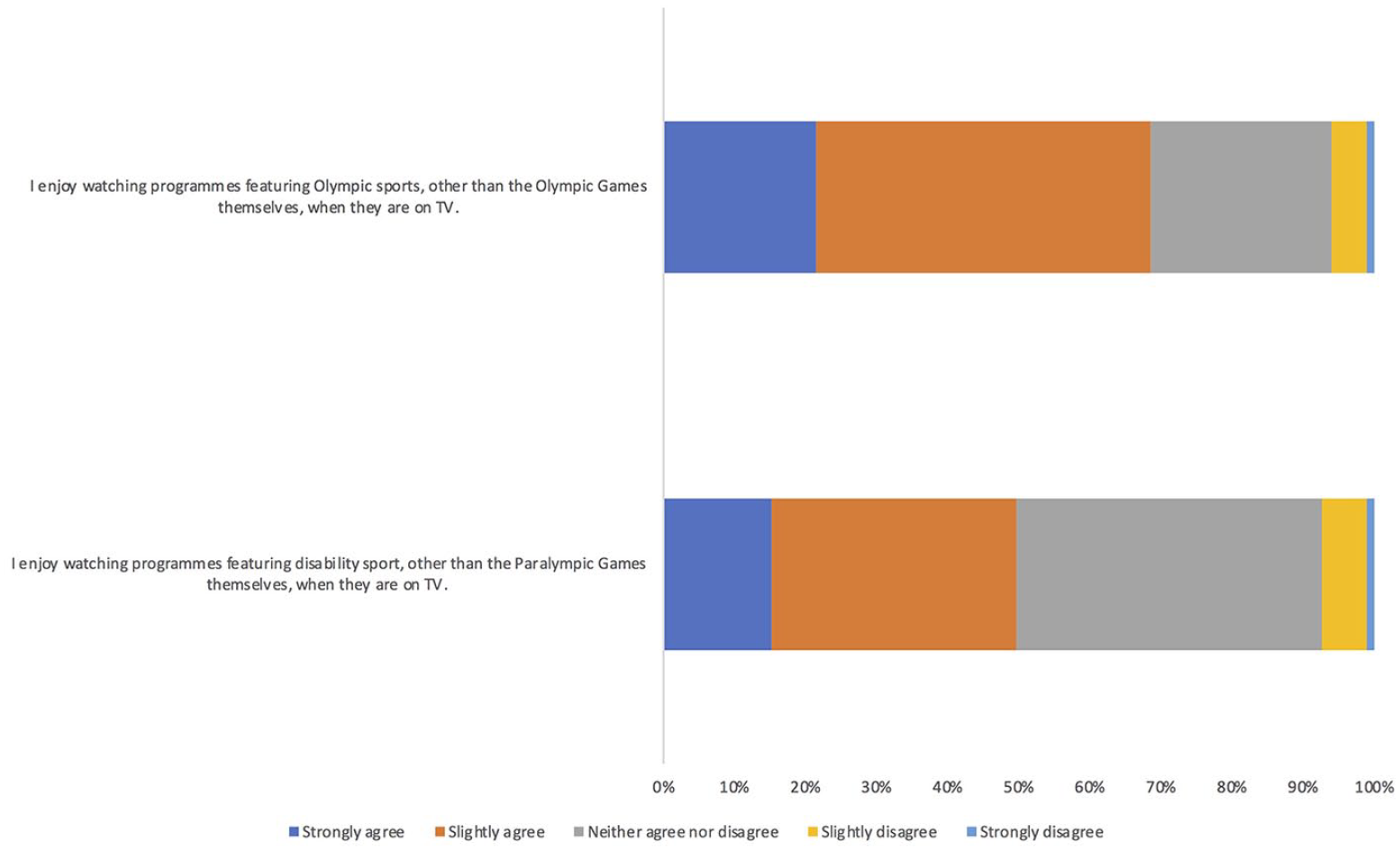
Enjoyment of para-sport beyond the Paralympics.
Furthermore, in Paralympic and para-sport broadcasting there are a number of unique or para-specific events in addition to the IPC’s classification system which adds a layer of complexity and unfamiliarity in para-sport viewing for audiences. Indeed, this is expressed in the claim below:
“I would prefer to watch things where it tends to be the wheelchair athletes because everybody seems to be consistent. When you watch able-bodied athletes, they are all able-bodied and consistent. When you watch wheelchair athletes they’re all in wheelchairs so there is consistency which is easy to follow . . . I can understand what I’m looking at”
While no significant relationships were found for age, gender or disability, survey data indicates that greater interest in sport correlated significantly with interest in para-sport outside of the Paralympics (r[1047] = 0.156, p < .001). Importantly, it highlights the need to provide more para-sport coverage between Paralympic Games to both develop the audience base and improve the familiarity of Paralympic classification systems that help enhance viewing.
What is the Impact of Paralympic Broadcasting on Attitudes toward Disability and Societal Change?
Next, we explored a range of sentiments about the impact of the Paralympics on perceptions of disability sport (RQ2a), and disabled people in general (RQ2b). For these questions, again we only present the data for participants who have followed Paralympic events since 2012 (N = 1047).
For the athletes (RQ2a), we found that 82 percent of Paralympic audiences are interested in the sporting achievements of athletes and 70 percent are interested in the backgrounds of athletes (Figure 3). While there were no significant demographic relationships for interest in athlete achievements, youth was significantly correlated with interest in backstories (rs[1047] = 0.081, p .006) albeit with a weak effect size, disabled audiences (M = 1.93, SD = 0.859) were significantly more likely than non-disabled audiences (M = 2.12, SD = 0.883, t(1015) = 2.830, p < .005) to be interested in backstories, as were females (M = 1.97, SD = 0.889) over males (M = 2.19, SD = 0.860, t(1038) = −3.969, p < .001) 2 . As our wider project data has suggested (Pullen et al. 2019), these backstories were an important feature of C4’s Paralympics broadcasting; a way to develop an audience interest in para-athletes and educate audiences about disability through the lives of para-athletes. Broadly, there is evidence that audiences are responding positively and there is considerable interest in elite disabled athletes.
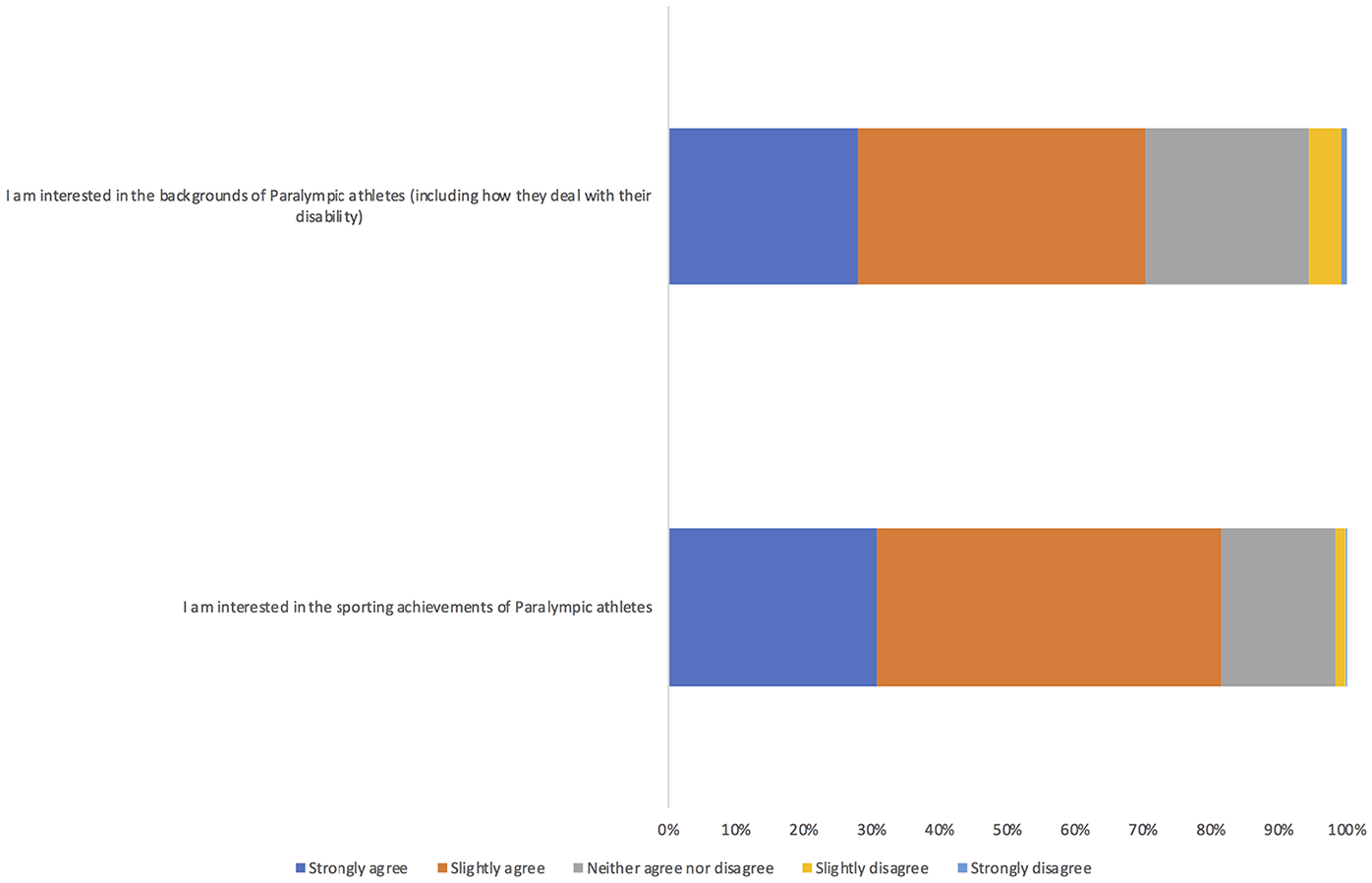
The impact of watching the Paralympics on attitudes toward disabled athletes.
The qualitative audience data evidences this point and the broad appeal of backstories in Paralympic broadcasting. Indeed, as one audience member claimed, backstory features allow the audience to “understand the monumental struggle that many of the sports people were experiencing” and “which just added your you know, even greater to your admiration of those people who were there.” These sentiments were dominant across the audience dataset, with many people claiming how backstories operated through emotive engagement leading to feelings of fanship and support:
“You feel that you have more of a personal, you just feel more like you want to support them, you want to back them and watch them so you know that you kind of know a bit more about their life and how they got to where they are”
The audience responses build on Bartsch et al (2018) who demonstrated how emphatic themes toward athletes in audiences is fostered through the connection with Paralympic backstories—and emotive stories of disability overcoming—and the success of individual Paralympians. Indeed, both the survey and qualitative findings highlight how emotive and individual narratives of success stimulate audience consumption and fanship in multi-event sports coverage rather than through, what Devlin and Billings (2016) described, as the more typical “nation versus nation” (p.59) narratives of single event coverage.
Importantly, in Paralympic broadcasting, backstories provided an opportunity for non-disabled audiences who were less familiar with disability—both on and off screen—to understand many of the social and cultural barriers disabled people faced.
“People are immune to or just don’t choose to know what different disabilities are out there, how severe, like the severity of the same disability it can range. . . I think you’re only going to get the population to know and educate them about it [disability] by doing these stories”
There is evidence then that backstory features in Paralympic broadcasting have stimulated greater awareness of disability amongst non-disabled audiences. Perhaps unsurprisingly then, and as Figure 4 shows, 95 percent of the audience agree that the Paralympics have had a positive impact on the lives of disabled people (with no notable demographic differences) implying a perception of progressive social change (RQ2b). Further, findings demonstrate that 53.2percent agree that it has given them more confidence with disabled people in terms of real-world interactions. Here, the younger you are (rs[1047] = 0.068, p < .05) and more interested in sport you are (r[1047] = 0.147, p < .001), the more likely you agree with the statement, albeit with weak effect sizes. Indeed, the qualitative data supports this; many audience members claimed how the Paralympics have made them “feel much more comfortable engaging with [disabled] people”. This is captured in the extract below:
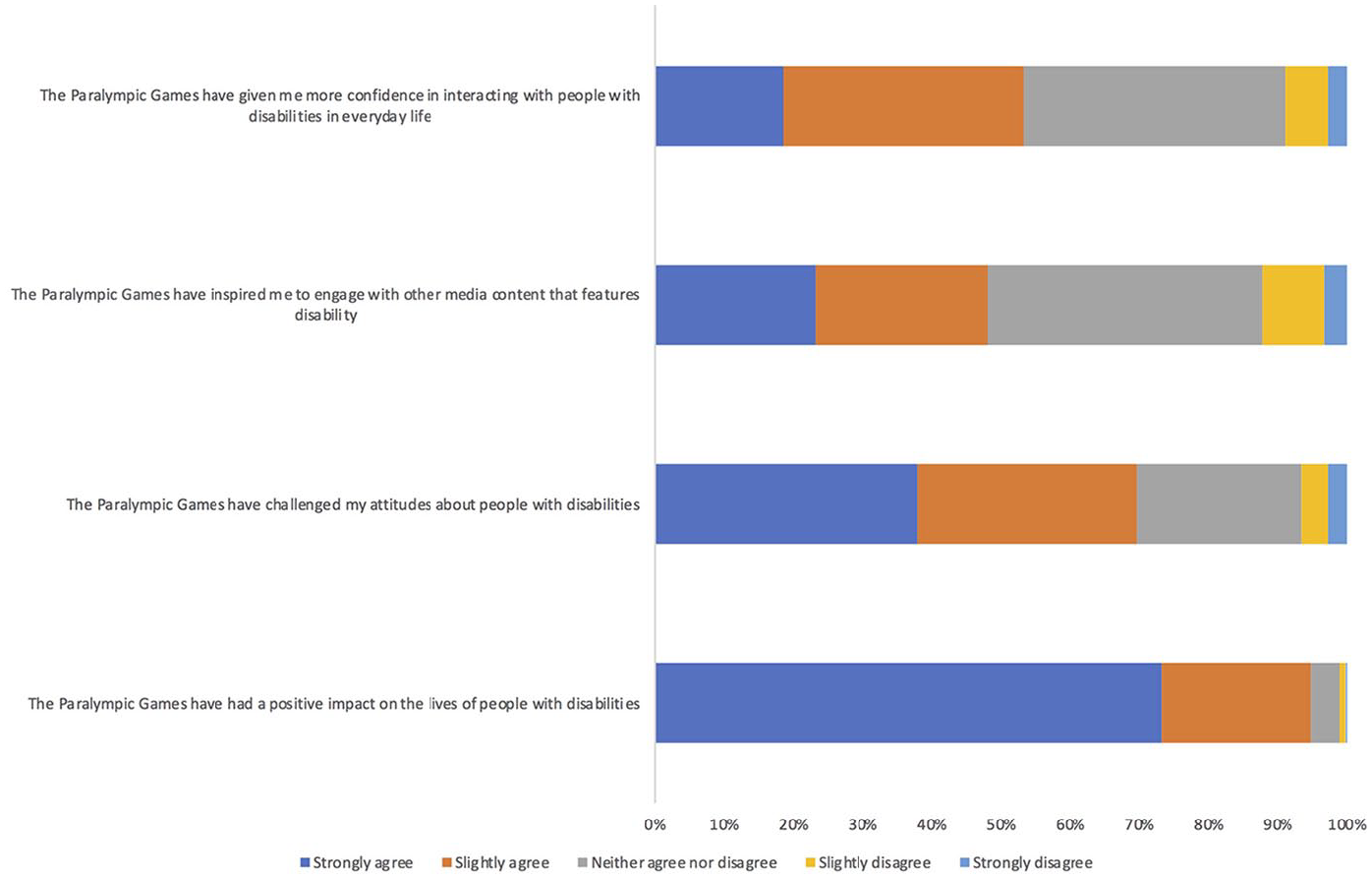
The impact of the Paralympics on attitudes toward disabled people.
“much more willing to try and engage with people I come across in daily life with a disability than previously I might not have. I have found over the last 6 years, having been exposed to it more on TV, that I want to talk to people”
However, there was a small proportion of audience members who suggested that the athlete backstory features focused on disability “defined them a bit too much” and, as one audience member claimed, “Sometimes almost I felt as though I wanted to know less.” Despite the generally positive role backstory features played, there was is an extent to which some audience members felt backstory features exceptionalized disability by reinforcing difference.
For nearly half of participants, the Paralympics has inspired them to engage in other media that features disability, suggesting a considerable impact beyond sport and to general media consumption. Youth (rs[1047] = 0.209, p < .001), and interest in sport (r[1047] = 0.167, p < .001), were correlated with greater agreement with this statement. Indeed, for younger audiences there is now more disability media content available and, as result of diversity practices and “mainstreaming,” greater disability representation across popular program production. Thus, this finding may be less a direct result of the Paralympics, and more so related to the general shift toward more disability representation on TV.
Together, this data presents an important break from previous research in Paralympic audiences conducted prior to 2012 where confidence in engaging with disability was lacking (Hodges et al. 2015). Current findings evidence a clear and palpable shift amongst audiences toward greater societal comfort with disability reflecting a degree of success in C4’s broadcasting strategy centered on progressive social change in public attitudes toward disability. This is similarly reflected in the 70 percent that agree that the Paralympics have challenged their attitudes about disabled people. Indeed, many audience members expressed a similar attitude to the one captured in the claim below:
“I think yeah the Paralympics has probably helped . . . it shows that the job is for everyone and that you shouldn’t feel that just because somebody has that [disability] that they’re not able to do something and that’s exactly what the Paralympics shows”
Perhaps unsurprisingly given their direct experiences of disability, non-disabled audiences (M = 1.99, SD = 0.987) were significantly more likely to agree with the statement than disabled audiences (M = 2.15, SD = 1.093, t(1015) = −2.076, p < .05). Greater interest in sport was also positively associated agreement with the statement (r[1047] = 0.084, p < .05) but with a small effect size.
What obstacles to engaging with Paralympic broadcasting exist?
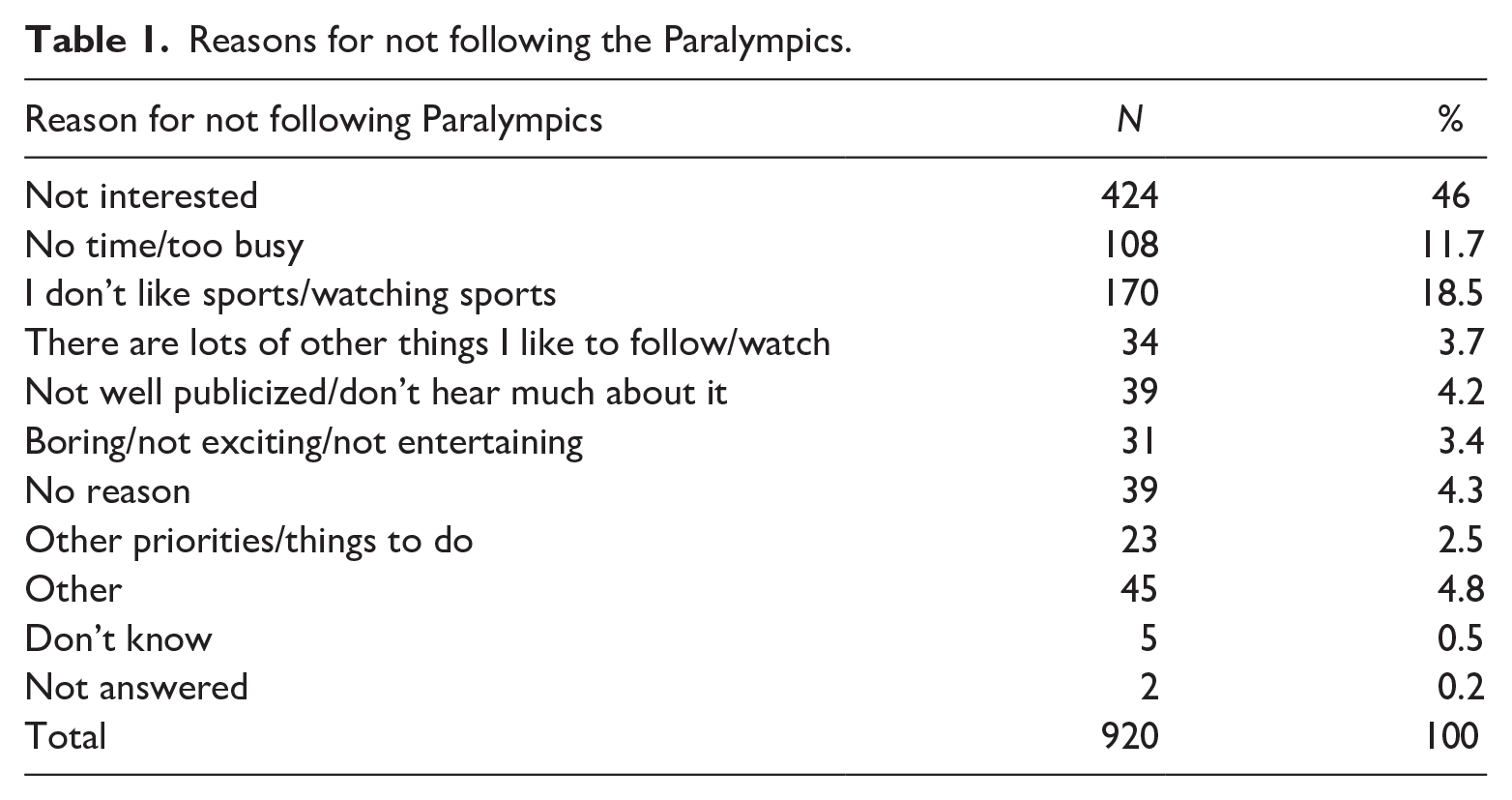
All participants who said they have not followed the Paralympics since 2014 in Figure 1 (N = 920), were asked why in an open-ended question, which were then coded into ten categories seen in Table 1. Findings suggest the main explanations to be a lack of interest in sport generally (18.5%), the Paralympics in particular (46%), and time (11.7%).
Reasons for not following the Paralympics.
These responses suggest that the main obstacles to Paralympic followership lie outside of the way it is represented in the media. However, we also wanted to directly address three obstacles to engaging with Paralympic broadcasting that were identified in previous qualitative research in 2011 to 12 (Hodges et al. 2015) (and were again evident to a degree in the focus groups we conducted), two of which relate quite directly to media representations of disability. Focusing on all participants (n = 1843) except for the 8 percent who have followed the Paralympics “a lot” since 2014 (see Figure 1) we found that in 2019, two of these sentiments (discomfort toward watching disabled people and a feeling that the Paralympics does not represent elite sport) barely registered (with 6% and 13% respectively agreeing with the statements) (Figure 5). Indeed, this is reflected across the qualitative focus groups, with a significant proportion of audiences expressing sentiments such as “I don’t think disability comes into it” and “I like the sport and if I come in I’ll watch it, same with the Olympics, no difference you know.” Compared to sentiments that emerged in 2011 to 12 (Hodges et al. 2015), both the survey and focus group data represent positive social progress for para-sport and disability more widely; a likely impact of the UK’s Paralympic broadcasting.
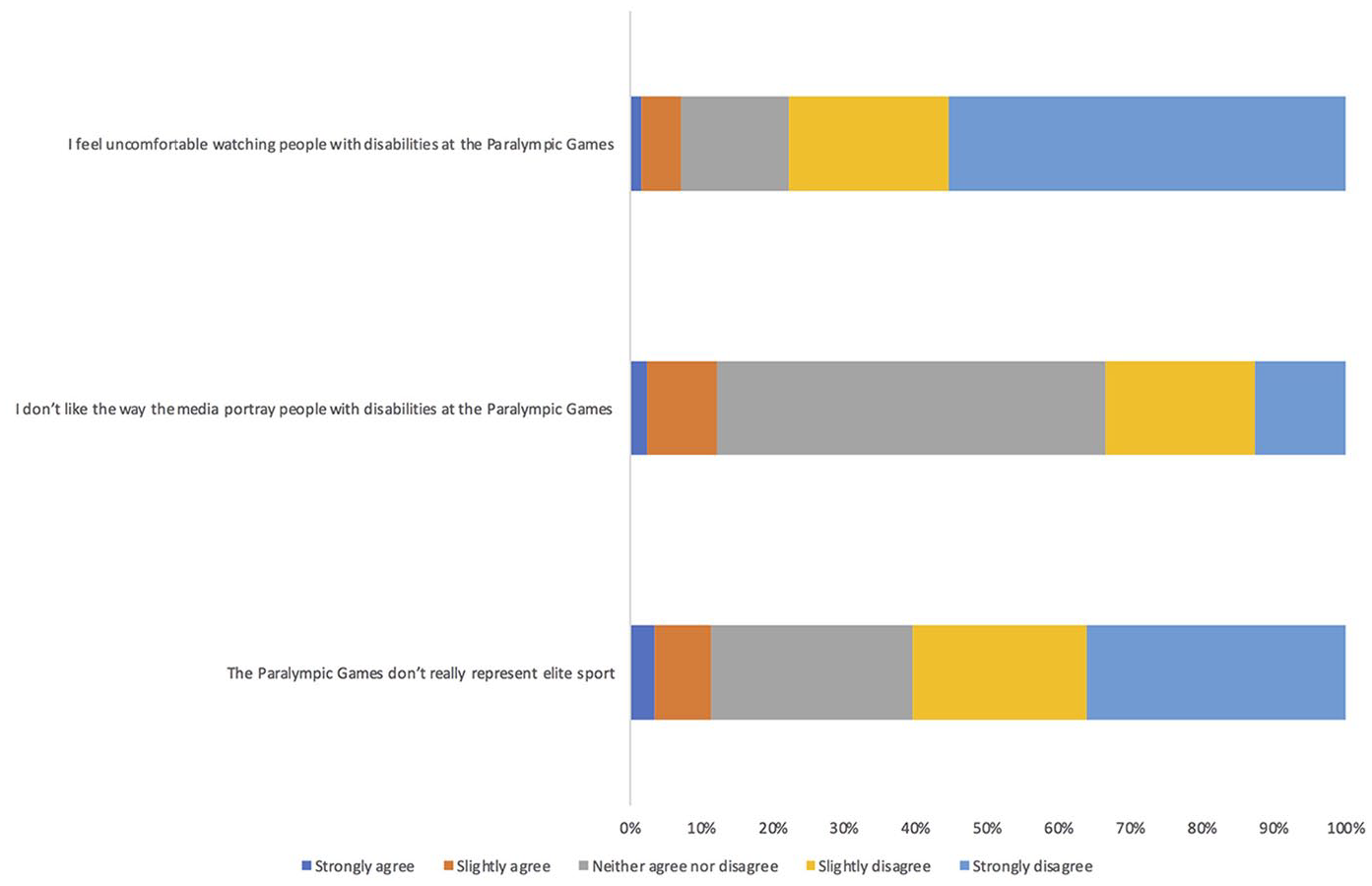
Obstacles to engaging with the Paralympics.
Low interest in sport was positively correlated with discomfort when watching the Paralympics (r[1843] = 0.074, p < .001) as was youth (rs[1843] = −0.092, p < .001). Male audiences (M = 4.16, SD = 1.027) were significantly more likely to feel uncomfortable watching the Paralympics than female audiences (M = 4.32, SD = 0.965, t(1481) = 3.908, p < .05). When it comes to seeing Paralympics as non-elite sport, male audiences (M = 3.67, SD = 1.166) were significantly more likely to agree with the statement than female audiences (M = 3.96, SD = 1.032, t(1481) = 5.664, p < .001), as were older audiences (rs[1843] = 0.053, p < .05) and those less interested in sport (r[1843] = 0.050, p < .05), though again with weak affect sizes.
Opinions were more divided on the manner in which athletes participating at Paralympics are portrayed in the media. The only significant demographic predictor for this question was disability status, where disabled people (M = 3.18, SD = 0.971) were more likely to agree with the statement than non-disabled people (M = 3.37, SD = 0.879, t(1795) = 3.743, p < .001). This points to a deeper tension for disabled audiences, that was expressed in focus groups. This includes perceptions that the Paralympics “glamorises disability” and the “branding all the physical disabilities as superhuman” which, many disabled audiences felt led to further marginalization of non-physical disabilities whilst, at the same time, creating “a lot of pressure on a disabled person to be amazing and to be inspiring.” As one disabled participant said:
“I do think the Paralympics has had a slightly negative effect on the disabled community, because basically, things that disabled people hate hearing is ‘Were you in the Paralympics?’ If they are disabled then they must be in the Paralympics, they must be this superhuman person”
Such data reflects the extent to which “supercrip” narratives (Silva and Howe 2012) are perceived positively by non-disabled audiences and operate to inform and educate, yet, remain a tension for disabled audiences.
Discussion and Conclusion
The findings presented here provide the first mixed methods and integrated empirical analysis of Paralympic audiences to date. Building on the findings of extant qualitative studies (see, Hodges et al. 2015), we asked: who is the audience for the Paralympics in the UK (RQ1); how has watching the Paralympics shaped interest in the achievements of disabled athletes? (RQ2(a)); how has watching the Paralympics shaped perceptions toward disabled people in everyday life? (RQ2(b)), and, what barriers exist amongst UK audiences toward engaging with Paralympic broadcasting? (RQ3). Beyond the detail of the audience data presented hitherto, in the following discussion we present four overarching findings that stand out as important for taking our understanding of mediated para-sport forward.
Our findings could be read as highly promising for the Paralympic vision and the role of national PSB therein. Before 2012, the Paralympics operated on the margins of UK TV schedules, only receiving daily highlights to relatively small audiences. Audience research conducted prior to 2012 suggested there was little more than a niche audience following, with significant barriers to engaging with disability sport for many (Hodges et al. 2015). After two Paralympic cycles since 2012—and with its elevation to mainstream TV schedules—our first key finding is that the UK Paralympic audience is both considerable and demographically diverse largely reflecting Olympic fan demographics (see Tainsky et al. 2014; Tang and Cooper 2012). Indeed, given the considerable audience following, we would suggest there is a para-sport media market beyond the Paralympic Games; an important finding for broadcasters who have yet to fully realize both the commercial and cultural potential of para-sport beyond the dictates of the mega-event marketplace.
Further, our data implies that spectatorship of the Paralympics has facilitated progressive social change (RQ2(a,b)); our second key finding. This is important given the philosophy of the Paralympic movement, aims of the IPC, and C4’s statutory remit as a PSB. Despite this vision—largely at odds with the logics of the sport media economy—the Paralympics has indeed managed to capture a considerable audience, be commercially successful, and shift attitudes toward disability and disability sport by stimulating many audience members to reflect on their own assumptions and perceptions. Certainly, perceptions of Paralympic athletes and disability sport by non-disabled audiences were positive and tensions concerning representation and obstacles to engagement were far less pronounced than prior to 2012. This finding has important cultural significance insofar as it demonstrates progressive social change over time and the power of public service broadcasting remits in contributing to challenging attitudes and understandings around marginalized sporting groups and identities. With the global retreat of public service broadcasting and rising tide of digital narrowcasting and neoliberal deregulation, this finding is of critical importance in demonstrating the cultural value of PSB in sports broadcasting and its role as a crucial platform, beyond sports broadcasting, for challenging the status quo and disability rights.
Throughout the data there were traces of demographic differences, albeit with some small effect sizes. Two such threads were that younger and, at times, female audiences were more receptive to Paralympic broadcasting. This is our third key finding. The generational differences in audience viewing were likely a result of differences in societal comfort with disability in younger people which impacted on their engagement with the Paralympics. Indeed, it was clear from the focus group data that younger generations perceived disability as far more culturally visible and felt comfortable engaging with disability in wider cultural settings. We argue that this is largely a result of greater integration of disability within institutional and social spaces—especially in the last decade—through progressive inclusionary policies (particularly in educational spaces) as well as disability mainstreaming across PSBs and other media platforms of which are likely to impact younger generations (See Ellis and Kent 2016).
The gender differences are of potential significance given the historical dominance of male sports and the impact this has had on the gendering of sporting audiences in the media sport landscape. Indeed, when placed alongside other sporting mega-events (including the Olympics), the Paralympics is unique in the gendered make up of its audience. This may be partly a result of the IPC’s focus since 2012 on greater gender parity across Paralympic events with the Tokyo 2021 Paralympics set to include more female Paralympic events than ever before (Paralympics.org 2017). Whilst this has implications for the future marketing and promotion of the Paralympics, it provides an important context to study issues of progressive gender representation at the intersection of disabled bodies through a feminist critique of representation across both broadcasting and digital platforms.
On the other hand, our fourth key finding—hinted at within the survey data but more evident in focus groups—was that disabled audiences are somewhat less positive when discussing Paralympic broadcasting and more critical of its role as a vehicle to social change. Indeed, the tension for disabled audiences’ centers on the normalization of particular types of disabled people through Paralympic coverage therefore contributing to societal comfort and visibility of certain physical forms of disability. This tension implies that C4’s Paralympic broadcasting continues to be viewed by disabled people as relatively exclusionary of the vast majority of disabilities, contributing to marginalization and disability representation palatable for consumption by non-disabled audiences. This is a criticism aimed at much mainstream media in the representation of disability on screen (Ellis and Goggin 2015). This finding provides a broad indicator of the impact of greater diversity within the production of disabled media by disabled people themselves given the higher proportion of disabled people involved in C4’s Paralympic production (and as on-screen presenters). Certainly, tensions over media representation of disability continue to remain an issue and this presents a challenge to broadcasters committed to greater mediated disability representation and the inclusion of more disabled people in the production process. Potentially, a media “deficiency” between production and representation of disability content exists; a further avenue to explore through future qualitative research exploring the impact of Paralympic production.
Whilst our findings provide the first integrated mixed method study to explore Paralympic audience interest and engagement to date, our quantitative findings are limited by being drawn from a single-shot survey reliant on self-reported attitude change. Only with replication over more Paralympic cycles can we measure attitudinal change and the role of broadcasters with a degree of certainty. Further, our study is conducted in a national media context where progressive disability representations are increasingly common (Clayton et al. 2014), and where the Paralympic broadcaster has committed to both elevating the Paralympics to mega sporting spectacle and challenging disability stereotypes. These conditions will be present in other countries, and so it is crucial that we build a comparative evidence base on which to further understand how audiences are responding to the increasing (albeit cyclical and ephemeral) visibility of disability. Our study suggests that despite the many historical shortcomings in the media’s representation of disability sport, progressive and committed broadcasting of the Paralympics can be both commercially successful and an agent of social change. Amongst the many research questions that still remain, we now need to examine the dynamics of broadcasting (from policy to production practices, content to audience consumption) in other national contexts, to understand the conditions, logics, and relations of power under which progressive social change—facilitated by sports broadcasting—can prosper.
Footnotes
Declaration of Conflicting Interests
The author(s) declared no potential conflicts of interest with respect to the research, authorship, and/or publication of this article.
Funding
The author(s) disclosed receipt of the following financial support for the research, authorship, and/or publication of this article: This research was funded by the Arts and Humanities Research Council (Grant Reference: AH/P003842/1).
