




Abstract
This article examines several recent changes in the technological composition and market logics of television. It considers what these developments might mean for the medium’s preservational qualities and for our understanding of television history more broadly. By focusing on the growth of streaming, the increasing “datafication” of the TV industry, and the prominence of interfaces and catalogs, I demonstrate that the ephemerality of television is both intensifying and diversifying, creating a number of methodological challenges in the process. These developments are placed in a longer history of critical debates around the preservation of digital media and the prospect of a digital dark age so that we might learn lessons from the past that can be applied to the preservational challenges of the present. The article concludes by proposing a number of practical steps so that future television historians might be better equipped to avoid a “scholarly dark age.”
Keywords
For a brief moment in late 2017, eagle-eyed Netflix subscribers were able to access an Easter egg, promoting the second season of the streaming service’s popular series, Stranger Things (2016—present). By clicking on the twisted, pulsating red and black vines located on the right-hand side of a promotional banner, situated at the top of the Netflix interface (see Figure 1), viewers were virtually transported to the “Upside Down”—the fictional parallel world featured within the series itself. Once there, the interface quite literally turned upside down, rotating 180°, whilst the visitor’s cursor transformed into a torch that could be used to highlight different areas of the now dimly-lit screen. The transformation included other aesthetic and aural elements associated with the series such as the signature floating particles and an array of familiar and ominous sounds. The sequence concluded with the sudden appearance of a “Demogorgan” leaping toward the viewer at which point the interface reverted back to its original state. As is usually the case with these kinds of paratextual materials, this Easter egg was only available for a short period of time before it eventually disappeared, mirroring the ephemeral, intangible, and elusive nature of the parallel universe that it sought to depict.
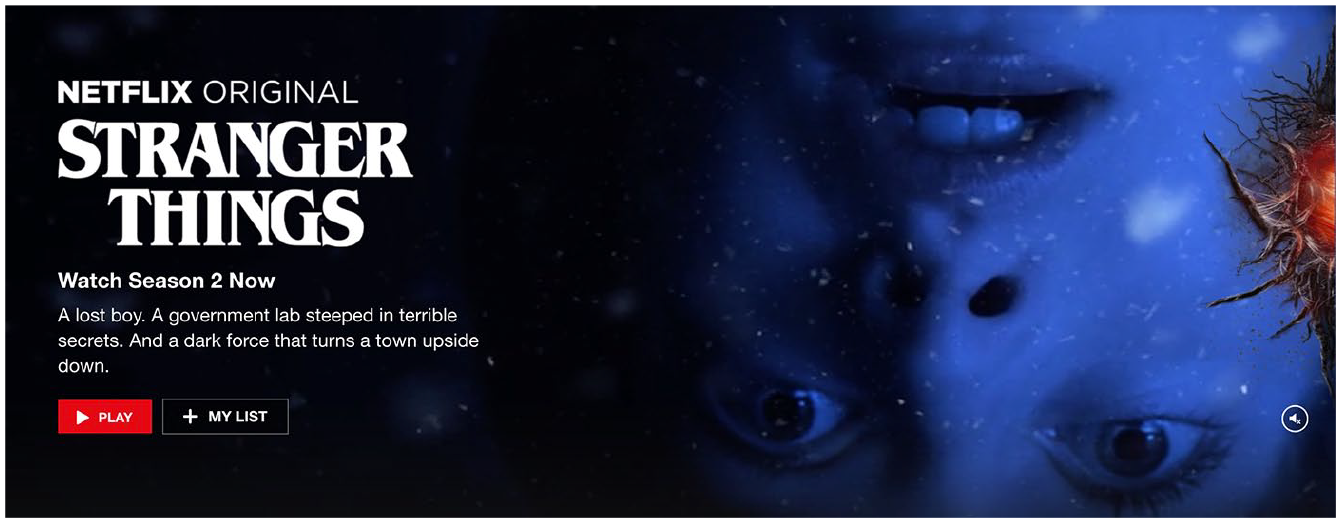
Screenshot of the Stranger Things promotional banner which appeared on the Netflix interface in late 2017.
The Stranger Things Easter egg is just one of countless examples that demonstrates the increasing ephemeralisation of contemporary screen media. In this instance, the ephemerality stems from the fleeting availability of the promotional text which, once no longer available via the Netflix interface, becomes impossible to reproduce and therefore impossible to study. Although television has always been a highly ephemeral medium (Holdsworth 2011, 1), most of the various promotional elements of broadcast TV—namely advertisements, trailers, and interstitials—were at least archivable, even if only a small percentage of those texts were actually preserved. But today, television is increasingly delivered via platforms (as opposed to networks) and through interfaces and algorithms (as opposed to schedules), all of which are intrinsically more ephemeral (Johnson 2019). Although fans often document these promotional materials—typically through screen captures which are uploaded to video archives such as YouTube—they still remain difficult to locate, are vulnerable to sudden loss (for example, through copyright takedown claims), and often lack sufficient contextual information (when and to whom was it made available and under what circumstances did it appear?) Furthermore, these archived versions are only ever secondary representations, often lacking the interactive properties that characterize the originals, and thus denying scholars the opportunity to examine these texts in their original and intended form.
Given the proliferation of highly ephemeral paratexts such as the Stranger Things example cited above, it is unsurprising that there has been a growing critical concern with the more fleeting and oft-neglected aspects of media culture (see, for instance; Grainge 2011; Gray 2010; Pesce and Noto 2016). 1 Notably, these studies appear to share the consensus that ephemerality has been driven by a number of factors, key amongst them the simultaneous proliferation, brevity, and transience of such promotional materials. But this is just the tip of the ephemeral iceberg, so to speak. In addition to the proliferation of interactive and highly transient paratexts such as the Stranger Things promotion, television has become ephemeral in a number of other ways in recent years. This includes the ongoing “datafication” of the creative industries, the prominence of interfaces, catalogs, and personalization, and the rise of the subscription economy as an ever-more popular model of media consumption.
Ephemerality today is thus an increasingly widespread, multifaceted and complex challenge for media scholars. But it is particularly challenging for television historians for whom the object of study itself has undergone a profound transformation, resulting in a medium that has become much more resistant to preservation. However at one time, television scholars had to contend with documenting, analyzing, and archiving a relatively limited and arguably much more ontologically defined set of texts and paratexts—though admittedly many of these have since been lost—today, we find ourselves in the midst of a heavily saturated mediascape in which it has become all but impossible to keep track of the volume, variety, or circulation of these texts let alone their various paratexts. Furthermore, scholars tend to have very limited access to the data that are generated through our frequent interactions with these texts and paratexts (Andrejevic 2014; Kelly 2019), data which are becoming increasingly influential when it comes to making decisions about the production and distribution of television, and which therefore have significant value in an academic context.
In light of these various developments, this article intends to broaden the scope of current debates around television ephemerality, debates which have tended to focus on the more paratextual and promotional aspects of this phenomenon. In doing so, I argue that ephemerality is not only confined to television’s more fleeting and marginal texts, but that it permeates the medium in a range of different ways, all of which will have significant implications for media historians, for how we might preserve these increasingly complex and diverse forms of contemporary television, and ultimately for how we might access and study them in the future. In particular, I argue that despite the utopian view that digital technologies provide us with limitless archives, endless choice, and instant and ubiquitous access, television is, in many ways, becoming increasingly ephemeral and therefore ever more prone to loss. This article focuses on streaming as an emerging space where these issues are most prevalent and where ephemerality is therefore most pronounced. These developments affect both film and television, but to address both would be beyond the scope of this article. Having said that, the boundaries between the two have become increasingly blurred, particularly in the context of the streaming industries, and thus the arguments I present here are largely applicable to both.
Whilst I argue that media historians are facing a number of new challenges, I consider these recent developments in relation to a longer history of popular and critical debates around the preservation of television and digital culture—particularly in relation to growing anxieties around the perceived threat of a digital dark age (Kuny 1997). In doing so, I suggest that we might simultaneously learn something from these earlier accounts, whilst also using them to draw attention to the different anxieties and challenges involved in the preservation of contemporary TV. Following this, I use the example of Netflix, currently the most popular subscription video-on-demand (SVOD) service in the world, to illustrate how these anxieties are beginning to manifest and to consider some of the methodological challenges this presents for media historians today and in the future. Finally, the article concludes by proposing a number of practical steps and further lines of enquiry so that future television historians might be better equipped to avoid a “scholarly dark age.”
A Digital Dark Age?
One of the main anxieties around digital preservation today is the concern that content and data are being produced at a far greater rate than they can be cataloged and stored. Indeed, there is a consensus amongst critics that we now live in the age of “big data,” an era in which information is not only rapidly proliferating but in which it is also becoming an increasingly integral if often unseen part of economic, political, and cultural activity (Kelly 2019). While digital technologies have no doubt contributed to this surfeit of data and content, the idea that we are living in an era characterized by abundance and expansion is hardly new (Milligan 2019), especially in the context of television history. Studies of the historical development of television have routinely drawn attention to its trajectory of continued growth and expansion. For instance, in his seminal account, John Ellis (1999) describes the history of television using volumetric terms, as a gradual evolution from “scarcity” to “availability” to “abundance.”
Despite the long history of these debates around excess and preservation, these concerns are especially acute today. This is due to a number of different factors including the proliferation of new forms of data such as those generated through our interactions with television, data that are rarely archived let alone made available outside of specific institutional boundaries. This particular example supports the idea that we are entering into, if not already in, a digital dark age (Kuny 1997). Broadly speaking, the prospect of a digital dark age is based on the belief that digital and electronic media are, in many respects, much more ephemeral than their analogue antecedents (Bollacker 2010; Keene 2002). As such, a central tenet of the digital dark ages critique holds that historians in the future will know very little about late twentieth and early twenty-first century digital culture. To give just one example, while a significant amount of historical research undertaken today relies heavily upon physical archives of hand-written correspondence, production notes, annotated scripts, and other such analogue artifacts, there is a great deal of uncertainty as to whether future historians will have access to the email threads or other digital data that surround, accompany, and inform contemporary productions. More problematically, however, there is a great deal of uncertainty as to whether these materials are even being preserved in the first place.
The concept of a digital dark age gained widespread notoriety after it featured in a keynote address by Vint Cerf, vice president of Google, early in 2015 (by Maffeo 2015). However, it has a much longer history than this. Indeed, it is worth briefly revisiting the original formulation of this critique, as many of its key characteristics are pertinent to issues around the growing ephemerality and subsequent need for preservation of digital media culture today. The first recorded reference to the concept of a digital dark age appeared in a paper by Terry Kuny, presented at the International Federation of Library Associations and Institutions conference in 1997. In the paper, Kuny (1997, 1) expressed a concern about the rate at which information was expanding, arguing that “one of the impacts [of the information age] is how we are to preserve the historic record in an electronic era where change and speed is valued more highly than conservation and longevity.” Kuny (1997, 1) goes on to outline a number of justifications for his assertion that, “we are moving into an era where much of what we know today, much of what is coded and written electronically, will be lost forever.” Several of these are especially pertinent to the changes currently taking shape around television today, including (i) too much information, (ii) non-accessible information, and (iii) non-reliable information. Indeed, these are problems that have come to characterize the challenges of working with big data and which will therefore need to be addressed by television scholars as the datafication of the industry continues to gather momentum (Kelly 2019).
Within these broader categories, Kuny identifies a number of more specific factors that are contributing to this supposed digital dark age, several of which again speak to current developments around television today. Key amongst these are as follows:
Hardware and software obsolescence. For instance, files that become inaccessible due to updates or changes in software, codecs, and/or operating systems (something that has become particularly important for digital media historians).
The increasing privatization of data, which Mark Andrejevic (2014) has more recently described in terms of a “data divide” in which access to information is increasingly uneven, almost always privileging institutions over individuals.
“Increasingly restrictive intellectual property and licensing regimes” (Kuny 1997, 3)—in other words, copyright issues going on behind-the-scenes that are jeopardizing the potential permanence of, and access to, digital media.
From Owning to Renting: The Rise of the Subscription Economy
Kuny’s suggestion that the prospect of a digital dark age is partly driven by “increasingly restrictive intellectual property and licensing regimes” is somewhat prescient of a broader transition currently taking place across the media industries—one that involves and affects the preservation of, and access to, television. As a number of scholars have already observed (Johnson 2019; Lotz 2017; Nelson 2014; Steirer 2014; Tryon 2009), the media industries are embracing more ephemeral modes of delivery, in which permanent and physical models of ownership are gradually being displaced by more temporary forms of access. This growing economic model is often referred to as the subscription economy and has become popular across a range of industries, products, and services.
Elissa Nelson (2014, 63), for instance, has observed that DVD sales of film and television began to decline as early as 2004. Prior to this decline, however, television enjoyed a brief period in which it was perhaps at its least ephemeral.
2
Although it is difficult to substantiate such an abstract claim, the proliferation of physical media in the early 2000s, coupled with the popularity of digital recording technologies such as TiVo, suggest that this was a period in which more television was being owned and archived than ever before. Citing a study by Barry Brown and Louise Barkhuus, Sharon Strover and William Moner (2014, 238) note that: . . . while television in the broadcast era was largely ephemeral . . . informants described archiving behavior with DVRs and peer-to-peer downloading. For example, users of BSkyB’s Sky+ DVR service record several episodes of a series on their devices and then watch multiple episodes in order in one sitting.
However, it is important to bear in mind that whilst more television was being recorded to DVRs, this does not necessarily mean that more television was being permanently archived. Devices such as Sky+ have limited storage space, are designed to easily overwrite or automatically delete previously viewed content, and are routinely upgraded. Even if recordings are retained, it is difficult to “export” them from such a device so that they can be archived and made available at a later date. Likewise, it is important to remember that during this same period certain forms of television were being purchased and archived far more than others. As Matt Hills (2007) has pointed out, the introduction of DVDs resulted in generic discrimination between those titles that were preserved and those that were ultimately discarded. As Hills (2007, 50) explains: . . . shows which are culturally and discursively positioned as being absolutely “of their time,” or as being disposable parts of “that day’s schedule” remain far more likely to permanently disappear from consumer availability, in marked contrast to “high-end” and “quality-popular” or cult TV.
As such, even though television enjoyed this brief spell of heightened preservation, large sections of it remained highly ephemeral. 3
At the same time, however, a significant amount of television (and film) was, and still is, being preserved via other less-official channels such as peer-to-peer networks. In many ways, the unofficial copying and sharing of content through sites such as Pirate Bay 4 is a continuation of earlier analogue archival practices which equally sought to address the problem of television’s ephemerality, only today it occurs on a much larger scale. While peer-to-peer networks offer access to content that might otherwise be lost or discarded, this is often on a very temporary basis with empirical studies demonstrating that “relatively few torrents exhibit long-term survivability” (Martin 2016). Moreover, these unofficial sites are less likely to archive paratextual materials, particularly those that are more resistant to preservation such as audio-visual content embedded within an interface. Fortunately, many of these materials are often archived, or at the very least described, on fan-run wiki sites. Peer-to-peer networks and wikis thus clearly function as crucial sites of cultural preservation (Tanvir 2014), but their unofficial status means that they tend to remain highly ephemeral, incomplete, and therefore unreliable.
As the examples above suggest, the Internet has created both opportunities and challenges when it comes to the preservation of television. In terms of the latter, the dwindling popularity of physical media is often understood to be a direct consequence of the emergence of newer models of delivery such as streaming. As Chuck Tryon (2009, 3) argues, “the persistent availability of movies through different VOD services has altered their value, often with the result that consumers have felt less urgency to own copies of individual films.” Although Tryon’s account is primarily concerned with the impact of digital distribution on film culture, his argument applies equally to television. Either way, there is clearly an inverse correlation between the rise of streaming and the decline of the physical ownership of television, resulting in more intense and diverse forms of ephemerality.
But what is driving these changes? As Gregory Steirer (2014) has suggested, the economic logic underpinning this distributional shift from ownership (or permanence) to subscription (or ephemerality) is largely the result of efforts by the industry to assert greater control over media products at all stages within the economic chain. This is where streaming and digital downloads have a distinct advantage for rights holders. After physical media are first purchased (known as first sale), they can be sold on in secondary markets. However, the original publisher will not see any of these profits. As Steirer points out, these secondary markets exist thanks to the legal concept of the “First-Sale Doctrine” which affords consumers a greater degree of control over what happens to the physical text—most importantly, including the right to sell it on. The first-sale doctrine, however, does not apply to digital-only copies. Streaming therefore represents a key opportunity for the industry to “wrest power back from consumers and retailers” (Steirer 2014, 80). In doing so, it creates a steady and more secure revenue stream for SVOD services in what has historically been a very unpredictable market. For consumers, the subscription model has its advantages too. Subscribers can get access to thousands of titles for the same price (or less) than the cost of one physical copy, albeit temporarily. Media historians also benefit from the increase in access to content, just as they did following the arrival of DVDs (Hills 2007). Unlike DVDs, however, the subscription model is far more ephemeral and therefore poses a number of challenges when it comes to preservation.
At present, streaming constitutes a relatively small but growing percentage of our overall television viewing diet. As such, the issues I have identified around ownership and access will only become more pronounced in years to come. Indeed, according to the 2018 Communications Market Report by UK broadcasting and telecommunications regulatory authority Ofcom, the average UK viewer spends 71 percent of their time watching broadcast TV (though only 51% of this is viewed live via a TV set), whilst the remaining 29 percent is comprised of content accessed via streaming services such as YouTube, the BBC iPlayer, Netflix, and Amazon (Ofcom 2018). However, this latter figure is significantly higher amongst those aged between sixteen to thirty-four (54% for this particular demographic versus 29% for all demographics), suggesting that streaming will play a much more prominent role in the audio-visual diets of future generations. 5
Studies such as the Communications Market Report indicate that Netflix has played a central role in the growth of streaming. While there are a number of streaming services—some commercial, some public service—Netflix is the most widely used and globally accessible. Indeed, by the first quarter of 2019, the streaming service reported almost 149 million subscribers worldwide (Statista 2020), a figure that rises substantially if we bear in mind that subscribers tend to share their accounts with family and friends. My own personal subscription, for example, is accessed at various times by myself, my wife, my two children, and both of my parents. Even at a relatively conservative estimate of three users per subscription, it is feasible that Netflix is already being accessed by well in excess of 400 million people across the globe.
Netflix also warrants attention because of its successful foray into original production. Thanks to critically acclaimed series such as House of Cards (2013–2018), and Orange is the New Black (2013–2019), the streaming service has accrued an impressive number of industry-recognized awards and nominations over the past few years, even surpassing more established networks (for example, at the 2015 Emmys they received thirty-one nominations to AMC’s 26). Given its exclusive rights to this catalog of prestigious content, Netflix can no longer be considered an on-demand database of repurposed film and television content—that is, as a collection of programming readily available on other networks, via physical media, and/or through other streaming services. Rather, through its growing investment in original productions and exclusive streaming rights, 6 we are seeing an increasing amount of original content housed behind its subscription pay-wall. This, in turn, has implications for the study of contemporary television, as it renders otherwise useful archival tools such as the Internet Archive’s “wayback machine” entirely ineffective. Of course, Netflix original series do usually receive a physical release, though this seems to be a less common practice for its original films (Wroot 2019). 7 Nevertheless, the fact remains that sales of DVDs and Blu-Rays are still declining significantly whilst subscriptions to digital streaming services continue to grow. Ultimately, these trends suggest that the once popular practice of permanent ownership is gradually being replaced by the much more temporary option of streaming, making television more ephemeral and intangible as an object of study.
The Challenges of Studying Online TV
Netflix has clearly established itself as a key player in the television market—as such, its ephemeral model of distribution requires further interrogation. Here, I want to consider how the emergence of SVODs presents a number of specific methodological challenges for media historians, focussing on two related areas that, in different ways, highlight the complex ephemerality of streaming—firstly, the interfaces and catalogs of services such as Netflix, and secondly, issues around access and the “data divide” (Andrejevic 2014).
Interfaces and Catalogs
When it comes to studying streaming, the first and perhaps most obvious methodological obstacle is the highly ephemeral nature of interfaces and catalogs (Johnson 2019), both of which are integral to the operation of services such as Netflix. While the programmed flows of broadcast television are relatively fixed and, to some extent, well documented, 8 the “schedules” of streaming services are highly personalized, often unpredictable, and therefore virtually non-existent. Historically, scheduling practices have provided crucial insights into our understanding of the social, cultural, and ideological functions of broadcast television (Ellis 2000), but this temporal dimension is largely absent within the streaming realm.
Given the relative flexibility and variety of choice offered by services such as Netflix, it is increasingly difficult if not impossible to make generalizations about what people are watching. It is also surprisingly difficult to know what is even available in the first place. This is largely because digital catalogs are highly prone to change. As Jussi Parikka (2012, 99) explains: Although the traditional archive used to be a rather static memory, the notion of the archive in Internet communication tends to move toward an economy of circulation: permanent transformations and updating . . . The aesthetics of fixed order is being replaced by permanent reconfigurability.
Although Parikka’s assertion that traditional archives are a “rather static memory” could be contested (given that physical items are constantly added, removed and re-ordered), the digital catalog is, comparatively speaking, much more transient. In the case of Netflix, this paradoxical notion of “permanent reconfigurability” is most visible in its interface, which differs significantly depending on a number of contextual factors, including time, location, user, and device. The main interface itself is largely organized around a series of constantly evolving recommendation lists. These range from the highly specific “top picks for you,” and “because you watched . . .” to more generic categories such as “popular on Netflix” and “New arrivals.”
The ephemerality of the interface is further compounded by the fact that it is frequently intertwined with other forms of television ephemera, such as the Stranger Things example with which this article begins. To reinforce this point further, I want to briefly draw attention to another visit to Netflix during which time I was confronted with a rather unusual recommendation list entitled “Watched by Tobias Fünke”—a fictional character from Arrested Development, a sitcom that was revived by and exclusively distributed via Netflix from its fourth season onwards (see Figure 2).
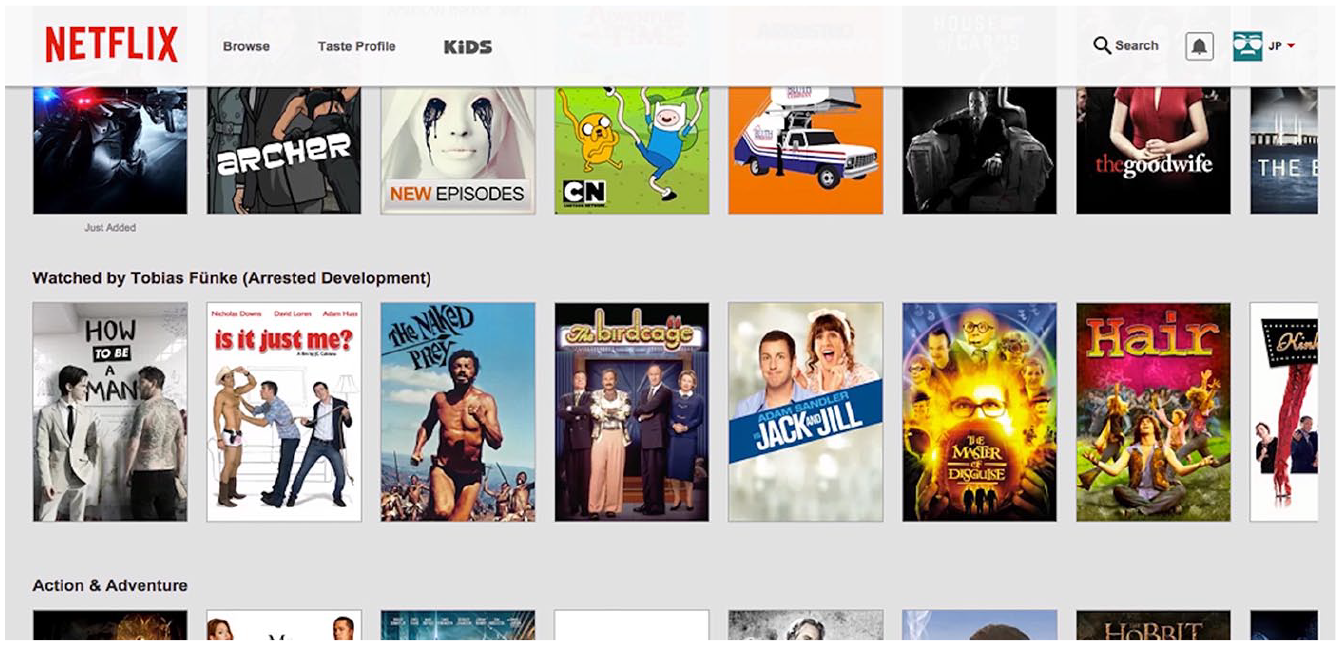
Screenshot of the Netflix interface featuring a “Watched by Tobias Fünke” recommendation list.
This particular recommendation list featured a number of titles that gestured toward one of the series’ running jokes in which Fünke’s heterosexuality is subject to constant scrutiny. Although a rather humorous and unusual example of how Netflix was able to exploit the versatility of its interface, the use of this narrative detail has implications for our understanding of the original text (in this case, by reinforcing a certain character’s traits) 9 and for our consumption of film and television more broadly (e.g. by algorithmically recommending other content based on very niche, inside jokes related to an individual’s viewing history).
As I soon discovered, the “Watched by Tobias Fünke” recommendation list was just one in a larger constellation of Arrested Development paratexts through which Netflix sought to exploit the versatility of its interface. This included search results pages for titles containing the word “blue” bearing painted hand-prints of the same color, in an obscure reference to Fünke’s failed attempts to join the Blue Man Group, another running gag in the series. It also included fake entries in the Netflix catalog for non-existent titles such as Mock Trial with Judge Reinhold and Les Cousins Dangereux, both of which exist only within the narrative world of Arrested Development. 10 Although these examples may seem trivial, paratexts are an important part of an increasingly complex media culture in which the television text is just one of many different elements. Located at the “threshold of interpretation”—to borrow Gerard Genette’s (1997) term—paratexts (and, by extension, interfaces) frame and shape our encounters with texts in significant ways (Gray 2010; Kelly 2018). Yet the examples cited above no longer exist, once again illustrating the highly transient nature of the Netflix interface and the permanent loss of various television ephemera. Unfortunately, because these kinds of paratexts do not necessarily translate to other formats, they are rarely made available beyond the SVOD interface—unlike the bonus materials that are regularly bundled onto physical releases and which have become an important resource for media scholars. Indeed, it is comparatively rare to find materials such as director commentaries or behind-the-scenes featurettes on streaming services such as Netflix—materials which are commonplace on physical releases. 11 Of course, paratextual materials have always existed and locating them has always been a challenge for media historians. However, contemporary paratexts are far more diverse and far more prolific, making archiving and retrieving them all the more difficult. For example, in their recent analysis of television interfaces, David Hesmondhalgh and Amanda Lotz (2020) give the example of electronic program guides (EPGs), describing how they have become much more complex and sophisticated over the years, offering more layers and levels through which a user can navigate. If anything, such observations highlight some fundamental differences between earlier analogue and electronic paratexts and those that circulate today, with the latter often more resistant to preservation not least due to their prolificacy. These observations also stress the urgency with which we therefore need to develop new methods for preserving the increasingly complex and intangible elements that surround contemporary television. 12
It is npt just the interfaces and paratexts of streaming services that are susceptible to loss. The main collection itself is also subject to “permanent reconfigurability” (Parikka 2012). This is evident in that content is continuously added and removed. While some services, such as the BBC iPlayer, often foreground expiration dates, in the case of Netflix the removal of material can occur without prior warning. This uncertainty around the availability of a title can be frustrating for subscribers who can, and have, suddenly lost access to content—particularly when in the middle of a long-running series. There are also problems with the variety of content available in VOD catalogs, with many streaming services appearing to prioritize more contemporary content to the detriment of “classic” film and television series, so much so that popular website Vox.com once boldly pronounced that “The age of streaming is killing classic film” (VanDerWeff 2016). This emphasis on more contemporary content has obvious ramifications for both film and television studies, limiting access and exposure to classic titles—a problem that was compounded by the closure of Turner Classic Movies (TCM)’s classic film-oriented VOD service, FilmStruck in 2018 despite the very same Vox article suggesting that this SVOD service could well be the savior of classic film. As these examples indicate, the rise of streaming is having a significant impact on the availability and types of content that can be accessed via VOD services, with provision of short-term availability of more contemporary titles seemingly the most common approach.
Access and the Data Divide
The second methodological barrier that I want to consider is access, or rather, lack of access and the “data divide” (Andrejevic 2014). In many ways, Netflix is exemplary of Andrejevic’s (2014) data divide critique, in which he describes the distribution, availability, and usability of data as highly uneven, with the balance typically in favor of institutions over individuals. This lack of access is especially problematic for media historians, given that data have become increasingly important when it comes to making decisions about the production and distribution of media content. As Reed Hastings, CEO of Netflix, once explained in an interview: With a streaming service, we get a lot of signals about what and how people are watching . . . we know what we’ve shown to you . . . we know what we put on the screen as possibilities for you, what you snapped up or passed over in favour of something else. (in Silver 2015)
As Hastings elaborates, this information forms the basis of Netflix’s various recommendation algorithms which ultimately determine what an individual is offered. However, the company harvests other kinds of data too, and increasingly use these to inform licensing, commissioning, and production decisions—an example of what Philip M. Napoli (2014) has called the “algorithmic turn in media production.” Perhaps the most notable example of this in regard to Netflix was its acquisition of House of Cards. Although Netflix did not use an algorithm to conceive the show, it did consult its data in order to help determine whether or not the specific combination of stars, director, producer, plot, and genre would prove popular amongst its subscribers. Either way, this is just one of numerous such examples that offers clear evidence of the growing importance and influence of data within creative contexts.
As the examples above demonstrate, and as a number of critics have recently observed, “curation by code” (Morris 2015) has become a common practice in the creative industries. For instance, Netflix’s recommendation algorithms, whose primary function is to curate (i.e. personalize) the SVOD’s sizeable catalog, is a good example of this phenomenon. However, as in the case of House of Cards, we are also witnessing the use of data to inform decision making prior to the moment of curation—in this instance, to inform commissioning decisions. Numerous other examples of data-driven decision-making can be found on the Netflix Tech Blog. For example, in a post titled “Data Science and the Art of Producing Entertainment at Netflix,” Kumar et al. (2018) describe how the SVOD service has sought to automate many aspects of a production, including choice of filming location, shooting schedule, post-production asset management, and content localization. As these examples indicate, data can, and often does, play an important role across all stages of a production—not just in terms of how content is recommended to the subscriber. This is particularly true when it comes to data-driven SVODs such as Netflix, but it is increasingly the case for more conventional broadcasters who also operate in these spaces (i.e. by offering OTT services such as the BBC iPlayer) and who are likewise building, and increasingly making decisions, based on their own proprietary data sets. But despite the growing significance and value of data within the creative industries, this material remains largely invisible and inaccessible to anyone outside of specific institutional boundaries, and very often within those boundaries too (Andrejevic 2014; Kelly 2019).
We have not quite reached the stage where data and algorithms have superseded human agency in the creative process, nor do I think we ever will. Nevertheless, the examples described above demonstrate that these phenomena are playing an increasingly prominent role in the organization, delivery, commissioning, and purchasing of contemporary television. At the same time, however, there exists a very problematic data divide in which producer-distributors such as Netflix are not only gathering but hoarding this valuable information. Even basic statistics such as viewing figures, a staple of the broadcast industry and a key source of evidence for academics, are seldom made available. Producers themselves are rarely privy to this information. Given that our critical attention is often based on the popularity of programs, the absence of such data will therefore have significant implications for what we choose to examine (or ignore), for the development of a television canon, and for our understanding of TV history more broadly.
Conclusion
I want to conclude by briefly summarizing my broader argument and by outlining some potential directions for future research. Throughout this article, I have illustrated how and why digital television is becoming increasingly ephemeral, and thus more difficult to preserve. This ephemerality has been driven by, amongst other things: a vast expansion of the medium that has been accompanied by a proliferation of both texts and paratexts, many of which are highly resistant to preservation; new market logics that promote temporary access to larger catalogs of content; the ongoing “datafication” of television which is producing data that are increasingly used to inform production and distribution but which are rarely archived or made available outside of specific institutional contexts; and the inherent ephemerality and transience of digital media itself (particularly interfaces and catalogs), as exemplified in Kuny’s (1997) digital dark ages critique.
The primary purpose of this article has been to draw attention to the precarious nature of contemporary digital television culture so that we might be better positioned to prevent a “scholarly dark age” for future media historians. But in order to avoid this happening, we need to do more than simply identify the medium’s heightened ephemerality and its increasing resistance to preservation. As such, I want to conclude by proposing a number of practical steps and further lines of enquiry for future research in this area.
Firstly, it is crucial that scholars embrace and develop new analytical approaches and methodologies that are more tailored to the study of contemporary television, particularly to the analysis of the interfaces and the ever-evolving catalogs of SVOD services such as Netflix. Of course, this is far easier said than done. While it is possible to locate, document and/or reconstruct the schedules of broadcast television, and to gain access to many of the programs themselves—and much of the ephemera in between them (commercials, idents, continuity announcements, and so forth)—how is one to archive, reproduce and study an interface or a catalog? Fortunately, there have been a number of recent efforts to move beyond purely theoretical discussions of these phenomena. 13 Ramon Lobato (2018), for instance, has proposed several different ways we might begin to study catalogs, including utilizing publicly available application programming interfaces (APIs) 14 such as uNoGS 15 to explore the availability of Netflix titles across different territories. These kinds of research innovations will be crucial to the future of the discipline not least because, as Lobato (2018, 2) maintains, “as television studies moves further into the Internet age, it must develop a robust understanding of how catalogs work if it wishes to understand wider dynamics of access, choice, and diversity in digital distribution.”
Despite their potential, however, these APIs often have significant limitations (for example, restrictions on the number of searches one can execute), do not necessarily provide access to all of the metadata for entries in a catalog (for example, acquisition or expiration date of a title), and tend to require a high level of technical competency to operate. Moreover, given that catalogs are subject to “permanent reconfigurability” (Parikka 2012), and since APIs such as uNoGS can only provide us with a snapshot of the “live” data, they are therefore of limited use if we wish to develop a more diachronic understanding of the history or evolution of such collections. As such, one way forward might be for scholars to build and share their own data sets, to construct historical indices of catalogs that track, and allow others to explore, the permanent reconfigurations of SVODs such as Netflix.
If catalogs are problematic as objects of study, the highly ephemeral and personalized nature of SVOD interfaces poses an even greater methodological challenge for media historians. Yet despite their transience, Catherine Johnson (2019, 109) has demonstrated that “textual analysis of the GUI [Graphical User Interface] of an online TV interface” 16 can offer important insights, enabling us “to examine how its design shapes the experience of using the service.” Indeed, Johnson’s close textual analysis of different VOD interfaces reveals a number of corporate strategies and preferred user behaviors that are built-in to their very design (see also, Ash 2016; Chamberlain 2011; Stanfill 2015). Since most of the work in this vein has been comprised of close textual analyses of interfaces—particularly in terms of their features and the behaviors that such features elicit from the user—the field would clearly benefit from larger scale, longitudinal studies that track the evolution of these interfaces over time and/or search for patterns in content (for example, how frequently certain titles or genres are recommended, how prominently they feature within a given interface). As with the study of catalogs, I am proposing an approach more akin to “distant reading” (Manovich 2009; Moretti 2013). This would complement existing close textual analyses of interfaces by offering more macroscopic insights.
Secondly, media scholars need to develop more robust institutional/industrial alliances in order to gain greater access to the data that, as I have shown above, increasingly shapes the production, distribution and promotion of contemporary TV. Although I have suggested that it is necessary that we create our own data sets (not least because certain kinds of data are likely not being recorded let alone retained), it is equally important to try and gain greater access to, and ultimately preserve, “official” industry generated data—also known as “direct data” (Kelly 2019). Indeed, having the necessary methodologies in place is of limited use if we have little if any access to these kinds of direct data. A further advantage of developing institutional relationships is that they not only facilitate greater access to data but they may also potentially increase access to the expertise and tools required to make sense of said data. As William Uricchio (2015, 7) explains: If only we had access . . ., the mantra goes. But even if we did have access, we would immediately face the expertise problem, for most individual algorithms inhabit vast interdependent algorithmic systems (not to mention models, goals, data profiles, testing protocols, etc.)—and making sense of them typically requires large teams of experts.
Finally, it is important to nurture these institutional/industrial relationships so that media historians can not only gain greater access to data but also to help ensure that the appropriate digital/data preservation policies are in place. Establishing and maintaining these relationships, or gaining access to such data, is far from easy. However, as those working in fields such as production studies have demonstrated (see, for instance, Caldwell 2008; Ramsay 2018), these relationships can provide an invaluable source of knowledge and/or increase access to important data. Such studies also offer methodological paradigms of how to undertake this kind of research, including practical steps on how to establish, maintain and develop industrial relationships.
Although anxieties around the preservation of television have existed almost as long as the medium itself, the various developments detailed above suggest that TV is just as ephemeral, if not more ephemeral, than ever before. As such, we need to focus our efforts on developing innovative critical skills and forming new industrial relationships if we are to avoid creating a “scholarly dark age” for future television historians.
Footnotes
Declaration of Conflicting Interests
The author declared no potential conflicts of interest with respect to the research, authorship, and/or publication of this article.
Funding
The author received no financial support for the research, authorship, and/or publication of this article.