




Abstract
Twenty years on from Television & New Media’s first issue, we find ourselves in an era defined by fracture, anger, anxiety, and nervousness. This short article considers one notable response to this crisis: nostalgia for the 1990s manifesting across a number of cultural fields, including television, music, and celebrity.
Introduction
Twenty years on from Television & New Media’s first issue, the Global North finds itself in an era defined by fracture (Rodgers 2012), anger (Mishra 2017), anxiety (Lavin 2019), and nervousness (Davies 2018). The so-called “War on Terror”, which began in 2001, and the decade of ideologically driven austerity that followed the global financial crisis of 2008 (Mirowski 2013), clearly underpin this period; though, placed in a wider frame, our current discontents can be seen as inevitable consequences of a longer structural collapse (Harvey 2011). Rampant neoliberalism (Harvey 2007) has led to decades of stagnant wages, historic levels of state and personal debt, and a contemporary labor market defined by temporary, precarious jobs (Graeber 2018) that undermine possibilities of long-term life planning (Sennett 2006); it has also forged the conditions for the rise of populism and authoritarianism (Werner-Muller 2017) and thus fears about the loss of “Western Liberalism” (Luce 2018). The cosmopolitan European ideal, which, like third-way economics, promised so much in the aftermath of the fall of the Berlin Wall (Tooze 2018), now teeters on the brink of collapse, due to the calamity of Brexit (O’Rourke 2018), structural contradictions that undermine the single currency (Varoufakis 2017), and a democratic deficit that contaminates the European Union (Gillingham 2016; Lapavistas 2018). Meanwhile, other utopian visions of the 1990s, such as the potential of networked technologies to be liberatory (Castells 1996), have also largely evaporated. They may have lived long enough to fuel media coverage of the 2011 revolutions in Egypt and Tunisia (Shearlaw 2016) and their traces linger in some accounts today (Mason 2015); but their hegemony was quickly challenged (Dean 2010), then largely overwhelmed, by pessimistic readings anatomizing the harm that social media is doing to our everyday relationships (Turkle 2016). Meanwhile, we hurtle toward an uncertain future of automation, augmented reality, and artificial intelligence: technologies that are already “[shaping] our perceptions, condition[ing] the choices available to us, and [remaking] our experience of space and time” (Greenfield 2018, 8). And while these processes are given a positive spin by some theorists (Bastani 2019), critics post reminders that the potential of technology rests largely in the hands of those wielding hard power (Zuboff 2019). Most serious of all, of course, is the existential threat to humanity itself in the form of total climate breakdown, mass displacement, and eventual obliteration (Wallace-Wells 2019).
Assuming the work of analyzing media culture still has some value in the face of the apocalypse, it remains pertinent to enquire about the nature of the cultural response, especially since The Age of Catastrophe also happens to be The Age of Media Saturation.
The Return of the 1990s
A number of notable cultural trends have emerged in recent years that foreground anxiety about the contemporary condition. These include the rise of the true crime genre (Making a Murderer 2015), Trumpian apocalyptic TV (The Handmaid’s Tale 2017), and Tech-anxiety TV (Black Mirror 2011; Years and Years 2019). While each of these examples might be read as politically charged critiques of the present, another notable trend has been an increasing focus on the 1990s which has manifested in various cultural forms and has, in part, been colored by “restorative nostalgia” (Boym 2002), whereby looking backwards to a long-lost world is a sentimental and essentially conservative way of comparing unfavorably the present to the past. A quick sketch of the retreat to the 1990s includes the following.
First: re-makes and sequels of prominent 1990s texts on streaming platforms and video-on-demand services, including Total Recall (2012), Point Break (2015), T2: Trainspotting (2017), Fargo (2014), 12 Monkeys (2015), Twin Peaks (2017), Scream (2015), The X-Files (2016–2018). These texts supplement a robust body of original 1990s feature films, which are in turn celebrated in listicles such as “The Best Netflix movies from the 1990s” (radiotimes.com, n.d.) and “25 Best ‘90s Movies on Netflix 2019” (Esquire.com 2019).
Second: the plethora of reformations of influential bands that were originally part of the early 1990s Seattle scene, but who had previously been inactive for some time, including Sleater Kinney, L7, and Babes in Toyland, who all reunited and embarked on live tours in 2014; Bikini Kill (reunited 2017), and prior to Chris Cornell’s death in 2017, Soundgarden. These reformations have marked a music industry that continues to reconstitute itself in the age of streaming. Grunge is perhaps the most quintessential of all 1990s identities, in that it was both an aesthetic style and a political sensibility, which explicitly rejected the excesses of the 1980s, and took part in the wider cultural elaboration of the stereotype of the “slacker.”
Why the 1990s?
The decade of the 1990s is often constructed in the contemporary imagination as a peaceful fin de siècle, or an interregnum: in this case the period between the fall of the Berlin Wall in 1989 and 9/11. Frequently lauded by liberal critics as a time of hope, during which the hard edges of Reaganism and Thatcherism were softened by the rise of the Third Way, the 1990s in this narrative is a decade that started in recession, but which grew hopefully toward the new century. As such, it signifies the point in history immediately before anxiety became the defining issue of the present era, arising from the so-called “War on Terror,” the 2008 financial crisis, debt, and precarity. (Such delusions are remedied by reading critics such as Mike Davis [2017]). As Shelley Cobb et al. (2018) and I have argued, there is a reason why Friends (2004–2004) is still the most popular TV show among millennials and Gen X-ers alike (BBC News), even though the younger generation did not see it during its first run (a kind of “prosthetic memory” [Landsberg 2004] where mass culture allows experience of events through which people themselves did not live): that is, because it is an unattainable fantasy of young adult companionship relatively free of stress. As Keir Milburn argues, the 2008 financial crisis has hit younger generations exponentially hard, with the “current generation gap…marked by diverging living standards, life chances, income and wealth” (Milburn 2019: 21).
The photograph shown in Figure 1, taken in a London café, and spread on social media platforms in December 2015 after it was posted on a blog (Zhang 2015), speaks almost directly to the physical centerpiece of Friends, the coffee house, Central Perk. It is one of a plethora of recent viral memes that point to the now common practice of service industry outlets branding themselves as oases from the digital world. (Predictably, Amazon.com now sells versions of these signs.) These memes signify another reason why the 1990s are longed for, being the last time in history that was pre-smart phone and pre-social media. They speak directly to contemporary anxiety about how social media has ruined the ways that we interact with each other and construct the 1990s as an era in which relationships and social interactions were more “authentic” than they are today. Such notions have been theorized by high-profile public intellectuals, such as Andrew Keen (2015) and Sherry Turkle (2016), who have warned (not unproblematically) that networked technologies have bastardized our culture and are isolating us from each other.
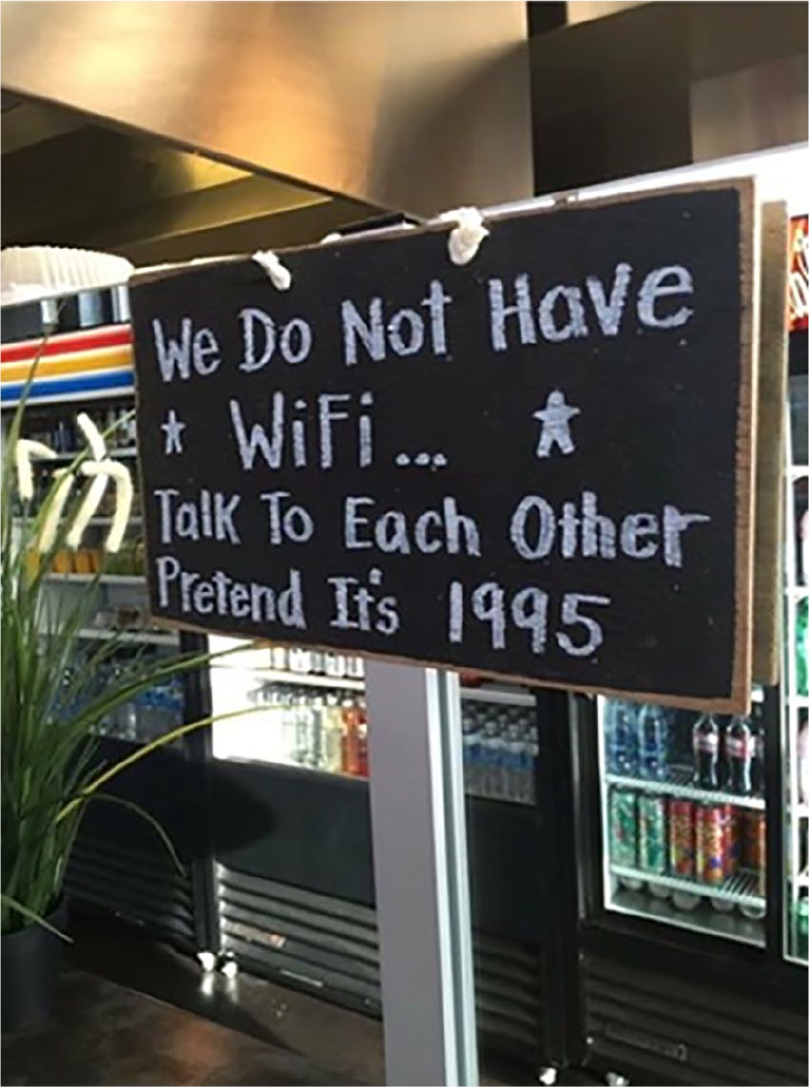
“We do not have Wi-Fi. Talk to each other. Pretend it’s 1995.”
Conclusion
While it is certainly not unusual for previous eras to return as fashions in the present, the extent to which the 1990s have re-emerged in the last decade has been striking. This is the inevitable outcome of the fact that many of the current producers of professional media content (writers, directors, and producers) were teenagers in the late 1980s and early 1990s and were therefore influenced by the concerns of Generation X, grunge culture, and the political backlash to Reagan and Thatcher. More pertinently, though an imaginative return to the 1990s is attractive and affectively powerful amid rising inequality and the rampant disorientation of the present.
My reductive throwing together of the texts above of course negates their individual strengths and weaknesses. No doubt some have more residual political potential than others. However, as much as they signify a comfort mechanism or “happy consciousness” (Marcuse 2002) for dealing with the present, there are batches of other recent 1990s-inspired texts that signify more explicitly productive relationships to the past (“reflective nostalgia,” as Boym has it). These include texts that interrogate momentous historical events of the 1990s, including I, Tonya (2017), The People v. O. J. Simpson: American Crime Story (2016), OJ: Made in America (2016), Manhunt: Unabomber (2017), Menendez: Blood Brothers (2017), Waco (2018), The Assassination of Gianni Versace: American Crime Story (2018), and Lorena (2019).
Re-births of prominent celebrities associated with the 1990s also encourage critical reflection, including Hillary Clinton, whose unsuccessful 2017 presidential run was haunted by the specter of her time as first lady in the 1990s, culminating in the glorious renewal of Monica Lewinsky as a public figure (see The Clinton Affair 2018). In similar, yet much more disturbing ways, the scandal surrounding Brett Kavanaugh’s appointment to the Supreme Court, and specifically the testimony given to Congress by Christine Blasey Ford, recalled the harrowing treatment of Anita Hill, who in 1991 shot to international fame when she accused Supreme Court nominee Clarence Thomas of sexual harassment.
These reflective texts and events tend towards resisting sentimentalizing, glorifying, or whitewashing the past. That is to their credit. When Television & New Media was launched, to become the first “specialist television journal” (Miller 2000), the Twin Towers were still standing, the first iPhone was still seven years away, and 16-year-old Mark Zuckerberg was about $55 billion worse off than he is today. As such, the 20th anniversary compels us to reflect on how new media technologies continue to shape the world, and how history has a habit of being rather messy, if interrogated critically. The 1990s are currently being celebrated as a glorious past. That is fine, as long as they are also considered as a breeding ground for our own contemporary crisis.
Footnotes
Declaration of Conflicting Interests
The author declared no potential conflicts of interest with respect to the research, authorship, and/or publication of this article.
Funding
The author received no financial support for the research, authorship, and/or publication of this article.
