




Abstract
This article presents a case study of a series of Swedish football commentary webcasts where both producers and users engage in communication with each other during the FIFA World Cup in 2014. The main aim is to identify what the participants do to construct sociable bonds with each other using the technological affordances available, specifically those connected to second screens. Second screening is approached as a thoroughly sociable activity rather than a practice you engage in for primarily instrumental reasons like finding facts or statistics. The analysis shows how users and producers adopt strategies of inclusion oriented to creating a joint sense of “being here together” in the community that is formed around the official hashtag expressenvm. The results indicate that second screen setups of this kind have the potential of displacing the big TV screen and its live sports event, at least for a specific user crowd.
Throughout broadcasting history, broadcasters have relied on discursive and nondiscursive means to build “communicative relationships” with audiences (Scannell 1989). This has included adopting an informal, conversational voice to harmonize with the intimacy of the home (Scannell and Cardiff 1991), using greeting phrases such as “good evening” and looks-to-camera, so that viewers have been made to feel personally and exclusively addressed. What has been constructed through these interactional choices is a place for potential interaction (Tolson 2006). However, it is a place where audiences have not been able to enter into any real interaction. They have been, and oftentimes still are, positioned in what Thompson (1995) has referred to as quasi-interactive situations.
Of course, with social media platforms and interactive technologies, broadcast audiences need not settle for quasi-interactive positions. Cross-platform TV productions commonly offer interactive setups on a variety of social media platforms to stimulate audience participation (Ytreberg 2009). To cast votes via texting, or partake in a discussion group relating to an ongoing program, can boost a user’s sense of presence in the production (Ytreberg 2009). Within such TV formats, the feeling of being included in a communicative relationship is not solely up to the design and organization of the broadcaster’s talk and interaction. Rather, it is dependent on the technological affordances of a certain format and how these affordances are used by both producer and user.
However, as shown by, for example, Laursen and Sandvik (2014) and Sørensen (2016), producers often do not exploit the potential for dialogue with users that is enabled by a production’s technological setup. Indeed, formats that mutually engage producers and users in real-time interactions are scarcely investigated in media research. We therefore know little about what producers do to attract and hold users’ attention in such interactive contexts, that is, how they construct sociable bonds with audiences using interactive technologies. Vice versa, we know little about how users choose to engage with producers if given the chance, and what the purposes for their engagement may be.
This article explores these issues and looks at how communicative relationships are established and maintained in a multiscreen-supported environment that allows for dialogical communication between producers and users. It presents a case study of a series of Swedish football commentary webcasts—Primetime VM (PTVM)—where both producers and users actively engaged in communication with each other during the FIFA World Cup in 2014. The main aim has been to identify what the participants do to construct sociable bonds with each other using the technological affordances available, specifically those connected to second screens, as resources to accomplish their communicative goals.
In addition to generating knowledge about (changing) communicative (interactive) practices as TV broadcasting extends to web TV productions, the results will allow me to address current arguments around the relationship between traditional TV and the practice of second screening in relation to sports. Can we, along with Gantz and Lewis (2014) and Boyle (2014), argue that TV will remain the medium of choice for many sports fans even if there are second screen productions that allow for a potentially more intense and enriching user experience than the TV screen can provide? I argue that the study answers to the need for more empirically grounded studies into the viewing habits of second screen audiences (Wilson 2016), and into the micro-practices of how screen technologies (or social TV) are really used (Hassoun 2014; cf. Selva 2016). A case from sports programming is particularly apt to examine as big television events as the Word Cup are “prime second screen territory” (Yorke and Greenwood 2014, 2) and sports is considered a front-runner of technological innovation (Boyle 2014; Meese and Podkalicka 2015). After a short section on data and method, I will concentrate on the following main questions as I present the empirical case:
How is the PTVM format set up and initially enacted to enable sociable relations with audiences in comparison with ordinary TV football commentary?
How is Twitter used to develop sociable relations between users and producers and how does the Twitter interaction influence these relations?
What are the characteristics of the communicative relationship between users and producers as it evolves over the period of the month-long championship (and thereafter)?
The answers to these questions will be used to discuss current ideas and arguments regarding second screen/ing more generally, as well as, specifically, media sport audiences’ alleged screen preferences. I will round off with a critical reflection of my adopted “sociability approach” and identify areas for further research.
Data and Method
This study follows the so-called “Broadcast Talk” strand of research, where forms of talk are treated as fundamental to the way a certain media work (Hutchby 2006; Tolson 2006). What is studied is the involved participants’ actions and how these reveal patterns and structures (Tolson 2006). The data consist of eight audio recordings of full game talk (approximately ninety minutes each), screenshots capturing various interactional situations during the recorded games, and selected video clips from live studio talk. Instances of live interactions were also captured in notes, and the official hashtag feed was monitored throughout the championship period and also a while thereafter. In addition, an interview with a user who followed PTVM during the World Cup was conducted to get an indication as to the motives and rationales for following the production from an audience point of view. Samples from similar setups during the Women’s World Cup and European Championship that later followed (2015, 2016) were also collected. It is a netnographic study in the sense that all data apart from the face-to-face complementary student interview consist of online material, and the online context is integral to whatever results are drawn (Kozinets 2010, 65). The study attempts to grasp some of the distinguishing interactional properties of an innovative format caught in the “live” moment of its own invention. It is not the mass of data that is important but to identify key segments of interactions which capture interactional patterns revealed through the participants’ activities. It has been important to follow the interactional “flow” of the activities to try and capture changes in sociable bonding over time.
The data (studio interactions and tweets) have first been studied extensively to observe recurring patterns of interaction. From this broader sweep, particular instances of discourse that are argued to illustrate certain traits of the interaction have been identified and examined more closely. Thus, discourse analysis has been conducted on strategically chosen strips of interaction discerned during the more general mission of attempting to uncover “what is going on” over the course of the championship interactions between producers and users.
Basic Conditions for the Communicative Relationship: The Setup of PTVM
The PTVM webcast is produced and distributed by the Swedish evening newspaper Expressen which operates one of Sweden’s busiest online news sites, and it is accessible through the sports section of its news website. Web TV content, referring here to full-length (often live) online programming over a spectrum of genres, often produced by non-broadcasters, keep increasing in popularity. Recent statistics on the media use of Swedes show that web TV make up 22 percent of the population’s use of media on digital platforms. In the span of fifteen- to twenty-four-year-olds, the web TV slice is as high as 41 percent (Facht 2016).
PTVM provides an alternative to the live broadcasts of the matches on regular TV with one major communicative obstacle: Expressen do not have the rights to show any audiovisual material from the matches. The setup must therefore try and attract audiences without the main component, the live match. Needless to say, this poses a communicative dilemma for the producers. TV’s very attraction lies in the ability to create a sense of liveness where “we,” as audiences, are swept away in the “now,” whether this event is really transmitted and received in real time or simply constructed and styled “as if” live (Marriott 2007). Viewers of such events are positioned as witnesses to live performances whereby a sense of a shared copresent reality is accomplished (Ellis 2000; cf. Scannell 1996).
As the PTVM webcasts start, the producers go about handling the nonmatch situation in basically two ways. First, by borrowing established conventions from sports broadcasting in its pre-talk and intermission activities, and partly also during match commentary. Second, by fundamentally breaking with conventions during match commentary, first and foremost when it comes to visual orientation in relation to the audience.
The pre-talk setup looks like any other broadcast equivalent where upcoming matches are discussed between the host and a guest. The studio participants engage in orderly conversation arranged as is the broadcast convention for “intraprofessional dialogues” (Kroon Lundell 2010) with not only looks oriented at each other during talk but also frequent looks to a frontal camera to acknowledge “the absent viewer’s” presence (Heritage 1985). The discourse universe (Linell 2009), what the talk is about in terms of topics and content, is by and large related to the football match to come, and shots of the yet empty playing field can be seen projected on a screen in the background. The audience is oriented to as an ordinary viewer of a football game who is positioned in a quasi-interactional way (Thompson 1995) as in most broadcast talk. They are recognized with a “welcome” and looks-to-camera from a conventional-looking studio but are not integrated as an active part of the interaction. So far, the production does not signal that the web production would offer any other kind of interactional situation than what the regular sports TV viewer is familiar with.
But as the live matches start, the conditions for the communicative relationship as set up by the producers change rather drastically, not least visually. The shot is redesigned to include three people lined up beside each other. The frames show the host Gusten Dahlin, most often in mid-frame, and the main expert-commentator, Thomas Wilbacher, to the left-hand side. In addition, a third external pundit is seen to the right. This is generally an ex-footballer, journalist, or football-loving celebrity. This guest acts as co-commentator but is less active than the other two participants. The background lighting varies slightly in the three frames, making it appear as if they are sitting in different locations. However, as the camera sometimes reveals when they lean into each other’s frames, they are, in fact, sitting next to each other at the same table. Apart from during half-time reports from Rio, this is the kind of shot that the audience sees for the ninety minutes of the game (Figure 1).
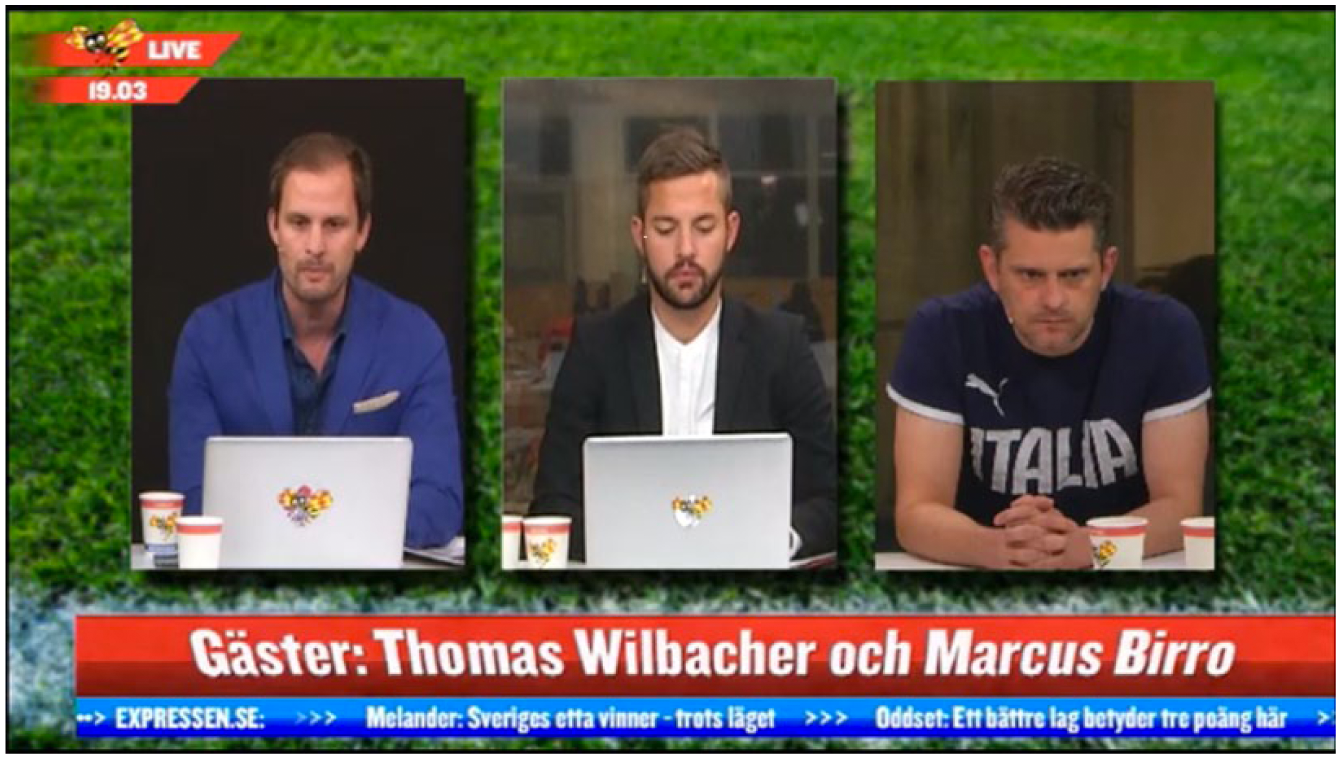
Breaking with established look conventions for bonding with viewers during PTVM game talk.
In front of each person is a laptop (not always visible in the external guest’s frame). It becomes apparent in discourse that it is on the laptop screens the producers watch the ongoing games using the broadcasters’ live streaming services. The screen-intent look orientation breaks with conventional TV’s “for-anyone-as-someone structure,” where viewers, in phrases and frequent looks-to-camera, are positioned as both part of a mass and as exclusive viewers, who are being made to feel as if they are individually addressed (Scannell 2000). Here, it seems looks are for “none other” than themselves, seemingly ignoring any relationship-bonding with audiences. The format bears intertextual resemblance to popular YouTube Let’s Play videos in which play-throughs of video games are documented together with humorous or critical commentary from the gamer. The setup has some similarity to the British TV program Gillette Soccer Saturday, where pundits talk animatedly about games on our behalf which viewers cannot see (Tolson 2016).
If the visuals are not set up to invite the user into any sociable positioning except for that as an onlooker of a seemingly disinterested other, the discourse is more clearly designed and organized for users. For one thing, there is a notable LIVE tag at the upper left-hand corner of the camera shot alongside Expressen’s symbol bee and the time indicator. The importance of providing this commentary “live” as events unfold lies, as was mentioned earlier, at the heart of TV’s attraction. Hence, it is also crucial for how audiences are made to feel included in a copresent “now” of unfolding events.
A sports commentator’s main task is to provide the audience with “a framework through which events can be viewed, ordered, interpreted and emotionally glossed” (Tudor 1992, 391). This is true both when no visuals are to be had from the game (as on the radio) or on TV. The live component is nevertheless important even if it is a recorded live moment that is replayed. However, the studio participants’ match commentaries in PTVM are by necessity synchronized with the broadcasters’ streaming services on their laptops. These streamed audiovisuals lag if only ever so slightly behind real-time events on TV depending on the quality of the PTVM Internet connection. The “live” in relation to match events therefore has to be reenacted as if in an animated replay of the broadcast images (Extract 1a).
Opa!
What! What! What! YEAAAAH!!
There Miroslav Klose scores TWO nil and is up in the sole lead of the tournament’s goal scorers
ALRIIIGHT! KLOSE!
I mean in World Cup history—he misses the first return ball and then he SLAMS in two nothing and GERMANY has after twenty-two minutes TWO nothing against Brazil Thomas Wilbacher what’s happening here?!!
Yes but again the defense play is very poor by Brazil while the Germans are doing a great job . . .
The host Dahlin and the expert Wilbacher here treat their match report as if truly live, and as if their talk really captures the dramatic turn of events. This is done while, in other sequences, explicitly complaining on camera about lagging behind because they are forced to have their studio “in a bunker.”
This (and the following) example shows how the producers use an orientation to real-time match liveness as an interactional resource to accomplish sociable relations with the users. They are well aware that users most likely have seen the goals on TV, but what they can offer is their own personal enactment of them. The ways in which they enact liveness also reveal a particular audience orientation that differs from that of an ordinary TV football viewer’s positioning (see Extract 1b).
Magical check this out here comes Philipp Lahm check it out
Here comes Toni Kroos
YEAAAAAAAAAA (yelling for five to six seconds)
DEUTSCHLAND DEUTSCHLAND ÜBER ALLES!!!
Heh THE GERMAN!
. . . what a total butchery we’re experiencing it’s still a World Cup semi—
Oh oh oh oh oh oh
OOH! OOH! OOH! OOH! OOH! OOH!
OOOOOOHHH YEAAAAAAAH!!!! (yelling for five to six seconds)
Even if this match was particularly spectacular scenario-wise, the PTVM participants regularly add liveliness and drama to their talk by, at times, screaming and yelling, throwing coffee cups onto the floor, or raising their arms to the sky as if in utter despair (Figure 2). This performance of events, through a kind of ecstatic animation, can be compared with the actions of a group of peers in a pub, or a group of dedicated friends watching TV together at home.
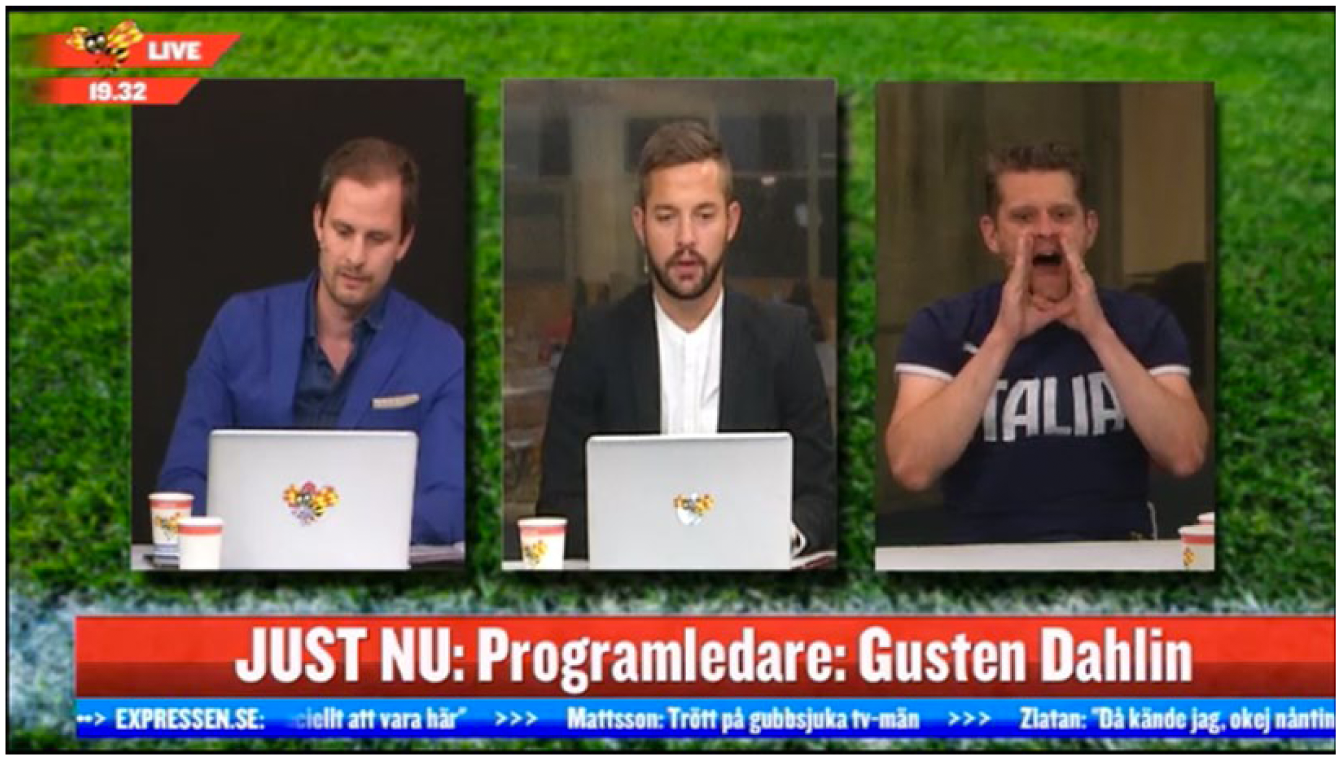
Performing animated, “co-fan” game talk in absence of live game images.
The producers construct a ground for sociable relations with users by orienting to them as fellow fans with whom one can experience feelings of both elation and despair. The main live broadcast event is used as a resource to fuel live replay performances (even if they are often only a second or so from real-time actions).
Summing up this section, devoid of any match footage, PTVM is visually set up as a play-through look-alike where the audience risks being positioned as passive onlookers of what others are looking at. Although younger users in the age of YouTube are surely more accustomed and accepting of such a, seemingly, unsociable role in relation to the people on screen, PTVM adopts strategies to overcome such a potentially alienating audience positioning. In discourse, producers ecstatically animate live-ish game events and invite users to experience their animated reactions. In doing so, the producers simultaneously enable a more asymmetrical “joint fan” space for users than in regular sports commentator broadcasting.
The following section will deal with how the official PTVM hashtag is used as an interactional tool by both producers and users to develop the communicative relationship which users, by the setup, have been invited to.
Using Twitter as a Tool to Construct Producer–User Sociability
The conditions for connecting the PTVM format to a social media platform such as Twitter and making something more of it than a sounding board for interuser communication are favorable in several respects. The host Dahlin is a former (if not major) football player and columnist, and the studio expert Wilbacher is a football expert and columnist specializing in the Italian football league, both active social media users. As was confirmed by the informant who followed PTVM and was interviewed for this study, the fact that he had discovered the format at all was due to the expert posting a tweet about it, and the interviewee was one of his Twitter followers. It is therefore likely that these particular webcasters are chosen for their aptitude and willingness to be actively engaged on social media.
So, perhaps unsurprisingly, the PTVM producers not only announce the format’s existence on Twitter beforehand but also invite audiences to be active in their official #expressenvm. This invitation does not say anything about whether the hashtag will be used as a dialogical tool between users and producers or not. In practice, the producers may choose not to be active themselves, even if they are experienced social media users themselves (cf. Laursen and Sandvik 2014). Equally, producers can hardly be sure as to how active and engaged users are going to be especially because PTVM competes with the actual live TV broadcasts for audiences’ attention. As noted by Bolin (2010, 74), “the fact that digitization produces opportunities for audience participation does not mean that audiences accept the offer.” In this case, there is ample evidence in the PTVM discourse that the producers are quite taken aback at how popular the hashtag becomes. Before I come to that, I will first give an account for, if coarsely, what users and producers do in, and with, the hashtag during the webcasts, and then summarize this part with what I argue are the main consequences of the Twitter engagement on studio commentary and interaction.
Increasing Producer–User Screen Engagement
At the beginning of the championship, the host and the expert primarily invite users by ways of asking them to help find particular statistics or additional information relating to the ongoing game commentary. Users are quick to reply, and already a few webcasts into the World Cup, the hashtag starts to pick up in intensity as to the number of tweets posted, and the same users start to return night after night, often staying for the two games if that is what is on that evening. The speed with which users begin to multitask and return with answers on Twitter to the producers’ fact-finding requests shows that they operate a number of devices to follow PTVM, the hashtag, as well as the TV broadcast. This multiscreen engagement by users is also recognized by the expert who makes a comment about there not seeming to be any financial crises affecting Swedish homes given how many screens users seem to be operating. He also comments to audiences on his own multiscreen orientation: “I have a camera there/points to the camera straight ahead, then points to three objects on the desk/screen, screen, twitter.” To stare at the screen is not really a sign of the host and expert turning away from users, but to them, to their activities on Twitter.
Both the host and expert and sometimes the guest commentator post tweets during matches, as well as some of the members of the production staff. These tweets can, for example, consist of alerts regarding upcoming webcasts, comments to other contributors, comments on the game but also more playful and personal contributions such as selfies from the studio or meta-comments about something that they have said or done. This is an example from Expressen’s/PTVM’s Rio reporter Axel Pileby, who conducts interviews during halftime.
Pileby: If my English was a catastrophe earlier I just broke every record in the German interview. Oh my god.
The fact-finding questions from the producers soon come to be replaced by a number of activities initiated by either users or studio participants which revolve around various forms of game. These games include look-alike images of players or webcasters, quizzes based on “likelihood” activities in the studio (of the type, “somebody is going to take a selfie at some point”; “Wilbacher is going to throw mug on the floor”), or cross-word puzzles which also stem from studio activities or prior hashtag contributions. Betting on the football games becomes one such prominent activity where both producers and users get involved, placing both actual bets on the upcoming matches or on blatantly unrealistic ones just for fun. These bets are talked about by the host and expert while laughing appreciatively (“Anders Jonsson bets six goals by Player X in the first ten minutes”). This collaboratively produced humor which is also found in online football text commentary (Chovanec 2012) has a multipurpose function such as bonding, expression of solidarity to the group, entertainment, and subversion (Chovanec 2012). It also spurs users on to be even more creative in their jokes to get quoted, as this type of manifest recognition is “a matter of prestige within the community of sports fans” (Chovanec 2012, 127).
At times, the procedure of establishing which bets to make becomes the sole focus of the host’s and expert’s discourse. In one webcast opening, the female guest commentator repeatedly attempts to get the pair to direct their attention to the match that just started, exclaiming frustratedly: “What’s happening you guys, it’s a yellow card!” In this particular instance, it takes a good quarter of an hour for the host and the expert to finish their bets and finally turn their concentration toward the match. The repeated patterns of game engagement make users feel that they are entering a familiar space where they know and understand what is going on like an initiated member.
The host and expert also begin explicitly recognizing users who tweet repeatedly by name and the tweets’ content are smoothly integrated in conversation (cf. Chovanec 2009; Kroon Lundell 2014). Hashtag contributors are treated as friendly co-commentators who do not compete with the experts’ professional know-how (Extract 2). However, the willingness to include users in conversation sometimes also competes with attempts at monitoring match events (Extract 2).
One of our active members here in the hashtag expressenvm is Johan Bristic. He reminds us that this is the World Cup of dramatic turns. And that Italy will solve this in the second half
Not the way things look in the first
Oscar Dahlin asks who the handsome man with the beautiful glasses is. Well I can tell you that it’s Enrico Castellaci Italy’s medic.
OK we should say that the second half is underway
Here’s Italy in an interesting situation. Fredrik reminds us that—
He’s taken care of in a brutal manner!
He’s d*** well kicked down from behind!
. . .
Harsh words there from Birro
. . .
Join us and write whatever you want to us on twitter we’re here hashtag expressenvm and it’s always equally wonderful when they’re with us isn’t it Wilbacher
Yes. Jonas he says here that it’s not even close to being a penalty according to him
The producers thus actively utilize the affordances of Twitter to come into direct contact with users, and instead of just monitoring posts at a distance, they make use of tweets in discourse and orient to users as co-commentators with equal authority to predict match events. They engage in joint jokes and invented games, and talk appreciatively about funny or thoughtful things that users post in the hashtag. Likewise, users throw compliments at the studio participants in their tweets and post screenshots of studio interactions with their own witty but friendly comments to the webcasters. The discourse universe shifts fluently between what Chovanec (2009) labels the primary layer of narration (game-related talk) and secondary layer (utterances unrelated to game events), with a definite expansion of the latter from the initial phase of the championship commentary and onward.
Also, as the hashtag is getting more and more busy and the host and expert are increasingly engaged in communication with the audience, users start posting “home pictures” exposing their home environment, and, importantly, their screen arrangements. The home picture becomes a recurring feature in the hashtag (see Figure 3 for a collage of home pictures from Twitter users).
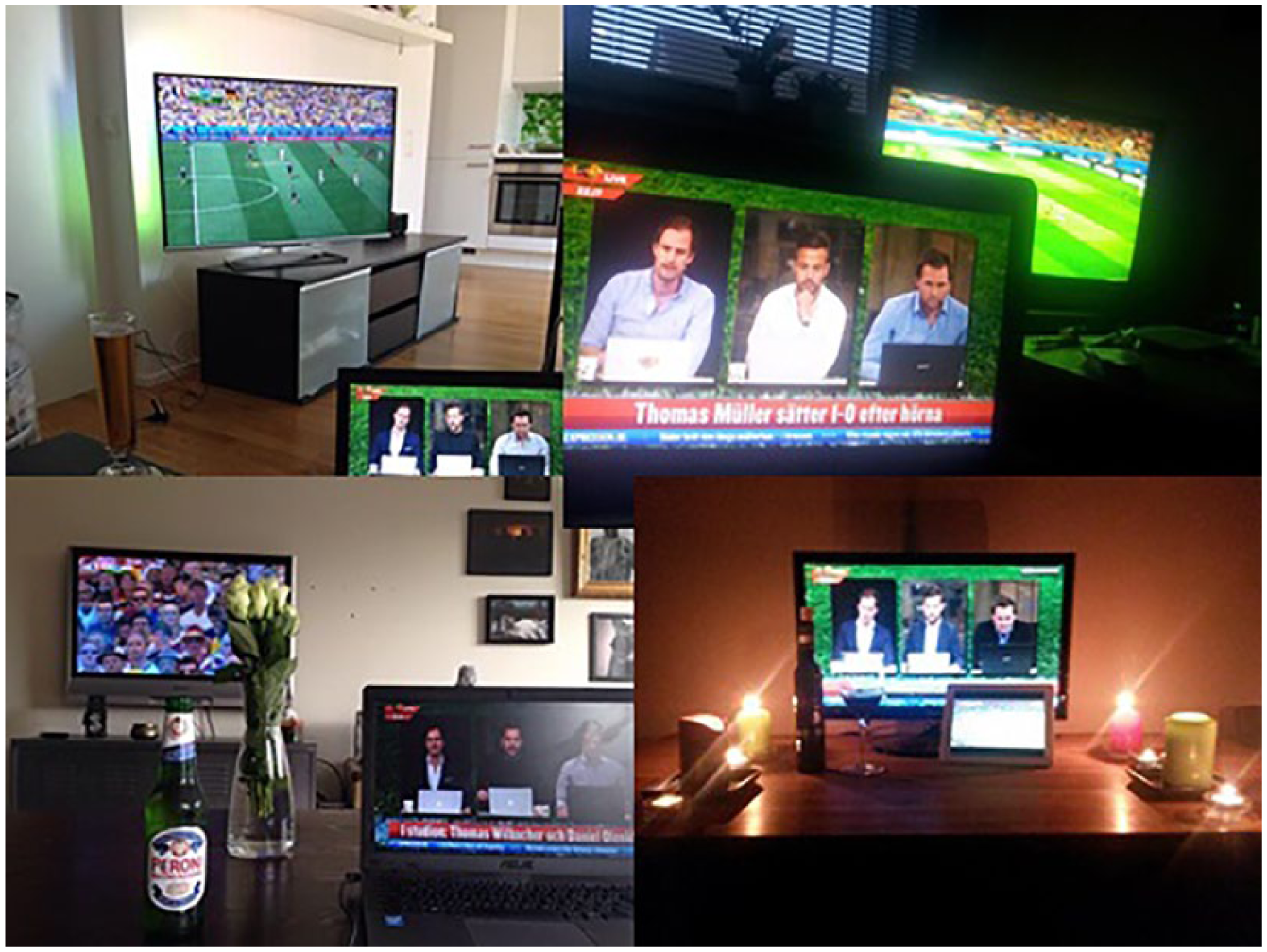
Users’ screen organization to optimize viewer experience as posted on Twitter.
Besides showing how screens are arranged for the ultimate user experience, additional props are added to signal certain preferences, most often food and beverages. These tweets are also sometimes followed by normative comments directed at other users on how it “should” be done: “This is how The World Cup should be followed.” Notably, users repeatedly show how they prioritize PTVM interaction on their biggest screen while the live match on ordinary TV is downgraded to a smaller screen device.
I argue that the home pictures play an important role in the construction of an inclusive “we” (who experience this together), in a jointly produced sociability. The studio participants who are seen on screens in the pictures are treated as real people in the living rooms of users and not as webcasters on screens far away, as in this user tweet to a home picture: “nice and clean when one has distinguished guests in the living room.” Besides being a gesture of intimacy and inclusion, the home picture enforces the user’s role in the community that is the hashtag expressenvm, and shows that one is ready to partake in the activities to come. It is also an identity constructor in the sense that it makes explicit the kinds of technology that users have/can afford as resources to take part in the interaction. The ways in which users prioritize and create hierarchies between screens, and then manifest these choices in home pictures, convey what kind of image they want to portray of themselves. Also, the chosen food and beverages (for instance, wine or whiskey; if whiskey, what brand) show how the user wants to portray himself or herself in this mediated context. The home pictures are then recontextualized and used as resources in the studio discourse. Not only are their existence as tweets recognized, but they treated as manifestations of the users having quite concretely “arrived” to the community, as if just having walked through the studio door.
Marika Westberg is with us. Great! She’s winging it from the balcony this evening. She’s done a classic, eh, placed herself on the balcony, pulled out the television set a little bit and then the tablet on us then.
In general, users are often recognized as individuals with names by the studio participants, and recurring contributors are welcomed back with affection: “So nice to see Fredrik back this evening . . . ,” the user being recognized as “someone” rather than “anyone.” (cf. Scannell 2000)
The Twitter setup as it is practiced by both users and producers, then, allows for a number of communicative circuits to be exploited, and both parties make meaningful use of them. The concrete impact that user tweets have on producers’ talk is that their discourse universe widens from match talk to talk about virtually anything, where users become active coproducers of what the talk is about. Consequently, the live match on TV diminishes in meaningfulness in conversation, and the sociability, here understood as the expressed sociable bonds between user and producer, is foregrounded in talk and interactions.
I will now present an overlook over what I understand to be the interactional outcome of the mutual engagement of producers and users in the PTVM/#expressenvm experience with a focus on users’ perceptions. I describe this in terms of an evolving communicative relationship. I will then discuss my main results.
PTVM and #Expressenvm—A Sociable and Loving Communicative Relationship
There is nothing in the interaction at the start of the webcasts that indicates that the producers predict the high level of involvement with users that comes to transpire during the course of the World Cup coverage. Quite the opposite, a rising excitement is observed from the producers’ point of view as users start engaging in the hashtag, and there is a reciprocal manifested feeling of increased excitement among the active users from the initial matches and onward. As mentioned above, the mutual appreciation and commitment to the hashtag as a sense of belonging to a community of peers comes to have a direct impact on the content of the studio commentary. This goes from being more match-oriented at the start of the championship to being only indirectly to do with live match activities, and more about fun and games and mutual bonding. The host, spurred on by their interactional success a while into the webcasts, exclaims tellingly as he notices the activities in the hashtag one evening: “We’re about to create a movement that’s almost more fun than the World Cup itself!” A user later expresses similar thoughts of appreciating the interaction rather than the actual commentary in a tweet: “I notice I don’t remember any match commentary from the World Cup, thanks #expressenvm.”
Second screening, as it is practiced in this case, is distinctly sociable in character, and has little to do with instrumental technological usage (e.g., finding facts). The producers work at showing that they not only include users but treat them as co-fans, co-commentators, and close friends, and, by doing so, bridge the communicative distance which characterizes the quasi-interaction of ordinary broadcasting. The users embrace being embraced and reciprocate with compliments, joyful banter, and “invitations” to their homes in pictures. This (second screen) sociability is thus characterized by an intensity in the level of engagement among those who are active on both the producer and user side, and in an intimacy of the relations between users and producers as they are articulated in both studio interactions and in the hashtag. I would argue that the communicative relationship that develops in this context can be described as a mutually loving one. They address each other as friends with first names and refer to the hashtag as the equivalent of a group of relatives which they long for when they cannot be around:
You’ll have to excuse me that I’m not with our football family tonight but you are with me in my thoughts.
It is also a relationship that does not end as the championship draws to a close. Feelings of loneliness and loss are expressed in the hashtag immediately after the final.
#expressenvm love you guys, will cry myself to sleep tonight
How’s #expressenvm today? Great emptiness on my end
Notably, it is the hashtag and the “guys” active in it that are missed, not the live drama of the games, and the hashtag is talked of as embodying feelings as if human (“how’s #expressenvm today?”). This nostalgia continues also in the weeks after where posts keep appearing:
miss #expressenvm when I’m now watching a football game all alone again
MAGIC! Resurrect #expressenvm—don’t want to leave the summer!
#expressenvm ’til I die!
The hashtag has in fact been resurrected a few times. The first time was around the New Year 2014/2015, when both the previous host and expert along with users started posting pictures and comments about how they were about to celebrate New Year’s Eve (notably what food and drinks they were going to devour).
The fact that the hashtag by then had come to represent much more than a place where general commentaries relating to matches were posted was further testified by the minor crisis that erupted as it was revealed that Expressen would use a similar webcast setup for the 2015 Women’s World Cup. Users immediately started to lobby for a resurrection, requesting that “the old” #expressenvm was to be used. However, the producers decided to replace it with #expressenLIVE. This caused a debate among users who only reluctantly chose to make use of the new one:
Good old #expressenVM why don’t we use it, after all, it’s the World Cup #expressenlive
The question is WHY aren’t we running #expressenvm #Expressenlive
Even though the hashtag was changed for the 2015 World Cup webcasts, it did not stop users (and producers) to engage in more nostalgic look-backs at the activities of the previous year during half-time breaks, causing one user to comment in the new #ExpressenLIVE:
Can’t we roll #expressenVM-flashbacks all night? Never mind the matches. #ExpressenLIVE
The strong commitment to the expressenvm community, post–World Cup 2014, was also manifested when the commercial broadcaster TV4 tried a similar “competing” setup online during the 2015 World Cup using the hashtag vmsoffan (“the WC couch”). However, the attempt was immediately ridiculed by the Expressen hashtag users and called “a copycat.” Even in July and August of 2016, two years after the first PTVM World Cup webcasts, both producers and users post reminiscences of old times and refer to the #expressenvm as “the original.”
Discussion and Conclusion
I will now briefly address some of the recent and current ideas and arguments around second screen/ing and its relation to TV, and clarify what I think the PTVM case can contribute with in this area.
Only four to five years ago, second screening was talked about, from an industry perspective, in terms of a problem in need of solving. It was seen as a problem in the sense that second screens provided “distractions” (McClelland 2012) from the main television screen and its commercials. The solution was to find ways to make viewers snap back to television using innovative gadgets. However, second screening was equally heralded as an opportunity to be used for, for example, the cross-promotion of broadcasting content (Giuffre 2012). The latter is also what broadcasters do today as they exploit the possibilities of accessing audiences across platforms with “live” material, thus using second screening to benefit their broadcast live event (Sørensen 2016).
However, PTVM is, production-wise, disconnected from any broadcaster. This sets it apart from other discussed cases in current literature. It is designed as a print media-distributed webcast in relation to a series of live TV broadcasts which other media produce. Faced with a problem of not being able to access matches, second screening the championship becomes part of the solution for the paper. PTVM thus proves that there is a potential for non-broadcasters to find niched audiences and build their brands in relation to big live broadcast events if they find ways to connect with these audiences in sufficiently successful ways.
Second screening has proved to be growing globally in popularity (Cameron and Geidner 2014; Giglietto and Selva 2014). Not least, this is true of sports consumption where more and more content is streamed digitally (Ienco 2016). Still, as Wilson (2016, 188–89) points out, the very concept of a “second screen” indicates a subservient status to that of TV. The TV screen is still, by and large, understood to be at the center of the live sporting experience, while online and mobile devices’ roles are primarily seen as add-ons (Boyle 2014). Also, the understanding of what people do when they second screen sports has, so far, mainly highlighted instrumental rather than social objectives and motivations. It is argued that second screening is first and foremost used to obtain information about an ongoing event, or to watch previews, reviews, and get analyses of sports to enhance the TV experience (Gantz and Lewis 2014; Gil de Zúñiga et al. 2015).
In the case of PTVM, users organize their screens so as to enable simultaneous live event monitoring on TV and engagement with the webcasters and other users on second screens. Indeed, as an identity forms around a collective “we” in the hashtag, and subsequently grows in intensity, TV screens are shown, in tweets, to fade into the background. Alternatively, PTVM images are redirected so that the webcasters appear on the big screen and the live match is deprioritized to the smaller screen. The reorganization of screens are made to enhance the experience of PTVM and the World Cup as a whole, and not to fulfill an isolated instrumental function. PTVM users quite concretely enact what Galily (2014) and Rowe (2014) argue for, namely, that second screen usage may replace the desire of experiencing sports events live at the stadium, or even live on traditional TV. This because multiscreen use may enable more attractive and intense experiences than “being there” can provide. However, it seems that current terminology around multiscreen usage, which indicates a normative and hierarchical relation between screens, is not mirrored in people’s complex screen practices and motivations. Future practice-oriented second screen research will most likely contribute to a more nuanced terminology.
Importantly, PTVM showcases second screening as a thoroughly sociable activity rather than being a practice that can be reduced to “eyeballs” on a “device.” Second screening can here be understood as a joint practice oriented to the initiating, establishing, and maintaining of a communicative relationship between producers and users with the support of multiscreen technologies and social media. Sociability, in the PTVM context, is both the objective of the interaction, the characteristics of it, and the result of producers’ and users’ interactions with each other using screens. It is a perspective and approach that emphasizes the sociable rather than the technological functions and instrumental drives behind second screen usage. It brings to the fore both the communicative work and reward that come from the mutual engagement of users and producers in a jointly constructed “we,” who talk with each other in the here and now.
A Mythical “We”?
Admittedly, what is described here as the establishment and reproduction of an intimate, friendly, even lovingly expressed, communicative relationship between producers and users, centered around a “we” who identify with the hashtag as representing “our” community, conceals issues relating to power. The constructed “we” or “us” of PTVM can be likened to “a myth of natural collectivity” that is formed when using social networking platforms (Couldry 2014, 620). Behind the emotional investment of users in the official hashtag’s activities and the bonding strategies with producers lie commercial interests which have little to do with any real friendship making. The launch of the PTVM format is a conscious strategy, if a relatively restricted and inexpensive one, in the attempt to brand the newspaper Expressen as a successful TV producer. Needless to say, the producers are paid to become “buddies” with users. From this perspective, the kind of communicative relationship that is enabled by the PTVM setup can never be but a pseudo or quasi one. The joking and the banter and the affectionate expressions of love and belonging between producers and users conceal the commercial interests at the heart of the matter. The symmetry in the expressed relationship is thus only superficially expressed, or so critics might say.
However, this would be a too narrow an understanding of what is going on, and would definitely miss the target when it comes to explaining why users get so engaged during a full month, and thereafter, in the PTVM activities. Users are not paid to be there and they can easily turn to the big broadcasters and watch the live matches on TV. As Scannell (1996, 23) puts it, the relationship between broadcasters (here: webcasters) and audiences is “unforceable.” The hashtag activities, as well as the expressed elation of the producers at having created “a movement that’s almost more fun than the World Cup itself,” reveal another story. PTVM develops into a social encounter that leaves a lasting imprint in the form of fond memories of a fun summer among both users and producers, just like any other memorable real-life experience. In that sense, the “we” created in, and by, PTVM seems far from mythical.
Going Forward
The PTVM case is a small contribution to what is a further need for studies on the everyday practices of second screening (cf. Selva 2016). Besides problematizing what second screen is, how it motivates users, and how it positions TV, PTVM raises some issues relating to fan studies (Sandvoss 2005). These questions include the relationship between “media text” and audience/fan, and between “producer” and consumer/fan, as well as what constitutes fandom (Sandvoss 2005). Users of PTVM most likely started off as ordinary football fans wanting to follow the World Cup. However, they ended up expressing a devotion reminiscent of fandom to the producers themselves, as well as becoming fans of their own creation—the hashtag expressenvm.
Footnotes
Acknowledgements
The author wishes to thank the anonymous reviewers, and the participants at the 23rd Ross Priory International Seminar on Broadcast Talk, 2015, for constructive comments on earlier versions of this article.
Declaration of Conflicting Interests
The author declared no potential conflicts of interest with respect to the research, authorship, and/or publication of this article.
Funding
The author disclosed receipt of the following financial support for the research, authorship, and/or publication of this article: This work was funded by The Swedish Foundation for Humanities and Social Sciences, Project ID: P13-1106:1.