



Abstract
This study examines the extent to which participation in sport has a causal effect on subjective well-being among individuals experiencing loneliness and depression. Utilizing longitudinal data from the Dutch LISS panel (2009–2018) with a fixed-effects model to address endogeneity, the analysis explores how hours of sport per week affect happiness for adults between 21–65 years, with interaction effects for severe loneliness and frequent depressive moods. The analysis indicates that an hour of sport per week can mitigate 14% of the SWB deficit experienced by frequent depression and 37% for loneliness. Subsequently, using the Well-being Valuation Approach, this translates to a monthly value of €526 for individuals with frequent depression, and €1,266 per month for loneliness, above the value of sport for an average person (€249). This highlights the potential of sport as ‘well-being medicine’, informing targeted policies and practices to leverage sport for a happier society.
Introduction
Economic theory is constructed around the assumption that utility is central to human behavior, but is difficult to measure directly (Mas-Colell et al., 1995; Varian, 2010). Because of this assumption, economists rely on revealed behavior, i.e., individuals choose goods and services that maximize their satisfaction or utility. Under this paradigm, higher demand reflects higher utility (Hicks, 1939; Samuelson, 1938). However, over time, economic inquiry has evolved to account for intangible and non-economic aspects of welfare, broadening the scope of utility beyond mere market consumption (Stiglitz et al., 2009). Specifically, the direct modeling of well-being through self-reported measures has broadened economists’ ability to account for altruism, social interactions, and other externalities that shape experienced utility (Diener et al., 2009; Kahneman et al., 1999; van Praag & Frijters, 1999). Within this expanded lens, sport participation is increasingly conceptualized as one of the choices individuals make to enhance their well-being, not merely through direct use values (e.g., recreation) but also via indirect use values, such as improved health, social support, and overall quality of life (Kim & James, 2019; Testoni et al., 2018; Wheatley & Bickerton, 2017). Consequently, understanding how sport influences well-being – especially how this impact varies across individuals – is crucial, as profound effects on individual welfare remain underrepresented in standard economic indicators (Downward et al., 2024; Frey & Stutzer, 2002). By expressing the well-being benefits of sport participation for specific target groups in comparable monetary units, it offers a richer understanding of societal benefits and facilitates more informed resource allocation (Downward et al., 2024).
Participation in sport is known for its causal connection to emotional states and moods (Frey & Gullo, 2021; Orlowski & Wicker, 2018; Testoni et al., 2018; Thormann et al., 2022). Given the established link between sport and well-being, it is plausible that sport can be particularly helpful for those struggling with conditions strongly characterized by negative emotional states. Indeed, physical activity, a key component of many sports, has been consistently shown to alleviate feelings of loneliness and reduce depressive symptoms (Craft & Perna, 2004; Panza et al., 2020; Pels & Kleinert, 2016; Rebar et al., 2015). Furthermore, the social aspects inherent in many sports may offer an additional layer of benefit (Eime et al., 2013; Pawlowski & Schüttoff, 2019; Schüttoff et al., 2018). For example, research suggests that sports involving social interaction are more strongly associated with happiness than solitary sports (Downward & Rasciute, 2011). Therefore, the combination of the positive impact on emotional states, the symptom-reducing effects of physical activity, and the potential for enhanced social connection positions sport participation as a highly relevant and promising context for individuals experiencing loneliness and depression, warranting further investigation into the specific nature and magnitude of these benefits.
Nevertheless, the specific impact of sport participation on the well-being of individuals experiencing loneliness and depression remains an area that has not been investigated. Given the increasing acknowledgment of loneliness and depression as pivotal determinants of well-being (Farrell et al., 2023; Kinderman et al., 2015), the inquiry into whether sport can elevate well-being in these groups becomes paramount. From a policy perspective, loneliness and depression are increasingly recognized as urgent global health priorities. The US Surgeon General explicitly referred to loneliness as a public health threat (Liang et al., 2024) and governments in various countries have therefore implemented national policies focusing on social inclusion and mental health to mitigate feelings of isolation and enhance community ties (Dalingwater, 2019; Department of Health & Social Care, 2021).
This research contributes to this policy context, aiming to determine if and to what extent sport can serve as a lever for enhancing well-being, specifically for people dealing with loneliness and depression. It conducts a longitudinal analysis of Dutch data spanning from 2009 to 2018, employing a fixed effects model to remove time-invariant unobserved heterogeneity, with the aim of isolating the causal effect of changes in sport participation hours on (self-reported) happiness. Moreover, it uses the Well-being Valuation Approach (WVA) to communicate the effect of sport in monetary terms, so policymakers and practitioners can better prioritize public investment (Dolan & Fujiwara, 2016; Downward et al., 2024).
Literature Review
Subjective Well-Being Measurement and Sport Participation
Philosophers have long argued that a responsible society must be concerned about the well-being of its citizenry, and that measures of well-being should be included in social indicator systems (Campbell, 1976; Smith, 1759). There is a growing recognition that subjective well-being (SWB) can be consistently and reliably measured (Diener & Seligman, 2018). This enhanced ability to measure SWB has, in turn, broadened economists’ capacity to better measure externalities of human behavior that shape experienced utility (Diener et al., 2009; Kahneman & Krueger, 2006).
The measures of SWB are distinguished in three ways: evaluations, experiences and eudaimonia (Dolan & Kudrna, 2016). Evaluations offer an overarching view of SWB, asking individuals for comprehensive life assessments. Studies show that life satisfaction is influenced by various factors including income, employment, health, and major life events (Diener, 2013; Dolan et al., 2008). Experiences, on the other hand, capture the daily emotions individuals encounter. The concept refers to the everyday feelings, affects, and emotions experienced by the person. Eudaimonia focuses on a sense of meaning and purpose in life, encompassing aspects such as personal fulfillment, belonging, and the realization of one's potential (Dolan & Kudrna, 2016; Ryan & Deci, 2001). SWB is typically operationalized by self-report measures of life satisfaction (evaluation), happiness (experiences), or belonging (eudaimonia) (Eurofound, n.d.). While these categories capture different facets of SWB, in practice they are frequently treated as interchangeable constructs (Layard, 2011; Veenhoven, 2011).
A wealth of research has investigated the connection between sport participation and SWB. Correlational studies consistently demonstrate a positive link between various indicators of sport participation and well-being outcomes (Downward & Rasciute, 2011; Rasciute & Downward, 2010). Further investigation using instrumental variable methodologies has confirmed the causal impact of sport participation on enhancing SWB (Becchetti et al., 2008; Dolan et al., 2014; Downward et al., 2024; Huang & Humphreys, 2012; Pawlowski et al., 2011; Thormann et al., 2022). Additionally, panel data analysis, tracking changes in both dependent and independent variables over time, plays a crucial role in establishing causality (Frey & Gullo, 2021; Orlowski & Wicker, 2018). Such studies report positive causal relationships between sport participation and SWB. Frey and Gullo (2021) show that the reverse causality – wherein higher SWB might prompt sport participation – exhibits a significantly lesser effect.
Existing literature suggests that increased frequency and duration of sport participation correlate with higher levels of SWB (Downward & Dawson, 2016; Lee & Park, 2010; Orlowski & Wicker, 2018). Regarding the intensity of sport participation, there is evidence that higher-intensity activities do not significantly affect SWB positively and may even have negative impacts (Wicker & Frick, 2017). Downward and Dawson (2016) found that leisure activities not meeting recommended health-promoting intensity guidelines – presumably engaged in for their social, recreational, or fun aspects – contribute more to SWB than activities meeting those guidelines. Furthermore, sports that involve greater levels of social interaction are more strongly associated with SWB compared to those with lower levels of social interaction (Downward & Rasciute, 2011).
Loneliness and Depression
Loneliness can be defined as the discomfort experienced when an individual's social relationships are perceived as inadequately fulfilling and is characterized by a range of negative social emotions (Perlman & Peplau, 1981). Unlike depressive emotions, which are broader and include a range of emotional, behavioral, cognitive, and physical symptoms (Thurston & Kubzansky, 2009), loneliness is a profound emotional burden – often manifesting as deep sadness, feelings of abandonment, and psychological stress. This distinguishes it from a mere evaluative dissatisfaction with one's social contacts that may not evoke such intense negative affect (Hawkley & Cacioppo, 2010; Rokach, 2012). The De Jong Gierveld & Van Tilburg loneliness scale is a validated instrument, and widely used to measure loneliness, encompassing both emotional and social dimensions through 6 or 11 items (De Jong Gierveld & Van Tilburg, 2010; Honigh-de Vlaming et al., 2013).
Although loneliness and depression are conceptually distinct, both can significantly impair life satisfaction and the capacity for social functioning, relationships, work, and financial support (Cacioppo et al., 2006; Gigantesco et al., 2019; Hawkley et al., 2008). A systematic review encompassing 18 studies found a consistent negative correlation between loneliness and SWB, irrespective of the well-being component or measurement tool employed (Castelletti et al., 2024). Recent work from Liang et al. (2024) using genetic evidence instead of cross-sectional studies, showed that loneliness is a marker for health issues but not necessarily causing them. While loneliness is strongly associated with various physical and mental health conditions, such as increased risks of dementia and cardiovascular disease, this would not imply a causal relationship. Instead, loneliness may serve as an early warning sign or correlate of underlying health vulnerabilities. For depression and SWB causal pathways are proven by genetic evidence (Hilliard et al., 2024; Liang et al., 2024).
The synthesis of findings from meta-analyses reveals also a clear relationship between sport participation and reduced symptoms of loneliness and depression (Panza et al., 2020; Pels & Kleinert, 2016). For depression, previous research consistently demonstrated that adolescents actively engaged in sport exhibit significantly lower symptoms of anxiety and depression compared to their non-sporting peers, albeit the effect size remained modest (Panza et al., 2020). Physical activity, as researched by Ahn and Fedewa (2011), significantly curtails symptoms of depression and anxiety across both clinical and non-clinical populations of children and adolescents. Beyond the physical benefits, sport participation fosters social relationships and community participation, enhancing mental health through psychosocial support, a sense of personal control, and social identity (Eime et al., 2013; Pawlowski & Schüttoff, 2019; Schüttoff et al., 2018). The intersection of sport with social support networks, as reviewed by Sheridan et al. (2014), highlights the importance of social interactions within sport settings in shaping individuals’ perceptions of social support. These findings suggest that sport contexts can significantly contribute to the formation and reinforcement of meaningful social connections, potentially decreasing feelings of loneliness (Jose et al., 2012; Kokolakakis et al., 2024). So far, there are no studies exploring the relationship between sport and SWB for individuals experiencing loneliness and depression.
Valuation of Well-Being Effects
From an economic standpoint, individuals consciously allocate time and resources to activities that enhance their overall well-being, while avoiding those that detract from it (Kahneman et al., 1997; Wicker, 2020). But a central challenge in welfare economics is assigning monetary value to these well-being-enhancing activities, that lack explicit outcomes. In response, both revealed preference and stated preference methods have been developed to illuminate individuals’ underlying valuations (Orlowski & Wicker, 2019). Revealed preference methods infer value based on actual choices and behaviors in real markets, assuming that people's expenditures reflect their underlying preferences (e.g., hedonic pricing, travel cost). In contrast, stated preference methods (e.g., contingent valuation, choice modeling) rely on survey-based techniques where individuals explicitly express their willingness to pay for hypothetical scenarios, providing insights into values that may not be observable in market transactions.
A growing application is to translate the benefits of non-market goods, such as sport, into monetary values. The WVA, sometimes referred to as shadow pricing method, can be used for this purpose. WVA offers a more sophisticated way to estimate the value of non-market goods than the hypothetical scenarios or proxy-market transactions commonly used in revealed-preference studies (Fujiwara, 2019). The WVA technique holds an advantage over stated preference methods, as individuals are not asked to directly assign a value to non-market goods, reducing the likelihood of strategic or socially desirable answers (Kahneman et al., 1997; Testoni et al., 2018). The WVA method builds on a well-being equation and assumes that individuals act to maximize their utility (Blanchflower & Oswald, 2004). This method allows the contribution of a non-market good, such as sport participation, to SWB to be assessed and monetized by estimating the amount of income required to maintain the same level of well-being in the absence of that good (Clark & Oswald, 2002; Dolan & Fujiwara, 2016). Measures of SWB are assessed using ordinal scales. Empirical evidence suggests that treating these ordinal utility measures as cardinal rarely affects the results (e.g., Ferrer-i-Carbonell & Frijters, 2004; Oswald & Powdthavee, 2008). However, the influence of non-market goods or services might differ at various levels of life satisfaction, supporting the use of generalized ordered response models (Mentzakis, 2011; Orlowski & Wicker, 2018).
Method
Participants
This study utilizes the Longitudinal Internet Studies for the Social Sciences (LISS) database, a representative sample of Dutch households from the CBS (Statistics Netherlands) population register. Self-registration for participation in this panel is not possible, as inclusion is by invitation only, based on a true probability sample of households drawn from the population register by Statistics Netherlands. To ensure representativeness, households that would otherwise have been unable to participate are provided with a basic computer and internet access. The LISS panel was founded in 2007 and is managed by the independent non-profit institute Centerdata (Tilburg University, the Netherlands). The panel covers 5,000 households. The survey window for the items used in this study was from the start of May to the end of June each year. Data from 2009 to 2018 were combined to create a panel of 1,802 individuals with an average of 6.7 time points, resulting in 12,021 observations. Individuals older than 65 or younger than 21 were excluded due to the study's focus on the working-age adult population and the particular interest in the impact of income on SWB, as necessary for the WVA.
Measures
In the study, SWB serves as the primary dependent variable, determined through a single-item measure of happiness. Participants rated their overall happiness on an 11-point scale ranging from 0 (totally unhappy) to 10 (totally happy), allowing for an extensive assessment of their SWB. The analyses focus on happiness, as this dimension of SWB is particularly suited to capturing the direct, positive impacts of sport participation, thereby aligning closely with the core objective of our research (Testoni et al., 2018). Conceptually, happiness is a general measure of SWB that captures feelings about life as a whole instead of experiential and momentary measures of well-being reflecting an affective state at a particular time (Dolan & Kudrna, 2016). Robustness checks with life satisfaction confirm that the findings also hold for the explicitly evaluative dimension of SWB. The main independent variable of interest is the number of hours participants engage in sport each week, with one outlier (31 h per week) removed.
Identification
Both depression and loneliness were self-reported and do not represent a clinical diagnosis. To identify these psychosocial states, this study utilized available variables from the survey questionnaire. Loneliness was assessed using the validated 6 items from the De Jong Gierveld Loneliness Scale (De Jong Gierveld & Van Tilburg, 2006). Respondents rated statements like ‘I often feel deserted’ and ‘there are enough people I can count on in case of a misfortune’ on a three-point Likert scale (0 = no, 1 = more or less, 2 = yes; see Table 1). Following the prescribed scoring procedure, each item was first recoded to a binary value. For the three negatively worded items, responses 1 (“more or less”) and 2 (“yes”) were recoded to 1 (lonely) and response 0 (“no”) to 0. For the three positively worded items, responses 0 (“no”) and 1 (“more or less”) were recoded to 1, while response 2 (“yes”) was recoded to 0. We aggregate these 6 items to a Loneliness Index, with a possible range of scores from 0 (not lonely) to 6 (very lonely). This Loneliness Index showed acceptable internal consistency (Cronbach's α = 0.79). In addition, a dummy was created for “severe lonely” (people with an aggregate score of 5 or 6).
Descriptive Results.
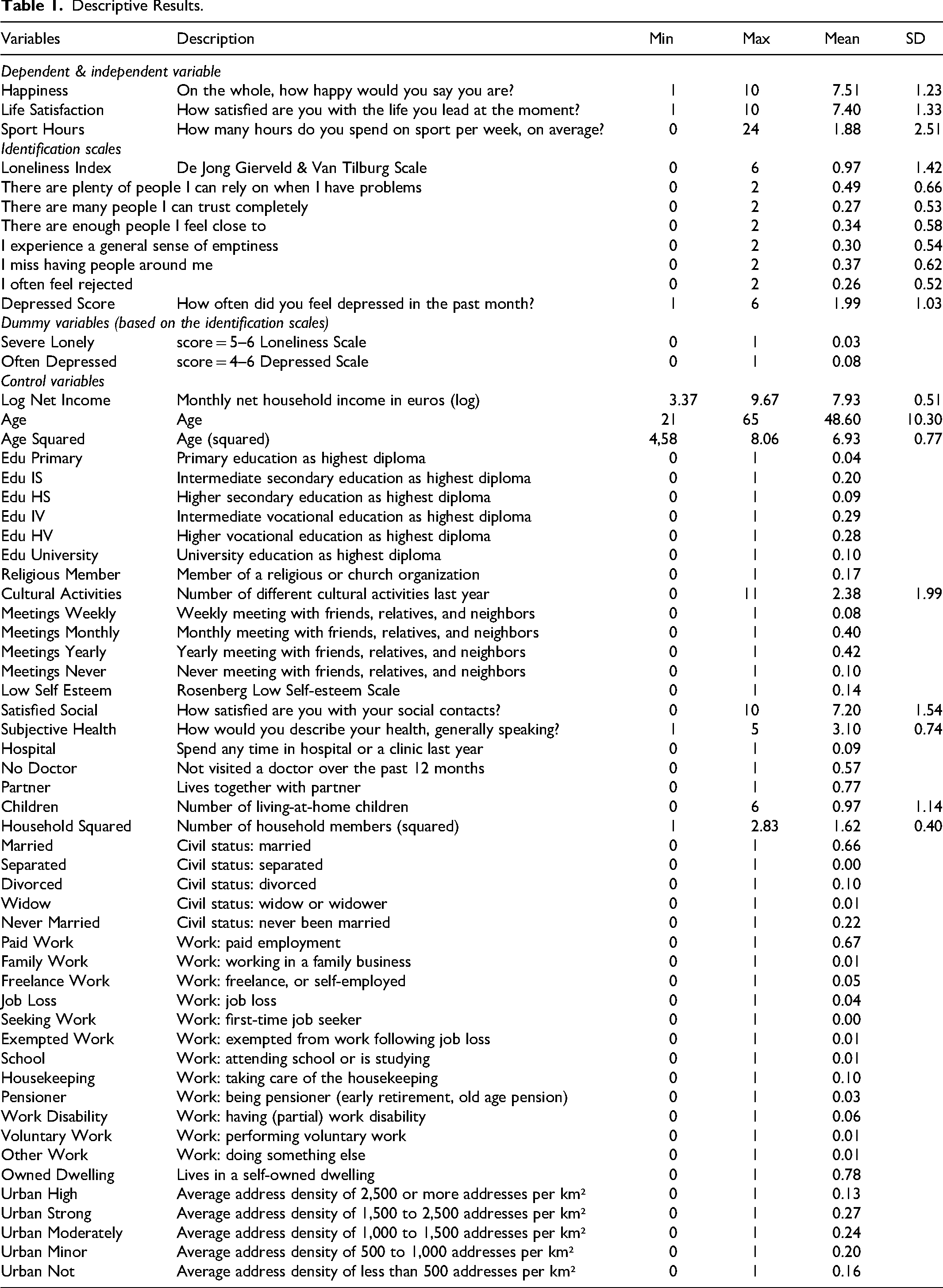
Depression was measured with a single item asking respondents to reflect on the past month (which corresponds to the May–June data collection window) and rate the frequency of feeling depressed and gloomy on a six-item scale. Based on their responses, a dummy variable was created to measure “depressed” for those indicating they often (4), mostly (5), or continuously (6) felt depressed and gloomy. While these items provide valuable insights into participants’ recent experiences, they do not necessarily reflect clinical severity of either loneliness or depression over longer durations. However, similar single-item measures are frequently used in large-scale surveys and have been shown to provide a reasonable indication of depressive symptomatology (Ahmad et al., 2014; Young et al., 2015).
The loneliness and depression measures are operationalized on an ordinal scale, with the underlying assumption that the differences between response categories represent meaningful gradations in the severity of loneliness or depressive feelings, allowing for a richer interpretation than a binary classification. This practice has been applied in the measurement of loneliness to facilitate quantitative analysis (De Jong Gierveld & Van Tilburg, 2006; Russell, 1996). However, to avoid strong nonparametric assumptions and potential biases introduced by arbitrary cardinalization, this paper relies on dummy variables for loneliness and depression in the main analysis.
Control Variables
In this study, several control variables were incorporated to account for factors known to influence SWB, ensuring a comprehensive analysis (see Table 1). The natural logarithm of household income (measured in euros) was utilized to address the principle of diminishing marginal utility, reflecting the nuanced impact of income levels on SWB (Odermatt & Stutzer, 2019). In this study, all logarithms are natural logarithms (ln). Age and its squared term were included to capture the non-linear relationship between age and SWB (Blanchflower & Oswald, 2004). Education was categorized into six levels, ranging from primary education to university level (Frey & Gullo, 2021). Religion, defined by membership in a church or religious organization, and participation in cultural activities, measured by engagement in a variety of cultural events throughout the year, were both considered for their roles in enriching SWB (Schoemaker, 2023).
Research indicates that loneliness does not necessarily equate to infrequent social interactions (Liang et al., 2024). Therefore, to estimate the causal effect of loneliness on SWB, it is essential to control for social engagement. Social relationships were measured by the frequency of meetings with friends, relatives, and neighbors, as well as satisfaction with these social relations on a scale from 0–10 (Powdthavee, 2008). Self-esteem was evaluated using the Rosenberg self-esteem scale. To prevent individuals with very low self-esteem – who are less likely to take up sports – affecting the relationship between sport participation, loneliness and depression, a dummy variable was included for scores below 15. For the same reason, health variables included hospital stays and visiting the doctor in the past year (yes or no), and subjective health on a five-point scale, are included. Research by Liang et al. (2024) suggest that loneliness is not causing health problems and therefore we believe health should be controlled for. In the robustness analysis, we test this assumption.
Living arrangements, such as cohabitation with a partner, the presence of children in the household, marital status and work were detailed in multiple categories to capture the diverse circumstances of individuals in these areas that have an influence on SWB (Frey & Gullo, 2021). Household size was squared to explore the nonlinear effects following Odermatt and Stutzer (2019). Homeownership and the degree of urban character of the place of residence were included to account for environmental factors affecting SWB. Lastly, dummy variables were made for the timing of SWB fieldwork measurements to ensure consistency across data collection periods.
Procedures
Inspired by the research on sport and happiness conducted by Frey and Gullo (2021), this study utilized a Fixed Effects (FE) model for the analysis. This approach accounts for unchangeable, individual-specific factors not directly observable, focusing instead on what causes changes among individuals over time. By anchoring the comparison within individuals rather than between individuals, the FE estimator sharply reduces bias from any stable, unobserved confounders and thus lends greater credibility to a causal interpretation (Wooldridge, 2010). Although FE does not fully address all endogeneity concerns, it represents a substantial improvement over cross-sectional methods by limiting bias from stable, unmeasured confounders (Allison, 2009). Our standard model follows the following equation:
In this equation, α represents the baseline constant, the sport vector denotes hours of sport participation per week, and states captures psychosocial states through the scores of loneliness and depression. The variable income represents monthly net household income (measured in euros) on a logarithm scale. The term control includes additional control variables, such as demographic characteristics, time-fixed effects, and individual fixed effects, to account for unobserved individual heterogeneity. Finally, ε represents the error term capturing unexplained variability.
An interaction model tests whether the relationship between sport and the SWB measures varies for those who experience severe loneliness and frequent depression, using dummy variables for these psychosocial states (equation 2).
When testing a specific state in a model, such as severe loneliness, the corresponding state (e.g., Loneliness Index) is omitted from the regression, and the extreme levels of the psychosocial state are included as dummy, with the reference group representing the rest of the population. This reference group serves as the baseline against which the effects of the extreme psychosocial states are measured. The interaction terms must be interpreted as the average SWB effect per hour of sport for those with the psychosocial state (e.g., lonely or depressed), beyond the effect observed for all respondents.
Within the SWB literature, it is common to treat survey scales as cardinal and to use linear estimators (e.g., OLS and fixed-effects models). This practice is typically motivated by evidence that linear and ordinal models often yield similar qualitative conclusions, especially regarding coefficient signs and significance (Clark & Oswald, 2002; Ferrer-i-Carbonell & Frijters, 2004). More recent work, however, cautions that such comparisons can mask non-trivial differences in both signs and magnitudes under certain conditions, implying that estimator choice may matter more than previously assumed (e.g., Rasciute et al., 2023; Schröder & Yitzhaki, 2017). For policy appraisal and cost–benefit analysis, effect magnitudes are decisive because SWB impacts are translated into euros. We therefore estimate linear fixed-effects models to identify within-person changes and to remain comparable with the dominant empirical practice in the SWB literature. To assess how estimator choice affects magnitudes we re-estimate the key specifications with an ordered response model (see Robustness check).
Monetary Valuation
The WVA method was used to compute the compensational value associated with the change in SWB caused by sport, using equation 3 below. Ῡ is the average monthly net household income (measured in euros) from the sample (ln = 7.93; 2,779 euros, Table 1). Β5 is derived using equation 2 for the interaction of hours of sport with those who experience severe loneliness and frequent depression. β3 is the effect of monthly income on SWB coming from equation 2.
Robustness Check
To test the robustness of our findings, potential concerns regarding reversed causality and alternative causal pathways were first addressed. Loneliness and depression were examined in relation to the number of hours individuals participate in sport. The same fixed effects models and covariates as in Equations 1 and 2 were re-estimated, but with loneliness and depression or sport hours as dependent variables, and SWB as the main independent variable. In addition, lagged panel models were applied to assess whether prior hours of sport predict later SWB 1 year later, and vice versa, thereby providing further insight into the possibility of reversed causation.
Second, additional analyses were conducted using an alternative measure of SWB, namely life satisfaction. The regression models, including both main and interaction effects, were replicated using life satisfaction to assess the consistency of the results across different operationalizations of SWB.
Third, to address potential concerns regarding endogeneity and multicollinearity among explanatory variables, an additional robustness check was performed by re-estimating the models without the health and social interaction variables. This approach evaluated the extent to which these controls influenced the estimated effect between sport participation, loneliness, and well-being.
Fourth, in light of the ordinal nature of the SWB variable, an Ordinal Logistic Regression (OLR) was performed, as an additional robustness check. Results drawn from linear regressions on ordinal data can be sensitive to monotonic transformations and potentially reversed (Schröder & Yitzhaki, 2017). However, due to the complexity introduced by the large number of predictors and interaction terms, the OLR model faced convergence issues, limiting its applicability.
Results
Table 2 presents the results from the standard Ordinary Least Squares (OLS) in model 1, based on equation 1. The coefficient for average sport hours per week is highly significant and with the effect size (b = 0.017, p < .01). Additionally, the loneliness index (b = −0.042, p < .01) and depressed score (b = −0.100, p < .01) are also significantly linked to happiness. Furthermore, the logarithm of household income exhibits a highly significant effect (b = 0.178, p < .01), as well as, not in the table, the number of different cultural activities undertaken (b = 0.023, p < .05), low self-esteem (b = −0.409, p < .01), satisfaction with social contacts (b = 0.093, p < .01), subjective health (b = 0.143, p < .01), marital status (b = 0.231, p < .05 for being married), and work variables (e.g., table freelance work, pensioner, work disability, volunteering work).
Regression Results for Happiness.
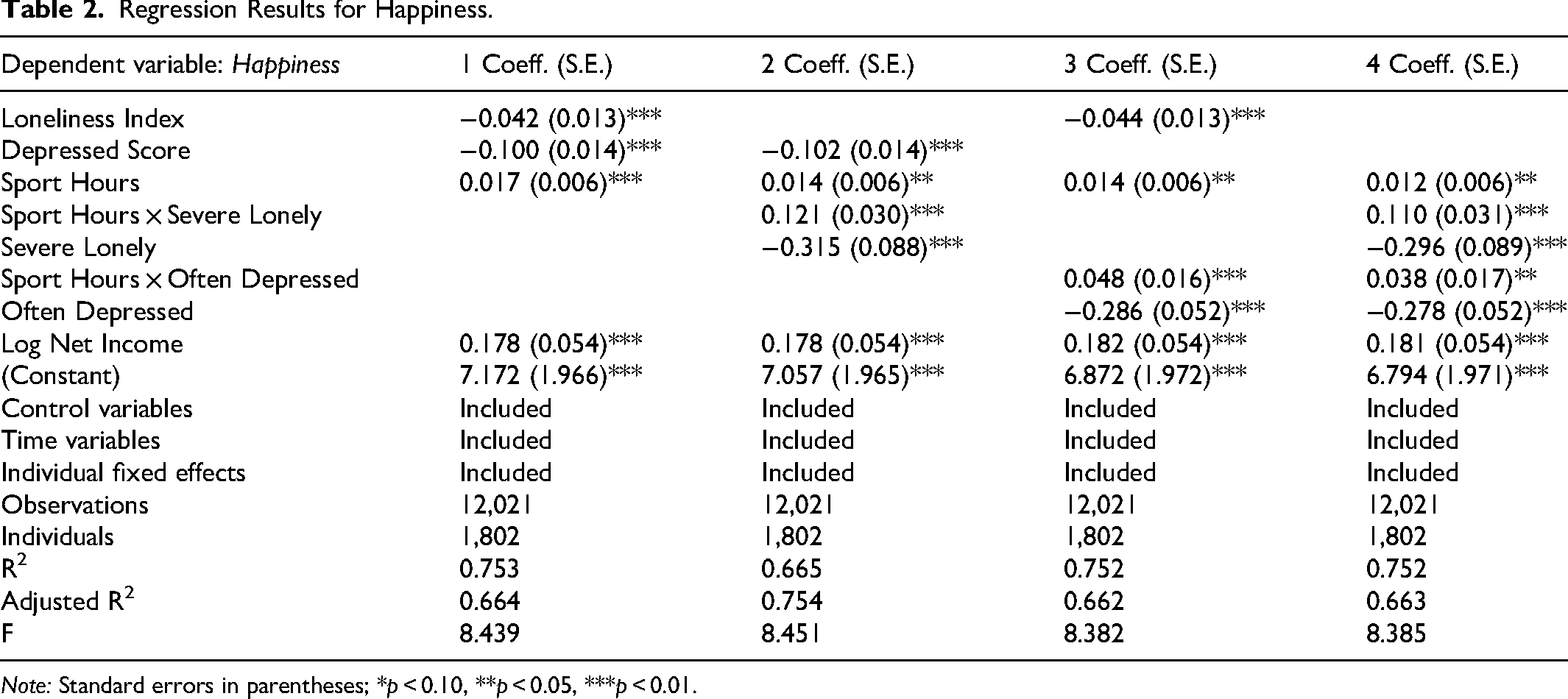
Note: Standard errors in parentheses; *p < 0.10, **p < 0.05, ***p < 0.01.
In Table 2, the analysis of the interaction effects between sport hours and loneliness and depression on happiness, across models 2–4 based on equation 2, reveals additional insights. Model 2 shows that severe loneliness significantly decreases happiness (b = −0.315, p < 0.01), while the interaction of sport hours per week with severe loneliness significantly improves happiness (b = 0.121, p < 0.01). In Model 3, a similar pattern to loneliness is observed with depression, where individuals- frequently experiencing depressive symptoms have significantly lower happiness levels (b = −0.286, p < 0.01); however, hours of sport markedly mitigate this effect, indicating a positive contribution to happiness for this group (b = 0.048, p < 0.01).
Model 4 integrates both interaction effects, providing an overview of how sport hours interact with loneliness and depression in relation to happiness. This model reaffirms the specific positive impacts of sport on individuals facing loneliness (b = 0.110, p < 0.01) and depression (b = 0.038, p < 0.01), without these associations being overshadowed by overlapping influences from each other.
Monetizing the Effects of Sport Participation on SWB
Using the WVA method, from equation 3, this study quantifies the compensatory values of sport participation on SWB, converting the benefits of sport hours into monetary terms on a monthly and annual basis. Table 3 shows the outcomes of equation 3. It reveals the compensating values in terms of a change in average income that correspond to a change in SWB by one hour of sport per week. The coefficient from the standard model (b = 0.017) indicates that each additional hour of sport participation per week equates to a monthly compensatory value of €249, amounting to an annual benefit of €2,990. For individuals experiencing severe loneliness, as highlighted in Model 3, the effect of sport hours is markedly amplified, with a coefficient of 0.110 translating into an extra monthly compensatory value of €1,266. Individuals often feeling depressed exhibit a notable benefit from sport hours per week, with a coefficient of 0.038 translating into a compensatory monthly value of €526.
Monetary Value of Sport Using the Well-Being Valuation Approach.
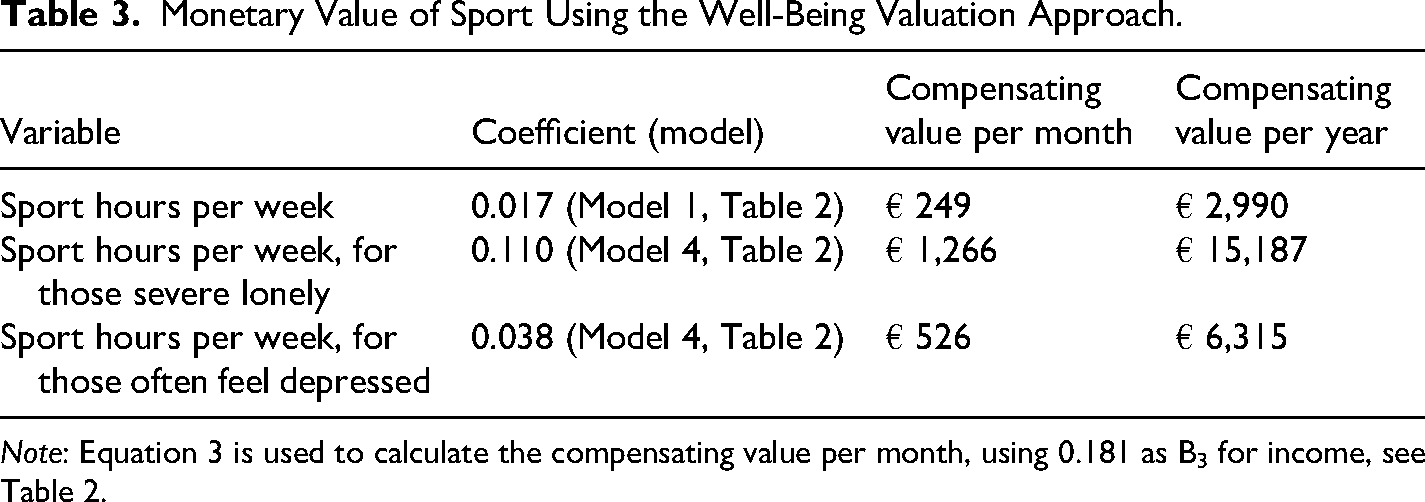
Note: Equation 3 is used to calculate the compensating value per month, using 0.181 as B3 for income, see Table 2.
Robustness Analysis
A key concern in this type of analysis is potential endogeneity and reverse causality. To examine the possibility of selection effects, additional analyses were conducted using alternative model specifications. Table 4 shows that no significant relationship was found between sport hours and either the Loneliness Index or Depression Score. This suggests that the previously observed effects of sport on well-being are unlikely to be driven by self-selection into sport based on these psychosocial states. Interestingly, the results do reveal that happiness significantly predicts sport hours, indicating the potential for reversed causality. To further investigate this, Table S1 presents a lagged panel model, which shows that lagged sport hours have a significant effect on subsequent happiness, whereas lagged happiness does not significantly predict later sport hours.
Regression for Loneliness, Depression and Sport Hours.
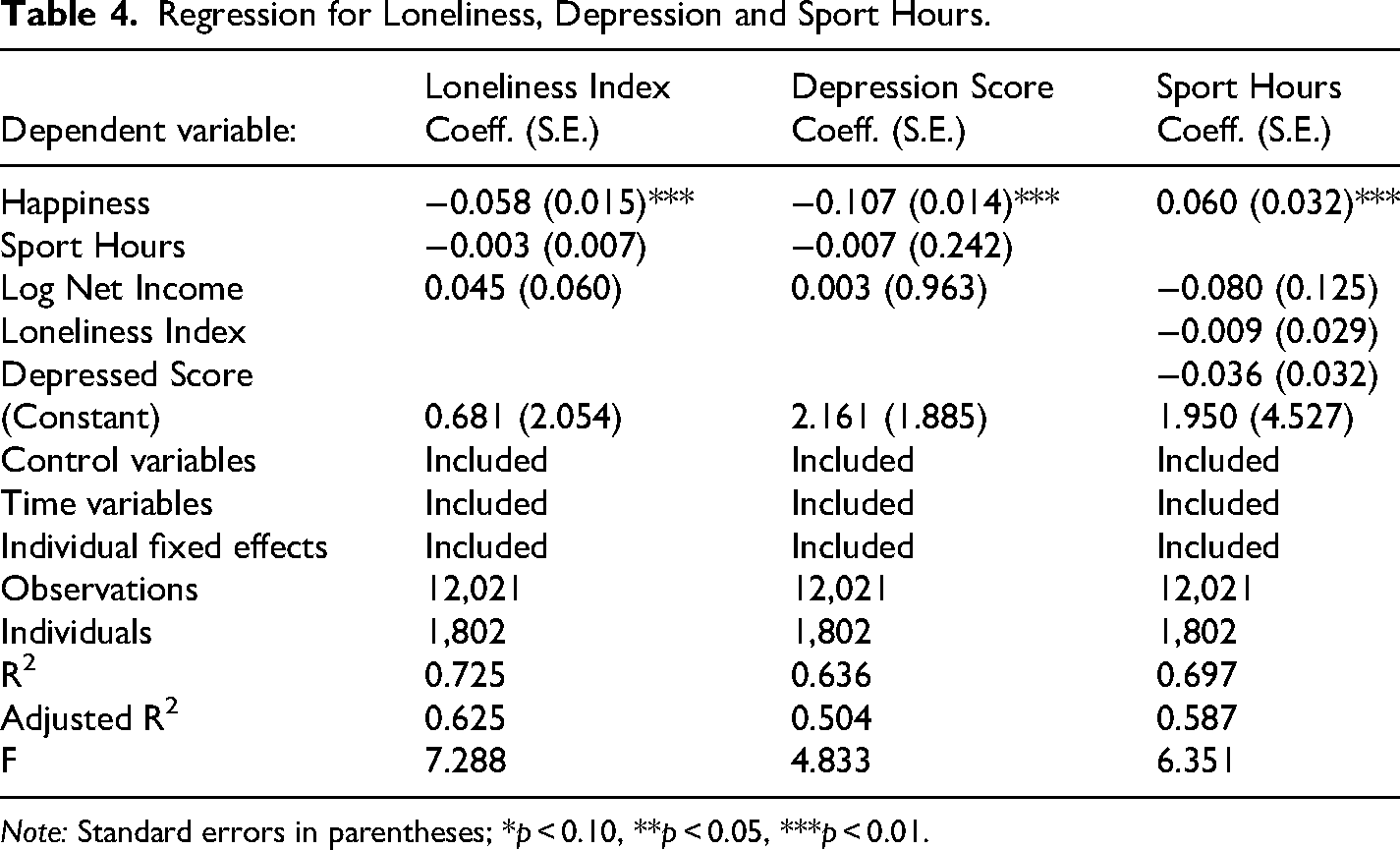
Note: Standard errors in parentheses; *p < 0.10, **p < 0.05, ***p < 0.01.
In addition to this causality check, several other robustness tests were conducted. The regression analysis for the standard model and the interaction models were also conducted for life satisfaction as a different measure of SWB (see Table S2), yielding consistent results. Sport hours contributed positively to life satisfaction (b = 0.021, p < 0.01), in model 1, with an increased effect coefficient for severe lonely individuals (b = 0.081, p < 0.05) and for frequently depressed individuals (b = 0.051, p < 0.01), in model 4, compared to those without the extreme levels of the psychosocial state.
To address concerns regarding potential endogeneity and redundancy in explanatory variables, a robustness check was performed by re-estimating the model without health and social control variables (see Table S3). This approach aimed at isolating the extent to which these controls influence the estimated relationships between sport participation, loneliness, and happiness. The exclusion of health and social variables resulted in a small decrease in the magnitude of the loneliness (b = 0.097, p < 0.01) and depression coefficient (b = 0.024, p < 0.01, from model 4, suggesting that only a small part of the effect is mediated through health and social factors. Notably, the effect of sport hours on happiness also diminished when health and social interaction variables were excluded (b = 0.012, p < 0.01). Despite these adjustments, the overall model fit remained relatively stable, with only a marginal decrease in R² values. This suggests that while health and social factors contribute to explaining happiness, they do not fundamentally alter the core relationships identified in our study.
Given that happiness is measured on an ordinal scale, an additional robustness check was performed using OLR. The OLR results were largely consistent with the OLS estimates, maintaining similar directional effects and effect sizes (see Table S4). For instance, the average step size between thresholds in the OLR model was approximately 2.73. Given the estimated coefficient for Sport Hours (b = 0.046, p < 0.01), this implies an expected increase of about 0.017 steps per additional hour of sport on the happiness scale. Among individuals experiencing severe loneliness, the effect translates to a 0.078 step increase. However, the interaction effect between sport hours and frequent depression was not statistically significant in the final model. A key limitation of OLR in this context is the complexity introduced by the large number of predictors and interaction terms, which led to convergence issues due to a high number of zero-frequency cells.
Discussion
This study is the first to explore the effects of sport hours on the SWB of individuals experiencing severe loneliness and frequent depression. Using a Fixed Effects (FE) model on a longitudinal panel, this study established the causal relationship between sport participation and changes in SWB among these specific groups. Across several specifications, including models without health and social control variables, the positive moderating effect of sport holds for both happiness, a more general measure of SWB that respondents may interpret in experiential or evaluative ways, and life satisfaction, which more explicitly captures the evaluative dimension. Notably, the absence of significant associations between sport hours and the psychosocial measures – when examined in isolation – diminishes concerns regarding selection effects and the lagged effect model indicates that the effect is not driven by reversed causality. In other words, differences in sport participation do not appear to be directly determined by levels of loneliness or depression or prior SWB levels. However, while some studies have found that loneliness and depression are directly associated with lower levels of physical activity (Muñiz et al., 2023; Pels & Kleinert, 2016), our analyses do not explicitly model such a relationship. This divergence may reflect that our model does not explicitly estimate the direct causal path from loneliness/depression to sport participation. Nonetheless, its robust design with fixed-effects inherently accounts for many confounding factors. Therefore, other factors may also be at play and warrant further investigation.
The relationship between sport participation and SWB in individuals with severe loneliness and depression supports previous evidence from multiple studies. Engaging in sport is linked to reduced depressive symptoms and increased meaningful interaction, which enhances SWB by providing social support (Eime et al., 2013; Panza et al., 2020). However, it is important to note that our data do not differentiate between individual and team sports or the specific social environments in which participation occurs. While research suggests that sport with a stronger social component may contribute more significantly to SWB (Downward & Rasciute, 2011), our findings should be interpreted with caution regarding the exclusive role of social capital. Beyond social mechanisms, the inherent psychological and health benefits of physical activity itself may also help mitigate the effects of loneliness and depression (Cacioppo et al., 2006; Castelletti et al., 2024).
The pronounced positive effect of sport participation on individuals with specific conditions, aligns with findings from Frey and Gullo (2021), who found that sport can play a substantial role in enhancing the SWB of those confronting health challenges. The coefficient for hours of sport appears relatively modest when compared with findings from other studies on the effect of sport participation on SWB (Schoemaker, 2023). The employment of a fixed effects model and the extensive use of control variables for social interactions, self-esteem and health in this research, while rigorous, may naturally lead to the understatement of effects by averaging changes over time at an individual level and overcontrolling for indirect effects of loneliness and depression. This methodological choice can result in a relatively low explained variance, signaling the conservative nature of this analytical approach (Frey & Gullo, 2021).
This study yielded significant monetary values for sport participation. An additional hour of sport per week was valued at €249 per month for the average participant. At the sample's mean of approximately 1.9 h/week, the implied monthly marginal value for a ‘typical’ participant is around €470. These values summarize the intensive margin (an extra hour per week), not merely ‘any participation’, and are identified within a fixed-effects framework utilizing rich controls. When evaluating the marginal values derived herein against prior studies, it is observed that the value for the average participant tends to be lower than many reported figures.
For instance, studies focusing on participation status, such as Orlowski and Wicker (2018), estimated the monetary value of participating in sport at least once per week, with values ranging from €577 to €1,662 per month for men and €577 to €1,471 per month for women. Similarly, Downward et al. (2024) reported that playing soccer in a typical four-week period was valued between $720 and $1,303 depending on gender and type of participation, equivalent to roughly €660-€1,200 per month. Moreover, for studies that also examined marginal hours, the results tended to be mostly larger than those found in our study. For example, Thormann et al. (2022) reported a value between €11.05 and €1,167 per hour per month, depending on the statistical procedure. Downward and Rasciute (2011) and Downward and Dawson (2016) valued an additional hour of sport at approximately €633–€1,236 (converted from £110–£215 per year per minute of sport every four weeks).
Our comparatively lower value is consistent with our focus on the marginal hour rather than participation status and identification via within-person fixed effects with rich covariates. This combination of methodological choices tends to yield more conservative monetary valuations (Layard & Oparina, 2021). Furthermore, variations in specific sport activities, demographic characteristics, and cultural contexts across studies could contribute to these observed differences.
In these monetary terms, WVA reveals that an additional hour of sport per week is equivalent to a significant increase in income, reaching €526 per hour per week for individuals experiencing frequent depressive moods and €1,266 per hour per week for those reporting severe loneliness, emphasizing the substantial value of sport as a non-pharmaceutical intervention. This implies that targeted sport programs could serve as cost-effective strategies in public health and social welfare policies, particularly beneficial for those experiencing severe loneliness or depression. However, this does not mean that sport can solve loneliness and depression itself. Rather it can help deal with the lower SWB levels associated with these states. Our analysis indicates that an additional hour of sport per week can mitigate 14–37% of the SWB deficit typically experienced by those with loneliness and depression.
In light of these results, our findings suggest a potential pathway for policy actions. First, governments and local authorities could explore developing targeted sports programs specifically designed for individuals experiencing loneliness and depression. Such initiatives could potentially facilitate meaningful social interactions and provide direct psychosocial support to those most at risk. Second, national mental health strategies could consider integrating sport participation as an intervention, leveraging its potential benefits to enhance SWB as advocated by the WHO Global Action Plan for Physical Activity (WHO, 2019). Third, local sports facilities and clubs could be considered for subsidies, particularly in urban areas with high rates of social isolation, to increase accessibility and encourage regular participation among targeted populations. Fourth, public awareness campaigns could be launched to educate communities about the mental health benefits of sport, thereby potentially reinforcing its role in reducing loneliness and promoting overall well-being.
Limitations
This study, while providing valuable insights into the relationship between sport participation and SWB, faces several limitations due to the scope of available data and methodological constraints. A significant methodological limitation stems from the use of fixed-effects models, which do not account for unobserved characteristics that change over time. Through the inclusion of control variables and by focusing on weekly hours of sport, we aimed to mitigate this limitation by capturing a more immediate and variable aspect of behavior that is likely to reflect changes in individual SWB. Furthermore, although the WVA requires the estimated effect of income on SWB to calculate monetary values, it does not address potential endogeneity biases in income. Studies employing instrumental variables to correct income's endogeneity tend to report low monetary values, attributed to higher estimates of the income coefficient (Layard & Oparina, 2021; Schoemaker, 2023). Consequently, there is a risk of overstating the value of sport hours in this study. Future research could address this limitation by employing an instrumental variable approach to better isolate the causal impact of income, thereby improving the accuracy of monetary valuations derived from well-being regressions. While our robustness check provides insights into the sensitivity of effect magnitudes, it is also important to acknowledge further limitations regarding linearity assumptions. Specifically, our analysis focused on linear effects in the relationship between sport and well-being. Thormann et al. (2022) included squared terms of sporting hours in the empirical models, showing diminishing returns. Future research could explore more complex non-linear relationships, such as diminishing returns or threshold effects, in the impact of sport on well-being for these vulnerable populations. Such explorations would further enhance the nuanced understanding of how methodological choices, including the specification of functional forms, influence well-being valuations.
While the results show that reversed causality – whereby SWB influences sport participation rather than the other way around – is minimal, consistent with the findings of Frey and Gullo (2021), the findings of this current study should still be interpreted with caution. Within specific groups, reversed causality may be more pronounced, potentially accounting for some observed effects. Tracking specific groups over time using panel data could help disentangle these effects and clarify the potential pathways. This study relies on fixed effects models and lagged specifications to strengthen causal inference, future research, including approaches such as instrumental variables, propensity score matching, or quasi-experimental designs (e.g., difference-in-differences), could provide valuable insights with regard to causality. On the other hand, it is conceivable that the impact of sport on loneliness and depression may have greater significance when examined through the lens of eudaimonia, a measure of well-being emphasizing belonging and fulfillment (Çiçek, 2021). Future research should explore the relationship between sport, loneliness, depression, and SWB from these perspectives.
The definition of sport utilized here is broad, encompassing any form of physical activity or exercise as conveyed by participants. This broad categorization might miss detailed distinctions in the effects of different types of sport, intensity, and the context in which they're practiced – be it through non-profit clubs, commercial entities, or informally – on SWB. Future studies could benefit from a more detailed analysis, including possible adverse outcomes like sport-related injuries or interpersonal violence, to offer a balanced view of physical activity's impact on SWB (Schoemaker et al., 2024). Although this study employed the robust De Jong Gierveld & Van Tilburg scale for a reliable measure of severe loneliness, the assessment of depression relied on a self-reported single-item variable. This limitation may lead to inaccuracies in defining the groups under study, highlighting the need for more detailed clinical measures in future research.
Conclusion
This study demonstrates the positive causal relationship between sport and SWB, with particularly pronounced benefits for individuals experiencing loneliness and depression. This indicates that sport can offer a notable buffer against the adverse effects of these conditions on SWB. Translating the effect into monetary terms, this study shows that for each hour per week the improvement of SWB for individuals with frequent depressive moods is equivalent to the increase in well-being they would experience from an additional €526 in monthly income, above the value of sport for an average person (€249). For those experiencing severe loneliness, this well-being improvement is equivalent to the well-being gain from an additional €1,266 in monthly income, above the value of sport for an average person. Consequently, these insights advocate for the targeted use of sport participation as ‘well-being medicine’ for addressing the lower SWB levels associated with depression and loneliness, thereby supporting the development of nuanced, evidence-based policies that leverage sport for a happier and more prosperous society.
Supplemental Material
sj-docx-1-jse-10.1177_15270025251396496 - Supplemental material for The Well-Being Value of Sport for Loneliness and Depression
Supplemental material, sj-docx-1-jse-10.1177_15270025251396496 for The Well-Being Value of Sport for Loneliness and Depression by Jelle Schoemaker, Willem De Boer, Larissa Davies, and Themis Kokolakakis in Journal of Sports Economics
Footnotes

Funding
The author(s) disclosed receipt of the following financial support for the research, authorship, and/or publication of this article: This work was supported by the Dutch Knowledge Centre of Sports & Exercise.
Declaration of Conflicting Interests
The author(s) declared no potential conflicts of interest with respect to the research, authorship, and/or publication of this article.
Data Availability Statement
The data for this article are available from the authors upon request.
Supplemental Material
Supplemental material for this article is available online.
Author biographies
References
Supplementary Material
Please find the following supplemental material available below.
For Open Access articles published under a Creative Commons License, all supplemental material carries the same license as the article it is associated with.
For non-Open Access articles published, all supplemental material carries a non-exclusive license, and permission requests for re-use of supplemental material or any part of supplemental material shall be sent directly to the copyright owner as specified in the copyright notice associated with the article.
