




Abstract
The host country effect — where nations typically perform better when hosting the Olympic Games — is a well-documented phenomenon. However, its magnitude may be shaped by institutional and societal factors. This paper investigates how corruption and gender inequality moderate the host country advantage using a panel dataset covering all Summer and Winter Olympic Games from 2000 to 2022. We analyze their effects on athlete participation, medal counts, and the conversion rate of athletes to medals, with a particular focus on gender disparities. Our findings show that higher levels of corruption and gender inequality are associated to weaker Olympic performance, especially for female athletes and in the Summer Games, as shown by smaller benefits of hosting. These results highlight the critical role of transparent governance and gender equity in maximizing the returns of hosting international sporting events.
Introduction
The Olympic Games stand as the pinnacle of global sporting competition, bringing together nations in a grand showcase of athletic excellence and national pride. Yet, for participating countries, the stakes extend well beyond the field of play, encompassing aspirations of national prestige, international recognition, and the validation of domestic policies. As a result, both governments and private stakeholders invest heavily in athletes and infrastructure, seeking not only to secure medals but also to enhance their global standing through Olympic success. 1
While athletic skill is essential, Olympic outcomes are shaped by a wide array of non-sporting factors. Chief among these are corruption, gender inequality, and the so-called host country effect — all of which can significantly influence a nation’s Olympic performance. Although the performance boost enjoyed by host countries is well-established, the degree to which this advantage is diminished by systemic issues like corruption and gender inequality remains underexplored. These factors may weaken the benefits of hosting, particularly when examining disparities in outcomes between male and female athletes. A deeper understanding of these dynamics is essential for policymakers and sports administrators aiming to harness the Olympic Games as a vehicle for both national advancement and social progress.
In this paper, we examine how corruption, gender inequality, and the host country effect jointly shape Olympic outcomes. Specifically, we analyze how these factors influence three key dimensions of performance: the number of athletes a country fields, the number of medals won, and the efficiency with which participation translates into success — measured by the conversion rate of athletes to medals. Our analysis places particular emphasis on gender disparities in these outcomes. To this end, we construct a panel dataset covering all Summer and Winter Olympic Games held between 2000 and 2022, a period characterized by significant geopolitical shifts and economic transformation. By disaggregating the data by gender, we shed light on the differential impact of institutional and societal factors on male and female athletes in both editions of the Games.
The host country effect is among the most well-documented phenomena in sports economics research (Bernard & Busse, 2004; Forrest et al., 2010; Hoffmann et al., 2002, 2004; Johnson & Ali, 2004; Lowen et al., 2016; Lui & Suen, 2008). Host nations typically experience a substantial increase in medal counts relative to non-hosting years. This effect is commonly attributed to a confluence of advantages: reduced travel burden, familiarity with local conditions, automatic qualification in select sports, larger delegation sizes, and heightened government and public investment in athletic preparation. Hosting the Games may also galvanize national pride and media attention, creating a more supportive environment for athletes.
Yet, the magnitude of the host country advantage varies widely across contexts. Differences in institutional capacity, investment in sports infrastructure, and economic development can moderate the extent to which host nations benefit (Forrest et al., 2010). Wealthier countries with larger populations, for instance, are often better equipped to exploit the opportunity (Lowen et al., 2016; Lui & Suen, 2008). Building on this literature, our study investigates the links between this advantage and two key institutional variables: Corruption and gender inequality.
While corruption has received less attention than gender inequality in studies of Olympic performance, its implications for sporting success are increasingly salient. Corruption can undermine the efficacy of investments in infrastructure and athlete development by diverting resources from their intended uses. In highly corrupt environments, misallocation of funding, nepotism in athlete selection, and opaque governance can erode competitive preparation and athlete morale. As Shughart and Tollison (1993) argue, athletes’ ability to retain the rewards of their success positively influences performance; corruption threatens that incentive structure. Supporting this, previous work shows that stronger civil and political liberties are linked to higher Olympic success (Campbell et al., 2005), while lower corruption levels are associated with a greater medal count (Pierdzioch & Emrich, 2013).
Gender inequality, meanwhile, remains a deeply entrenched barrier in global sport, shaping participation levels, access to resources, and competitive outcomes. Countries with higher gender equality tend to support more successful female athletes by ensuring access to training, funding, and international opportunities. In contrast, women in more unequal societies often face structural disadvantages, including limited institutional support, reduced visibility, and fewer competitive pathways. For instance, Bernini and Acton (2025) find that gender inequality in professional cycling leads to fewer female participants, less competitive balance, and diminished success for women. Olympic-specific studies remain limited, though existing research confirms the trend: Johnson and Ali (2004) document increased female participation over time (driven primarily by larger countries) but do not explore medal outcomes or underlying institutional determinants. Lowen et al. (2016) find that gender equality predicts both increased participation and improved medal performance, even among male athletes. We extend this line of inquiry by analyzing how gender inequality interacts with the host country effect, potentially amplifying or mitigating its influence on female Olympic performance.
By analyzing together three sporting outcomes — the host country advantage, the role of corruption in sports, and the impact of gender inequality — this paper offers a comprehensive account of the institutional determinants of Olympic success. The findings have clear implications for policymakers and sports administrators: mitigating corruption and promoting gender equity are not only matters of fairness and governance, but might also prove valuable strategies to enhance national performance on one of the world’s most visible stages.
Theoretical Framework and Hypotheses
Scholars also highlight the psychological dimension of the host effect. Competing at home can enhance confidence, reduce stress, and increase motivation, yielding gains beyond the material resources invested (Forrest et al., 2010). Hosting elevates the symbolic value of medals, intensifying preparation by athletes and coaches, while the prestige attached to the Games encourages governments and sporting bodies to expand resources and refine selection processes. Together, these mechanisms reinforce the performance advantage of host nations.
At a broader institutional level, corruption reduces the efficiency of public spending on sport. When resources are siphoned away from infrastructure, training facilities, or coaching programs, athletes are left with fewer opportunities to develop their skills. Corruption also distorts incentives: selection to Olympic teams may be based on connections rather than merit, weakening the competitiveness of the squad. Psychological studies suggest that environments perceived as unfair depress motivation and performance, as athletes doubt that effort will be rewarded equitably (Colquitt et al., 2001). Thus, in highly corrupt systems, the positive incentives that typically accompany Olympic preparation are muted, and the country’s overall performance suffers.
The mechanisms behind this relationship are both structural and cultural. Structurally, gender inequality limits access to facilities, coaching, and funding, all of which are critical to competitive success. Culturally, norms that undervalue women’s sports can reduce visibility, weaken pathways to elite competition, and diminish the motivational effects of public recognition. Importantly, these disadvantages extend beyond female athletes: more inclusive sporting systems generate broader talent pools and more competitive environments, benefiting men as well. By contrast, in societies with entrenched gender inequality, sporting development is segmented, resources are underutilized, and overall Olympic performance declines.
This perspective positions hosting as a stress test for national institutions: rather than erasing governance and social disparities, the Olympics often amplify them. In contexts with transparent governance and equitable social arrangements, the additional resources and visibility associated with hosting can be translated efficiently into participation and medals. In more corrupt or gender-unequal settings, however, the same influx of investment may be misallocated or captured by a narrow group, preventing the host country from reaping the full benefits. This conditionality underscores the central theoretical claim of this paper: that the host country effect is not automatic but contingent, and that its magnitude depends critically on the quality of a country’s institutions.
Data
We construct a panel dataset covering all twelve Summer and Winter Olympic Games held between 2000 and 2022. The data are drawn from multiple sources, including the International Olympic Committee (IOC), the World Bank, and the Varieties of Democracy (V-Dem) Project. By integrating these sources, we assemble a comprehensive cross-national panel that captures Olympic participation and performance over two decades. This structure allows for a detailed investigation of how the host country effect interacts with country-level measures of corruption and gender inequality.
Specifically, the corruption index, developed by Pemstein et al. (2023) and reported by Coppedge et al. (2024), measures the pervasiveness of political corruption in a given country-year. It covers six distinct types of corruption across different levels of the political system, distinguishing between executive, legislative, and judicial corruption. Within the executive realm, the index differentiates between corruption related to bribery and embezzlement. The index is calculated by averaging four sub-indices:
Similarly, the gender inequality index, also developed by Pemstein et al. (2023) and reported by Coppedge et al. (2024), measures the political empowerment of women in a given country-year. Political empowerment is defined here as a process of increasing capacity for women, leading to greater choice, agency, and participation in societal decision-making. It is constructed as the mean of three equally weighted components:
For interpretability, we rescale both indices to range from 0 to 100, with higher values indicating greater corruption and more severe gender inequality. 3
Our analysis of the host country effect includes eleven distinct host countries, with six unique hosts for each edition of the Games: Australia (Sydney 2000), the United States (Salt Lake City 2002), Greece (Athens 2004), Italy (Turin 2006), China (Beijing 2008 and 2022), Canada (Vancouver 2010), the United Kingdom (London 2012), Russia (Sochi 2014), Brazil (Rio de Janeiro 2016), South Korea (Pyeongchang 2018), and Japan (Tokyo 2021). Although the sample of host nations is relatively small (limiting statistical power in interaction analyses) it spans a diverse set of countries, mitigating concerns about omitted variable bias.
Trends in the dependent variables for host countries are illustrated in Figure A.3, which shows performance by year. We observe substantial jumps in both athlete participation and medal counts during hosting years. For example, Greece fielded 426 athletes in the 2004 Athens Summer Olympics — nearly four times its average across other Games in the period. Likewise, South Korea earned 17 medals when hosting the 2018 Winter Olympics, more than double its average and the highest total recorded during the sample window.
Corruption, Gender Inequality, and the Host Country Advantage
The Empirical Strategy
In this study, we investigate the effects of corruption and gender inequality, as well as their interaction with the host country effect. We construct a panel dataset that covers all Summer and Winter Olympic Games between 2000 and 2022 to estimate the following baseline specification:

For total athlete count and total medal count, Equation (1) is estimated using the Poisson Pseudo-Maximum Likelihood (PPML) regression method (Correia et al., 2020). This approach is particularly well-suited for this analysis for several reasons. First, both outcome variables can be classified as count data.
7
. PPML allows the logarithm of the expected count to be modeled as a linear function of the predictors, accommodating the non-linear nature of count-based outcomes. The estimation model in the context of PPML is specified as:

The main focus of this analysis is on the interaction terms between the host country status and the measures of corruption and gender inequality. By including these interaction terms, the analysis aims to uncover whether corruption and gender inequality modify the host country advantage across different outcome variables (separated by gender) and Olympic Games (i.e., Summer vs. Winter):

When equation (3) is estimated via PPML, the interpretation of the coefficients is derived by exponentiating them. For example, if
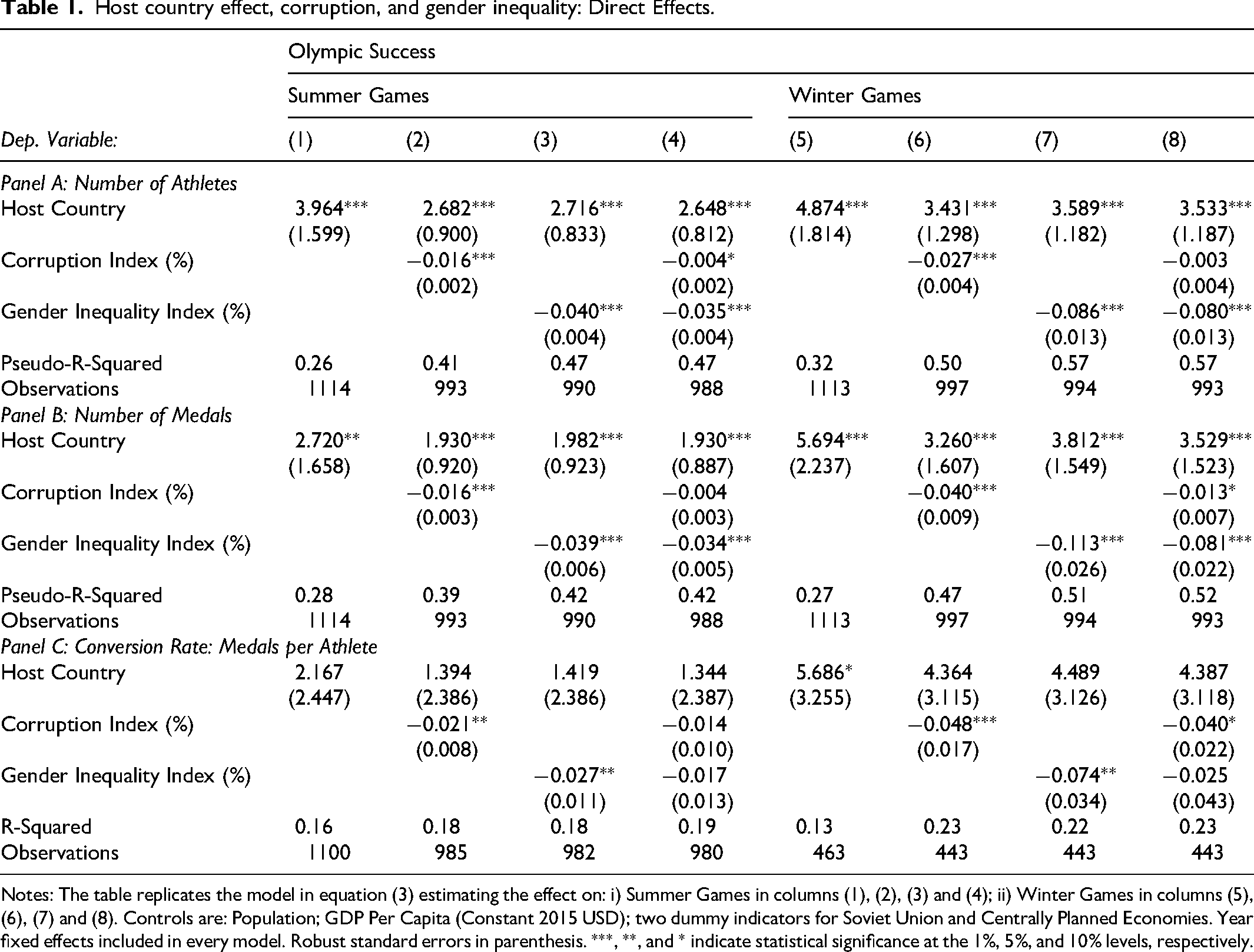
Host country effect, corruption, and gender inequality: Direct Effects.
Notes: The table replicates the model in equation (3) estimating the effect on: i) Summer Games in columns (1), (2), (3) and (4); ii) Winter Games in columns (5), (6), (7) and (8). Controls are: Population; GDP Per Capita (Constant 2015 USD); two dummy indicators for Soviet Union and Centrally Planned Economies. Year fixed effects included in every model. Robust standard errors in parenthesis.
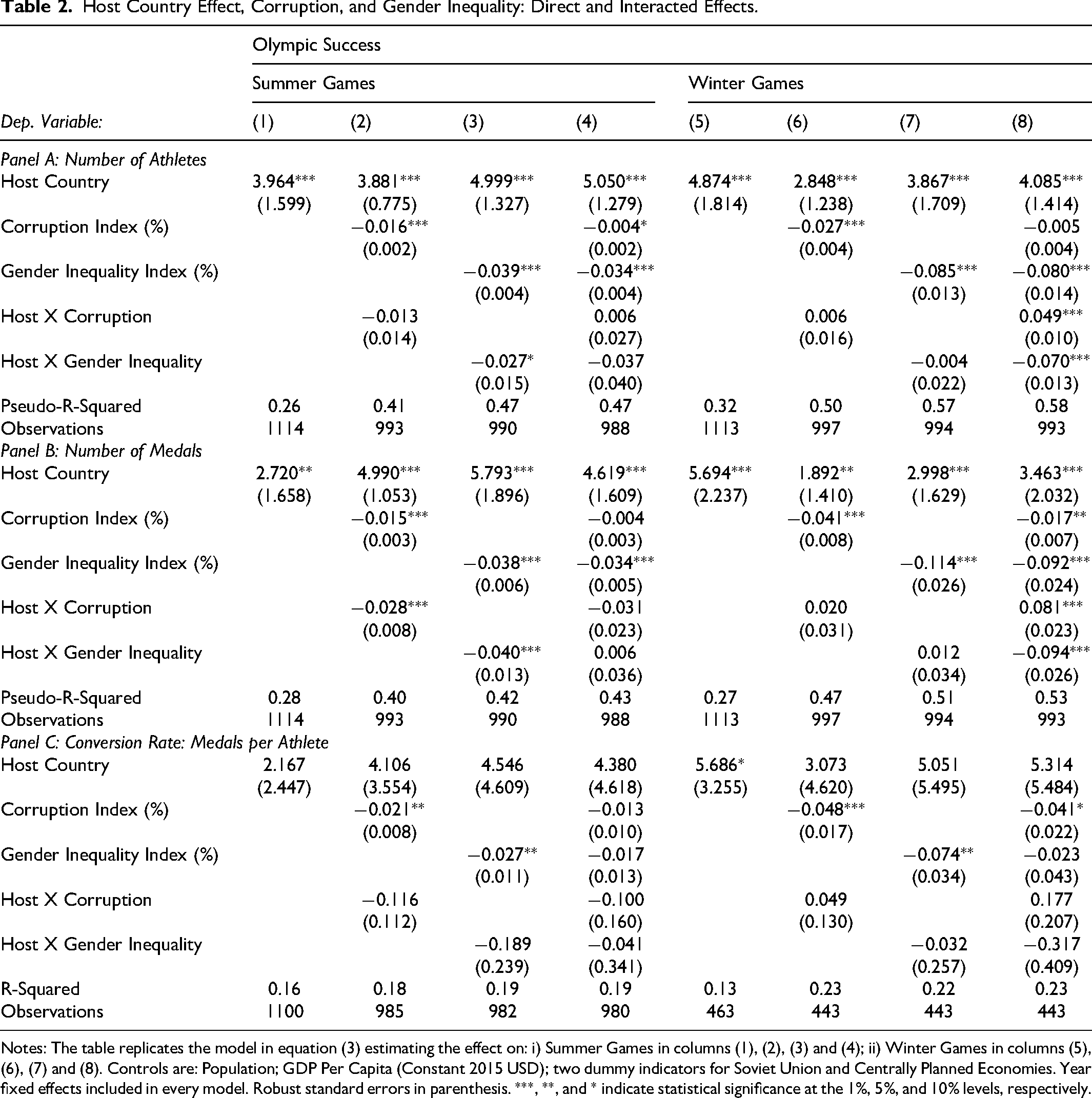
Host Country Effect, Corruption, and Gender Inequality: Direct and Interacted Effects.
Notes: The table replicates the model in equation (3) estimating the effect on: i) Summer Games in columns (1), (2), (3) and (4); ii) Winter Games in columns (5), (6), (7) and (8). Controls are: Population; GDP Per Capita (Constant 2015 USD); two dummy indicators for Soviet Union and Centrally Planned Economies. Year fixed effects included in every model. Robust standard errors in parenthesis.
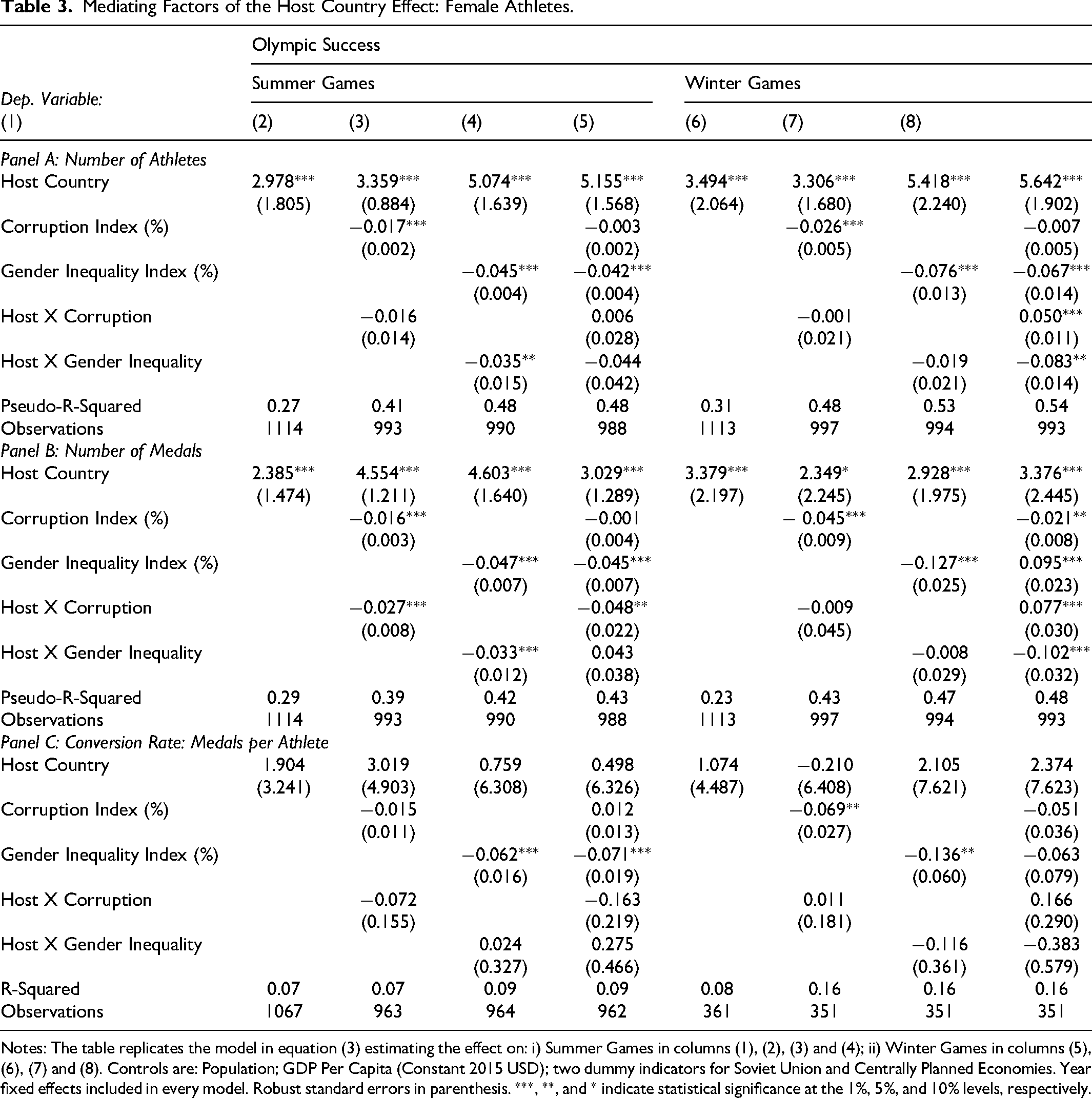
Mediating Factors of the Host Country Effect: Female Athletes.
Notes: The table replicates the model in equation (3) estimating the effect on: i) Summer Games in columns (1), (2), (3) and (4); ii) Winter Games in columns (5), (6), (7) and (8). Controls are: Population; GDP Per Capita (Constant 2015 USD); two dummy indicators for Soviet Union and Centrally Planned Economies. Year fixed effects included in every model. Robust standard errors in parenthesis.
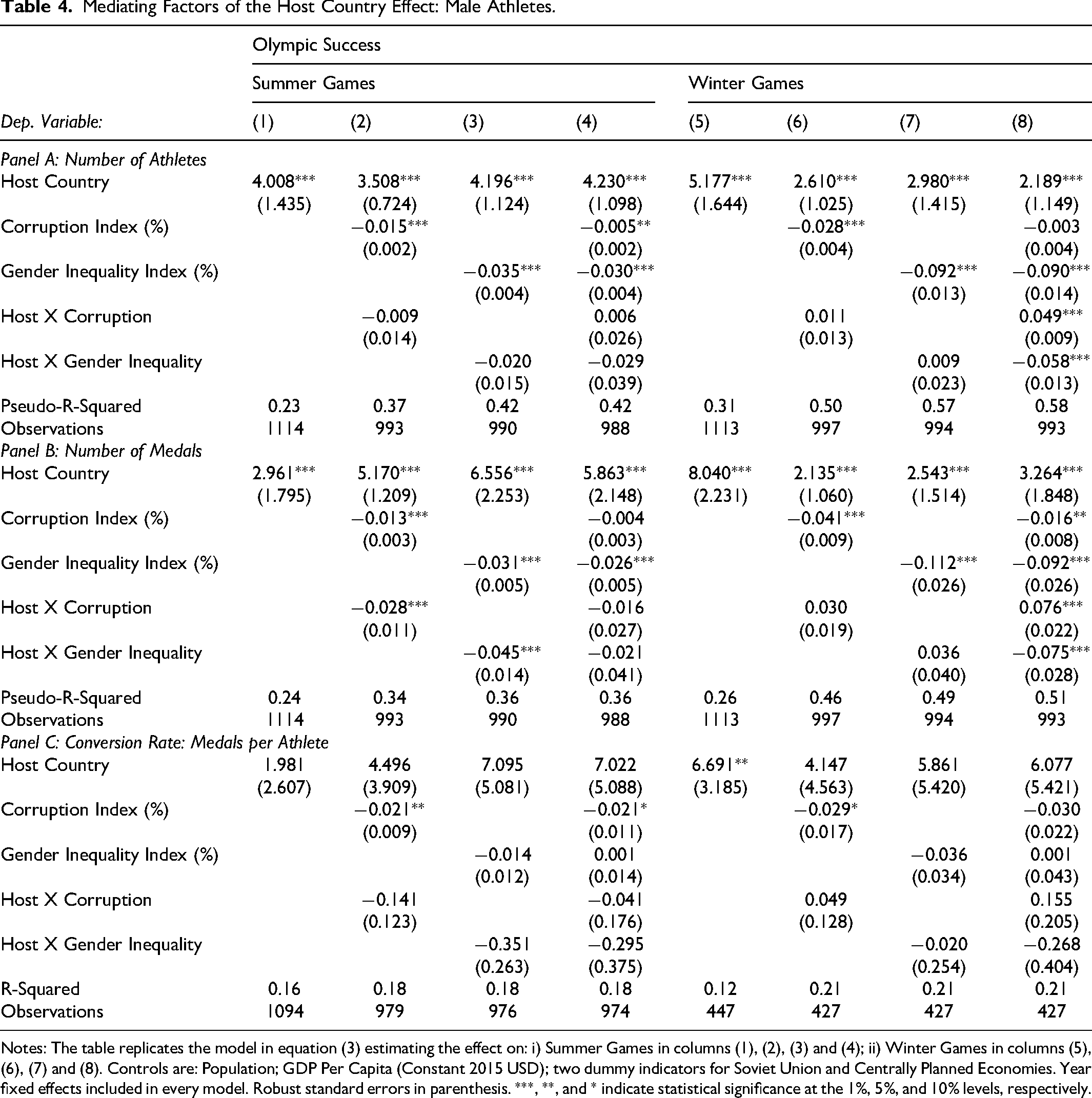
Mediating Factors of the Host Country Effect: Male Athletes.
Notes: The table replicates the model in equation (3) estimating the effect on: i) Summer Games in columns (1), (2), (3) and (4); ii) Winter Games in columns (5), (6), (7) and (8). Controls are: Population; GDP Per Capita (Constant 2015 USD); two dummy indicators for Soviet Union and Centrally Planned Economies. Year fixed effects included in every model. Robust standard errors in parenthesis.
Other studies in the literature rely on other predictors in their analysis. Notably, Lowen et al. (2016) rely on the percentage of the population that is Muslim, and finds a negative relationship with the number of athletes of both genders sent. We however decided not to include it to avoid issues linked to collinearity with the female empowerment index. Similarly, Forrest et al. (2010) use the share of public expenditure on recreation, and identifies a positive relationship with Olympic performance. We ultimately decided not to use it ourselves, due to lack of statistical significance found in their paper, as well as concerns with regard to the data: as they highlight themselves, it was estimated through the amount spent on “recreational, cultural and religious affairs,” a broad category that may hide disparities between countries.
Estimating the Direct Effects
In Table 1, we present the results from estimating equation (2), focusing on the direct effects of the host country indicator, the corruption index, and the gender inequality index.
First, the results of Table 1 underscore the significant advantage that host countries enjoy during the Olympics. The host country effect, which is represented by a binary variable equal to 1 if the country is hosting the Olympic Games, is consistently positive and statistically significant across all outcome variables considered. When looking at the number of athletes competing across in Summer Olympic Games — Panel A, column (4) — the coefficient for the host country effect indicates an increase of about 265% in the number of athletes a country fields, when both corruption and gender inequality are accounted for. For the Winter Olympics, the increase in athlete participation for host countries is even larger (approximately 90 percentage points higher). The substantial increase in the number of athletes competing reflects the significant resources and attention that host countries typically invest in preparing for the Olympic Games, ensuring that a larger contingent of athletes is fielded, as well as guaranteed qualifications in certain sports such as football and volleyball for the host country. Since countries from 2000 to 2012 sent on average 51 athletes when not hosting, and using the host country coefficient found in column (4) of panel A of Table 1, we find an increase of 135 athletes when hosting. In comparison, when considering the Summer Olympics from 1996 to 2012, (Lowen et al., 2016) find an increase in the number of athletes sent to the Summer Olympics by a host country of around 222 athletes. This difference might be explained by their choice of method, which differs from ours as they rely on a Tobit regression with random effects by country. Results from Panel B and Panel C confirm the existing results in the literature by showing that the positive effect of hosting the Olympic Games extends to the number of medals won, as well as to the conversion rate of medals per athlete. The effect of being a host country on conversion rate is less pronounced than on the number of athletes and medals, as these opposing trends influence the conversion rate. As a point of comparison, looking at the Olympic Games between 1952 and 2004, Lui and Suen (2008) estimate that host countries experience a 112% (using a Poisson model) and 149% (using a negative binomial model) increase in medals won, while we find a similar increase of 93%.
Second, Table 1 highlights that corruption (which we have scaled to range from 0 to 100, with 100 indicating higher corruption) is consistently negatively associated with Olympic success. The PPML coefficients for corruption suggest that higher corruption levels is linked to fewer athletes being fielded fewer medals won, and a lower conversion rate of medals per athlete. For example, the estimated coefficient in Panel A, column (2), implies that a 1-point increase in the corruption index is associated with a 1.6% decrease in the number of athletes a country sends to the Olympics. In the Winter Olympic Games, the same increase in corruption corresponds to a 2.7% reduction in athlete participation. As an example, in 2014, Norway had a corruption score of 0.6 and sent 110 athletes. Had they had a score equal to that of the United States (5.6), this coefficient suggests that they would have sent 96 athletes instead. In Panel B and Panel C, the results imply a similar reduction in the number of medals won and in the conversion rate (medals per athlete). For example, a 1-point increase in the corruption index is associated with a 1.6% decrease in the number of medals won and a 2.1% reduction in the share of medals won per athlete competing in the Summer Olympics. The negative impact of country-level corruption on Olympic success likely stems from corruption’s tendency to misallocate resources, reduce transparency, and undermine the morale and preparation of athletes. The estimates of Table 1 align with the existing limited evidence on the relationship between corruption and Olympic success. For example, looking at data from the 2008 Summer Olympics, Pierdzioch and Emrich (2013) find a reduction of 2.0% in the count of medals won for a 1-point increase in the corruption perception index published by Transparency International.
Third, Table 1 highlights a strong and negative relationship between gender inequality and Olympic success. As shown in Panel A, column (3), a 1-point increase in the gender inequality index (scaled to range from 0 to 100, with 100 indicating higher inequality) is associated with a 4.0% reduction in the number of athletes a country fields at the Summer Olympics. When considering the number of medals won (Panel B) and the conversion rate (Panel C), the coefficients indicate a reduction by 3.9% and 2.7%, respectively. For instance, in 2016, Germany and the United States had a (reversed) gender inequality score of 4.6 and 9 respectively. The estimated association suggests that, had Germany had the same gender inequality as the United States, they would have earned 35 medals, or a 7 medal decrease compared to the 42 medals that they earned. Similarly, as can be seen in column (7), a 1-point increase in the gender inequality index is associated with a 8.6% decrease in the number of athletes fielded at the Winter Olympics. The effects on the number of medals earned and the conversion rate are even more pronounced, with a decrease of respectively 11.3% and 7.4% in number of medals earned and in the conversion rate. This result is in line with the existing evidence on the negative relationship observed between the Gender Inequality Index and different measures of Olympic success during the Summer Olympic Games from 1996 through 2012 (Lowen et al., 2016). However, the stronger effect we observe for Winter Olympic Games might be of particular interest to policymakers, due to its large size and statistical significance, as well as the high cost associated with training athletes capable of participating in the Winter Olympics.
Mediating Factors of the Host Country Effect
Across Tables 2 to 4, we present the results from estimating equation (3), focusing on the interaction between the host country dummy indicator and each measure of corruption and gender inequality. We present different outcomes — participation, medal counts, and conversion rates — first without a breakdown by gender (Table 2), and then separately for female (Table 3) and male (Table 4) athletes. The results presented in these three tables offer a nuanced understanding of how corruption and gender inequality interact with the host country effect to influence Olympic outcomes. The host country effect, typically characterized by a significant advantage in terms of both athlete participation and medal counts — as shown in Table 1 — is not uniform across all contexts. Instead, the effect varies depending on levels of corruption and gender inequality in the host country.
When considering the number of participating athletes, we observe a negative correlation with both corruption and gender inequality. First, higher corruption levels generally are linked to a lower number of athletes participating in the Olympics, particularly in the Summer Olympic Games. This effect is even more pronounced and statistically significant when considering gender inequality, which is associated with a 2.7% decrease in participation for a 1-unit increase in the measure of gender inequality in the host country (Table 2, Panel A). These results underscore how societal factors can limit opportunities for athletes, especially in environments where corruption and gender disparities are more prevalent. When disaggregated by gender, the coefficients highlight that female participation is particularly vulnerable to these factors. In Table 3, Panel A, a 1-unit increase in the gender inequality index is associated with a 3.5% reduction in female athlete participation in the Summer Olympic Games. This suggests that in societies with greater gender inequality, the potential for women to participate in sports may be limited, even when their country is the Olympic host. 8 Lastly, for male athletes (Table 4, Panel A), the interaction effects are less severe but still notable. Both corruption and gender inequality are correlated with a slight reduction in participation in the Summer Olympic Games for the host country, respectively 0.9% and 2.0%. While we cannot conclude statistical significance from this sample, these results suggest that while male athletes are also affected by corruption and gender inequality, the impact is more significant for female athletes, indicating a gendered dimension to how these societal issues influence Olympic participation in the host countries. These dynamics are less pronounced in the Winter Olympics, where the interaction between the host country effect and these variables is close to zero, as can be seen in columns (6) and (7) of Table 2. This is possibly due to host country selection bias or socioeconomic characteristics, as winter sports are more prevalent in wealthier nations with lower levels of corruption and gender inequality.
The number of medals won by a host country, a key indicator of Olympic success, is similarly correlated with corruption and gender inequality. As seen in Table 2, Panel B, corruption is associated with significantly reduced medal count in the Summer Olympics, with a 1-unit increase in corruption in the host country connected to a 2.8% decrease in the number of medals. Gender inequality exhibits an even stronger link, with a 4.0% reduction in medals won for every unit increase in this index. As seen in (Table 3, Panel B) and (Table 4, Panel B), the link between both corruption and gender inequality and medal count is similar for men and women when it comes to the Summer Olympics. This is not the case for Winter Olympics: Indeed, the interacted coefficient between host country and gender inequality and host country status and corruption in Table 3 indicate a positive relationship with the number of medals earned by male athletes, and a neutral one on those earned by female athletes, while the uninteracted coefficients still indicate a negative association. While corruption is connected to a reduction of 2.8% in the medal count in the Summer Olympic Games for men, in the Winter Olympic Games it is linked to an increase of 3.0%. Gender inequality is similarly tied to a 4.5% reduction in Summer medals for men, but also to an increase in Winter medals by 3.6%. In contrast, for women, corruption and gender inequality are associated to a respectively 2.7% and 3.3% drop in medal count , while having an effect that is close to null for the Winter Olympics. This suggests that in the Winter Olympics, where sports are often more niche and less accessible, corruption and gender inequality in host countries might paradoxically benefit certain male athletes, potentially by skewing resource allocation or selection processes in their favor, while not significantly affecting female athletes. Alternatively, considering the lower diversity amongst host countries for the Winter Olympics, this may be due to some form of omitted variable bias.
Lastly, the conversion rate of medals per athlete provides insight into how efficiently a host country translates its athlete participation into Olympic success. The results in Table 2, Panel C, show that corruption generally goes alongside a lower conversion rate, particularly in the Summer Olympics, where a 1-unit increase in corruption is linked to a 11.6% reduction in the conversion rate. Gender inequality is similar, with an associated 18.9% reduction, highlighting that in more unequal host countries, even when athletes do participate, they are less likely to achieve success. For female athletes (Table 3, Panel C), the overall trend in corruption and gender inequality indicates that these factors are associated with a lower ability of female athletes to compete effectively on the world stage. Male athletes (Table 4, Panel C) show a similar pattern, with corruption linked to a 14.1% reduction in the conversion rate in the home country in the Summer Olympic Games. However, in the Winter Olympic Games, corruption is associated to an increase of the conversion rate by 4.9%, although neither result is statistically significant. This suggests that in host countries where Winter sports dominate, societal issues like corruption and inequality might not be as detrimental to male athletic performance, and might even create environments where certain athletes excel, possibly due to less competition or more targeted support.
Our findings with regards to the interacted term in the Winter Olympics were surprising, as they seemed to contradict the rest of our results, as they are largely positive, although never at a statistically significant level. As can be seen in Table A3. however, this positive correlation for the host country with regards to corruption is primarily driven by Russia. We offer the following two hypotheses that may explain this: First of all, Russia might have more largely benefited from the spending from the Soviet Union on sport than other ex-Soviet countries. Howell (1975) for instance highlights that Moscow alone built seventy stadia in forty-five years, including “The most outstanding sports complex in the Soviet Union [
Discussion and Policy Implications
This study deepens our understanding of the host country effect by highlighting that Olympic success is shaped not only by logistical and environmental advantages but also by the broader institutional context in which hosting occurs. While the traditional host country advantage (driven by factors such as increased investment, home crowd support, and reduced travel strain) is well-established, our findings challenge the assumption that this benefit is uniformly realized. Instead, we show that the effectiveness of hosting in boosting Olympic outcomes is significantly conditioned by non-sporting factors, including corruption and gender inequality.
A central finding is the presence of negative interaction effects between host status and both corruption and gender inequality, especially in the context of the Summer Games. Gender inequality, in particular, emerges as a powerful constraint on Olympic success for female athletes. Even when countries host the Games (typically a moment of heightened investment and attention) structural gender disparities persist, limiting participation and reducing medal potential. This pattern echoes broader trends in the literature, which point to the enduring influence of societal norms and institutional barriers that restrict women’s advancement in sport (Bernini & Acton, 2025; Cooky et al., 2013; Deaner & Smith, 2012; Leeds & Leeds, 2024; Lowen et al., 2016; Stevenson, 2007, 2010).
Corruption similarly erodes the host country advantage by reducing the efficiency and equity of resource allocation. Misappropriated funds, favoritism in team selection, and lack of institutional accountability can all compromise athlete development and preparation. Our results indicate that these effects are particularly salient in the Summer Olympics, where the greater scale and diversity of sports increase the risk and impact of corrupt practices (Johnson & Ali, 2004). These findings underscore the importance of good governance and institutional integrity in ensuring that hosting translates into actual performance gains (Campbell et al., 2005; Pierdzioch & Emrich, 2013; Shughart & Tollison, 1993).
By contrast, we find no significant interaction effects in the Winter Games and even observe weakly positive effects for male athletes. This asymmetry likely reflects the distinct characteristics of Winter Olympic host nations, which tend to be wealthier, more institutionally stable, and better resourced. As Johnson and Ali (2004) note, participation in the Winter Olympics is more strongly correlated with national income than in the Summer Games. In such contexts, stronger governance and more targeted investment may help insulate athletic performance from the negative effects of societal inequality. Moreover, in environments where corruption and gender disparities are less pronounced — or are counterbalanced by institutional supports — male athletes may even experience enhanced benefits from hosting. As we mentioned however, these findings are likely to have been affected by unique characteristics of Russia, and must thus be considered with precaution.
Taken together, these findings highlight that the host country effect is not a fixed or automatic advantage but one that is conditional on broader societal conditions. Hosting the Olympics can amplify a country’s strengths, but it can also expose and magnify underlying institutional weaknesses. For policymakers and sports administrators, the implications are clear: efforts to improve Olympic outcomes must go beyond logistical planning and infrastructure investment. Enhancing transparency, reducing corruption, and advancing gender equity are key measures not only to foster more inclusive and effective sports systems overall, but also to maximize the returns from hosting. These institutional reforms, that carry broader societal benefits, also reinforce the Olympic spirit of fairness and inclusion.
Conclusions
Olympic success is shaped not only by athletic performance but also by the broader institutional and societal context in which countries operate. This paper demonstrates that non-sporting factors (particularly corruption and gender inequality) exhibit significant negative correlation with the well-documented host country advantage, especially in the Summer Games and for female athletes. While hosting the Olympics generally confers performance benefits, these gains are far from guaranteed and may be undermined by weak governance or entrenched social disparities.
In this paper, we investigate the interactions between the host country effect (a phenomenon where nations generally perform better when hosting the Olympics) and the levels of corruption and gender inequality. We construct a panel dataset for all Summer and Winter Olympic Games between 2000 and 2022 to analyze how these factors influence the number of athletes a country fields, the number of medals won, and the conversion rate of athletes to medals, with a particular focus on gender disparities. The results indicate that while hosting the Olympics generally provides a performance boost, this advantage is significantly diminished in countries with higher levels of corruption and gender inequality, particularly in the Summer Olympics and among female athletes. These findings underscore the importance of institutional quality in realizing the full potential of Olympic investment and spotlight the need for transparent governance and inclusive sports policy.
Our results also raise important questions for future research. What mechanisms link corruption and gender inequality to Olympic outcomes? Do similar dynamics exist in other major sporting events, such as the FIFA World Cup or FINA World Aquatics Championships? And what are the long-term impacts of hosting on national sports systems, political accountability, and gender equity? Addressing these questions is crucial not only for improving competitive performance but also for advancing equity and integrity in global sport.
Footnotes

Funding
The authors received no financial support for the research, authorship, and/or publication of this article.
Declaration of Conflicting Interests
The authors declared no potential conflicts of interest with respect to the research, authorship, and/or publication of this article.