



Abstract
Teams playing in the top English football league—English Premier League—face three types of financial incentives: rank-based prize money, qualification to European competitions, and relegation. For each type of incentive, we compute the monetary importance of each match for each team. A team's monetary match importance (MMI) is the difference between the team's expected award in the event it wins versus loses the match. We find that strong EPL teams have low average MMI relative to other teams. They are paid like bureaucrats as they face no risk of relegation, yet still receive a large and guaranteed award. We also show that total EPL MMI could be greatly increased by having a league with competitive balance.
Keywords
Introduction
There is much variation across countries, sports, and over time in how sports organizations share between participants the revenues collected from broadcasting rights. Top North American leagues lean toward equal sharing rules, although the teams winning the most games receive additional revenue by participating in some variation of a playoff system to crown the league's champion. Conversely, European association football (or soccer, henceforth referred to as football) leagues use a mix of revenue sharing and merit-based awards in addition to the more punitive cost associated with relegating the worst performing teams to a league with a lower level of play (Speer, 2023).
Although many have debated how leagues should distribute their proceeds, few have looked at how this choice impacts teams’ incentive to win games. Past studies have estimated the impact of winning a game on a single outcome of interest such as winning a tournament, being relegated from the competition, or qualifying for a follow-up competition. When a league employs multiple types of financial incentives, as is common in football, it is natural to ask how much each component contributes to a team's incentives to win and whether the incentive to win games differs systematically for weak and strong teams. We study these questions in the context of the English Premier League (EPL).
The EPL collects more than £2B from broadcasting revenues each season, and distributes the majority of this bounty among the 20 participating teams through a set of financial awards. 1 EPL teams face three types of rank-based incentives: the team's final rank at the end of each season determines a team's pay-per-rank cash award, the opportunity to compete in ancillary tournaments organized by the Union of European Football Associations (UEFA), and the threat of relegation to the lower-tier English Football League Championship (EFL). The left panel on Figure 1 plots the award amount as a function of final rank for each of the three awards for Brighton & Hove Albion in the 2017–18 season. While the first two awards are the same for all teams, relegation incentives are team specific as it operates as claw-back system rather than as an end-of-season cash payment: a relegated team forfeits its right to compete in the EPL for at least one season and cannot return until it qualifies for a promotion from the EFL. An independent contribution of this work is to use a value function approach to compute the cost associated with relegation.
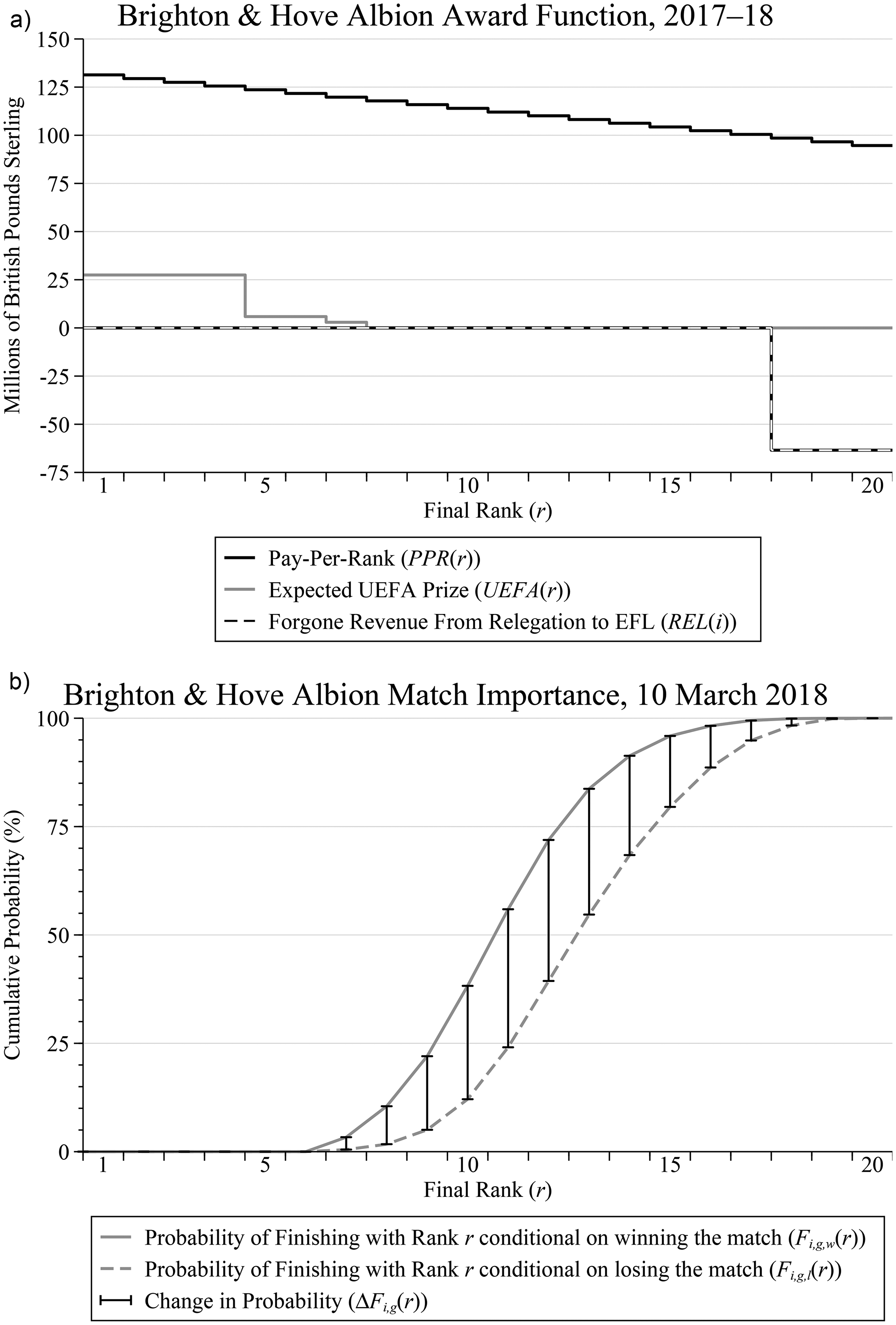
EPL Award and Incremental Impact of a Win.
We detail how the EPL's financial awards incentivize teams to win games. We compute each team's monetary match importance (MMI), for each of the 38 matches it plays each season, as the difference between the team's expected awards in the event it wins versus loses a match. MMI is team- and game-specific: it measures the monetary return for a given team to win a given game. We argue that it can contribute to the understanding teams’ fine-tuned game-by-game decisions through various trade-offs (e.g., game-specific player selection, within-game player substitution, choice of high- or low-effort strategies, etc.).
We follow related literature to compute a teams’ final rank conditional on game outcomes (Geenens, 2014; Goller & Heiniger, 2023; Lahvicka, 2015; Lei & Humphreys, 2013; Scarf & Shi, 2008; Schilling, 1994). To illustrate our approach, the right panel on Figure 1 plots the cumulative probability that Brighton & Hove Albion achieves a given rank conditional on winning (solid gray curve) and conditional on losing (dashed gray curve) its match on 10 March 2018. Prior to this date, each team has played 29 matches and very little has been mathematically determined; only four teams are mathematically certain to avoid relegation; and several UEFA bids remain mathematically attainable, however unlikely, for all teams. Brighton & Hove Albion, our exemplar team, can improve its expected final rank if it wins the day's match. For example, it is about 35 percentage points more likely to end the 2017–18 season amongst the top 12 teams with a win compared to a loss (vertical black line for rank 12).
While the literature has looked at the impact of a win on final rank, we go a step further and attach a monetary value using the three types of EPL financial incentives: for example, we calculate that the monetary stakes for Brighton & Hove Albion for its 10 March 2018 match is equal to £4.1 M, computed as the sum of the incremental probabilities to achieve a given rank (again, the vertical black lines of the right panel of Figure 1) multiplied by the incremental award from reaching that rank (the steps of the left panel). Repeating this calculation for each team and match yields our measure of monetary match importance (MMI) for each of the 760 team-games in an EPL season.
The value of the MMI computed in Figure 1 is team-game specific and is also conditional on the outcomes of the matches that took place prior to 10 March. Taking the expectation of this value at the beginning of the season (unconditional on all previous match outcomes) provides a measure of the expected importance of the 10 March match for Brighton & Hove Albion: this second measure of team-game importance can be averaged across all games played by Brighton & Hove Albion which represents the team's average incentive throughout the season. Our study of team incentives focuses on this team-level measure of MMI.
We show that, although relegation incentives generate high absolute levels of MMI when compared to pay-per-rank and UEFA awards, this is not the case when one considers MMI per British pound sterling of award. In fact, UEFA awards generate the highest level of MMI per pound of award. The contribution of UEFA awards on total MMI, however, is small because the EPL purse is large compared to expected UEFA awards.
We distinguish two types of teams: strong teams (about one-third of the league, which is mostly comprised of the teams referred to as the “Big Six”) that are never relegated and are perennial contenders for qualification to UEFA tournaments; and weak teams that have little hope of qualifying for any UEFA tournament and are instead often relegated. We argue that strong EPL teams are paid like bureaucrats, receiving large, guaranteed awards while facing little risk of relegation.
We then investigate whether the EPL could increase MMI with competitive balance, maintaining the incentive framework the EPL currently uses (rank-based awards and a system of promotion and relegation). We evaluate the MMI that would result from a league of homogenous EPL teams (i.e., all teams have the same chance to win and lose each game). Under this scenario, total aggregate MMI increases by a factor of 4.6. The EPL incentives are weak under current team heterogeneity relative to a counterfactual league with competitive balance. This further demonstrates that EPL teams are paid like bureaucrats.
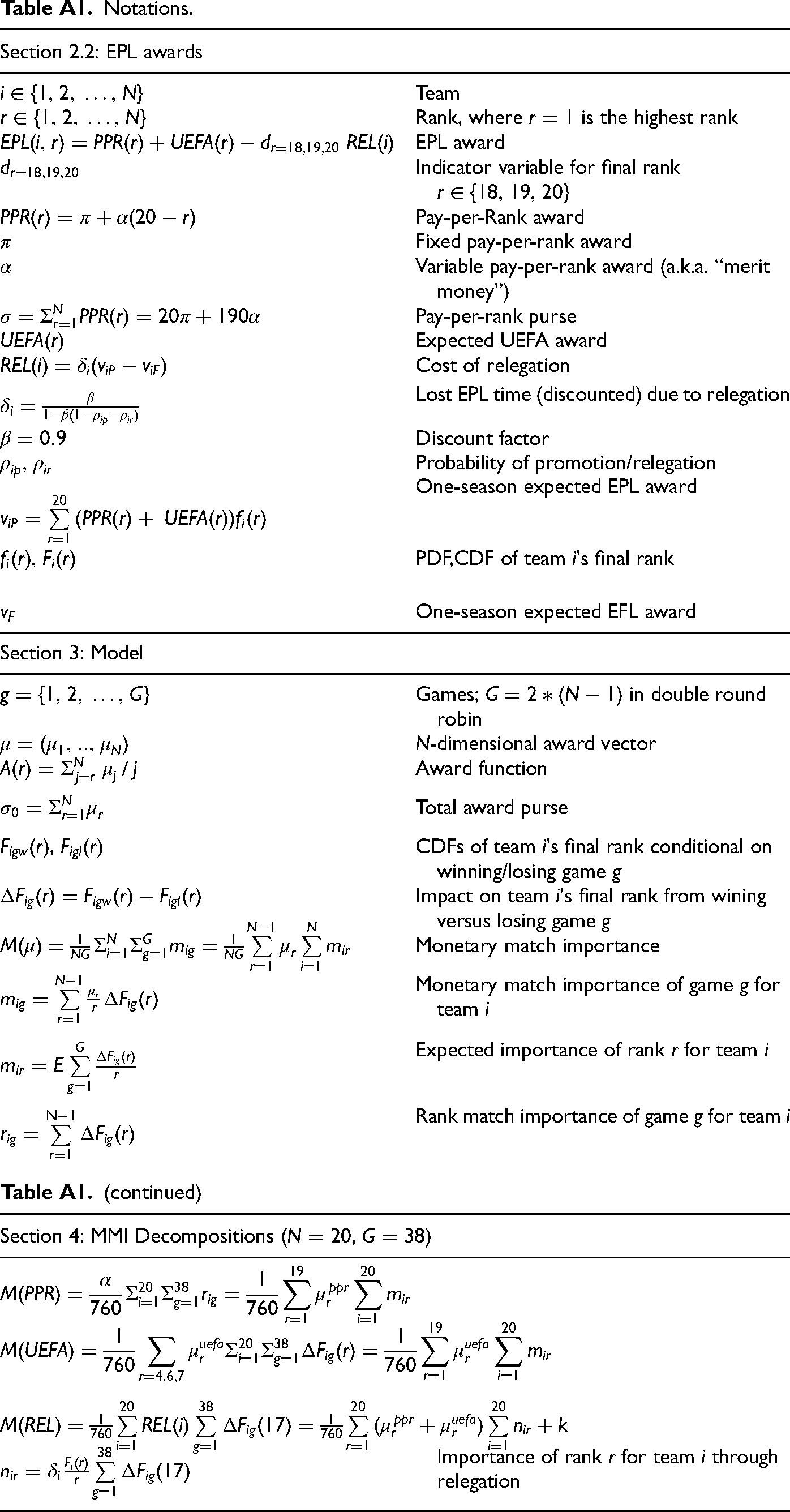
This paper is organized as follows: the rest of this introduction relates our work to the literature; Section 2 reviews the data and offers a detailed description of the financial incentives faced by teams; Section 3 presents a formal definition of match importance; Section 4 decomposes our measure of match importance by award category, season, team, and rank. The exposition requires an extensive use of notation to capture the three types of incentives used in the EPL and to explain the different decompositions. For the sake of clarity, Table A1 in the Appendix summarizes the notations used in the paper.
Contribution to the Literature: Understanding Incentives in EPL
This work makes three main contributions. Our first contribution is demonstrating that teams face very different incentives to win games. This analysis complements the literature that focuses on team's investment at the beginning of the season, focusing largely on wage expenditure (Garcia-del-Barrio & Szymanski, 2009). 2 In contrast, we take teams’ heterogeneity in player investments as given. These investments largely determine teams’ strengths and win probabilities. Our focus is on the incentive to modify gameplay strategies to win each game as the season progresses. For example, a strong team may may be able attract top players by offering high wages, but given this investment, our analysis shows that it faces little incentive (low MMI) to invest in each individual game. A weak team that is at risk of relegation throughout the season, however, faces stronger incentives (high MMI) to win games. 3
A second contribution is to demonstrate that heterogeneity in team strength negatively impacts the average incentives across the whole league. This points to a previously undocumented benefit of competitive balance (defined here as having teams of equal strength) that has been overlooked in the literature; Késenne, 2000): competitive balance is not only connected to uncertainty of game outcomes and fan demand (Szymanski, 2022), but it also increases the overall incentive across all teams in the league (i.e., higher average MMI). 4
Finally, this work contributes to the literature that investigates whether game importance influences real outcomes by developing a straight-forward methodology to measure the financial importance of each game in the EPL. Incentive theory says that teams should respond to changes in MMI over the season. In fact, there is much circumstantial evidence that teams do not select its best players in less important games. 5 One could use our measure of game importance to study whether it influences other team decisions. For example, Courty and Cisyk (2024) shows that concussion injuries increase with match importance in American football and Goller and Heiniger (2023) studies the impact of match importance on public interest. Our new MMI measure could be used in future research to study a variety of game-specific outcomes in the EPL (e.g., fouls or yellow and red cards).
EPL: Data, Awards, and Stylized Facts
EPL Background and Data
Each EPL season, 20 teams compete in a double round-robin tournament, playing a total of 380 matches that take place over a 38-week season. Our main sample covers 2,660 matches from seven seasons (2015–16 to 2021–22), with 31 distinct teams competing in at least one EPL season. Three sets of data were collected from publicly available sources (see Appendix A2.1). First, we collect the 2,660 realized EPL match outcomes: a match may end with a home team win, an away team win, or a home and away team draw. Second, we collect the details of the financial award structures for the seven seasons. The EPL and UEFA allocate domestic and international broadcast revenues to teams based on team performance. We record the award formulas that describe team payment conditional on final EPL rank or stage of ancillary UEFA tournament. The third data source is the probability of each match outcome. For each season, we collect the Elo values of each team (Elo,1967). The Elo values are used to calculate the probability of a game ending in a home win, loss, or draw in a process described in Appendix A2.2. 6
This work focuses on the distribution of the EPL and UEFA revenues which come largely from selling broadcasting rights. 7 Teams also receive revenues from advertising, sponsorship, and match-day sales which represent 40 percent of total team revenues. 8 The influence of these revenues on MMI is more difficult to evaluate because one does not know the sensitivity of these revenues to team performance as precisely as one does for EPL and UEFA ones. Instead, we focus on the league's influence on MMI through the choice of award structure.
Due to promotion and relegation, our panel is unbalanced, with only one third of the 31 teams having no missing observation (Table 1 shows that only 11 teams were part of the EPL in all seven seasons). This can be problematic, for example, when we compare average team awards as the EPL award purse has increased by 70 percent during our sample period and the UEFA award purse by 50 percent (see Table 2). The awards of the teams that compete at the end of the sample are inflated relative to those that compete at the beginning. To deal with this problem, we normalize the yearly award values by the season's award purse. These normalized values can be meaningfully compared across years.
League MMI by Seasons for PPR, UEFA, REL and Total (Values Relative to Pay-per-Rank Purse
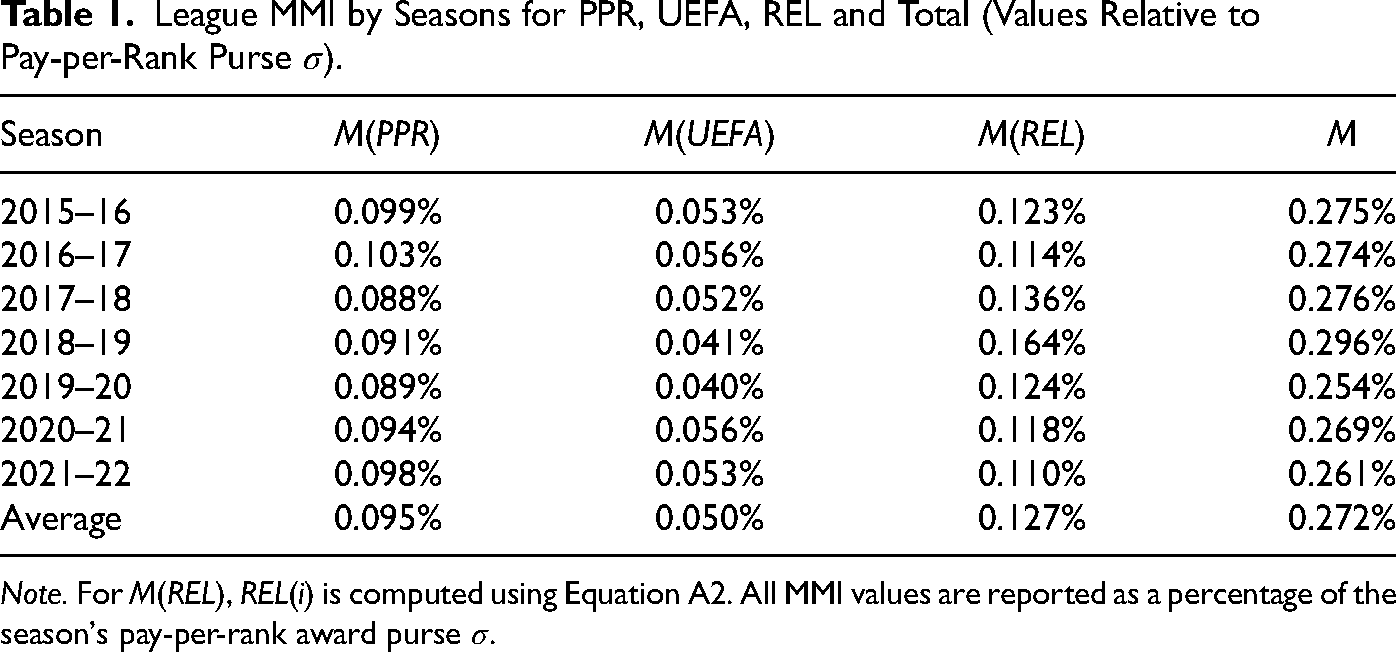
Note. For
Total Purse By Season (Millions of British Pounds).
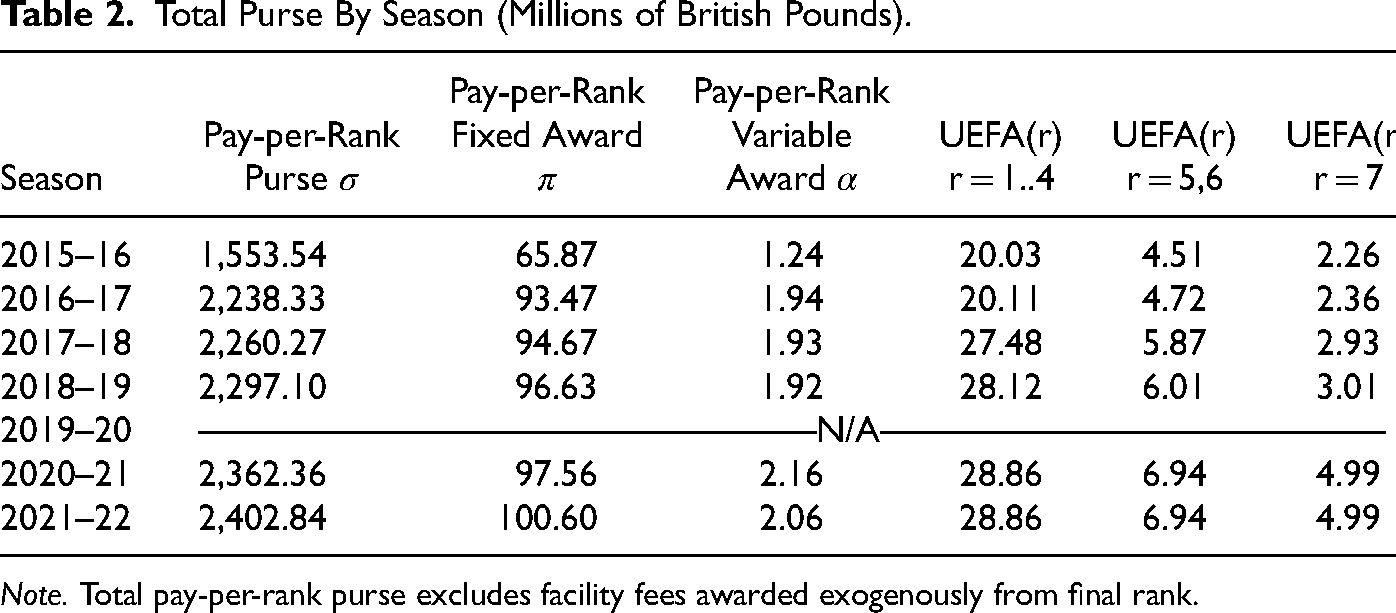
Note. Total pay-per-rank purse excludes facility fees awarded exogenously from final rank.
EPL Financial Awards
An EPL team's award depends on its ranking at the end of the season. Very stylistically, the expected benefit that team i receives from ending the season in rank r is composed of three sources:


The total pay-per-rank purse,
In addition, the teams ranked highest at the end of the EPL season participate in a sequence of ancillary competitions organized by UEFA. Performance in each competition determines the payment for that stage and the team's eligibility to progress to the next stage. The greatest expected awards are available to participants of the UEFA Champions League, followed by the UEFA Europa League, and, since season 2020–21, the UEFA Europa Conference League. Teams ending the EPL in higher ranks are seeded in more valuable tracks (Csató, 2020). We denote
The last source of EPL incentives is created through the system of promotion and relegation between the EPL and EFL.
12
At the end of each season, the three lowest EPL teams are relegated to the EFL, while the top three EFL teams are promoted to the EPL.
13
Relegated teams are not eligible to compete in the EPL the following season. Instead, they must compete in the EFL which yields much lower financial reward. In this sense, relegation operates as a claw-back system (Dehaan et al., 2013). In the season(s) that follow relegation, the relegated team bares the cost of not being eligible to compete in the EPL. We denote by
EPL teams face three types of incentives: pay-per-rank, UEFA qualification, and relegation.
The cost of relegation for Brighton & Hove Albion in the 2017–18 season, plotted in Figure 1, is about £70 M. This is estimated using a value function approach: because a relegated team is eligible to earn its promotion back to EPL after at least one season in the EFL, the loss from being relegated next season is equal to the difference in present value from competing in the EPL versus EFL. The cost of being relegated at the end of the current season is equal to this value discounted by one period:




Relegation incentives operate like a claw-back system: a relegated team loses the EPL premium for the time that it is not eligible to participate in the EPL.
Table 3 reports the relegation and subsequent promotion probabilities for the 2017–18 EPL teams, the teams’ expected pay-per-rank rewards, and estimated relegation costs (expressed as a percentage of the pay-per-rank award purse in the 2017–18 season). Implied relegation durations are short (around one season). This is because a strong team is likely to be promoted the season following relegation while a weak team is likely to be relegated next season if it is not this season. On the high end, we obtain relegation values in the range of 2.2 and 3.1 percent (equivalent to £50 M and £70 M in the 2017/18 season for Southampton and Huddersfield Town, respectively). Speer (2023) uses a regression discontinuity approach and report a relegation cost of about £159 m across the five European leagues. Speer (2023), however, applies only to the subset of teams that are relegated and thus cannot be used here because it does not deliver team-specific relegation costs. 16 Our structural value-function approach imposes a much lower data requirement and can be applied to any team, including those that face little chance of relegation.
Relegation Costs in Season 2017–18.
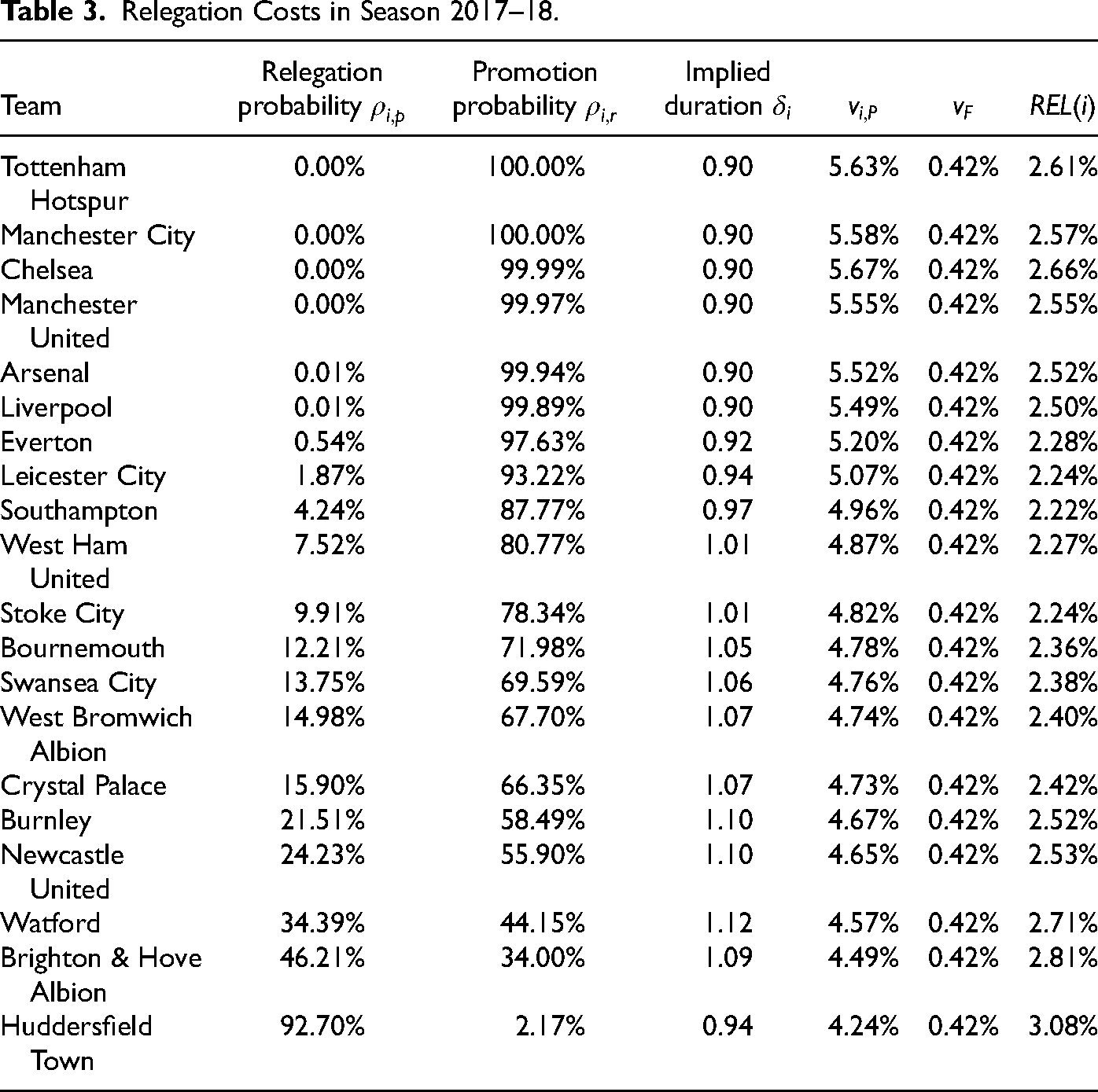
Team Rankings and Awards
Table 3 reports summary statistics for the 31 teams in our sample. Team performance varies greatly across teams. Some teams regularly achieve high ranks and others perform systematically poorly. The same seven teams consistently participate in the UEFA Champions League during our sample. The second right-most column shows that the pay-per-rank award is distributed remarkably evenly across teams and most teams receive around four to six percent of the pay-per-rank award purse (
Monetary Match Importance: A Theory of Rank-Based Incentives
This section derives team-game MMI and total league MMI for an archetypal rank-dependent award that distributes purse amount
The N teams that are paired in games. Teams play 
This measure of team-game importance can be averaged across all games for a given team, to obtain
Team-game MMI is measured in monetary units where 
Consider again the example of a single-elimination, ‘winner-takes-all’ tournament with four teams this time, that are equally strong. In this scenario
The value of
In the simple case where the incremental awards are constant, 
Rank match importance is small if teams vary a lot in quality. When this is the case, each team's expected final rank has a narrow range prior to the season's commencement. Final rank is determined by a team's ability and one would expect
Table 4 reports the values of MMI for different payoff functions. With constant incremental awards, an interesting case occurs when one-win-one-rank holds. This implies that
Payoff Function and MMI.
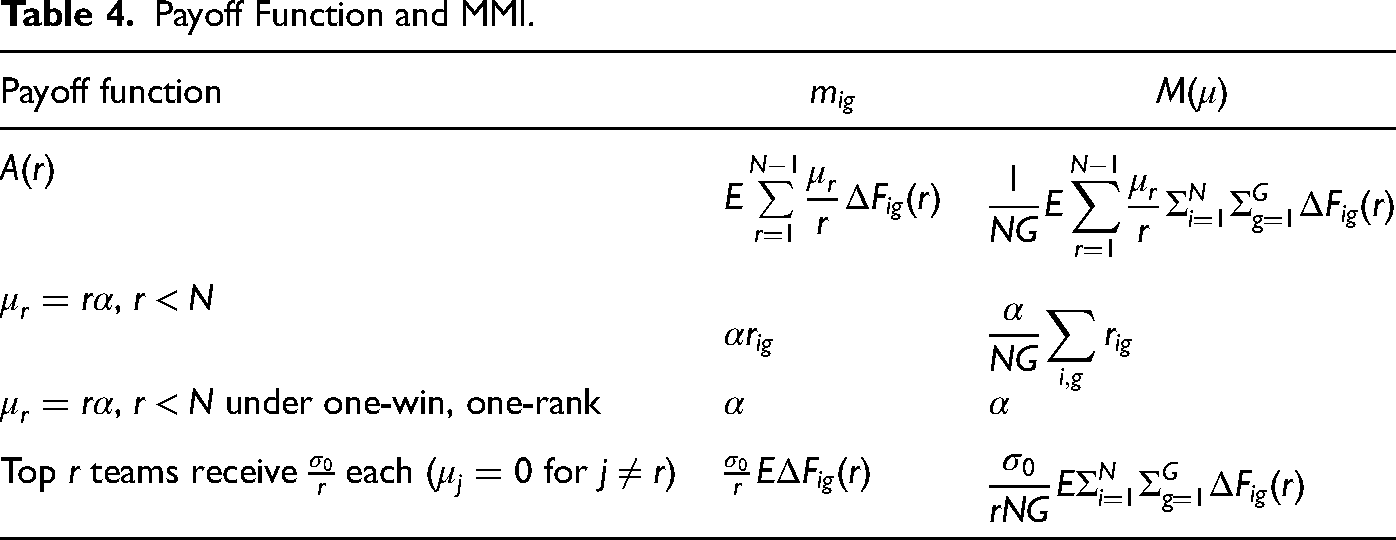
Table 1 illustrates the problem with fixed awards:
Equation 6 and Proposition 1 offer one decomposition where total MMI is broken down into team-match components. We offer another decomposition that demonstrates the importance of each rank: Instead of decomposing MMI into match components (summing over g as done in Equation 6 we decompose MMI into rank components (summing over
Note that the importance of match g for team i, denoted by
Application to the EPL
This section applies the results of the previous section to the three EPL awards. The application is straightforward in the case of
We use a simulation approach to compute each MMI component. For each season, we simulate the 380 game outcomes 50,000 times using the match outcome probabilities obtained from the Elo values. Each iteration corresponds to a possible season history. For each team-game, we construct the team's average award across the 50,000 histories, conditional on the team winning or losing the game. We compute the team-game MMI using Equation 5 and replacing the expected awards with the average value from the simulation for each of the three award components. See Appendix 2.2 for details.
MMI Decomposition by Award Category
This section decomposes a season's MMI by award category. For the sake of keeping notations simple, we use
Table 1 reports the league's total MMI by seasons for the three award components. Again, here all MMI values in a given season are reported as a percentage of that season's pay-per-rank award purse
In Table 1,
Relegation incentives generate high levels of MMI.
Next, we look at the average MMI per £1,000 of award. That is, we do not normalize the MMI by the same value (total pay-per-rank purse,
For relegation incentives, we use the guaranteed award component in pay-per-rank (£2,012 M for 2021–22) because this accounts for the majority of the loss experienced upon relegation. One should keep in mind, however, that this is a lower bound on the award funds contributing to relegation incentives and adding the pay-per-rank and UEFA awards would only reinforce the point we are about to make. With this lower bound, we obtain that relegation incentives deliver only £1.5 MMI per £1,000 of award. 24 Thus, the three types of awards can be ranked by level of efficiency with UEFA the highest, followed by pay-per-rank, then relegation.
Relegation generate low MMI per pound of award relative to pay-per-rank and UEFA awards; UEFA awards generate the higher level of MMI per pound of award.
MMI Decomposition by Team
Next, we turn at the analysis of MMI by team. We use the same formulas as in the previous section but omitting the summation over team. The
MMI Values by Team (Values Relative to Total Pay-per-Rank Purse σ).
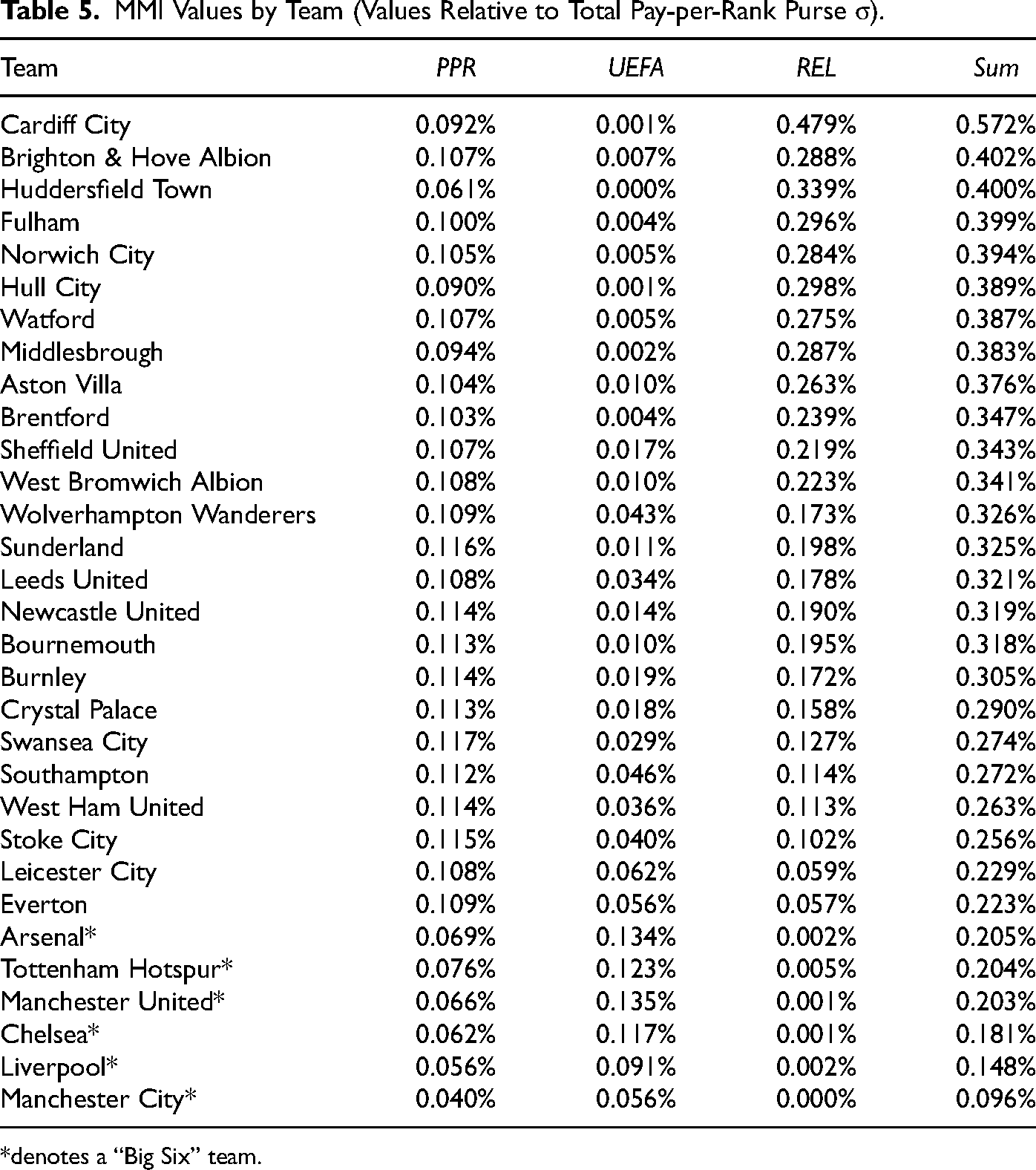
denotes a “Big Six” team.
Awards by EPL Team, Seasons 2015–16 to 2021–22.
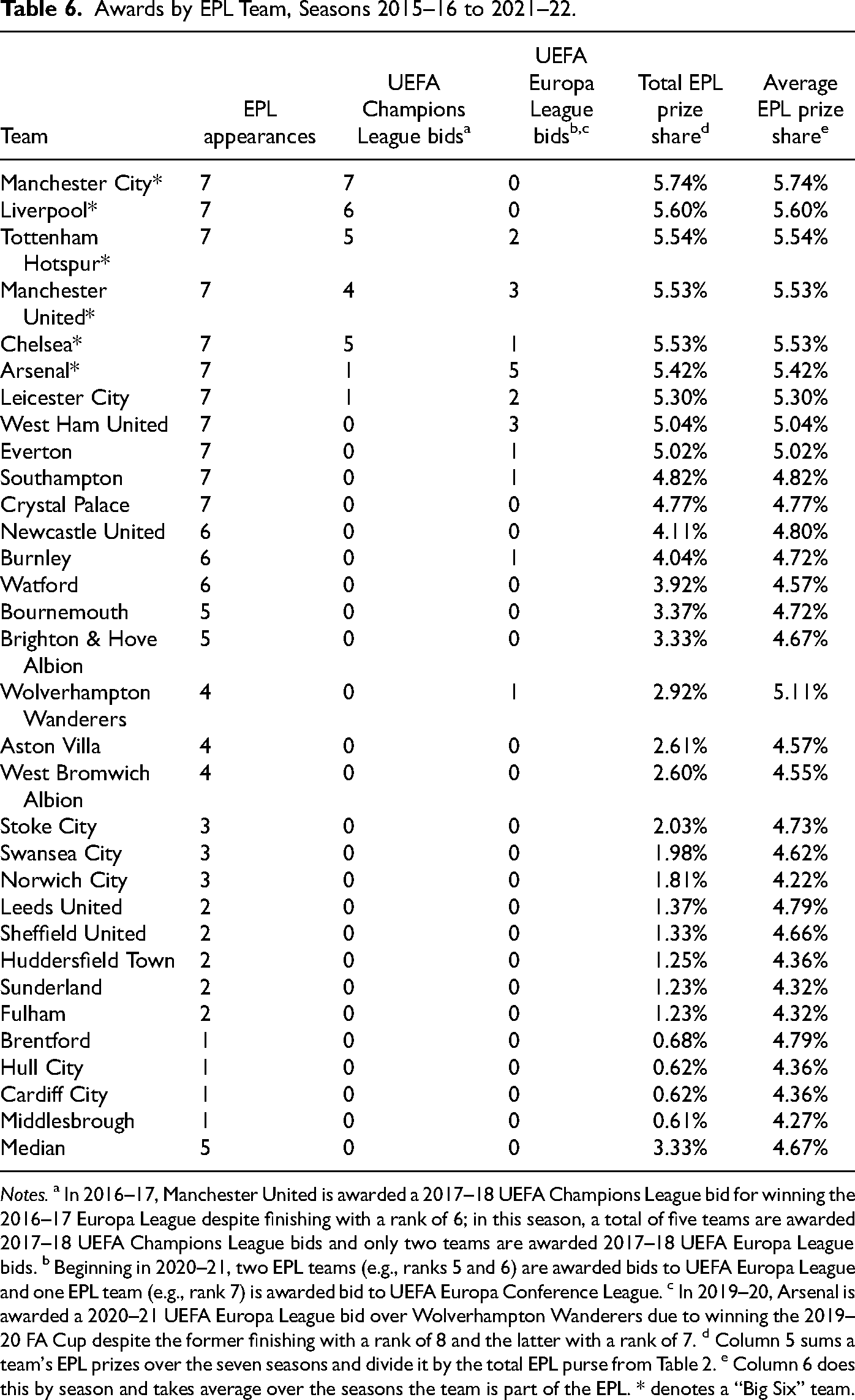
Notes. a In 2016–17, Manchester United is awarded a 2017–18 UEFA Champions League bid for winning the 2016–17 Europa League despite finishing with a rank of 6; in this season, a total of five teams are awarded 2017–18 UEFA Champions League bids and only two teams are awarded 2017–18 UEFA Europa League bids. b Beginning in 2020–21, two EPL teams (e.g., ranks 5 and 6) are awarded bids to UEFA Europa League and one EPL team (e.g., rank 7) is awarded bid to UEFA Europa Conference League. c In 2019–20, Arsenal is awarded a 2020–21 UEFA Europa League bid over Wolverhampton Wanderers due to winning the 2019–20 FA Cup despite the former finishing with a rank of 8 and the latter with a rank of 7. d Column 5 sums a team's EPL prizes over the seven seasons and divide it by the total EPL purse from Table 2. e Column 6 does this by season and takes average over the seasons the team is part of the EPL. * denotes a “Big Six” team.
The values of average MMI vary widely across teams for UEFA and relegation incentives, but not so for pay-per-rank (the coefficient of variation in the MMI measures is 1.1, 0.7, and 0.2 for UEFA, relegation, and pay-per-rank, respectively). This is because all teams (but the top-ranked team) can improve their rank and earn a constant marginal benefit. Conversely, UEFA tournaments are achievable only for strong teams, and relegation incentives matter most for weak teams.
The main source of MMI is from UEFA tournaments for strong teams and relegation risk for mediocre teams.
A team that is unlikely to fall in one of the bottom-three ranks faces low relegation incentives, and very few teams have this privilege: only eight teams have an average relegation incentive of less than one tenth of a percent. Other teams face a non-negligible chance to be relegated with huge financial consequences. Even teams that are never relegated during our sample period still have significant relegation incentives. For example, Crystal Palace and Southampton have relegation incentive values of 0.158 and 0.114 percent, respectively (equivalent to an average of £3.8 M and £2.7 M per game in the 2021/22 season, respectively). This is because these two teams continually risk concluding the season at a rank of 17 or worse. 25 The remaining teams have typically high values of relegation incentives and are occasionally relegated. To conclude, relegation is the most important incentive, but some teams seem completely immune to it.
This above finding delivers an answer to whether EPL teams are paid like bureaucrats. The last column of Table 5 orders teams with the teams generating most MMI at the top: stronger teams, including the teams that comprise the “Big Six,” are listed near the bottom. These teams have relatively small MMI under the current incentives because they receive a large, guaranteed payment with no risk of losing it, with almost no relegation incentives which is the most powerful source of incentives across all teams.
Strong EPL teams are paid like bureaucrat because the guaranteed award has no impact on their MMI.
Relegation and pay-per-rank incentives are positively correlated across teams (
MMI Decomposition by Rank
Corollary 1 applies to

Award component
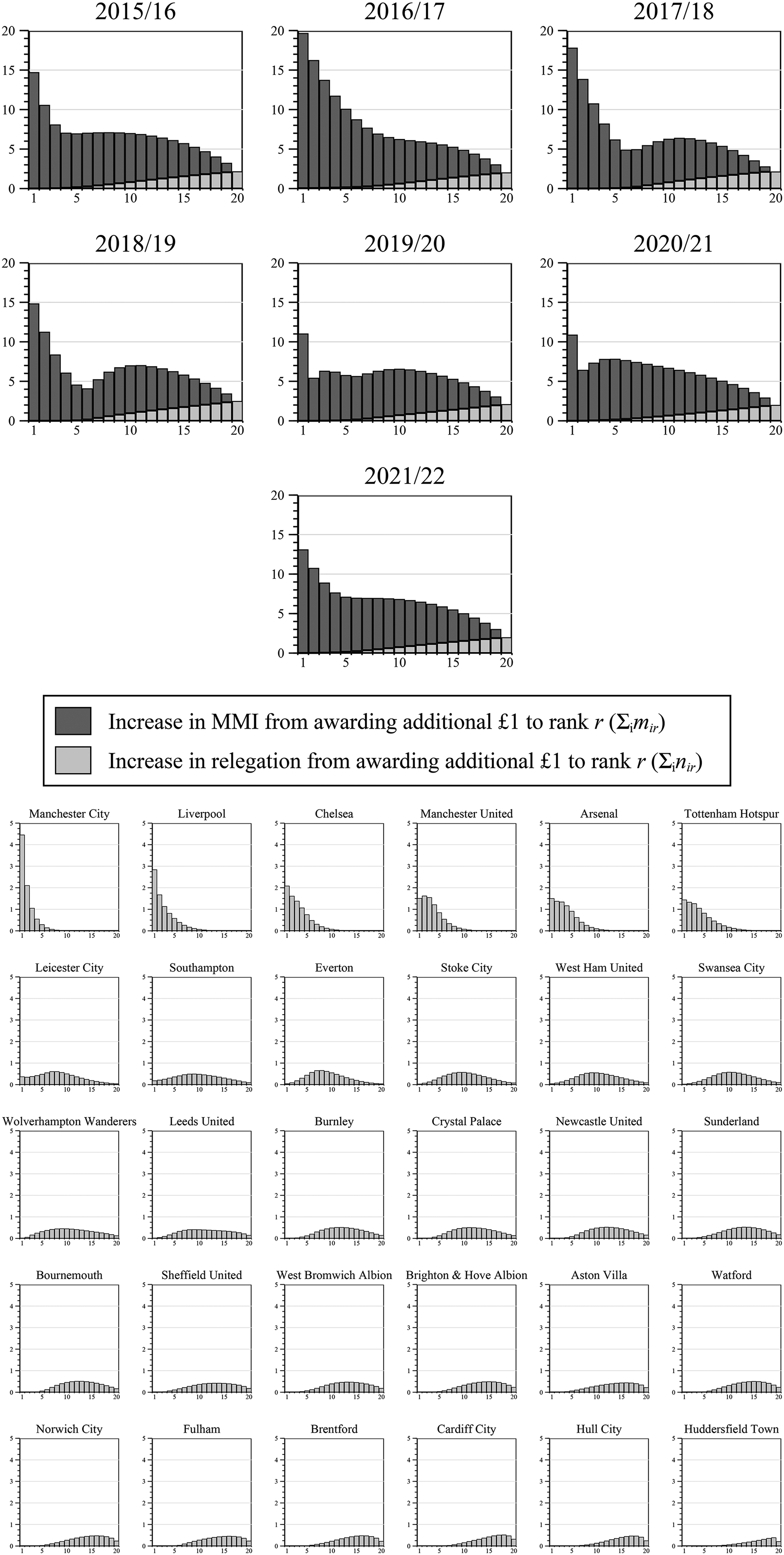
Figures 2 plot the values of
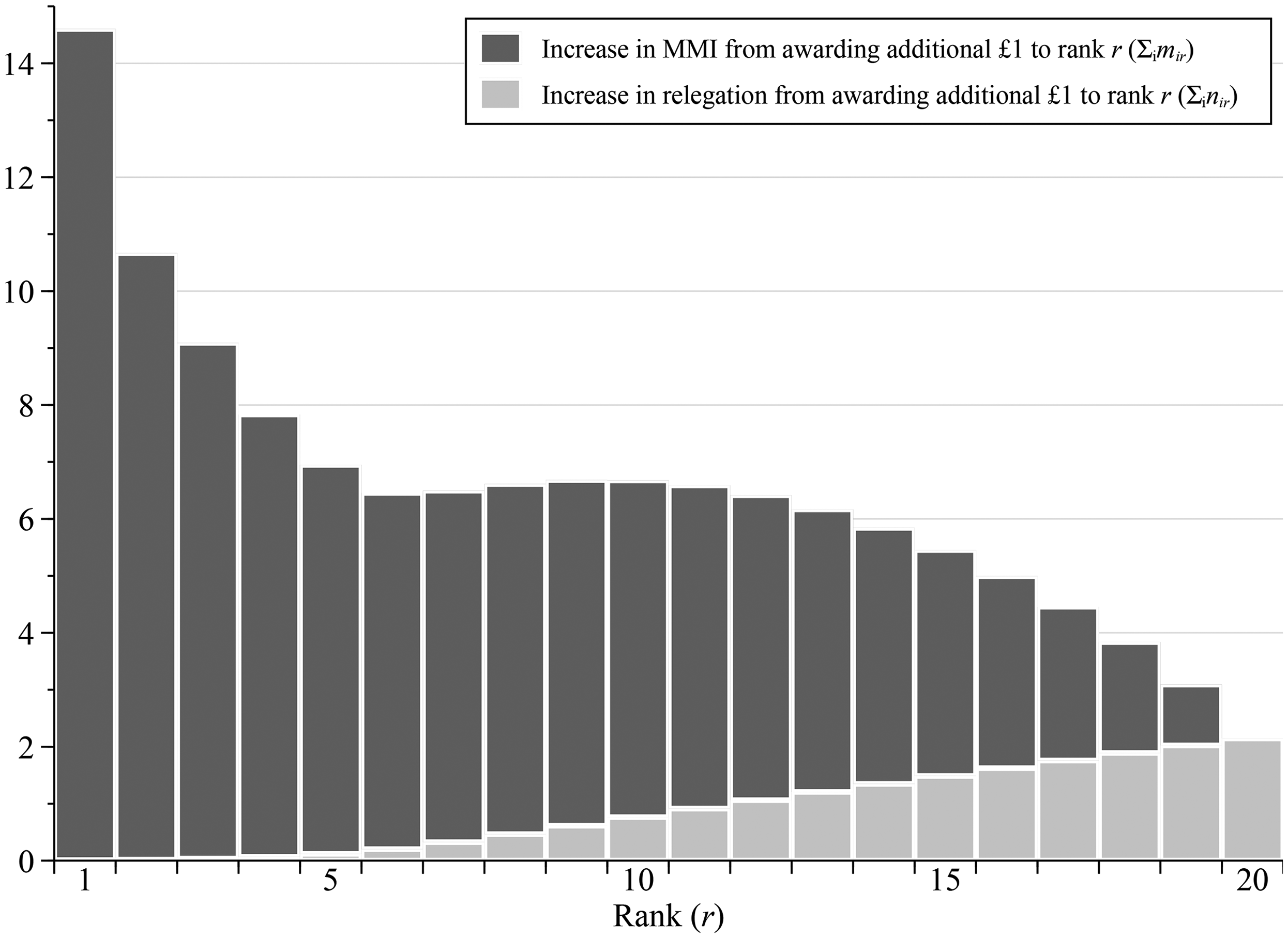
Figure 3 decomposes the function
Last, we consider a counter-factual hypothetical version of the EPL that has perfect competitive balance. That is, we compute a new set of
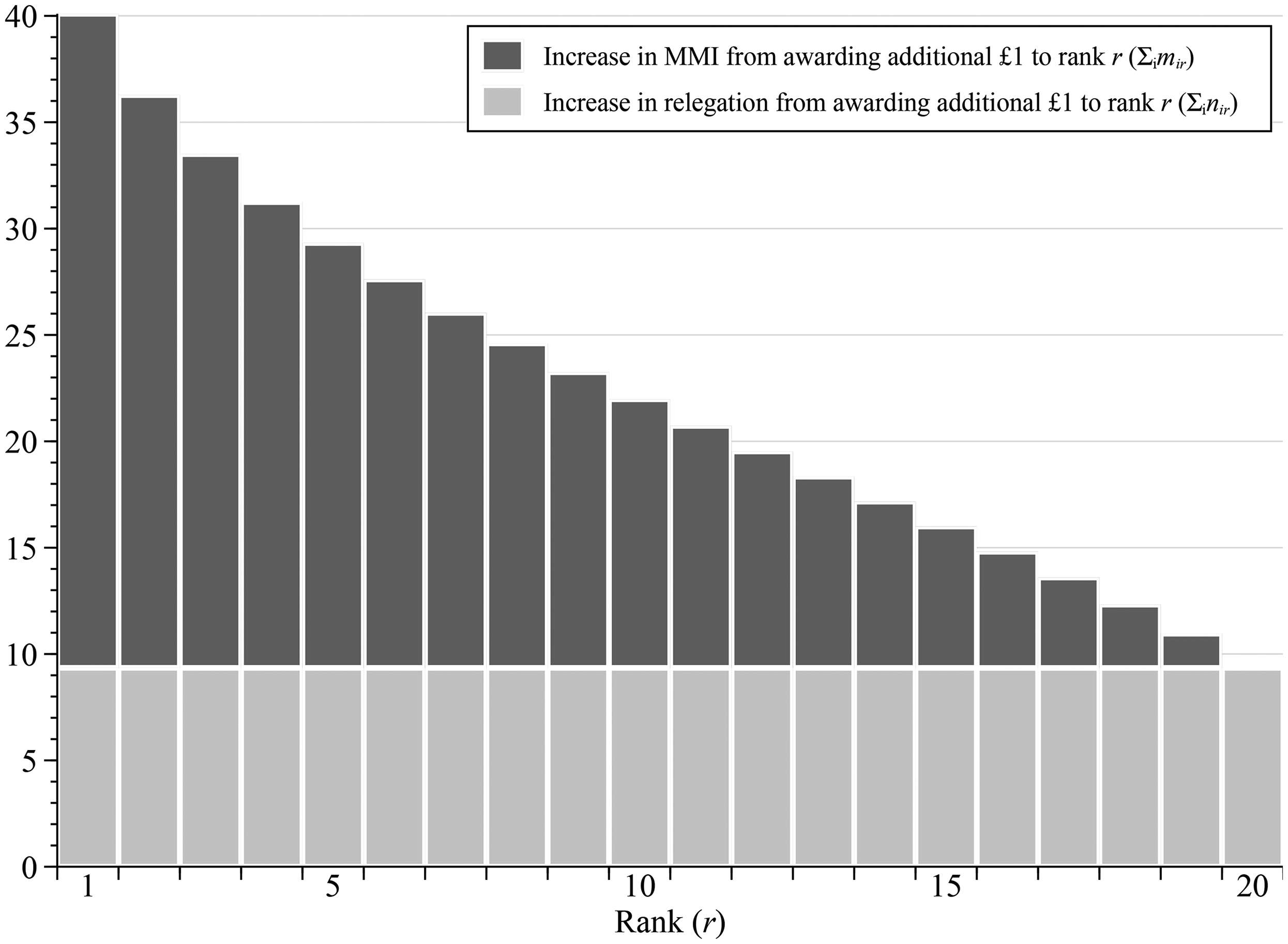
Team heterogeneity within the EPL greatly reduces MMI.
Conclusion
We measure teams’ incentive to win games using a new measure, called monetary match importance (MMI), defined as the difference between a team's expected award in the event it wins versus loses a match. We compute the MMI for the three types of incentives used in the EPL: pay-per-rank, UEFA qualification, and relegation. Relegation incentives generate high absolute levels of MMI but low MMI when measured per British pounds sterling of monetary award. Strong and weak teams respond differently to the three types of EPL incentives: weak teams are incentivized largely by relegation incentives while strong teams are incentivized by UEFA incentives, although the magnitude of the latter is small due to the relatively small expectation-weighted UEFA financial stakes. Strong teams are paid like bureaucrats because they do not risk losing the large, guaranteed EPL award as most other teams do. We also show that introducing competitive balance (equal team strength) while keeping the current EPL award would increase MMI by a factor of 4.6.
This work proposes an incentive-based approach to analyze the rule that dictates how a leagues’ revenues are distributed. This approach has been pursued with much success in other economic fields, where the award designer pursues a well-defined objective (i.e., personnel economics). While we focus here on average team and league MMI over the season, future work could exploit the large within-season variation in a team's MMI to study whether team- and game-specific investments depend on MMI.
In our application to sports, we assumed that audiences are interested in watching teams that are eager to win games. But there is more to sports contest than average MMI as assumed in this work. To start, fans may not care only about how hard teams try to win games. Having some games with low MMI, for example, may be detrimental to the league if fans find these boring. Fans may also care about suspense and other dimensions of a sports competition (Chan et al., 2009). In addition, sports leagues are concerned about how the award allocation influences competitive balance (Szymanski, 2006) or may want to reward the teams that contribute most to broadcasting revenues (Bergantiños & Moreno-Ternero, 2020) and these teams may not necessarily be the teams that try hardest to win games. 26 Integrating these approaches opens interesting questions for future research.
Supplemental Material
sj-docx-1-jse-10.1177_15270025251348181 - Supplemental material for Are English Premier League Teams Paid Like Bureaucrats? An Incentive Analysis of Monetary Match Importance
Supplemental material, sj-docx-1-jse-10.1177_15270025251348181 for Are English Premier League Teams Paid Like Bureaucrats? An Incentive Analysis of Monetary Match Importance by Jeffrey Cisyk, Pascal Courty, and Amin Kouhbor in Journal of Sports Economics
Footnotes
Declaration of Conflicting Interests
The author(s) declared no potential conflicts of interest with respect to the research, authorship, and/or publication of this article.
Funding
The author(s) received no financial support for the research, authorship, and/or publication of this article.

Supplemental Material
Supplemental material for this article is available online.
Notes
Author Biographies
Appendix 1. Proofs and generalization
Notations.
| Section 2.2: EPL awards | |
| Team | |
| Rank, where is the highest rank | |
| EPL award | |
| Indicator variable for final rank | |
| Pay-per-Rank award | |
| Fixed pay-per-rank award | |
| Variable pay-per-rank award (a.k.a. “merit money”) | |
| Pay-per-rank purse | |
| Expected UEFA award | |
| Cost of relegation | |
| Lost EPL time (discounted) due to relegation | |
| Discount factor | |
| Probability of promotion/relegation | |
| One-season expected EPL award | |
| PDF,CDF of team 's final rank | |
| One-season expected EFL award | |
| Section 3: Model | |
| Games; in double round robin | |
| -dimensional award vector | |
| Award function | |
| Total award purse | |
| , |
CDFs of team 's final rank conditional on winning/losing game |
| Impact on team 's final rank from wining versus losing game | |
| Monetary match importance | |
| Monetary match importance of game g for team | |
| Expected importance of rank r for team | |
| Rank match importance of game g for team | |
| Section 4: MMI Decompositions ( , | |
|
|
|
| Importance of rank r for team i through relegation | |
Appendix 2. Data and Simulations
References
Supplementary Material
Please find the following supplemental material available below.
For Open Access articles published under a Creative Commons License, all supplemental material carries the same license as the article it is associated with.
For non-Open Access articles published, all supplemental material carries a non-exclusive license, and permission requests for re-use of supplemental material or any part of supplemental material shall be sent directly to the copyright owner as specified in the copyright notice associated with the article.
