



Abstract
The migration of professional athletes increased in volume and composition in the recent decades. We use a rational choice model to explain migration in certain sports and test it by applying the Poisson pseudo maximum likelihood estimator and the negative binomial pseudo maximum likelihood estimator. We can show that diaspora significantly impel the migration of athletes, while the GDP per capita is a significant pulling factor for athletics, but not for tennis and figure skaters. Considering the differences between nation's success in international competition, we find evidence for positive selection for athletes. With this study, we notably contribute to migration economics in the field of sport by analyzing migration in the sports of athletics, tennis, and figure skating for the first time.
Introduction
The migration of professional athletes increased in magnitude and composition in the recent decades (see List of sportspeople who competed for more than one nation). Transnational sports migration research has been focused primarily on football players (e.g., Darby, 2013; Gerrard, 2002; Lally et al., 2022) or on migration to certain countries, for instance in and out of the USA (Pedo Lopes et al., 2024). Indeed, research in sports migration in other sports than football, most notably individual sports, has a shortage. The rationale behind taking the decision to migrate is, among others, linked to an athlete's skills. While the out-flow of high-skilled employees is commonly known as Brain Drain, there exists a sport-related analogy, the Muscle Drain (Andreff, 2001). Though, other relevant intentions may be to get better training and development opportunities (Thibault, 2009). Other pull factors are striving for higher standards of living or sociocultural conditions, whereas inequality of resources in or political instability in the home nations are classical pushing factors (Chepyator-Thomson & Ariyo, 2016). In fact, failed institutions, poor healthcare or corruption are also factors that push athletes migration.
Indeed, the mosaic of pushing and pulling factors varies among each sport, we seek to address the understanding of athlete's migration in a more general framework, that enables us to reconcile the migration in every individual sport. If we want to generalize the sports migration under one model, things are going to be bounded by the fact, that individual and team sports hugely distinguish in terms of migration decisions. Team sport athletes are usually embedded in qausi-free labor markets (beyond that international federations or the EU set special transfer rules) and part of clubs that operating within league systems. This means, that such athletes are usual employees, while individual sports athletes are mostly embedded in world-wide contests or tours, not receiving permanent income from a club. As a consequence, individual sports athletes have to consider, contrary to team sport athletes, more than only the aspect of income maximization. They need to account for training facilities, health care, and so on. Having in mind this inherently difference, we propose a formal model from which we can derive empirical strategies to quantify migration of individual sports athletes.
Despite research on sports migration has enlarged since a couple of years, most of it is not quantitative, but rather interview-based. In addition, the superior size of the football market, its popularity across the world and the fact that the data basis provided by professional sports leagues are much more elaborated, the research of sports migration has focused either on football players (e.g., Magee & Sugden, 2002; Poli, 2006; Travlos et al., 2017), basketball players (Chiba, 2013; Falcous & Maguire, 2005), or handball players (Agergaard, 2008).
Looking on the individual sports level, e.g., Simiyu Njororai (2012) focus on the labor migration of Kenyan runners. The motives behind the migration of motocross and supercross athletes to the United States are recently assessed by Pedo Lopes et al. (2024) in terms of interviews. Except Besnier et al. (2020), little attention has been paid to sports migration in relatively less popular disciplines such as rugby or running.
The remainder of this paper is structured as follows: In the Modeling Athlete’s Migration section, we give a short overview of selected sport migration theories. Our model, which is based on the Rational Choice Approach, is presented in section Empirics, followed by the empirical part, where we present und discuss our estimation results. Finally, we close with concluding remarks.
Modeling Athlete's Migration
We model the athletes migration in context of the familiar rational choice framework used in migration economics (Beine, 2016; Cattaneo & Peri, 2016; Klöcker & Daumann, 2023). Hence, we set up a number of assumptions: (i) Individuals are totally informed and seek to maximize their expected utility by changing their eligibility from country i to j. (ii) Individuals build rational expectations over win probabilities in sport




The cost function (3) only takes into account athletes who tend to physically move to country j. Though, the professional sports sphere is distinct from common migratory aspects in the sense, that professional sports people, who do individual sports, mainly perform this at single contest embedded in seasonal world tours. Those athletes do not need to physically emigrate to the destination country, because they actually do not resist on one headquarter. To capture this kind of “sports migrants”, we have to adjust the cost function in (3) in such a way, that costs only exist in terms of reputational losses; reputation is connected with income from advertising contracts, and we assume that eligibility transfers diminish it.


Definition 1: Sports people who physically move from country i to j and additionally change their eligibility are defined as Type I-Migrants.
Definition 1: Sports people who do not physically move from country i to j, but only change their eligibility are defined as Type II-Migrants.
Athletes only migrate if their expected success (and so the income) is higher than in the case to stay or to keep the eligibility. The incentive-condition for migrants is as follows:





non-binding feasibility constraint.
Proof: Since
The first proposition states that an increasing talent stock
nations, the fraction of emigrants to j with non-binding feasibility constraint decreases.
Proof: Since
The increasing expected win probability of nation i and j leads to less migration from i to j. In cases in which the positive selection condition holds, the incentive to migrate reduces, because the individual expects to participate on the higher probability of success in the origin country.
non-binding feasibility constraint.
Proof: Since
Since the migration costs for an individual increase, the fraction of migrants diminishes even if positive selection holds.
By log-linearizing (6) and (8) and merging both together, we derive our estimation equation:

Empirics
Data and Empirical Methods
Because we consider three sports, athletics, tennis and figure skating, we prepare sets consisting of 109 nations (athletics), 65 nation (tennis) and 43 nations (figure skating). Only countries where sports migration took place between 1990 and 2022 are taken into account. In total, our dataset contains 179 athletes of type I-migration and 422 of type II, 52 tennis players of type I-migration, 86 of type II-migration, 35 figure skaters of type I-migration, and 75 figure skaters of type II.
We retrieve all data associated with immigration and emigration of athletes from the List of eligibility transfers in athletics (LETA, 2023), while data associated with tennis players and figure skaters could only be collected from the Wikipedia webpage List of sportspeople who competed for more than one nation. 6
The biggest problem in context of missing data concerns the talent stocks

We include climate zones factor variables for both, the origin and the destination, in estimating the determinants of migration in athletics. Because the migration decision depends not only on either the origin or destination climate zone, but rather on both. We assume that, for instance, long-distance runners prefer warmer climates. But if both, the origin and destination country are located in such a zone, the migration decision should not be affected by any of the climate dummies. The mapping of the climate zones is based on the classification of the National Oceanic Atmospheric Administration (NOAA, 2023). Since tennis and figure skating are more or less independent from a climate zones themselves, we leave out such factors in the estimations of these sports.
Econometric Issues
We face off dealing with zero emigrants within our dataset. The trivial solutions, either ignoring zero-observation or transforming them by adding a small constant, lead to biases, because zeroes indicate the absence of movements. We thus apply two commonly used estimation methods, the Poisson pseudo maximum likelihood (PPML) estimator as well as the negative binomial pseudo maximum likelihood (NBPML) estimator.
11
The PPML proposed by Santos Silva & Tenreyro (2006) as well as the NBPML provide unbiased estimates in cases of heteroskedasticity and additionally handle the problem of zero-observations for the dependent variable (Gomez-Herrera, 2013). Further econometric issues concerning the possible endogeneity caused by omitted variables. It is clear, that the inclusion of the GDP per capita is a very weak proxy for the talent stock, hence we are aware of this point. Another notably issue may lay in a reverse causality between the immigration and the index
Results
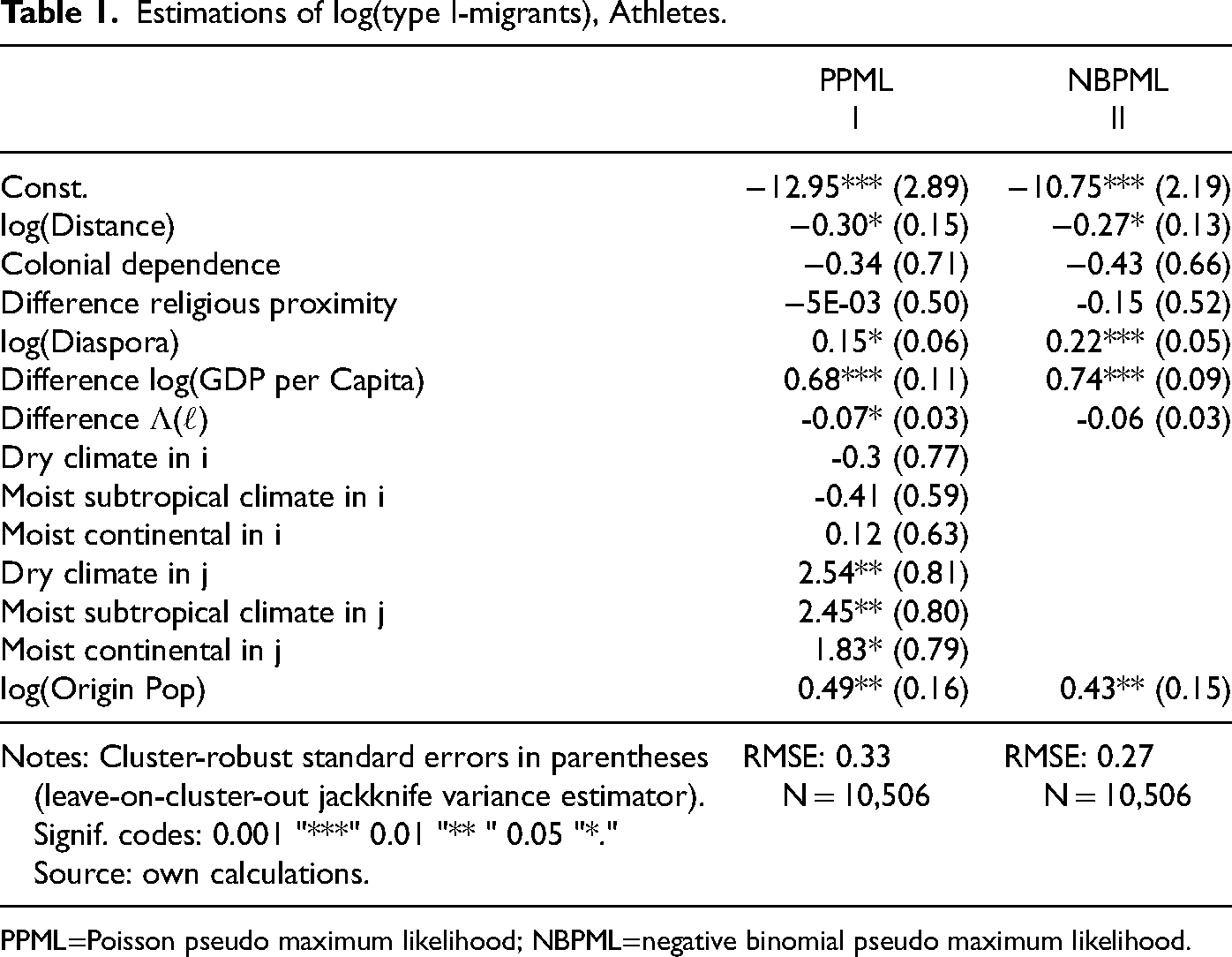
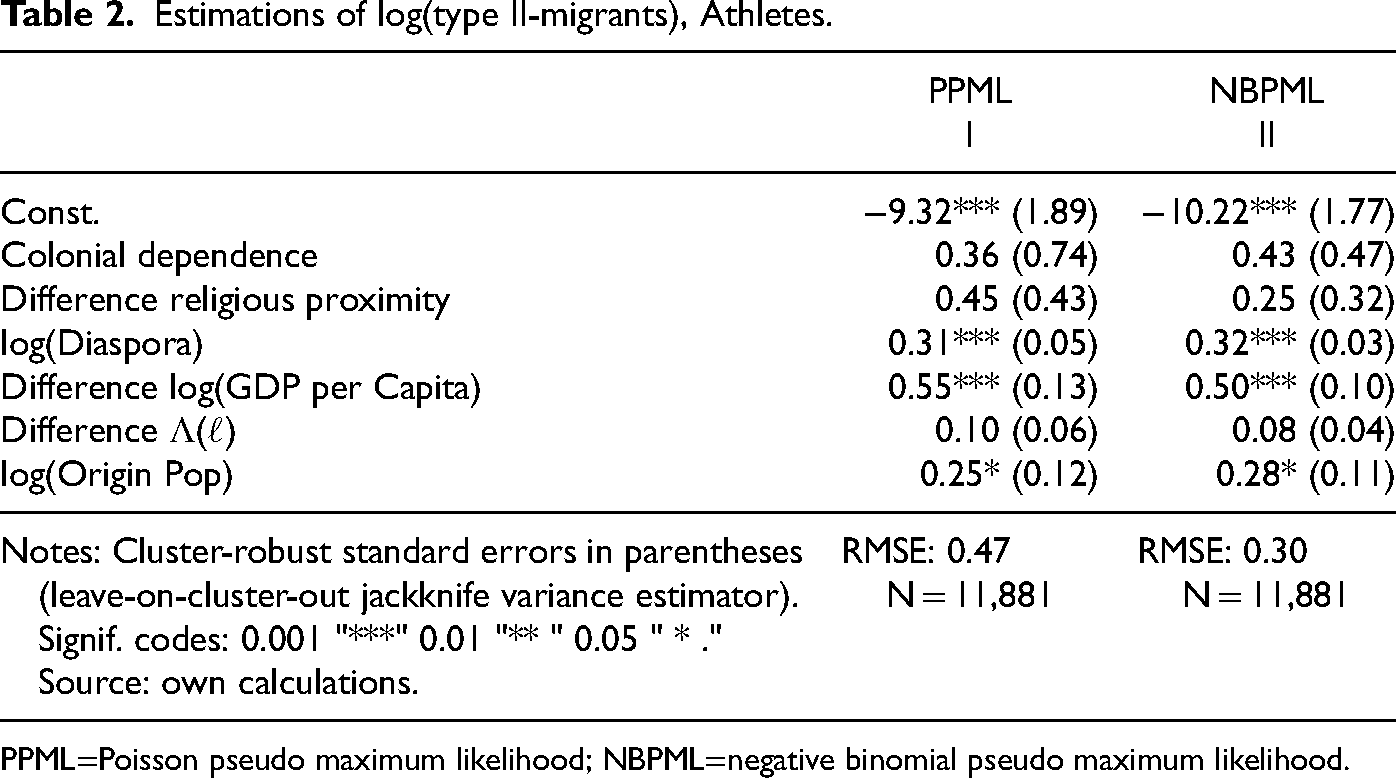
Table 1 provides the estimation results for athletes of type I-migration, while table 2 shows the results for type II-migrants. Model I refers to the PPML estimation, whereas model II is assigned to the results of the NBPML estimations.
Estimations of log(type I-migrants), Athletes.
PPML=Poisson pseudo maximum likelihood; NBPML=negative binomial pseudo maximum likelihood.
Estimations of log(type II-migrants), Athletes.
PPML=Poisson pseudo maximum likelihood; NBPML=negative binomial pseudo maximum likelihood.
From propositions 1 and 2, we are able to detect positive selection. This gets along with a positive sign in the difference of the GDP per capita, while the sign for the difference in
As the results in table 1 show, the spatial distance significantly affecting the emigration volume with an elasticity at about 0.3%. While former colonial dependencies and religiousness proximity are not significant, the diaspora's size on the immigration volume (due to sinking migration costs) is significant. This is best-known from the previous research, as, e.g., in Naujoks (2022) or Beine (2016). Therefore, the highly significant impacts in both models confirm this for professional athletes, too. A larger gap in the logarithmized GDP per capita shows highly significance in both models, too. A one-percentage rise there enlarges the emigration volume between 0.68% and 0.74%. The difference in
Regarding the climate zones factor variables, we firstly emphasize that the countries in our country set are only distributed in four out of the six climate zones. The first climate zone (tropic) is set as reference category. Interestingly, only the climates at the destination substantially affect the migration volume. Compared to nations with tropical climate, all other zones indicate huge effects. For example, destinations located in dry climate zones have a higher inflow of migrants than tropical destinations of roughly 254%
The results for type II-migrants are similar to the type I-migrants. The diaspora's size has a positive and significant impact. Also the difference in the GDP per capita affects the migration volume positive and is significant. Distinct to the former estimates, the difference in the expected win probabilities is not significant anymore, so a clear statement about positive or negative selection is not possible.
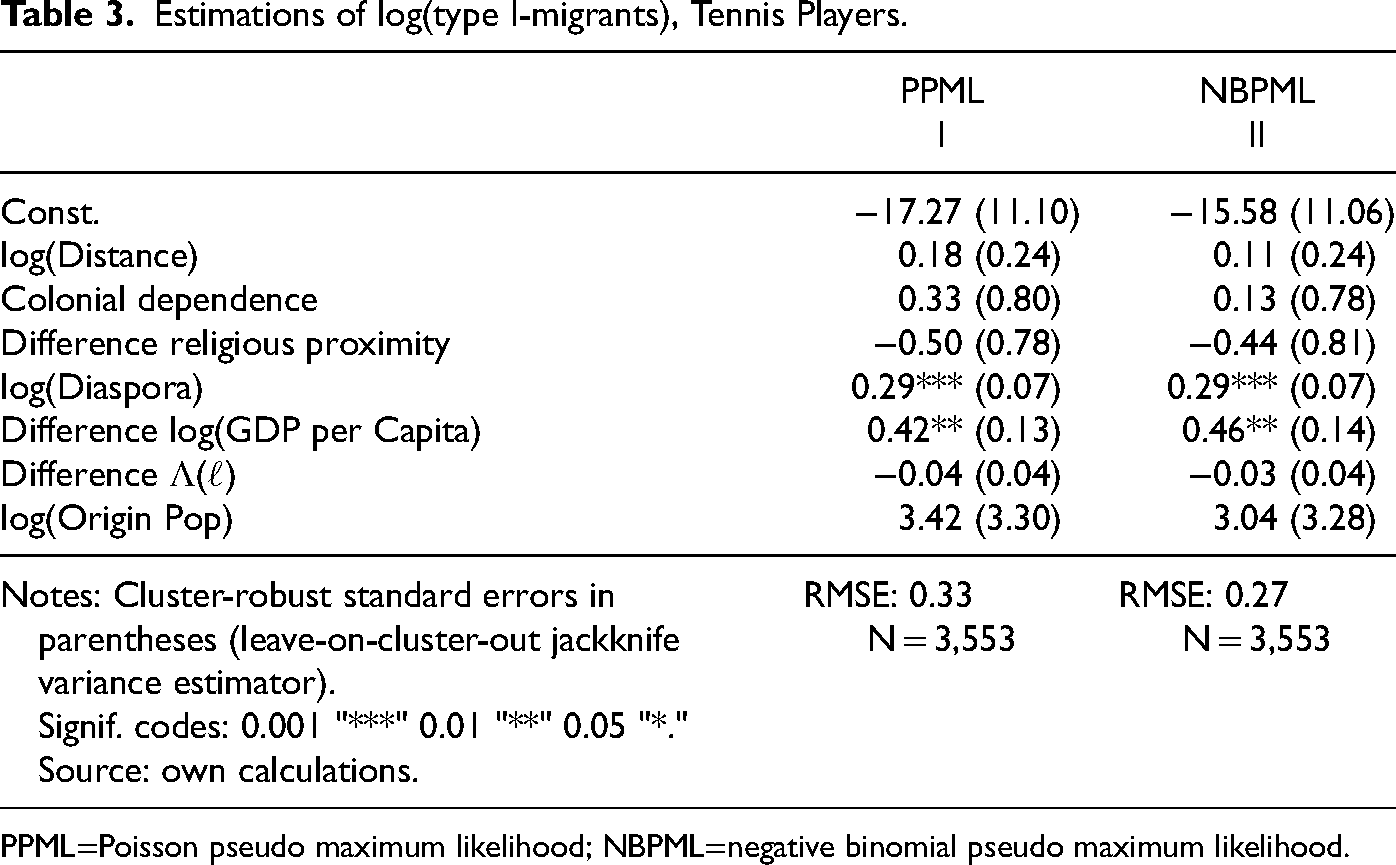
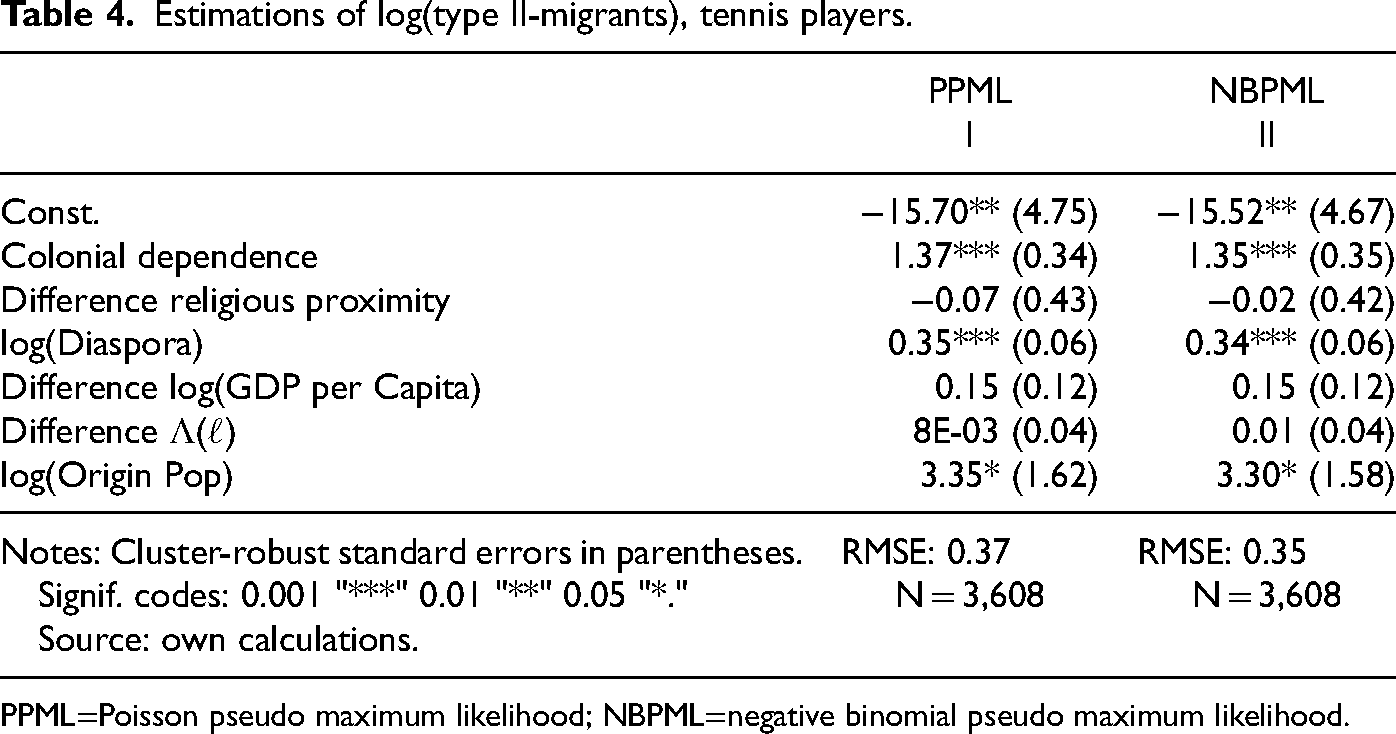
Tables 3 and 4 provide the results for tennis players. What has been shown for usual labor migration (e.g., Gheasi & Nijkamp, 2017; Kennan & Walker, 2011; Klöcker & Daumann, 2023) is now verified for professional tennis players, too: the diaspora's size significantly contributes to the migration of tennis players in both models and for both types of migration.
Estimations of log(type I-migrants), Tennis Players.
PPML=Poisson pseudo maximum likelihood; NBPML=negative binomial pseudo maximum likelihood.
Estimations of log(type II-migrants), tennis players.
PPML=Poisson pseudo maximum likelihood; NBPML=negative binomial pseudo maximum likelihood.
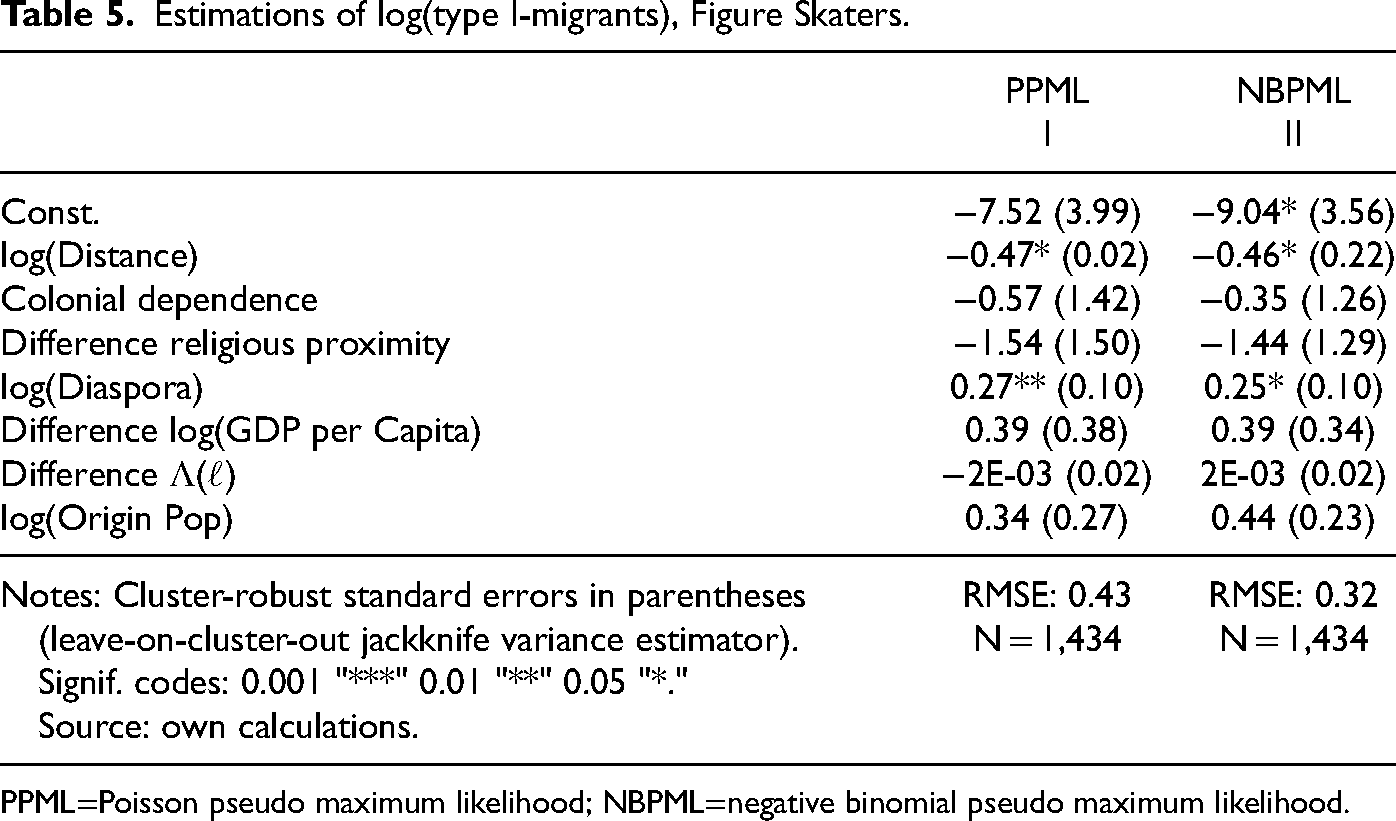
Estimations of log(type I-migrants), Figure Skaters.
PPML=Poisson pseudo maximum likelihood; NBPML=negative binomial pseudo maximum likelihood.
Worthwhile to mention is that a tennis player's migration choice does not depend on religiousness proximity or spatial distances. The latter one may be explained by the special situation of the tennis world tour, what makes tennis players to returnees in Maguire's (1996) definition: they travel around the world over a season and usually returns to their headquarter only during the off-season, making the migration decision from country i to j independent from the spatial distance between them. For type-I migrants, we find no evidence for positive selection, because the economic welfare differential is positive and significant, but the differential in the performance index is negative and insignificant. For type II-migrants, there is indeed the right constellation of signs, albeit neither the differential in the GDP, nor the differential in
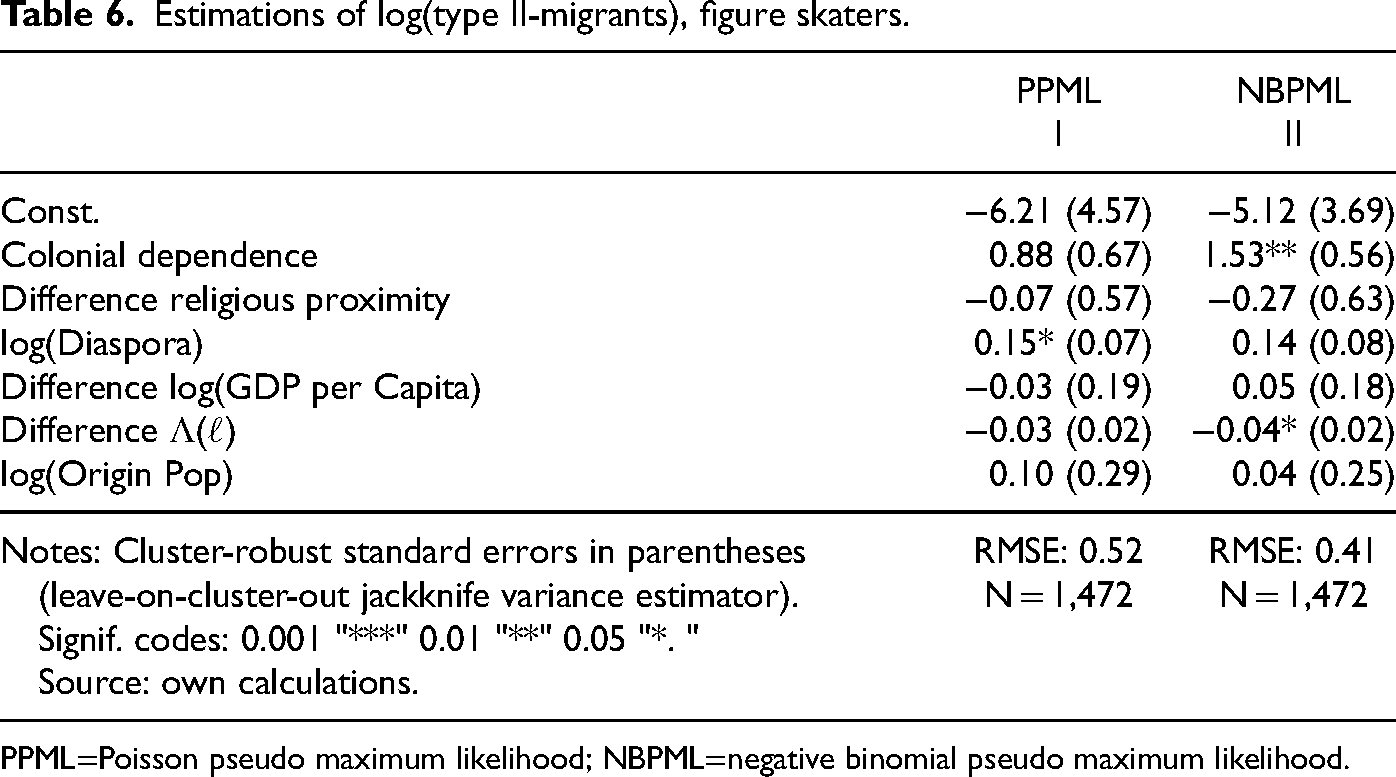
Considering the figure skater's migration, we firstly state that we abstain from climate or weather factors, because Figure skating is a complete indoor sport. Our findings for the figure skaters suggest (see, Tables 5 and 6), that both, the geodesic distance as well as the diaspora's size, significantly determine the type I-migration. One should keep in mind, that the distance may play a substantial role by the fact, that figure skating had a wide tradition in the former Eastern bloc; as a consequence, after the breakup of the Soviet Union and the downfall of the iron curtain, figure skaters from there were able to move to Western European states or to other former Soviet republics.
Estimations of log(type II-migrants), figure skaters.
PPML=Poisson pseudo maximum likelihood; NBPML=negative binomial pseudo maximum likelihood.
By looking on the results for type II-migrants, the both estimations techniques give different results concerning the significance. According to the PPML, the networks or diaspora's size, respectively, is slight significant with an elasticity at 0.15%. Contrary, subjected to the NBPML, former colonial dependencies show significance and the difference in
Finally, for both types of migrants, the estimates suggest rather to negative selection than to positive.
Discussion
Our findings are mostly in line with the theoretical expectations. For instance, we find strong evidence that diasporas or networks, respectively, significantly impel migration of athletes. These results are fully compliant with a lot of previous studies in common migration economics, such as Giovannetti et al. (2024) or Bertoli & Ruyssen (2018). What is logical for common labor migration, is logical for professional athletes, too. Diasporas effectively reduce the migration costs and provide support in the destination country. Besides, the results distinguish among the sports. Considering tennis, former colonial linkages significantly push the type I-migration and are thus compliant with findings from common migration research (Darby, 2013). This may be obvious, because nations linked by former colonial relations interchanged cultures and values, which consequently reduce the “psychological costs” of immigration. Albeit, this rational does not seem to hold for athletics and figure skating, for what we cannot provide explanations.
Our findings verify the GDP per capita to be a significant pulling factor for type I-migrating athletes and tennis players. The exception of figure skating may based on the fact, that figure skaters generally do not have high expected incomes, no matter where they life.
Of course, the most impressive implications arose by the attempt to approximate the impact of positive or negative selection. In the latter case, rather unsuccessfully athletes tend to emigrate in order to flee from the intensive competition in the origin. Such athletes expect to get better starting opportunities in international tournaments, since in the destination is less competition with worse competitors. The results suggest a positive selection for type I-migrants in athletics and tennis. Undoubtably, we have to take these results with care, because we were restricted to indirectly measure them. Of course, the case of type II-migrants in all three sports does not show the right constellation of signs (except under NBPML for Figure skaters). Instead, in cases such this, individuals could have the incentive to migrate by an extending gap in the expected win probability, because their ability to exploit their born talent stock
Why is there no positive selection for type II-migrants? Sports people with the intention to change the eligibility and in addition, move to the new nation, could be seen as “big fishes in small ponds”. This metaphor, established in the context of informal discussions of careers, refers to such individuals that are talented, assure of their skills and embrace the challenge of joining a competitive environment with uncertain prospects but potentially high revenues (DeVaro et al., 2024).
Limitations and Conclusion
The aim of this paper was to analyze the determinants of professional athletes’ migration decision quantitatively. Since the overwhelming previous research in this topic is qualitative, our approach is based on a formal model. Because this is the first study which empirically analyzes that specific kind of migration, it is obvious that our results may be limited. The foremost limitation concerns the data of migrated athletes, tennis players, and figure skaters. More specifically, because sports migration should not trivially be understood as movement from one country to another such as common labor migration, we introduced two definitions of migration, type I, and type II-migration.
Regarding the chosen time period, we set the cut-off at 1990, since only the fall of the Iron Curtain permitted global migration flows as a whole.
A larger issue was, caused by the sparse sports migrants, the necessary pooling of the data from 1990 until 2022. For this reason, we averaged time serial data such as GDP per capita. This procedure is at information's charge.
All in all, it is necessary to check whether the GDP per capita is a good proxy for the talent stock. Other variables such as the recruitment rate in a sport could be more suitable here. In addition, the distance between two countries, measured as the distance between their capital cities, seems to lead to distortions in some cases. Therefore, territorial states in particular need to be examined more closely. For example, the distance between Moscow and Washington is very large, while the distance between the Aleutian Islands as part of the US and Sakhalin of Russia is comparatively small. The same applies to the distance between Brasilia and Paris. However, an athlete migrating from French-Guyana to the Brazilian state of Amapá would only have to cross the border.
Of course, foreign institutions, such as sports federation, can of course play a significant role in the individual migration decision. For example, they could actively attract athletes, possible those with a second or third generational migration background. Though, such a mechanism is covered by our model, because, e.g., financial promotions by foreign institutions are incorporated within the expected wage after a migration.
Our paper significantly contributes to the sports migration research, not only because it is one of the scare empirically one, but because it provides a formal framework as theory, too. Further research is encouraged to both, in extending our mathematical framework and to empirically test this on more sports, especially team sports, for which classical labor migration takes place in terms of transfers. Since the limited data availability is a core issue, we believe, that the construction of a scientific data base consisting of all sports migrants will be an essential job in order to get robuster empirical analysis of sport migration.
Footnotes
Declaration of Conflicting Interests
The authors declared no potential conflicts of interest with respect to the research, authorship, and/or publication of this article.
Funding
The authors received no financial support for the research, authorship, and/or publication of this article.
